1967 CHEVROLET CAMARO tow
[x] Cancel search: towPage 392 of 659
CLUTCH AND TRANSMISSIONS 7-33
from rolling. The pointer on the indicator quadrant
should line up properly with the range indicators in all
ranges.
OIL LEAKS
Before attempting to correct an oil leak, the actual
source of the leak must be determined. In many cases
the source of the leak can be deceiving due to "wind flow1 f
around the engine and transmission.
The suspected area should be wiped clean of all oil
before inspecting for the source of the leak. Red dye is
used in the transmission oil at the assembly plant and
will indicate if the oil leak is from the transmission.
The use of a "black light"* to identify the oil at the
source of leak is also helpful. Comparing the oil from
the leak to that on the engine or transmission dip stick
(when viewed by black light) will determine the source
of the leak.
Oil leaks around the engine and transmission are gen-
erally carried toward the rear of the car by the air
stream. For example, a transmission "oil filter tube
to case leak" will sometimes appear as a leak at the
rear of the transmission. In determining the source of
an oil leak it is most helpful to keep the engine running.
The mating surfaces of servo cover, converter housing,
transmission case and transmission case extension
should be carefully examined for signs of leakage. The
vacuum modulator must also be checked to insure that
the diaphragm has not ruptured as this would allow trans-
mission oil to be drawn into the intake manifold. Us-
ually, the exhaust will be excessively smoky if the
diaphragm ruptures due to the transmission oil added to
the combustion. The transmission case extension rear
oil seal should also be checked. All test plugs should be
checked to make sure that they are tight and that there
is no sign of leakage at these points. The converter
underpan should also be removed. Any appreciable quan-
tity of oil in this area would indicate leakage at the pump
square seal ring, pump seal assembly, or pump bolt
sealing washers.
BASIC PRESSURE CHECKS
Four basic pressure checks are used for diagnosis and
operational checks for the Aluminum Powerglide trans-
mission. All checks should be made only after thoroughly
warming up the transmission.
• Wide Open Throttle Upshift Pressure.
• Idle Pressure in "Drive" Range.
• Manual "Low" Range Pressure.
• "Drive" Range Overrun (Coast) Pressure.
It is not recommended that stall tests be conducted
which would result in engine vacuum falling below 10" Hg.
Pressure gauge hose connections should be made at
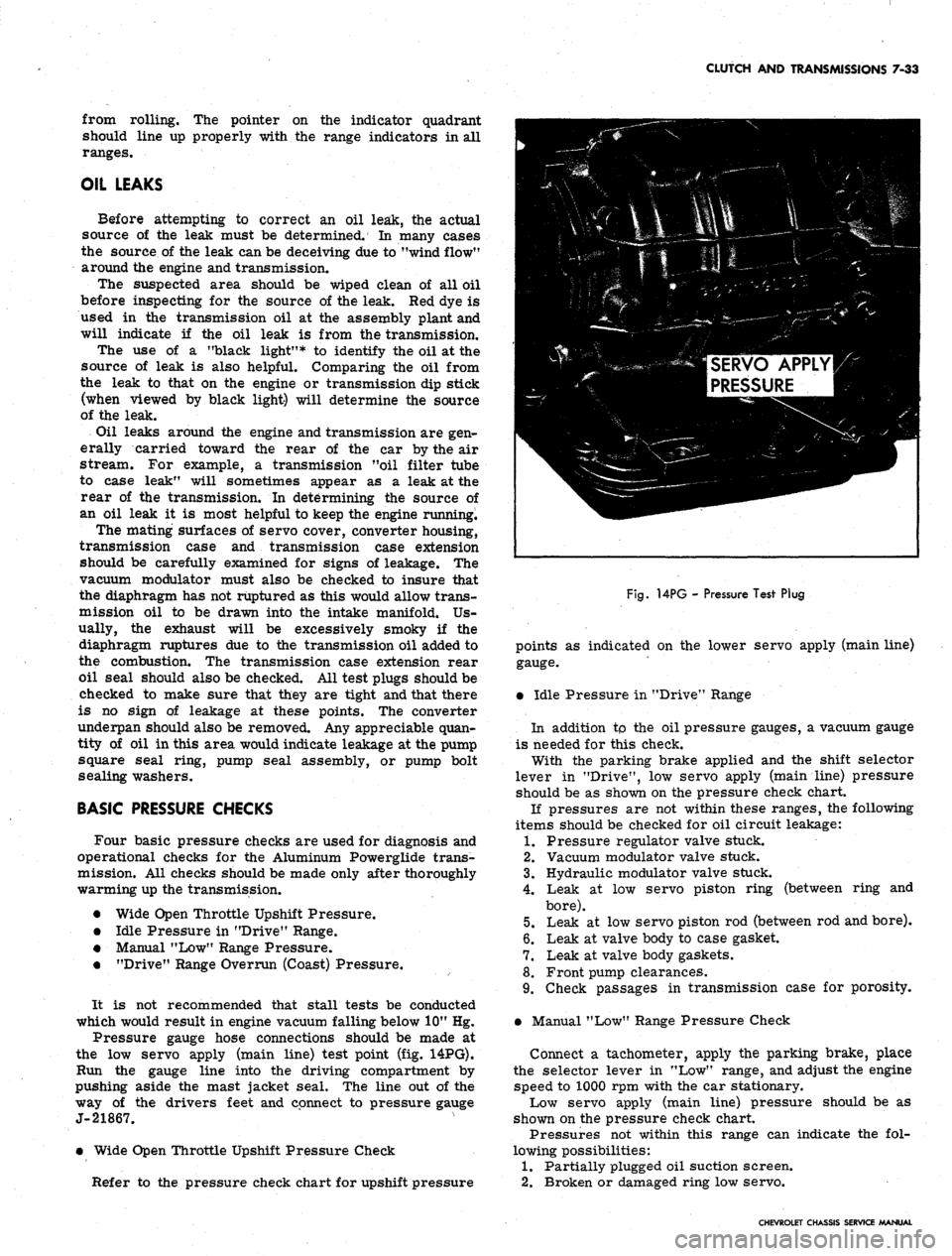
the low servo apply (main line) test point (fig. 14PG).
Run the gauge line into the driving compartment by
pushing aside the mast jacket seal. The line out of the
way of the drivers feet and connect to pressure gauge
J-21867.
• Wide Open Throttle Upshift Pressure Check
Refer to the pressure check chart for upshift pressure
SERVO APPLY
PRESSURE
Fig.
14PG - Pressure Test Plug
points as indicated on the lower servo apply (main line)
gauge.
• Idle Pressure in "Drive" Range
In addition tp the oil pressure gauges, a vacuum gauge
is needed for this check.
With the parking brake applied and the shift selector
lever in "Drive", low servo apply (main line) pressure
should be as shown on the pressure check chart.
If pressures are not within these ranges, the following
items should be checked for oil circuit leakage:
1.
Pressure regulator valve stuck.
2.
Vacuum modulator valve stuck.
3.
Hydraulic modulator valve stuck.
4.
Leak at low servo piston ring (between ring and
bore).
5.
Leak at low servo piston rod (between rod and bore).
6. Leak at valve body to case gasket.
7.
Leak at valve body gaskets.
8. Front pump clearances.
9. Check passages in transmission case for porosity.
• Manual "Low" Range Pressure Check
Connect a tachometer, apply the parking brake, place
the selector lever in "Low" range, and adjust the engine
speed to 1000 rpm with the car stationary.
Low servo apply (main line) pressure should be as
shown on the pressure check chart.
Pressures not within this range can indicate the fol-
lowing possibilities:
1.
Partially plugged oil suction screen.
2.
Broken or damaged ring low servo.
CHEVROLET CHASSIS SERVICE MANUAL
Page 396 of 659

CLUTCH AND TRANSMISSIONS 7-37
LI.
- LI Range can be selected at any vehicle speed,
and the transmission will shift to second gear
and remain in second until vehicle speed is re-
duced to approximately 40 MPH, .depending on
axle ratio. LI Range position prevents the trans-
mission from shifting out of first gear.
It is very important that any communication concerning
the Turbo Hydra-Matic always contain the transmission
serial number and that all transmission parts returned
to Chevrolet Motor Division always be tagged with the
transmission serial number.
MAINTENANCE AND ADJUSTMENTS
TRANSMISSION FLUID
Transmission fluid level should be checked with trans-
mission warm and selector lever in "P" Park position,
every time engine oil level is checked or as specified in
Section 0 when engine oil is changed.
CAUTION: Since the Turbo Hydra-Matic trans-
mission is very sensitive to oil level, special
precautions should be taken when checking the
oil level, to insure against an overfifE
Transmission fluid should be changed as specified in
Section 0.
FLUID LEVEL INDICATOR
The fluid level indicator is located in the filler pipe at
the right rear corner of the engine. To bring the fluid
level from the add mark to the full mark add 1 pint.
Fluid level should be to the full mark with transmission
at normal operating temperature. With cold fluid the
level should be at the add mark or slightly below.
SHIFT CONTROL LINKAGE ADJUSTMENT
Adjust linkage as shown below and in Figure 2.
1.
The shift tube and lever assembly must be free in the
mast jacket See Section 9 for alignment of steering
column assembly if necessary.
2.
To check for proper shift linkage adjustment, lift the
transmission selector lever towards the steering
wheel. Allow the selector lever to be positioned in
drive (D) by the transmission detent.
NOTE: Do not use the indicator pointer as a
reference to position the selector lever. When
performing linkage adjustment, pointer is ad-
justed last.
3.
Release the selector lever. The lever should be in-
hibited from engaging low range unless the lever is
lifted.
4.
Lift the selector lever towards the steering wheel,
and allow the lever to be positioned in neutral (N) by
the transmission detent.
5.
Release the selector lever. The lever should now be
inhibited from engaging reverse range unless the
lever is lifted.
6. A properly adjusted linkage will prevent the selector
lever from moving beyond both the neutral detent,
and the drive detent unless the lever is lifted to pass
over the mechanical stop in the steering column.
See schematic diagram.
7.
In the event that an adjustment is required, place the
selector lever in drive (D) position as determined by
the transmission detent. See Steps 2 and 3.
8. Loosen the adjustment swivel at the cross-shaft, and
rotate the transmission lever so that it contacts the
drive stop in the steering column.
9. Tighten the swivel and recheck the adjustment. See
Steps 2 and 6. -
l(h Readjust indicator needle if necessary to agree with
the transmission detent" positions. See Section 9.
11.
Readjust neutral safety switch if necessary to pro-
vide the correct relationship to the transmission de-
tent positions. See Section 12.
12.
When properly adjusted the following conditions must
be met by manual operation of the steering column
shift lever:
a. From reverse to drive position travel, the trans-
mission detent feel must be noted and related to
indicated position on dial.
b.
When in drive and reverse positions, pull lever
rearward (towards steering wheel) and then re-
lease. It must drop back into position with no
restrictions.
NEUTRAL SAFETY SWITCH ADJUSTMENT
The neutral safety switch must be adjusted so that the
car will start in the park or neutral position, but will not
start in the other positions. For replacement refer to
Section 12 of this Manual.
DRAINING AND REFILLING TRANSMISSION
Drain oil immediately after operation before it has had
an opportunity to cool.
To drain oil proceed as follows:
1.
Remove bottom pan attaching screws, pan, and gas-
ket.
2.
Remove oil strainer. Remove "O" ring seal from
pick-up pipe and discard.
3.
Discard strainer if dirty.
4.
Install new "O" ring seal on pick-up pipe and install
strainer and pipe assembly.
5.
Thoroughly clean bottom pan.
6.. Affix new gasket to bottom pan with petroleum jelly.
7.
Install bottom pan with attaching screws and torque
to specifications;
8. If only the pan has been removed, pour approximately
7-1/2 pints of fluid into the transmission. If the
valve body has also been removed use 9-1/2 pints.
After a complete overhaul approximately 19 pints
are required. Be sure container, spout, or funnel is
clean.
9. Start engine and let idle (carburetor off fast idle
step).
Place selector lever in P position and apply
hand brake.
10.
With transmission warm (approximately 150°F), add
fluid to bring level to full mark on indicator.
CAUTION: Do not overfill. Foaming will re-
sult.
CHEVROLET CHASSIS SERVICE MANUAL
Page 400 of 659

CLUTCH AND TRANSMISSIONS 7-41
CAUTION: Use converter holding ToolJ-5384
when lowering transmission or keep rear of
transmission lower than front so as not to lose
converter.
The installation of the transmission is the reverse of
the removal.
TURBO HYDRA-MATIC DIAGNOSIS PROCEDURE
Accurate diagnosis of transmission problems begins
with a thorough understanding of normal transmission
operation. In particular, knowing which units are in-
volved in the various speeds or shifts so that the specific
units or circuits involved in the problem can be isolated
and investigated further. Analytical diagnosis will pro-
tect the technician from come backs and certainly will
improve owner satisfaction.
An important and often overlooked aspect of diagnosis
is finding out specifically what the customer is com-
plaining of. For this purpose a short ride with the cus-
tomer will often prove beneficial. It may be found that
the condition the customer wants corrected is standard
and should not be altered.
The following sequence, based on field experience, pro-
vides the desired information quickly and in most cases
actually corrects the malfunction without requiring the
removal of the transmission. Details of the items listed
in this sequence are covered further in the text.
SEQUENCE FOR TURBO HYDRA-MATIC
DIAGNOSIS PROCEDURE
1.
Check oil level and condition.
2.
Check and correct detent switch.
3.
Check and correct vacuum line and fittings.
4.
Check and correct manual linkage.
OIL LEVEL AND CONDITION CHECK
Always check the oil level before road testing. Oil
must be visible on dip stick prior to operating the ve-
hicle. Erratic shifting, pump noise, or other malfunc-
tions can in some cases be traced to improper oil level.
Oil level should be checked with the selector lever in
the Park (P) position, engine running, and the vehicle on
level pavement.
Fluid level should be to the FULL mark with the trans-
mission at normal operating temperature (170°-190°
F.).
With warm fluid (room temperature), the level should be
at or slightly below the ADD mark.
If oil level was low, refer to Oil Leaks.
The condition of the oil is often an indication of whether
the transmission should be removed from the vehicle, or
to make further tests. When checking oil level, a burned
smell and discoloration indicate burned clutches or bands
and the transmission will have to be removed.
MANUAL LINKAGE
Manual linkage adjustment and the associated neutral
safety switch are important from a safety standpoint
The neutral safety switch should be adjusted so that the
engine will start in the Park and Neutral positions only.
With the selector lever in the Park position, the park-
ing pawl should freely engage and prevent the vehicle
from rolling. The pointer on the indicator quadrant
should line up properly with the range indicators in all
ranges.
OIL LEAKS
Before attempting to correct an oil leak, the actual
source of the leak must be determined. In many cases,
the source of the leak can be deceiving due to "wind flow"
around the engine and transmission.
The suspected area should be wiped clean of all oil be-
fore inspecting for the source of the leak. Red dye is
used in the transmission oil at the assembly plant and
will indicate if the oil leak is from the transmission.
. The use of a "black light"* to identify the oil at the
source of leak is also helpful. Comparing the oil from
the leak to that on the engine or transmission dip stick
(when viewed by black light) will determine the source
of the leak.
Oil leaks around the engine and transmission are gen-
erally carried toward the rear of the car by the air
stream. For example, a transmission "oil filler tube to
case leak" will sometimes appear as a leak at the rear of
the transmission. In determining the source of an oil
leak it is most helpful to keep the engine running.
POSSIBLE POINTS OF OIL LEAKS
• 1. TRANSMISSION OIL PAN LEAK
a. Attaching bolts not correctly torqued.
b.
Improperly installed or damaged pan gasket.
c. Oil pan gasket mounting face not flat.
2.
REAR EXTENSION LEAK
a. Attaching bolts not correctly torqued.
b.
Rear seal assembly — damaged or improperly
installed.
c. Gasket seal — (extension to case) damaged or
improperly installed.
d. Porous casting.
3.
CASE LEAK
a. Filler pipe "O" ring seal damaged or missing;
misposition of filler pipe bracket to engine —
"loading" one side of
"O"
ring.
b.
Modulator assembly "O" ring seal
—
damaged or
improperly installed.
c. Governor cover, gasket and bolts — damaged,
loose; case face leak.
d. Speedo gear
—
"O" ring damaged.
e. Manual shaft seal — damaged, improperly in-
stalled.
f. line pressure tap plug — stripped, shy sealer
compound.
g. Parking pawl shaft cup plug
—
damaged, improp-
erly installed.
h. Vent pipe (refer to Item 5).
i. Porous case.
4.
FRONT END LEAK
a. Front seal - damaged (check converter neck for
nicks,
etc., also for pump bushing moved for-
ward);
garter spring missing from pump to con-
verter seaL
b.
Pump attaching bolts and seals
—
damaged, miss-
ing, bolts loose.
CHEVROLET a
SERVICE
Page 408 of 659

FUEL TANK AND EXHAUST SYSTEMS 8-2
COMPONENT PART REPLACEMENT
FUEL TANK
Draining Tank
The absence of a drain plug in the gas tanks makes it
necessary to siphon fuel from the tank when draining is
needed. The following procedure is recommended.
1.
Obtain approximately 10 feet of 3/8" I.D. hose and
cut a flat-type slit 18" from one end. Make this cut
on the hose in the direction "toward the shorter end
(See Figure 2).
2.
Insert a small pipe nipple (slightly larger O.D. than
the hose I.D.) into the opposite end of hose.
3.
Insert the nipple end of the siphon hose into the fuel
tank filler neck with the natural curl of the hose
pointing down. Insert until the hose is heard to strike
bottom of the tank.
4.
With the opposite end of the hose in a suitable con-
taner insert an air hose in downward direction in the
flap-type slit and trigger the flow of fuel.
FUEL FLOW
-If*
APPROX.-1 >SUT «<>«
AS SHOWN
10 FEET APPROX.-
Fig. 2—Siphon Construction
FWD
V-8
VIEW B
Fig. 3-Fuel Lines
CHEVROLET CHASSIS SERVICE MANUAL
Page 425 of 659

FUEL TANK AND EXHAUST SYSTEMS 8-19
Fig.
22—Spare Tire Carrier Installed
6. Remove two fuel tank retaining strap bottom nuts
from forward support member located at forward
front side of tank.
7. Remove fuel tank metering unit wires (fig. 25).
8. Remove fuel pickup line and drain tank.
9. Remove gas cap, filler neck boot from the top of tank
and disconnect drain line (fig. 24).
NOTE:6
Coupe Models—Remove filler neck.
10.
Remove fuel tank support frame attachment bolts and
support.
11.
Lower tank and rotate toward the front of vehicle.
Installation (20 Gallon Tank)
NOTE:
Place hoses and wires to one side and
position anti-squeak pads to the crossmember,
END OF HOSE FLUSH
TO Va INCH BACK FROM
EDGE OF BUMPERETTE
Fig.
24-Gas Tank Filler Neck Vent Hose
cemented to the support and attached to the tank.
Replace with new pads as required.
1.
Hook retaining straps at the rear frame crossmem-
ber. (Crimp strap ends at rear frame attachment.)
NOTE:
Make certain strap ends are hooked and
anti-squeak pads are properly positioned.
2.
Slowly rotate fuel tank into position.
CAUTION: Coupe-Install filler neck after tank
is installed.
3.
Attach fuel tank support at the frame side rails.
TANK METERING UNI
WIRE CONNECTIONS
Fig.
23—Exhaust System Tail Pipe Attachment
Fig.
25—Fuel Tank Metering Unit, Wires and Lines
CHEVROLET CHASSIS SERVICE MANUAL
Page 431 of 659

FUEL TANK AND EXHAUST SYSTEMS 8-25
4.
Cut the exhaust pipe near the muffler (see cau-
tion above) to allow sufficient pipe for muffler
replacement.
5.
^
Replace muffler and secure with new clamps.
NOTE:
Clamps must be assembled with nuts
attached toward the rear of the vehicle -
reference 90° to sawcuts in service muffler
pipe.
6. Reverse procedure for installation.
NOTE:
If bracket mounting insulators (tire
carcass mountings) are fatigued, replace to in-
sure a secure exhaust system.
7. In the event the tail pipe bezel has been damaged and
replacement is required, remove three screws and
replace the bezel. i
SIDE MOUNTED EXHAUST (Fig. 31)
Replacement
1.
Raise and support vehicle.
2.
Remove sill molding attaching screws and disengage
molding from the retainer.
3.
Remove cover retaining screws, cover and retainer
assembly.
4.
Remove exhaust pipe-to-manifold attaching nuts, and
rear bracket retaining nut, then detach exhaust pipe
from manifold studs and remove from vehicle.
Fig.
31—Side Mounted Exhaust System
CHEVROLET
CHASSIS SEKVK
Page 461 of 659

STEERING 9-21
Fig.
43-Removing Shift Tube Using Shift Tube Remover J-22551
nut on tool. If the shift tube is not completely free
when tool is removed, complete removal by hand.
As shift tube is removed from automatic columns,
use care as lower shift lever is lowered through bot-
tom of mast jacket. Do not hammer or force shift
tube during removal from mast jacket.
23.
Remove lockplate (fig. 44) by sliding out of jacket
notches. Tip plate down toward bowl hub and slide
out from under top edge of jacket opening. Remove
wave washer.
24.
Remove bowl from mast jacket. Remove signal
switch and bearing housing if not previously
removed.
25.
On automatic column, remove shift lever spring from
bowl by winding spring up with pliers and pulling out.
26.
On automatic column, remove screws securing shift
stop plate to support, if necessary.
27.
Remove upper bearing from upper bearing housing, if
necessary.
Fig.
44—Lockplate Installed
28.
Remove lower bearing from lower bearing adapter,
if necessary.
29.
Service lock shoes, release springs, or shoe release
if necessary, as follows:
a. Drive the lock shoe retaining pin out of the hous-
ing using release lever pivot remover Tool
J-22635 (fig. 45, View A).
b.
Hold the shoe springs in compression by rocking
lock shoes in with a wedge to relieve the load on
the shoe release lever; drive out shoe release
lever pin using Tool J-22635 (fig. 45, View B).
Remove shoe release lever and release lever
spring.
c. Remove lock shoes and lock shoe springs.
30.
If necessary, remove seals from lower end of shift-
tube and discard seals.
31.
Unwrap mesh cover from jacket, if necessary.
Assembly-Tilt Column (Fig. 37)
1.
Apply a thin coating of lithium soap grease to all
friction surfaces.
2.
Assemble bearing housing components as follows:
NOTE:
With tilt lever opening on the left side,
shoes facing up, position the four slot shoe on
the left.
a. Place lock shoe springs and lock shoes in position
in bearing housing. Line up shoes for pin instal-
lation using Tool J-22635 (fig. 45). Install shoe
pin flush with housing face on shoe release lever
pin side.
b.
Hold the shoe springs in compression by rocking
lock shoes in. Insert pin through release lever
and install pin and lever.
3.
If lower bearing was removed, press lower bearing
into adapter.
4.
If upper bearing was removed, press upper bearing
into race on top of bearing housing.
5. On automatic columns, install stop plate on support
CHEVROLET CHASSIS SERVICE MANUAL
Page 462 of 659

STEERING 9-22
Fig.
45—Removing Lock Shoe Retaining Pin Using Tool J-22635
with screws, if plate was removed during dis-
assembly.
On automatic columns, press a new shift lever spring
into bowl, if original spring was removed.
Insert the signal switch wire harness and connector
through the bearing housing and bowl. Retain the
housing and bowl together during remaining assem-
bly. (On columns where signal switch connector can
be inserted through bowl, it is not necessary to re-
Fig.
46—Installing Shift Tube Using Shift Tube
Installer Tool J-22549
tain bearing housing and bowl together.)
8. Slide bowl into top of mast jacket.
9. Place wave washer and lockplate into position. Work
lockplate into notches in jacket by tipping lockplate
toward bowl hub under the top edge of the jacket.
10.
If seals were removed from lower end of shift tube,
cement new seals into place.
11.
Carefully install shift tube in lower end of mast
jacket. On automatic columns, align key way in tube
with key in bowl. Complete installation of shift tube
using shift tube installer Tool J-22549 as shown in
Figure 46. Do not hammer or force tube when in-
stalling in jacket.
12.
Pull up on bowl to compress wave washer and install
thrust washer and shift tube retaining ring.
13.
Insert support into jacket by aligning "V" in support
with "V" notch in jacket. Insert mounting screws
through support into lockpiate and tighten screws.
14.
Align fingers of lower bearing adapter with holes in
jacket and pilot adapter over shift tube. Snap adapter
into place.
15.
Install back-up lamp/neutral start switch on column,
if so equipped, using the same mounting nuts re-
moved during disassembly. Install the switch loose-
ly, it is to be adjusted when column is installed in
the vehicle.
16.
Assemble the steering shaft as follows:
a. Clamp the lower portion of the steering shaft in a
vise with the socket facing upward.
b.
Apply front wheel bearing lube to the centering
spheres and the steering shaft sockets. Assemble
the spheres, with the wave washer in between, and
place the spheres in the upper shaft socket.
c. Turn the spheres so the lower shaft may be in-
stalled over the grooves.
NOTE: The locating marking on the end of the .
CHEVROLET CHASSIS SERVICE MANUAL