Page 52 of 582
Introduction/Getting Started with Your Electric Vehicle
1-46
Using V2L Function
Using the Vehicle to Load (V2L) feature, you can turn on electronic devices by connecting
them to the high voltage battery.
Safety Precautions When Using the V2L Function
Before using the V2L function, read and comply with all the safety information below.
Failure to do so may cause electric shock or fire and result in serious injury, death, vehicle
malfunction, or property damage.
Precautions when using the V2L function
WARNING • Do not use the V2L function if the V2L connector, charging inlet, power plug, or cable is damaged, corroded, or rusted.
• Do not touch the V2L connector, charging inlet, or power plug with wet hands.
• Do not use the V2L function if the connection part of the V2L connector and the charging inlet is loose.
• Check if there is no water, dust, or other contaminants before connecting the connector and the power plug. They may cause electric shock or fire.
• Do not put metal objects or touch the V2L connector or charging inlet with bare hands.
• For electric devices used outdoors in a vehicle, use a product that is waterproof or use it in a waterproof environment. If rain or humidity intrude into electric devices,
multi-outlets, extension cords, etc., it may cause electric shock or damage the vehicle
or devices.
• If there is a risk of lightning, do not use the V2L function outside the vehicle.
• Do not use electric heating appliances such as an electric kettle, toaster, or iron in the vehicle. Doing so may result in a fire and injury.
Precautions when the cooling fan operates
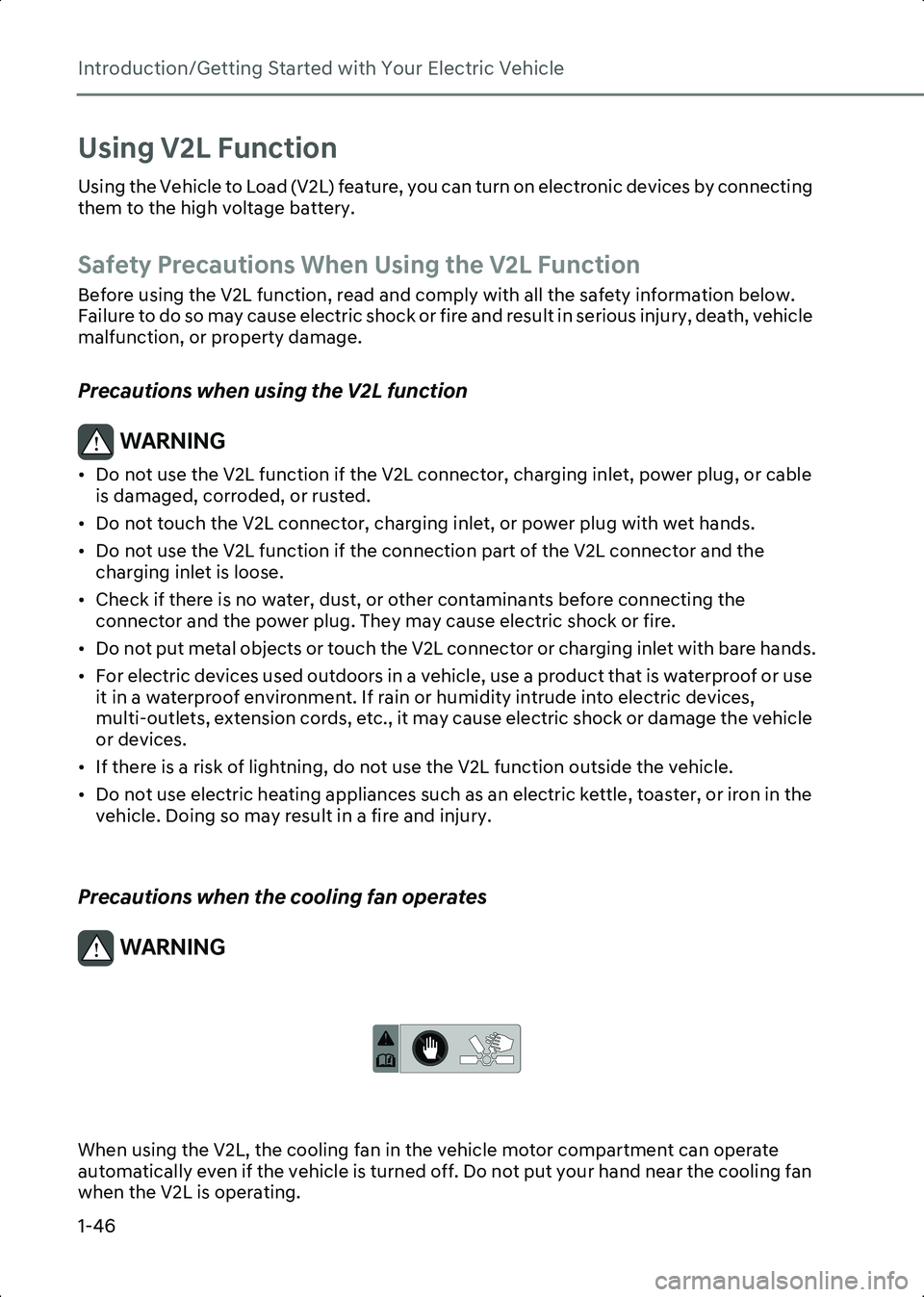
WARNING
WL_MotorRoomHotCaution
When using the V2L, the cooling fan in the vehicle motor compartment can operate
automatically even if the vehicle is turned off. Do not put your hand near the cooling fan
when the V2L is operating.
Hyundai_CE_en_US.book Page 46
Page 63 of 582
1
1-57
Checking the real time energy status (CHARGE/POWER gauge)
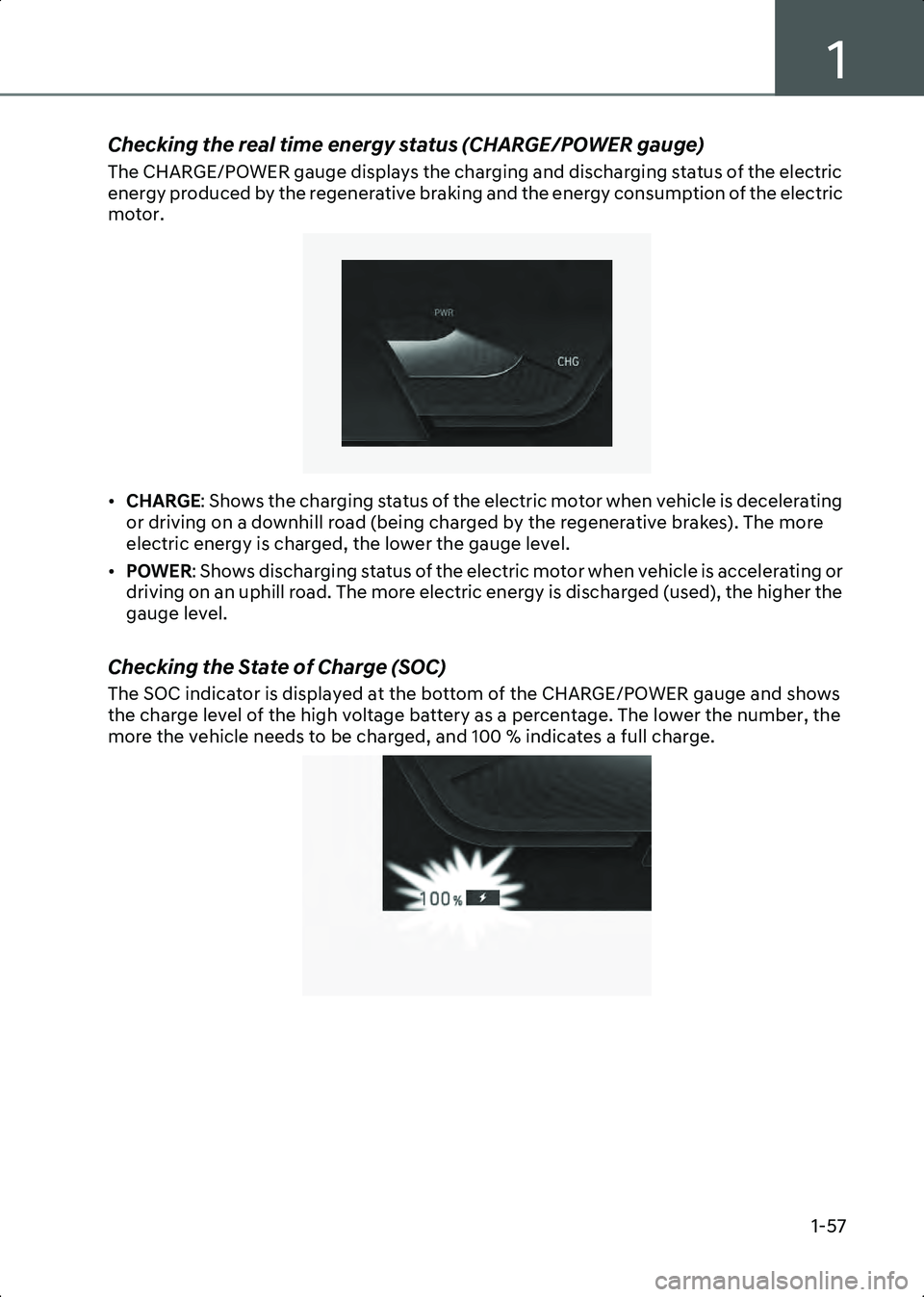
The CHARGE/POWER gauge displays the charging and discharging status of the electric
energy produced by the regenerative braking and the energy consumption of the electric
motor.
B0002902
•CHARGE : Shows the charging status of the electric motor when vehicle is decelerating
or driving on a downhill road (being charged by the regenerative brakes). The more
electric energy is charged, the lower the gauge level.
• POWER : Shows discharging status of the electric motor when vehicle is accelerating or
driving on an uphill road. The more electric energy is discharged (used), the higher the
gauge level.
Checking the State of Charge (SOC)
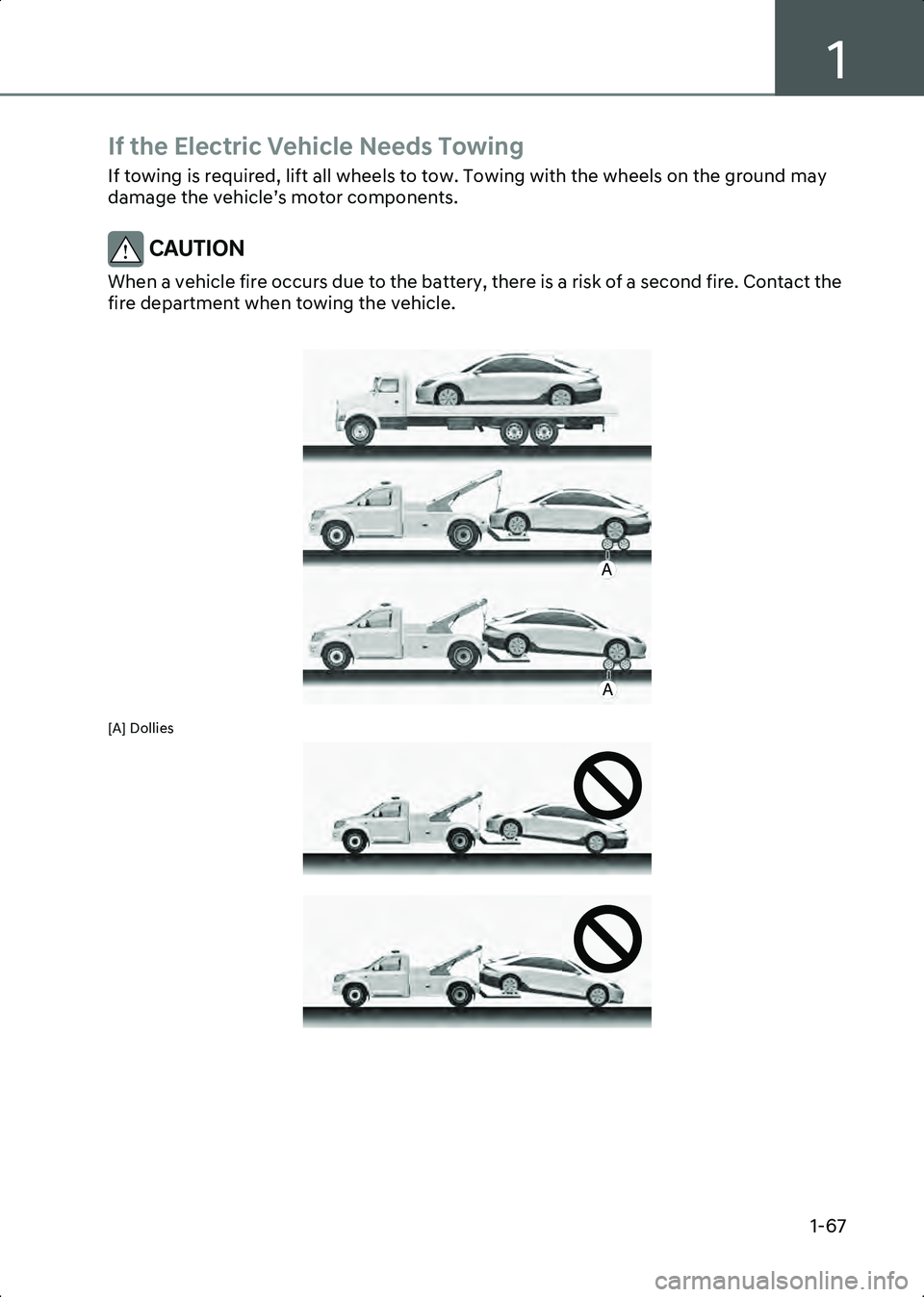
The SOC indicator is displayed at the bottom of the CHARGE/POWER gauge and shows
the charge level of the high voltage battery as a percentage. The lower the number, the
more the vehicle needs to be charged, and 100 % indicates a full charge.
B0002903
Hyundai_CE_en_US.book Page 57
Page 71 of 582
1
1-65
Countermeasures for Accidents or Fire
When an accident occurs while driving the electric vehicle, turn on the Hazard warning
light, move the vehicle to a safe place, and take following measures.
WARNING When a vehicle accident occurs and the high voltage battery is damaged, harmful gas
and electrolytes may leak.
• Be careful not to touch the leaked liquid.
• When you suspect leakage of inflammable gas and other harmful gases, open the windows and immediately evacuate to a safe location.
• If any leaked fluid comes in contact with your eyes or skin, immediately clean the affected area thoroughly with tap water or saline solution and have doctors inspect it
as soon as possible.
Turning Off the High Voltage Battery
In case disconnecting the high voltage cut-off switch is required in an emergency, follow
the instructions below.
WARNING • Do not intentionally disconnect the high voltage cut-off switch except in an emergency. The vehicle will not start if the high voltage battery is disconnected. Also,
when the switch is disconnected, dangerous accidents, such as electric shock, may
occur and various electric devices may be damaged.
• Do not touch any components inside the motor compartment with wet hands.
• Do not touch any components except for the components instructed to operate in this manual for a specific task.
• Do not touch wires exposed inside or outside the vehicle.
• Do not touch the high voltage electric wire (orange), connector, and all electric components and devices.
1. Open the hood and open the high voltage cut-off switch box on the right side of the motor compartment.
2. Pull the yellow label in the high voltage cut-off switch to shut down high voltage battery.
CAUTION Do not put excessive force to the switch lever while shutting down the high voltage
battery. Doing so may damage the high voltage cut-off switch.
Hyundai_CE_en_US.book Page 65
Page 73 of 582
1
1-67
If the Electric Vehicle Needs Towing
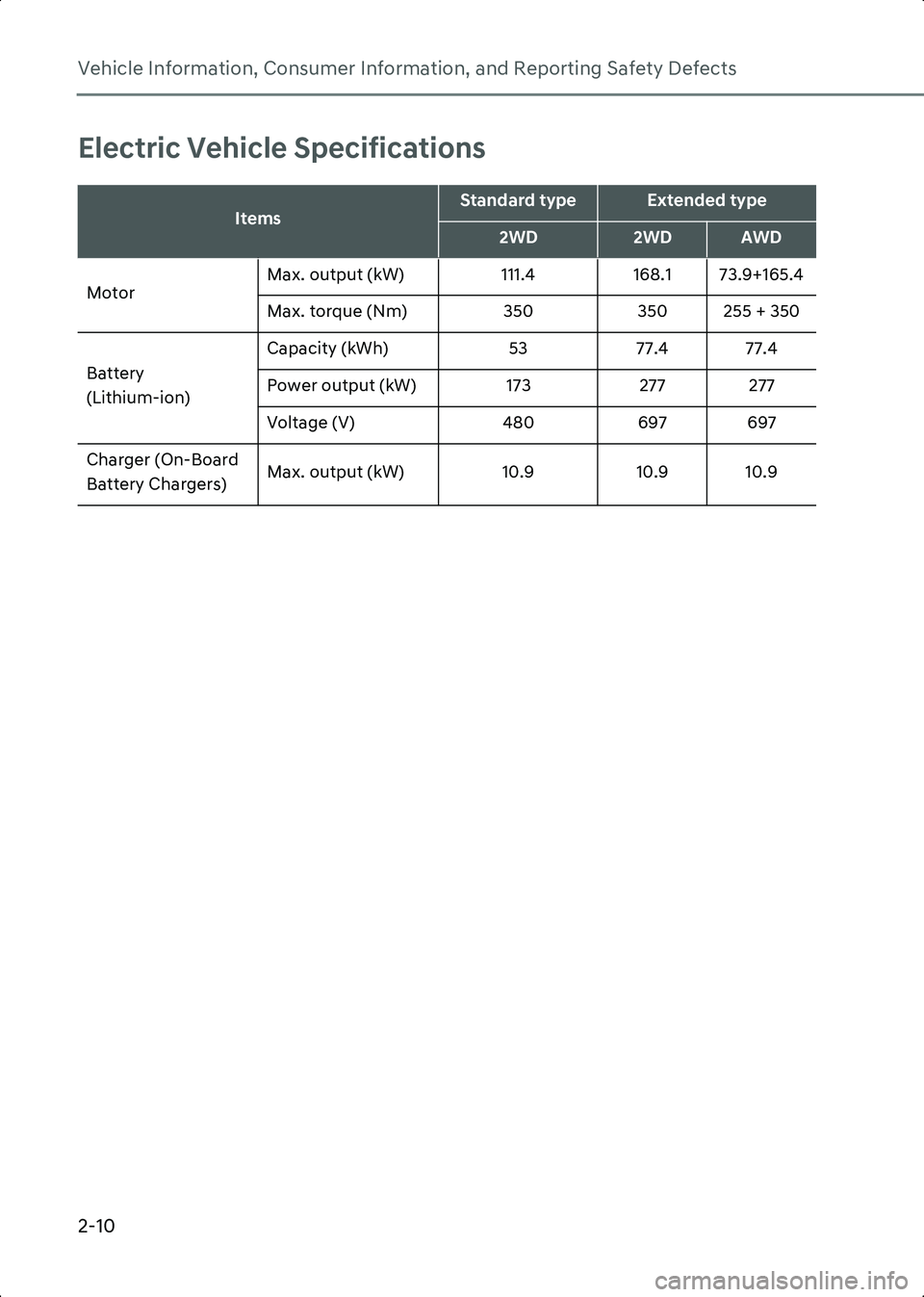
If towing is required, lift all wheels to tow. Towing with the wheels on the ground may
damage the vehicle’s motor components.
CAUTION When a vehicle fire occurs due to the battery, there is a risk of a second fire. Contact the
fire department when towing the vehicle.
B0003401[A] Dollies
B0003402
B0003403
A
A
Hyundai_CE_en_US.book Page 67
Page 75 of 582
2
2. Vehicle Information, Consumer Information, and
Reporting Safety Defects
Exterior Overview (Front View)....................................................................................... 2-2
Exterior Overview (Rear View) ........................................................................................ 2-3
Interior Overview ............................................................................................................. 2-4
Center Console Overview ............................................................................................... 2-5
Steering Wheel Control Overview .................................................................................. 2-7
Motor Compartment Overview ...................................................................................... 2-8
Dimensions ...................................................................................................................... 2-9
Electric Vehicle Specifications ..................................................................................... 2-10
Bulb Wattage .................................................................................................................. 2-11
Tires and Wheels............................................................................................................. 2-12
Air Conditioning System ................................................................................................2-13
Vehicle Weight and Luggage Volume ...........................................................................2-13
Available Front Trunk Weight ........................................................................................2-13
Recommended Lubricants and Capacities ..................................................................2-14
Vehicle Identification Number (VIN) ............................................................................. 2-15
Vehicle Certification Label ............................................................................................. 2-15
Tire Specification and Pressure Label ...........................................................................2-16
Motor Number ................................................................................................................2-16
Air Conditioner Compressor Label ................................................................................ 2-17
Refrigerant Label ............................................................................................................ 2-17
Consumer Information ...................................................................................................2-18
Reporting Safety Defects ...............................................................................................2-19
Open Source Software Notice ...................................................................................... 2-20
Hyundai_CE_en_US.book Page 1
Page 82 of 582

Vehicle Information, Consumer Information, and Reporting Safety Defects
2-8
Motor Compartment Overview
A1000901The actual motor compartment in the vehicle may differ from the illustration.
(1) Coolant reservoir .......................................................................................................9-12
(2) Windshield washer fluid reservoir........................................................................... 9-14
(3) Brake fluid reservoir ................................................................................................. 9-13
(4) Fuse box.................................................................................................................... 9-33
(5) Battery (12 V)............................................................................................................. 9-18
(6) Front trunk ................................................................................................................ 5-54
(7) Cabin air filter ........................................................................................................... 9-14
Hyundai_CE_en_US.book Page 8
Page 84 of 582
Vehicle Information, Consumer Information, and Reporting Safety Defects
2-10
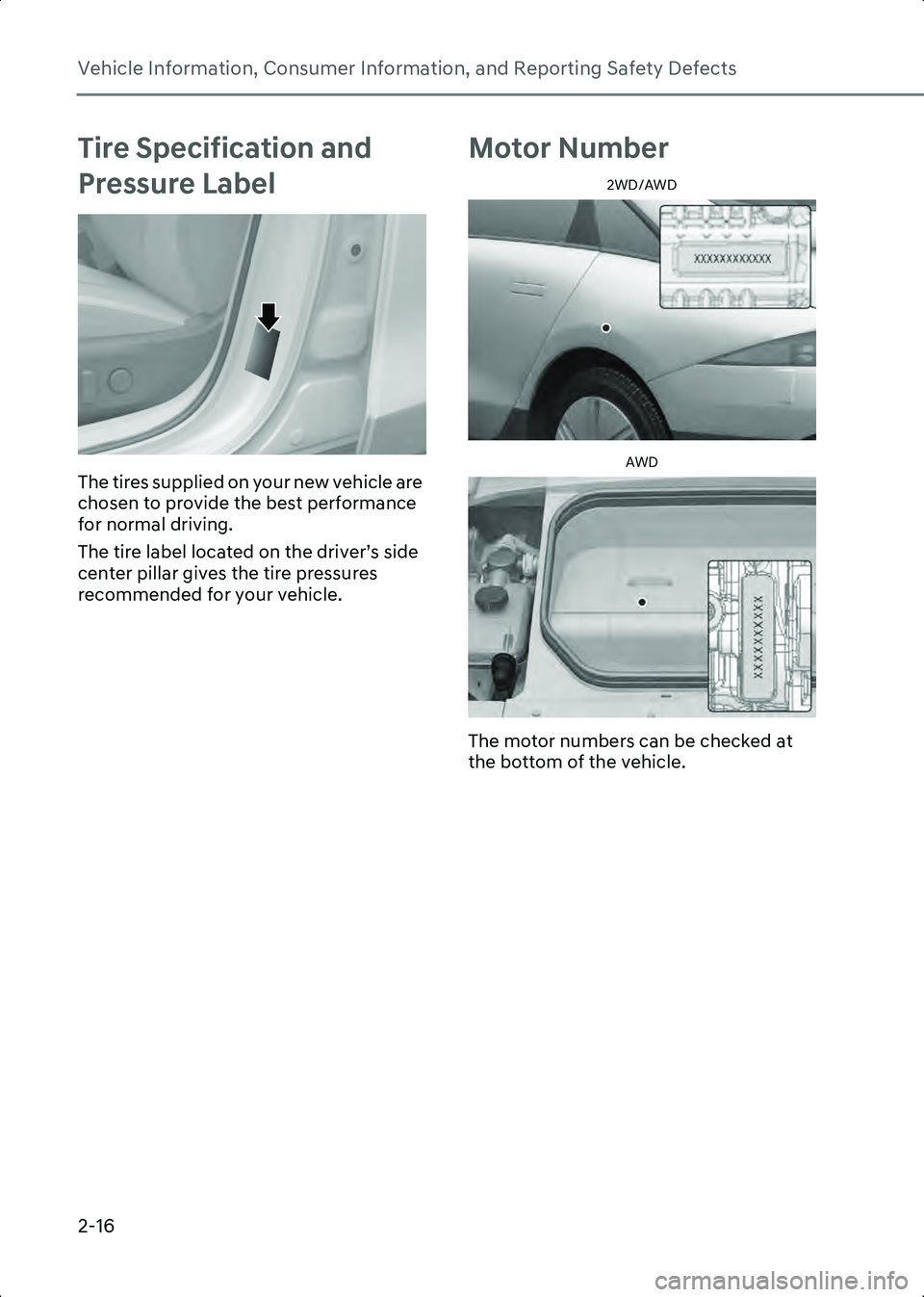
Electric Vehicle Specifications
ItemsStandard typeExtended type
2WD2WDAWD
Motor Max. output (kW)
111.4168.1 73.9+165.4
Max. torque (Nm) 350350 255 + 350
Battery
(Lithium-ion) Capacity (kWh)
5377.4 77.4
Power output (kW) 173 277 277
Voltage (V) 480697 697
Charger (On-Board
Battery Chargers) Max. output (kW)
10.910.9 10.9
Hyundai_CE_en_US.book Page 10
Page 90 of 582
Vehicle Information, Consumer Information, and Reporting Safety Defects
2-16
Tire Specification and
Pressure Label
ONE1011025L
The tires supplied on your new vehicle are
chosen to provide the best performance
for normal driving.
The tire label located on the driver’s side
center pillar gives the tire pressures
recommended for your vehicle.
Motor Number
2WD/AWD
B1002401AWD
B1002402
The motor numbers can be checked at
the bottom of the vehicle.
Hyundai_CE_en_US.book Page 16