2023 HYUNDAI IONIQ 6 motor
[x] Cancel search: motorPage 7 of 582
1
1. Introduction/Getting Started with Your Electric Vehicle
Introduction ...................................................................................................................... 1-3
HYUNDAI Motor America................................................................................................. 1-3
Guide to HYUNDAI Genuine Parts ...................................................................................1-4
How to Use This Manual .................................................................................................. 1-5
Safety Messages ...............................................................................................................1-6
Vehicle Modifications ....................................................................................................... 1-7
Vehicle Data Collection and Event Data Recorders ....................................................... 1-7
About "Getting Started with Your Electric Vehicle" ...................................................... 1-8
Understanding Your Electric Vehicle ..............................................................................1-9
Characteristics of Your Electric Vehicle ......................................................................1-9Precautions When Using the High Voltage Battery.................................................. 1-10
Other Precautions for Electric Vehicle Management................................................ 1-11
Charging Your Electric Vehicle ...................................................................................... 1-12 Safety Precautions for Charging Your Electric Vehicle ............................................ 1-12
Checking Basic Information on Charging Your Electric Vehicle ............................. 1-15
Using an AC Charger................................................................................................... 1-21
Using a DC Charger.....................................................................................................1-24
Using a Portable Charger (ICCB) ...............................................................................1-26
Using EV Mode Functions ..............................................................................................1-33 Checking the EV Mode Screen Configuration ..........................................................1-33
Checking Energy Information ....................................................................................1-34
Setting the Next Departure Time............................................................................... 1-37
Setting Scheduled Charging and Climate ................................................................ 1-38
Setting a Battery Discharging Limit When Using Vehicle to Load (V2L)................ 1-40
Setting Electric Vehicle Specialized Functions ......................................................... 1-41
Using V2L Function........................................................................................................ 1-46 Safety Precautions When Using the V2L Function .................................................. 1-46
Using Electricity Outside the Vehicle ....................................................................... 1-48
Using Electricity Inside the Vehicle .......................................................................... 1-49
Solving V2L Problems ................................................................................................. 1-51
Aux. Battery Saver+ ........................................................................................................ 1-52
Driving Your Electric Vehicle .........................................................................................1-53 Starting and Stopping the Vehicle .............................................................................1-53
Checking Electric Vehicle Driving Information.........................................................1-54
Hyundai_CE_en_US.book Page 1
Page 9 of 582

1
1-3
Introduction
Congratulations, and thank you for choosing HYUNDAI. We are pleased to welcome you
to the growing number of discerning people who drive HYUNDAIs. We are very proud of the advanced engineering and high-quality construction of each HYUNDAI we build.
Your Owner’s Manual will introduce you to the features and operation of your new
HYUNDAI. To become familiar with your new HYUNDAI, so that you can fully enjoy it,
read this Owner’s Manual carefully before driving your new vehicle.
This manual contains important safety information and instructions intended to
familiarize you with your vehicle’s controls and safety features so you can safely operate
your vehicle.
This manual also contains information on maintenance designed to enhance safe
operation of the vehicle. It is recommended that all service and maintenance on your car
be performed by an authorized HYUNDAI dealer. HYUNDAI dealers are prepared to
provide high-quality service, maintenance and any other assistance that may be
required.
This Owner’s Manual should be considered a permanent part of your vehicle, and should
be kept in the vehicle so you can refer to it at any time. The manual should stay with the
vehicle if you sell it to provide the next owner with important operating, safety and
maintenance information.
HYUNDAI MOTOR AMERICA
CAUTION Severe vehicle damage may result from the use of poor quality lubricants that do not
meet HYUNDAI specifications. You must always use high quality lubricants that meet the
specifications listed in the Vehicle Specifications section of the Owner’s Manual.
Copyright 2023 HYUNDAI Motor America. All rights reserved. No part of this publication
may be reproduced, stored in any retrieval system or transmitted in any form or by any
means without the prior written permission of HYUNDAI Motor America.
Hyundai_CE_en_US.book Page 3
Page 10 of 582
Introduction/Getting Started with Your Electric Vehicle
1-4
GUIDE TO HYUNDAI GENUINE PARTS
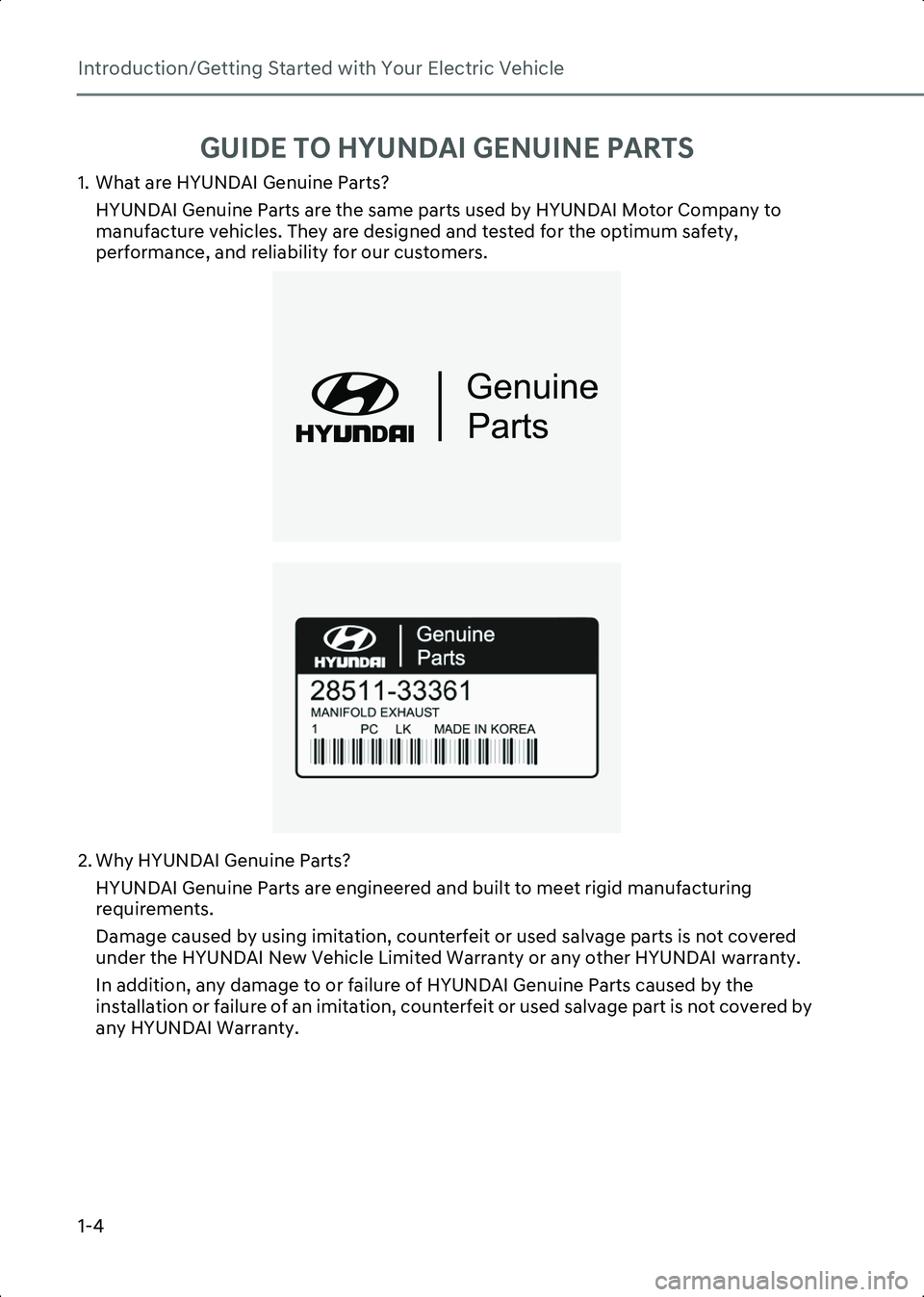
1. What are HYUNDAI Genuine Parts?HYUNDAI Genuine Parts are the same parts used by HYUNDAI Motor Company to
manufacture vehicles. They are designed and tested for the optimum safety,
performance, and reliability for our customers.
A100A01L
A100A02L
2. Why HYUNDAI Genuine Parts?HYUNDAI Genuine Parts are engineered and built to meet rigid manufacturing
requirements.
Damage caused by using imitation, counterfeit or used salvage parts is not covered
under the HYUNDAI New Vehicle Limited Warranty or any other HYUNDAI warranty.
In addition, any damage to or failure of HYUNDAI Genuine Parts caused by the
installation or failure of an imitation, counterfeit or used salvage part is not covered by
any HYUNDAI Warranty.
Hyundai_CE_en_US.book Page 4
Page 15 of 582
1
1-9
Understanding Your Electric Vehicle
Electric vehicles are driven using a battery and an electric motor. Understand the
characteristics of your electric vehicle and check the features that you must know before
driving it.
Characteristics of Your Electric Vehicle
The characteristics that differentiate electric vehicles from gasoline vehicles are as
follows:
• Electric vehicles are eco-friendly because they do not use fossil fuels for driving. Additionally, unlike gasoline vehicles, noise and vibration are minimal, and the
vehicle’s lifespan is relatively long.
• When slowing down or driving downhill, regenerative braking is used. Regenerative braking charges the high voltage battery and minimizes energy loss.
• If the high voltage battery is running low, you can charge the vehicle using the AC charger, DC charger, or portable charging cables. For more information, refer to the
"Charging Your Electric Vehicle" section in this chapter.
Information Regenerative braking uses an electric motor when decelerating and braking, and it transforms
kinetic energy to electrical energy in order to charge the high voltage battery.
Battery information
The batteries used in the electric vehicle are as follows:
•High voltage battery (high capacity) : Drives the motor and operates the air
conditioner and heater. It can be charged via an AC charger, DC charger, or portable
charger.
• 12 V battery : Operates all lights, wipers, and audio system. The 12 V battery charge can
also be maintained by the high voltage battery at parked condition at certain
conditions.
Main components of your electric vehicle
The main components of your electric vehicle and their functions are as follows:
• On-Board Charger (OBC) : Charges the high voltage battery by converting the power
grid’s AC power to DC power.
• Inverter : Converts power from direct current (DC) to alternating current (AC) and
supplies power to the motor, and converts power from AC to DC to charge the high
voltage battery during deceleration and braking.
• Low Voltage DC-DC Converter (LDC) : Converts the high voltage battery’s power
source to a low voltage (12 V) power source for supply of power to the electrical devices
on the vehicle.
Hyundai_CE_en_US.book Page 9
Page 16 of 582

Introduction/Getting Started with Your Electric Vehicle
1-10
•Vehicle Control Unit (VCU) : Controls the various controllers and sensors on the
vehicle.
• Motor : Uses electricity accumulated on the high voltage battery to drive the vehicle
(same role as an engine in gasoline vehicles).
• Gear: Delivers the rotational force of the motor to the tires at appropriate speeds and
torque.
• High voltage battery (Lithium-ion battery) : Stores and supplies power necessary for
the electric vehicle to operate. (The separately installed 12 V battery provides power to
the vehicle when the vehicle is in ACC or OFF.)
WARNING • Do not remove or disassemble any high voltage battery’s connectors and wires. Doing so may lead to accidents, such as electric shock, and result in serious injury and
significantly degrade the vehicle’s performance and durability.
• When the high voltage battery or its related components require inspection and maintenance, contact an authorized HYUNDAI dealer.
Precautions When Using the High Voltage Battery
Precautions for high voltage battery when driving and storing the vehicle are as follows:
CAUTION • Keep the gauge of the high voltage battery from going below 10 %. Storing the vehicle while the battery level is too low for a long time may damage the battery or reduce the
battery’s capacity.
• If a collision occurs and the vehicle is impacted, have the vehicle inspected by an authorized HYUNDAI dealer and check the battery connection status.
• Using the V2L function may reduce the driving distance due to the use of high voltage battery energy, and repeated use of the V2L function may impact battery life.
• Frequent use of DC charging may impact battery life.
• The high voltage battery level may reduce naturally even if the vehicle is not driven.
• Storing the vehicle in temperatures that are too hot or cold may degrade the battery performance.
• The distance to empty or power output may vary depending on the driving conditions, such as the outside temperature. Driving on highway at high speeds or uphill will
increase battery consumption, resulting in a shorter distance to empty.
• If you use the air conditioner or heater, which is powered by the high voltage battery, the distance to empty will be reduced. Maintain reasonable temperature when using
the air conditioner or heater to maximize distance to empty.
• Depending on the vehicle’s period of use, natural degradation of the battery may occur that reduces distance to empty over long period of vehicle life. When the charge
Hyundai_CE_en_US.book Page 10
Page 17 of 582

1
1-11
capacity and distance to empty keep failing, have the vehicle inspected by an
authorized HYUNDAI dealer.
• If you do not use the vehicle for a long time, charge the vehicle at least once every three months to prevent both the high voltage and the 12 V battery from fully discharging.
When the battery level has low level, immediately charge the vehicle.
• Using AC charging as much as possible can help keep the battery in optimal condition. Fully charging the battery when it is 20 % or lower helps to keep the battery in optimal
condition. (Charging once a month or more is recommended.)
• The charging level value displayed on the instrument cluster may decrease according to the charging conditions (charger status, outside temperature, battery temperature,
etc.). For longer battery life and safety, after a certain charging level is reached, the
charging current is gradually lowered to fully charge the battery.
Other Precautions for Electric Vehicle Management
CAUTION • When heat treatment after repairs or painting is applied to the vehicle due to an accident, the high voltage battery’s performance may be degraded. If heat treatment
is required, contact an authorized HYUNDAI dealer.
• When cleaning the motor compartment, do not use a high pressure washer. Doing so may result in electric shock, due to a discharge in high voltage electricity, or damage
the vehicle’s electric system.
• Do not install third-party parts or modified parts on the vehicle. Doing so may damage the electric power system. Only use or install genuine parts.
Hyundai_CE_en_US.book Page 11
Page 19 of 582
1
1-13
- Use a waterproof charger. Do not charge the vehicle in a place where rainwater may come in contact with the joints of the charging cable connector and the charging
plug.
- Ensure there is no water, dust, or other contaminants on the charging cable connector and the charging plug.
- Immediately stop charging if you feel abnormal conditions, such as odor or smoke.
- Do not charge the vehicle if there is a risk of lightning.
Information • While charging, the gear cannot be shifted from P (Park) to any other gear.
• Ensure the vehicle door is unlocked before disconnecting the charging connector. The release button on the charging connector does not work when the vehicle door is locked.
• To control the temperature of the high voltage battery while charging or when the battery temperature is high, the air conditioning is used to cool down the battery. It may generate noise
or vibration from operation of the air conditioning compressor and cooling fan, but this is a
normal condition when charging the high voltage battery.
• The cooling system may be operated when using the air conditioner during charging. This may degrade the air conditioner’s performance temporarily.
• Depending on the condition and durability of the high voltage battery, charger specifications, and ambient temperature, the time required for charging the battery may vary.
• In rare cases, you might hear high-frequency noise (a small beeping sound) outside the vehicle when charging with a 400 V DC charger that has deteriorated or has long communication delay.
The high-frequency noise can be generated only when the vehicle tries to reduce its own
electromagnetic waves to keep DC charging as stable as possible. This beep sound does not
affect the charging performance or the vehicle itself.
Precautions for operating the cooling fan
WARNING
WL_MotorRoomHotCaution
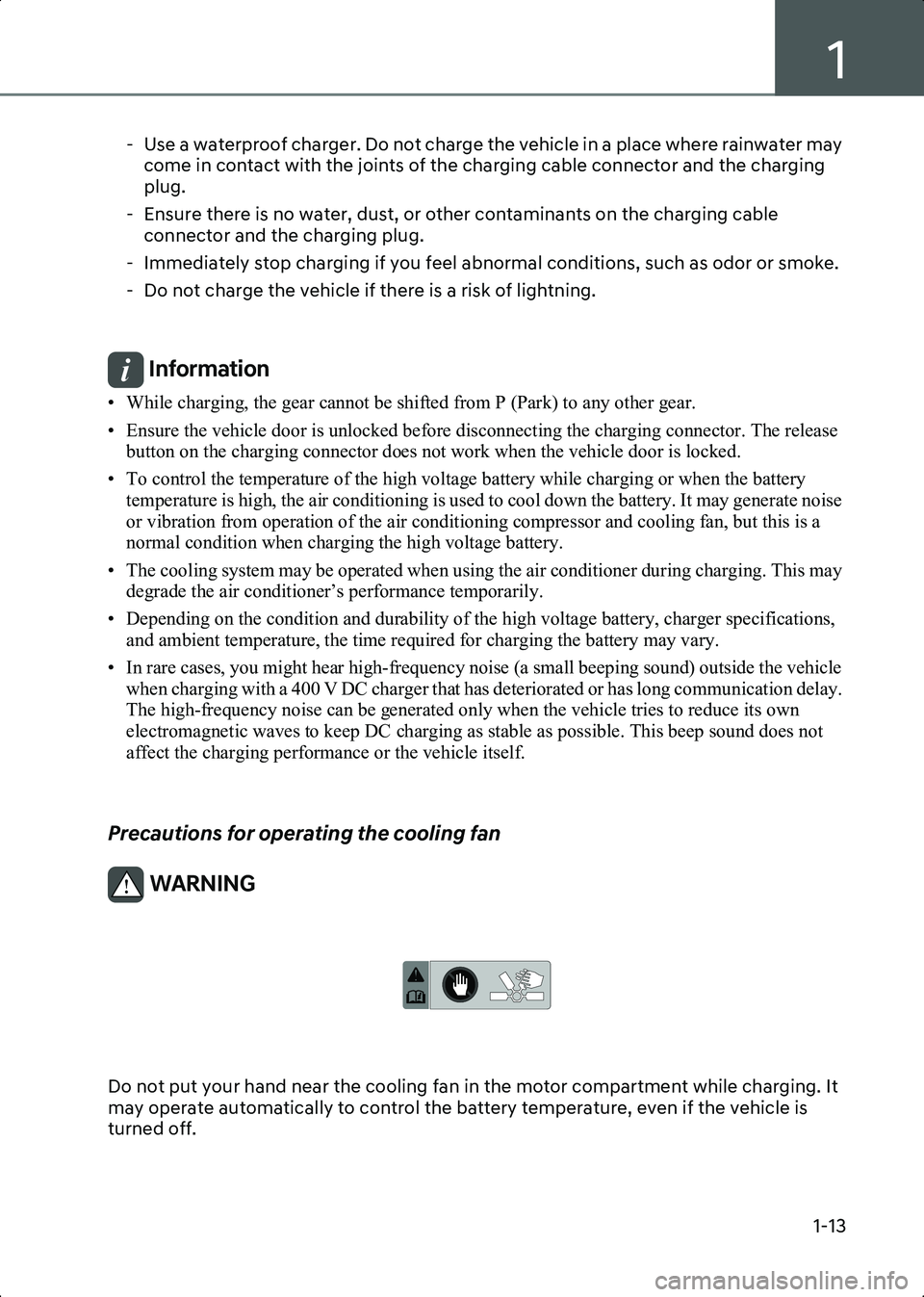
Do not put your hand near the cooling fan in the motor compartment while charging. It
may operate automatically to control the battery temperature, even if the vehicle is
turned off.
Hyundai_CE_en_US.book Page 13
Page 42 of 582

Introduction/Getting Started with Your Electric Vehicle
1-36
Checking electricity use
On the Energy Information screen, select Electricity Use.
• You can check the current energy consumption for each vehicle system.
B0001703
No.NameDescription
(1) Electronics Shows the power and energy consumption used by the vehicle
system, including the instrument cluster, infotainment system
(speaker and navigation), headlight, vehicle control unit, etc., and
the percentage of the power vehicle system used in total power
used since starting the vehicle.
(2) Climate Shows the power and energy consumption used by the air
conditioner or heater and the percentage of the power climate
system used in total power used since starting the vehicle.
(3) Drive train Shows the percentage of instantaneous and regenerative energy
consumed by the motor to drive the vehicle and the percentage of
the power driving system used in total power used since starting
the vehicle.
(4) Battery Care Shows the momentary power and energy consumption used when
increasing and cooling down the battery temperature to maintain
optimal battery performance and the percentage of battery
temperature control mode (Battery Care mode) used in the total
power used since starting the vehicle.
1234
Hyundai_CE_en_US.book Page 36