Page 305 of 680
05
5-113
winDshielD Defrosting AnD Defogging
WARNING
Windshield heating
Do not use the
position during
cooling operation in extremely humid
weather. The difference between the
temperature of the outside air and that
of the windshield could cause the outer
surface of the windshield to fog up,
causing loss of visibility could cause
an accident resulting in serious injury
or death. In this case, set the mode
selection to the
position and fan
speed control to a lower speed. • For maximum defrost performance,
set the temperature control to the
highest temperature setting and
the fan speed control to the highest
setting.
• If warm air to the floor is desired while
defrosting or defogging, set the mode
to the floor-defrost position.
• Before driving, clear all snow and ice
from the windshield, rear window,
outside rearview mirrors, and all side
windows.
• Clear all snow and ice from the
hood and air inlet in the cowl grill
to improve heater and defroster
efficiency and to reduce the
probability of fogging up the inside of the windshield.
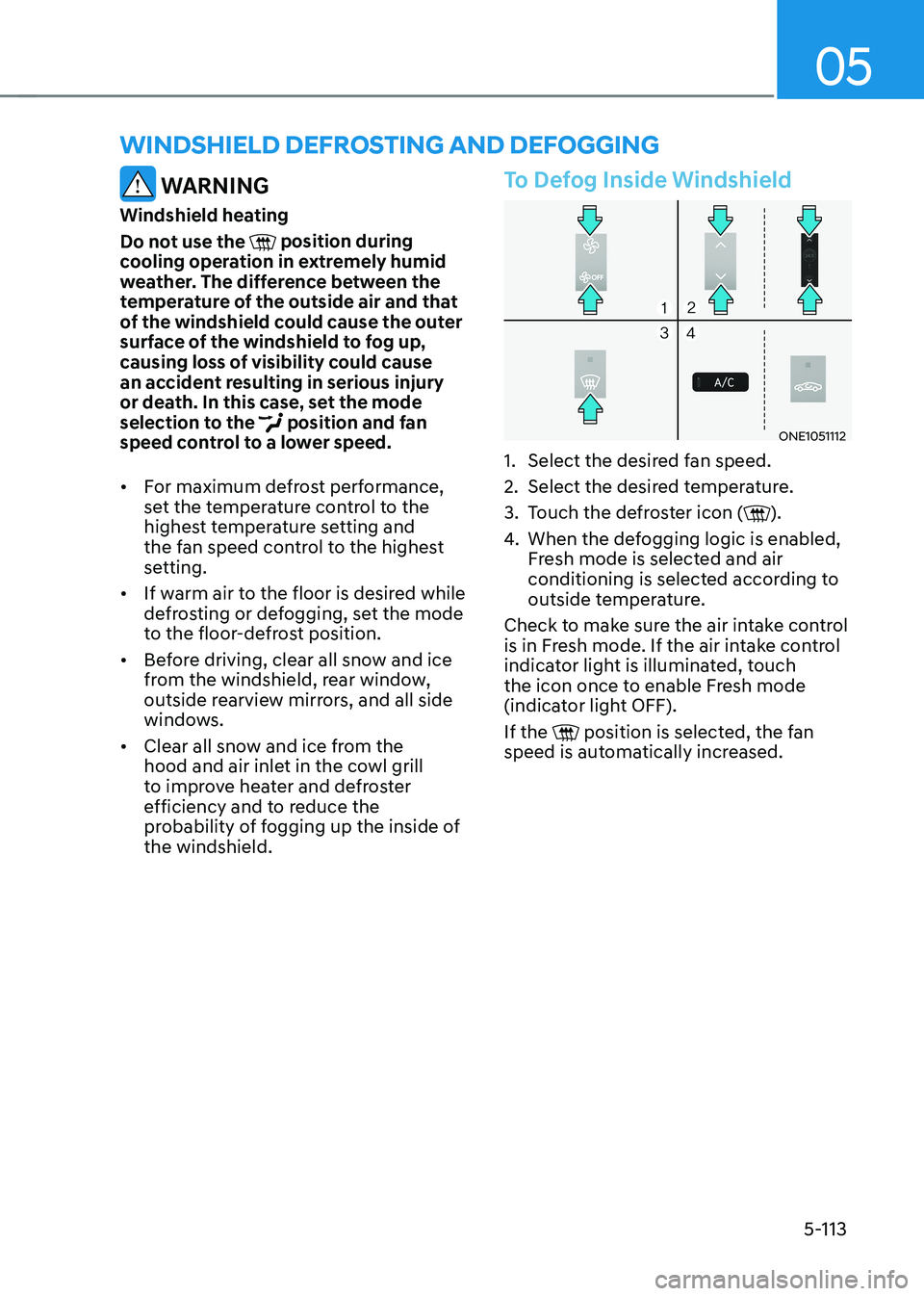
To Defog Inside Windshield
ONE1051112
1. Select the desired fan speed.
2. Select the desired temperature.
3. Touch the defroster icon (
).
4. When the defogging logic is enabled,
Fresh mode is selected and air
conditioning is selected according to
outside temperature.
Check to make sure the air intake control
is in Fresh mode. If the air intake control
indicator light is illuminated, touch
the icon once to enable Fresh mode
(indicator light OFF). If the
position is selected, the fan
speed is automatically increased.
Page 401 of 680
06
6-75
WARNING
To prevent serious or fatal injury: • Do not get out of the vehicle without
the parking brake firmly set. If you
have left the vehicle running, the
vehicle can move suddenly. You and
others could be seriously or fatally
injured.
• Do not apply the accelerator pedal to
hold the vehicle on an uphill.
Driving the vehicle after it has been
parked on a hill
1. With the gear in P (Park), apply your brakes and hold the brake pedal down
while you:
• Start your vehicle;
• Shift into gear; and
• Release the parking brake.
2. Slowly remove your foot from the brake pedal.
3. Drive slowly until the trailer is clear of the chocks.
4. Stop and have someone pick up and
store the chocks.Maintenance when Towing a
Trailer
Your vehicle will need service more
often when you regularly pull a trailer.
Important items to pay particular
attention to include reduction gear fluid,
axle lubricant and cooling system fluid.
Brake condition is another important
item to frequently check. If you’re
trailering, it’s a good idea to review these
items before you start your trip. Don’t
forget to also maintain your trailer and
hitch. Follow the maintenance schedule
that accompanied your trailer and check
it periodically. Preferably, conduct the
check at the start of each day’s driving.
Most importantly, all hitch nuts and bolts
should be tight.
NOTICE
To prevent vehicle damage: • Due to higher load during trailer
usage, overheating might occur on
hot days or during uphill driving.
• When towing check reduction gear
fluid more frequently.
Page 609 of 680

9-8
Maintenance
Normal Maintenance Schedule The following maintenance services must be performed to ensure good vehicle performance.
Keep receipts for all vehicle services to protect your warranty. Where both mileage and time are shown, the frequency of
service is determined by whichever occurs first.
MAINTENANCE INTERVALS
MAINTENANCE ITEM Months
4 8 12 16 20 24 28 32 36 40 44 48 52 56 60 64 68 72 76 80 84 88 92 96
Miles×1,000 5 10 15 20 25 30 35 40 45 50 55 60 65 70 75 80 85 90 95 100 105 110 115 120
Km×1,000 8 16 24 32 40 48 56 64 75 80 88 96 104 112 120 128 136 144 152 160 168 176 184 192
Cooling system
Inspect every 15,000 miles or 12 months
Rotate Tires
(Includes Tire Pressure and
Tread Wear Inspection) I I I I I I I I I I I I I I I I I I I I I I I I
Replace Climate Control Air
Filter (For Evaporator and
Blower Unit) R R
R R R R R R
Coolant *
1 Standard
At first, replace 120,000 miles (200,000 km) or 120 months.
After that, replace every 25,000 miles (40,000 km) or 24 month.
Low Conductivity Replace every 40,000 miles (60,000 km) or 36 months *
2
12V auxiliary battery condition I I
I I I I I I
Brake lines, hoses, and connections I I
I I I I I I
I : Inspect and if necessary, adjust, correct, clean or replace.
R : Replace or change. *1 : When replacing or adding coolant, visit an authorized HYUNDAI dealer.
*2 : For your convenience, it can be replaced prior to it’s interval when you do maintenance of other items.
Page 612 of 680

09
9-11
Cooling System
Check cooling system components, such
as radiator, coolant reservoir, hoses and
connections for leakage and damage.
Replace any damaged parts.
Coolant
The coolant should be changed at the
intervals specified in the maintenance schedule.
Reduction Gear Fluid
The reduction gear fluid should be
inspected according to the intervals
specified in the maintenance schedule.
Brake Hoses and Lines
Visually check for proper installation,
chafing, cracks, deterioration and any
leakage. Replace any deteriorated or
damaged parts immediately.
Brake Fluid
Check the brake fluid level in the brake
fluid reservoir. The level should be
between the MIN and the MAX marks
on the side of the reservoir. Use only
hydraulic brake fluid conforming to DOT
4 specification.
Brake Discs, Pads, Calipers and
Rotors
Check the pads, the disc, and the rotor
for any excessive wear-out. Inspect
calipers for any fluid leakage.
Suspension Mounting Bolts
Check the suspension connections for
looseness or damage. Retighten to the
specified torque.
Steering Gear Box, Linkage &
Boots/Lower Arm Ball Joint
With the vehicle stopped and the vehicle
off, check for excessive free-play in the
steering wheel. Check the linkage for
bends or damage. Check the dust boots
and ball joints for deterioration, cracks, or damage.
Replace any damaged parts.
Drive Shafts and Boots
Check the drive shafts, boots and clamps
for cracks, deterioration, or damage.
Replace any damaged parts and, if
necessary, repack the grease.
Air Conditioning Refrigerant
Check the air conditioning lines and
connections for leakage and damage.
explanation of scheduled Maintenance iteMs
Page 613 of 680

Maintenance
9-12
„„Standard coolant
ONE1091002
„„Low conductivity coolant
ONE1091003
Check the condition and connections
of all cooling system hoses and
heater hoses. Replace any swollen or
deteriorated hoses.
The coolant level should be filled
between the MAX or F and the MIN
or L marks on the side of the coolant
reservoir when the parts in the motor
compartment is cool.
If the coolant is low, have the vehicle
inspected by an authorized HYUNDAI
dealer.
Use only designated coolant water for
electric vehicles, adding other types
of water or antifreeze can damage the
vehicle.
WARNING
Since specific coolant water (Blue color,
Low conductivity) is applied for electric
vehicles, replenishment of other
antifreeze or water may cause problems
to the vehicle.
WARNING
The electric motor for the
cooling fan may continue to
operate or start up when the
vehicle is not running and can
cause serious injury.
Keep hands, clothing and tools
away from the rotating fan
blades of the cooling fan.
The electric motor for the cooling
fan is controlled by vehicle coolant
temperature, refrigerant pressure and
vehicle speed. As the vehicle coolant
temperature decreases, the electric
motor will automatically shut off. This is
a normal condition.
coolant
Page 645 of 680
Maintenance
9-44
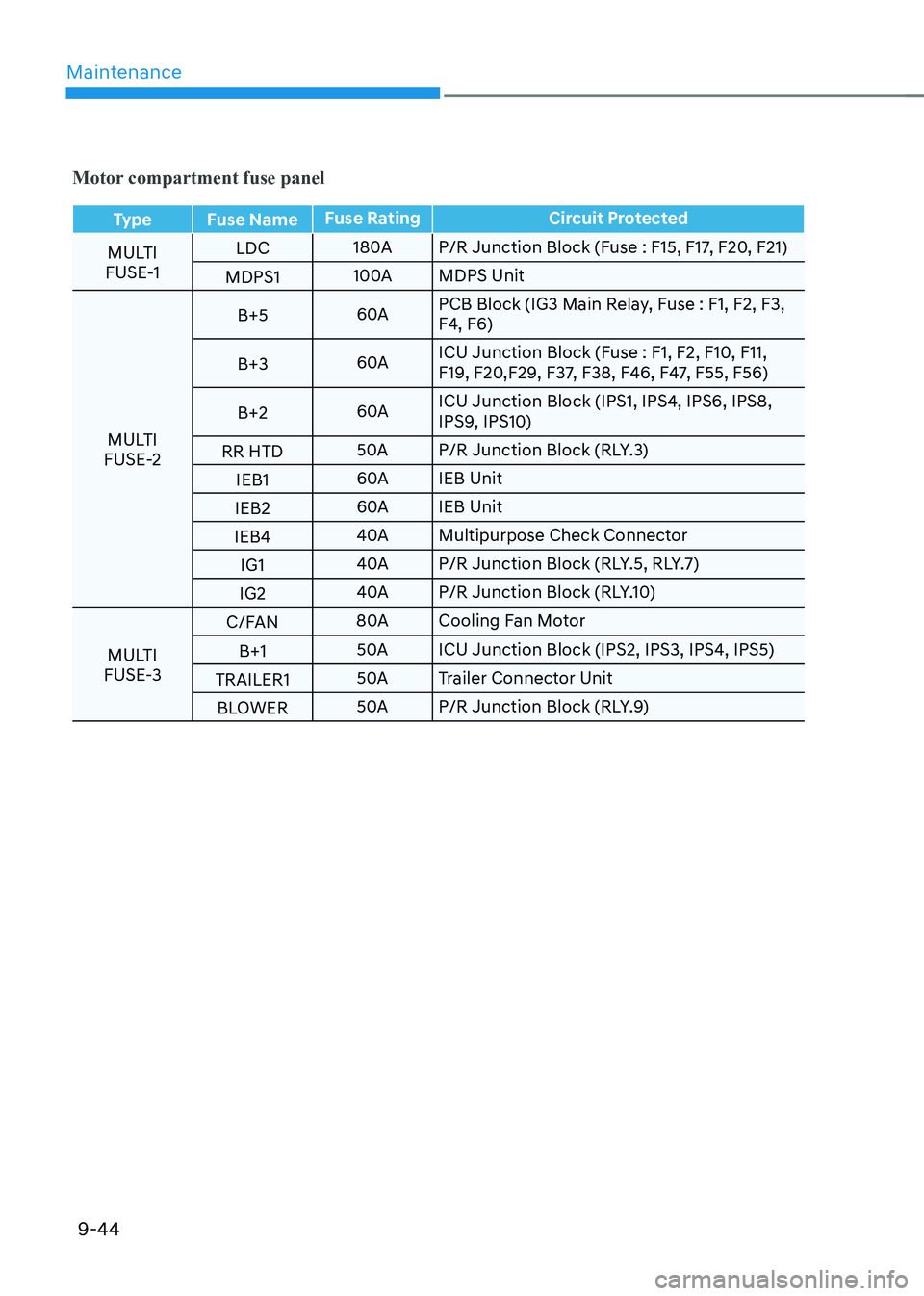
Motor compartment fuse panel
Type Fuse NameFuse Rating Circuit Protected
MULTI
FUSE-1 LDC
180A P/R Junction Block (Fuse : F15, F17, F20, F21)
MDPS1 100A MDPS Unit
MULTI
FUSE-2 B+5
60APCB Block (IG3 Main Relay, Fuse : F1, F2, F3,
F4, F6)
B+3 60AICU Junction Block (Fuse : F1, F2, F10, F11,
F19, F20,F29, F37, F38, F46, F47, F55, F56)
B+2 60AICU Junction Block (IPS1, IPS4, IPS6, IPS8,
IPS9, IPS10)
RR HTD 50A
P/R Junction Block (RLY.3)
IEB1 60A
IEB Unit
IEB2 60A
IEB Unit
IEB4 40A
Multipurpose Check Connector
IG1 40A
P/R Junction Block (RLY.5, RLY.7)
IG2 40A
P/R Junction Block (RLY.10)
MULTI
FUSE-3 C/FAN
80A
Cooling Fan Motor
B+1 50A
ICU Junction Block (IPS2, IPS3, IPS4, IPS5)
TRAILER1 50A
Trailer Connector Unit
BLOWER 50A
P/R Junction Block (RLY.9)
Page 648 of 680
09
9-47
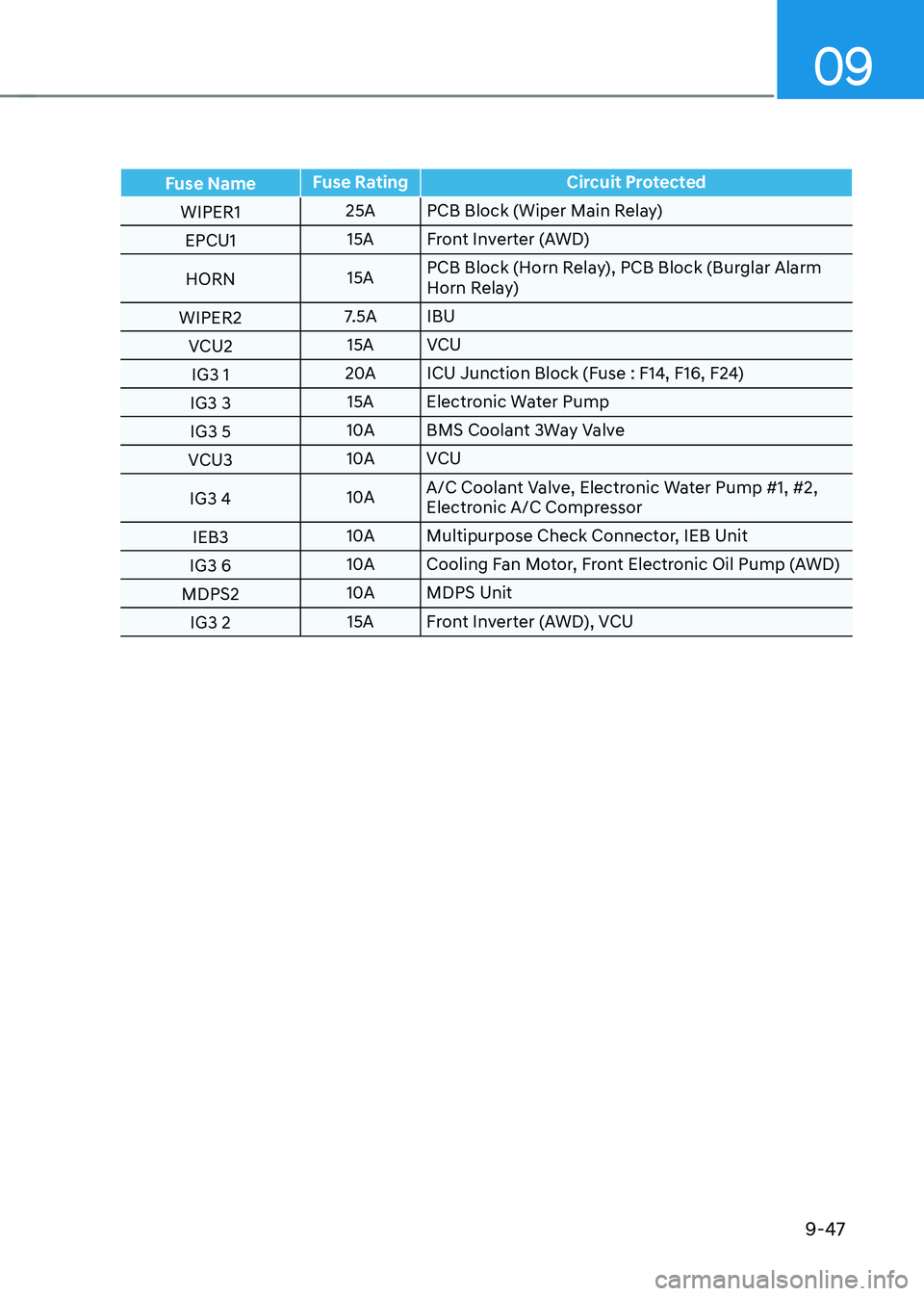
Fuse NameFuse Rating Circuit Protected
WIPER1 25A PCB Block (Wiper Main Relay)
EPCU1 15A Front Inverter (AWD)
HORN 15APCB Block (Horn Relay), PCB Block (Burglar Alarm
Horn Relay)
WIPER2 7.5A IBU
VCU2 15A
VCU
IG3 1 20A
ICU Junction Block (Fuse : F14, F16, F24)
IG3 3 15A Electronic Water Pump
IG3 5 10A
BMS Coolant 3Way Valve
VCU3 10A
VCU
IG3 4 10AA/C Coolant Valve, Electronic Water Pump #1, #2,
Electronic A/C Compressor
IEB3 10A
Multipurpose Check Connector, IEB Unit
IG3 6 10A
Cooling Fan Motor, Front Electronic Oil Pump (AWD)
MDPS2 10A
MDPS Unit
IG3 2 15A Front Inverter (AWD), VCU