2023 HONDA PILOT brake
[x] Cancel search: brakePage 514 of 814
Continued513
uuTowing a Trailer uTowing Preparation
Driving
■Trailer light
Trailer lights and equipment must comply with federal, state, province/territory, and
local regulations. Check with your local trailer sales or rental agency for the
requirements in the area where you plan to tow.
We recommend that you have a dealer inst all a Honda wiring harness and converter.
They are designed for your vehicle.
The lighting and wiring of trailers can vary by type and brand. If a connector is
required, it should only be installed by a qualified technician.
■Hitches
The hitch must be of an approved type and properly bolted to the underbody.
1 Trailer light
The trailer lighting connect or is located behind the
left side panel in the cargo area.
Even if you are planning to use the non-Honda trailer
lighting harness and converte r, ask a dealer for the
correct connector and pins.
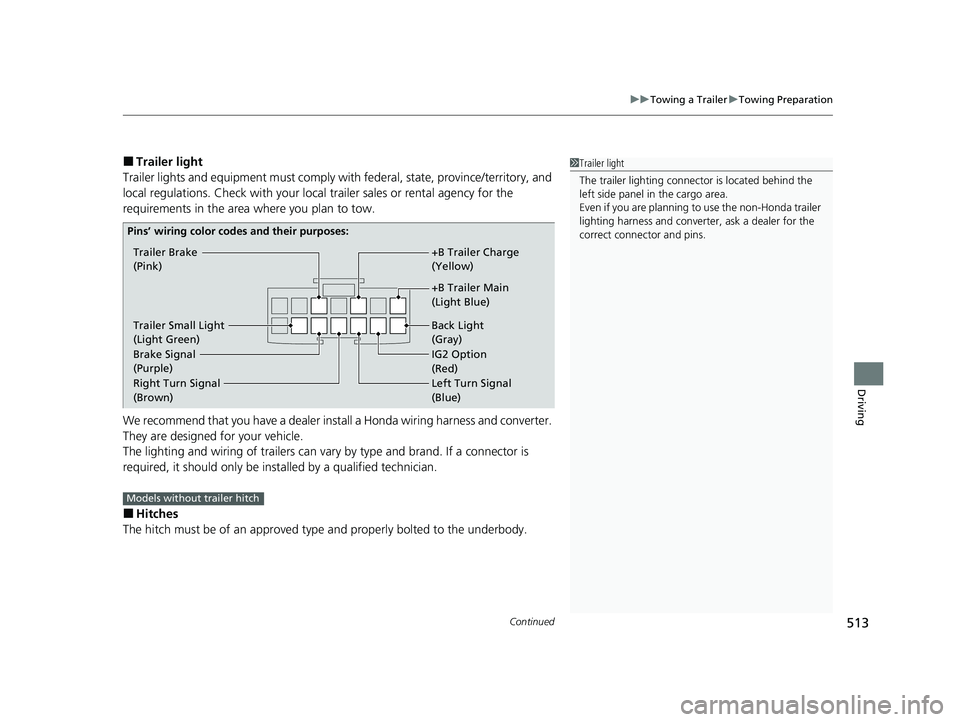
Trailer Brake
(Pink)
+B Trailer Main
(Light Blue) +B Trailer Charge
(Yellow)
IG2 Option
(Red) Back Light
(Gray)
Trailer Small Light
(Light Green)
Brake Signal
(Purple)
Pins’ wiring color codes and their purposes:
Right Turn Signal
(B ro wn) Left
Turn Signal
(Blue)
Models without trailer hitch
23 PILOT-31T906000_03.book 513 ページ 2022年10月31日 月曜日 午前10時26分
Page 516 of 814
515
uuTowing a Trailer uTrailer Stability Assist
Driving
Trailer Stability Assist
Helps stabilize the vehicle and traile r when the trailer severely sways.
■How trailer stability assist works
When the vehicle and trailer become unstable while driving, trailer stability assist
determines the cause. If the trailer oscilla tion is detected as the cause, and the
swaying increases, the system applies the br akes or controls engine output to reduce
vehicle speed.
Both the vehicle and trailer brake lights co me on automatically if you brake to
reduce vehicle speed.
1 Trailer Stability Assist
Trailer stability assist is not a function that prevents
the vehicle and trailer from swaying. Avoid high
speeds, abrupt steering, improper trailer load, and
sudden braking to keep th e trailer from swaying.
When swaying too severely, the system becomes
ineffective, and you may lose control of your vehicle,
causing the trailer to ro ll over or get damaged.
2 Driving Safely with a Trailer P. 516
Trailer towing sway is caused by:
•Crosswinds
•Improper tongue load
•Excessive Speed
The VSA ® system indicator blinks during the trailer
stability assist operation. 2 VSA ® Operation P. 555
23 PILOT-31T906000_03.book 515 ページ 2022年10月31日 月曜日 午前10時26分
Page 517 of 814

516
uuTowing a Trailer uDriving Safely with a Trailer
Driving
Driving Safely with a Trailer
• Have the trailer properly serviced and keep it in good condition.
• Make sure that all the weights and load in the vehicle and trailer are within limits.
2Towing Load Limits P. 508
•Securely attach the hitch, safety chains, and other necessary parts to the trailer.
• Securely store all the items in and on the tr ailer so that they do not shift while
driving.
• Check if the lights and brakes on the trailer are working properly.
• Check the pressures of the traile r tires, including the spare.
• Turn off the Auto Idle Stop syst em using the Auto Idle Stop OFF button. The
trailer weight can affect your vehicle's br ake effectiveness if Auto Idle Stop is
activated on a hill while towing a trailer.
• Select TOW mode for optimized transmissio n operation when towing a trailer.
2Drive Mode System P. 548
•Turn off the rear parking sensor system.
2 Parking sensor system on and off P. 664
•Turn off the Low Speed Braking Control syst em. It may activate if it detects the
towed object as an obstacle.
2 System On and Off P. 587
■Things You Need To Know Before Towing a Trailer1Driving Safely with a Trailer
Operating speed when towing a trailer must not
exceed 62 mph (100 km/h).
Parking
In addition to the normal precautions, place wheel
chocks at each of the trailer’s tires.
Remember to unhitch the tra iler before changing a
flat tire. Ask the trailer sales or rental agency where
and how to store the trailer’s spare tire.
Models with Parking Sensor System
Models with Low Speed Braking Control
23 PILOT-31T906000_03.book 516 ページ 2022年10月31日 月曜日 午前10時26分
Page 518 of 814
517
uuTowing a Trailer uDriving Safely with a Trailer
Driving
• Drive slower than normal.
• Obey posted speed limits fo r vehicles with trailers.
• Use the
(D position when towing a trailer on level roads.
• Turn more slowly and with a wider turning arc than normal.
• Allow more time and distance for braking.
• Do not brake or turn suddenly.
• If the Engine temperature near limit. Av oid heavy acceleration and high
speed. message appears on the driver information interface, turn off the climate
control system and reduce speed.
If the Engine temperature too hot. Do no t drive. Allow engine to cool.
message appears on the driver information interface, pull to the side of the road
safely to cool down the engine.
• Change the gear position to
(S position if the transmission shifts frequently.
When retrieving a boat from the wa ter, the sequential shift mode
(S is
recommended to utilize the transmissions lower gears.
■Towing Speeds and Gears
■Turning and Braking
■Driving in Hilly Terrain
■Retrieving a Boat
1Towing Speeds and Gears
When towing a fixed-sided trailer (e.g., camper), do
not exceed 55 mph (88 km/h).
At higher speeds, the trai ler may sway or affect
vehicle handling.
1 Driving in Hilly Terrain
If the automatic transmission fluid temperature
exceeds the specified limit, the transmission will also
automatically up shift, even in the sequential shift
mode.
23 PILOT-31T906000_03.book 517 ページ 2022年10月31日 月曜日 午前10時26分
Page 523 of 814
522
uuOff-Highway Driving Guidelines uOff-Highway Driving
Driving
Off-highway driving requires special skills, knowledge and experience, as the safety
risks are greatly increased when the yo ur vehicle is operated at its upper
performance abilities. As a responsible driver, you should not drive above your skill
limits or training, even if your vehicle’ s performance levels would otherwise allow
you to do so. If you intend to engage in off-highway drivi ng, Honda strongly
recommends that:
• You first obtain appropriate, professional training
• Turn off any devices or systems that may distract you from the driving task
Off-highway driving in genera l, results in greater wear and tear on the vehicle. If
your vehicle is not in top c ondition or if certain compon ents, such as the brakes or
tires, have undue wear, those components could experience a loss of performance,
or fail, when engaging in off-highway driv ing. Therefore, Honda highly recommends
that you undertake more proactive and frequent maintenance than that required
under normal use and have your vehicle insp ected at an authorized dealer (and all
necessary repairs or adjustments made) before you engage in any off-highway
driving. In addition to any required ma intenance, there are specific items and
protocols that you should pay special atte ntion to before, during and after engaging
in any off-highway driving. Ultimately, the decision whether to engage in off-
highway driving is yours, and depending on your vehicle’s condition and prior usage,
the items and protocols listed below may or may not be sufficient to ensure a safe
driving experience.
BEFORE DRIVING
•Before off-highway driving, fill the engine oil up to the upper level.
• Recommend starting with full fuel tank and not allowing fuel to drop below ¼
tank while driving off-highway.
23 PILOT-31T906000_03.book 522 ページ 2022年10月31日 月曜日 午前10時26分
Page 524 of 814
523
uuOff-Highway Driv ing GuidelinesuOff-Highway Driving
Driving
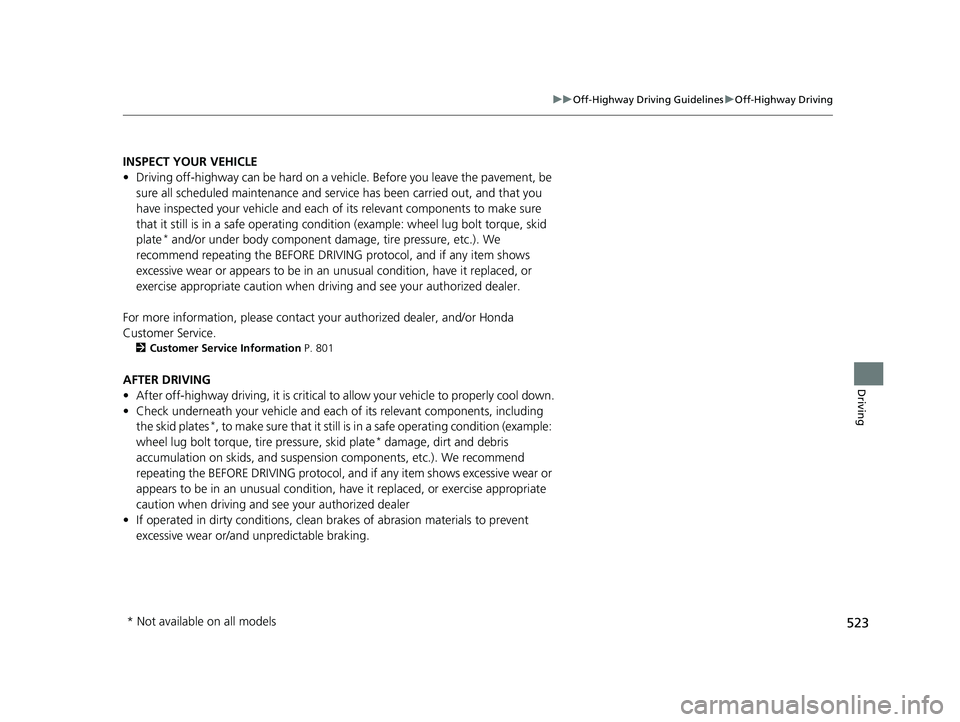
INSPECT YOUR VEHICLE
• Driving off-highway can be hard on a vehi cle. Before you leave the pavement, be
sure all scheduled maintenance and service has been carried out, and that you
have inspected your vehicle and each of its relevant components to make sure
that it still is in a safe operating condition (example: wheel lug bolt torque, skid
plate
* and/or under body component damage, tire pressure, etc.). We
recommend repeating the BEFORE DRIVIN G protocol, and if any item shows
excessive wear or appears to be in an unusual condition, have it replaced, or
exercise appropriate caution when driv ing and see your authorized dealer.
For more information, please contact your authorized dealer, and/or Honda
Customer Service.
2 Customer Service Information P. 801
AFTER DRIVING
•After off-highway driving, it is critical to allow your vehicle to properly cool down.
• Check underneath your vehicle and each of its relevant components, including
the skid plates
*, to make sure that it still is in a safe operating condition (example:
wheel lug bolt torque, tire pressure, skid plate* damage, dirt and debris
accumulation on skids, and suspension components, etc.). We recommend
repeating the BEFORE DRIVING protocol, a nd if any item shows excessive wear or
appears to be in an unusual condition, ha ve it replaced, or exercise appropriate
caution when driving and se e your authorized dealer
• If operated in dirty conditions, clean brakes of abrasion materials to prevent
excessive wear or/and unpredictable braking.
* Not available on all models
23 PILOT-31T906000_03.book 523 ページ 2022年10月31日 月曜日 午前10時26分
Page 525 of 814

524
Driving
When Driving
Starting the Engine
1.Make sure the parking brake is applied.
u The parking brake and brake system
indicator (red) comes on for 30 seconds
when you pull up the electric parking
brake switch.
2. Depress the brake pedal.1Starting the Engine
Keep your foot firmly on the brake pedal when
starting the engine.
The engine is harder to st art in cold weather and in
thinner air found at al titudes above 8,000 feet
(2,400 meters).
When starting the engine in cold weather, turn off all
electrical accessories such as the lights, climate
control system and rear de fogger in order to reduce
battery drain.
If you live in a region where winter is extremely cold,
an engine block heater will improve starting and
warming of the engine. Consult a dealer for details.
If the exhaust system sounds abnormal or you can
smell exhaust gas inside the vehicle, have your vehicle
checked by a dealer. There may be a problem with
the engine or exhaust system.
Bring the keyless remote close to the ENGINE
START/STOP button if the batte ry in the keyless
remote is weak.
2 If the Keyless Remote Battery is Weak
P. 764
The engine may not start if the keyless remote is
subjected to strong radio waves.
Brake Pedal
23 PILOT-31T906000_03.book 524 ページ 2022年10月31日 月曜日 午前10時26分
Page 529 of 814

uuWhen Driving uStarting the Engine
528
Driving
When started remotely, the engine automati cally shuts off after 10 minutes of idling
and/or the brake pedal and ENGINE START/STOP button have not been pressed
simultaneously.
To extend the run time for another 10 minutes during the first run, press the
button, then press and hold the button. u Some exterior lights flash six times if a 10-minute extension request was
transmitted successfully.1Remote Engine Start*
The engine may not start by the remote engine start
if:
•You have disabled a remo te engine start setting.
2 Settings* P. 140
2 Customized Features P. 429
•The power mode is not in VEHICLE OFF.
•The transmission is in a position other than (P.•The hood is open, or any door or the tailgate is
unlocked.
•You have already used the keyless remote twice to
start the engine.
•Another registered keyless remote is in the vehicle.
•There is any antenna failure.•The door is unlocked with the built-in key.
•The engine oil pressure is low.
•The engine coolant temper ature is extremely high.•The telematics unit malfunctions.*
•The security system alarm is not set.
•The 12-volt battery charge is too low.
* Not available on all models
23 PILOT-31T906000_03.book 528 ページ 2022年10月31日 月曜日 午前10時26分