2023 FORD MUSTANG tow
[x] Cancel search: towPage 272 of 535

When this occurs, your vehicle stilloperates, however:
•Engine power is limited.
•The air conditioning system turns off.
Continued operation increases the enginetemperature, causing the engine tocompletely shut down. Your steering andbraking effort increases in this situation.
When the engine temperature cools, youcan re-start the engine. Have your vehiclechecked as soon as possible to minimizeengine damage.
When Fail-Safe Mode Is Activated
WARNING: Fail-safe mode is foruse during emergencies only. Operateyour vehicle in fail-safe mode only aslong as necessary to bring your vehicleto rest in a safe location and seekimmediate repairs. When in fail-safemode, your vehicle will have limitedpower, will not be able to maintainhigh-speed operation, and maycompletely shut down without warning,potentially losing engine power, powersteering assist, and power brake assist,which may increase the possibility of acrash resulting in serious injury.
WARNING: Do not remove thecoolant reservoir cap when the engine ison or the cooling system is hot. Wait 10minutes for the cooling system to cooldown. Cover the coolant reservoir capwith a thick cloth to prevent thepossibility of scalding and slowly removethe cap. Failure to follow this instructioncould result in personal injury.
Your vehicle has limited engine powerwhen in the fail-safe mode, drive yourvehicle with caution. Your vehicle does notmaintain high-speed operation and theengine may operate poorly.
Remember that the engine is capable ofautomatically shutting down to preventengine damage. In this situation:
1.Pull off the road as soon as safelypossible and switch the engine off.
2.If you are a member of a roadsideassistance program, we recommendthat you contact your roadsideassistance service provider.
3.If this is not possible, wait for a shortperiod of time for the engine to cool.
4.Check the coolant level. If the coolantlevel is at or below the minimum mark,add prediluted coolant immediately.
5.When the engine temperature cools,you can re-start the engine. Have yourvehicle checked as soon as possible tominimize engine damage.
Note:Driving your vehicle without repairincreases the chance of engine damage.
Engine Coolant TemperatureManagement (If Equipped)
WARNING: To reduce the risk ofcrash and injury, be prepared that thevehicle speed may reduce and thevehicle may not be able to acceleratewith full power until the coolanttemperature reduces.
If you tow a trailer with your vehicle, theengine may temporarily reach a highertemperature during severe operatingconditions, for example ascending a longor steep grade in high ambienttemperatures.
At this time, you may notice the coolanttemperature gauge moves toward the redzone and a message may appear in theinformation display.
268
2023 Mustang (CZG) Canada/United States of America, Vehicles Built From: 14-11-2022, enUSA, Edition date: 202209, First-PrintingMaintenance
Page 282 of 535

TRACK USE - MACH 1
Operating at High Speeds andTrack Days
Your vehicle is capable of sustained highspeeds and track day driving.
Before operating your vehicle at highspeeds:
•Verify your tires have the correctpressures.
•Inspect wheels and tires for wear anddamage. Replace any damaged wheelsand tires.
•Check and set lug nut torque. SeeTechnical Specifications (page 336).
•Verify fluid levels for oil, coolant, brakeand hydraulic fluid. See Capacitiesand Specifications (page 337).
•Change the engine oil and replace theengine oil filter prior to use on the track.Change the engine oil and filter againafter every four hours of track time.Maintain the engine oil level at or nearthe max mark on the engine oil dipstick.See Engine Oil Check (page 262).
•Replace the brake fluid with freshMotorcraft/Ford DOT 4 LV HighPerformance Brake Fluid or other DOTcompliant fluid with a dry boiling pointgreater than 500°F (260°C) from asealed container. Do not use siliconeor DOT 5 brake fluids.
•If you are operating your Mach 1 on adrag strip, use drag strip selectabledrive mode in addition to using line lockand launch control to provide a specificset-up tuned for the quickest straightline elapsed times.
•If you are operating your Mach 1 on aroad course, use sport or trackselectable drive modes to provide aspecific set-up tuned for optimal shiftand suspension set-up that is tunedtowards handling prowess on closedcourse surfaces.
After operating your vehicle at high speedsor track day driving, do the following:
•Set the tire pressure to the properspecification.
•Check and set the lug nut torque. SeeTechnical Specifications (page 336).
•Check all fluid levels.
•Refer to the track maintenance intervalchart. See Normal ScheduledMaintenance (page 452).
•Check the front and rear wheelbearings for abnormal wear.
•Inspect brake caliper dust boots forabnormal wear.
Track Apps
WARNING: Track Apps™ is fortrack use only. Remember that evenadvanced technology cannot defy thelaws of physics. It is always possible tolose control of a vehicle due toinappropriate driver input for theconditions. Aggressive driving on anyroad condition can cause you to losecontrol of your vehicle increasing the riskof personal injury or property damage.
278
2023 Mustang (CZG) Canada/United States of America, Vehicles Built From: 14-11-2022, enUSA, Edition date: 202209, First-PrintingTrack Use (If Equipped)
Page 283 of 535

This information display driven featureprovides a suite of menu options to recordand optimize your track performances.See General Information (page 98).
Note: Track Apps are for track use only. Donot use them under any other drivingconditions.
Note:You cannot view or clear your resultsunless your vehicle is at a complete stopwith the right arrow on the display menuinactive. If your vehicle does not reach100 mph (160 km/h) during the track run,your display may not show your selectedinterval's results.
Note:The pre-collision assist system turnsoff when using Track Apps or when youswitch off your stability control system.
Acceleration Timer
Displays your vehicle's rate of accelerationfor a given speed or distance range.
Accelerometer
Displays your vehicle's rate of accelerationor deceleration. A dot moves toward thearea of acceleration or deceleration.
LEFT Acceleration or Deceleration
When accelerating or decelerating left, thedot moves to the right on theaccelerometer.
RIGHT Acceleration or Deceleration
When accelerating or decelerating right,the dot moves to the left on theaccelerometer.
Brake Performance
Displays your vehicle's rate of decelerationfor a given speed range.
Exhaust Mode
Gives the driver the ability to choose thevehicle's exhaust mode.
Note:The Track Exhaust Mode setting isonly for use at tracks and not for use onpublic roadways. Use of this setting resultsin increased exterior noise, which may notmeet state and local laws and regulations.It is the obligation of the driver to operatethe vehicle in a manner that complies withstate and local requirements. Only use theTrack Exhaust Mode setting at acompetition track or an off-road coursewhere elevated exterior vehicle noise isacceptable.
Lap Timer
Gives you the ability to record lap times atthree separate tracks.
Launch Control (If Equipped)
Maximizes your vehicle's traction from astanding start.
Follow these steps to use launch control:
1.Bring your vehicle to a complete stop.
2.Make sure launch control is enabled.The indicator illuminates in theinformation display when launchcontrol is enabled. See WarningLamps and Indicators (page 93).
3.Fully press the clutch pedal.
4.Shift the transmission into 1st gear.
5.Fully depress the accelerator pedal andallow the engine RPM to stabilize.
6.Release the clutch pedal.
279
2023 Mustang (CZG) Canada/United States of America, Vehicles Built From: 14-11-2022, enUSA, Edition date: 202209, First-PrintingTrack Use (If Equipped)
Page 290 of 535

Note:The pre-collision assist system turnsoff when using Track Apps or when youswitch off your stability control system.
Acceleration Timer
Displays your vehicle's rate of accelerationfor a given speed or distance range.
Accelerometer
Displays your vehicle's rate of accelerationor deceleration. A dot moves toward thearea of acceleration or deceleration.
LEFT Acceleration or Deceleration
When accelerating or decelerating left, thedot moves to the right on theaccelerometer.
RIGHT Acceleration or Deceleration
When accelerating or decelerating right,the dot moves to the left on theaccelerometer.
Brake Performance
Displays your vehicle's rate of decelerationfor a given speed range.
Exhaust Mode
Gives the driver the ability to choose thevehicle's exhaust mode.
Note:The Track Exhaust Mode setting isonly for use at tracks and not for use onpublic roadways. Use of this setting resultsin increased exterior noise, which may notmeet state and local laws and regulations.It is the obligation of the driver to operatethe vehicle in a manner that complies withstate and local requirements. Only use theTrack Exhaust Mode setting at acompetition track or an off-road coursewhere elevated exterior vehicle noise isacceptable.
Lap Timer
Gives you the ability to record lap times atthree separate tracks.
Launch Control (If Equipped)
Maximizes your vehicle's traction from astanding start.
Follow these steps to use launch control:
1.Bring your vehicle to a complete stop.
2.Make sure launch control is enabled.The indicator illuminates in theinstrument display when launch controlis enabled. See Warning Lamps andIndicators (page 93).
3.Fully press the clutch pedal.
4.Shift the transmission into first gear.
5.Fully depress the accelerator pedal andallow the engine RPM to stabilize.
6.Release the clutch pedal.
Line Lock
Line lock is a feature intended for use attracks only and should not be used onpublic roadways. Use of this feature mayresult in significantly increased rear tirewear. It is intended to condition the reartires to maximize traction prior to track use.Line lock maintains brake force at the frontwheels, allowing the rear wheels to spinwith minimal vehicle movement.
This feature is located in the Track Appsmenu. Make selections through the 5-wayinformation display control and OK buttonlocated on the steering wheel.
Using Line Lock
There are three line lock stages:
•Initiated.
•Engaged.
•Off.
286
2023 Mustang (CZG) Canada/United States of America, Vehicles Built From: 14-11-2022, enUSA, Edition date: 202209, First-PrintingTrack Use (If Equipped)
Page 297 of 535

SpecificationName
WSS-M14P19-AMotorcraft® Premium Windshield Wash Concentrate withBitterant, ZC-32-B2 (U.S.)
WSS-M14P19-AMotorcraft® Premium Quality Windshield Washer Fluid, CXC-37-F/M (Canada)
Motorcraft® Professional Strength Carpet & Upholstery Cleaner,ZC-54 (U.S. & Canada)
ESR-M14P5-AMotorcraft® Premium Glass Cleaner, CXC-100 (Canada)
Motorcraft® Spot and Stain Remover, ZC-14 (U.S.)
ESR-M14P5-AMotorcraft® Ultra-Clear Spray Glass Cleaner, ZC-23 (U.S.)
Motorcraft® Wheel and Tire Cleaner, ZC-37-A (U.S. & Canada)
CLEANING THE EXTERIOR -
MACH 1
Washing Your Vehicle
Note:Do not use a touchless car wash orany kind of commercial car washequipment.
Note:Always hand wash your vehicle if youhave vinyl stripes.
Do not drive your vehicle through anautomated, commercial car wash due tothe vehicle’s low ground clearance and tirewidth. Wash your vehicle by hand, or byusing a commercial wash with nomechanical tracks on the floor. Do not usea power washer or high pressure wand.
To maintain proper cooling andaerodynamics at high speeds, your vehiclehas heat exchangers integrated with thefront fascia designed to maximizeperformance. Do not use a power washeror high powered spray nozzle as damageto the cooling fins could occur.
Note:For heavy accumulation of debris ordirt, clean with a non-metallic soft bristlecar wash brush and warm soapy water asneeded.
CLEANING THE EXTERIOR
Wash your vehicle regularly with cool orlukewarm water and a neutral pHshampoo, we recommend MotorcraftDetail Wash.
•Never use strong household detergentsor soap, for example dish washing orlaundry liquid. These products candiscolor and spot painted surfaces.
•Never wash your vehicle when it is hotto the touch, or during strong or directsunlight.
•Dry your vehicle with a chamois or softterry cloth towel to eliminate waterspotting.
•Immediately remove fuel spillages, birddroppings, insect deposits and road tar.These may cause damage to yourvehicle’s paintwork or trim over time.We recommend Motorcraft Bug andTar Remover.
293
2023 Mustang (CZG) Canada/United States of America, Vehicles Built From: 14-11-2022, enUSA, Edition date: 202209, First-PrintingVehicle Care
Page 306 of 535

General Information
WARNING: Failure to follow theseguidelines could result in an increasedrisk of loss of vehicle control, injury ordeath.
Note:Do not use the kit if you have severelydamaged a tire. Only seal punctures withinthe tire tread with the kit.
Do not attempt to repair punctures largerthan ¼ inch (6 millimeters) or damage tothe tire's sidewall. The tire may notcompletely seal.
Loss of air pressure may adversely affecttire performance. For this reason:
Note:Do not drive the vehicle above50 mph (80 km/h).
Note:Do not drive further than 120 mi(200 km). Drive only to the closestauthorized dealer or tire repair shop to haveyour tire inspected.
•Drive carefully and avoid abruptsteering maneuvers.
•Periodically monitor tire inflationpressure in the affected tire; if the tireis losing pressure, have the vehicletowed.
•Read the information in the Tips forUse of the Kit section to make sure safeoperation of the kit and your vehicle.
Tips for Use of the Kit
To ensure safe operation of the kit:
•Read all instructions and cautions fully.
•Before operating the kit, make sureyour vehicle is safely off the road andaway from moving traffic. Switch onthe hazard lights.
•Always set the parking brake to ensurethe vehicle does not moveunexpectedly.
•Do not remove any foreign objects,such as nails or screws, from the tire.
•When using the kit, leave the enginerunning (only if the vehicle is outdoorsor in a well-ventilated area) so thecompressor does not drain thevehicle's battery.
•Do not allow the compressor tooperate continuously for more than 15minutes. This will help prevent thecompressor from overheating.
•Never leave the kit unattended duringoperation.
•Sealant compound contains latex.Those with latex sensitivities shoulduse appropriate precautions to avoidan allergic reaction.
•Keep the kit away from children.
•Only use the kit when the ambienttemperature is between -22°F (-30°C)and 158°F (70°C).
•Only use the sealing compound beforethe use-by date. The use-by date is ona label on the sealant canister, whichyou can see through the rectangularviewing window on the bottom of thecompressor. Check the use-by dateregularly and replace the canister whenthe sealant expires.
•Do not store the kit unsecured insidethe passenger compartment of thevehicle as it may cause injury during asudden stop or crash. Always store thekit in its original location.
•After sealant use, an authorized dealermust replace the tire pressuremonitoring system sensor and valvestem on the wheel.
•Operating the kit could cause anelectrical disturbance in radio, CD andDVD player operation.
302
2023 Mustang (CZG) Canada/United States of America, Vehicles Built From: 14-11-2022, enUSA, Edition date: 202209, First-PrintingWheels and Tires
Page 308 of 535
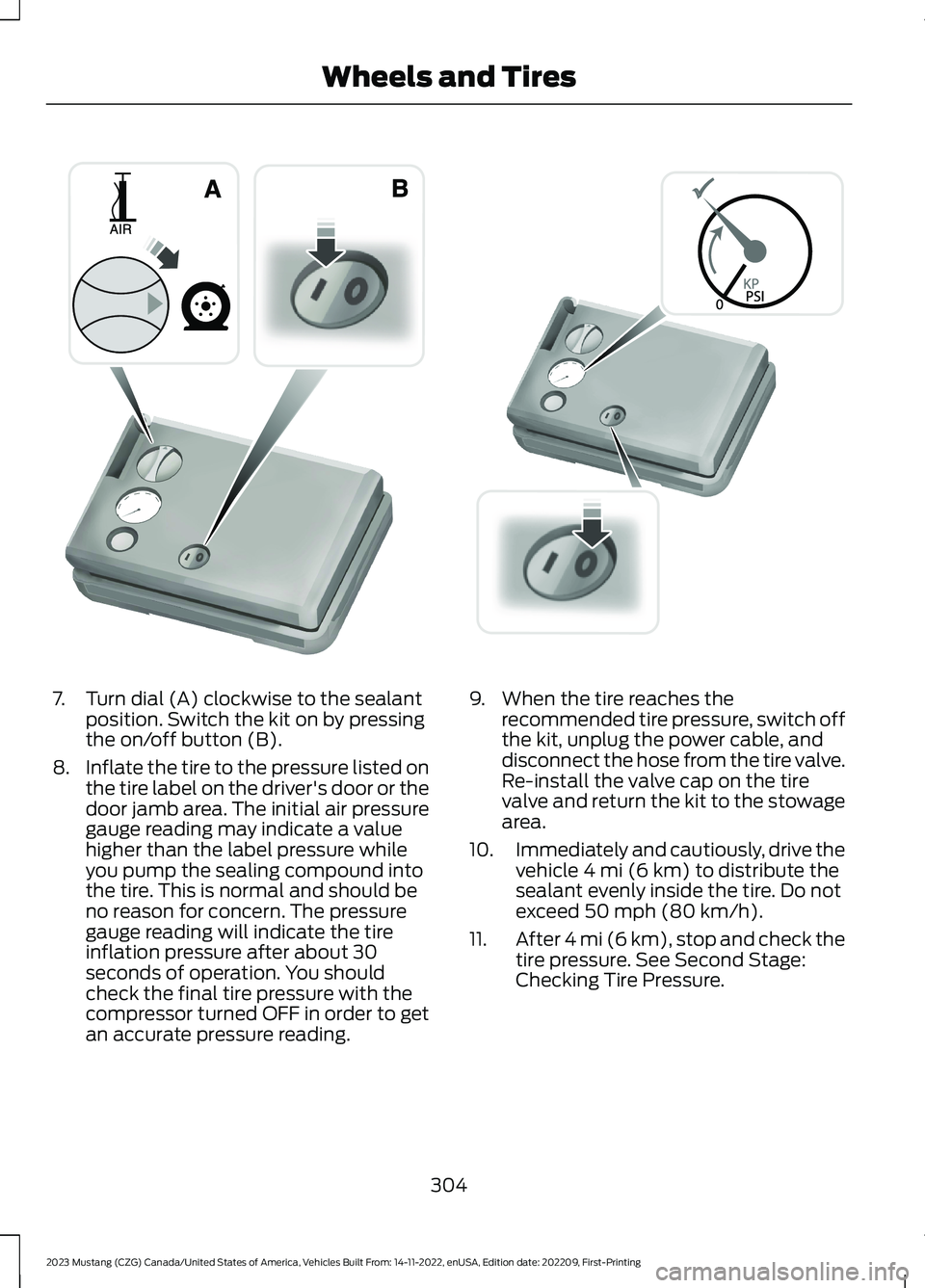
7.Turn dial (A) clockwise to the sealantposition. Switch the kit on by pressingthe on/off button (B).
8.Inflate the tire to the pressure listed onthe tire label on the driver's door or thedoor jamb area. The initial air pressuregauge reading may indicate a valuehigher than the label pressure whileyou pump the sealing compound intothe tire. This is normal and should beno reason for concern. The pressuregauge reading will indicate the tireinflation pressure after about 30seconds of operation. You shouldcheck the final tire pressure with thecompressor turned OFF in order to getan accurate pressure reading.
9.When the tire reaches therecommended tire pressure, switch offthe kit, unplug the power cable, anddisconnect the hose from the tire valve.Re-install the valve cap on the tirevalve and return the kit to the stowagearea.
10.Immediately and cautiously, drive thevehicle 4 mi (6 km) to distribute thesealant evenly inside the tire. Do notexceed 50 mph (80 km/h).
11.After 4 mi (6 km), stop and check thetire pressure. See Second Stage:Checking Tire Pressure.
304
2023 Mustang (CZG) Canada/United States of America, Vehicles Built From: 14-11-2022, enUSA, Edition date: 202209, First-PrintingWheels and TiresE175981 E175982
Page 309 of 535

Note:If you experience any unusualvibration, ride disturbance or noise whiledriving, reduce your speed until you cansafely pull off to the side of the road to callfor roadside assistance. Note: Do notproceed to the second stage of thisoperation.
Second Stage: Checking TirePressure
Note:If you are proceeding from the FirstStage: Re-inflating the Tire with SealingCompound and Air section and haveinjected sealant in the tire and the pressureis below 20 psi (1.4 bar), continue to thenext step.
WARNING: The power plug mayget hot after use and should be handledcarefully when unplugging.
Check the air pressure of your tires asfollows:
1.Remove the valve cap from the tirevalve.
2.Firmly screw the air compressor hoseonto the valve stem by turningclockwise.
3.Push and turn the dial clockwise to theair position.
4.If required, switch on the compressorand adjust the tire to therecommended inflation pressureshown on the tire label on the driver'sdoor or door jamb area. You shouldcheck the tire pressure with thecompressor turned OFF in order to getan accurate pressure reading.
5.Unplug the hoses, re-install the valvecap on the tire and return the kit to thestowage area.
What to Do After the Tire Has BeenSealed
After using the kit to seal your tire, you willneed to replace the sealant canister. Youcan obtain sealant canisters and spareparts at an authorized dealer. You candispose of empty sealant canisters athome. However, you should dispose ofcanisters still containing liquid sealantthrough your local authorized dealer or tiredealer, or in accordance with local wastedisposal regulation.
Note:After you use the sealing compound,the maximum vehicle speed is 50 mph(80 km/h) and the maximum drivingdistance is 120 mi (200 km). You shouldinspect the sealed tire immediately.
You can check the tire pressure any timewithin the 120 mi (200 km) by performingthe steps listed previously in the SecondStage: Checking Tire Pressure procedure.
305
2023 Mustang (CZG) Canada/United States of America, Vehicles Built From: 14-11-2022, enUSA, Edition date: 202209, First-PrintingWheels and TiresE175983