2022 TOYOTA SUPRA lock
[x] Cancel search: lockPage 269 of 498

267
3
3-1. CONTROLS
CONTROLS
The independent ventilation allows
the temperature of the interior to be
adjusted before the journey starts.
Depending on the set temperature
and ambient temperature, the inte-
rior is ventilated or heated using
any available residual heat from the
engine.
The system can be switched on
and off directly or for a preselected
departure time.
The switch-on time is calculated
based on the outside temperature.
The system will switch on in good
time before the preselected depar-
ture time.
Vehicle is in rest or standby state
and not in drive-ready state.
Battery is sufficiently charged.
When activated, the independent venti-
lation uses power from the vehicle bat-
tery. As a result, the maximum
activation time is restricted to protect
the battery. After the engine is started
or after driving a short distance, the
system will be av ailable again.
Ensure that the date and time
are set correctly in the vehicle.
Open the vents to allow the air to
enter the passenger compart-
ment.
The system can be switched on or
off in various ways.
The system switches off automati-
cally after a certain period of time. It
continues to run for a short time
after it has been switched off.
■General
If the vehicle is in standby state, the
independent ventilation can be
switched on or off via the buttons of
the automatic air conditioning.
■Switching on
Press any button, except:
Rear window heating.
Lower side of air flow button.
Seat heating.
■Switching off
The system switches off after leav-
ing and locking the vehicle.
Press and hold the down
button.
1 "My Vehicle"
2 "Vehicle settings"
Independent ventilation
Principle
General
Operating requirements
Switching on/off directly
General
Using the button
Via Toyota Supra Command
Page 276 of 498
2743-1. CONTROLS
The vehicle interior contains multi-
ple storage compartments for stow-
ing objects.
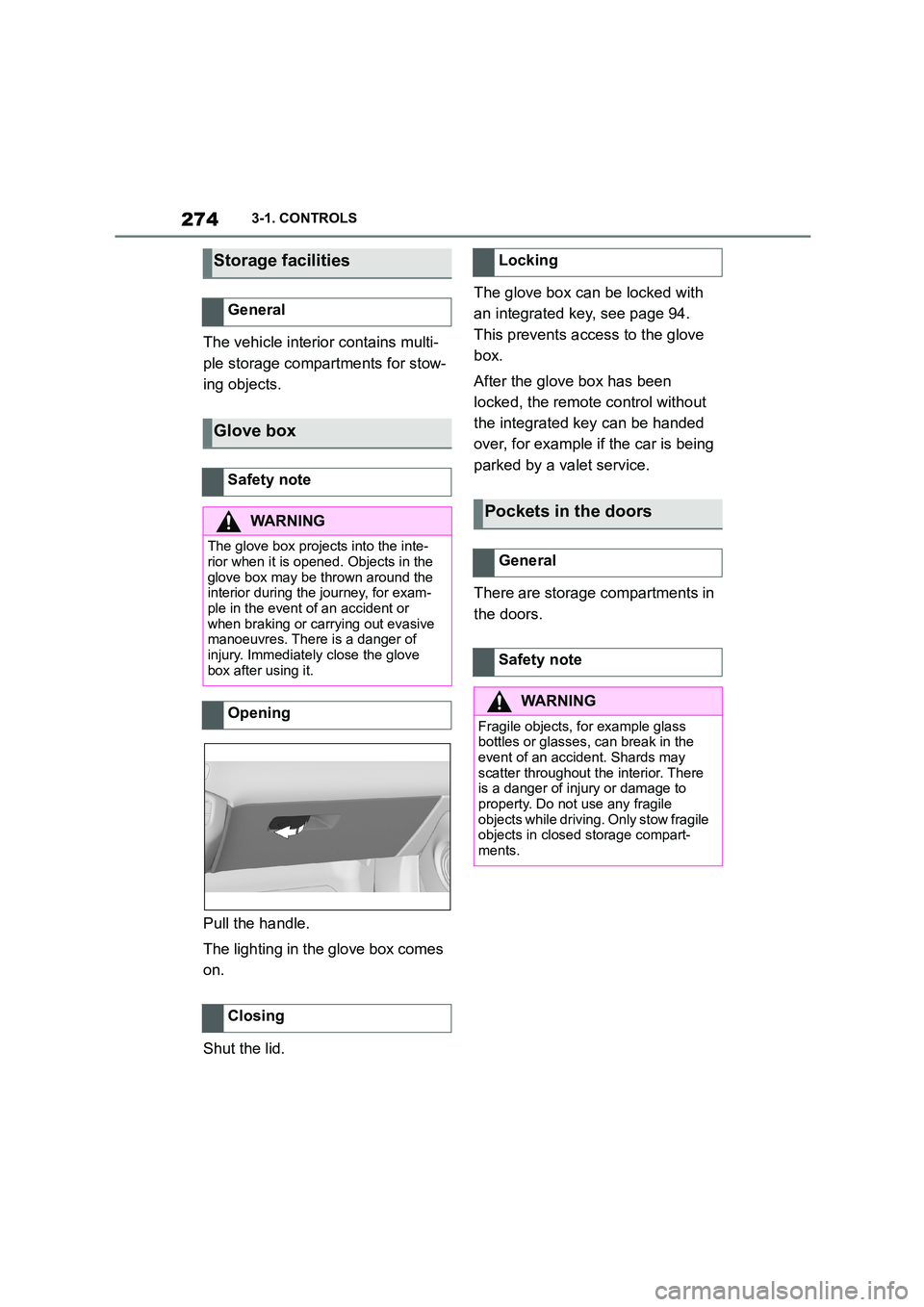
Pull the handle.
The lighting in the glove box comes
on.
Shut the lid.
The glove box can be locked with
an integrated key, see page 94.
This prevents access to the glove
box.
After the glove box has been
locked, the remote control without
the integrated key can be handed
over, for example if the car is being
parked by a valet service.
There are storage compartments in
the doors.
Storage facilities
General
Glove box
Safety note
WA R N I N G
The glove box projects into the inte- rior when it is opened. Objects in the
glove box may be thrown around the
interior during the journey, for exam- ple in the event of an accident or
when braking or carrying out evasive
manoeuvres. There is a danger of injury. Immediately close the glove
box after using it.
Opening
Closing
Locking
Pockets in the doors
General
Safety note
WA R N I N G
Fragile objects, for example glass
bottles or glasses, can break in the event of an accident. Shards may
scatter throughout the interior. There
is a danger of injury or damage to property. Do not use any fragile
objects while driving. Only stow fragile
objects in closed storage compart- ments.
Page 279 of 498
277
3
3-1. CONTROLS
CONTROLS
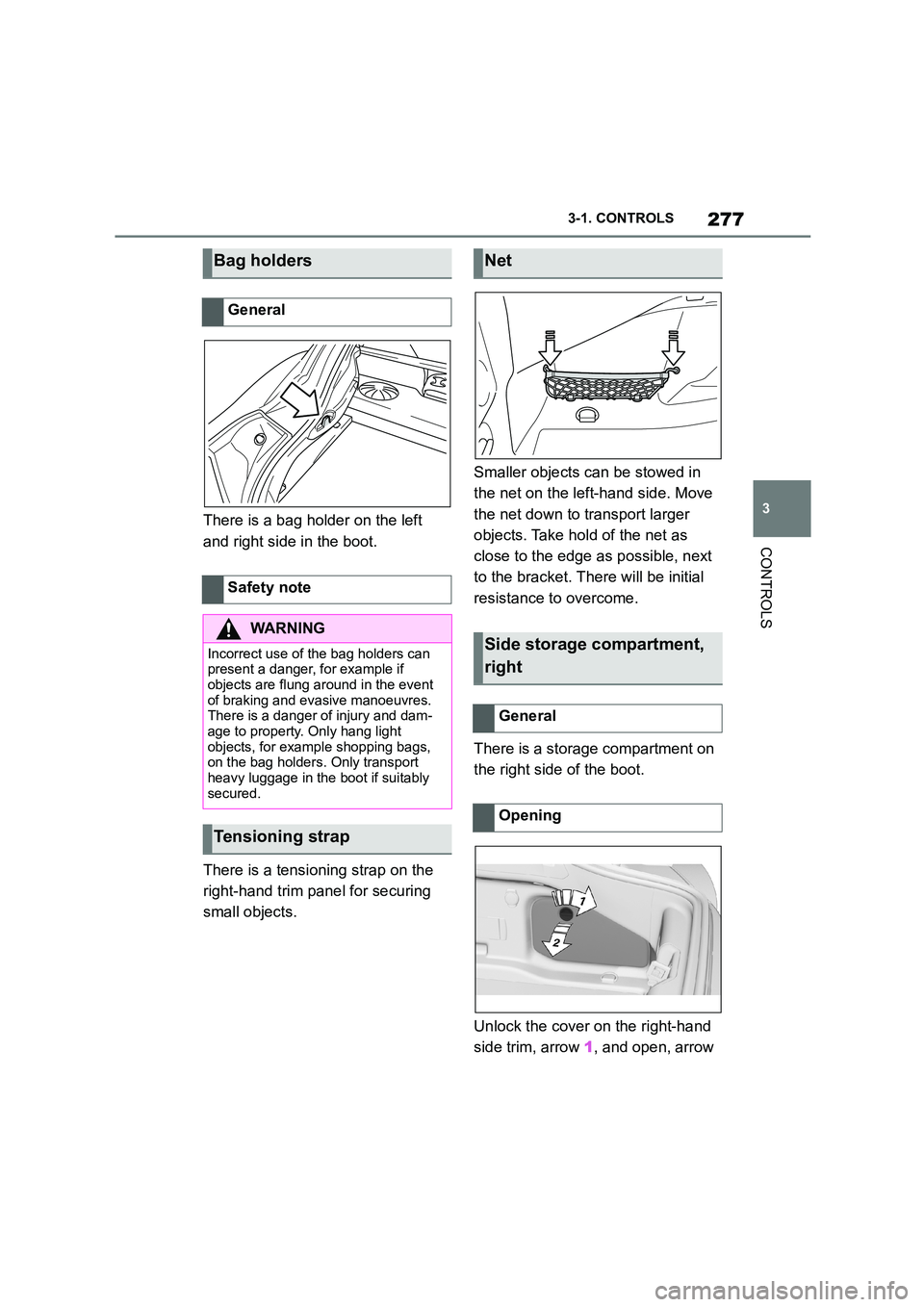
There is a bag holder on the left
and right side in the boot.
There is a tensioning strap on the
right-hand trim panel for securing
small objects.
Smaller objects can be stowed in
the net on the left-hand side. Move
the net down to transport larger
objects. Take hold of the net as
close to the edge as possible, next
to the bracket. Th ere will be initial
resistance to overcome.
There is a storage compartment on
the right side of the boot.
Unlock the cover on the right-hand
side trim, arrow 1, and open, arrow
Bag holders
General
Safety note
WA R N I N G
Incorrect use of the bag holders can
present a danger, for example if
objects are flung around in the event of braking and evasive manoeuvres.
There is a danger of injury and dam-
age to property. Only hang light objects, for example shopping bags,
on the bag holders. Only transport
heavy luggage in the boot if suitably secured.
Tensioning strap
Net
Side storage compartment,
right
General
Opening
Page 286 of 498
2844-1. DRIVING HINTS
This situation, known as aquaplan-
ing, means that the tyre can actu-
ally lose contact completely with
the road surface and the vehicle
can neither be steered, nor the
brakes properly applied.
Please comply with the following
when driving through water:
Deactivate the Automatic
Start/Stop function.
Only drive through still water.
Only drive through water up to a
max. depth of 25 cm, 9.8 in.
Drive through water at a walking
speed of no more than 5 km/h, 3
mph.
The vehicle is equipped with the
Anti-lock Brake System ABS as
standard.
Perform full brakin g in situations
that require it.
The vehicle remains steerable. Any
obstacles can be avoided by steer-
ing as smoothly as possible.
A pulsing of the brake pedal and
hydraulic regulating sounds indi-
cate that the anti-lock brake system
ABS is functioning.
In certain braking situations, the
perforated brake discs can cause
functional noise. However, func-
tional noises have no effect on the
efficiency and operational safety of
the brakes.
In wet weather, on gritted roads and
in heavy rain, apply the brakes
lightly every few kilometres/miles.
Driving through water
General
Safety note
NOTICE
Driving through excessively deep water too fast can result in water
entering the engine compartment,
electrical system or transmission. There is a danger of damage to prop-
erty. When driving through water, do
not exceed the maximum water depth and speed specified above.
Safe braking
General
Objects in the range of movement
of the pedals
WA R N I N G
Objects in the driver's footwell can
restrict the pedal travel or block a
pedal that has been pressed. There is a risk of accident. Ensure that items in
the vehicle are stowed securely and
cannot get into the driver's footwell. Only use floor mats that are suitable
for the vehicle and can be securely
fastened to the floor. Do not use loose floor mats, and do not place several
floor mats on top of one another.
Make sure that there is sufficient space for the pedals. Ensure that floor
mats are securely reattached after
removal, for example for cleaning.
Wet roads
Page 293 of 498
291
5
5-1. MOBILITY
MOBILITY
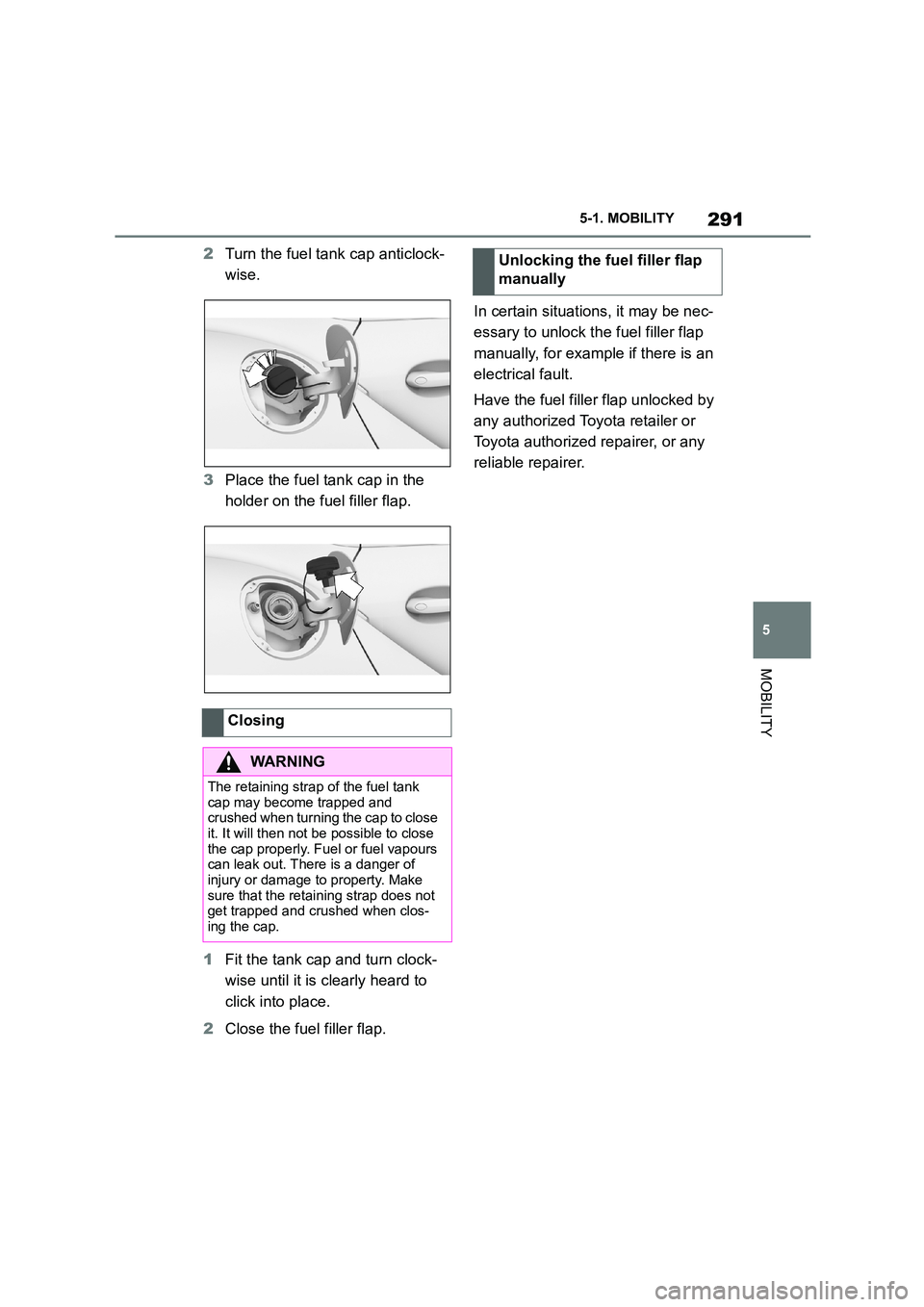
2 Turn the fuel tank cap anticlock-
wise.
3 Place the fuel tank cap in the
holder on the fuel filler flap.
1 Fit the tank cap and turn clock-
wise until it is clearly heard to
click into place.
2 Close the fuel filler flap.
In certain situations, it may be nec-
essary to unlock th e fuel filler flap
manually, for example if there is an
electrical fault.
Have the fuel filler flap unlocked by
any authorized Toyota retailer or
Toyota authorized repairer, or any
reliable repairer.
Closing
WA R N I N G
The retaining strap of the fuel tank
cap may become trapped and crushed when turning the cap to close
it. It will then not be possible to close
the cap properly. Fuel or fuel vapours can leak out. There is a danger of
injury or damage to property. Make
sure that the retaining strap does not get trapped and crushed when clos-
ing the cap.
Unlocking the fuel filler flap
manually
Page 298 of 498
2965-1. MOBILITY
The date of manufacture of the tyre
is indicated on the tyre sidewall.
Have the wheel fitted and balanced
by any authorized Toyota retailer or
Toyota authorized repairer, or any
reliable repairer.
The following properties are recom-
mended and approved by the man-
ufacturer of the vehicle for the
approved wheels and tyres per
vehicle type and special equipment:
• Wheel and tyre combinations.
•Rim designs.
• Tyre sizes.
• Tyre makes.
You can ask any authorized Toyota
retailer or Toyota authorized
repairer, or any reliable repairer
about the approved wheels and
tyres for the vehicle and the special
equipment.
Date of manufacture
DesignationDate of manufac-
ture
DOT … 382038th week of 2020
Replacement of wheels and
tyres
Fitting and balancing
Permissible wheels and tyres
General
Safety notes
WA R N I N G
Wheels and tyres that are not suitable
for your vehicle can damage parts of the vehicle. For example they could
come into contact with the bodywork
on account of their dimensional toler- ances, despite having the same nomi-
nal size. There is a danger of
accidents. The manufacturer of the
vehicle recommends using wheels and tyres that have been categorised
as suitable for the respective vehicle
type.
WA R N I N G
Mounted steel wheels can lead to
technical problems, for example wheel studs may work loose and
brake discs may be damaged. There
is a risk of accident. Do not install steel wheels.
WA R N I N G
Incorrect wheel/tyre combinations
impair the vehicle's handling charac- teristics and interfere with the proper
functioning of various systems, such
as the Anti-lock Brake System or Vehicle Stability Control. There is a
danger of accidents. To maintain good
vehicle handling, always fit tyres of the same make and tread pattern to
all wheels. The manufacturer of the
vehicle recommends using wheels and tyres that have been categorised
as suitable for the respective vehicle
type. After a tyre has been damaged, refit the same wheel/tyre combination
as the original.
Page 301 of 498
299
5
5-1. MOBILITY
MOBILITY
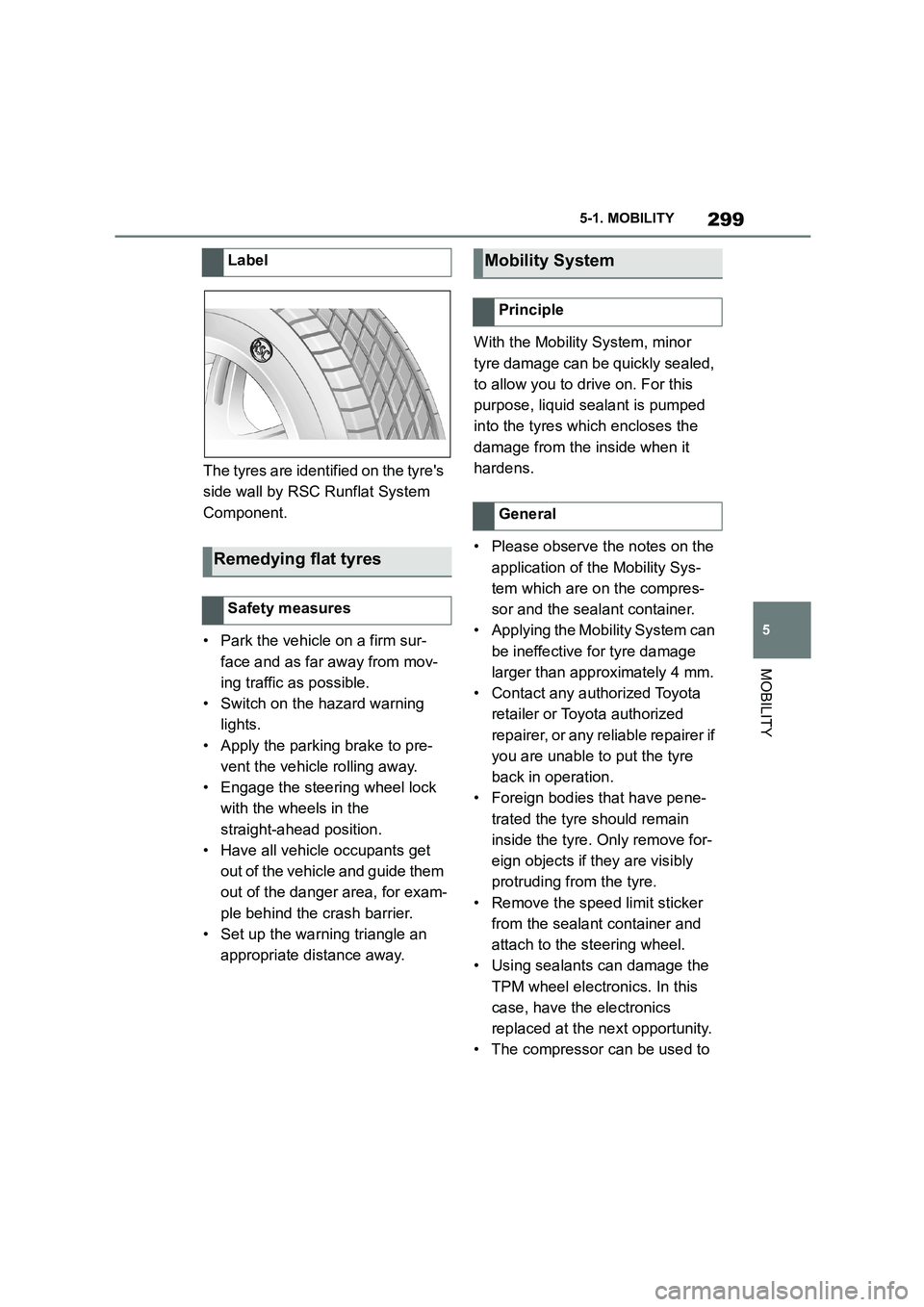
The tyres are identified on the tyre's
side wall by RSC Runflat System
Component.
• Park the vehicle on a firm sur-
face and as far away from mov-
ing traffic as possible.
• Switch on the hazard warning
lights.
• Apply the parking brake to pre-
vent the vehicle rolling away.
• Engage the steering wheel lock
with the wheels in the
straight-ahead position.
• Have all vehicle occupants get
out of the vehicle and guide them
out of the danger area, for exam-
ple behind the crash barrier.
• Set up the warning triangle an
appropriate distance away.
With the Mobility System, minor
tyre damage can be quickly sealed,
to allow you to drive on. For this
purpose, liquid sealant is pumped
into the tyres which encloses the
damage from the inside when it
hardens.
• Please observe the notes on the
application of the Mobility Sys-
tem which are on the compres-
sor and the sealant container.
• Applying the Mobility System can
be ineffective for tyre damage
larger than approximately 4 mm.
• Contact any authorized Toyota
retailer or Toyota authorized
repairer, or any reliable repairer if
you are unable to put the tyre
back in operation.
• Foreign bodies that have pene-
trated the tyre should remain
inside the tyre. Only remove for-
eign objects if they are visibly
protruding from the tyre.
• Remove the speed limit sticker
from the sealant container and
attach to the steering wheel.
• Using sealants can damage the
TPM wheel electronics. In this
case, have the electronics
replaced at the next opportunity.
• The compressor can be used to
Label
Remedying flat tyres
Safety measures
Mobility System
Principle
General
Page 302 of 498
3005-1. MOBILITY
check the tyre inflation pressure.
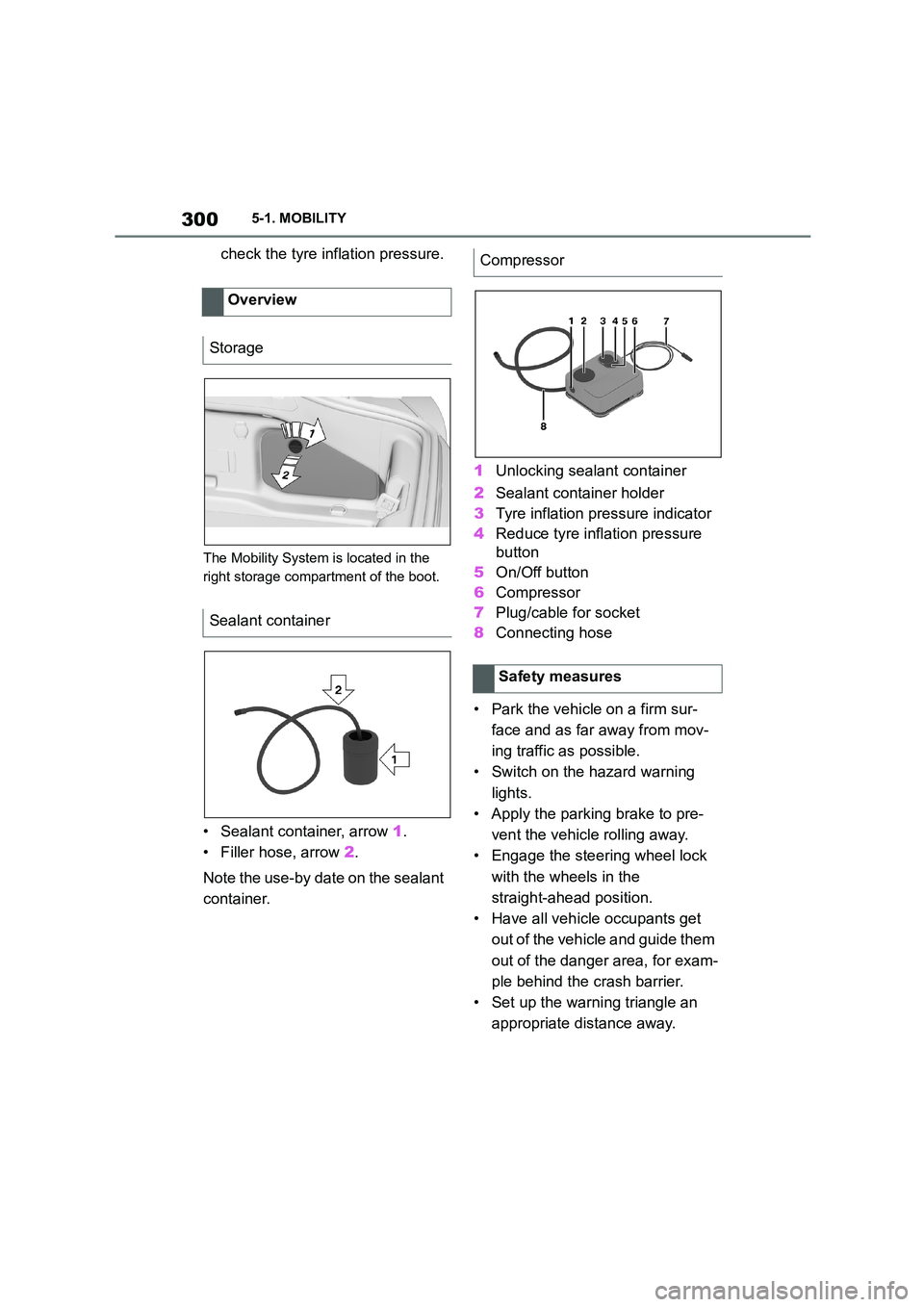
The Mobility System is located in the
right storage compartment of the boot.
• Sealant container, arrow 1.
• Filler hose, arrow 2.
Note the use-by date on the sealant
container.
1 Unlocking sealant container
2 Sealant container holder
3 Tyre inflation pressure indicator
4 Reduce tyre inflation pressure
button
5 On/Off button
6 Compressor
7 Plug/cable for socket
8 Connecting hose
• Park the vehicle on a firm sur-
face and as far away from mov-
ing traffic as possible.
• Switch on the hazard warning
lights.
• Apply the parking brake to pre-
vent the vehicle rolling away.
• Engage the steering wheel lock
with the wheels in the
straight-ahead position.
• Have all vehicle occupants get
out of the vehicle and guide them
out of the danger area, for exam-
ple behind the crash barrier.
• Set up the warning triangle an
appropriate distance away.
Overview
Storage
Sealant container
Compressor
Safety measures