351
5
5-1. MOBILITY
MOBILITY
WA R N I N G
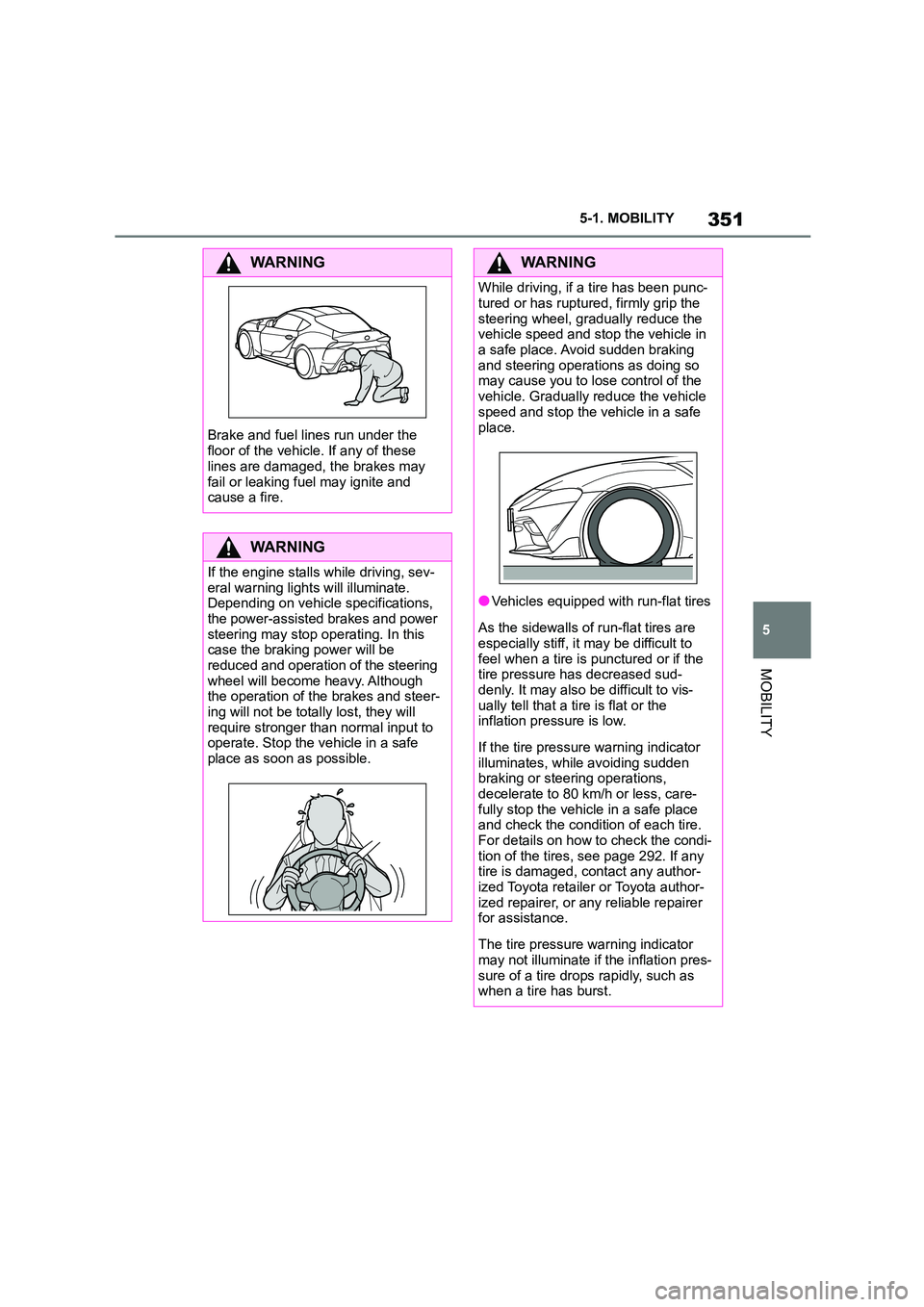
Brake and fuel lines run under the
floor of the vehicle. If any of these
lines are damaged, the brakes may
fail or leaking fuel may ignite and cause a fire.
WA R N I N G
If the engine stalls while driving, sev-
eral warning lights will illuminate. Depending on vehicle specifications,
the power-assisted brakes and power
steering may stop operating. In this case the braking power will be
reduced and operation of the steering
wheel will become heavy. Although the operation of the brakes and steer-
ing will not be totally lost, they will
require stronger than normal input to
operate. Stop the vehicle in a safe place as soon as possible.
WA R N I N G
While driving, if a tire has been punc-
tured or has ruptured, firmly grip the
steering wheel, gradually reduce the vehicle speed and stop the vehicle in
a safe place. Avoid sudden braking
and steering operations as doing so may cause you to lo se control of the
vehicle. Gradually reduce the vehicle
speed and stop the vehicle in a safe
place.
●Vehicles equipped with run-flat tires
As the sidewalls of run-flat tires are
especially stiff, it may be difficult to
feel when a tire is punctured or if the tire pressure has decreased sud-
denly. It may also be difficult to vis-
ually tell that a tire is flat or the inflation pressure is low.
If the tire pressure warning indicator illuminates, while avoiding sudden
braking or steering operations,
decelerate to 80 km /h or less, care- fully stop the vehicle in a safe place
and check the condition of each tire.
For details on how to check the condi- tion of the tires, see page 292. If any
tire is damaged, contact any author-
ized Toyota retailer or Toyota author- ized repairer, or any reliable repairer
for assistance.
The tire pressure warning indicator
may not illuminate if the inflation pres-
sure of a tire drops rapidly, such as when a tire has burst.
3585-1. MOBILITY
3Switch off any power consumers
in both vehicles.
The jump-starting connection in the
engine compartment serves as the
battery positive terminal.
A special connection on the body
serves as the negative battery ter-
minal in the engine compartment.
For further information:
Overview of the engine compart-
ment, see page 320.
Open the lid of the positive battery
terminal.
Before starting, switch off all unnec-
essary power consumers, for
example the radio, on both vehi-
cles.
1 Open the cover of the
jump-starting connection.
2 Connect a terminal clamp on the
positive/+ jump lead to the posi-
tive terminal of the battery or the
corresponding jump-starting
connection on the donor vehicle.
3 Connect the second terminal
clamp to the battery's positive
terminal or to the corresponding
jump-starting connection on the
vehicle to be started.
4 Connect a terminal clamp on the
negative/– jump lead to the neg-
ative terminal of the battery or
the corresponding engine or
body earth connection on the
donor vehicle.
5 Connect the second terminal
clamp to the negative terminal of
the battery or to a corresponding
engine or body earth connection
on the vehicle to be started.
Do not use spray products sold as
starting aids.
1 Start the engine of the donor
vehicle and allow it to run for a
few minutes at a slightly
increased idle speed.
2 Start the engine of the vehicle to
be started as normal.
If an initial attempt to start the engine
fails, wait several minutes until the dis-
charged battery has been recharged somewhat.
3 Allow both engines to run for a
few minutes.
4 Disconnect the jump leads in
reverse order to connection.
Check the battery and have it
recharged if necessary.
Jump-starting connections
Connecting the cables
Starting the engine
487Alphabetical Index
Driving Assistant, see Toyota Supra
Safety .......................................... 205
Driving hints ................................. 281
Driving information, general........ 281
Driving information, running in ... 280
Driving lights control, automatic 185
Driving on racing tracks .............. 285
Driving path lines, rear-view camera
..................................................... 255
Driving Stability Control Systems228
Driving through water .................. 284
Drying air, see Cooling function . 262
Dynamic radar cruise control with
full-speed range ......................... 238
E
Electrical power window switches
..................................................... 105
Electronic oil measurement......... 324
Electronic Stability Programme, ESP,
see VSC ....................................... 229
Emergency assistance, see Break-
down assistance ........................ 353
Emergency braking function when
parking, Parking Sensors with
emergency braking function ..... 251
Emergency release, fuel filler flap
..................................................... 291
Emergency running properties, tyres
..................................................... 298
Emergency services, see Breakdown
assistance ................................... 353
Emergency unlocking, transmission
lockout ........................................ 158
Emergency wheel ......................... 318
Engine ........................................... 372
Engine compartment .................... 320
Engine coolant .............................. 327
Engine coolant, Capacity............. 375
Engine oil .............................. 323, 374
Engine oil change......................... 327
Engine oil filler neck .................... 325
Engine oil grades for topping up 326
Engine oil level, checking electroni-
cally ............................................. 324
Engine oil temperature ................. 169
Engine start, starting assistance 357
Engine, automatic start-stop func-
tion ............................................... 145
Entering letters and numbers ........ 63
Entry comparison, navigation ....... 57
ESP, Electronic Stab ility Programme,
see VSC ....................................... 229
Exhaust gas particle filter ............281
Exhaust system ............................ 281
Exhaust, see Exhaust system ..... 281
Exterior lights when unlocking ..... 89
Exterior lights with the vehicle
locked ............................................ 91
Exterior mirror, automatic parking
function ....................................... 118
Exterior mirror, automatically dim-
ming ............................................. 118
Exterior mirrors............................. 117
Exterior mirrors, malfunction ...... 118
External start, see Starting assis-
tance ............................................357
Extinguisher, see Fire extinguisher
..................................................... 356
Eye for towing ............................... 360
Eyes, see Lashing eye in the boot
..................................................... 276
F
Failure notification, see Vehicle mes-
sages ...........................................163
False alarm, see Avoiding false
alarms .......................................... 104
Fan run-on, see Exhaust gas particle
filter..............................................281
Fastening seat belts, see Seat belts
..................................................... 111
Fatigue warning function .............226
Fault display, see Vehicle messages
..................................................... 163
Favourites buttons, Toyota Supra
Command ...................................... 68