2022 TOYOTA SUPRA bonnet
[x] Cancel search: bonnetPage 50 of 498

483-1. CONTROLS
13 Horn, entire area
14 To release the bonnet
P. 3 2 1
15 Unlocking the boot lid P.91
1 Control Display P.59
2 Hazard warning lights
P. 3 5 2
3 Ventilation P.266
4 Glove box P.274
5 Radio/multimedia, see Naviga-
tion system Owner's manual
6 Automatic air conditioning P.261
7 Controller with buttons P.60,
P. 6 1
8 Sport mode switch P.160
SPORT drive mode
Toyota Supra Safety P.205
Auto Start/Stop P.145
Parking Sensors P.50
Rear-view camera P.253
RCTA (Rear cross traffic alert)
function P.256
Park Assistant P.50
Vehicle Stability Control,
VSC P.229
9 Parking brake P.148
10 Automatic transmission selector
lever P.154
Around the centre console
1
4
23
5
6
7
89
10
11
Page 104 of 498
1023-1. CONTROLS
The last position setting is inde-
pendent of the positions saved via
the seat memory.
Via Toyota Supra Command:
1 "My Vehicle"
2 "Vehicle settings"
3 "Doors/Key"
4 "Flash for lock/unlock"
Unlocking is acknowledged by flashing
twice, locking by flashing once.
Via Toyota Supra Command:
1 "My Vehicle"
2 "Vehicle settings"
3 "Doors/Key"
4 "Relock automatically"
The vehicle is automatically locked
again after a short while if no door is
opened after unlocking.
Via Toyota Supra Command:
1 "My Vehicle"
2 "Vehicle settings"
3 "Doors/Key"
4 Select the desired setting:
• "Unlock doors when in Park"
• "Unlock at end of journey"
After the drive-ready state has been
switched off by pressing the start/stop
button, the locked vehicle is automati-
cally unlocked.
Via Toyota Supra Command:
1 "My Vehicle"
2 "Vehicle settings"
3 "Doors/Key"
4 "Fold mirrors in when locked"
The exterior mirrors are folded in auto-
matically when the vehicle is locked.
Via Toyota Supra Command:
1 "My Vehicle"
2 "Vehicle settings"
3 "Doors/Key"
4 "Switch off after door opening"
Idle state, see page 53, is established
when the front doors are opened.
The alarm system visually and
acoustically signals when some-
one attempts to open the locked
vehicle.
The alarm system responds to the
following changes when the vehicle
is locked:
• A door, the bonnet or the boot lid
Acknowledgement signals of
the vehicle
Automatic locking
Automatic unlocking
Folding the mirrors automati-
cally
Establishing idle state after
opening the front doors
Alarm system
Principle
General
Page 148 of 498
1463-1. CONTROLS
On steep downward gradients.
Brake not pressed strongly
enough.
High outside temperature and
operation of the automatic air
conditioning.
Interior not heated or cooled to
the desired temperature.
Where there is a risk of conden-
sation when the automatic air
conditioning is switched on.
Engine or other parts not at oper-
ating temperature.
Engine cooling is required.
Sharp steering angle or steering
operation.
Vehicle battery is heavily dis-
charged.
At high altitudes.
Bonnet is unlocked.
Park Assistant is activated.
Stop-and-go traffic.
Selector lever position in N or R.
After reversing.
Use of fuel with high ethanol
content.
For driving off, the engine automati-
cally starts under the following con-
ditions:
By releasing the brake pedal.
After starting the engine, accelerate
as normal.
After an automatic shut down, the
engine will not rest art automatically,
if one of the following conditions is
met:
Driver's seat belt unbuckled and
driver's door open.
Bonnet has been unlocked.
Several indicator lamps illuminate
for various lengths of time.
The engine can only be started
using the start/stop button.
Even if you do not want to drive off,
the engine restarts automatically in
the following situations:
Very high temperature in the
interior when the cooling function
is switched on.
Very low temperature in the inte-
rior when the heating is switched
on.
Where there is a risk of conden-
sation when the automatic air
conditioning is switched on.
When the steering wheel is
turned.
Shift from selector lever position
D to N or R.
Engine start
Operating requirements
Driving off
Safety function
System limits
Page 206 of 498

2043-1. CONTROLS
3Make sure that the key switch is
in the ON position to activate the
airbags.
The front passenger airbags are
reactivated and can deploy cor-
rectly if the need arises.
The indicator lamp for the front pas-
senger airbags in the roof lining
shows the operating status of the
front passenger airbags.
After switching on the drive-ready
state, the light illuminates briefly
and then shows whether the
airbags are activated or deacti-
vated.
*: if equipped
The active pedestrian protection
system raises the bonnet if the
vehicle's front end collides with a
pedestrian. Sensors underneath
the bumper are used for detection.
When the pedestrian protection
system is triggered, it creates
deformation space underneath the
bonnet for the subsequent head
impact.
Indicator lamp for front pas-
senger airbags
DisplayFunction
If the front passenger
airbag is activated, the
indicator lamp illuminates
for a short period and then
extinguishes.
When front passenger
airbags are deactivated,
the indicator lamp remains
illuminated.
Active pedestrian protec-
tion*
Principle
General
Safety notes
WA R N I N G
The system can trigger inadvertently if contact is made with individual com-
ponents of the hinges and bonnet
locks. There is a danger of injury or damage to property. Do not touch
individual components of the hinges
and bonnet locks.
WA R N I N G
Modifications to the pedestrian pro-
tection system can le ad to a failure, a
malfunction or accidental triggering of the pedestrian protection system.
There is a danger of injury or even
death. Do not modify the pedestrian protection system, its individual com-
ponents or its wiring. Do not disman-
tle the system.
Page 207 of 498
205
3
3-1. CONTROLS
CONTROLS
The active pedestrian protection
system is only triggered at speeds
between approximately 30 km/h, 18
mph and 55 km/h, 34 mph.
For safety reasons, the system may
also trigger in rare instances where
impact with a pedestrian cannot be
excluded beyond all doubt, for
example in the following situations:
Collision with objects such as a
skip or a boundary post.
Collision with animals.
Stone impact.
Driving into a snow drift.
Immediately drive at moderate
speed to any authorized Toyota
retailer or Toyota authorized
repairer, or any reliable repairer to
have the system checked and
repaired.
Toyota Supra Safety enables the
driver assistance systems to be
operated centrally.
Depending on the equipment,
Toyota Supra Safety consists of
one or more systems which can
help to avoid the risk of a collision.
Pre-Collision System, see page
207.
Pre-Collision System (for pedes-
WA R N I N G
Work carried out incorrectly can lead
to a failure, a malfunction or acciden-
tal triggering of the system. If there is a malfunction, the system might not
trigger as intended in an accident, in
spite of the accident being of the appropriate severity. There is a dan-
ger of injury or even death. Have the
system tested, repaired or removed
and disposed of by any authorized Toyota retailer or Toyota authorized
repairer, or any reliable repairer.
WA R N I N G
If the system has tr iggered or is dam-
aged, its functions will be restricted,
or will no longer work at all. There is a danger of injury or even death.
If the system has tr iggered or is dam-
aged, have it checked and renewed at any authorized Toyota retailer or
Toyota authorized repairer, or any reli-
able repairer.
NOTICE
Opening the bonnet when the pedes-
trian protection system has triggered
may damage the bonnet or the pedestrian protec tion system. There
is a risk of material damage. Do not
open the bonnet after the vehicle message is displayed. Have the sys-
tem checked by any authorized
Toyota retailer or Toyota authorized repairer, or any reliable repairer.
System limits
Malfunction
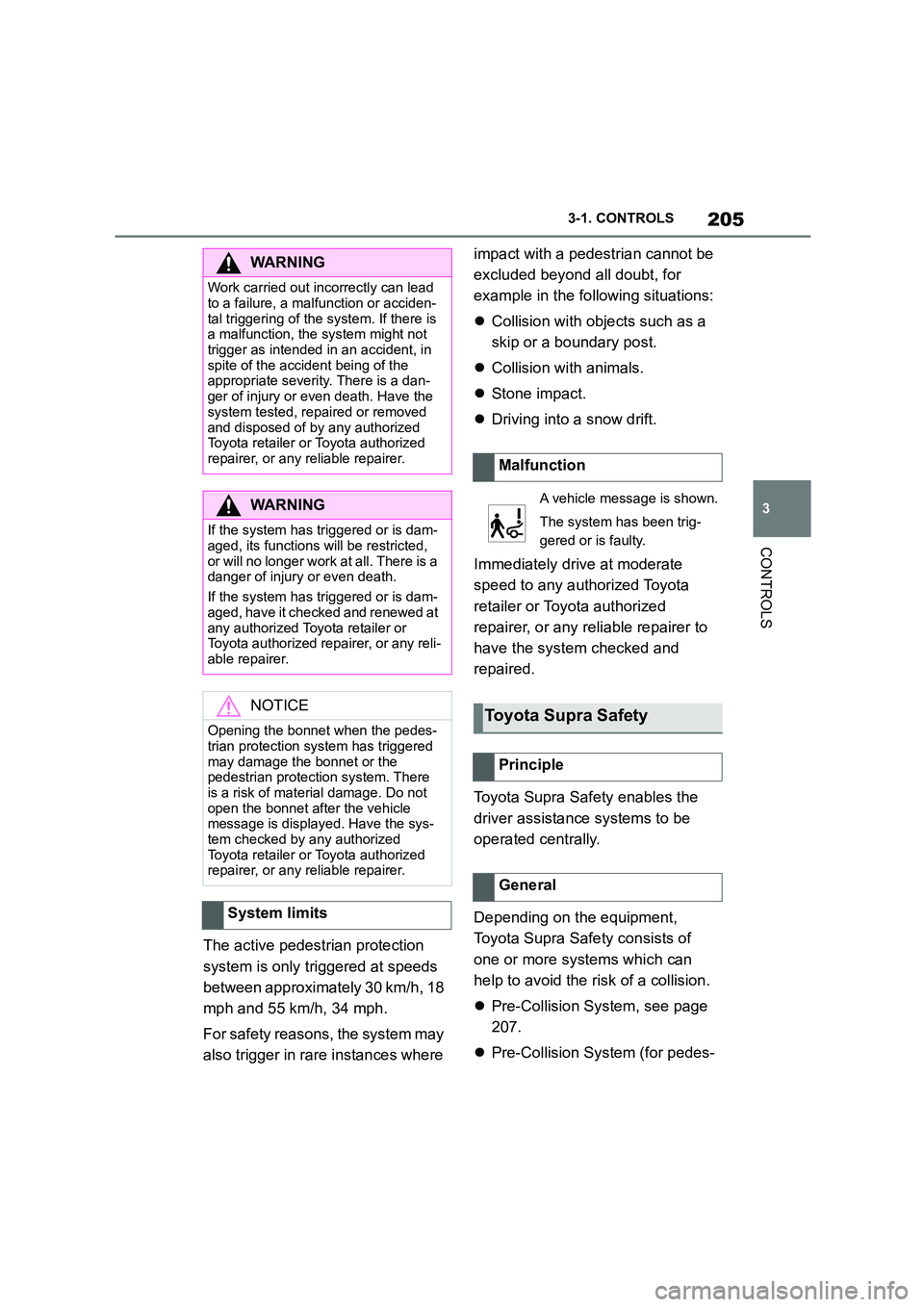
A vehicle message is shown.
The system has been trig-
gered or is faulty.
Toyota Supra Safety
Principle
General
Page 322 of 498
3205-1. MOBILITY
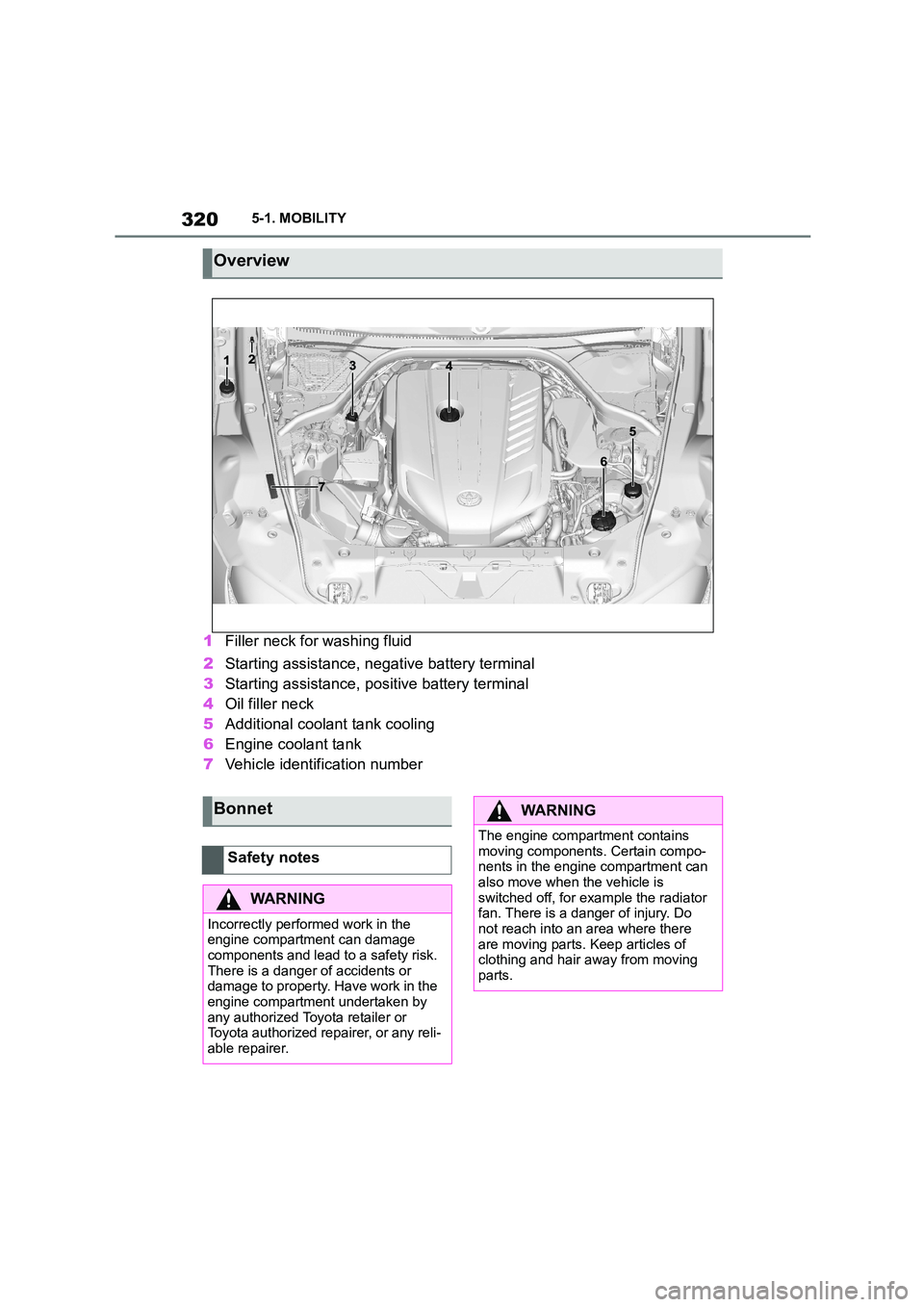
1Filler neck for washing fluid
2 Starting assistance, negative battery terminal
3 Starting assistance, positive battery terminal
4 Oil filler neck
5 Additional coolant tank cooling
6 Engine coolant tank
7 Vehicle identification number
Overview
Bonnet
Safety notes
WA R N I N G
Incorrectly performed work in the
engine compartment can damage components and lead to a safety risk.
There is a danger of accidents or
damage to property. Have work in the engine compartment undertaken by
any authorized Toyota retailer or
Toyota authorized repairer, or any reli- able repairer.
WA R N I N G
The engine compartment contains
moving components. Certain compo- nents in the engine compartment can
also move when the vehicle is
switched off, for example the radiator fan. There is a danger of injury. Do
not reach into an area where there
are moving parts. Keep articles of clothing and hair away from moving
parts.
Page 323 of 498
321
5
5-1. MOBILITY
MOBILITY
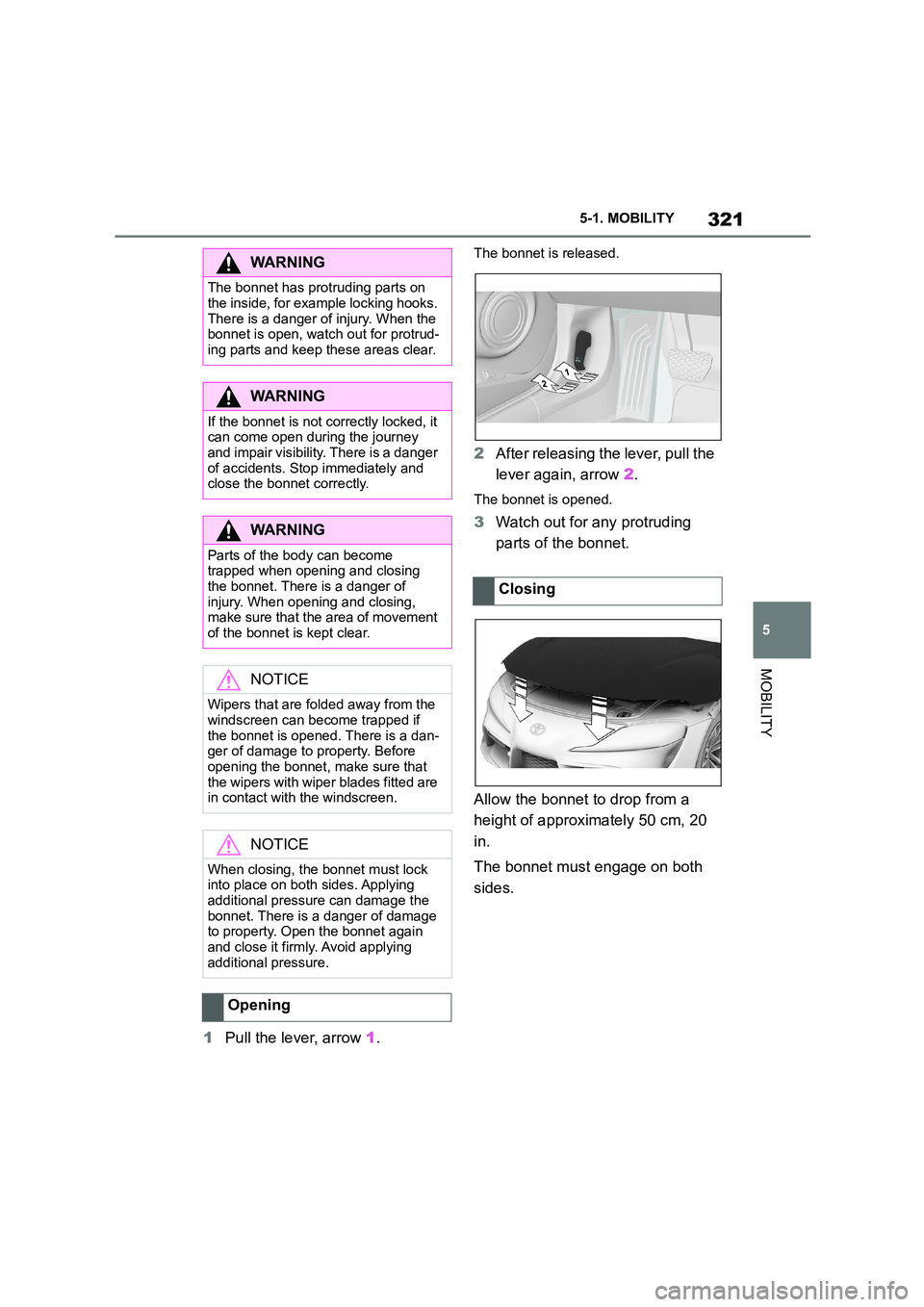
1 Pull the lever, arrow 1.
The bonnet is released.
2After releasing the lever, pull the
lever again, arrow 2.
The bonnet is opened.
3Watch out for any protruding
parts of the bonnet.
Allow the bonnet to drop from a
height of approximately 50 cm, 20
in.
The bonnet must engage on both
sides.
WA R N I N G
The bonnet has protruding parts on
the inside, for example locking hooks.
There is a danger of injury. When the bonnet is open, watch out for protrud-
ing parts and keep these areas clear.
WA R N I N G
If the bonnet is not correctly locked, it can come open during the journey
and impair visibility. There is a danger
of accidents. Stop immediately and close the bonnet correctly.
WA R N I N G
Parts of the body can become
trapped when opening and closing the bonnet. There is a danger of
injury. When opening and closing,
make sure that the area of movement of the bonnet is kept clear.
NOTICE
Wipers that are folded away from the
windscreen can become trapped if the bonnet is opened. There is a dan-
ger of damage to property. Before
opening the bonnet, make sure that the wipers with wiper blades fitted are
in contact with the windscreen.
NOTICE
When closing, the bonnet must lock into place on both sides. Applying
additional pressure can damage the
bonnet. There is a danger of damage to property. Open the bonnet again
and close it firmly. Avoid applying
additional pressure.
Opening
Closing
Page 327 of 498
325
5
5-1. MOBILITY
MOBILITY
ating temperature.
■Carrying out a detailed meas-
urement
Via Toyota Supra Command:
1 "My Vehicle"
2 "Vehicle status"
3 "Engine oil level"
4 "Engine oil level measurement"
5 "Start measurement"
The engine oil level is checked and
shown on a scale.
Do not top up engine oil unless a
message is displayed in the instru-
ment cluster. The top-up amount is
specified in the message on the
Control Display.
Only replenish with suitable types
of engine oil, see page 326.
Safely stop the vehicle and switch
off drive-ready state before topping
up with engine oil.
Do not add too much engine oil. The oil filler neck is in the engine
compartment , see page 320.
1 Open the bonnet, see page 321.
Adding engine oil
General
Safety notes
WA R N I N G
Service products, for example oils,
greases, coolants and fuels, can con- tain substances that are harmful to
health. There is a danger of injury or
even death. Please comply with the instructions on the containers. Do not
allow service products to come into
contact with clothing, skin or eyes. Do
not pour service products into other bottles. Keep service products out of
the reach of children.
NOTICE
Too little engine oil causes engine
damage. There is a danger of dam-
age to property. Top up with engine oil immediately.
NOTICE
Too much engine oil can damage the
engine or the catalytic converter. There is a danger of damage to prop-
erty. Do not add too much engine oil.
If there is too much engine oil, have the engine oil level corrected by any
authorized Toyota retailer or Toyota
authorized repairer, or any reliable repairer.
Overview
Adding engine oil