After changing a wheel
First read and observe the introductoryinformation and safety warnings⇒
Introduction
•Clean the tools as necessary and place them back in the foam rubber holder in the luggage
compartment ⇒ Vehicle toolkit.
•Stow the spare wheel, temporary spare wheel or the removed wheel safely in the luggage
compartment.
•The tightening torque of the wheel bolts should be checked immediately with a torque wrench
⇒ Tightening torque for the wheel bolts.
•The damaged wheel should be replaced as soon as possible.
Breakdown set
Introduction
This chapter contains information on the followingsubjects:
⇒ Contents of the breakdown set
⇒ Preparation
⇒ Sealing and inflating tyres
⇒ Test after driving for 10 minutes
You can use the breakdown set (tyre mobility set) to safely seal any tyre damage caused by foreign
bodies or punctures (up to 4 mm in diameter). Do not remove foreign objects (e.g. screws or
nails) from the tyre!
Once the sealant has been added to the tyre, the tyre pressure must be checked again after
approximately 10 minutes of driving.
Seek expert assistance if more than one vehicle tyre is damaged. The breakdown set is only
designed for filling one tyre.
Only use the breakdown set if the car is parked in a safe place, you are familiar with the required
actions and safety procedures, and you have access to the correct breakdown set. Seek expert
assistance if this is not the case.
The tyre sealant must not be used:
•If the rim is damaged.
•If the outside temperature is below -20°C (-4°F).
•If there are cuts or punctures in the tyre that are larger than 4 mm.
•If the tyre pressure is very low or the tyres are flat.
•If the use-by date on the tyre filler bottle has expired.
•If a foreign object has been removed from the tyre.
Additional information and warnings:
•Vehicle key set ⇒ Vehicle key set
•Braking, stopping and parking ⇒ Braking, stopping and parking
•Wheels and tyres ⇒ Wheels and tyres
•In an emergency ⇒ In an emergency
•Hubcaps ⇒ Hubcaps
Incorrect torque or incorrect use of wheel bolts can lead to a loss of control of the vehicle,
cause accidents and serious injuries.
•Always keep all wheel bolts and threads in the wheel hubs clean and free from oil and
grease. The wheel bolts must be easy to turn and be tightened to the specified torque.
•The hexagonal socket in the screwdriver handle should only be used for turning wheel
bolts, not use for loosening or tightening them.
WARNING
•You will need to depress the brake pedal more vigorously than normal as the brake servo is not
working. Do not drive too close to the towing vehicle.
•Read and comply with the information and notes in the owner's manual of the towing vehicle.
Notes for the driver of the towing vehicle
•Accelerate carefully and gently. Avoid any sudden driving manoeuvres.
•Brake earlier than normal by pressing lightly on the brake pedal.
•Read and comply with any information and notes in the owner's manual of the towed vehicle.
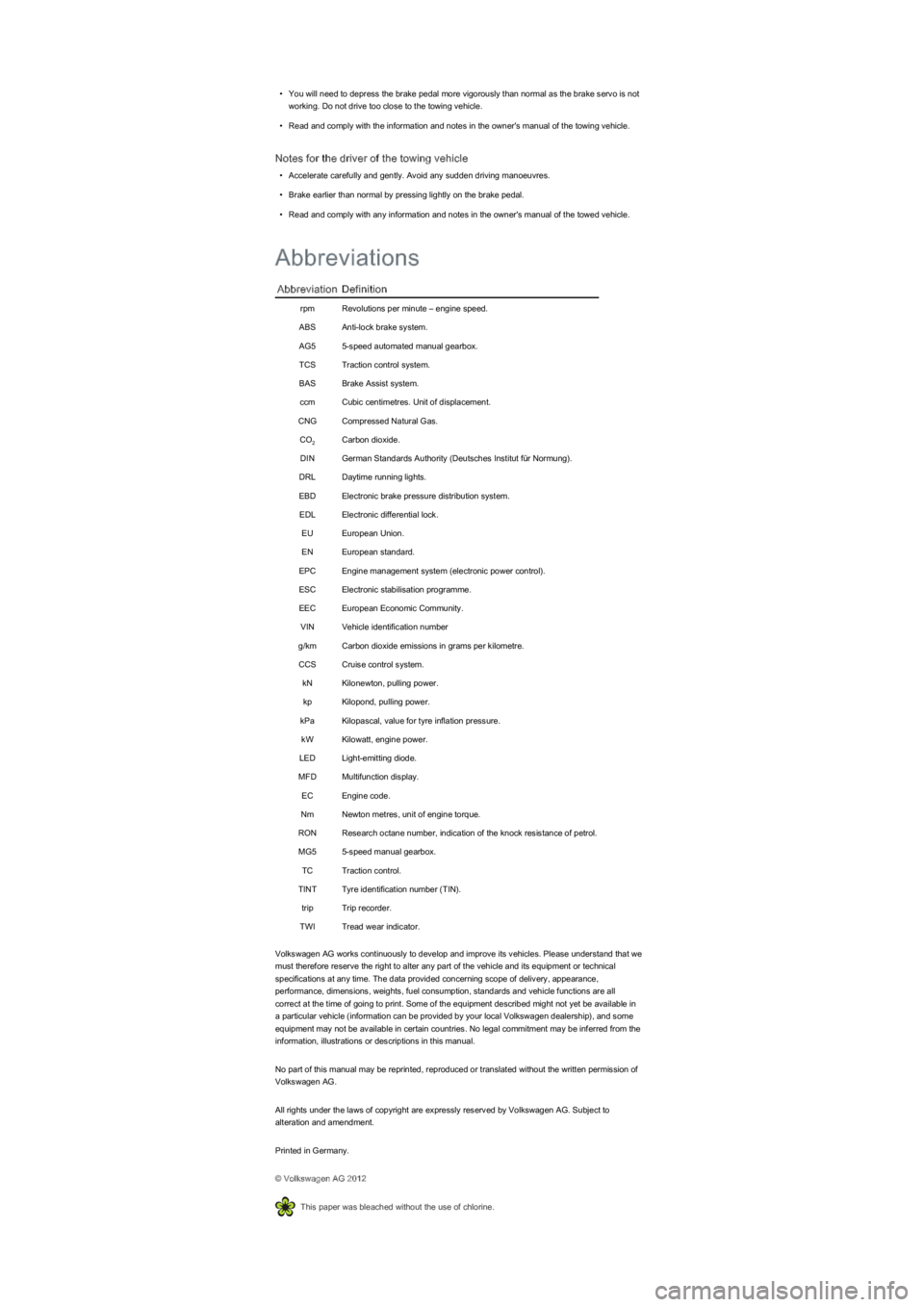
AbbreviationDefinition
rpmRevolutions per minute – engine speed.
ABSAnti-lock brake system.
AG55-speed automated manual gearbox.
TCSTraction control system.
BASBrake Assist system.
ccmCubic centimetres. Unit of displacement.
CNGCompressed Natural Gas.
COCarbon dioxide.
DINGerman Standards Authority (Deutsches Institut für Normung).
DRLDaytime running lights.
EBDElectronic brake pressure distribution system.
EDLElectronic differential lock.
EUEuropean Union.
ENEuropean standard.
EPCEngine management system (electronic power control).
ESCElectronic stabilisation programme.
EECEuropean Economic Community.
VINVehicle identification number
g/kmCarbon dioxide emissions in grams per kilometre.
CCSCruise control system.
kNKilonewton, pulling power.
kpKilopond, pulling power.
kPaKilopascal, value for tyre inflation pressure.
kWKilowatt, engine power.
LEDLight-emitting diode.
MFDMultifunction display.
ECEngine code.
NmNewton metres, unit of engine torque.
RONResearch octane number, indication of the knock resistance of petrol.
MG55-speed manual gearbox.
TCTraction control.
TINT Tyre identification number (TIN).
tripTrip recorder.
TWITread wear indicator.
Volkswagen AG works continuously to develop and improve its vehicles. Please understand that we
must therefore reserve the right to alter any part of the vehicle and its equipment or technical
specifications at any time. The data provided concerning scope of delivery, appearance,
performance, dimensions, weights, fuel consumption, standards and vehicle functions are all
correct at the time of going to print. Some of the equipment described might not yet be available in
a particular vehicle (information can be provided by your local Volkswagen dealership), and some
equipment may not be available in certain countries. No legal commitment may be inferred from the
information, illustrations or descriptions in this manual.
No part of this manual may be reprinted, reproduced or translated without the written permission of
Volkswagen AG.
All rights under the laws of copyright are expressly reserved by Volkswagen AG. Subject to
alteration and amendment.
Printed in Germany.
© Volkswagen AG 2012
This paper was bleached without the use of chlorine.
Abbreviations
2