2021 ALFA ROMEO STELVIO flat tire
[x] Cancel search: flat tirePage 244 of 280
SERVICING AND MAINTENANCE
242
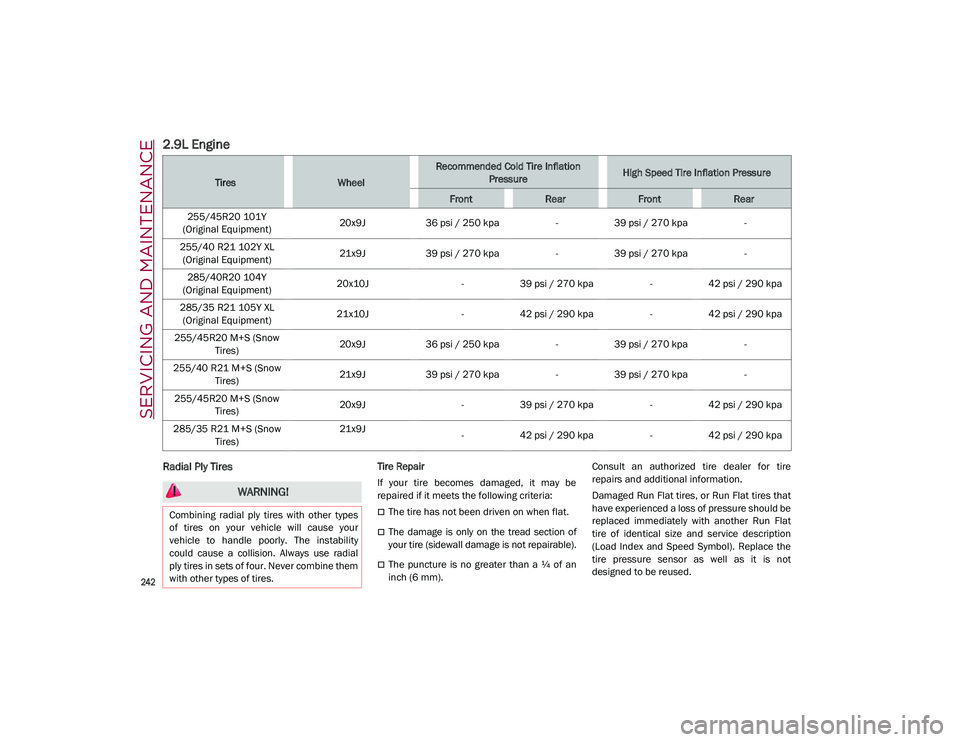
2.9L Engine
Radial Ply Tires Tire Repair
If your tire becomes damaged, it may be
repaired if it meets the following criteria:
The tire has not been driven on when flat.
The damage is only on the tread section of
your tire (sidewall damage is not repairable).
The puncture is no greater than a ¼ of an
inch (6 mm).Consult an authorized tire dealer for tire
repairs and additional information.
Damaged Run Flat tires, or Run Flat tires that
have experienced a loss of pressure should be
replaced immediately with another Run Flat
tire of identical size and service description
(Load Index and Speed Symbol). Replace the
tire pressure sensor as well as it is not
designed to be reused.
TiresWheel
Recommended Cold Tire Inflation
PressureHigh Speed Tire Inflation Pressure
FrontRearFrontRear
255/45R20 101Y
(Original Equipment) 20x9J
36 psi / 250 kpa -39 psi / 270 kpa -
255/40 R21 102Y XL (Original Equipment) 21x9J
39 psi / 270 kpa -39 psi / 270 kpa -
285/40R20 104Y
(Original Equipment) 20x10J
-39 psi / 270 kpa -42 psi / 290 kpa
285/35 R21 105Y XL (Original Equipment) 21x10J
-42 psi / 290 kpa -42 psi / 290 kpa
255/45R20 M+S (Snow Tires) 20x9J
36 psi / 250 kpa -39 psi / 270 kpa -
255/40 R21 M+S (Snow Tires) 21x9J
39 psi / 270 kpa -39 psi / 270 kpa -
255/45R20 M+S (Snow Tires) 20x9J
-39 psi / 270 kpa -42 psi / 290 kpa
285/35 R21 M+S (Snow Tires) 21x9J
-42 psi / 290 kpa -42 psi / 290 kpa
WARNING!
Combining radial ply tires with other types
of tires on your vehicle will cause your
vehicle to handle poorly. The instability
could cause a collision. Always use radial
ply tires in sets of four. Never combine them
with other types of tires.
21_GU_OM_EN_USC_t.book Page 242
Page 245 of 280
243
Run Flat Tires — If Equipped
Run Flat tires allow you the capability to drive
50 miles (80 km) at 50 mph (80 km/h) after a
rapid loss of inflation pressure. This rapid loss
of inflation is referred to as the Run Flat mode.
A Run Flat mode occurs when the tire inflation
pressure is of/or below 14 psi (96 kPa). Once
a Run Flat tire reaches the run flat mode it has
limited driving capabilities and needs to be
replaced immediately. A Run Flat tire is not
repairable. When a run flat tire is changed
after driving with underinflated tire condition,
please replace the TPM sensor as it is not
designed to be reused when driven under run
flat mode 14 psi (96 kPa) condition.
NOTE:
TPM Sensor must be replaced after driving the
vehicle on a flat tire condition.
It is not recommended driving a vehicle loaded
at full capacity or to tow a trailer while a tire is
in the run flat mode.
For more information
Ú
page 161.
Tire Spinning
When stuck in mud, sand, snow, or ice condi -
tions, do not spin your vehicle's wheels above
30 mph (48 km/h) or for longer than 30 seconds
continuously without stopping.
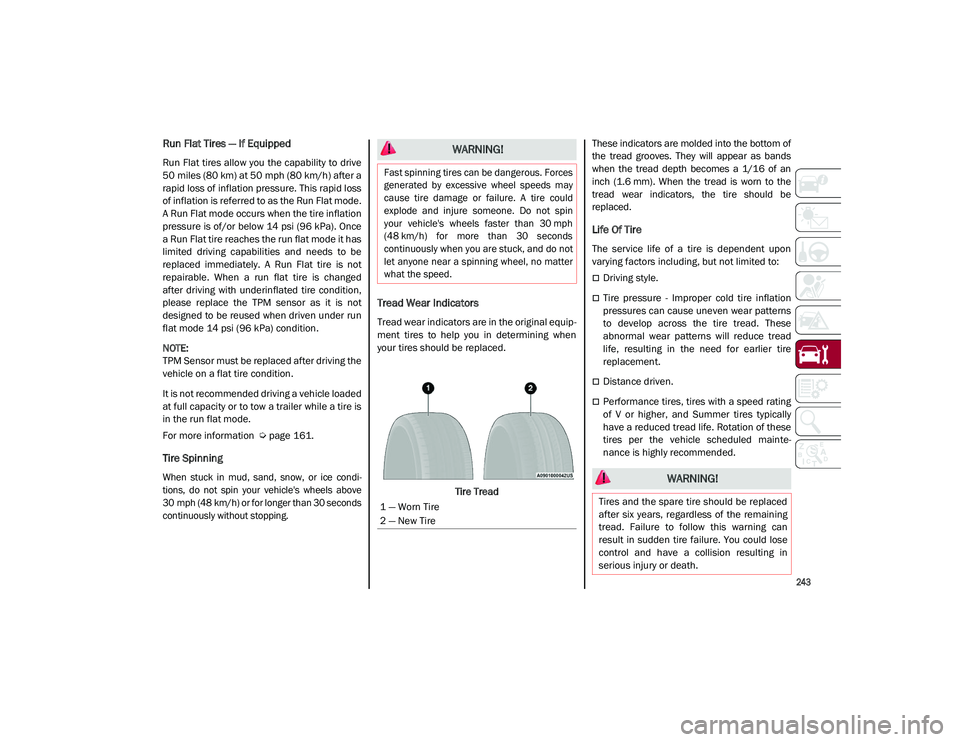
Tread Wear Indicators
Tread wear indicators are in the original equip -
ment tires to help you in determining when
your tires should be replaced.
Tire Tread These indicators are molded into the bottom of
the tread grooves. They will appear as bands
when the tread depth becomes a 1/16 of an
inch (1.6 mm). When the tread is worn to the
tread wear indicators, the tire should be
replaced.
Life Of Tire
The service life of a tire is dependent upon
varying factors including, but not limited to:
Driving style.
Tire pressure - Improper cold tire inflation
pressures can cause uneven wear patterns
to develop across the tire tread. These
abnormal wear patterns will reduce tread
life, resulting in the need for earlier tire
replacement.
Distance driven.
Performance tires, tires with a speed rating
of V or higher, and Summer tires typically
have a reduced tread life. Rotation of these
tires per the vehicle scheduled mainte
-
nance is highly recommended.
WARNING!
Fast spinning tires can be dangerous. Forces
generated by excessive wheel speeds may
cause tire damage or failure. A tire could
explode and injure someone. Do not spin
your vehicle's wheels faster than 30 mph
(48 km/h) for more than 30 seconds
continuously when you are stuck, and do not
let anyone near a spinning wheel, no matter
what the speed.
1 — Worn Tire
2 — New Tire
WARNING!
Tires and the spare tire should be replaced
after six years, regardless of the remaining
tread. Failure to follow this warning can
result in sudden tire failure. You could lose
control and have a collision resulting in
serious injury or death.
21_GU_OM_EN_USC_t.book Page 243
Page 246 of 280

SERVICING AND MAINTENANCE
244
NOTE:
Wheel valve stem must be replaced as well
when installing new tires due to wear and tear
in existing tires.
Keep dismounted tires in a cool, dry place with
as little exposure to light as possible. Protect
tires from contact with oil, grease, and gaso-
line.
Replacement Tires
The tires on your new vehicle provide a
balance of many characteristics. They should
be inspected regularly for wear and correct
cold tire inflation pressures. The manufacturer
strongly recommends that you use tires equiv -
alent to the originals in size, quality and perfor -
mance when replacement is needed
Ú
page 243. Refer to the Tire and Loading
Information placard or the Vehicle Certifica -
tion Label for the size designation of your tire.
The Load Index and Speed Symbol for your tire
will be found on the original equipment tire
sidewall.
See the Tire Sizing Chart example for more
information relating to the Load Index and
Speed Symbol of a tire
Ú
page 233.
It is recommended to replace the two front
tires or two rear tires as a pair. Replacing just
one tire can seriously affect your vehicle’s
handling. If you ever replace a wheel, make
sure that the wheel’s specifications match
those of the original wheels. It is recommended you contact an authorized
tire dealer or original equipment dealer with
any questions you may have on tire specifica
-
tions or capability. Failure to use equivalent
replacement tires may adversely affect the
safety, handling, and ride of your vehicle.
Spare Tires — If Equipped
NOTE:
For vehicles equipped with Tire Service Kit
instead of a spare tire
Ú
page 198.
Spare Tire Matching Original Equipped Tire
And Wheel — If Equipped
Your vehicle may be equipped with a spare tire
and wheel equivalent in look and function to
the original equipment tire and wheel found on
the front or rear axle of your vehicle. This spare
tire may be used in the tire rotation for your
vehicle. If your vehicle has this option, refer to
an authorized tire dealer for the recom -
mended tire rotation pattern.
WARNING!
Do not use a tire, wheel size, load rating,
or speed rating other than that specified
for your vehicle. Some combinations of
unapproved tires and wheels may change
suspension dimensions and performance
characteristics, resulting in changes to
steering, handling, and braking of your
vehicle. This can cause unpredictable
handling and stress to steering and
suspension components. You could lose
control and have a collision resulting in
serious injury or death. Use only the tire
and wheel sizes with load ratings
approved for your vehicle.
Never use a tire with a smaller load index
or capacity, other than what was originally
equipped on your vehicle. Using a tire with
a smaller load index could result in tire
overloading and failure. You could lose
control and have a collision.
Failure to equip your vehicle with tires
having adequate speed capability can
result in sudden tire failure and loss of
vehicle control.
CAUTION!
Replacing original tires with tires of a
different size may result in false
speedometer and odometer readings.
CAUTION!
Because of the reduced ground clearance,
do not take your vehicle through an
automatic car wash with a compact or
limited use temporary spare installed.
Damage to the vehicle may result.
21_GU_OM_EN_USC_t.book Page 244
Page 247 of 280
245
Compact Spare Tire — If Equipped
The compact spare is for temporary emer-
gency use only. You can identify if your vehicle
is equipped with a compact spare by looking at
the spare tire description on the Tire and
Loading Information Placard located on the
driver’s side door opening or on the sidewall of
the tire. Compact spare tire descriptions begin
with the letter “T” or “S” preceding the size
designation. Example: T145/80D18 103M.
T, S = Temporary Spare Tire
Since this tire has limited tread life, the orig -
inal equipment tire should be repaired (or
replaced) and reinstalled on your vehicle at
the first opportunity.
Do not install a wheel cover or attempt to
mount a conventional tire on the compact
spare wheel, since the wheel is designed
specifically for the compact spare tire. Do not
install more than one compact spare tire and
wheel on the vehicle at any given time.
Full Size Spare — If Equipped
The full size spare is for temporary emergency
use only. This tire may look like the originally
equipped tire on the front or rear axle of your
vehicle, but it is not. This spare tire may have
limited tread life. When the tread is worn to the
tread wear indicators, the temporary use full
size spare tire needs to be replaced. Since it is
not the same as your original equipment tire,
replace (or repair) the original equipment tire
and reinstall on the vehicle at the first oppor -
tunity.
Limited Use Spare — If Equipped
The limited use spare tire is for temporary
emergency use only. This tire is identified by a
label located on the limited use spare wheel.
This label contains the driving limitations for
this spare. This tire may look like the original
equipped tire on the front or rear axle of your
vehicle, but it is not. Installation of this limited
use spare tire affects vehicle handling. Since it
is not the same as your original equipment
tire, replace (or repair) the original equipment
tire and reinstall on the vehicle at the first
opportunity.
Wheel And Wheel Trim Care
All wheels and wheel trim, especially
aluminum and chrome plated wheels, should
be cleaned regularly using mild (neutral Ph)
soap and water to maintain their luster and to
prevent corrosion. Wash wheels with the same
soap solution recommended for the body of
the vehicle and remember to always wash
when the surfaces are not hot to the touch.
Your wheels are susceptible to deterioration
caused by salt, sodium chloride, magnesium
chloride, calcium chloride, etc., and other road
chemicals used to melt ice or control dust on
dirt roads. Use a soft cloth or sponge and mild
soap to wipe away promptly. Do not use harsh
chemicals or a stiff brush. They can damage
WARNING!
Compact and collapsible spares are for
temporary emergency use only. With these
spares, do not drive more than 50 mph
(80 km/h). Temporary use spares have
limited tread life. When the tread is worn to
the tread wear indicators, the temporary
use spare tire needs to be replaced. Be
sure to follow the warnings, which apply to
your spare. Failure to do so could result in
spare tire failure and loss of vehicle control.
WARNING!
Limited use spares are for emergency use
only. Installation of this limited use spare
tire affects vehicle handling. With this tire,
do not drive more than the speed listed on
the limited use spare wheel. Keep inflated
to the cold tire inflation pressures listed on
your Tire and Loading Information Placard
located on the driver’s side B-pillar or the
rear edge of the driver’s side door. Replace
(or repair) the original equipment tire at the
first opportunity and reinstall it on your
vehicle. Failure to do so could result in loss
of vehicle control.
21_GU_OM_EN_USC_t.book Page 245
Page 249 of 280

247
(Continued)
tires only in sets of four; failure to do so may
adversely affect the safety and handling of
your vehicle.
Snow tires generally have lower speed ratings
than what was originally equipped with your
vehicle and should not be operated at
sustained speeds over 75 mph (120 km/h).
For speeds above 75 mph (120 km/h) refer to
original equipment or an authorized tire dealer
for recommended safe operating speeds,
loading and cold tire inflation pressures.
While studded tires improve performance on
ice, skid and traction capability on wet or dry
surfaces may be poorer than that of
non-studded tires. Some states prohibit
studded tires; therefore, local laws should be
checked before using these tire types.
Tire Chains and Traction Devices
It is possible to fit 13 mm chains on all the
tires except for R20.
Use of traction devices require sufficient
tire-to-body clearance. Follow these recom-
mendations to guard against damage.
NOTE:
Traction device must be of proper size for
the tire, as recommended by the traction
device manufacturer.
Use on rear tires only.
Check the tension of the snow chains after
the first few meters have been driven.
Using snow chains with tires with non-orig -
inal dimensions may damage the vehicle.
Using different tires sizes or types (M+S,
snow, etc.) between the front and rear axles
may adversely affect vehicle driveability,
with the risk of losing control of the vehicle
and resulting accidents.
Tire Rotation Recommendations
Tires on the front and rear axles of vehicles
operate at different loads and perform
different steering, driving, and braking func -
tions. For these reasons, they wear at unequal
rates. These effects can be reduced by timely
rotation of tires. Rotation will increase tread
life, maintain traction levels and contribute to
a smooth, quiet ride.
To resolve this problem, tires should be
rotated at each service interval (approximately
every 10,000 miles [16,000 km]). More
frequent rotation is permissible if desired. The
reasons for any rapid or unusual wear should
be corrected prior to rotation being performed.
Tire Rotations Not Recommended — If
Equipped
Due to different size tires and wheels on front
and rear axles tire rotation is not possible for:
2.0T GME Engine equipped with a different
front and rear tire size.
CAUTION!
To avoid damage to your vehicle or tires,
observe the following precautions:
Because of restricted traction device
clearance between tires and other
suspension components, it is important
that only traction devices in good condi -
tion are used. Broken devices can cause
serious damage. Stop the vehicle immedi -
ately if noise occurs that could indicate
device breakage. Remove the damaged
parts of the device before further use.
Install device as tightly as possible and
then retighten after driving about ½ mile
(0.8 km).
Do not exceed 30 mph (48 km/h).
Drive cautiously and avoid severe turns
and large bumps, especially with a loaded
vehicle.
Do not drive for a prolonged period on dry
pavement.
Observe the traction device manufac -
turer’s instructions on the method of
installation, operating speed, and condi -
tions for use. Always use the suggested
operating speed of the device manufac -
turer’s if it is less than 30 mph (48 km/h).
Do not use traction devices on a compact
spare tire.
CAUTION! (Continued)
21_GU_OM_EN_USC_t.book Page 247
Page 251 of 280
249
test wheel. Sustained high temperature
can cause the material of the tire to
degenerate and reduce tire life, and
excessive temperature can lead to
sudden tire failure. The grade C corre-
sponds to a level of performance, which
all passenger vehicle tires must meet
under the Federal Motor Vehicle Safety
Standard No. 109. Grades B and A
represent higher levels of performance
on the laboratory test wheel, than the
minimum required by law.
STORING THE VEHICLE
If the vehicle is left inactive for longer than a
month, the following precautions should be
observed:
Park the vehicle in an area that is covered
and dry, and well-ventilated if possible.
Slightly open the windows.
Check that the Electric Park Brake (EPB) is
not activated.
Carry out the “Liftgate Emergency Opening”
procedure
Ú
page 62.
Disconnect the negative battery terminal
and check the battery charge. Repeat this
check once every three months during
storage.
If the battery is not disconnected from the
electrical system, check its state of charge
every 30 days.
Clean and protect the painted parts using
protective wax.
Clean and protect the shiny metal parts using
special compounds available commercially.
Sprinkle talcum powder on the windshield
wiper rubber blades, and lift them off the
glass.
Cover the vehicle with a fabric or perforated
plastic sheet, paying particular care not to
damage the painted surface by dragging
any dust that may have accumulated on it.
Do not use compact plastic sheets, as they
do not allow humidity to evaporate from the
surface of the vehicle.
Inflate tires to +7.25 psi (+0.5 bar) above
the standard prescribed pressure and
check it periodically.
Do not drain the engine cooling system.
Any time the vehicle is left inactive for two
weeks or more, operate the air conditioning
system with engine idling for at least five minutes, setting external air and with fan
set to maximum speed. This operation will
ensure appropriate lubrication for the
system, thus minimizing the possibility of
damage to the compressor when the
system is operated again.
NOTE:
After cycling the ignition to STOP and having
closed the driver side door, wait at least one
minute before disconnecting the electrical
supply from the battery. When reconnecting
the electrical supply to the battery, make sure
that the ignition is in the STOP position and the
driver’s side door is closed.
BODYWORK
Protection Against Atmospheric Agents
The vehicle is equipped with the best available
technological solutions to protect the body -
work against corrosion.
These include:
Painting products and systems which give
the vehicle resistance to corrosion and
abrasion.
Use of galvanized (or pre-treated) steel
sheets, with high resistance to corrosion.
Spraying of plastic parts, with a protective
function in the more exposed points: under
door, inner wing, edges, etc.
WARNING!
The temperature grade for this tire is
established for a tire that is properly inflated
and not overloaded. Excessive speed,
underinflation, or excessive loading, either
separately or in combination, can cause
heat buildup and possible tire failure.
21_GU_OM_EN_USC_t.book Page 249
Page 255 of 280
253
For the enthusiasts, the technician, or those
who just want to know every detail of their
vehicle, useful information on understanding
how your vehicle works is contained in this
chapter and illustrated with data, tables, and
graphics.
VEHICLE IDENTIFICATION
NUMBER (VIN)
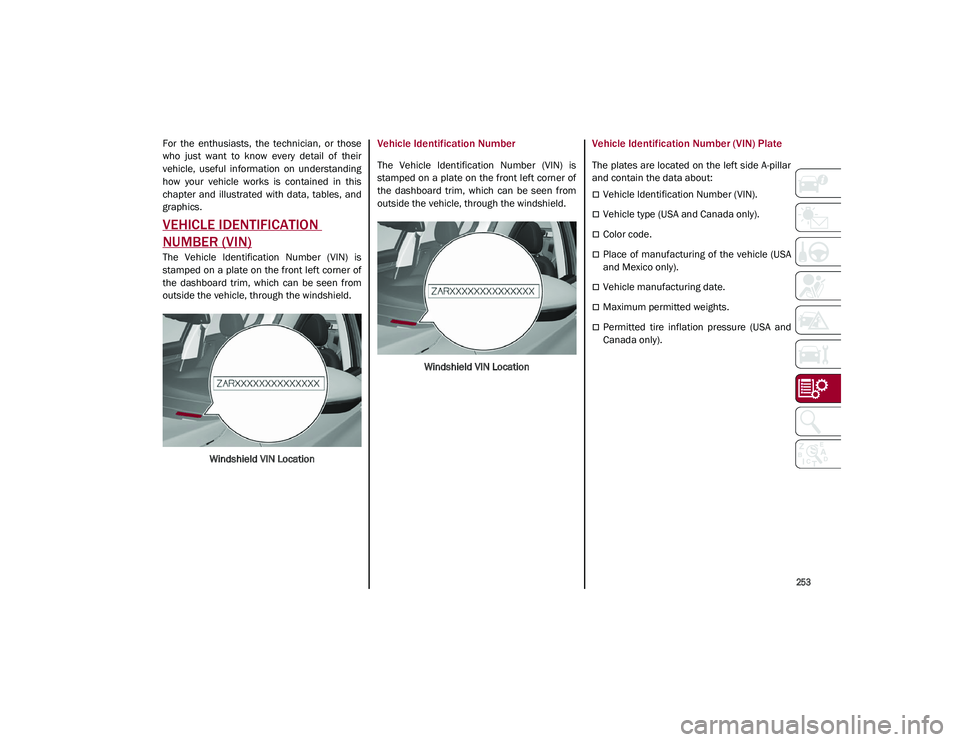
The Vehicle Identification Number (VIN) is
stamped on a plate on the front left corner of
the dashboard trim, which can be seen from
outside the vehicle, through the windshield.Windshield VIN Location
Vehicle Identification Number
The Vehicle Identification Number (VIN) is
stamped on a plate on the front left corner of
the dashboard trim, which can be seen from
outside the vehicle, through the windshield.Windshield VIN Location
Vehicle Identification Number (VIN) Plate
The plates are located on the left side A-pillar
and contain the data about:
Vehicle Identification Number (VIN).
Vehicle type (USA and Canada only).
Color code.
Place of manufacturing of the vehicle (USA
and Mexico only).
Vehicle manufacturing date.
Maximum permitted weights.
Permitted tire inflation pressure (USA and
Canada only).
21_GU_OM_EN_USC_t.book Page 253
Page 275 of 280
273
Tires .................................190, 239, 244, 248Aging (Life Of Tires) ................................ 243Air Pressure ............................................ 239
Changing.................................................198
Compact Spare ...................................... 245
General Information......................239, 244
High Speed ............................................. 240
Inflation Pressure...................................240Life Of Tires ............................................ 243
Load Capacity.........................................237
Pressure Monitoring System (TPMS) ...... 76
Quality Grading....................................... 248
Radial......................................................242
Replacement ..........................................244
Safety .............................................233, 239
Sizes .......................................................234
Snow Tires ..............................................246
Spare Tires ....................................244, 245Spinning..................................................243
Trailer Towing .........................................139
Tread Wear Indicators ...........................243
Tongue Weight/Trailer Weight .................. 138
Towing ................................................136, 138 Disabled Vehicle ....................................205
Towing Eyes ................................................206
TPMS (Tire Pressure Monitoring
System) .......................................................161 Traction Control System (TCS) .................. 149
Trailer Towing ............................................. 136
Hitches ................................................... 137
Minimum Requirements ....................... 139Tips ......................................................... 141
Trailer And Tongue Weight .................... 138
Wiring ..................................................... 140
Trailer Towing Guide .................................. 138
Trailer Weight ............................................. 138
Transmission .............................................. 255
Transporting Pets....................................... 189
Tread Wear Indicators ............................... 243
Turn Signals ...........................................44, 78
U
Uconnect Settings Customer Programmable Features ........ 25
Passive Entry Programming .................... 25
Uniform Tire Quality Grades ...................... 248
Universal Transmitter .................................. 39
Untwisting Procedure, Seat Belt ............... 166
V
Vehicle Changes/Alterations ......................... 4
Vehicle Identification Number .................. 253
Vehicle Loading ................................. 135, 237 W
Warning Lights (Instrument Cluster
Descriptions)................................................. 76
Warnings, Roll Over ........................................ 3
Warranty Information ................................ 267
Washer Fluid For Windshield/
Headlights .................................................. 217
Washers, Windshield.................................... 46
Weights ...................................................... 259
Wheel And Wheel Tire Care ...................... 245
Wheel And Wheel Tire Trim....................... 245
Wheels And Tires ....................................... 233
Wind Buffeting ..............................................59
Windows (Cleaning) ................................... 250
Windshield Defroster ................................ 189
Windshield Washers.....................................46
Windshield Wiper
Replacing Blades .................................. 222
Windshield Wipers ........................................46
Wipers, Rain Sensitive .................................46
21_GU_OM_EN_USC_t.book Page 273