2019 TOYOTA SUPRA lock
[x] Cancel search: lockPage 263 of 456
263
3
Supra Owner's Manual3-1. CONTROLS
CONTROLSThere is a tensioning strap on the
right-hand trim panel for securing
small objects.
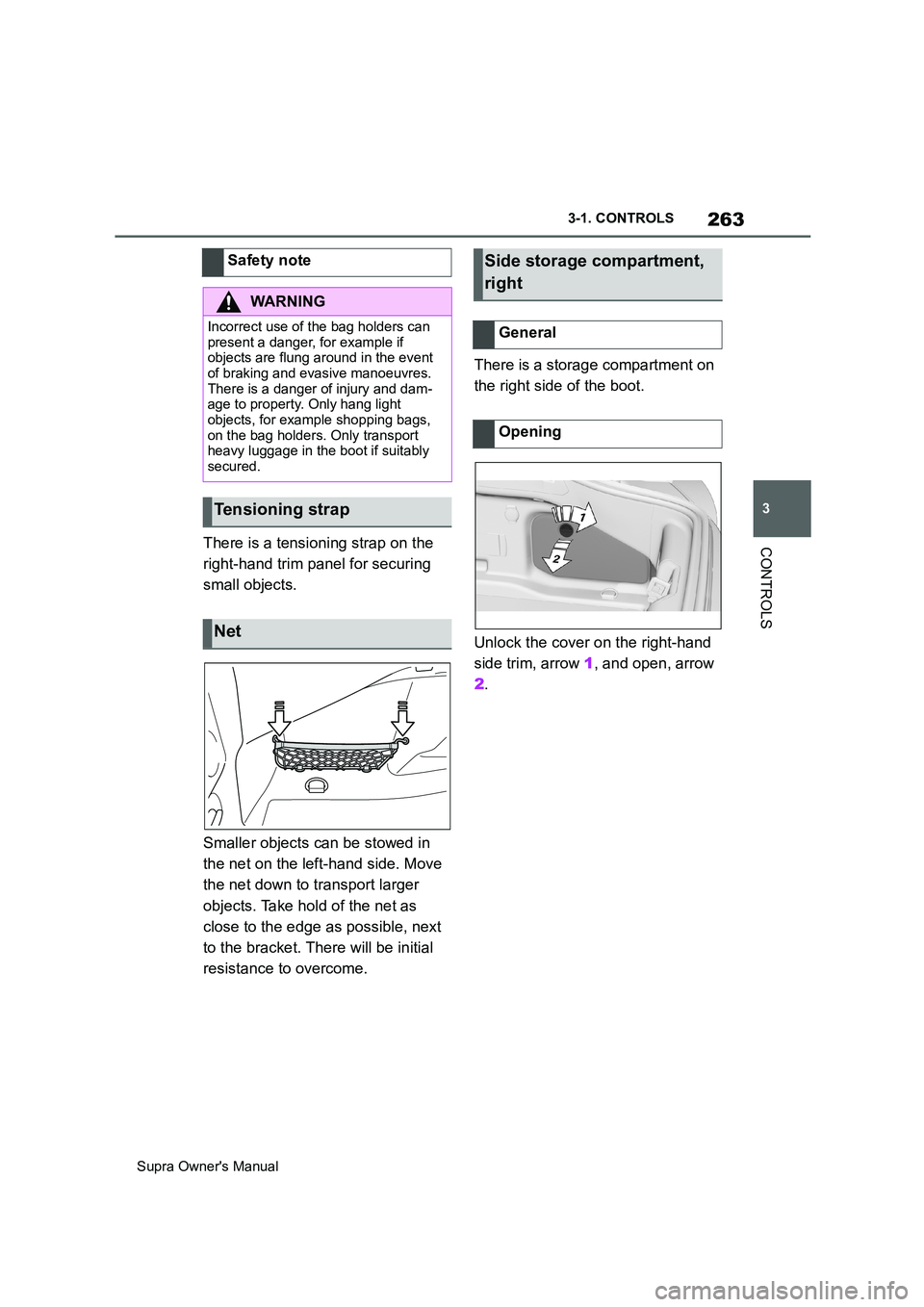
Smaller objects can be stowed in
the net on the left-hand side. Move
the net down to transport larger
objects. Take hold of the net as
close to the edge as possible, next
to the bracket. There will be initial
resistance to overcome.There is a storage compartment on
the right side of the boot.
Unlock the cover on the right-hand
side trim, arrow 1, and open, arrow
2. Safety note
WARNING
Incorrect use of the bag holders can
present a danger, for example if
objects are flung around in the event
of braking and evasive manoeuvres.
There is a danger of injury and dam-
age to property. Only hang light
objects, for example shopping bags,
on the bag holders. Only transport
heavy luggage in the boot if suitably
secured.
Tensioning strap
Net
Side storage compartment,
right
General
Opening
Page 270 of 456
270
Supra Owner's Manual4-1. DRIVING HINTS
This situation, known as aquaplan-
ing, means that the tyre can actu-
ally lose contact completely with
the road surface and the vehicle
can neither be steered, nor the
brakes properly applied.
Please comply with the following
when driving through water:
Only drive through still water.
Only drive through water up to a
max. depth of 25 cm, 9.8 in.
Drive through water at a walking
speed of no more than 5 km/h, 3
mph.
The vehicle is equipped with the
Anti-lock Brake System ABS as
standard.
Perform full braking in situations that require it.
The vehicle remains steerable. Any
obstacles can be avoided by per-
forming steering movements as
smoothly as possible.
A pulsing of the brake pedal and
hydraulic regulating sounds indi-
cate that the Anti-lock Brake Sys-
tem ABS is regulating.
In certain braking situations, the
perforated brake discs can cause
functional noise. However, func-
tional noises have no effect on the
efficiency and operational safety of
the brakes.
In damp weather, on gritted roads
and in heavy rain, apply the brakes
lightly every few kilometres/miles. Driving through water
General
Safety note
NOTICE
Driving through excessively deep
water too fast can result in water
entering the engine compartment,
electrical system or transmission.
There is a danger of damage to prop-
erty. When driving through water, do
not exceed the maximum water depth
and speed specified above.
Safe braking
General
Objects in the range of movement
of the pedals
WARNING
Objects in the driver's footwell can
restrict the pedal travel or block a
pedal that has been pressed. There is
a danger of accidents. Stow items in
the vehicle so that they are secure
and cannot get into the driver's
footwell. Only use floor mats that are
suitable for the vehicle and can be
securely fastened to the floor. Do not
use loose floor mats, and do not place
several floor mats on top of one
another. Make sure that there is suffi-
cient space for the pedals. Ensure
that floor mats are securely reat-
tached after having been removed, for
example for cleaning.
Wet roads
Page 277 of 456
277
5
Supra Owner's Manual5-1. MOBILITY
MOBILITY
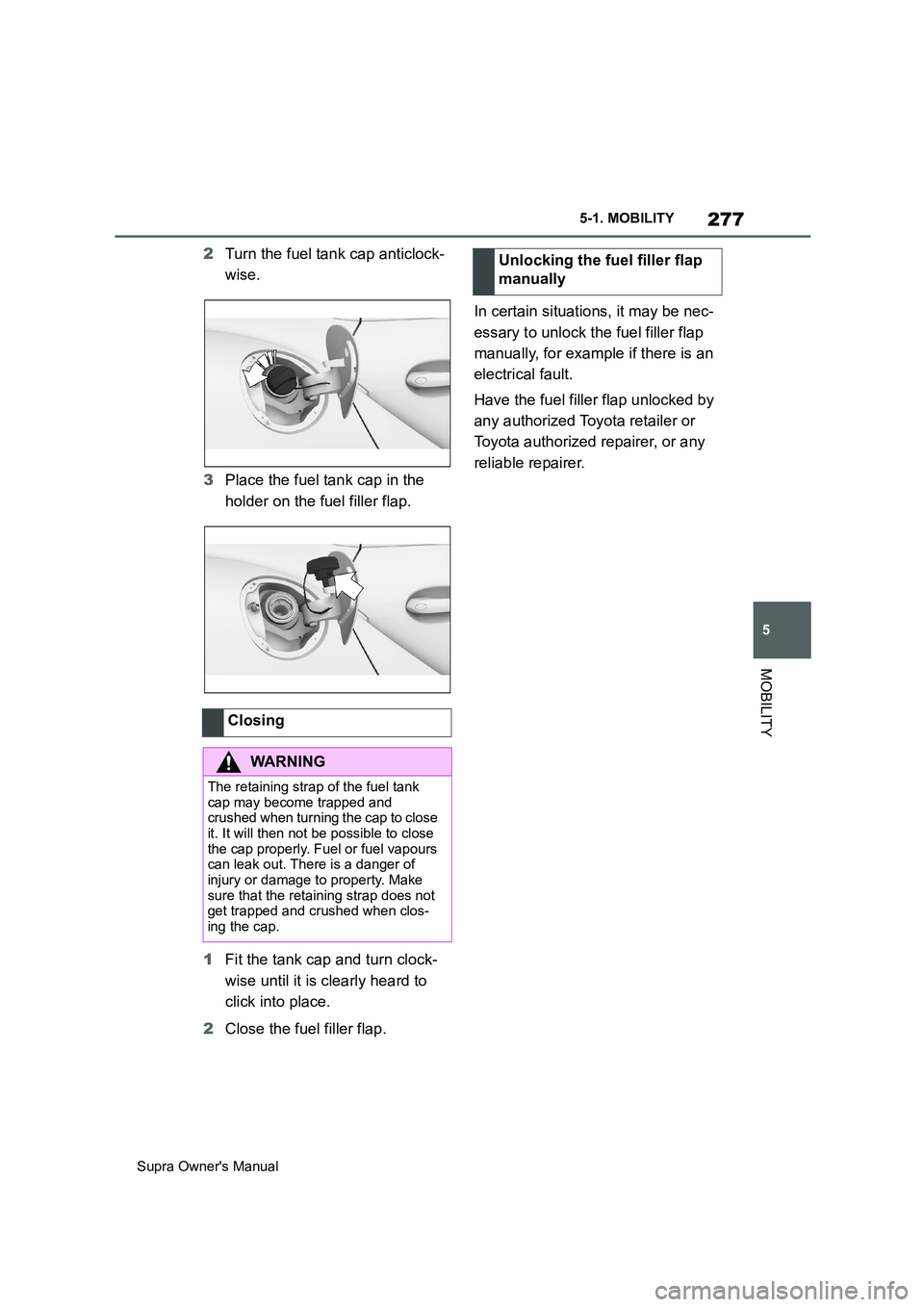
2Turn the fuel tank cap anticlock-
wise.
3Place the fuel tank cap in the
holder on the fuel filler flap.
1Fit the tank cap and turn clock-
wise until it is clearly heard to
click into place.
2Close the fuel filler flap.In certain situations, it may be nec-
essary to unlock the fuel filler flap
manually, for example if there is an
electrical fault.
Have the fuel filler flap unlocked by
any authorized Toyota retailer or
Toyota authorized repairer, or any
reliable repairer.
Closing
WARNING
The retaining strap of the fuel tank
cap may become trapped and
crushed when turning the cap to close
it. It will then not be possible to close
the cap properly. Fuel or fuel vapours
can leak out. There is a danger of
injury or damage to property. Make
sure that the retaining strap does not
get trapped and crushed when clos-
ing the cap.
Unlocking the fuel filler flap
manually
Page 282 of 456
282
Supra Owner's Manual5-1. MOBILITY
Have the wheel fitted and balanced
by any authorized Toyota retailer or
Toyota authorized repairer, or any
reliable repairer.
Information on the correct
wheel/tyre combination and rim
designs for the vehicle can be
obtained from any authorized
Toyota retailer or Toyota authorized
repairer, or any reliable repairer.
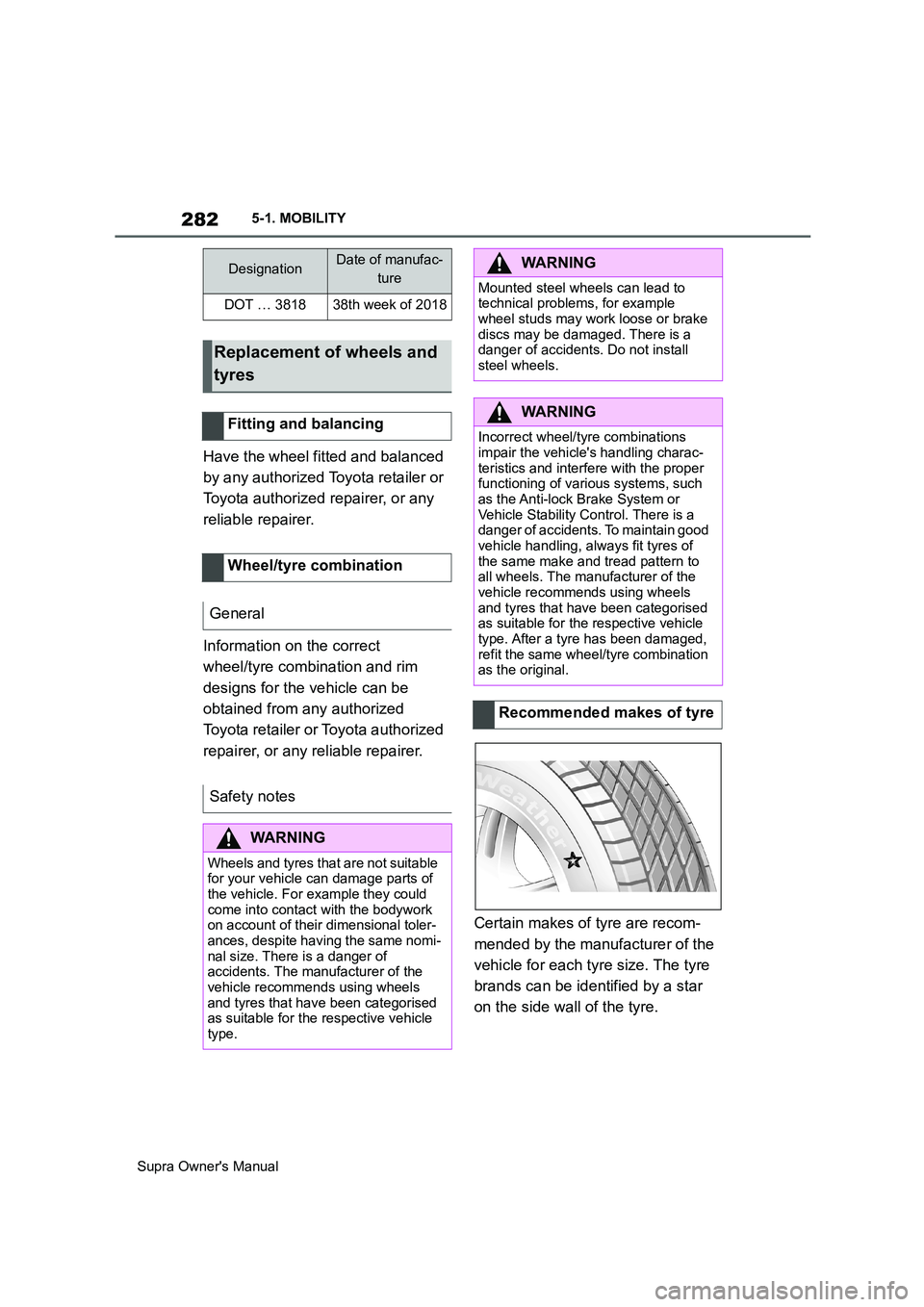
Certain makes of tyre are recom-
mended by the manufacturer of the
vehicle for each tyre size. The tyre
brands can be identified by a star
on the side wall of the tyre.
DesignationDate of manufac-
ture
DOT … 381838th week of 2018
Replacement of wheels and
tyres
Fitting and balancing
Wheel/tyre combination
General
Safety notes
WARNING
Wheels and tyres that are not suitable
for your vehicle can damage parts of
the vehicle. For example they could
come into contact with the bodywork
on account of their dimensional toler-
ances, despite having the same nomi-
nal size. There is a danger of
accidents. The manufacturer of the
vehicle recommends using wheels
and tyres that have been categorised
as suitable for the respective vehicle
type.
WARNING
Mounted steel wheels can lead to
technical problems, for example
wheel studs may work loose or brake
discs may be damaged. There is a
danger of accidents. Do not install
steel wheels.
WARNING
Incorrect wheel/tyre combinations
impair the vehicle's handling charac-
teristics and interfere with the proper
functioning of various systems, such
as the Anti-lock Brake System or
Vehicle Stability Control. There is a
danger of accidents. To maintain good
vehicle handling, always fit tyres of
the same make and tread pattern to
all wheels. The manufacturer of the
vehicle recommends using wheels
and tyres that have been categorised
as suitable for the respective vehicle
type. After a tyre has been damaged,
refit the same wheel/tyre combination
as the original.
Recommended makes of tyre
Page 284 of 456
284
Supra Owner's Manual5-1. MOBILITY
In the event of a complete loss of
tyre inflation pressure, run-flat tyres
enable you to continue driving, with
certain restrictions.
The wheels are fitted with tyres
which are self-supporting to a lim-
ited degree. They may also have
special rims.
The reinforced side wall means that
the tyre keeps the vehicle mobile to
a degree even if tyre inflation pres-
sure has been lost.
Observe the notes on continuing to
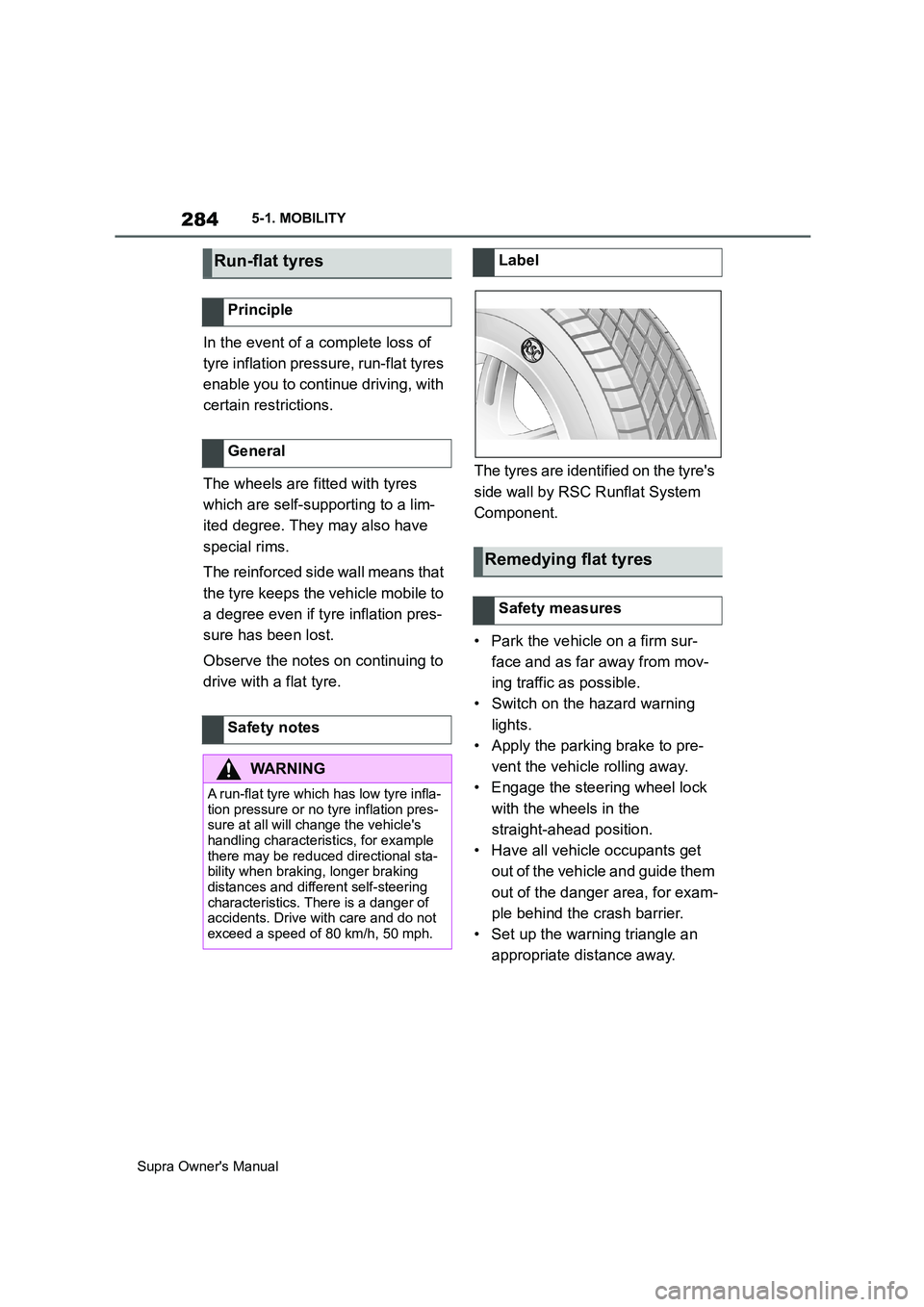
drive with a flat tyre.The tyres are identified on the tyre's
side wall by RSC Runflat System
Component.
• Park the vehicle on a firm sur-
face and as far away from mov-
ing traffic as possible.
• Switch on the hazard warning
lights.
• Apply the parking brake to pre-
vent the vehicle rolling away.
• Engage the steering wheel lock
with the wheels in the
straight-ahead position.
• Have all vehicle occupants get
out of the vehicle and guide them
out of the danger area, for exam-
ple behind the crash barrier.
• Set up the warning triangle an
appropriate distance away.
Run-flat tyres
Principle
General
Safety notes
WARNING
A run-flat tyre which has low tyre infla-
tion pressure or no tyre inflation pres-
sure at all will change the vehicle's
handling characteristics, for example
there may be reduced directional sta-
bility when braking, longer braking
distances and different self-steering
characteristics. There is a danger of
accidents. Drive with care and do not
exceed a speed of 80 km/h, 50 mph.
Label
Remedying flat tyres
Safety measures
Page 286 of 456
286
Supra Owner's Manual5-1. MOBILITY
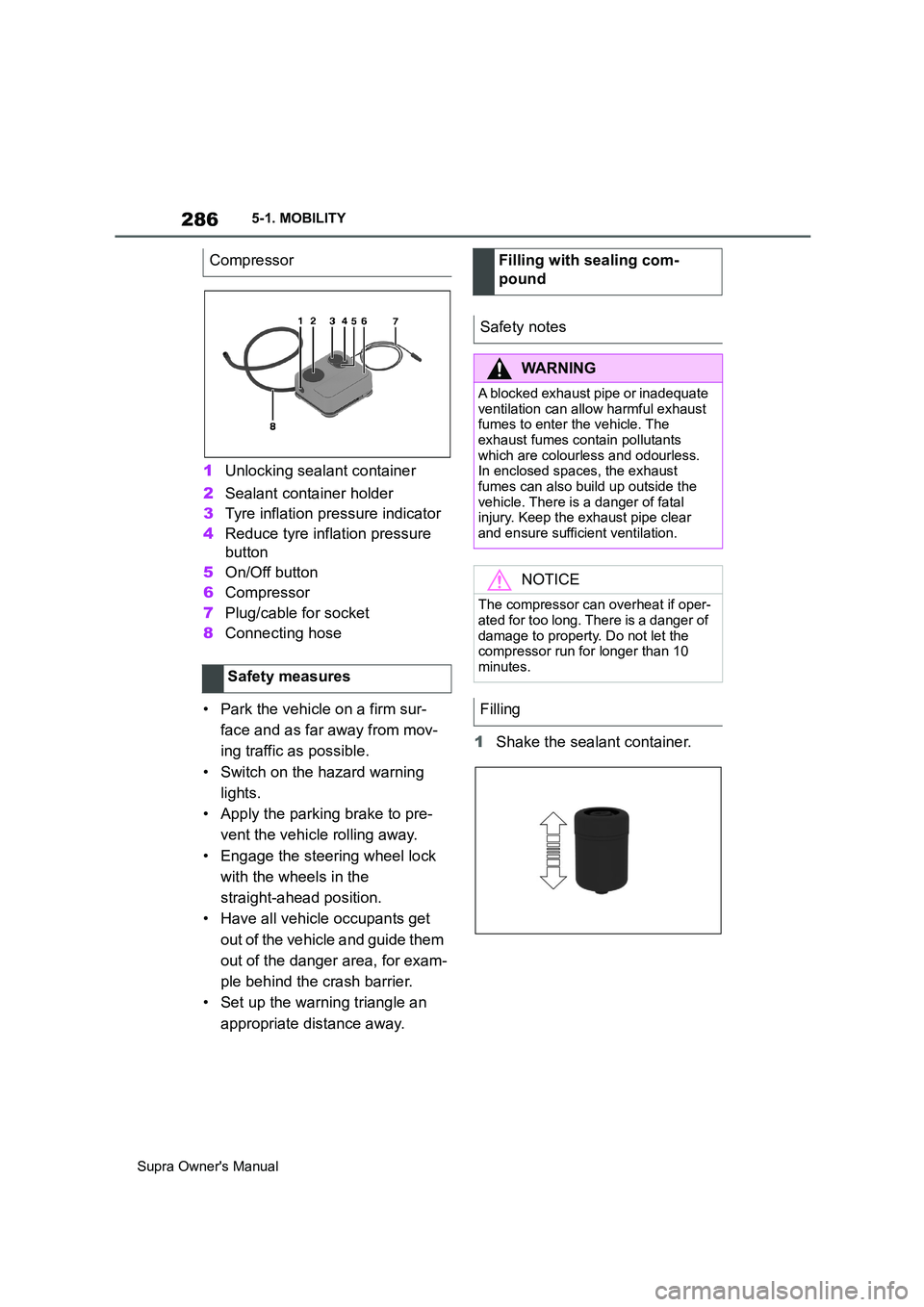
1Unlocking sealant container
2Sealant container holder
3Tyre inflation pressure indicator
4Reduce tyre inflation pressure
button
5On/Off button
6Compressor
7Plug/cable for socket
8Connecting hose
• Park the vehicle on a firm sur-
face and as far away from mov-
ing traffic as possible.
• Switch on the hazard warning
lights.
• Apply the parking brake to pre-
vent the vehicle rolling away.
• Engage the steering wheel lock
with the wheels in the
straight-ahead position.
• Have all vehicle occupants get
out of the vehicle and guide them
out of the danger area, for exam-
ple behind the crash barrier.
• Set up the warning triangle an
appropriate distance away.1Shake the sealant container. Compressor
Safety measures
Filling with sealing com-
pound
Safety notes
WARNING
A blocked exhaust pipe or inadequate
ventilation can allow harmful exhaust
fumes to enter the vehicle. The
exhaust fumes contain pollutants
which are colourless and odourless.
In enclosed spaces, the exhaust
fumes can also build up outside the
vehicle. There is a danger of fatal
injury. Keep the exhaust pipe clear
and ensure sufficient ventilation.
NOTICE
The compressor can overheat if oper-
ated for too long. There is a danger of
damage to property. Do not let the
compressor run for longer than 10
minutes.
Filling
Page 288 of 456
288
Supra Owner's Manual5-1. MOBILITY
1Switch off compressor.
2Read off the tyre inflation pres-
sure as shown on the tyre pres-
sure indicator.
To be able to continue the journey,
a tyre inflation pressure of at least 2
bar must be reached.
1Unscrew the filler hose of the
sealant container from the tyre
valve.
2Press the red unlocking device.
3Remove the sealant container
from the compressor.
4Pack and store the sealant con-
tainer to avoid soiling the boot.
1Unplug the connector from the
socket in the vehicle interior.
2Drive forwards and backwards
by 10 m, approximately 400
inches, to distribute the sealant
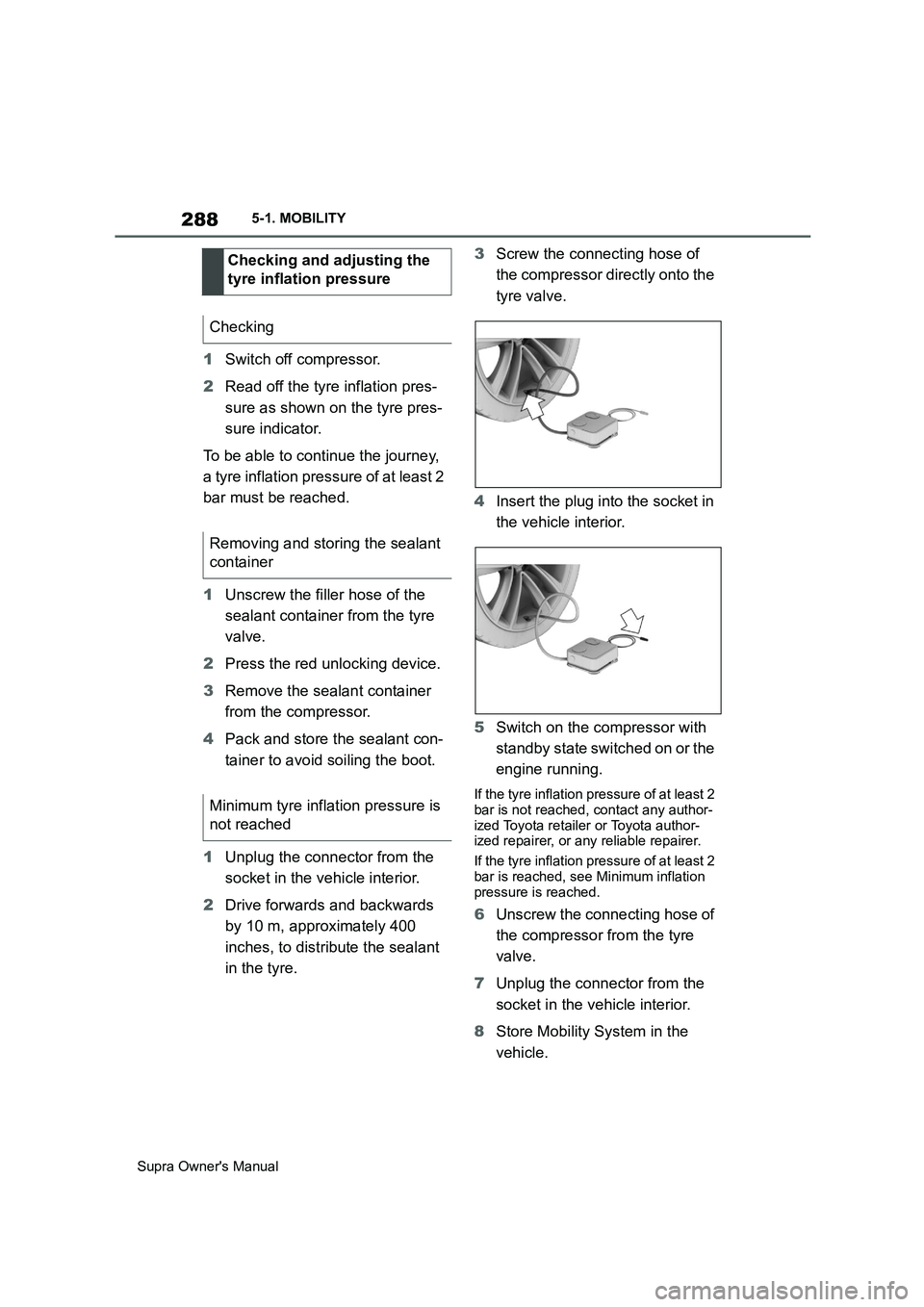
in the tyre.3Screw the connecting hose of
the compressor directly onto the
tyre valve.
4Insert the plug into the socket in
the vehicle interior.
5Switch on the compressor with
standby state switched on or the
engine running.
If the tyre inflation pressure of at least 2
bar is not reached, contact any author-
ized Toyota retailer or Toyota author-
ized repairer, or any reliable repairer.
If the tyre inflation pressure of at least 2
bar is reached, see Minimum inflation
pressure is reached.
6Unscrew the connecting hose of
the compressor from the tyre
valve.
7Unplug the connector from the
socket in the vehicle interior.
8Store Mobility System in the
vehicle. Checking and adjusting the
tyre inflation pressure
Checking
Removing and storing the sealant
container
Minimum tyre inflation pressure is
not reached
Page 298 of 456
298
Supra Owner's Manual5-1. MOBILITY
Tyres with special approval: the
system will not function correctly if
a reset has not been carried out, for
example, a flat tyre is reported in
spite of the correct tyre pressure.
• A wheel without TPM wheel elec-
tronics is fitted, for example
emergency wheel: have the
wheels checked if necessary.
• Malfunction: have the system
checked.
• Fault due to systems or devices
with the same radio frequency:
the system is automatically reac-
tivated upon leaving the field of
interference.
• In the case of tyres with special
approval: the system was unable
to complete the reset. Perform a
system reset again.For run-flat tyres or when using a
flat tyre kit, it is not always neces-
sary to change a wheel immedi-
ately if tyre inflation pressure is lost
due to a flat tyre.
If required, the tools for changing
wheels are available as optional
accessories from any authorized
Toyota retailer or Toyota authorized
repairer, or any reliable repairer. Reset not carried out
Malfunction
Message
The yellow warning lamp
flashes and is then illumi-
nated continuously. A
vehicle message is
shown. Tyre pressure
losses cannot be
detected.
Measure
Wheel change
General
Safety notes
WARNING
The jack is only intended for raising
the vehicle briefly during a wheel
change. Even if the safety measures
are complied with, there is a risk of
the raised vehicle falling over due
tothe jack slipping. There is a danger
of injury or even death. If the vehicle
is raised with the jack, do not lie
underneath the vehicle and do not
start the engine.
WARNING
Supports such as wooden blocks
under the vehicle jack can prevent it
from achieving its load capacity due
to the restricted height. The load
capacity of the wooden blocks may be
exceeded, causing the vehicle to tip
over. There is a danger of injury or
even death. Do not place supports
under the vehicle jack.