2019 MERCEDES-BENZ SPRINTER warning
[x] Cancel search: warningPage 45 of 354

Daimler
VANS US A,LLC
European Delivery Department
One Mercedes-Benz Drive
Sandy Springs, GA 30328
In Canada:
Mercedes-Benz Canada, Inc.
European Delivery Department
98 Vande rhoof Avenue
To ronto, Ontario M4G 4C9 Main
tenance information Yo
ur cus tomer service advisor will record every
service foryo u in the Service and Warranty In for‐
mation booklet. Information on
Roadside Assistance Ro
adside Assis tance of fers tech nical help in the
eve nt of a breakdown. Your calls totheto ll-f ree
Ro adside Assis tance Hotline are ans weredby our
agents 24hours a da y,365 da ysaye ar.
1- 87 7-762-826 7(USA)
1-800-387-0 100(Canada)
Yo u can find fur ther information in theRo adside
Assis tance brochu re(USA) or the "Roadside
Assis tance" section in the Service and Warranty
booklet (Canada). You will find bo thintheve hicle
document wallet. Information on
changing address or owner In
theeve nt of a change of address, please send
us the "Notification of Address Change" in the
Service and Warranty In form ation booklet or sim‐
ply call the Cus tomer Assis tance Center (USA) at
th e hotline number 1-8 77-762-826 7or Cus tomer
Service (Canada) at 1-800-387-0 100. So, if nec‐
essar y,we can reach you in a timely fashion.
If yo u sell your Mercedes, please lea vethe entire
literature in theve hicle so that it is available to
th e next owner. If you ha vepur chased a used
ve hicle, please send us the "Notification of Pur‐
ch ase of Used Car" in the Service and Warranty
In fo rm ation booklet or call the Cus tomer Assis‐
ta nce Center (USA) at the hotline number
1-8 77-762-826 7or Cus tomer Service (Canada) at
1-800-387-0 100. Po
ssible danger due tosubstances haza rdous
to health In compliance with Proposition 65 ("P
rop65"), the
fo llowing de tach able label has been added to
each vehicle sold in Califo rnia: Operating saf
ety &
WARNING Risk of accident due tomal‐
functions or sy stem failures
If yo u do not ha vethe prescribed service/
maintenance workor any requiredrepairs
car ried out, this could result in malfunctions
or sy stem failures. #
Always ha vethe prescribed service/
maintenance workas well any required
re pairs car ried out at a qualified special‐
ist workshop. &
WARNING Risk of accident and injury as
a re sult of incor rect modi fications to
electronic component parts
Modification toelectronic components, their
software or wiring could impair their function
and/or the function of other networ ked com‐
ponent parts. In particular, sy stems releva nt
to saf ety could also be af fected.
As a result, they may no longer function as
intended and/or endanger the operating
saf ety of theve hicle. #
Neverta mp er with the wiring and elec‐
tronic component parts or their soft‐
wa re. #
You should ha veall workon electrical
and electronic components car ried out
at a qualified specialist workshop. Obser
vethe "Vehicle electronics" section in the
"Technical data". Gene
ral no tes 21
Page 46 of 354
&
WARNING Risk offire due toflammable
materials on hot parts of theex haust sys‐
tem
Flammable material such as lea ves, grass or
twigs may ignite if they come into contact
wi th hot parts of theex haust sy stem. #
When driving on unpa vedro ads or off-
ro ad, regular lych eck theve hicle under‐
side. #
Remo vetrapped plants or other flam‐
mable material. #
Ifth ere is damage, consult a qualified
specialist workshop immediately. *
NO
TEDama getotheve hicle In
thefo llowing situations, in particular, there
is a risk of damage totheve hicle:
R The vehicle becomes grounded, e.g. on a
high curb or an unpa vedro ad
R The vehicle is driven toofast over an
obs tacle, e.g. a curb, speed bu mpor pot‐
hole
R A heavy object strike sth e underbody or
ch assis components
In situations such as this, the body, the
underbody, chassis components, wheels or
tires could be damaged without the damage
being visible. Components damaged in this
wa y can unexpectedly fail or, in the case of an
accident, may not absorb the loads that arise
as intended.
If th e underbody paneling is damaged, flam‐
mable materials such as lea ves, grass or
twigs can collect between the underbody and
th e underbody paneling. These materials may
ignite if they come into contact wi thhot parts
on theex haust sy stem. #
Have theve hicle checked and repaired
immediately at a qualified specialist
wo rkshop.
or #
If driving saf ety is impaired while con‐
tinuing your journe y,pull over and stop
th eve hicle immediately in accordance
with the traf fic conditions, and contact
a qu alified specialist workshop. Declarations of conformity
Information about
the decla ration of conform‐
ity for wi reless vehicle components USA:
"The wireless devices of this vehicle comply
with Part15 ofthe FCC Rules. Operation is sub‐
ject tothefo llowing two conditions: 1) These
devices may not cause harmful inter fere nce, and
2) These devices must acce ptany inter fere nce
re ceived, including inter fere nce that may cause
undesired operation. Changes or modi fications
not expressly appr ovedby the party responsible
fo r compliance could void the user's authority to
operate the equipment."
Canada: "The wireless devices of this vehicle
comply with Industry Canada license-e xemp t RSS
st andard(s). Operation is subject tothefo llowing
two conditions: (1) These devices may not cause
inter fere nce, and (2) These devices must acce pt
any inter fere nce, including inter fere nce that may
cause undesired operation of the device."
USA: "Wireless charging sy stem for mobile devi‐
ces (model: WMI2 Wireless Mobile Inter face): this
device complies with Part18 ofthe FCC Rules."
The name and address of there sponsible party
is:
peiker acustic GmbH
Max-Planc k-St r.28-32
61 381 Friedrichsdorf
Germany Diagnostics connection
The diagnostics connection is only intended for
th e connection of diagnostic devices at a quali‐
fi ed specialist workshop. &
WARNING Risk of accident due tocon‐
necting devices tothe diagnostics con‐
nection
If yo u connect equipment toa diagnostics
connection in theve hicle, it may af fect the
operation of vehicle sy stems.
As a result, the operating saf ety of theve hicle
could be af fected. #
Only connect equipment toa diagnos‐
tics connection in theve hicle which is
appr ovedfo ryo ur vehicle byMercedes-
Benz. 22
General no tes
Page 47 of 354

&
WARNING Risk of accident due to
objects in the driver's foot we ll
Objects in the driver's foot we ll may impede
pedal tr avel or block a depressed pedal.
This jeopardizes the operating and road
saf ety of theve hicle. #
Stow all objects in theve hicle securely
so that they cannot getinto the driver's
fo ot we ll. #
Always ins tallth efloor mats securely
and as prescribed in order toensure
th at there is alw ays suf ficient room for
th e pedals. #
Do not use loose floor mats and do not
place floor mats on top of one ano ther. *
NO
TEBattery discharging from using
devices connec tedto the diagnostics
connection Using devices at
the diagnostics connection
drains the batter y. #
Check thech arge leve l of the batter y. #
Ifth ech arge leve l is lo w,charge the bat‐
te ry, e.g. bydriving a considerable dis‐
ta nce. Connecting equipment
tothe diagnostics connec‐
tion can lead toemissions monitoring information
being reset, forex ample. This may lead tothe
ve hicle failing tomeet therequ irements of the
next emissions inspection du ring the main
inspection. Note
s onchanges tothe engine output
Output inc reases can:
R change the emission values.
R lead tomalfunctions.
R result in consequential damage.
The operating saf ety of the engine is not guaran‐
te ed in all situations.
Any tamp ering with the engine management in
order toinc rease the engine output will lead to
th e loss of the New Vehicle Limited Warranty and
ot her warranty entitlements.
If yo u sell theve hicle, inform the buyer of any
alterations totheve hicle's engine output. If you
do not inform the buyer, this may con stitute a
punishable of fense under national legislation. Qualified speciali
stwo rkshop
A qu alified specialist workshop has the necessary
special skills, tools and qualifications tocor rectly
car ryout any necessary workon your vehicle.
This particular lyapplies tosaf ety-re leva nt wo rks.
Alw ays ha vethefo llowing workon theve hicle
car ried out at a qualified specialist workshop:
R safety-re leva nt wo rks
R service and maintenance work
R repair work
R modifications as well as ins tallations and con‐
ve rsions
R workon electronic component parts
Mercedes-Benz recommends that you use an
authorized Mercedes-Benz Center forth is pur‐
pose. Ve
hicle registration
Mercedes-Benz may ask its service cen terto
car ryout tech nical inspections on cer tain vehi‐
cles. The quality or saf ety of theve hicle is
impr oved as a result of the inspection.
Mercedes-Benz can only inform you about vehicle
ch ecks if it Mercedes-Benz has your registration
data.
In thefo llowing cases your vehicle may not be
re gis tere dto yo uye t:
R You did not pur chase your vehicle at an
authorized specialist dealer.
R Your vehicle has not yet been inspected at an
au thorized Mercedes-Benz Center.
It is advisable toregis teryo ur vehicle with an
authorized Mercedes-Benz Center.
Inform Mercedes-Benz as soon as possible about
any change in address or vehicle ownership.
Yo u can do this, forex ample, at an authorized
Mercedes-Benz Center. Cor
rect use of theve hicle
If yo ure mo ve wa rning sticke rs,ot hers may failto
re cognize the dangers. Lea ve warning sticke rs in
position.
Obser vethefo llowing information in particular
when operating theve hicle:
R Safety no tes in these Operating Instructions
R Tech nical da taforth eve hicle General no
tes23
Page 48 of 354
R
Traf fic ru les and regulations
R Laws per taining tomo torve hicles and saf ety
st andards Multi Purpose
Vehicle &
WARNING Risk of accident due toa high
cen ter of gr avity
As a result of the high center of gr avity the
ve hicle can skid or rollo ver in theeve nt of
ab rupt steering mo vements and/or inapp ro‐
priate speed. #
Adapt the speed and the driving style to
th e driving characteristics of theve hicle
as well as the pr evailing road and
we ather conditions. Utility
vehicles ha vea significantly higher rollo ver
ra te than other types of vehicles.
If th is vehicle is not operated in a safe manner it
could result in an accident, rollo ver as well as to
se vere or fata l injuries.
In a rollo ver crash, an unbel ted person is signifi‐
cantly more likely todie than a person wearing a
seat belt.
Yo u and all vehicle occupants should alw ayswe ar
a seat belt. Information on problems with
your vehicle
If yo u should experience a problem with your
ve hicle, particularly one that you belie vemay
af fect its safe ope ration, weurge youto contact
an au thorized Mercedes-Benz Center immediately
to have the problem diagnosed and rectified.
If th e problem is not resol vedto yo ur satisfaction,
please con tact an au thorized Mercedes-Benz
Center again or write toone of thefo llowing
addresses.
In the USA:
Daimler VANS US A,LLC
Cus tomer Assis tance Center
One Mercedes-Benz Drive
Sandy Springs, GA 30328
In Canada:
Mercedes-Benz Canada, Inc.
Cu stomer Relations Department
98 Vande rhoof Avenue
To ronto, Ontario M4G 4C9 Re
porting saf ety defects
USA onl y:
The following text is published as required of
manufacturers under Title 49, Code of U.S. Fed‐
eral Regulations, Part57 5 pursuant tothe
"National Traf fic and Mo torVe hicle Saf etyAc t of
19 66".
If yo u belie vethat your vehicle has a defect which
could cause a crash or could cause injury or
death, you should immediately inform the
Na tional Highw ayTraf fic Saf etyAd ministration
(NHT SA) in addition tonotifying Daimler VANS
US A,LLC.
If NHT SAreceives similar complaints, it may open
an in vestigation, and if it finds that a saf ety
defect exists in a group of vehicles, it may order a
re call and remedy campaign. Ho wever,NHT SA
cannot become in volved in indi vidual problems
between you, your dealer, or Daimler VANS US A,
LLC.
To contact NHT SA,yo u may call theVe hicle
Saf ety Hotline toll-f ree at 1-888-327-4236
(TT Y:1-800-424-9 153); go tohttp://
www.safercar.gov, or write toAd ministrator,
NHT SA, 400 Se venth Street,SW .,Wa shington,
DC 20590, US A.
Yo u can find more information on vehicle saf ety
unde r:http://www.safercar.gov Limited
Warranty
* NO
TEDama getotheve hicle arising from
violation of these operating instructions. Damage
totheve hicle can arise from viola‐
tion of these operating instructions.
Such damage is not co veredby either the
Limited Warranty or the new or used-vehicle
wa rrant y. #
Obser vethe instructions in these oper‐
ating instructions on proper operation
of your vehicle as well as rega rding pos‐
sible vehicle damage. QR codes
forre scue card
The QR code sticke rs are af fixe dto the B-pillar on
th e driver's and front-passen ger side. In theeve nt
of an accident, emergency services can use the
QR code toquickly de term ine the cor responding
re scue card foryo ur vehicle. The cur rent rescue 24
General no tes
Page 52 of 354
Re
stra int sy stem Pr
otection bythere stra int sy stem The
restra int sy stem includes thefo llowing com‐
ponents:
R Seat belt sy stem
R Airbags
R Child restra int sy stem
R Child seat securing sy stems
The restra int sy stem can help pr eventtheve hicle
occupants from coming into contact with parts of
th eve hicle interior in theeve nt of an accident. In
th eeve nt of an accident, there stra int sy stem can
also reduce thefo rc es towhich theve hicle occu‐
pants are subjected.
A seat belt can only pr ovide the best le vel of pro‐
te ction if it is worncor rectly. Depending on the
de tected accident situation, Emer gency Tension‐
ing Devices and/or airbags supplement the pro‐
te ction of fere dby a cor rectly wornseat belt.
Emer gency Tensioning Devices and/or airbags
are not depl oyed in every accident.
Ve hicles with a front passenger bench seat: the
Emergency Tensioning Device on the front
passenger seat is triggered whe ther or not the
seat belt tongue is engaged in the seat belt
buckle.
If th eve hicle does not ha vea driver's airbag, the
seat belt sy stem does not include an Emer gency
Te nsioning Device or a seat belt forc e limiter.
In order forth ere stra int sy stem toprov ide the
intended le vel of pr otection, each vehicle occu‐
pant must obser vethefo llowing information:
R Fasten seat belts cor rectl y.
R Sit in an almost up right seat position with
th eir back against the seat backrest.
R Sit with their feet resting on thefloor, if possi‐
ble.
R Always secure persons under 5 ft(1.50 m)
ta ll in an additional restra int sy stem suitable
fo rth is vehicle.
Ho wever,no sy stem available today can com‐
ple tely eliminate injuries and fata lities in every
accident situation. In particular, the seat belt and
airbag general lydo not pr otect against objects
penetrating theve hicle from the outside. It is also
not possible tocomple tely rule out therisk of
injury caused bythe airbag deploying. Limited pr
otection from there stra int sy stem &
WARNING Risk of inju ryor death from
modifications tothere stra int sy stem
The restra int sy stem can no longer function
cor rectly af ter alterations ha vebeen made.
The restra int sy stem may then not pr otect the
ve hicle occupants as intended byfailing in an
accident or triggering unexpec tedly, forex am‐
ple #
Never alter the parts of there stra int
sy stem. #
Neverta mp er with the wiring or any
electronic component parts or their
software. If it is necessary
toadjust theve hicle toaccom‐
modate a person with disabilities, con tact an
au thorized Mercedes-Benz Center for de tails.
USA only: con tact our Cu stomer Assis tance Cen‐
te r at 1‑8 77‑762‑826 7for de tails. Re
stra int sy stem functionality When
the ignition is switched on, a self-test is
per form ed, during which the0075 restra int sys‐
te m wa rning lamp lights up. It goes out no later
th an a few seconds af terth eve hicle is star ted.
The components of there stra int sy stem are then
functional. Malfunctioning
restra int sy stem A malfunction has occur
red in there stra int sys‐
te m if:
R The 0075 restra int sy stem warning lamp does
not light up when the ignition is switched on
R The 0075 restra int sy stem warning lamp
lights up continuously or repeatedly during a
journey &
WARNING Risk of inju rydue tomalfunc‐
tions in there stra int sy stem
If th ere stra int sy stem is malfunctioning,
re stra int sy stem components may be trig‐
ge red unintentionally or may not deploy as
intended during an accident. This may af fect
th e Emer gency Tensioning Devices or airbags,
fo rex ample. 28
Occupant saf ety
Page 53 of 354

#
Have there stra int sy stem checked and
re paired immediately at a qualified spe‐
cialist workshop. Fu
nction of there stra int sy stem in an acci‐
dent How
there stra int sy stem works is de term ined by
th e se verity of the impact de tected and the type
of accident anticipated:
R Frontal impact
R Rear impact
R Side impact
R Rollover
The activation thre sholds forth e components of
th ere stra int sy stem are de term ined based on the
ev aluation of the sensor values measured at vari‐
ous points in theve hicle. This process is pre-
em ptive in nature. The triggering/deployment of
th e components of there stra int sy stem must
ta ke place in good time at thest art of the colli‐
sion.
Fa ctors whi chcan only be seen and measured
af te r a collision has occur red do not play a deci‐
sive role in the deployment of an airbag. Nordo
th ey prov ide an indication of airbag deployment.
The vehicle may be deformed significantly with‐
out an airbag being deplo yed. This is the case if
only parts which are relatively easily deformed
are af fected and thera te ofvehicle deceleration
is not high. Con versely, an airbag may be
deplo yedev en though theve hicle suf fers only
minor deformation. If very rigid vehicle parts such
as longitudinal members are hit, forex ample, this
may result in suf ficiently high le vels of vehicle
deceleration.
The components of there stra int sy stem can
be activated or deplo yed independently of
each other: Component De
tected deploy‐
ment situation
Emer gency Tensioning
Devices Fr
ontal impact, rear
impact, side impact 1)
,
ro llo ver
Driver's airbag, front
passenger front air‐
bag Fr
ontal impact Component De
tected deploy‐
ment situation
Side airbag Side impact
Wi ndow cur tain airbag Side impact, rollo ver,
frontal impact 1)
Only if theve hicle is equipped with a side air‐
bag or window cur tain airbag. &
WARNING Risk of bu rns from hot air bag
components
The air bag parts are hot af ter an air bag has
been depl oyed. #
Do not touch the air bag parts. #
Have a deplo yed air bag replaced at a
qu alified specialist workshop as soon as
possible. Fo
ryo ur saf ety and that of your passengers, it is
re commended that you ha vetheve hicle towe dto
a qu alified specialist workshop af ter an accident.
Ta ke this into account, particular lyif an Emer‐
ge ncy Tensioning Device is trig gered or an airbag
deplo yed.
If th e Emer gency Tensioning Devices are trig‐
ge red or an airbag is deplo yed, you will hear a
bang, and a small amount of powder may also be
re leased:
R The bang will not general lyaffect your hear‐
ing.
R Ingeneral, the powder released is not hazard‐
ous tohealth but may cause short-term
breathing dif ficulties topersons suf fering
from as thma or other pulmonary conditions.
Pr ov ided it is safe todo so, lea vetheve hicle
immediately or open the window in order to
pr eve nt brea thing dif ficulties.
Airbags and pyrotech nic Emergency Tensioning
Devices contain pe rchlorate material, which may
re qu ire special handling or environmental pr otec‐
tion measures. National guidelines rega rding
wa ste disposal must be obser ved. In California,
see http://www.dtsc.ca.gov/HazardousWas te/
Pe rchlorate/index.cfm. Occupant saf
ety29
Page 54 of 354
Seat belts
Pr
otection pr ovided bythe seat belt Alw
aysfast enyour seat belt cor rectly before
st arting a journe y.A seat belt can only pr ovide
th e best le vel of pr otection if it is worncor rectl y. &
WARNING Risk of inju ryor death due to
incor rectly fastened seat belt
If th e seat belt is not worncor rectly, it cannot
per form its intended pr otective function.
In addition, an incor rectly fastened seat belt
can also cause injuries, forex ample, in the
eve nt of an accident or when braking or
ch anging direction sudden ly.#
Always ensure that all vehicle occupants
ha ve their seat belts fastened cor rectly
and are sitting prope rly. Alw
ays obser vethe instructions about the cor rect
driver's seat position and adjusting the seats
(/ page 59).
In order forth e cor rectly wornseat belt topro‐
vide the intended le vel of pr otection, each vehicle
occupant must obser vethefo llowing information:
R The seat belt must not be twis ted and must fit
tightly and snu gly across the body.
R The seat belt must be routed across the cen‐
te r of the shoulder and as low down across
th e hips as possible.
R The shoulder section of the seat belt should
not touch your neck nor be routed under your
arm or behind your bac k.
R Avoid wearing bulky clo thing, e.g. a winter
coat.
R Push the lap belt down as far as possible
across your hips and pull tight with the shoul‐
der section of the belt. Ne verro ute the lap
belt across your abdomen.
Pregnant women must also take particular
care with this.
R Neverro ute the seat belt across sharp, poin‐
te d, abrasive or fragile objects.
R Only one person may use each seat belt at
any one time. Infants and children must ne ver
tr ave l sitting on the lap of a vehicle occupant.
R Never secure objects with a seat belt if the
seat belt is being used byone of theve hicle's
occupants. Alw ays obser vethe instructions
fo r loading theve hicle when securing objects,
luggage or loads (/ page72). Also ensure
that no objects, e.g. a cushion,
are ever placed between a person and the
seat.
The seat belts on thefo llowing seats are equip‐
ped with a special seatbelt retractor:
R Co-driver seat
R Rear seats
Ac tivate or deacti vate the special seatbelt retrac‐
to r of the seat belt (/ page 35).
If ch ildren are tr aveling in theve hicle, be sure to
obser vethe instructions and saf ety no tes on
"Children in theve hicle" (/ page 34). Limitations of
the pr otection pr ovided bythe
seat belt &
WARNING Risk of inju ryor death due to
incor rect seat position
The seat belt does not of ferth e intended le vel
of pr otection if you ha venot mo vedth e seat
backrest toan almost vertical position.
When braking or in theeve nt of an accident,
yo u could slide unde rneath the seat belt and
sus tain abdominal or neck injuries, forex am‐
ple. #
Adjust the seat properly before begin‐
ning your journe y. #
Always ensure that the seat backrest is
in an almost vertical position and that
th e shoulder section of your seat belt is
ro uted across the center of your shoul‐
der. &
WARNING Risk of inju ryor death when
additional restra int sy stems are not used
fo r persons with a smaller build
Pe rsons under 5 ft(1.50 m) tall cannot wear
th e seat belt cor rectly wi thout a suitable addi‐
tional restra int sy stem.
If th e seat belt is not worncor rectly, it cannot
per form its intended pr otective function. In
addition, an incor rectly fastened seat belt can
also cause injuries, forex ample, in theeve nt
of an accident or when braking or changing
direction suddenly. #
Always secure persons under 5 ft
(1.50 m) tall in a suitable restra int sys‐
te m. 30
Occupant saf ety
Page 55 of 354
&
WARNING Risk of inju ryor death due to
damaged or modified seat belts
Seat belts cann otprov ide pr otection in the
fo llowing situations:
R The seat belt is damaged, has been modi‐
fied, is extremely di rty, bleached or dyed
R The seat belt buckle is damaged or
extreme lydirty
R Modifications ha vebeen made tothe
Emergency Tensioning Device, seat belt
anchorage or seat belt retractor
Seat belts may su stain non-visible damage in
an accident, e.g. due toglass splin ters.
Modified or damaged seat belts could tear or
fa il in theeve nt of an accident, forex ample.
Modified Emer gency Tensioning Devices may
be depl oyed unintentionally or not function as
intended. #
Never modify the seat belts, Emer gency
Te nsioning Devices, seat belt ancho‐
ra ge s or seat belt retractors. #
Makesure that the seat belts are not
damaged, are not wornand are clean. #
Always ha vethe seat belts checked
immediately af ter an accident at a quali‐
fi ed specialist workshop. Only use seat belts
that ha vebeen appr ovedfor
yo ur vehicle bythe sales or ganization named on
th e inside front co ver. &
WARNING Risk of inju ryor death from
deplo yedpy rotech nic Emergency Ten‐
sioning Devices
Py rotech nic Emergency Tensioning Devices
th at ha vebeen deplo yed are no longer opera‐
tional and are unable toper form their inten‐
ded pr otective function. #
Therefore, ha vedeplo yedpy rotech nic
Emergency Tensioning Devices immedi‐
ately replaced at a qualified specialist
wo rkshop. Fo
ryo ur saf ety and that of your passengers, it is
re commended that you ha vetheve hicle towe dto
a qu alified specialist workshop af ter an accident. *
NO
TEDama gecaused bytrapping the
seat belt If an unused seat belt is not fully
retracted, it
may become trapped in the door or in the
seat mechanism. #
Always ensure that an unused seat belt
is fully retracted. Fa
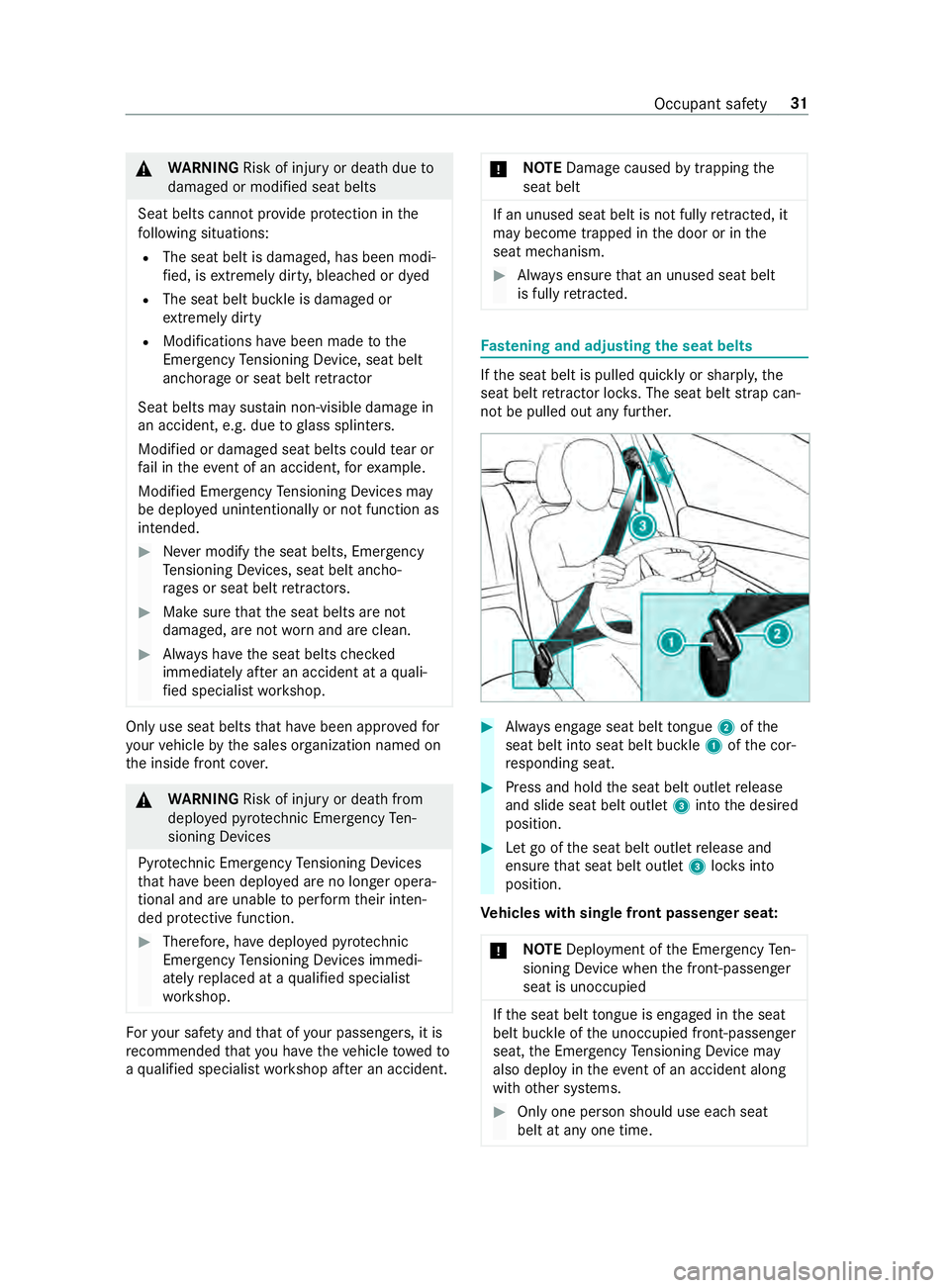
stening and adju sting the seat belts If
th e seat belt is pulled quickly or sharpl y,the
seat belt retractor lo cks. The seat belt stra p can‐
not be pulled out any fur ther. #
Always engage seat belt tongue 2ofthe
seat belt into seat belt buckle 1ofthe cor‐
re sponding seat. #
Press and hold the seat belt outlet release
and slide seat belt outlet 3into the desired
position. #
Let go of the seat belt outlet release and
ensure that seat belt outlet 3locksinto
position.
Ve hicles with single front passen ger seat:
* NO
TEDepl oyment of the Emer gency Ten‐
sioning Device when the front-passenger
seat is unoccupied If
th e seat belt tongue is engaged in the seat
belt buckle of the unoccupied front-passen ger
seat, the Emer gency Tensioning Device may
also depl oyintheeve nt of an accident along
wi th other sy stems. #
Only one person should use each seat
belt at any one time. Occupant saf
ety31