2019 MERCEDES-BENZ SPRINTER winter tires
[x] Cancel search: winter tiresPage 142 of 354

0047
Use
the engine's braking ef fect on extremely
st eep downhill gradients and on long down‐
hill stre tches. Using kickdown
#
For maximum acceleration: depressthe
accelerator pedal be yond the pressure point. #
Ease off the accelera tor pedal once the
desired speed is reached. All-wheel drive
Note
s on all-wheel drive All-wheel drive ensures permanent drive
for all
fo ur wheels, and toget her with ESP ®
it impr oves
th e traction of theve hicle.
The traction contro l ofthe all-wheel drive also
ta ke s place via the brake sy stem. Therefore, the
brake sy stem can overheat during extreme off-
ro ad use. In this case, ease off the accelerator
pedal or stop toallow the brake sy stem tocool
down.
If a driven wheel spins due toinsuf ficient trac‐
tion, obser vethefo llowing no tes:
R When pulling away, make use of the traction
cont rol integrated in ESP ®
. Depress the
accelerator pedal as far as necessar y.
R Take your foot off the accelera tor pedal,
slowly, while theve hicle is in motion.
In wintry driving conditions, alw ays use winter
tires (M+S tires) and, if necessar y,snow chains
(/ page 233). Only in this wa y can the maximum
ef fect of all-wheel drive be achie ved.
Use DSR (Downhill Speed Regulation) when driv‐
ing downhill off-road (/ page120).
If yo ufa ilto adapt your driving style or if you are
inat tentive, the all-wheel drive sy stem can neither
re duce therisk of an accident nor override the
la ws of ph ysics. The all-wheel drive sy stem can‐
not take road, weather and traf fic conditions into
account. The all-wheel drive sy stem is only an
aid. You are responsible for maintaining a safe
dis tan ce from theve hicle in front, forve hicle
speed, for braking in good time and forst ay ing in
lane. *
NO
TERisk of damage tothe driv etra in
and the brake sy stem If
yo u operate vehicles with all-wheel drive on
a one-axle test st and, you may damage the
driv etra in or the brake sy stem. #
A function or per form ance test should
only be car ried out on a two-axle test
st and. #
Ifyo u wish tooperate theve hicle on
such a test st and, please consult a
qu alified specialist workshop in
advance. *
NO
TERisk of damage tothe transfer
case If
yo uto w theve hicle with a raised axle, the
trans fer case can getdamaged. Such damage
is not co veredby Mercedes-Benz Limited
Wa rrant y. #
Neverto w theve hicle with a raised axle. #
Only tow theve hicle with all wheels on
th e ground or fully raised. #
Notethe instructions on towing the
ve hicle with full contact with the ground
fo r all wheels. Engaging all-wheel drive
Conditions
for en gaging/disengaging
Yo u can engage and deactivate the all-wheel drive
when stationary or while driving slowl y.
When stationar y,thefo llowing must be obser ved:
R The engine is running.
R The steering wheel in thest ra ight-ahead posi‐
tion.
If th e all-wheel drive cann otbe engaged when
st ationary: #
Vehicles with automatic transmission:
shift the selector le ver from 005Cto005B from
005B to005C from 005Cto005E and back to005C .
Engaging and disengaging the all-wheel drive
can be made easier in this wa y.
Obser vethefo llowing when driving slowly:
R The engine is running.
R The vehicle is not tr aveling fasterthan
6.2 mph (1 0 km/h).
R The vehicle is not being driven around a bend. 11 8
Driving and pa rking
Page 235 of 354
wa
sher and the associated spr aycould cause
considerable damage totheve hicle.
To avo id damage to yourvehicle, obser vethefo l‐
lowing when using a po werwa sher:
R maintain a minimum dis tance of 11.8 in
(30 cm) totheve hicle when using 25° flat-
spr aynozzles and di rtgrinders or 27.6 in
(70 cm) when using round-spray nozzles and
obse rveth e information in the equipment
manufacturer's operating instructions.
R do not direct the nozzle of the po werwa sher
directly at sensitive parts such as tires, slits,
electrical components, batteries, light bulbs
and ventilation slits.
R maintain a minimum di stance of 19.7 in
(50 cm) for a rear view camera. Wa
shing theve hicle byhand Obser
vethe legal requirements, forex ample in
many countries washing byhand is only allo wed
at specially designated wash ba ys. In this case,
make sure that a specially designated wash bay is
used forwa shing byhand. #
Use a mild cleaning agent, e.g. car shampoo. #
Washtheve hicle with luk ewarm wate r and a
soft car sponge. When doing so, do not
ex pose theve hicle todirect sunlight. #
Carefully spr aytheve hicle with water and dry
off with a leath er cloth. Be careful not to
point thewate r jet directly towa rdsth e air
inlet grilles. The blo wer should be switched
off while doing so. #
Do not let the cleaning agent dry on the paint‐
wo rk.
At the onset of winter, remo veall traces of road
salt deposits carefully and as soon as possible. Note
s on care of paint and matte finish *
NO
TEPaint wo rkdamage and cor rosion
due toinadequate care Fa
ilure toprom ptly and thoroughly remo ve
dirt from bird droppings or other residue
could result in paintwork damage and cor ro‐
sion at a later date. #
Clean dirt off paint and matte finish
th oroughly and as soon as possible. Maintenance and care
211
Page 256 of 354
Information on noise or unusual driving
ch aracteristics
While driving, pay attention tovibrations, noises
and unusual driving characteristics, e.g. pulling to
one side. This may indicate damage tothe wheels
or tires. If you suspect that a tire is defective,
re duce your speed. Stop theve hicle as soon as
possible tocheck if wheels and tires ha vebeen
damaged or are no longer functioning properly.
Hidden tire damage could also be causing the
unusual driving characteristics. If no signs of
damage can be de tected, ha vethe tires and
wheels checked at a qualified specialist work‐
shop. Note
s onregular lyinspecting wheels and
tires &
WARNING Risk of accident from dam‐
aged tires
Dama ged tires can cause tire pressure loss.
As a result, you could lose control of your
ve hicle. #
Check the tires regularly for signs of
dama geand replace any damaged tires
immediatel y. Check
the wheels and tires of your vehicle for
damage regular ly, i.e. at least every two weeks,
as well as af ter driving off-road or on rough
ro ads. Damaged wheels can lead toa loss of tire
pressure.
Look out forth efo llowing types of damage, for
ex ample:
R cuts in the tires
R punctures in the tires
R tears in the tires
R bulges on tires
R deformation or se vere cor rosion on wheels &
WARNING Risk ofhydroplaning because
tire tread is too low
Insuf ficient tire tread will result in reduced
tire traction. The tire tread will no longer be
able todissipate water.
This increases therisk of hydroplaning on wet
ro ad sur faces, pa rticularly when tra veling at
an inappropriate speed. If
th e tire pressure is too high or too lo w,tires
may exhibit dif fere nt le vels of wear at dif fer‐
ent locations on the tire tread. #
Regular lych eck the tire tread dep thand
th e condition of the tire tread across
th e entire width of all tires.
Minimum tread dep thfor use:
R In summer: 00CEin (3 mm)
R In winter: 00CFin (4 mm) #
For saf etyre asons, ha vethe tires
re placed before the legally prescribed
limit forth e minimum tire tread dep this
re ached. Conduct
thefo llowing checks regular lyon all
wheels, at least once a month or as requ ired, e.g.
before a long journey or when driving off- road:
R check the tire pressure (/ page 234)
R check theva lve caps
Va lves must be pr otected from moisture and
dirt with valve caps specifically appr oved by
Mercedes-Benz foryo ur vehicle.
R visually inspect the tread dep thand the tire
tread across the whole tire width
Fo r use in summer, the minimum tread dep th
is 00CE in (3 mm) and for use in winter 00CFin
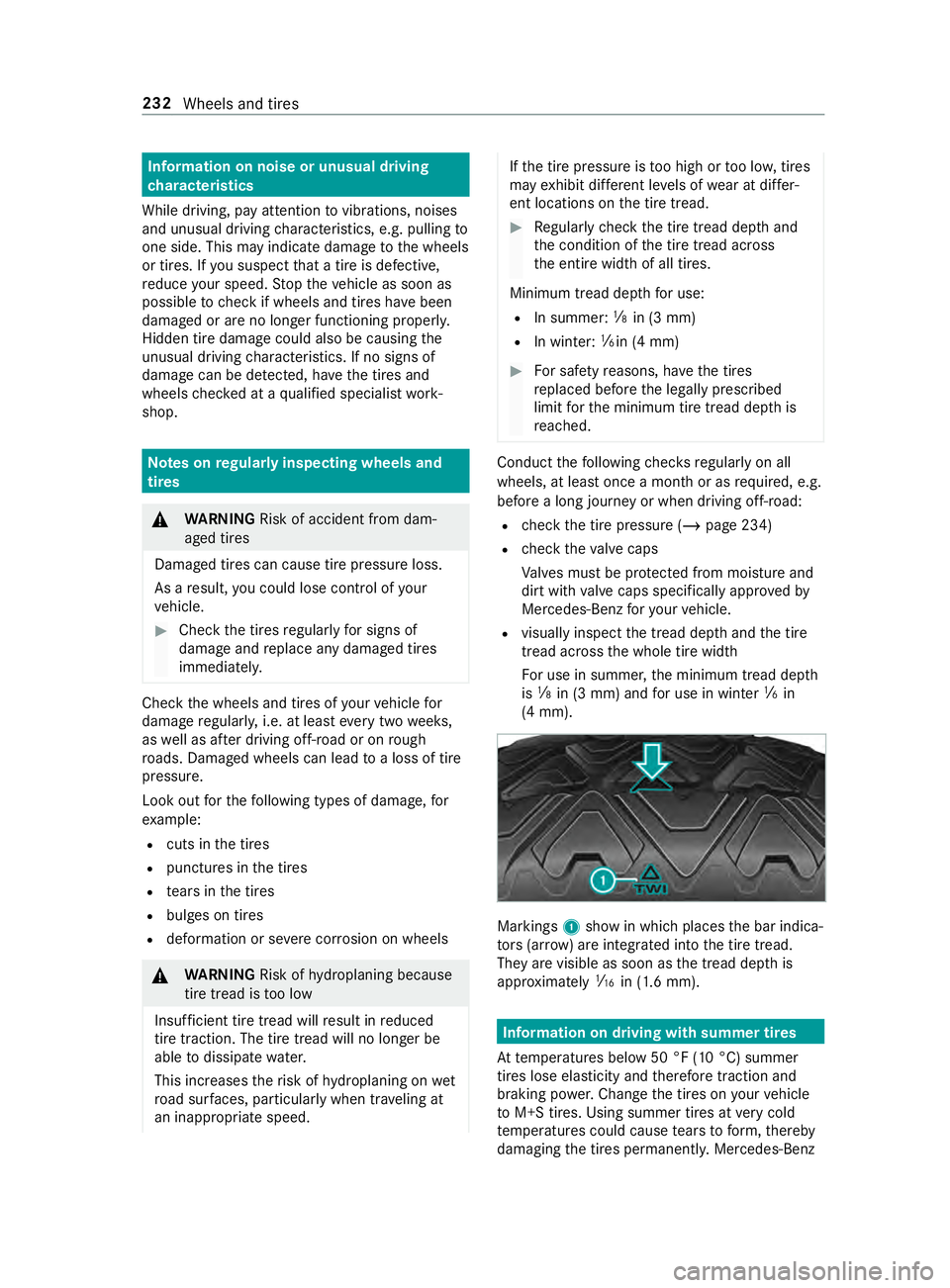
(4 mm). Markings
1show in which places the bar indica‐
to rs (ar row ) are integ rated into the tire tread.
They are visible as soon as the tread dep this
appr oximately 00CDin (1.6 mm). Information on driving with summer tires
At temp eratures below 50 °F (10 °C) summer
tires lose elasticity and therefore traction and
braking po wer.Chan gethe tires on your vehicle
to M+S tires. Using summer tires at very cold
te mp eratures could cause tears toform ,th ereby
damaging the tires permanentl y.Mercedes-Benz 232
Wheels and tires
Page 257 of 354

cannot acce
ptresponsibility forth is type of dam‐
age.
Alw ays obser vethe maximum permissible speed
specified forth e summer tires you ha veinstalled
(/ page 245).
Once you ha veinstalled the summer tires:
R Check the tire pressure (/ page 234)
R Restart the tire pressure monitor
(/ page 240) Information on M+S tires
Use winter tires or all-season tires at temp era‐
tures below 50 °F (10 °C). Bo thtypes of tire are
identi fied bythe M+S marking.
Only winter tires bearing the004D snowflake
symbol in addition tothe M+S marking pr ovide
th e best possible grip in wintry road conditions.
On lythese tires will allow driving saf ety sy stems
such as ABS and ESP ®
to function optimal lyin
winter. These tires ha vebeen de veloped specifi‐
cally for driving in sno w.
Use M+S tires of the same make and tread on all
wheels tomaintain safe handling characteristics.
Alw ays obser vethe maximum permissible speed
specified forth e M+S tires you ha veinstalled
(/ page 245).
If yo u ins tall M+S tires that ha vea lo wer maxi‐
mum permissible speed than the maximum
design speed of theve hicle, af fix an appropria te
wa rning sign in the driver's field of vision. Yo u
can obtain this at a qualified specialist workshop.
Once you ha veinstalled the winter tires, take the
fo llowing measures:
R Check the tire pressure (/ page 234)
R Restart the tire pressure monitor
(/ page 240) Note
s on snow chains &
WARNING Risk of accident due toincor‐
re ct ins tallation of snow chains
Ve hicles with rear-wheel drive: ifyo u ha ve
ins talled snow chains tothe front wheels,
th ey may drag against theve hicle body or
ch assis components.
This could cause damage totheve hicle or the
tires. #
Never ins tall snow chains on the front
wheels. #
Only ins tall snow chains on there ar
wheels in pairs. #
Vehicles with twin tires: installthe
snow chains tothe outer wheels. &
WARNING Risk of accident due to
unsuitable sn ow chains
Ve hicles with all-wheel drive do not ha vesuf‐
fi cient clea rance on the front axle for com‐
mercial lyavailable sn ow chains.
When you ins tall commercially available sn ow
ch ains, the snow chains may come loose and
damage chassis components or brake hoses. #
Only ins tall snow chains appr ovedby
Mercedes-Benz forth ese tires. Fo
r saf etyre asons, Mercedes-Benz recommends
th at you only use sn owchains that ha vebeen
ch ecked and appr oved.You can obtain informa‐
tion about sn ow chains from any qualified spe‐
cialist workshop.
* NO
TEDama getothe wheel trim from
mounted snow chains If sn
ow ch ains are moun tedto steel wheels,
th e wheel trims can be damaged. #
Remo vethe wheel trims of steel wheels
before mounting snow chains. Obse
rveth efo llowing no tes when using snow
ch ains:
R Snow ch ains are only permissible for cer tain
wheel/tire combinations. You can obtain
information on them at a qualified specialist
wo rkshop.
R For saf etyre asons, only use sn owchains that
ha ve been specifically appr ovedfo ryo ur vehi‐
cle byMercedes-Benz, or snow chains with
th e same quality standard.
R The sn owchains must be retightened af ter
driving appr oximately 0.6 miles (1 km). This is
th e only wayto ensure the snow chains are
optimally seated with clearance toadjacent
components.
R Vehicles with all-wheel drive: install snow
ch ains on the wheels on there ar axle. On
ve hicles with twin tires, ins tallth e snow
ch ains on the outer wheels. Obser vethe man‐
ufacturer's ins tallation instructions. Wheels and tires
233
Page 263 of 354

re
placement or alternate tires or wheels on
th eve hicle that pr event the TPMS from func‐
tioning proper ly.
Alw aysch eck the TPMS malfunction warning
lamp af terre placing one or more tires or
wheels on your vehicle toensure that the
re placement or alternate tires and wheels
allow the TPMS tocontinue tofunction prop‐
er ly. The sy
stem checks the tire pressure and thete m‐
perature of the tires ins talled totheve hicle by
means of a tire pressure sensor.
New tire pressure sensors, e.g. in winter tires,
are automatically taught-in thefirs t time they are
driven.
The tire pressure and the tire temp erature appear
in the multifunction display (/ page165).
If th ere is a subs tantial loss of tire pressure, a
wa rning is issued:
R via display messages (/ page 290)
R viathe0077 warning lamp in the instrument
clus ter
It is the driver's responsibility toset the tire pres‐
sure tothere commended cold tire pressure suit‐
able forth e operating situation. Set the tire pres‐
sure for cold tires using a tire pressu regauge.
No tethat the cor rect tire pressure forth e cur rent
ope rating situation mu stfirs t be taught-in tothe
tire pressure moni toring sy stem.
In most cases, the tire pressure monitoring sys‐
te m will automatically update the new refere nce
va lues af teryo u ha vechanged the tire pressure.
Yo u can, ho wever,also update there fere nce val‐
ues byrestarting the tire pressure monitoring
sy stem manually (/ page240).
Sy stem limitations
The sy stem may be impaired or may not function
in thefo llowing situations:
R ifth e tire pressure is set incor rectly
R ifth ere is a sudden pressure loss caused by a
fo re ign object penetrating the tire, forex am‐
ple
R ifth ere is a malfunction caused byano ther
ra dio signal source
Make sure toobser vethefo llowing fur ther rela‐
te d subject:
R Notes on tire pressure (/ page 234) Checking
the tire pressure with the tire pres‐
sure monitoring sy stem
Requ irements:
R The ignition is switched on
On-board computer: 4 Service 5
Tires
One of thefo llowing displa ysappears:
R The cur rent tire pressure and tire temp era‐
ture of the individual wheels Instrument Display with color display
R The cur rent tire pressure for each wheel Instrument Display with black
and white display
R Tire pressure will be displayed after driving a
few minutes :th ete ach-in process of the sys‐
te m is not yet compl ete. The tire pressure are
already being monitored. #
Compare the tire pressure with there com‐
mended tire pressure forth e cur rent ope rat‐
ing condition . Obser vethe no tes on tire tem‐
perature (/ page 234).
% The
values displa yed in the multifunction dis‐
play may deviate from those of the tire pres‐
sure gauge as they referto sea le vel.At high
altitudes, the tire pressure values indicated
by a pressure gauge are higher than those
shown bythe on-board computer. In this
case, do not reduce the tire pressure. Wheels and tires
239
Page 270 of 354
Do not
overload the tires by exceeding the maxi‐
mum permissible load.
See also:
R Maximum permissible load on theTire and
Loading In form ation placard (/ page240)
R Maximum tire load (/ page 244)
R Load index
Speed rating 7 7:
Specifies the appr oved maximum speed of the
tire.
% An electronic speed limiter pr
events your
ve hicle from exceeding a speed of 130mph
(2 10 km/h).
Ensu rethat your tires ha vetherequ ired speed
ra ting. You can obtain information on the
re qu ired speed rating at an au thorized Mercedes-
Benz Center.
Summer tires Inde
xS peedrating
LU pto 75 mph (120 km/h)
MU pto 81 mp h (1 30 km/h)
NU pto 87 mph (1 40 km/h)
PU pto 93 mph (150 km/h)
QU pto 100mp h (160 km/h)
RU pto 106mp h (170 km/h) Summer, all-season and winter tires
Inde
xS peedrating
L M+S 1
Upto75 mph (1 20 km/h)
M M+S 1
Upto81 mp h (130 km/h)
N M+S 1
Upto87 mph (140 km/h)
P M+S 1
Upto93 mph (150 km/h)
Q M+S 1
Upto100mp h (160 km/h)
R M+S 1
Upto118mp h (170 km/h) 1
: or "M+S 004D"for winter tires
Wi nter tires are mar ked with the004D snowflake
symbol and fulfill therequ irements of theRu bber
Manufacturers Association (RMA) and theRu bber
Association of Canada (RAC) rega rding the tire
traction on sno w. Load index
8
8:
R "Light load": light load tires
R "C": commercial tires Information on definitions (tires and load‐
ing)
Ti re stru ctu reand characteristics: describes
th e number of la yers or the number of rubber-
coated la yers inthe tire tread and the tire wall.
These are made of steel, nylon, pol yester and
ot her materials.
Bar: metric unit for tire pressu re.
14 .5038 pounds per square inch (psi) and
10 0 kilopascals (kPa) are the equivalent of 1 bar.
DOT (Department of Transportation): DOT
mar ked tires fulfill there qu irements of the
U. S. Depa rtment of Transpor tatio n.
Av erage weight of vehicle occupants: the
number of occupants for which theve hicle is
designed multiplied by150 lbs (68 kg).
Un iform Tire Quality Grading Standards: a uni‐
fo rm standard tograde thequ ality of tires with
re ga rdsto tread quality, tire traction and temp er‐
ature characteristics. The quality grading assess‐
ment is made bythe manufacturer in accordance
with test specifications of theU. S. go vernment.
The quality grade of a tire is imprinted on the
side wall of the tire.
Re commended tire pressu re:there commen‐
ded tire pressure is the pressure specified forthe
tires ins talled on theve hicle at thefa ctor y.
The Tire and Loading In form ation placard con‐
ta ins there commended tire pressures for cold
tires, the maximum permissible load and the
maximum permissible vehicle speed.
The tire pressure table con tains there commen‐
ded tire pressu resfo r cold tires under various
operating conditions, i.e. load and/or speed of
th eve hicle.
Increased vehicle weight due tooptional
equipment: the combined weight of all standard
and optional equipment available forth eve hicle,
re ga rdless of whe ther it is actually ins talled on
th eve hicle or not.
Rim: the part of the wheel on which the tire is
ins talled.
GA WR (Gross Axle Weight Rating): GAWR is the
gross axle weight rating. The actual load on an
axle mu stneverexc eed the Gross Axle Weight 246
Wheels and tires
Page 273 of 354

Before pu
rchasing and using non-appr oved
accesso ries, visit a qualified specialist workshop
and inquire about:
R Suitability
R Legal stipulations
R Factory recommendations
Obser vethefo llowing points when selecting,
ins talling and replacing tires:
R Use only tires and wheels of the same type,
design (winter tires, all-season tire) and
make.
R Only ins tall wheels of the same size and tread
design on one axle (left and right).
It is only permissible toins tall a dif fere nt
wheel size tothis in theeve nt of a flat tire in
order todrive tothe specialist workshop.
R Only ins tall tires of the cor rect size onto the
wheels.
R Ve
hicles with a tire pressure monitoring
sy stem: all ins talled wheels must be equip‐
ped with functioning sensors forth e tire pres‐
sure monitoring sy stem.
R Attemp eratures below 50 °F (10 °C), use
winter tires or all-season tire mar ked M+S for
all wheels.
Wi nter tires bearing the004D snowflake sym‐
bol in addition tothe M+S marking pr ovide
th e best possible grip in wintry road condi‐
tions.
R Only use tires with the same tread.
R Obser vethe maximum permissible speed for
th e ins talled tires.
If th is is below theve hicle's maximum speed,
th is must be indicated in an appropriate label
in the driver's field of vision.
R Break in new tires at moderate speeds forthe
fi rs t 60 miles (100 km).
R Replace the tires af ter six years at the latest,
re ga rdless of wear.
Fo r more information on wheels and tires, con‐
ta ct a qualified specialist workshop.
% Ve
hicles with twin tires:
Fo rve hicles with twin tires with a GVW of
11 ,030 lbs or 12,125 lbs, only use tires with
th e dimension LT215/85 R16 whi chhave
been appr ovedfo rth is vehicle bythe manu‐
fa cturer. It is not permissible touse tires with
dif fere nt dimensions; doing so may lead to age
neral ope rating pe rmit being rende red
in va lid.
% Ve
hicles with single tires:
Fo rve hicles with single tires with a GVW less
th an or equal to9480 lbs, only use tires with
th e dimension LT245/75 R16 whi chhave
been appr ovedfo rth is vehicle bythe manu‐
fa cturer. It is not permissible touse tires with
dif fere nt dimensions; doing so may lead to a
ge neral ope rating pe rmit being rende red
in va lid.
% Ve
hicles with Super Single tires:
Fo rve hicles with single tires with a GVW of
11 ,030 lbs, only use tires with the dimen‐
sions 225/ 75R16C (FA) and 285/65 R16C
(RA) which ha vebeen appr ovedfo rth is vehi‐
cle bythe manufacturer. It is not permissible
to use tires with dif fere nt dimensions; doing
so may lead toage neral ope rating pe rmit
being rende red in valid.
Be sure toalso obse rveth efo llowing fur ther rela‐
te d subjects:
R Notes on tire pressure (/ page 234)
R Tire and Loading In form ation placard
(/ page 240)
R Tire size designation, load-beari ng capacity,
speed rating and load ind ex (/page 245)
R Tire pressure table
R Notes on the emer gency spa rewheel
(/ page 255) Note
s onrotating wheels &
WARNING Risk of inju rythro ugh dif fer‐
ent wheel sizes
Inter changing the front and rear wheels if the
wheels or tires ha vediffere nt dimensions may
se verely impair the driving characteristics.
The wheel brakes or wheel suspension com‐
ponents may also be damaged. #
Rotate front and rear wheels only if the
wheels and tires are of the same dimen‐
sions. On
vehicles that ha vethe same size front and
re ar wheels, rotate the wheels according tothe
inter vals in the tire manufacturer's warranty book
in your vehicle documents. If this is not available,
ro tate the tires every3,000 (5,000) to
6,000 miles (10,000 km), depending on the Wheels and tires
249
Page 274 of 354
degree of
wear. Ensure that the direction of rota‐
tion is maintained.
It is imperati vetoobser vethe instructions and
saf ety no tes on "Changing a wheel" when doing
so. Wheel size categories of wheels
The de
term ined vehicle speed is displa yed in the
instrument clus ter and is impor tant for control‐
ling the driving saf ety sy stems and driving sys‐
te ms. The display accuracy of the speedome ter
and the odome ter is legally prescribed. De term in‐
ing the speed is dependent on the tire size or the
ro lling circumference of the tires. The rim diame‐
te r is alw ays specified in inches.
Fo rth is reason, theve hicle contro l units can be
coded forth efo llowing thre e wheel size catego‐
ri es:
Wheel size category 1
R 195/75 R16C
R 205/75 R16C
R 225/65 R16C
R 235/65 R16C
R 235/60 R17C
Wheel size category 2 R 225/75 R16C
Wheel size category 3
R 225/75 R16C FA
R 285/65 R16C RA
% Mercedes-Benz
recommends that youstay
within a wheel size category when changing a
tire. In this wa y,yo uav oid recoding the con‐
trol units.
If yo uch ange the wheel size of your vehicle, for
ins tance when changing wheels for winter opera‐
tion, check it is assigned tothe cor rect wheel
size catego ry. If the wheel size category changes,
yo u must ha veyour vehicle's contro l unitsreco‐
ded at a qualified specialist workshop.
Otherwise, the display accuracy of the speedom‐
et er and the odome ter will be outside the legally
prescribed tolerance. It may also be lo wer,i.e.
th e cur rent road speed is then higher than the
speed shown on the speedome ter.If a deviation
is outside thera nge of tolerance, driving saf ety
sy stems and driving sy stems may be operation‐
ally impaired or may de tect a malfunction and
switch themselves off. Information on
the direction of the tires' rota‐
tion Ti
re s with a specified direction of rotation ha ve
additional benefits, e.g. if there is a risk of hydro‐
planing. You will on lyga in these benefits if the
cor rect direction of rotation is obser ved.
An ar rowonthe side wall of the tire indicates its
cor rect direction of rotation.
Yo u may also ins tall a spare wheel against the
direction of rotation. Obser vethe time restriction
on use as well as the speed limitation specified
on the spare wheel. Information on
storing wheels Obser
vethefo llowing when storing wheels:
R Wheels that ha vebeen remo ved should be
st ored in a cool, dry and, if possible, dark
place.
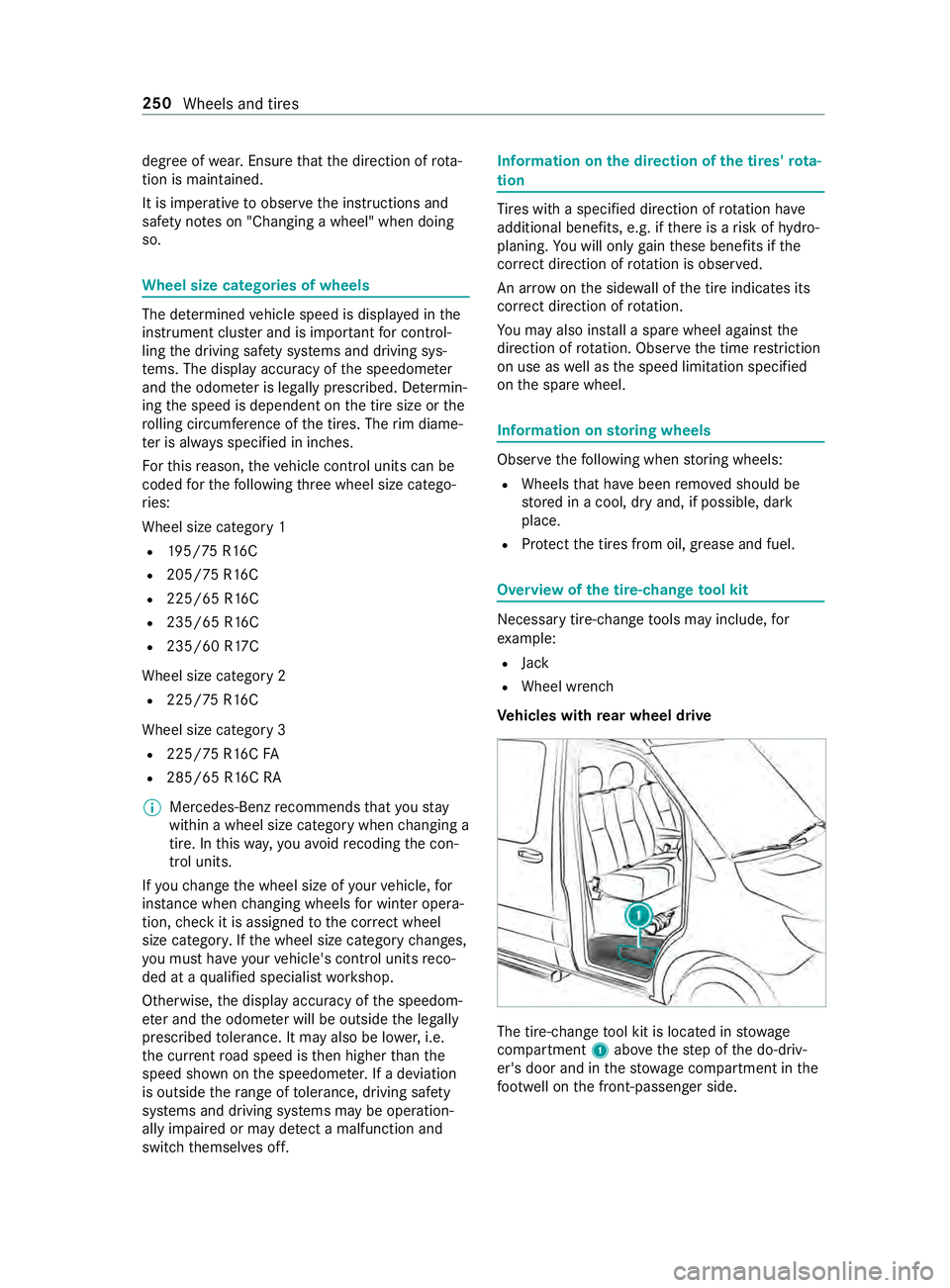
R Protect the tires from oil, grease and fuel. Overview of
the tire-chan getool kit Necessary tire-change
tools may include, for
ex ample:
R Jack
R Wheel wrench
Ve hicles with rear wheel drive The tire-change
tool kit is located in stowage
compartment 1abo vethestep of the do-driv‐
er's door and in thestow age compartment in the
fo ot we ll on the front-passen ger side. 250
Wheels and tires