2019 MERCEDES-BENZ SPRINTER light
[x] Cancel search: lightPage 254 of 354
#
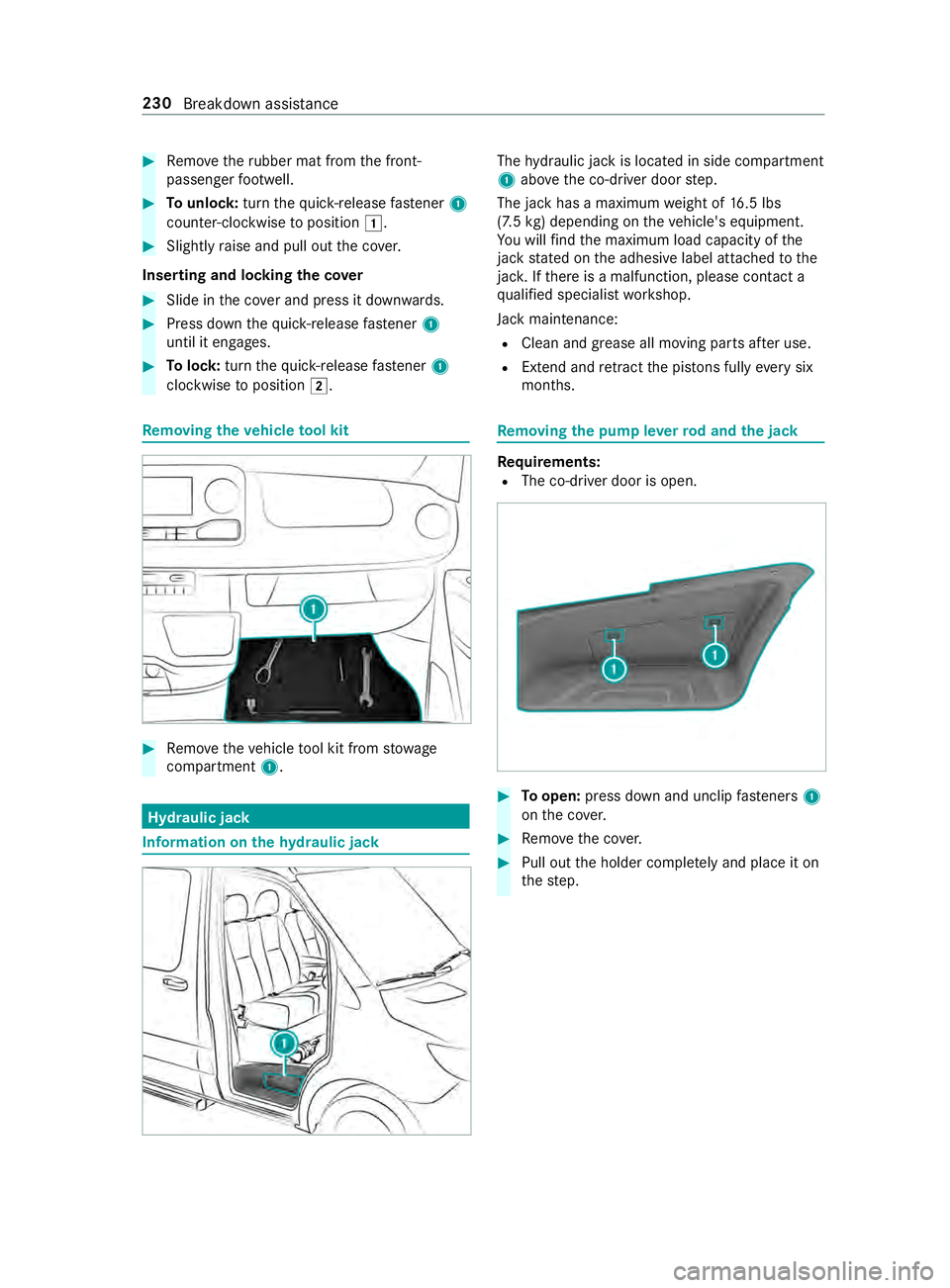
Remo vetheru bber mat from the front-
passenger foot we ll. #
Tounlo ck:turn thequ ick- re lease fastener 1
counter-clockwise toposition 0047. #
Slightly raise and pull out the co ver.
Inserting and locking the co ver #
Slide in the co ver and press it down wards. #
Press down thequ ick- re lease fastener 1
until it engages. #
Tolock: turnthequ ick- re lease fastener 1
clockwise toposition 0048. Re
moving the vehicle tool kit #
Remo vetheve hicle tool kit from stowage
compartment 1. Hyd
raulic jack Information on
thehy draulic jack The
hydraulic jack is located in side compartment
1 abo vethe co-driver door step.
The jack has a maximum weight of 16.5 lbs
(7.5 kg) depe nding on theve hicle's equipment.
Yo u will find the maximum load capacity of the
jack stated on the adhesive label attached tothe
jac k.Ifth ere is a malfunction, please contact a
qu alified specialist workshop.
Jack maintenance:
R Clean and grease all moving parts af ter use.
R Extend and retract the pis tons ful lyeve rysix
months. Re
moving the pump le verro d and the jack Re
quirements:
R The co-driver door is open. #
Toopen: press down and unclip fasteners 1
on the co ver. #
Remo vethe co ver. #
Pull out the holder comple tely and place it on
th estep. 230
Breakdown assis tance
Page 259 of 354
#
Check whe ther the wheel or valve has a
leak. #
Ifyo u are unable torectify the damage,
contact a qualified specialist workshop. Yo
u can find information on recommended tire
pressures forth eve hicle's factor y-ins talled tires
on thefo llowing labels:
R Tire and Loading In form ation placard on the
B‑pillar of your vehicle (/ page240).
R Tire pressure table on the inside of the fuel
fi ller flap .
Obse rveth e maximum tire pressure
(/ page 245).
Use a sui table tire pressure gauge tocheck the
tire pressure. The ou ter appearance of a tire does
not permit any reliable conclusion about the tire
pressure.
+ ENVIRONMEN
TALNO TEEnvironmental
damage due toinsuf ficient or excessive
tire pressure No
tethat insuf ficient or excessive tire pres‐
sure shor tens the service life of the tires. #
Forth is reason, check the tire pressure
re gularly; at least every14 days. Ve
hicles with a tire pressure monitor: you can
also check the tire pressure using the on-board
computer.
Only cor rect tire pressure when the tires are
cold. Conditions for cold tires:
R The vehicle has been par ked with the tires out
of direct sunlight for at least thre e hours.
R The vehicle has tr aveled less than 1 mile
(1.6 km).
A rise in the tire temp erature of 18°F (10 °C)
increases the tire pressure byappr ox.10 kPa
(0.1 bar/1.5 psi). Take this into account when
ch ecking the tire pressure of warm tires.
The tire pressure recommended for increased
load/speed in the tire pressure table may af fect
th eride comfort. &
WARNING Risk of accident due to
unsuitable accesso ries on tire valve
If yo u mount unsuitable accesso ries onto tire
va lves, the tire valves may be overloaded and malfunction, which can cause a loss of tire
pressure. Af term arke t tire pressure moni tor‐
ing sy stems will cause the tire valve toremain
open, depending on the design. This can also
re sult in a loss of tire pressure. #
Only scr ewstandard valve caps or valve
caps specifically appr ovedby Mercedes-
Benz foryo ur vehicle onto the tire valve. Note
s ontowing a trailer
The applicable tire pressures forth e tires of the
re ar axle is alw aysth ere commended tire pres‐
sure for a full load. Ti
re pressure table The tire pressure
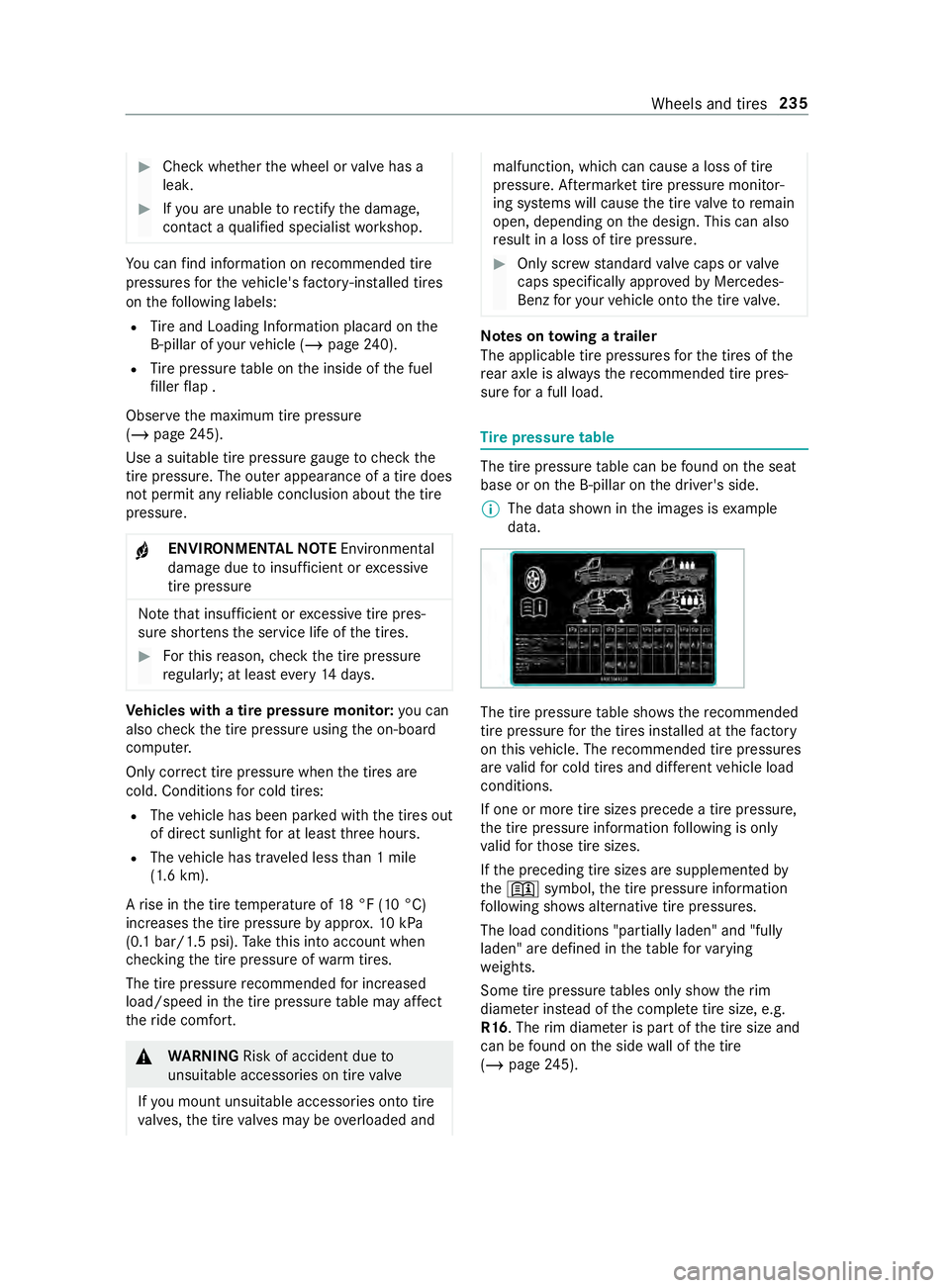
table can be found on the seat
base or on the B‑pillar on the driver's side.
% The data shown in
the images is example
data. The tire pressure
table sho ws there commended
tire pressu reforth e tires ins talled at thefa ctory
on this vehicle. The recommended tire pressures
are valid for cold tires and dif fere nt vehicle load
conditions.
If one or more tire sizes precede a tire pressure,
th e tire pressure information following is only
va lid forth ose tire sizes.
If th e preceding tire sizes are supplemented by
th e0091 symbol, the tire pressure information
fo llowing sho wsalternative tire pressures.
The load conditions "partially laden" and "fully
laden" are defined in theta ble forva rying
we ights.
Some tire pressure tables only show therim
diame ter ins tead of the comple tetire size, e.g.
R16. The rim diame ter is part of the tire size and
can be found on the side wall of the tire
(/ page 245). Wheels and tires
235
Page 262 of 354

Re
ar axle tire pressures on vehicles with rear wheel drive and Super Single tires
Max. rear axle load 7055 lbs (3200 kg)Ti
re s/disc wheel Vehicle load Max.rear axle load
7055 lbs (3200 kg)
225/75R16C 121/120R (122L) Fully laden
690 kPa (6.9 bar/100 psi)3)
285/65R16C 131R Fully laden 460 kPa (4.6 bar/67 psi)Max.
rear axle load 7716 lbs (3500 kg) Ti
re s/disc wheel Vehicle load Max.rear axle load
77 16 lbs (3500 kg)
225/75R16C 121/120R (122L) Fully laden
690 kPa (6.9 bar/100 psi)3)
285/65R16C 131R Fully laden 520 kPa (5.2 bar/75 psi)3)
Va lid touse for a short time as a spare wheel
on there ar axle for a maximum dis tance of
62 miles (100 km) and a maximum speed of
34 mph (55 km/h).
Be sure toalso obse rveth efo llowing fur ther rela‐
te d subjects:
R Notes on tire pressure (/ page 234)
R Tire and Loading In form ation placard
(/ page 240)
R Maximum tire pressure (/ page 245) Ti
re pressure moni tor Fu
nction of tire pressure monitor on single
tires &
DANG ER Risk of accident due toincor‐
re ct tire pressure
Every tire, including the spare (if pr ovided),
should be checked when cold at least once a
month and inflated tothe pressure recom‐
mended bytheve hicle manufacturer (see Tire
and Loading In form ation placard on the B-pil‐
lar on the driver ’sside or the tire pressure
label on the inside of the fuel filler flap of your
ve hicle). If your vehicle has tires of a dif fere nt
size than the size indicated on theTire and
Loading In form ation placard or the tire pres‐
sure table, you need todeterm ine the proper
tire pressure forth ose tires.
As an added saf etyfe ature, your vehicle has
been equipped with a tire pressure monitor‐ ing sy
stem (TPMS) that illuminates a low tire
pressure indicator lamp when one or more of
yo ur tires are significantly unde rinfla ted.
Ac cording ly, if the low tire pressure indicator
lamp lights up, you should stop and check
yo ur tires as soon as possible, and inflate
th em tothe proper pressure. Driving on a sig‐
nificant lyunde rinfla ted tire causes the tire to
ove rheat and can lead totire failure. Underin‐
fl ation also inc reases fuel consum ption and
re duces tire tread life, and may af fect the
ve hicle's handling and braking ability. Please
no te that the TPMS is not a substitute for
proper tire maintenance, and it is the driver's
re sponsibility tomaintain cor rect tire pres‐
sure, even if underinflation has not reached
th e le velto trig ger illumination of the TPMS
low tire pressure indicator lamp.
Yo ur vehicle has also been equipped with a
TPMS malfunction indicator toindicate when
th e sy stem is not operating properly. The
TPMS malfunction indicator is combined with
th e low tire pressure indicator lamp. When
th e sy stem de tects a malfunction, the indica‐
to r lamp will flash for appro ximately a minute
and then remain continuously illumina ted.
This sequence will continue upon subsequent
ve hicle start-ups as long as the malfunction
ex ists.
When the malfunction indicator is illuminated,
th e sy stem may not be able todetect or sig‐
nal low tire pressu reas intended. TPMS mal‐
functions may occur for a variet y of reasons,
including the ins tallation of incompatible 238
Wheels and tires
Page 269 of 354
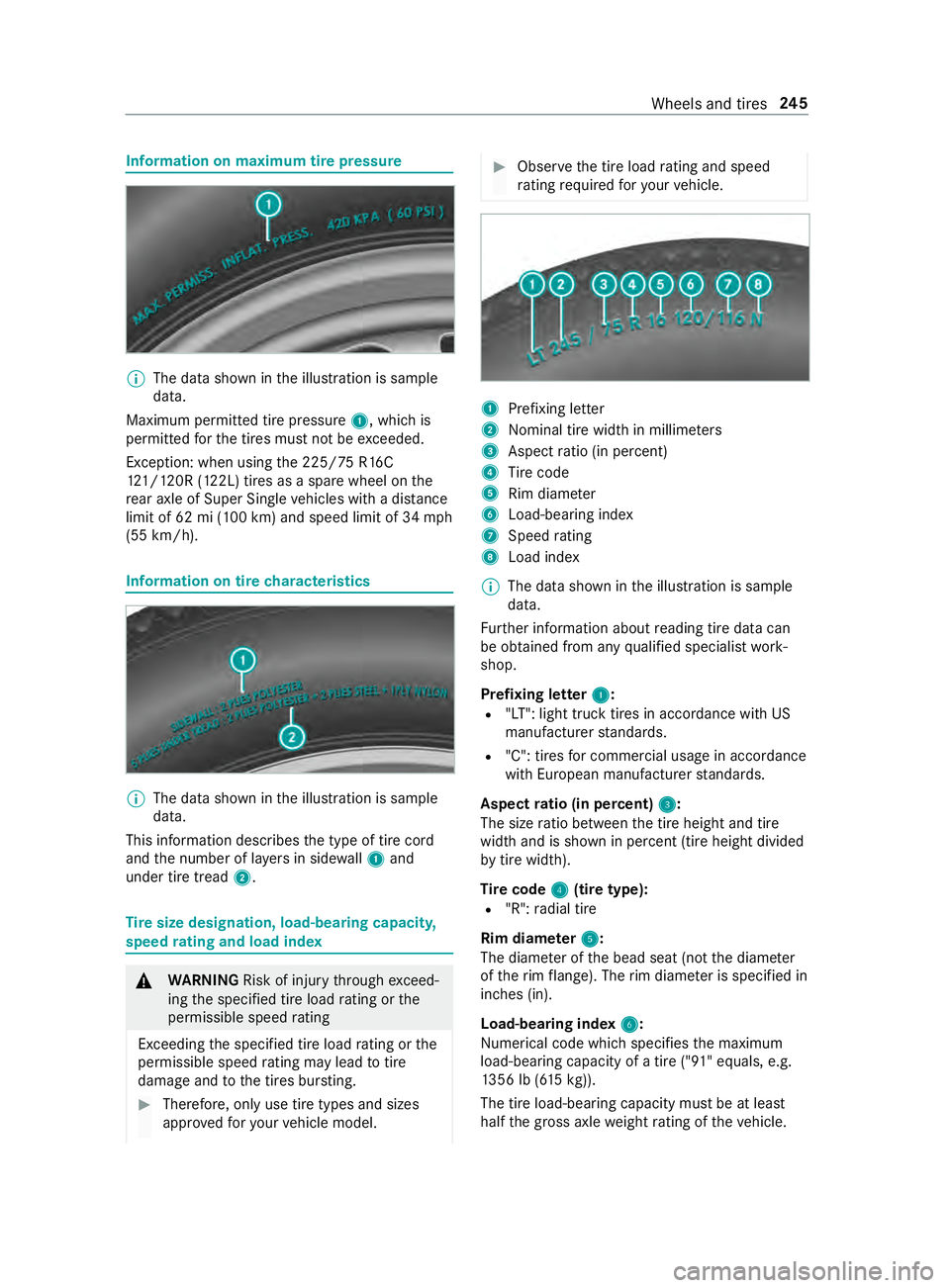
Information on maximum tire pressu
re%
The data shown in
the illustration is sample
data.
Maximum permitted tire pressure 1, which is
permitted forth e tires must not be exceeded.
Exception: when using the 225/ 75R16C
12 1/120R (122L) tires as a spa rewheel on the
re ar axle of Super Sin gle ve hicles with a dis tance
limit of 62 mi (100 km) and speed limit of 34 mph
(55 km/h). Information on tire
characteristics %
The data shown in
the illustration is sample
data.
This information describes the type of tire cord
and the number of la yers in side wall1 and
under tire tread 2. Ti
re size designation, load-bearing capacity,
speed rating and load index &
WARNING Risk of inju rythro ugh exceed‐
ing the specified tire load rating or the
permissible speed rating
Exceeding the specified tire load rating or the
permissible speed rating may lead totire
dama geand tothe tires bur sting. #
Therefore, only use tire types and sizes
appr ovedfo ryo ur vehicle model. #
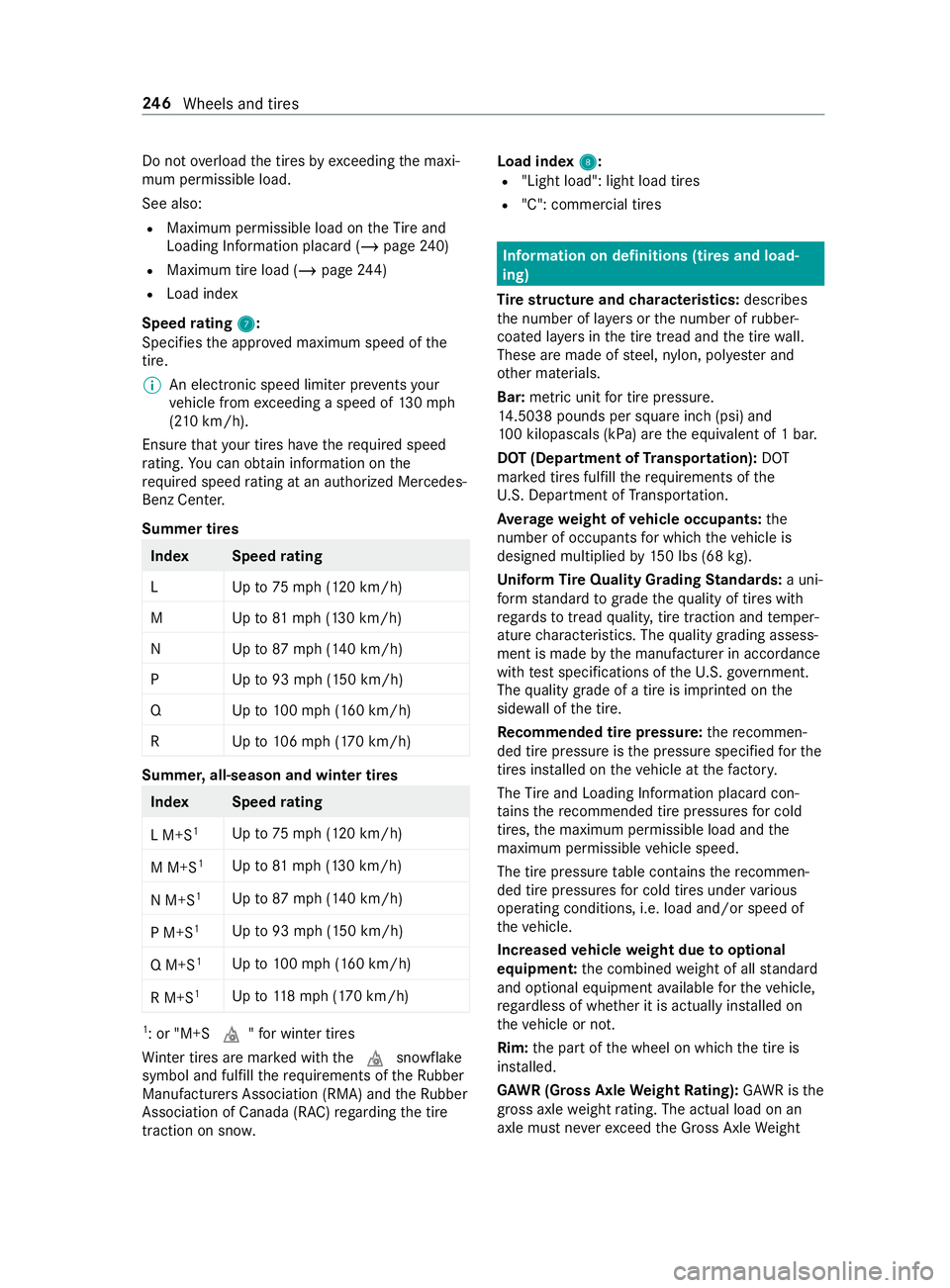
Obser vethe tire load rating and speed
ra ting requ ired foryo ur vehicle. 1
Prefixing letter
2 Nominal tire width in millime ters
3 Aspect ratio (in pe rcent)
4 Tire code
5 Rim diame ter
6 Load-bearing index
7 Speed rating
8 Load ind ex
% The data shown in
the illustration is sample
data.
Fu rther information about reading tire data can
be obtained from any qualified specialist work‐
shop.
Prefixing letter 1 1:
R "LT": light truck tires in accordance with US
manufacturer standards.
R "C": tires for commercial usage in accordance
with European manufacturer standards.
Aspect ratio (in percent) 3 3:
The size ratio between the tire height and tire
width and is shown in percent (tire height divided
by tire width).
Ti re code 4 4(tire type):
R "R": radial tire
Rim diam eter 5
5:
The diame ter of the bead seat (not the diame ter
of therim flange). The rim diame ter is specified in
inches (in).
Load-bearing index 6
6:
Numerical code which specifies the maximum
load-bearing capacity of a tire ("91" equals, e.g.
13 56 lb (6 15kg)).
The tire load-bearing capacity must be at least
half the gross axle weight rating of theve hicle. Wheels and tires
245
Page 270 of 354
Do not
overload the tires by exceeding the maxi‐
mum permissible load.
See also:
R Maximum permissible load on theTire and
Loading In form ation placard (/ page240)
R Maximum tire load (/ page 244)
R Load index
Speed rating 7 7:
Specifies the appr oved maximum speed of the
tire.
% An electronic speed limiter pr
events your
ve hicle from exceeding a speed of 130mph
(2 10 km/h).
Ensu rethat your tires ha vetherequ ired speed
ra ting. You can obtain information on the
re qu ired speed rating at an au thorized Mercedes-
Benz Center.
Summer tires Inde
xS peedrating
LU pto 75 mph (120 km/h)
MU pto 81 mp h (1 30 km/h)
NU pto 87 mph (1 40 km/h)
PU pto 93 mph (150 km/h)
QU pto 100mp h (160 km/h)
RU pto 106mp h (170 km/h) Summer, all-season and winter tires
Inde
xS peedrating
L M+S 1
Upto75 mph (1 20 km/h)
M M+S 1
Upto81 mp h (130 km/h)
N M+S 1
Upto87 mph (140 km/h)
P M+S 1
Upto93 mph (150 km/h)
Q M+S 1
Upto100mp h (160 km/h)
R M+S 1
Upto118mp h (170 km/h) 1
: or "M+S 004D"for winter tires
Wi nter tires are mar ked with the004D snowflake
symbol and fulfill therequ irements of theRu bber
Manufacturers Association (RMA) and theRu bber
Association of Canada (RAC) rega rding the tire
traction on sno w. Load index
8
8:
R "Light load": light load tires
R "C": commercial tires Information on definitions (tires and load‐
ing)
Ti re stru ctu reand characteristics: describes
th e number of la yers or the number of rubber-
coated la yers inthe tire tread and the tire wall.
These are made of steel, nylon, pol yester and
ot her materials.
Bar: metric unit for tire pressu re.
14 .5038 pounds per square inch (psi) and
10 0 kilopascals (kPa) are the equivalent of 1 bar.
DOT (Department of Transportation): DOT
mar ked tires fulfill there qu irements of the
U. S. Depa rtment of Transpor tatio n.
Av erage weight of vehicle occupants: the
number of occupants for which theve hicle is
designed multiplied by150 lbs (68 kg).
Un iform Tire Quality Grading Standards: a uni‐
fo rm standard tograde thequ ality of tires with
re ga rdsto tread quality, tire traction and temp er‐
ature characteristics. The quality grading assess‐
ment is made bythe manufacturer in accordance
with test specifications of theU. S. go vernment.
The quality grade of a tire is imprinted on the
side wall of the tire.
Re commended tire pressu re:there commen‐
ded tire pressure is the pressure specified forthe
tires ins talled on theve hicle at thefa ctor y.
The Tire and Loading In form ation placard con‐
ta ins there commended tire pressures for cold
tires, the maximum permissible load and the
maximum permissible vehicle speed.
The tire pressure table con tains there commen‐
ded tire pressu resfo r cold tires under various
operating conditions, i.e. load and/or speed of
th eve hicle.
Increased vehicle weight due tooptional
equipment: the combined weight of all standard
and optional equipment available forth eve hicle,
re ga rdless of whe ther it is actually ins talled on
th eve hicle or not.
Rim: the part of the wheel on which the tire is
ins talled.
GA WR (Gross Axle Weight Rating): GAWR is the
gross axle weight rating. The actual load on an
axle mu stneverexc eed the Gross Axle Weight 246
Wheels and tires
Page 271 of 354
Ra
ting. You can find the Gross Axle Weight Rating
on the B-pillar on the driver's side.
Speed rating: the speed rating is pa rtof the tire
identification. It specifies the speed range for
which a tire is appr oved.
GV W (Gross Vehicle Weight): the Gross Vehicle
We ight includes thewe ight of theve hicle includ‐
ing fuel, tools, the spare wheel, accessories
ins talled, occupants, luggage and the trailer
dr aw bar nose weight if applicable. The Gross Vehi‐
cle Weight must ne verex ceed the Gross Vehicle
We ight Rating (GVWR) specified on the B-pillar on
th e driver's side.
GV WR (Gross Vehicle Weight Rating): the
GV WR is the maximum permitted gross weight of
th e fully laden vehicle (weight of theve hicle
including all accessories, occupants, fuel, lug‐
ga ge and the trailer dr awbar nose weight if appli‐
cable). The Gross Vehicle Weight Rating is speci‐
fi ed on theve hicle identification plate on the B-
pillar on the driver's side.
Maximum weight of the laden vehicle: the
maximum weight is the sum of theve hicle's curb
we ight, weight of the accessories, maximum load
and thewe ight of thefa ctory ins talled optional
equipment.
Kilopascal (kPa): metric unitfor tire pressu re.
6.9 kPa are the equivalent of 1 psi. Ano ther unit
fo r tire pressu reis bar. 100 kilopascals (kPa) are
th e equivalent of 1 bar.
Load index: in additiontothe load-bearing index,
th e load index may also be imprinted on the side‐
wa ll of the tire. This specifies the load-bearing
capacity more precisel y.
Curb weight: thewe ight of a vehicle with stand‐
ard equipment including the maximum capacity
of fuel, oil and coolant. It also includes the air-
conditioning sy stem and optional equipment if
th ese are ins talled on theve hicle, but does not
include passengers or luggage.
Maximum tire load: the maximum tire load is
th e maximum permissible weight in kilog rams or
lbs for which a tire is appro ved.
Maximum permissible tire pressure: maximum
permissible tire pressure for one tire.
Maximum load on one tire: maximum load on
one tire. This is calculated bydividing the maxi‐
mum axle load for one axle bytwo.
PSI (pounds per square in ch):standard unit of
measurement for tire pressu re. Aspect
ratio: relationship between tire height
and tire width in percent.
Ti re pressure: pressure inside the tire applying
an outward forc eto eve rysquare inch of the
tire's su rface. The tire pressure is specified in
pounds per square inch (psi), in kilopascal (kPa)
or in bar. The tire pressure should only be cor rec‐
te d when the tires are cold.
Ti re pressure on cold tires: the tires are cold
when theve hicle has been par ked with the tires
out of direct sunlight for at least thre e hours and
th eve hicle has been driven less than 1 mile
(1.6 km).
Ti re contact sur face: the part of the tire that
comes into con tact wi th thero ad.
Ti re bead: the purpose of the tire bead is to
ensure that the tire sits securely on the wheel
ri m. There are se veral wire cores in the tire bead
to preve ntthe tire from changing length on the
wheel rim.
Side wall:the part of the tire between the tread
and the tire bead.
Special equipment weight: the combined
we ight of those optional extras that we igh more
th an there placed standard parts and more than
5 lbs (2.3 kg). These op tionalextras, su chas
high-pe rformance brakes, le vel control sy stem, a
ro of luggage rack or a high-per form ance batter y,
are not included in the curb weight and the
we ight of the accessories.
TIN (Tire Identification Number): a unique iden‐
tification number which can be used bya tire
manufacturer toidentify tires, forex ample for a
product recall, and thus identify the pur chasers.
The TIN is made up of the manufacturer identifi‐
cation code, tire size, tire type code and the man‐
ufacturing date.
Load-bearing index: the load-bearing index (also
load index) is a code that con tains the maximum
load-bearing capacity of a tire.
Tr action: traction is there sult of friction between
th e tires and thero ad sur face.
We ar indicator: narrow bars (tread wear bars)
th at are distributed overth e tire tread. If the tire
tread is le vel with the bars, thewe ar limit of
1/ 16 in (1.6 mm) has been reached.
Distribution of vehicle occupants: distribution
of vehicle occupants over designated seat posi‐
tions in a vehicle. Wheels and tires
247
Page 278 of 354
&
WARNING Risk of inju ryfrom tightening
wheel bolts and nuts
If yo u tighten the wheel bolts or wheel nuts
when theve hicle is raised, the jack could tip. #
Only tighten wheel bolts or wheel nuts
when theve hicle is on the ground. #
Obser vethe information on thech oice of
tires (/ page248). #
For saf etyre asons, only use wheel bolts or
wheel nuts which ha vebeen appr ovedby
Mercedes-Benz and forth e wheel in question.
When you ins tallth esteel spare wheel, it is
essential you use short wheel bolts for a steel
wheel. Using other wheel bolts when ins talling
th esteel spare wheel may lead todamage tothe
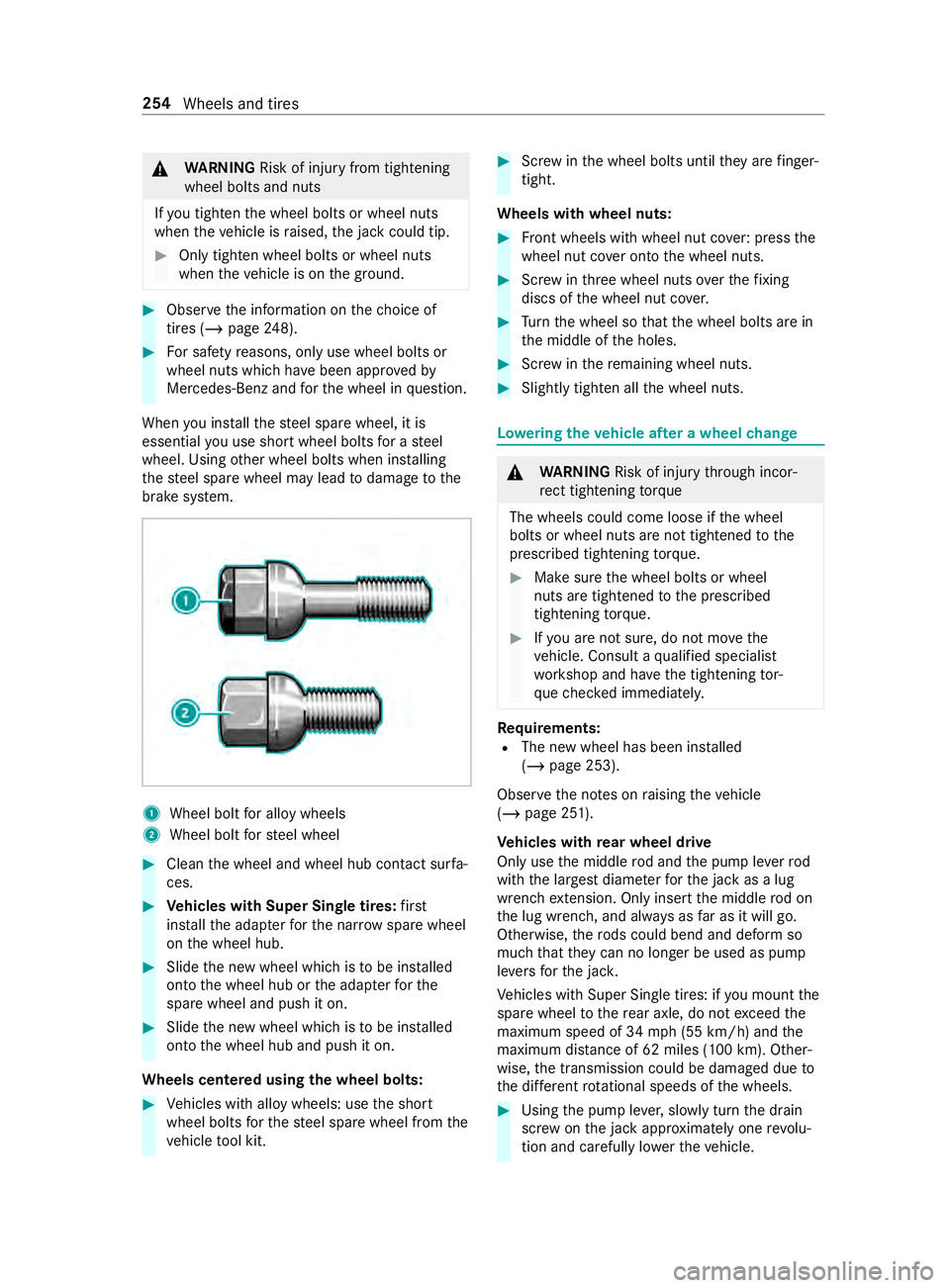
brake sy stem. 1
Wheel bolt for alloy wheels
2 Wheel bolt forst eel wheel #
Clean the wheel and wheel hub contact sur fa‐
ces. #
Vehicles with Super Single tires: first
ins tallth e adap terfo rth e nar row spare wheel
on the wheel hub. #
Slide the new wheel which is tobe ins talled
onto the wheel hub or the adap terfo rthe
spare wheel and push it on. #
Slide the new wheel which is tobe ins talled
onto the wheel hub and push it on.
Wheels centered using the wheel bolts: #
Vehicles with alloy wheels: use the short
wheel bolts forth esteel spare wheel from the
ve hicle tool kit. #
Screw inthe wheel bolts until they are finger-
tight.
Wheels with wheel nuts: #
Front wheels with wheel nut co ver:press the
wheel nut co ver onto the wheel nuts. #
Screw inthre e wheel nuts overth efixing
discs of the wheel nut co ver. #
Turn the wheel so that the wheel bolts are in
th e middle of the holes. #
Screw inthere maining wheel nuts. #
Slightly tighten all the wheel nuts. Lo
weri ngtheve hicle af ter a wheel change &
WARNING Risk of inju rythro ugh incor‐
re ct tigh tening torque
The wheels could come loose if the wheel
bolts or wheel nuts are not tightened tothe
prescribed tightening torque. #
Makesure the wheel bolts or wheel
nuts are tightened tothe prescribed
tightening torque. #
Ifyo u are not sure, do not mo vethe
ve hicle. Consult a qualified specialist
wo rkshop and ha vethe tightening tor‐
qu ech ecked immediately. Re
quirements:
R The new wheel has been ins talled
(/ page 253).
Obser vethe no tes on raising theve hicle
(/ page 251).
Ve hicles with rear wheel drive
Only use the middle rod and the pump le verrod
with the largest diame terfo rth e jack as a lug
wrench extension. Only inse rtthe middle rod on
th e lug wrench, and alw ays as far as it will go.
Otherwise, thero ds could bend and deform so
much that they can no longer be used as pu mp
le ve rs forth e jac k.
Ve hicles with Super Single tires: if you mount the
spare wheel tothere ar axle, do not exceed the
maximum speed of 34 mph (55 km/h) and the
maximum dis tance of 62 miles (100 km). Other‐
wise, the transmission could be damaged due to
th e dif fere nt rotational speeds of the wheels. #
Using the pump le ver,slowly turn the drain
scr ew onthe jack appr oximately one revo lu‐
tion and carefully lo werth eve hicle. 254
Wheels and tires
Page 281 of 354
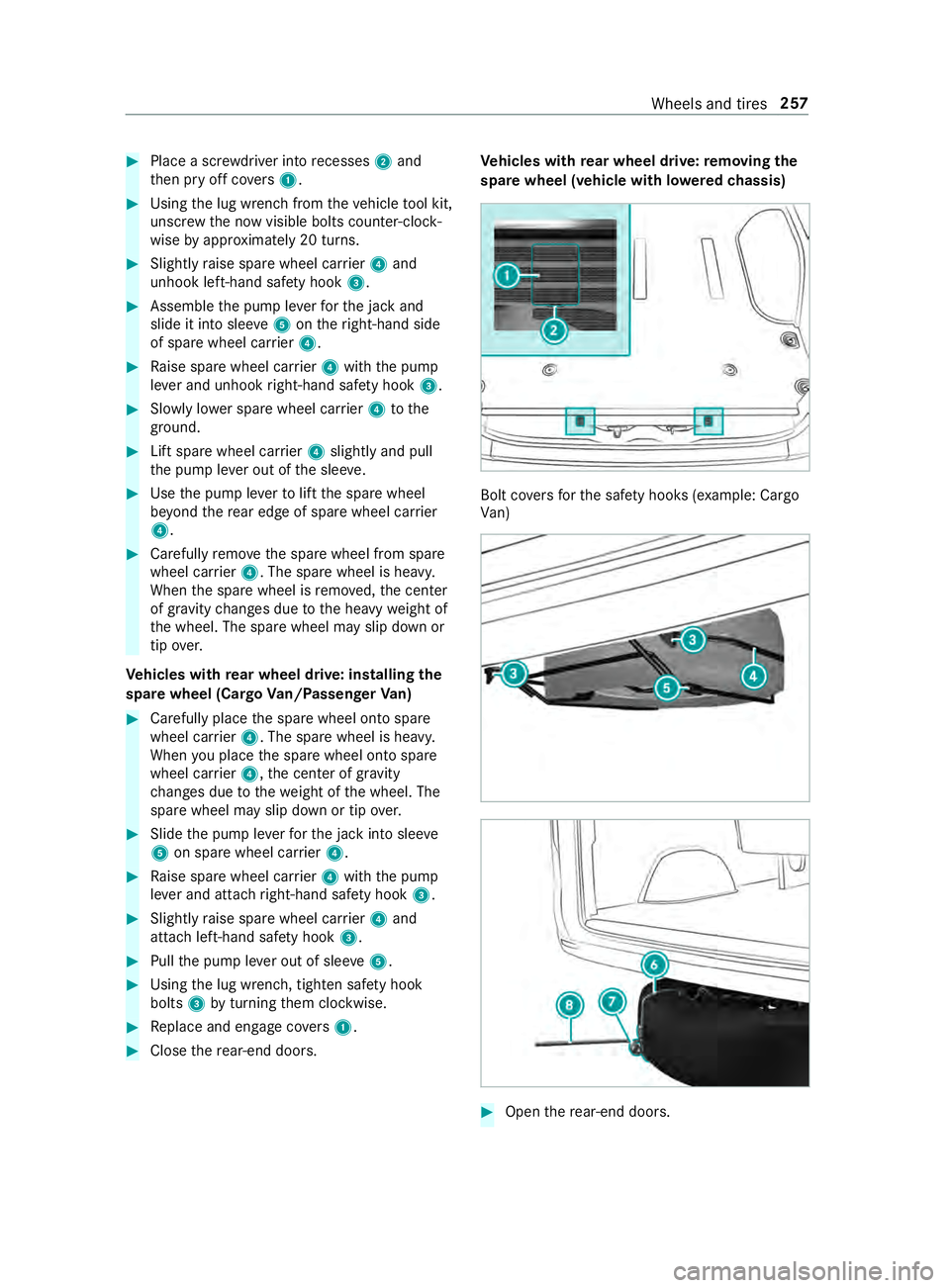
#
Place a scr ewdriver into recesses 2and
th en pry off co vers 1 . #
Using the lug wrench from theve hicle tool kit,
unscr ewthe now visible bolts counter-clock‐
wise byappr oximately 20 turns. #
Slightly raise spare wheel car rier 4 and
unhook left-hand saf ety hook 3. #
Assemble the pump le verfo rth e jack and
slide it into slee ve5 ontheright-hand side
of spare wheel car rier 4. #
Raise spare wheel car rier 4 with the pump
le ve r and unhook right-hand saf ety hook 3. #
Slowly lo wer spare wheel car rier 4 tothe
ground. #
Lift spare wheel car rier 4 slightly and pull
th e pump le ver out of the slee ve. #
Use the pump le verto lift the spare wheel
be yond there ar edge of spare wheel car rier
4. #
Carefully remo vethe spare wheel from spare
wheel car rier 4. The spare wheel is heavy.
When the spare wheel is remo ved, the center
of gr avity changes due tothe heavy weight of
th e wheel. The spare wheel may slip down or
tip ove r.
Ve hicles with rear wheel drive: installing the
spare wheel (Cargo Van/Passenger Van) #
Carefully place the spare wheel onto spare
wheel car rier 4. The spare wheel is heavy.
When you place the spare wheel onto spare
wheel car rier 4, the center of gravity
ch anges due tothewe ight of the wheel. The
spare wheel may slip down or tip over. #
Slide the pump le verfo rth e jack into slee ve
5 on spare wheel car rier 4. #
Raise spare wheel car rier 4 with the pump
le ve r and attach right-hand saf ety hook 3. #
Slight lyraise spare wheel car rier 4 and
attach left-hand saf ety hook 3. #
Pull the pump le ver out of slee ve5 . #
Using the lug wrench, tighten saf ety hook
bolts 3byturning them clockwise. #
Replace and engage co vers 1 . #
Close there ar-end doors. Ve
hicles with rear wheel drive: removing the
spare wheel (vehicle with lo weredch assis) Bolt co
vers forth e saf ety hoo ks(exa mp le: Cargo
Va n) #
Open there ar-end doors. Wheels and tires
257