2019 MERCEDES-BENZ GLA winter tires
[x] Cancel search: winter tiresPage 5 of 346

Stowage and features......................250
Loading guidelines ...............................250
Stowage areas ..................................... 250
Features .............................................. 257
Maintenance and care......................273
Engine compartment ........................... 273
ASSYST PLUS ...................................... 277
Care ..................................................... 278
Roadside Assistance........................286
Where will I find...? .............................. 286
Flat tire ................................................ 287
Battery (vehicle) .................................. 292
Jump-starting ....................................... 295
Towing and tow-starting ......................298
Fuses ................................................... 301
Wheels and tires...............................304
Important safety notes ........................ 304
Operation ............................................ 304
Winter operation .................................. 306
Tire pressure ....................................... 307
Loading the vehicle .............................. 316
All about wheels and tires ................... 319
Changing a wheel ................................ 325
Wheel and tire combinations ...............329
Emergency spare wheel ....................... 330
Technical data...................................332
Information regarding technical data
............................................................. 332
Vehicle electronics .............................. 332
Identification plates .............................333
Service products and filling capaci-
ties ...................................................... 334
Vehicle data ......................................... 339
Vehicle data for off-road driving .......... 340
Contents3
Page 25 of 346
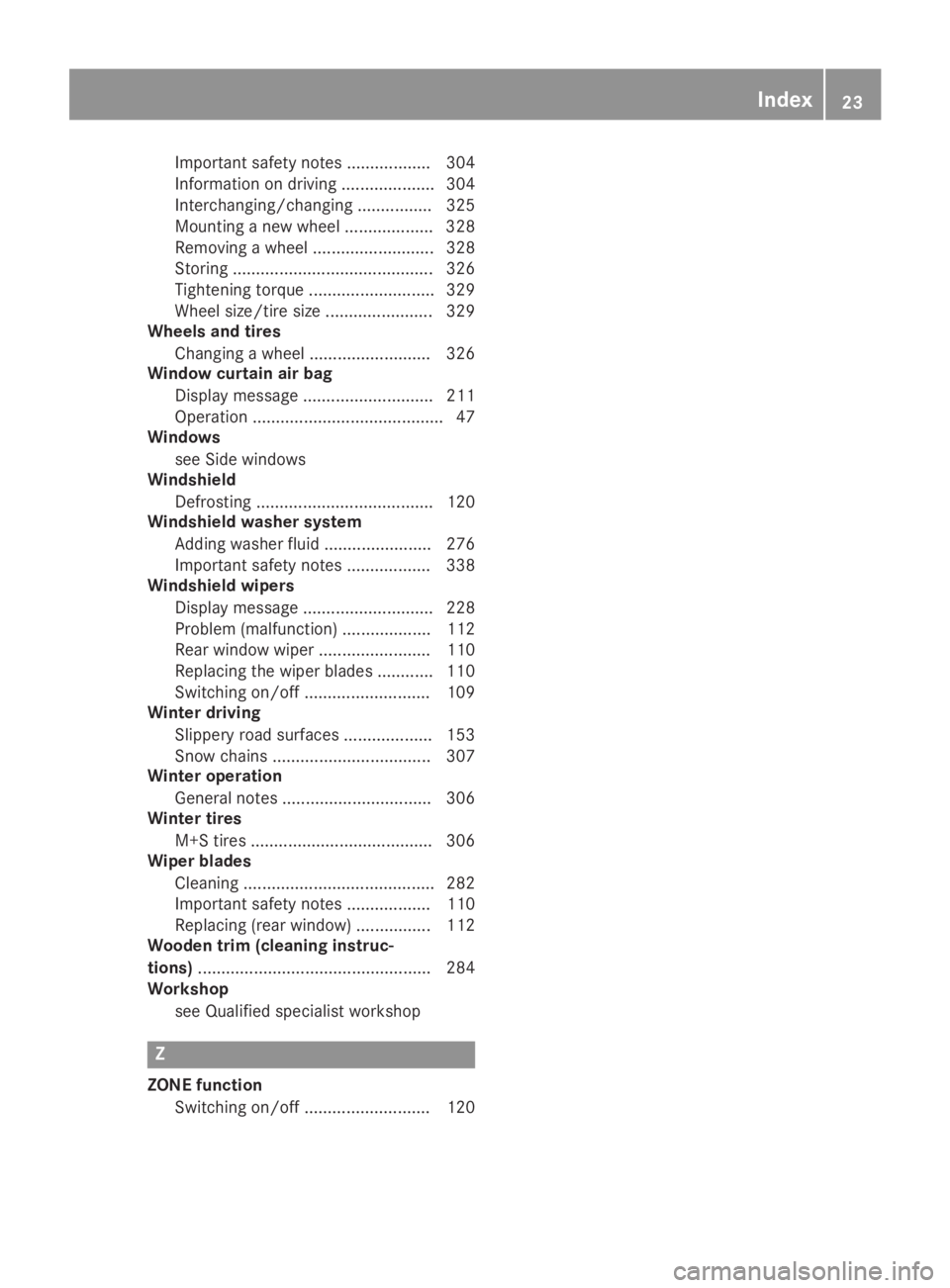
Important safety notes .................. 304
Information on driving .................... 304
Interchanging/changing ................ 325
Mounting a new wheel ................... 328
Removing a wheel.......................... 328
Storing ........................................... 326
Tightening torque ........................... 329
Wheel size/tire size ....................... 329
Wheels and tires
Changing a wheel.......................... 326
Window curtain air bag
Display message ............................ 211
Operation ......................................... 47
Windows
see Side windows
Windshield
Defrosting ...................................... 120
Windshield washer system
Adding washer fluid ....................... 276
Important safety notes .................. 338
Windshield wipers
Display message ............................ 228
Problem (malfunction) ................... 112
Rear window wiper........................ 110
Replacing the wiper blades ............ 110
Switching on/off........................... 109
Winter driving
Slippery road surfaces ................... 153
Snow chains .................................. 307
Winter operation
General notes ................................ 306
Winter tires
M+S tires....................................... 306
Wiper blades
Cleaning ......................................... 282
Important safety notes .................. 110
Replacing (rear window)................ 112
Wooden trim (cleaning instruc-
tions).................................................. 284
Workshop
see Qualified specialist workshop
Z
ZONE function
Switching on/off........................... 120
Index23
Page 62 of 346
Driving safety systems
Overview of driving safety systems
In this section, you will find information aboutthe following driving safety systems:
RABS (Anti-lockBrakingSystem)(Ypage 60)
RBAS (BrakeAssistSystem) (Ypage 61)
RActive Brake Assist (Ypage 61)
RESP®(ElectronicStabilityProgram)(Ypage 63)
REBD (ElectronicBrake forceDistribution)(Ypage 67)
RADAPTIVE BRAKE (Ypage 67)
RSTEER CONTROL (Ypage 67)
Important safety notes
If you fail to adapt your driving style or if youare inattentive, the driving safety systems canneither reduce the risk of an accident noroverride the laws of physics. Driving safetysystems are merely aids designed to assistdriving.
You are responsible for maintaining the dis-tance to the vehicle in front, for vehicle speed,for braking in good time, and for staying inlane. Always adapt your driving style to suitthe prevailing road and weather conditions andmaintain a safe distance from the vehicle infront. Drive carefully.
The driving safety systems described onlywork as effectively as possible when there isadequate contact between the tires and theroad surface. Please pay special attention tothe notes on tires, recommended minimumtire tread depths, etc. (Ypage 305).
In wintry driving conditions, always use wintertires (M+S tires) and if necessary, snowchains. Only in this way will the driving safetysystems described in this section work aseffectively as possible.
ABS (Anti-lock Braking System)
General information
ABS regulates brake pressure in such a waythat the wheels do not lock when you brake.
This allows you to continue steering the vehi-cle when braking.
The%ABS warning lamp in the instrumentcluster lights up when the ignition is switchedon. It goes out when the engine is running.
ABS works from a speed of about 5 mph(8 km/h), regardless of road-surface condi-tions. ABS works on slippery surfaces, evenwhen you only brake gently.
Important safety notes
iObserve the "Important safety notes" sec-tion (Ypage 60).
GWARNING
If ABS is malfunctioning, the wheels could
lock when braking. The steerability and
braking characteristics would be severely
affected. There is an increased danger of
skidding and accidents.
Drive on carefully. Have ABS checked imme-
diately at a qualified specialist workshop.
When ABS is malfunctioning, other systems,including driving safety systems, will alsobecome inoperative. Observe the informationon the ABS warning lamp (Ypage 233) anddisplay messages which may be shown in theinstrument cluster (Ypage 204).
Braking
XIf ABS intervenes:continue to depress thebrake pedal vigorously until the braking sit-uation is over.
XTo make a full brake application:depressthe brake pedal with full force.
If ABS intervenes when braking, you will feel apulsing in the brake pedal.
The pulsating brake pedal can be an indicationof hazardous road conditions, and functions asa reminder to take extra care while driving.
Off-road ABS
An ABS system specifically suited to off-roadterrain is activated automatically once the off-road program is activated (Ypage 170).
At speeds below 20 mph (30 km/h), the frontwheels lock cyclically during braking. The dig-ging-in effect achieved in the process reduces
60Driving safety systems
Saf ety
Page 155 of 346
For this reason, in the event of heavy rain or inconditions in which hydroplaning may occur,you must drive in the following manner:
Rlower your speed
Ravoid ruts
Ravoid sudden steering movements
Rbrake carefully
Driving on flooded roads
!Bear in mind that vehicles traveling in frontor in the opposite direction create waves.This may cause the maximum permissiblewater depth to be exceeded.
Failure to observe these notes may result indamage to the engine, electrical systemsand transmission.
If you have to drive on stretches of road onwhich water has collected, please bear in mindthat:
Rin the case of standing water, the waterlevel may be no higher than the lower edgeof the vehicle body
Ryou should drive no faster than walking pace
Winter driving
GWARNING
If you shift down on a slippery road surface
in an attempt to increase the engine's brak-
ing effect, the drive wheels could lose their
grip. There is an increased danger of skid-
ding and accidents.
Do not shift down for additional engine brak-
ing on a slippery road surface.
GDANGER
If the exhaust pipe is blocked or adequate
ventilation is not possible, poisonous gases
such as carbon monoxide (CO) may enter
the vehicle. This is the case, e.g. if the vehi-
cle becomes trapped in snow. There is a risk
of fatal injury.
If you leave the engine or the auxiliary heat-
ing running, make sure the exhaust pipe and
area around the vehicle are clear of snow.
To ensure an adequate supply of fresh air,
open a window on the side of the vehicle
that is not facing into the wind.
Have your vehicle winter-proofed at a qualifiedspecialist workshop at the onset of winter.
Drive particularly carefully on slippery roadsurfaces. Avoid sudden acceleration, steeringand braking maneuvers. Do not use cruisecontrol or Active Distance Assist DISTRONIC.
If the vehicle threatens to skid or cannot bestopped when moving at low speed:
XShift the transmission to position\\.
XTry to bring the vehicle under control usingcorrective steering.
The outside temperature indicator is notdesigned to serve as an ice-warning deviceand is therefore unsuitable for that purpose.Changes in the outside temperature are dis-played after a short delay.
Indicated temperatures just above the freezingpoint do not guarantee that the road surface isfree of ice. The road may still be icy, especiallyin wooded areas or on bridges.
You should pay special attention to road con-ditions when temperatures are around freezingpoint.
For more information on driving with snowchains, see (Ypage 307).
For more information on driving with summertires, see (Ypage 306).
Observe the notes in the "Winter operation"section (Ypage 306).
Off-road driving
Important safety notes
GWARNING
If you drive on a steep incline at an angle or
turn when driving on an incline, the vehicle
could slip sideways, tip and rollover. There is
a risk of an accident.
Always drive on a steep incline in the line of
fall (straight up or down) and do not turn the
vehicle.
Driving tips153
Driving and parking
Z
Page 170 of 346
iIf RACE START is used repeatedly within ashort period of time, it is only availableagain after the vehicle has been driven acertain distance.
AMG adaptive sport suspension sys-
tem
General notes
The electronically controlled damping systemworks continuously. This improves drivingsafety and ride comfort.
The damping is tuned individually to eachwheel and depends on:
Ryour driving style, e.g. sporty
Rthe road surface condition, e.g. bumps
Ryour individual selection ofSportorCom-fort
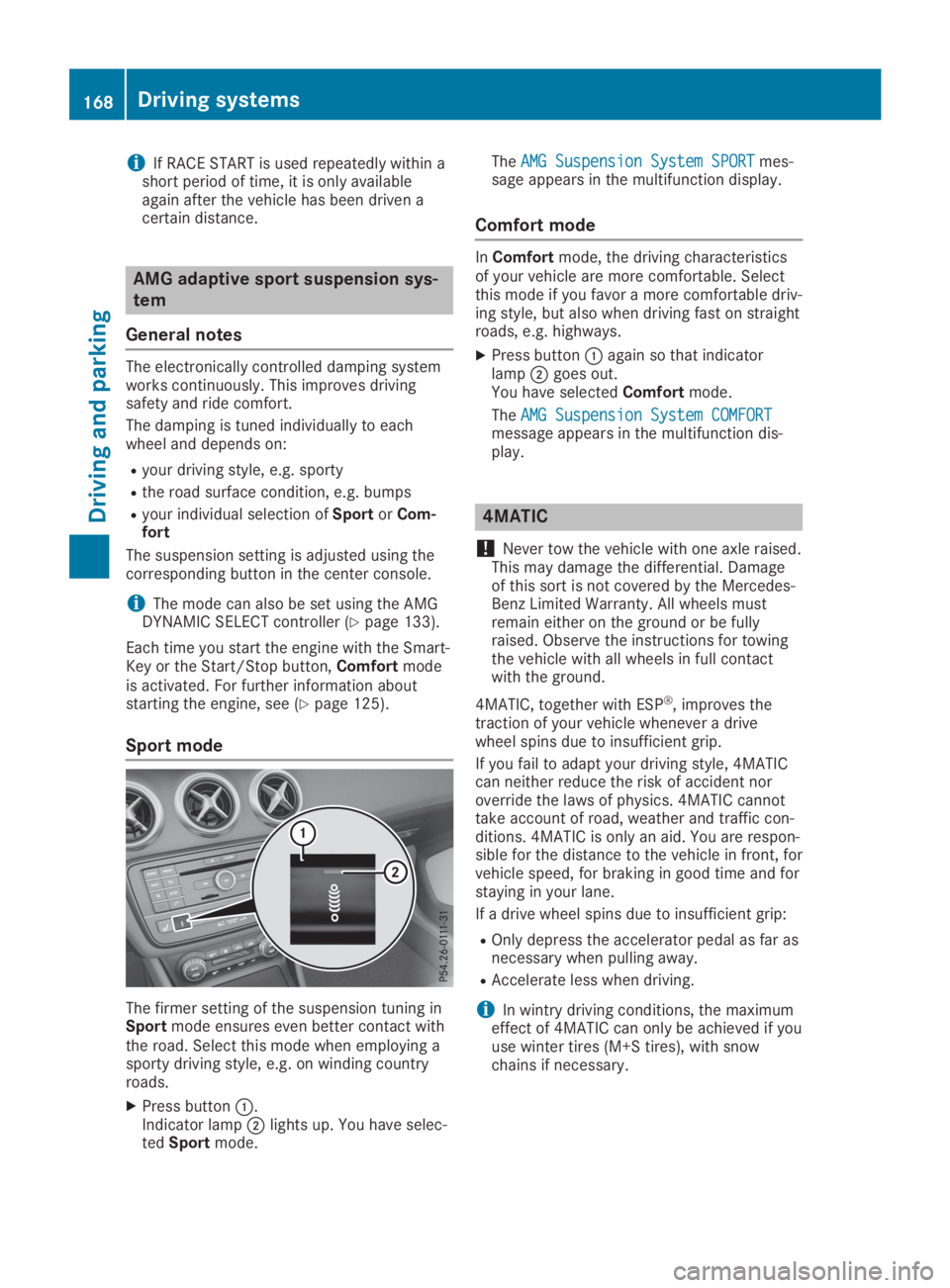
The suspension setting is adjusted using thecorresponding button in the center console.
iThe mode can also be set using the AMGDYNAMIC SELECT controller (Ypage 133).
Each time you start the engine with the Smart-Key or the Start/Stop button,Comfortmodeis activated. For further information aboutstarting the engine, see (Ypage 125).
Sport mode
The firmer setting of the suspension tuning inSportmode ensures even better contact withthe road. Select this mode when employing asporty driving style, e.g. on winding countryroads.
XPress buttonC.Indicator lampDlights up. You have selec-tedSportmode.
TheAMG Suspension System SPORTAMG Suspension System SPORTmes-sage appears in the multifunction display.
Comfort mode
InComfortmode, the driving characteristicsof your vehicle are more comfortable. Selectthis mode if you favor a more comfortable driv-ing style, but also when driving fast on straightroads, e.g. highways.
XPress buttonCagain so that indicatorlampDgoes out.You have selectedComfortmode.
TheAMG Suspension System COMFORTAMG Suspension System COMFORTmessage appears in the multifunction dis-play.
4MATIC
!Never tow the vehicle with one axle raised.This may damage the differential. Damageof this sort is not covered by the Mercedes-Benz Limited Warranty. All wheels mustremain either on the ground or be fullyraised. Observe the instructions for towingthe vehicle with all wheels in full contactwith the ground.
4MATIC, together with ESP®, improves thetraction of your vehicle whenever a drivewheel spins due to insufficient grip.
If you fail to adapt your driving style, 4MATICcan neither reduce the risk of accident noroverride the laws of physics. 4MATIC cannottake account of road, weather and traffic con-ditions. 4MATIC is only an aid. You are respon-sible for the distance to the vehicle in front, forvehicle speed, for braking in good time and forstaying in your lane.
If a drive wheel spins due to insufficient grip:
ROnly depress the accelerator pedal as far asnecessary when pulling away.
RAccelerate less when driving.
iIn wintry driving conditions, the maximumeffect of 4MATIC can only be achieved if youuse winter tires (M+S tires), with snowchains if necessary.
168Driving systems
Driving and parking
Page 290 of 346
XSwitch off the engine.
XVehicles without KEYLESS-GO:removethe SmartKey from the ignition lock.
XVehicles with KEYLESS-GO start-func-tion or KEYLESS-GO:open the driver'sdoor.The vehicle electronics are now in positionZ. This is the same as the SmartKey havingbeen removed.
XVehicles with KEYLESS-GO start-func-tion or KEYLESS-GO:remove the Start/Stop button from the ignition lock(Ypage 125).
XMake sure that the engine cannot be startedvia your smartphone (Ypage 126).
XMake sure that the passengers are notendangered as they do so. Make sure thatno one is near the danger area while awheel is being changed. Anyone who is notdirectly assisting in the wheel changeshould, for example, stand behind the bar-rier.
XGet out of the vehicle. Pay attention to traf-fic conditions when doing so.
XClose the driver's door.
MOExtended tires (tires with run-flat
properties)
General notes
With MOExtended tires (tires with run flatcharacteristics), you can continue to drive yourvehicle even if there is a total loss of pressurein one or more tires. The affected tire must notshow any clearly visible damage.
You can recognize an MOExtended tire by theMOExtended marking which appears on thesidewall of the tire. You will find this markingnext to the tire size designation, the load-bear-ing capacity and the speed index(Ypage 320).
MOExtended tires may be used only in con-junction with an activated tire pressure losswarning system (Canada only) or tire pressuremonitor (USA only).
If a pressure loss warning messageappears in the multifunction display:
Robserve the instructions in the display mes-sages (Ypage 223).
Rcheck the tire for damage
Rif driving on, observe the following notes
The driving distance possible in run-flat modeis approximately 50 miles (80 km) when thevehicle is partially laden. When the vehicle isfully laden it is approximately 19 miles(30 km).
In addition to the vehicle load, the driving dis-tance possible depends upon:
RVehicle speed
RRoad condition
ROutside temperature
The driving distance possible in run-flat modemay be reduced by extreme driving conditionsor maneuvers, or it can be increased through amoderate style of driving.
The driving distance possible in run-flat modeis counted from the moment the tire pressureloss warning appears in the multifunction dis-play.
You must not exceed the maximum permissi-ble speed for limp-home mode of 50 mph(80 km/h).
When replacing one or all tires, please observethe following specifications for your vehicle'stires:
RSize
RType and
RThe "MOExtended" marking
If a tire has gone flat and cannot be replacedwith an MOExtended tire, a standard tire maybe used as a temporary measure. Make surethat you use the proper size and type (summeror winter tire).
Vehicles equipped with MOExtended tires arenot equipped with a TIREFIT kit at the factory.It is therefore recommended that you addition-ally equip your vehicle with a TIREFIT kit if youmount tires that do not feature run-flat charac-teristics, e.g. winter tires. A TIREFIT kit may beobtained from a qualified specialist workshop.
288Flat tire
Roadside Assistance
Page 308 of 346
(tires with run-flat characteristics)" section(Ypage 288).
ROnly mount tires of the correct size onto thewheels.
RBreak in new tires at moderate speeds forthe first 60 miles (100 km). The new tiresonly reach their full performance after thisdistance.
RDo not drive with tires which have too littletread depth. This significantly reduces thetraction on wet roads (hydroplaning).
RReplace the tires after six years at the lat-est, regardless of wear.
Observe the notes on the emergency sparewheel (Ypage 330).
MOExtended tires (tires with run-flat
properties)
With MOExtended tires (tires with run flatcharacteristics), you can continue to drive yourvehicle even if there is a total loss of pressurein one or more tires.
MOExtended tires may only be used in con-junction with an activated tire pressure losswarning system (Canada only) or tire pressuremonitor (USA only) and only on wheels specifi-cally tested by Mercedes-Benz.
Notes on driving with MOExtended tires with aflat tire (Ypage 288).
Vehicles equipped with MOExtended tires arenot equipped with a TIREFIT kit at the factory.It is therefore recommended that you addition-ally equip your vehicle with a TIREFIT kit if youmount tires that do not feature run-flat charac-teristics, e.g. winter tires. A TIREFIT kit may beobtained from a qualified specialist workshop.
Winter operation
General notes
Have your vehicle winter-proofed at a qualifiedspecialist workshop at the onset of winter.
Observe the notes in the "Changing a wheel"section (Ypage 325).
Driving with summer tires
At temperatures below 45 ‡ (+7 †), summertires lose elasticity and therefore traction andbraking power. Change the tires on your vehi-cle to M+S tires. Using summer tires at verycold temperatures could cause cracks to form,thereby damaging the tires permanently.Mercedes-Benz cannot accept responsibilityfor this type of damage.
GWARNING
Damaged tires can cause tire inflation pres-
sure loss. As a result, you could lose control
of your vehicle. There is a risk of accident.
Check the tires regularly for signs of dam-
age and replace any damaged tires immedi-
ately.
M+S tires
GWARNING
M+S tires with a tire tread depth of less than
Page 324 of 346
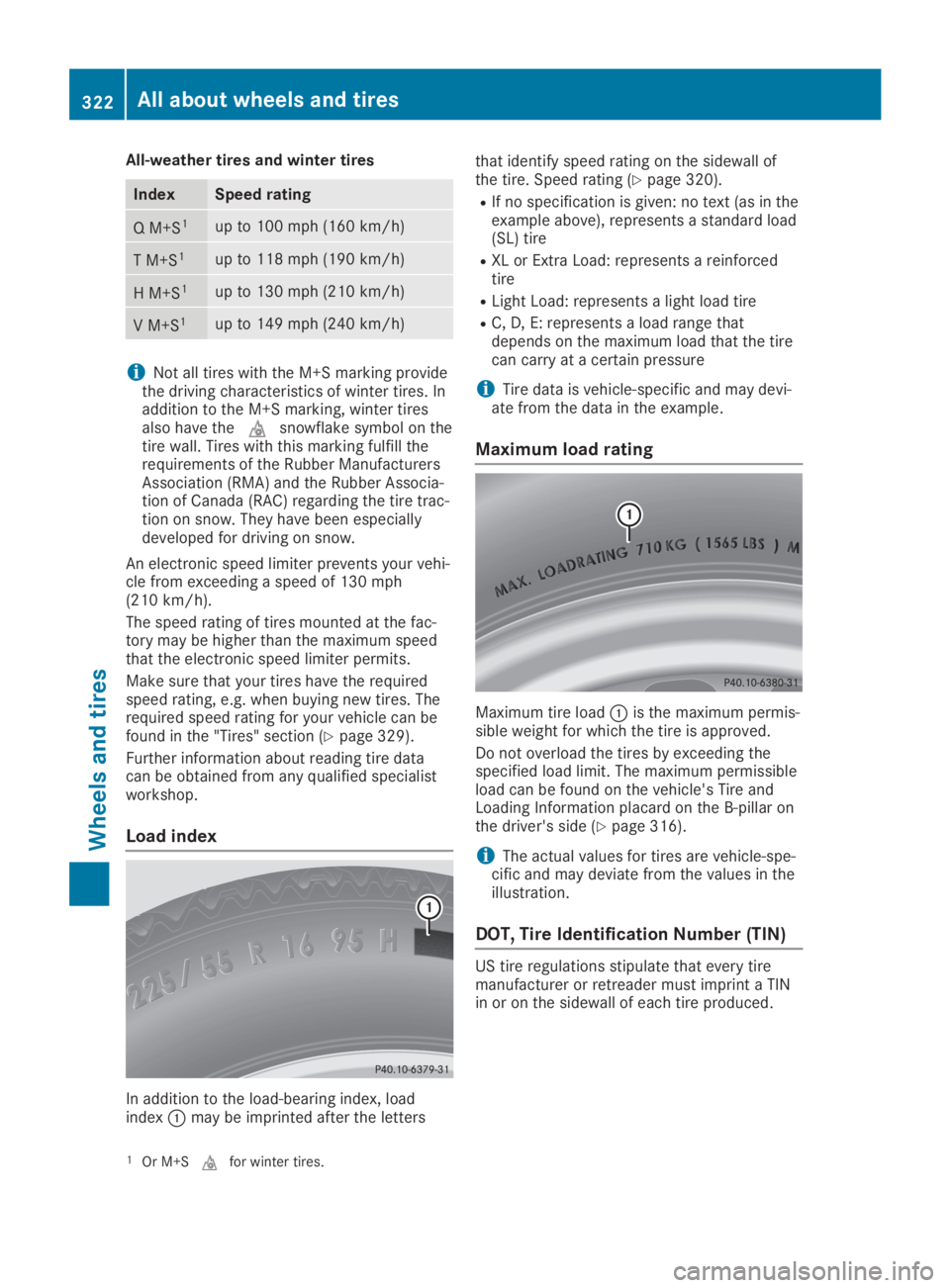
All-weather tires and winter tires
IndexSpeed rating
Q M+S1up to 100 mph (160 km/h)
T M+S1up to 118 mph (190 km/h)
H M+S1up to 130 mph (210 km/h)
V M+S1up to 149 mph (240 km/h)
iNot all tires with the M+S marking providethe driving characteristics of winter tires. Inaddition to the M+S marking, winter tiresalso have theMsnowflake symbol on thetire wall. Tires with this marking fulfill therequirements of the Rubber ManufacturersAssociation (RMA) and the Rubber Associa-tion of Canada (RAC) regarding the tire trac-tion on snow. They have been especiallydeveloped for driving on snow.
An electronic speed limiter prevents your vehi-cle from exceeding a speed of 130 mph(210 km/h).
The speed rating of tires mounted at the fac-tory may be higher than the maximum speedthat the electronic speed limiter permits.
Make sure that your tires have the requiredspeed rating, e.g. when buying new tires. Therequired speed rating for your vehicle can befound in the "Tires" section (Ypage 329).
Further information about reading tire datacan be obtained from any qualified specialistworkshop.
Load index
In addition to the load-bearing index, loadindexCmay be imprinted after the letters
that identify speed rating on the sidewall ofthe tire. Speed rating (Ypage 320).
RIf no specification is given: no text (as in theexample above), represents a standard load(SL) tire
RXL or Extra Load: represents a reinforcedtire
RLight Load: represents a light load tire
RC, D, E: represents a load range thatdepends on the maximum load that the tirecan carry at a certain pressure
iTire data is vehicle-specific and may devi-ate from the data in the example.
Maximum load rating
Maximum tire loadCis the maximum permis-sible weight for which the tire is approved.
Do not overload the tires by exceeding thespecified load limit. The maximum permissibleload can be found on the vehicle's Tire andLoading Information placard on the B-pillar onthe driver's side (Ypage 316).
iThe actual values for tires are vehicle-spe-cific and may deviate from the values in theillustration.
DOT, Tire Identification Number (TIN)
US tire regulations stipulate that every tiremanufacturer or retreader must imprint a TINin or on the sidewall of each tire produced.
1Or M+SMfor winter tires.
322All about wheels and tires
Wheels and tires