2019 MERCEDES-BENZ CLA oil capacity
[x] Cancel search: oil capacityPage 12 of 330
Deactivating/activating ................. 128
General information ....................... 127
Important safety notes.................. 127
Introduction ................................... 126
Electronic Stability Program
see ESP®(Electronic Stability Program)
Emergency
Automatic measures after an acci-
dent ................................................. 54
Emergency release
Driver's door .................................... 77
Vehicle ............................................. 77
Emergency spare wheel
General notes ................................ 316
Important safety notes .................. 315
Removing ....................................... 316
Emergency Tensioning Devices
Activation ......................................... 52
Emissions control
Service and warranty information .... 25
Engine
Check Engine warning lamp ........... 226
Display message ............................ 207
ECO start/stop function ................ 126
Engine number ............................... 319
Irregular running ............................ 128
Jump-starting ................................. 282
Starting (important safety notes)... 124
Starting problems .......................... 128
Starting the engine with the
SmartKey ....................................... 125
Starting with the Start/Stop but-
ton ................................................. 125
Switching off .................................. 143
Tow-starting (vehicle) ..................... 287
Engine electronics
Problem (malfunction) ................... 128
Engine oil
Adding ........................................... 262
Additives ........................................ 322
Checking the oil level ..................... 261
Checking the oil level using the
dipstick .......................................... 261
Display message ............................ 208
Filling capacity ............................... 322
Notes about oil grades................... 322
Notes on oil level/consumption .... 261
Temperature (on-board computer,
Mercedes-AMG vehicles) ............... 190
Entering an address
see also Digital Operator's Man-
ual .................................................. 231
ESP®(Electronic Stability Pro-
gram)
AMG menu (on-board computer) ... 191
Characteristics ................................. 65
Deactivating/activating (button
in Mercedes-AMG vehicles) ............. 66
Deactivating/activating (except
Mercedes‑AMG vehicles) ................. 65
Deactivating/activating (on-
board computer, except
Mercedes-AMG vehicles) ............... 187
Display message ............................ 194
Function/notes................................ 64
General notes .................................. 64
Important safety information ........... 64
Trailer stabilization ........................... 67
Warning lamp ................................. 223
ETS/4ETS (Electronic Traction Sys-
tem)...................................................... 64
Exhaust
see Exhaust pipe
Exhaust check................................... 146
Exhaust pipe
Cleaning ......................................... 270
Exterior lighting
Cleaning ......................................... 269
see Lights
Exterior mirrors
Adjusting ......................................... 97
Dipping (automatic) ......................... 98
Folding in when locking (on-board
computer) ...................................... 190
Folding in/out (automatically)......... 98
Folding in/out (electrically) ............. 98
Out of position (troubleshooting) ..... 98
Setting ............................................. 98
Storing settings (memory func-
tion) ............................................... 100
Storing the parking position ............. 99
Eyeglasses compartment................. 240
10Index
Page 311 of 330
Uniform Tire Quality Grading Standards
A uniform standard to grade the quality of tireswith regards to tread quality, tire traction andtemperature characteristics. The quality grad-ing assessment is made by the manufacturerfollowing specifications from the U.S. govern-ment. The ratings are molded into the sidewall ofthe tire.
Recommended tire pressures
The recommended tire pressure applies to thetires mounted at the factory.
The Tire and Loading Information placard con-tains the recommended tire pressures for coldtires on a fully loaded vehicle and for the maxi-mum permissible vehicle speed.
The tire pressure table contains the recommen-ded pressures for cold tires for various operat-ing conditions, i.e. differing load and speed con-ditions.
Increased vehicle weight due to optional
equipment
The combined weight of all standard andoptional equipment available for the vehicle,regardless of whether it is actually installed onthe vehicle or not.
Rim
This is the part of the wheel on which the tire ismounted.
GAWR (Gross Axle Weight Rating)
The GAWR is the maximum gross axle weightrating. The actual load on an axle must neverexceed the gross axle weight rating. The grossaxle weight rating can be found on the vehicleidentification plate on the B-pillar on the driver'sside.
Speed rating
The speed rating is part of the tire identification.It specifies the speed range for which the tire isapproved.
GVW (Gross Vehicle Weight)
The gross vehicle weight includes the weight ofthe vehicle including fuel, tools, the spare wheel,accessories installed, occupants, luggage andthe drawbar noseweight, if applicable. The grossvehicle weight must not exceed the gross vehi-cle weight rating GVWR as specified on the vehi-cle identification plate on the B-pillar on thedriver's side.
GVWR (Gross Vehicle Weight Rating)
The GVWR is the maximum permissible grossweight of a fully loaded vehicle (the weight of thevehicle including all accessories, occupants,fuel, luggage and the drawbar noseweight, ifapplicable). The gross vehicle weight rating isspecified on the vehicle identification plate onthe B-pillar on the driver's side.
Maximum loaded vehicle weight
The maximum weight is the sum of:
Rthe curb weight of the vehicle
Rthe weight of the accessories
Rthe load limit
Rthe weight of the factory installed optionalequipment
Kilopascal (kPa)
Metric unit for tire pressure. 6.9 kPa corre-sponds to 1 psi. Another unit for tire pressure isbar. 100 kilopascals (kPa) are the equivalent of1 bar.
Load index
In addition to the load-bearing index, the loadindex may also be imprinted on the sidewall ofthe tire. This specifies the load-bearing capacitymore precisely.
Curb weight
The weight of a vehicle with standard equipmentincluding the maximum capacity of fuel, oil andcoolant. It also includes the air-conditioning sys-tem and optional equipment if these are instal-led in the vehicle, but does not include passen-gers or luggage.
Maximum load rating
The maximum tire load is the maximum permis-sible weight in kilograms or lbs for which a tire isapproved.
Maximum permissible tire pressure
Maximum permissible tire pressure for one tire.
Maximum load on one tire
Maximum load on one tire. This is calculated bydividing the maximum axle load of one axle bytwo.
All about wheels and tires309
Wheels and tires
Z
Page 324 of 330

Engine oil
General notes
!Do not use engine oil or an oil filter withspecifications deviating from those expresslyrequired for the prescribed service intervals.Do not change the engine oil or oil filter inorder to set replacement intervals longer thanthose prescribed. This could otherwise causedamage to the engine or exhaust gas after-treatment.
Follow the instructions on the service intervaldisplay for changing the engine oil. This couldotherwise cause damage to the engine orexhaust gas aftertreatment.
When handling engine oil, observe the importantsafety notes on service products (Ypage 319).
The engine oils are matched to the performanceof Mercedes-Benz engines and service intervals.You should therefore only use engine oils and oilfilters that are approved for vehicles with main-tenance systems.
For a list of approved engine oils and oil filters,consult an authorized Mercedes-Benz Center.Or visit the websitehttp://bevo.mercedes-benz.com.
The table shows which engine oils have beenapproved for your vehicle.
ModelMB-Freigabe orMB-Approval
All models229.5
Use only SAE 0W-40 or SAE 5W-40 engine oilsfor Mercedes-AMG vehicles.
iMB approval is indicated on the oil contain-ers.
Filling capacities
The following values refer to an engine oilchange, including the oil filter.
ModelCapacity
Mercedes‑AMG vehicles5.8 US qt (5.5 l)
All other models5.9 US qt (5.6 l)
Additives
!Do not use any additives in the engine oil.This could damage the engine.
Brake fluid
GWARNING
The brake fluid constantly absorbs moisture
from the air. This lowers the boiling point of
the brake fluid. If the boiling point of the brake
fluid is too low, vapor pockets may form in the
brake system when the brakes are applied
hard. This would impair braking efficiency.
There is a risk of an accident.
You should have the brake fluid renewed at
the specified intervals.
When handling brake fluid, observe the impor-tant safety notes on service products(Ypage 319).
The brake fluid change intervals can be found inthe Maintenance Booklet.
Only use brake fluid approved by Mercedes-Benz in accordance with MB-Freigabe or MB-Approval 331.0.
Information about approved brake fluid can beobtained at any qualified specialist workshop oron the Internet athttp://bevo.mercedes-benz.com.
iHave the brake fluid regularly replaced at aqualified specialist workshop and the replace-ment confirmed in the Maintenance Booklet.
322Service products and filling capacities
Technical data
Page 325 of 330

Coolant
Important safety notes
GWARNING
If antifreeze comes into contact with hot com-
ponents in the engine compartment, it may
ignite. There is a risk of fire and injury.
Let the engine cool down before you add anti-
freeze. Make sure that antifreeze is not spilled
next to the filler neck. Thoroughly clean the
antifreeze from components before starting
the engine.
!Only add coolant that has been premixedwith the desired antifreeze protection. Youcould otherwise damage the engine.
You can find additional notes on the coolant inthe following places:
Rin the Mercedes-Benz Specifications forService Products, MB BeVo 310.1
-on the Internet athttp://bevo.mercedes-benz.com
-on the Mercedes-Benz BeVo app
Ra qualified specialized workshop
!Always use a suitable coolant mixture, evenin countries where high temperatures prevail.
Otherwise, the engine cooling system is notsufficiently protected from corrosion andoverheating.
iHave the coolant regularly replaced at aqualified specialist workshop and the replace-ment confirmed in the Maintenance Booklet.
Comply with the important safety notes for ser-vice products when handling coolant(Ypage 319).
The coolant is a mixture of water and corrosioninhibitor/antifreeze concentrate. It performsthe following tasks:
Ranti-corrosion protection
Rantifreeze protection
Rraising the boiling point
If the coolant has antifreeze protection down to-35 ‡ (-37 †), the boiling point of the coolantduring operation is approximately 266 ‡(130 †).
The antifreeze concentrate/corrosion inhibitorconcentration in the engine cooling systemshould:
Rbe at least 50%. This will protect the enginecooling system against freezing down toapproximately -35 ‡ (-37 †)
Rnot exceed 55% (antifreeze protection downto -49‡[-45 †]). Otherwise, heat will not bedissipated as effectively
Mercedes-Benz recommends a coolant or cor-rosion inhibitor/antifreeze concentrate inaccordance withMB Specifications for Service Products 310.1.
iWhen the vehicle is first delivered, it is filledwith a coolant mixture that ensures adequateantifreeze and anti-corrosion protection.
iThe coolant is checked with every mainte-nance interval at a qualified specialist work-shop.
Filling capacities
ModelCapacity
Mercedes‑AMGvehiclesApprox. 12.6 US qt(11.9l)
All other modelsApprox. 8.2 US qt(7.8 l)
Windshield washer system
Important safety notes
GWARNING
Windshield washer concentrate could ignite if
it comes into contact with hot engine compo-
nents or the exhaust system. There is a risk of
fire and injury.
Make sure that no windshield washer con-
centrate is spilled next to the filler neck.
!Only MB SummerFit and MB WinterFitwasher fluid should be mixed together. Thespray nozzles may otherwise becomeblocked.
Do not use distilled or de-ionized water. Other-wise, the level sensor may give a false reading.
Service products and filling capacities323
Technical data
Z
Page 326 of 330
When handling washer fluid, observe the impor-tant safety notes on service products(Ypage 319).
At temperatures above freezing:
XFill the washer fluid reservoir with a mixture ofwater and windshield washer fluid, e.g. MBSummerFit.
Add 1 part MB SummerFit to 100 parts water.
At temperatures below freezing:
XFill the washer fluid reservoir with a mixture ofwater and washer fluid, e.g. MB WinterFit.
For the correct mixing ratio refer to the infor-mation on the antifreeze reservoir.
iAdd windshield washer fluid, e.g. MB Sum-merFit or MB WinterFit, to the washer fluid allyear round.
Climate control system refrigerant
Important safety notes
The climate control system of your vehicle is fil-led with refrigerant R‑134a.
The instruction label regarding the refrigeranttype used can be found on the left, on the under-side of the hood.
!Only the refrigerant R‑134a and the PAG oilapproved by Mercedes-Benz may be used.The approved PAG oil may not be mixed withany other PAG oil that is not approved forR-134a refrigerant. Otherwise, the climatecontrol system may be damaged.
Service work, such as refilling with refrigerant orreplacing component parts, may only be carriedout by a qualified specialist workshop. All appli-cable regulations, as well as SAE standard J639,must be adhered to.
Always have work on the climate control systemcarried out at a qualified specialist workshop.
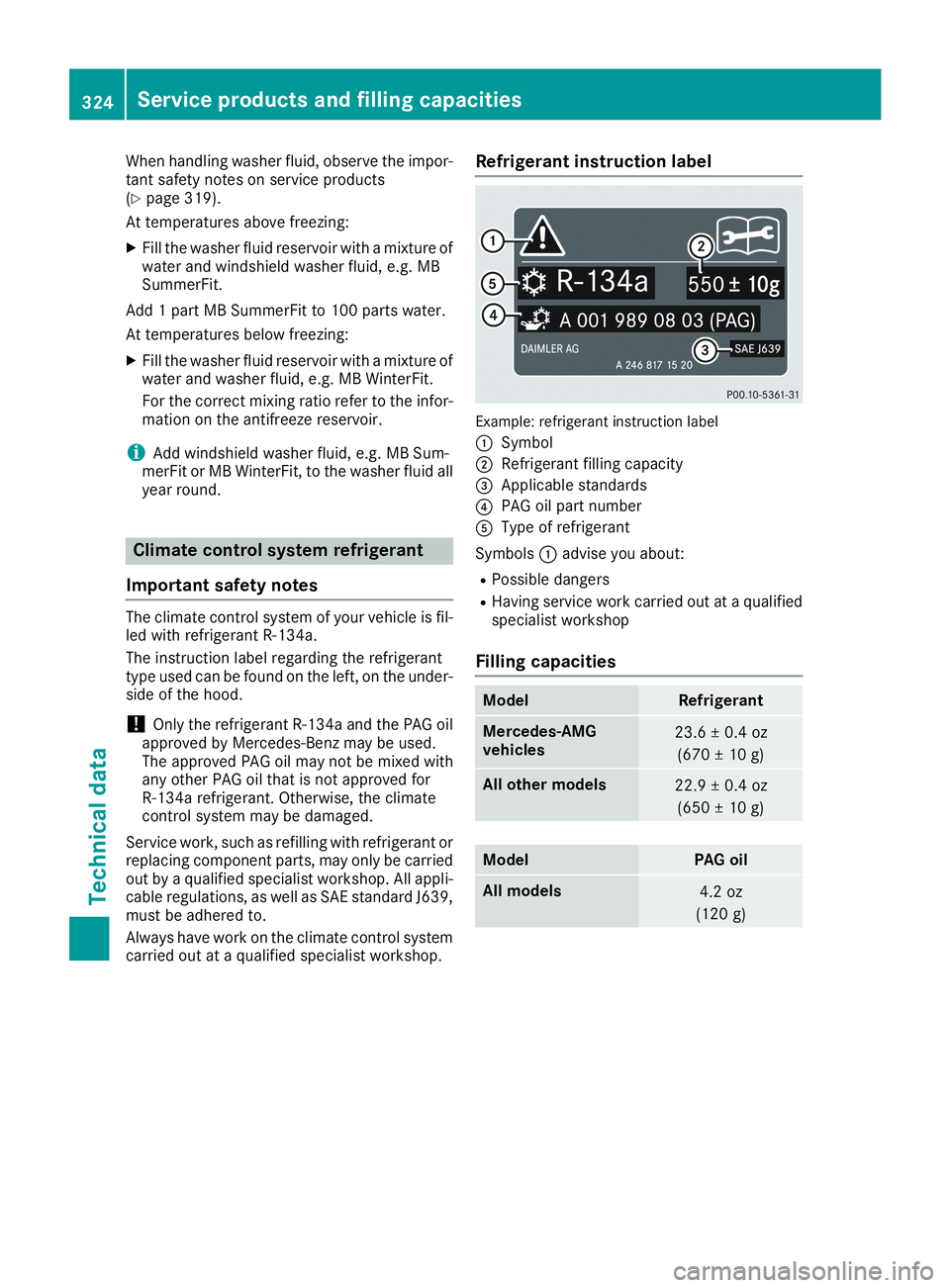
Refrigerant instruction label
Example: refrigerant instruction label
CSymbol
DRefrigerant filling capacity