2018 SUBARU WRX brake light
[x] Cancel search: brake lightPage 374 of 578

(387,1)
北米Model "A1700BE-B" EDITED: 2017/ 10/ 11
!N (Neutral)
This position is for restarting a stalled
engine. In this position, the transmission is
neutral, meaning that the wheels and
transmission are not locked. Therefore,
the vehicle will roll freely, even on the
slightest incline unless the parking brake
or foot brake is applied.
WARNING
Do not drive the vehicle with the
select lever in the“N”(neutral)
position. Engine braking has no
effect in this condition and the risk
of an accident is consequently in-
creased.NOTEIf the select lever is in the“N”position
when you stop the engine for parking,
you may not subsequently be able to
move it to the“R”and“P”positions. If
this happens, turn the ignition switch to
the“ON”position. You will then be able
to move the select lever to the“P”
position.!D (Drive)
This position is for normal driving. The
transmission shifts automatically and con-
tinuously into a suitable gear according to
the vehicle speed and the acceleration you
require. Also, while driving up and down a
hill, the transmission assists and controls
the driving performance and engine brak-
ing while corresponding to the road grade.
When more acceleration is required in the
“D”position, depress the accelerator pedal
fully to the floor and hold that position. The
transmission will automatically downshift.
If the Intelligent (I) mode or the Sport (S)
mode has been selected, the transmission
will operate like a conventional automatic
transmission. When you release the pedal,
the transmission will return to the original
gear position.
If you operate one of the shift paddles
behind the steering wheel while driving in
the“D”position, the transmission will
temporarily switch to the manual mode.
In this mode, you can shift into any gear
position using the shift paddles. For details
about the manual mode, refer to“Selection
of manual mode”F7-25. Once the vehicle
speed stabilizes, the transmission will
switch from the manual mode back to the
“D”position for normal driving.
&Selection of manual modeWith the vehicle either moving or station-
ary, move the select lever from the“D”
position to the“M”position to select the
manual mode.
–CONTINUED–
Starting and operating/Continuously variable transmission
7-25
7
Page 379 of 578

(392,1)
北米Model "A1700BE-B" EDITED: 2017/ 10/ 11
!Except STI
When you select the Sport Sharp (S#)
mode with the select lever in the“D”
position, the transmission gear ratio will
shift from variable speed to eight-speed.
The select lever/gear position indicator
display will change from“D”to the gear
position.
When selecting Sport Sharp (S#) mode,
the following controls will be applied.
.Uphill control
Prevents unnecessary shift-up/shift-down
during ascent.
.Cornering control
While turning, if there is a large centrifugal
force, shift-up will not occur: during re-
acceleration.
.Braking control
At the beginning of corners etc., heavy
application of the brake pedal will cause
automatic downshift and gently re-accel-
erate.
.Sudden acceleration return control
During acceleration, if acceleration pedal
is returned suddenly (for example, at
corners etc.), shift-up will not be applied.
&SI-DRIVE switch
NOTE.The next time you turn on the engine,
the following SI-DRIVE mode will be
selected.
–Intelligent (I) mode if you have
turned off the engine in the Intelli-
gent (I) mode
–Sport (S) mode if you have turned
off the engine in the Sport (S) mode
or Sport Sharp (S#) mode
.If the CHECK ENGINE warning light/
malfunction indicator light illuminates
during engine operation, the SI-DRIVE
mode changes to the Sport (S) mode. In
this case, it is not possible to change to
the Sport Sharp (S#) mode or Intelligent
(I) mode.
.If the engine coolant temperature
becomes so high that the engine could
overheat, it is not possible to change to
the Sport Sharp (S#) mode. While the
vehicle is in the Sport Sharp (S#) mode,
it changes to the Sport (S) mode when
the engine coolant temperature in-
creases.
.If any of the SI-DRIVE indicators
blink, the SI-DRIVE system may be
malfunctioning. Contact your SUBARU
dealer.!STI
SI-DRIVE switchTo select the Intelligent (I) mode:
Push the SI-DRIVE switch.
To select the Sport (S) mode:
Rotate the SI-DRIVE switch to the left.
To select the Sport Sharp (S#) mode:
Rotate the SI-DRIVE switch to the right.
After operating the SI-DRIVE switch, the
switch returns to its original position.
Starting and operating/SI-DRIVE
7-30
Page 382 of 578

(395,1)
北米Model "A1700BE-B" EDITED: 2017/ 10/ 11
Braking&Braking tips
WARNING
Never rest your foot on the brake
pedal while driving. This can cause
dangerous overheating of the
brakes and needless wear on the
brake pads and linings.
!When the brakes get wet
When driving in rain or after washing the
vehicle, the brakes may get wet. As a
result, brake stopping distance will be
longer. To dry the brakes, drive the vehicle
at a safe speed while lightly depressing the
brake pedal to heat up the brakes.
!Use of engine braking
Remember to make use of engine braking
in addition to foot braking. When descend-
ing a grade, if only the foot brake is used,
the brakes may start working improperly
because of brake fluid overheating,
caused by overheated brake pads. To help
prevent this, shift into a lower gear to get
stronger engine braking.
!Braking when a tire is punctured
Do not depress the brake pedal suddenly
when a tire is punctured. This could causea loss of control of the vehicle. Keep
driving straight ahead while gradually
reducing speed. Then slowly pull off the
road to a safe place.
&Brake system!Two separate circuits
Your vehicle has two separate circuit brake
systems. Each circuit works diagonally
across the vehicle. If one circuit of the
brake system should fail, the other half of
the system still works. If one circuit fails,
the brake pedal will go down much closer
to the floor than usual and you will need to
press it down much harder. And a much
longer distance will be needed to stop the
vehicle.
!Brake booster
The brake booster uses engine manifold
vacuum to assist braking force. Do not turn
off the engine while driving because that
will turn off the brake booster, resulting in
poor braking power.
The brakes will continue to work even
when the brake booster completely stops
functioning. If this happens, however, you
will have to depress the pedal much harder
than normal and the braking distance will
increase.!Brake assist system
WARNING
Do not be overconfident about the
brake assist. It is not a system that
brings more braking ability to the
vehicle beyond its braking capabil-
ity. Always use the utmost care
when driving regarding vehicle
speed and safe distance.
CAUTION
When you need to brake suddenly,
continue depressing the brake pedal
strongly to obtain the effect of the
brake assist.
Brake assist is a driver assistance system.
It assists the brake power when the driver
cannot depress the brake pedal strongly
and the brake power is insufficient.
Brake assist generates the brake power
according to the speed at which the driver
depresses the brake pedal.NOTEWhen you depress the brake pedal
strongly or suddenly, the following
phenomena occur. However, even
though these occur, they do not indi-
–CONTINUED–
Starting and operating/Braking
7-33
7
Page 383 of 578
(396,1)
北米Model "A1700BE-B" EDITED: 2017/ 10/ 11
cate any malfunctions, and the brake
assist system is operating properly.
.You might feel that the brake pedal is
applied by lighter force and generates a
greater braking force.
.You might hear an ABS operating
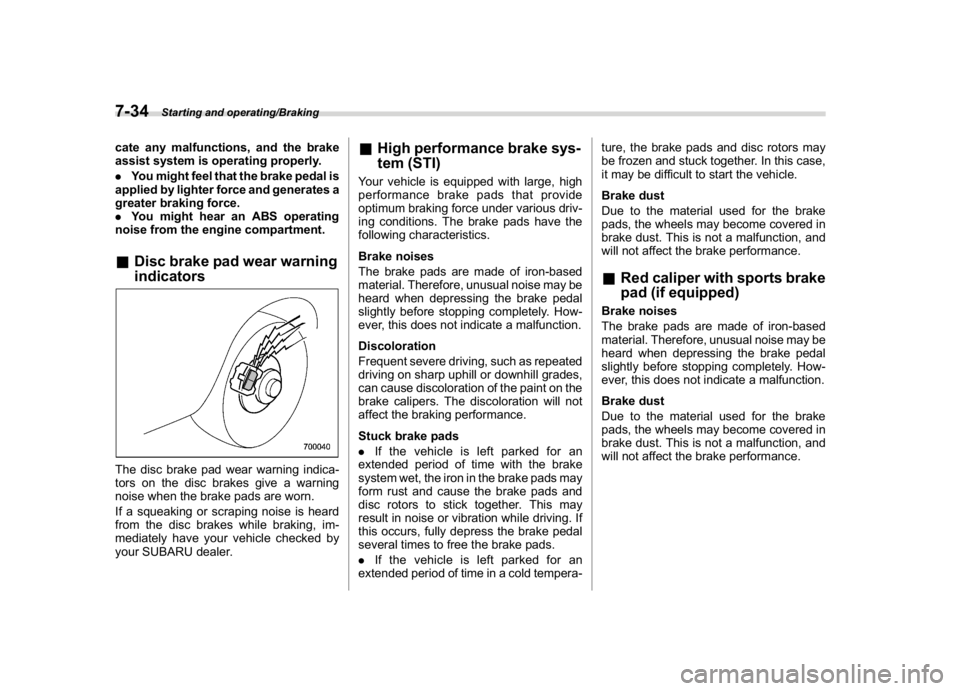
noise from the engine compartment.&Disc brake pad wear warning
indicatorsThe disc brake pad wear warning indica-
tors on the disc brakes give a warning
noise when the brake pads are worn.
If a squeaking or scraping noise is heard
from the disc brakes while braking, im-
mediately have your vehicle checked by
your SUBARU dealer.
&High performance brake sys-
tem (STI)Your vehicle is equipped with large, high
performance brake pads that provide
optimum braking force under various driv-
ing conditions. The brake pads have the
following characteristics.
Brake noises
The brake pads are made of iron-based
material. Therefore, unusual noise may be
heard when depressing the brake pedal
slightly before stopping completely. How-
ever, this does not indicate a malfunction.
Discoloration
Frequent severe driving, such as repeated
driving on sharp uphill or downhill grades,
can cause discoloration of the paint on the
brake calipers. The discoloration will not
affect the braking performance.
Stuck brake pads
.If the vehicle is left parked for an
extended period of time with the brake
system wet, the iron in the brake pads may
form rust and cause the brake pads and
disc rotors to stick together. This may
result in noise or vibration while driving. If
this occurs, fully depress the brake pedal
several times to free the brake pads.
.If the vehicle is left parked for an
extended period of time in a cold tempera-ture, the brake pads and disc rotors may
be frozen and stuck together. In this case,
it may be difficult to start the vehicle.
Brake dust
Due to the material used for the brake
pads, the wheels may become covered in
brake dust. This is not a malfunction, and
will not affect the brake performance.
&Red caliper with sports brake
pad (if equipped)Brake noises
The brake pads are made of iron-based
material. Therefore, unusual noise may be
heard when depressing the brake pedal
slightly before stopping completely. How-
ever, this does not indicate a malfunction.
Brake dust
Due to the material used for the brake
pads, the wheels may become covered in
brake dust. This is not a malfunction, and
will not affect the brake performance.
Starting and operating/Braking
7-34
Page 384 of 578

(397,1)
北米Model "A1700BE-B" EDITED: 2017/ 10/ 11
ABS (Anti-lock Brake Sys-
tem)The ABS prevents the lock-up of wheels
which may occur during sudden braking or
braking on slippery road surfaces. This
helps prevent the loss of steering control
and directional stability caused by wheel
lock-up.
When the ABS is operating, you may hear
a chattering noise or feel a slight vibration
in the brake pedal. This is normal when the
ABS operates.
The ABS will not operate when the vehicle
speed is below approximately 6 mph (10
km/h).
WARNING
Always use the utmost care in driv-
ing–overconfidence because you
are driving a vehicle with the ABS
could easily lead to a serious acci-
dent.
CAUTION
.The ABS does not always de-
crease stopping distance. You
should always maintain a safe
following distance from other
vehicles.
.When driving on badly surfaced
roads, gravel roads, icy roads, or
over deep newly fallen snow,
stopping distances may be long-
er for a vehicle with the ABS than
one without. When driving under
these conditions, therefore, re-
duce your speed and leave ample
distance from other vehicles.
.When you feel the ABS operating,
you should maintain constant
brake pedal pressure. Do not
pump the brake pedal since
doing so may defeat the opera-
tion of the ABS system.
&ABS self-checkJust after the vehicle is started, you may
feel on the brake pedal a vibration similar
to when the ABS operates, and you may
also hear the sound of the ABS working
from the engine compartment. This is
caused by an automatic functional test of
the ABS being carried out and does not
indicate any abnormal condition.&ABS warning lightRefer to“ABS warning light”F3-20.
Starting and operating/ABS (Anti-lock Brake System)
7-35
7
Page 385 of 578

(398,1)
北米Model "A1700BE-B" EDITED: 2017/ 10/ 11
Electronic Brake Force Dis-
tribution (EBD) systemThe EBD system maximizes the effective-
ness of the brakes by allowing the rear
brakes to supply a greater proportion of the
braking force. It functions by adjusting the
distribution of braking force to the rear
wheels in accordance with the vehicle’s
loading condition and speed.
The EBD system is an integral part of the
ABS and uses some of the ABS compo-
nents to perform its function of optimizing
the distribution of braking force. If any of
the ABS components used by the EBD
system malfunction, the EBD system also
stops working.
When the EBD system is operating, you
may hear a chattering noise or feel a slight
vibration in the brake pedal. This is normal
and does not indicate a malfunction.
&Steps to take if EBD system
malfunctionsBrake and ABS warning lightIf a malfunction occurs in the EBD system,
the system stops working and the brake
system warning light and ABS warning
light illuminate simultaneously.
The EBD system may be malfunctioning if
the brake system warning light and ABS
warning light illuminate simultaneously
while driving.
Even if the EBD system malfunctions, the
conventional braking system will still func-
tion. However, the rear wheels will be more
prone to locking when the brakes are
applied harder than usual and the vehicle’s
motion may therefore become somewhat
harder to control.If the brake system warning light and ABS
warning light illuminate simultaneously,
take the following steps.
1. Stop the vehicle in the nearest safe, flat
location.
2. Apply the parking brake and turn off the
engine.
3. Restart the engine.
4. Release the parking brake.
Even if both warning lights turn off:
The EBD system may be malfunctioning.
Drive carefully to the nearest SUBARU
dealer and have the system inspected.
If both warning lights illuminate again
and remain illuminated after restarting
the engine:
1. Turn off the engine again.
2. Apply the parking brake.
3. Check the brake fluid level. For details
about checking the brake fluid level, refer
to“Checking the fluid level”F11-24.
.If the brake fluid level is not below the
“MIN”mark, the EBD system may be
malfunctioning. Drive carefully to the
nearest SUBARU dealer and have the
system inspected.
.If the brake fluid level is below the“MIN”
mark, DO NOT drive the vehicle. Instead,
have the vehicle towed to the nearest
Starting and operating/Electronic Brake Force Distribution (EBD) system
7-36
Page 386 of 578

(399,1)
北米Model "A1700BE-B" EDITED: 2017/ 10/ 11
SUBARU dealer for repair.
WARNING
.Driving with the brake system
warning light illuminated is dan-
gerous. This indicates your brake
system may not be working prop-
erly. If the light remains illumi-
nated, have the brakes inspected
by a SUBARU dealer immedi-
ately.
.If at all in doubt about whether the
brakes are operating properly, do
not drive the vehicle. Have your
vehicle towed to the nearest
SUBARU dealer for repair.
Vehicle Dynamics Control
system
WARNING
Always use the utmost care in driv-
ing–overconfidence because you
are driving a vehicle with the Vehicle
Dynamics Control system could ea-
sily lead to a serious accident.
CAUTION
.Even if your vehicle is equipped
with Vehicle Dynamics Control
system, winter tires should be
used when driving on snow-cov-
ered or icy roads; in addition,
vehicle speed should be reduced
considerably. Simply having a
Vehicle Dynamics Control sys-
tem does not guarantee that the
vehicle will be able to avoid
accidents in any situation.
.Activation of the Vehicle Dy-
namics Control system is an
indication that the road being
travelled on has a slippery sur-
face; since having Vehicle Dy-
namics Control is no guaranteethat full vehicle control will be
maintained at all times and under
all conditions, its activation
should be seen as a sign that
the speed of the vehicle should
be reduced considerably.
.Whenever suspension compo-
nents, steering components, or
an axle are removed from a
vehicle, have an inspection of
that system performed by an
authorized SUBARU dealer.
.Observe the following precau-
tions in order to ensure that the
Vehicle Dynamics Control sys-
tem is operating properly:
–Fit all four wheels with tires of
the same size, type, and
brand. Furthermore, the
amount of wear should be the
same for all four tires.
–Keep the tire pressure at the
proper level as shown on the
vehicle placard attached to
the driver’s side door pillar.
–Use only the specified tempor-
ary spare tire to replace a flat
tire. With a temporary spare
tire, the effectiveness of the
Vehicle Dynamics Control
system is reduced and this
–CONTINUED–
Starting and operating/Vehicle Dynamics Control system
7-37
7
Page 387 of 578

(400,1)
北米Model "A1700BE-B" EDITED: 2017/ 10/ 11
should be taken into account
when driving the vehicle in
such a condition.
.If you use non-matching tires, the
Vehicle Dynamics Control sys-
tem may not operate correctly.
.The Vehicle Dynamics Control
system helps prevent unstable
vehicle motion such as skidding
using control of the brakes and
engine power. Do not turn off the
Vehicle Dynamics Control sys-
tem unless it is absolutely neces-
sary. If you must turn off the
Vehicle Dynamics Control sys-
tem, drive very carefully accord-
ing to the road surface condition.
In the event of wheelspin and/or skidding
on a slippery road surface and/or during
cornering and/or an evasive maneuver,
the Vehicle Dynamics Control system
adjusts the engine’s output and the
wheels’respective braking forces to help
maintain traction and directional control.
.Traction Control Function
The traction control function is designed to
prevent spinning of the driving wheels on
slippery road surfaces, thereby helping to
maintain traction and directional control.
Activation of this function is shown byflashing the Vehicle Dynamics Control
operation indicator light.
.Skid Suppression Function
The skid suppression function is designed
to help maintain directional stability by
suppressing the wheels’tendency to slide
sideways during steering operations. Acti-
vation of this function is shown by flashing
of the Vehicle Dynamics Control operation
indicator light.
Vehicle Dynamics Control operation indi-
cator lightNOTE.The Vehicle Dynamics Control sys-
tem may be considered normal when
the following conditions occur.
–Slight twitching of the brakepedal is felt.
–The vehicle or steering wheel
shakes to a small degree.
–An operating sound from the
engine compartment is heard briefly
when starting the engine and when
driving off after starting the engine.
–The brake pedal seems to jolt
when driving off after starting the
engine.
.In the circumstances shown in the
following list, the vehicle may be less
stable than it feels to the driver. The
Vehicle Dynamics Control System may
therefore operate. Such operation does
not indicate a system malfunction.
–on gravel-covered or rutted roads
–on unfinished roads
–when the vehicle is fitted with
snow tires or winter tires
.Activation of the Vehicle Dynamics
Control system will cause operation of
the steering wheelto feel slightly
different compared to that for normal
conditions.
.It is always important to reduce
speed when approaching a corner,
even if your vehicle is equipped with
the Vehicle Dynamics Control system.
.Always turn off the engine before
replacing a tire. Failure to do so may
render the Vehicle Dynamics Control
Starting and operating/Vehicle Dynamics Control system
7-38