2018 SUBARU WRX brake light
[x] Cancel search: brake lightPage 398 of 578

(411,1)
北米Model "A1700BE-B" EDITED: 2017/ 10/ 11
electronic parking brake indicator light is
off.
–Depress the accelerator pedal with
the driver’s seatbelt fastened and with
the doors closed.
–Press the electronic parking brake
switch with the brake pedal depressed.
.Under certain conditions, including a
malfunction of the Auto Vehicle Hold, a
warning buzzer will sound and a warning
message will appear on the combination
meter display (color LCD). All warning
messages should be strictly observed.
.On a steep slope, the vehicle cannot be
kept stopped by the Auto Vehicle Hold
function. In such a case, depress and hold
the brake pedal.
.When stopping on a steep slope with
the Auto Vehicle Hold function activated,
the electronic parking brake may automa-
tically be applied after stopping, then the
electronic parking brake indicator light
may flash. In such a case, depress and
hold the brake pedal while stopped.
Otherwise, the vehicle may move. When
getting out of the vehicle, stop the vehicle
on a flat surface, then apply the electronic
parking brake.
.If the Auto Vehicle Hold ON indicator
light does not illuminates even after
pressing the Auto Vehicle Hold switch with
the operating conditions met, the functionmay have a malfunction. Contact your
SUBARU dealer for an inspection.
.You may hear a sound while the Auto
Vehicle Hold function is keeping your
vehicle stopped. This is normal, and does
not represent a malfunction.
.While the vehicle is kept stopped by the
Auto Vehicle Hold function, the brake
pedal may feel stiff. However, this is not a
malfunction.
.When using the Auto Vehicle Hold
function, depress the brake pedal firmly.
Otherwise, the Auto Vehicle Hold may not
operate.
.When the Auto Vehicle Hold switch is
pressed and held for more than 30
seconds, the Auto Vehicle Hold ON in-
dicator light will turn off and further opera-
tion of the switch will be ignored. To make
the switch usable again, turn the ignition
switch to the“LOCK”/“OFF”position and
then turn it to the“ON”position.
Hill start assist system
WARNING
.The Hill start assist system is a
device only for helping the driver
to START the vehicle on an uphill
grade. To prevent accidents
when the vehicle is parked on a
slope, be sure to firmly set the
parking brake. When setting the
parking brake, make sure that the
vehicle remains stationary when
the clutch pedal (MT models) and
brake pedal (both MT and CVT
models) are released.
.Do not turn the ignition switch to
the“LOCK”/“OFF”position while
the Hill start assist system is
operating. The Hill start assist
system will be deactivated, caus-
ing an accident.NOTEFor models with the electronic parking
brake system:
.The Hill start assist system will
activate when the Auto Vehicle Hold
function is deactivated.
.The Hill start assist system will
–CONTINUED–
Starting and operating/Hill start assist system
7-49
7
Page 399 of 578

(412,1)
北米Model "A1700BE-B" EDITED: 2017/ 10/ 11
deactivate when the Auto Vehicle Hold
function is activated.
The Hill start assist system is a device to
make the following vehicle operations
easier.
1) Starting forward facing uphill
2) Starting backward facing downhill
A) Brake pedal (both MT models and CVT
models)
B) Clutch pedal (MT models only)In both these cases, the Hill start assist
system operates under the following con-ditions.
.when depressing both the clutch pedal
and the brake pedal (MT models)
.when the vehicle has stopped with the
brake pedal depressed (CVT models)
Braking power is maintained temporarily
(for approximately 2 seconds) by the Hill
start assist system after the brake pedal is
released. The driver is therefore able to
start the vehicle in the same way as on a
level grade, just using the clutch pedal (MT
models only) and accelerator pedal (all
models).
If the braking power of the Hill start assist
system is insufficient after the brake pedal
is released, apply more braking power by
depressing the brake pedal again.
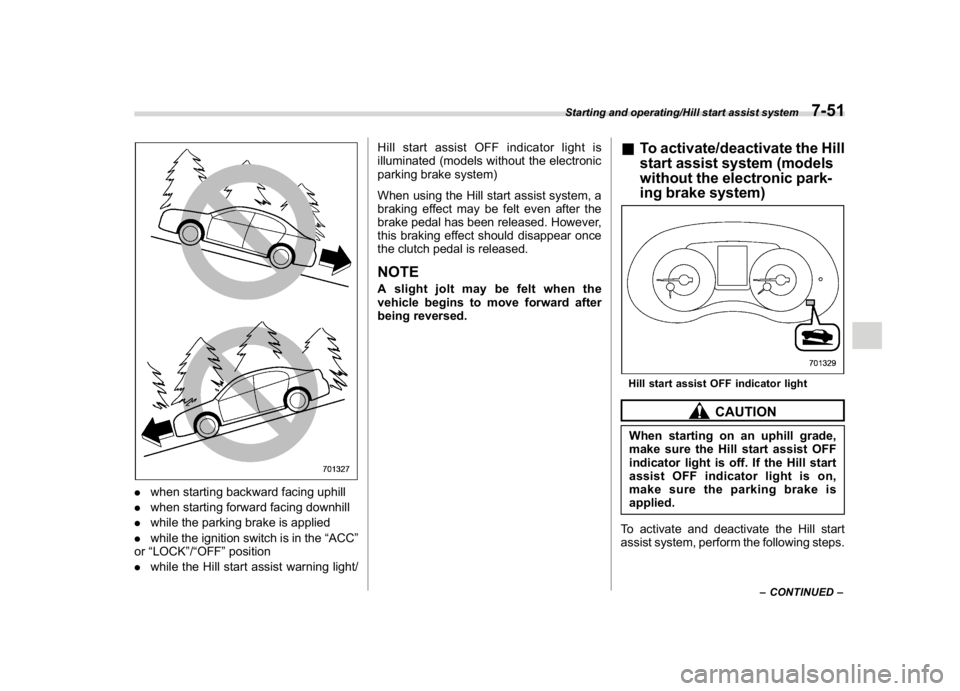
The Hill start assist system may not
operate on slight grades. Also, the Hill
start assist system does not operate in the
following cases.
Starting and operating/Hill start assist system
7-50
Page 400 of 578
(413,1)
北米Model "A1700BE-B" EDITED: 2017/ 10/ 11
.when starting backward facing uphill
.when starting forward facing downhill
.while the parking brake is applied
.while the ignition switch is in the“ACC”
or“LOCK”/“OFF”position
.while the Hill start assist warning light/Hill start assist OFF indicator light is
illuminated (models without the electronic
parking brake system)
When using the Hill start assist system, a
braking effect may be felt even after the
brake pedal has been released. However,
this braking effect should disappear once
the clutch pedal is released.
NOTEA slight jolt may be felt when the
vehicle begins to move forward after
being reversed.
&To activate/deactivate the Hill
start assist system (models
without the electronic park-
ing brake system)Hill start assist OFF indicator light
CAUTION
When starting on an uphill grade,
make sure the Hill start assist OFF
indicator light is off. If the Hill start
assist OFF indicator light is on,
make sure the parking brake is
applied.
To activate and deactivate the Hill start
assist system, perform the following steps.
–CONTINUED–
Starting and operating/Hill start assist system
7-51
7
Page 401 of 578
(414,1)
北米Model "A1700BE-B" EDITED: 2017/ 10/ 11
NOTEIf you make an error when performing
any steps in the following procedure,
place the ignition switch in the“LOCK”/
“OFF”position once and then start
over again.
!To deactivate
1. Park your vehicle in a flat and safe
location and apply the parking brake.
2. Turn the ignition switch to the“LOCK”/
“OFF”position.
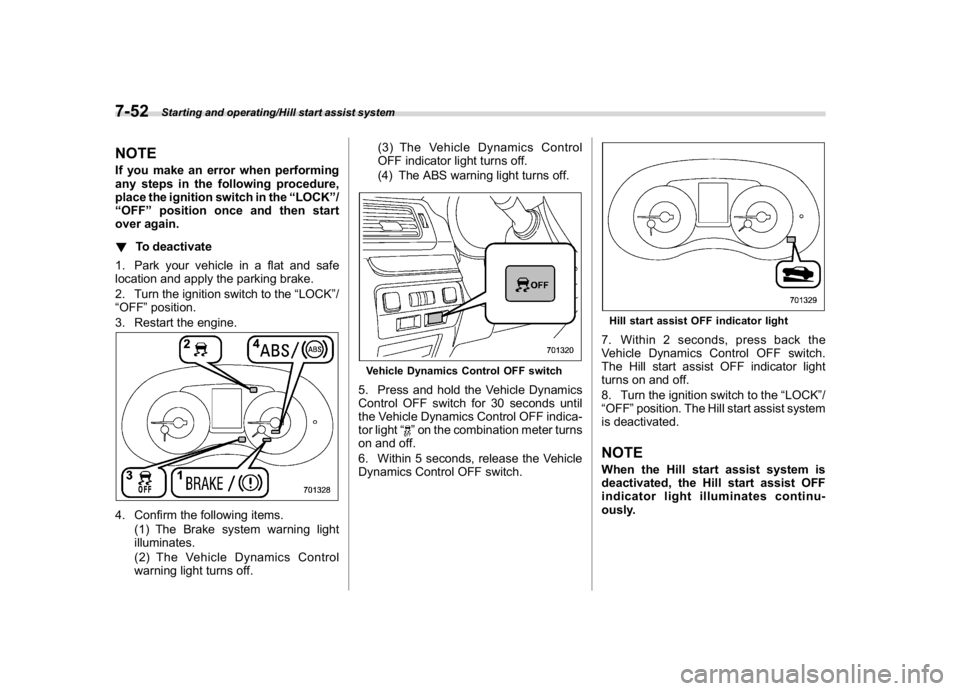
3. Restart the engine.4. Confirm the following items.
(1) The Brake system warning light
illuminates.
(2) The Vehicle Dynamics Control
warning light turns off.(3) The Vehicle Dynamics Control
OFF indicator light turns off.
(4) The ABS warning light turns off.
Vehicle Dynamics Control OFF switch5. Press and hold the Vehicle Dynamics
Control OFF switch for 30 seconds until
the Vehicle Dynamics Control OFF indica-
tor light“
”on the combination meter turns
on and off.
6. Within 5 seconds, release the Vehicle
Dynamics Control OFF switch.
Hill start assist OFF indicator light7. Within 2 seconds, press back the
Vehicle Dynamics Control OFF switch.
The Hill start assist OFF indicator light
turns on and off.
8. Turn the ignition switch to the“LOCK”/
“OFF”position. The Hill start assist system
is deactivated.NOTEWhen the Hill start assist system is
deactivated, the Hill start assist OFF
indicator light illuminates continu-
ously.
Starting and operating/Hill start assist system
7-52
Page 402 of 578

(415,1)
北米Model "A1700BE-B" EDITED: 2017/ 10/ 13
!To reactivate
To reactivate the Hill start assist system,
repeat steps 1 to 8. When the Hill start
assist system is activated, the Hill start
assist OFF indicator light turns off.&Hill start assist warning light/
Hill start assist OFF indicator
light (models without the
electronic parking brake sys-
tem)Refer to“Hill start assist warning light/Hill
start assist OFF indicator light (models
without electronic parking brake system)”
F3-24.
Cruise controlNOTEFor models with the EyeSight system:
Refer to the Owner’s Manual supple-
ment for the EyeSight system.
Cruise control enables you to maintain a
constant vehicle speed without holding
your foot on the accelerator pedal and it is
operative when the vehicle speed is 20
mph (30 km/h) or more.
WARNING
.Do not use the cruise control
under any of the following condi-
tions. These may cause loss of
vehicle control.
–driving up or down a steep
grade
–driving on slippery or winding
roads
–driving in heavy traffic
.When using the cruise control,
always set the speed appropri-
ately according to the speed limit,
traffic flow, road conditions, and
other conditions.
NOTE.On uphill and downhill slopes, de-
pending on the degree of the slope and
the load of the vehicle, there may be
cases when a constant speed cannot
be guaranteed.
.If the cruise control indicator does
not appear even after pressing the
cruise control main button, it is possi-
ble that there is a malfunction in the
system. We recommend that you con-
tact your SUBARU dealer for an inspec-
tion.
.Make sure the cruise control system
is turned off when the cruise control is
not in use to avoid unintentionally
setting the cruise control.
–CONTINUED–
Starting and operating/Cruise control
7-53
7
Page 419 of 578

(432,1)
北米Model "A1700BE-B" EDITED: 2017/ 10/ 11
–When reversing on an uneven
road
.In circumstances such as the follow-
ing, it may not be possible to avoid a
collision even when the system oper-
ates normally.
–Roads are slippery.
–The tire air pressure is not cor-
rect.
–The tires have become worn.
–Tire chains are installed.
–Tires which are not the desig-
nated size are installed.
–Emergency repairs were per-
formed using a puncture repair kit.
–The suspension was modified.
–Vehicle driving is unstable due to
accident or malfunction.–The brake warning light is illumi-
nated.
&Reverse Automatic Braking
System operationWhen the Reverse Automatic Braking
System is in operation, the range between
the vehicle and the detected object will be
indicated on the multi-function display
(color LCD). Also, warning sounds will
activate in 3 levels to warn the driver of a
potential collision.
While the RAB is operating, a warning
message is displayed on the multi-function
display (color LCD) and the combination
meter display (color LCD).
Starting and operating/Reverse Automatic Braking System
7-70
Page 458 of 578

(475,1)
北米Model "A1700BE-B" EDITED: 2017/ 10/ 11
&Tire pressure monitoring
system (TPMS) (U.S.-spec.
models)Low tire pressure warning lightThe tire pressure monitoring system pro-
vides the driver with the warning message
indicated by sending a signal from a
sensor that is installed in each wheel when
tire pressure is severely low.
The tire pressure monitoring system will
activate only when the vehicle is driven.
Also, this system may not react immedi-
ately to a sudden drop in tire pressure (for
example, a blow-out caused by running
over a sharp object).
WARNING
.If the low tire pressure warning
light illuminates while driving,
never brake suddenly. Instead,
perform the following procedure.
(1) Keep driving straight ahead
while gradually reducing
speed.
(2) Slowly pull off the road to a
safe place. Otherwise an acci-
dent involving serious vehicle
damage and serious personal
injury could occur.
(3) Check the pressure for all four
tires and adjust the pressure
to the COLD tire pressure
shown on the vehicle placard
on the door pillar on the
driver’s side.
If this light still illuminates while
driving after adjusting the tire
pressure, a tire may have signifi-
cant damage and a fast leak that
causes the tire to lose air rapidly.
If you have a flat tire, refer to“Flat
tires”F9-5.
.When a spare tire is mounted or a
wheel rim is replaced without the
original pressure sensor/trans-
mitter being transferred, the lowtire pressure warning light will
illuminate steadily after blinking
for approximately one minute.
This indicates the TPMS is unable
to monitor all four road wheels.
Contact your SUBARU dealer as
soon as possible for tire and
sensor replacement and/or sys-
tem resetting.
.When a tire is repaired with liquid
sealant, the tire pressure warning
valve and transmitter may not
operate properly. If a liquid sea-
lant is used, contact your nearest
SUBARU dealer or other qualified
service shop as soon as possi-
ble. Make sure to replace the tire
pressure warning valve and
transmitter when replacing the
tire. You may reuse the wheel if
there is no damage to it and if the
sealant residue is properly
cleaned off.
If the light illuminates steadily
after blinking for approximately
one minute, promptly contact a
SUBARU dealer to have the sys-
tem inspected.
In case of emergency/Flat tires
9-17
9
Page 471 of 578

(490,1)
北米Model "A1700BE-B" EDITED: 2017/ 10/ 11
Exterior care&Washing
CAUTION
TYPE RA: Do not use automatic car
washes. Doing so may damage the
rear wing or its finish.
CAUTION
.When washing the vehicle, the
brakes may get wet. As a result,
the brake stopping distance will
be longer. To dry the brakes, drive
the vehicle at a safe speed while
lightly depressing the brake ped-
al to heat up the brakes.
.Do not wash the engine compart-
ment and area adjacent to it. If
water enters the engine air intake
or electrical parts, it will cause
engine trouble or a malfunction
of electrical equipment.
.When washing the inner fenders,
underbody, bumpers and pro-
truding objects such as exhaust
pipes and exhaust finishers, be
careful to prevent injuries from
contacting sharp ends..Do not use any organic solvents
when washing the surface of the
bulb assembly cover. However, if
a detergent with organic solvents
is used to wash the cover sur-
face, completely rinse off the
detergent with water. Otherwise,
the cover surface may be da-
maged.
NOTEWhen having your vehicle washed in an
automatic car wash, make sure before-
hand that the car wash is of suitable
type.
The best way to preserve your vehicle’s
beauty is frequent washing. Wash the
vehicle at least once a month to avoid
contamination by road grime.
Wash dirt off with a wet sponge and plenty
of lukewarm or cold water. Do not wash the
vehicle with hot water and in direct sun-
light.
Salt, chemicals, insects, tar, soot, tree sap,
and bird droppings should be washed off
by using a light detergent, as required. If
you use a light detergent, make certain
that it is a neutral detergent. Do not use
strong soap or chemical detergents. All
cleaning agents should be promptly rinsedoff the surface and not allowed to dry there.
Rinse the vehicle thoroughly with plenty of
lukewarm water. Wipe the remaining water
off with a chamois or soft cloth. Wear
rubber gloves and use a hand brush when
washing down underbody, inner fenders
and suspension to effectively remove mud
and dirt off.
!Washing the underbody
Chemicals, salts and gravel used for
deicing road surfaces are extremely cor-
rosive, accelerating the corrosion of un-
derbody components, such as the exhaust
system, fuel and brake lines, brake cables,
floor pan and fenders, and suspension.
Thoroughly flush the underbody and inside
of the fenders with lukewarm or cold water
at frequent intervals to reduce the harmful
effects of such agents.
Mud and sand adhering to the underbody
components may accelerate their corro-
sion.
After driving off-road or on muddy or sandy
roads, wash the mud and sand off the
underbody. Carefully flush the suspension
and axle parts, as they are particularly
prone to mud and sand buildup. Do not use
a sharp-edged tool to remove caked mud.
Appearance care/Exterior care
10-2