Page 416 of 474

(429,1)
北米Model "A1320BE-C" EDITED: 2017/ 10/ 10
Pinch the upper part of the fuse puller
when removing it from the main fuse box.1) Good
2) BlownIf any lights, accessories or other electrical
controls do not operate, inspect the corre-
sponding fuse. If a fuse has blown, replace
it.
1. Turn the ignition switch to the“LOCK”/
“OFF”position and turn off all electrical
accessories.
2. Remove the cover.
3. Determine which fuse may be blown.
Look at the back side of each fuse box
cover and refer to“Fuses and circuits”
F12-10.
4. Pull out the fuse with the fuse puller.
5. Inspect the fuse. If it has blown,
replace it with a spare fuse of the same
rating.
6. If the same fuse blows again, this
indicates that its system has a problem.
Contact your SUBARU dealer for repairs.
Installation of accessoriesAlways consult your SUBARU dealer
before installing fog lights or any other
electrical equipment in your vehicle. Such
accessories may cause the electronic
system to malfunction if they are incor-
rectly installed or if they are not suited for
the vehicle.
Maintenance and service/Installation of accessories
11-35
11
Page 417 of 474
(430,1)
北米Model "A1320BE-C" EDITED: 2017/ 10/ 10
Replacing bulbs
WARNING
Bulbs may become very hot while
illuminated. Before replacing bulbs,
turn off the lights and wait until the
bulbs cool down. Otherwise, there is
a risk of sustaining a burn injury.
CAUTION
Replace any bulb only with a new
bulb of the specified wattage. Using
a bulb of different wattage could
result in a fire. For the specified
wattage of each bulb, refer to“Bulb
chart”F12-14.NOTEFor models with type B combination
meter, if SRH is malfunctioning, the
SRH OFF indicator appears on the
combination meter when the ignition
switch is in the“ON”position. It
indicates that SRH has been deacti-
vated. Contact a SUBARU dealer for an
inspection.
&Headlights (models with LED
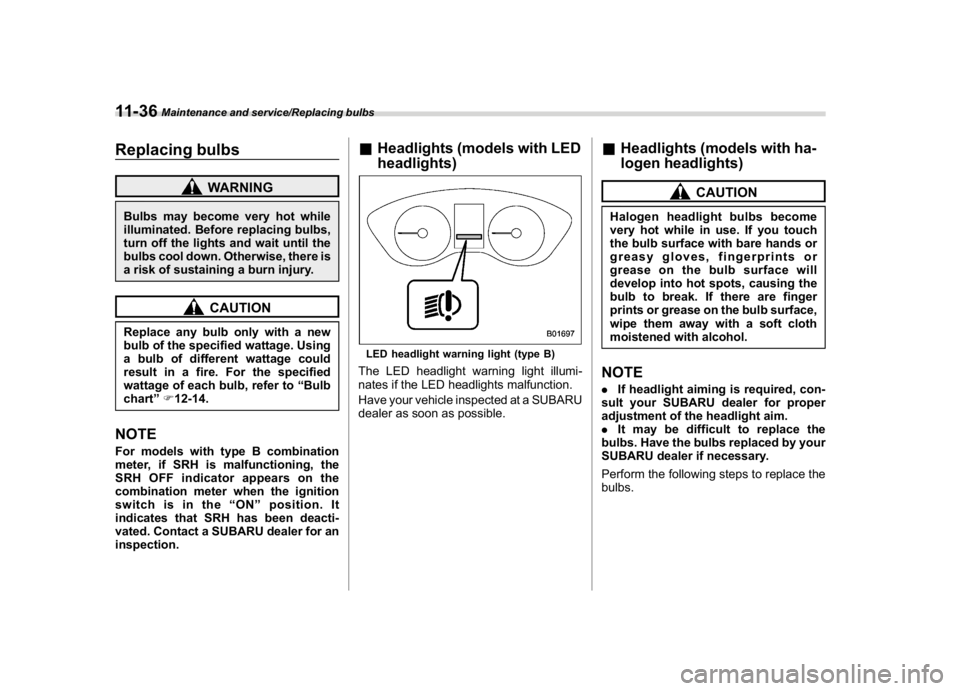
headlights)LED headlight warning light (type B)The LED headlight warning light illumi-
nates if the LED headlights malfunction.
Have your vehicle inspected at a SUBARU
dealer as soon as possible.
&Headlights (models with ha-
logen headlights)
CAUTION
Halogen headlight bulbs become
very hot while in use. If you touch
the bulb surface with bare hands or
greasy gloves, fingerprints or
grease on the bulb surface will
develop into hot spots, causing the
bulb to break. If there are finger
prints or grease on the bulb surface,
wipe them away with a soft cloth
moistened with alcohol.NOTE.If headlight aiming is required, con-
sult your SUBARU dealer for proper
adjustment of the headlight aim.
.It may be difficult to replace the
bulbs. Have the bulbs replaced by your
SUBARU dealer if necessary.
Perform the following steps to replace the
bulbs.
Maintenance and service/Replacing bulbs
11-36
Page 447 of 474
(464,1)
北米Model "A1320BE-C" EDITED: 2017/ 10/ 10
!Maximum load rating
The load rating at the maximum
permissible weight load for this tire.
For example,“MAX. LOAD 580 kg
(1279 LBS) @ 300 kPa (44 PSI)
MAX. PRESS.”
WARNING
Maximum load rating applies
only to the tire, not to the
vehicle. Putting a load rated
tire on any vehicle does not
mean the vehicle can be
loaded up to the tire’s rated
load.!Construction type
Applicable construction of this tire.
For example,“TUBELESS STEEL
BELTED RADIAL”
!Construction
The generic name of each cord
material used in the plies (both
sidewall and tread area) of this tire.
For example,“PLIES: TREAD 2STEEL + 2 POLYESTER SIDE-
WALL 2 POLYESTER”
!Uniform Tire Quality Grading
(UTQG)
For details, refer to“
Uniform tire
quality grading standards”F13-14.
&Recommended tire inflation
pressure!Recommended cold tire infla-
tion pressureFor recommended cold tire inflation
pressure for your vehicle’s tires,
refer to“
Tires”F12-8.
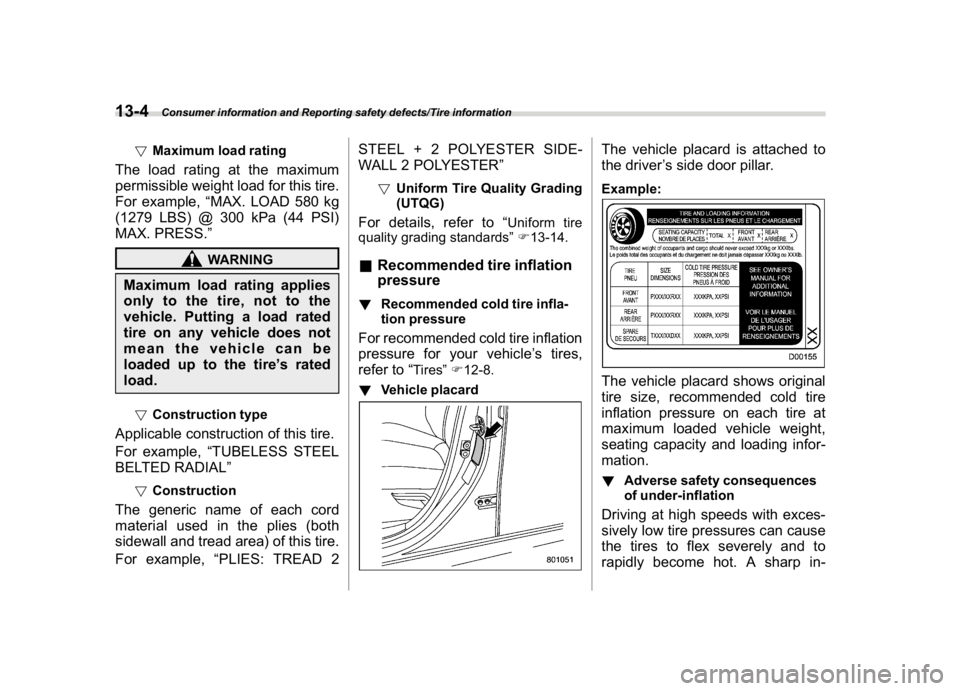
!Vehicle placard
The vehicle placard is attached to
the driver’s side door pillar.Example:The vehicle placard shows original
tire size, recommended cold tire
inflation pressure on each tire at
maximum loaded vehicle weight,
seating capacity and loading infor-
mation.!Adverse safety consequences
of under-inflationDriving at high speeds with exces-
sively low tire pressures can cause
the tires to flex severely and to
rapidly become hot. A sharp in-
Consumer information and Reporting safety defects/Tire information
13-4