2018 SUBARU CROSSTREK remove seats
[x] Cancel search: remove seatsPage 33 of 474
(34,1)
北米Model "A1320BE-C" EDITED: 2017/ 10/ 10
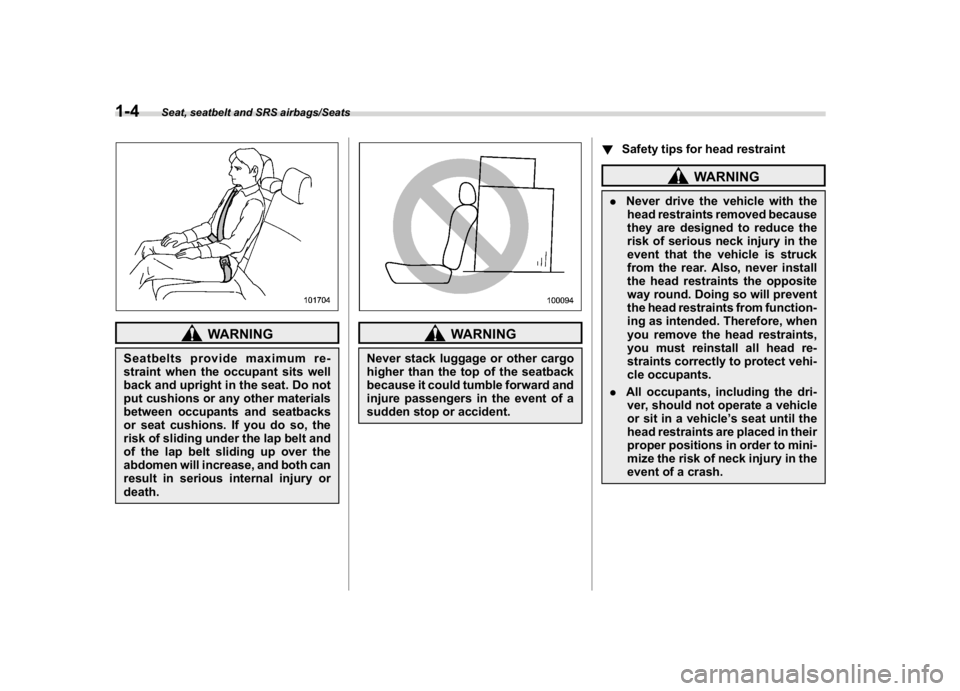
WARNING
Seatbelts provide maximum re-
straint when the occupant sits well
back and upright in the seat. Do not
put cushions or any other materials
between occupants and seatbacks
or seat cushions. If you do so, the
risk of sliding under the lap belt and
of the lap belt sliding up over the
abdomen will increase, and both can
result in serious internal injury or
death.
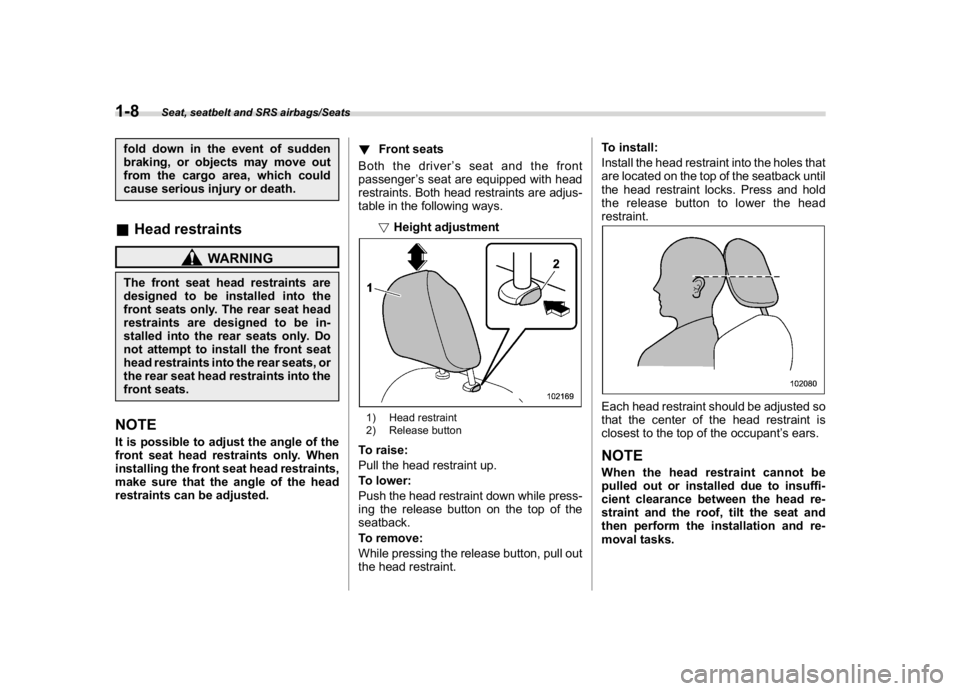
WARNING
Never stack luggage or other cargo
higher than the top of the seatback
because it could tumble forward and
injure passengers in the event of a
sudden stop or accident.!Safety tips for head restraint
WARNING
.Never drive the vehicle with the
head restraints removed because
they are designed to reduce the
risk of serious neck injury in the
event that the vehicle is struck
from the rear. Also, never install
the head restraints the opposite
way round. Doing so will prevent
the head restraints from function-
ing as intended. Therefore, when
you remove the head restraints,
you must reinstall all head re-
straints correctly to protect vehi-
cle occupants.
.All occupants, including the dri-
ver, should not operate a vehicle
or sit in a vehicle’s seat until the
head restraints are placed in their
proper positions in order to mini-
mize the risk of neck injury in the
event of a crash.
Seat, seatbelt and SRS airbags/Seats
1-4
Page 37 of 474
(38,1)
北米Model "A1320BE-C" EDITED: 2017/ 10/ 10
fold down in the event of sudden
braking, or objects may move out
from the cargo area, which could
cause serious injury or death.&Head restraints
WARNING
The front seat head restraints are
designed to be installed into the
front seats only. The rear seat head
restraints are designed to be in-
stalled into the rear seats only. Do
not attempt to install the front seat
head restraints into the rear seats, or
the rear seat head restraints into the
front seats.NOTEIt is possible to adjust the angle of the
front seat head restraints only. When
installing the front seat head restraints,
make sure that the angle of the head
restraints can be adjusted.!Front seats
Both the driver’s seat and the front
passenger’s seat are equipped with head
restraints. Both head restraints are adjus-
table in the following ways.
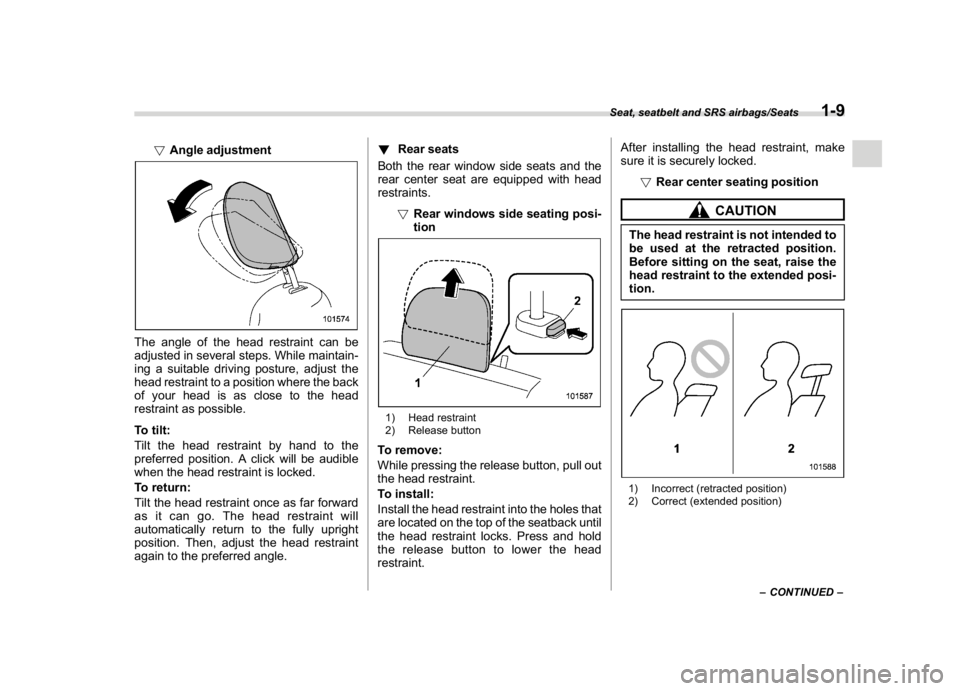
!Height adjustment
1) Head restraint
2) Release buttonTo raise:
Pull the head restraint up.
To lower:
Push the head restraint down while press-
ing the release button on the top of the
seatback.
To remove:
While pressing the release button, pull out
the head restraint.To install:
Install the head restraint into the holes that
are located on the top of the seatback until
the head restraint locks. Press and hold
the release button to lower the head
restraint.
Each head restraint should be adjusted so
that the center of the head restraint is
closest to the top of the occupant’s ears.NOTEWhen the head restraint cannot be
pulled out or installed due to insuffi-
cient clearance between the head re-
straint and the roof, tilt the seat and
then perform the installation and re-
moval tasks.
Seat, seatbelt and SRS airbags/Seats
1-8
Page 38 of 474
(39,1)
北米Model "A1320BE-C" EDITED: 2017/ 10/ 10
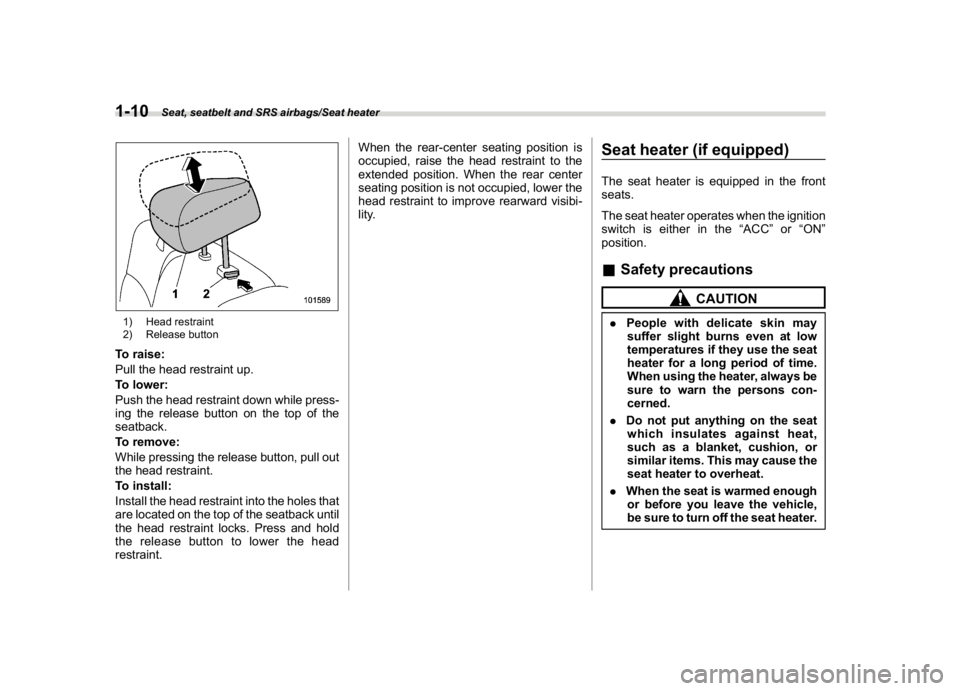
!Angle adjustment
The angle of the head restraint can be
adjusted in several steps. While maintain-
ing a suitable driving posture, adjust the
head restraint to a position where the back
of your head is as close to the head
restraint as possible.
To tilt:
Tilt the head restraint by hand to the
preferred position. A click will be audible
when the head restraint is locked.
To return:
Tilt the head restraint once as far forward
as it can go. The head restraint will
automatically return to the fully upright
position. Then, adjust the head restraint
again to the preferred angle.!Rear seats
Both the rear window side seats and the
rear center seat are equipped with head
restraints.
!Rear windows side seating posi-
tion
1) Head restraint
2) Release buttonTo remove:
While pressing the release button, pull out
the head restraint.
To install:
Install the head restraint into the holes that
are located on the top of the seatback until
the head restraint locks. Press and hold
the release button to lower the head
restraint.After installing the head restraint, make
sure it is securely locked.
!Rear center seating position
CAUTION
The head restraint is not intended to
be used at the retracted position.
Before sitting on the seat, raise the
head restraint to the extended posi-
tion.1) Incorrect (retracted position)
2) Correct (extended position)
–CONTINUED–
Seat, seatbelt and SRS airbags/Seats
1-9
1
Page 39 of 474
(40,1)
北米Model "A1320BE-C" EDITED: 2017/ 10/ 10
1) Head restraint
2) Release buttonTo raise:
Pull the head restraint up.
To lower:
Push the head restraint down while press-
ing the release button on the top of the
seatback.
To remove:
While pressing the release button, pull out
the head restraint.
To install:
Install the head restraint into the holes that
are located on the top of the seatback until
the head restraint locks. Press and hold
the release button to lower the head
restraint.When the rear-center seating position is
occupied, raise the head restraint to the
extended position. When the rear center
seating position is not occupied, lower the
head restraint to improve rearward visibi-
lity.
Seat heater (if equipped)The seat heater is equipped in the front
seats.
The seat heater operates when the ignition
switch is either in the“ACC”or“ON”
position.&Safety precautions
CAUTION
.People with delicate skin may
suffer slight burns even at low
temperatures if they use the seat
heater for a long period of time.
When using the heater, always be
sure to warn the persons con-
cerned.
.Do not put anything on the seat
which insulates against heat,
such as a blanket, cushion, or
similar items. This may cause the
seat heater to overheat.
.When the seat is warmed enough
or before you leave the vehicle,
be sure to turn off the seat heater.
Seat, seatbelt and SRS airbags/Seat heater
1-10
Page 59 of 474
(60,1)
北米Model "A1320BE-C" EDITED: 2017/ 10/ 10
!Installing forward facing child re-
straint
WARNING
Before installing a child restraint
system, be sure to confirm that the
seatback is securely locked into
place. Otherwise, in an accident,
serious injury or death could result.
1. Shake the seatback slightly to confirm
that it is securely locked into place.
–Check the red colored unlocking
marker which is attached to the bottom
of the lock release knob is invisible. For
details, refer to“Folding down the rear
seatback”F1-6.
2. Prepare the rear seat head restraint
where a child restraint system is intended
to be installed in the following way.
–When a child restraint system is
installed on thewindow-side seating
position, remove the rear seat head
restraint. For details, refer to“Rear
seats”F1-9.
Store the head restraint in the cargo
area. Avoid placing the head restraint
in the passenger compartment to pre-
vent it from being thrown around in the
passenger compartment in a sudden
stop or a sharp turn.–When a child restraint system is
installed on therear center seating
position, raise the rear seat head
restraint to the extended position. Do
not remove the head restraint. For
details, refer to“Rear seats”F1-9.
3. Place the child restraint system in the
rear seating position.
WARNING
When you intend to install a child
restraint system on the rear center
seating position, if the child restraint
system does not fit snugly against
the contours of the rear center seat
cushion, install the child restraint
system on the window-side seating
position to be safe. For details, refer
to“Where to place a child restraint
system”F1-26.
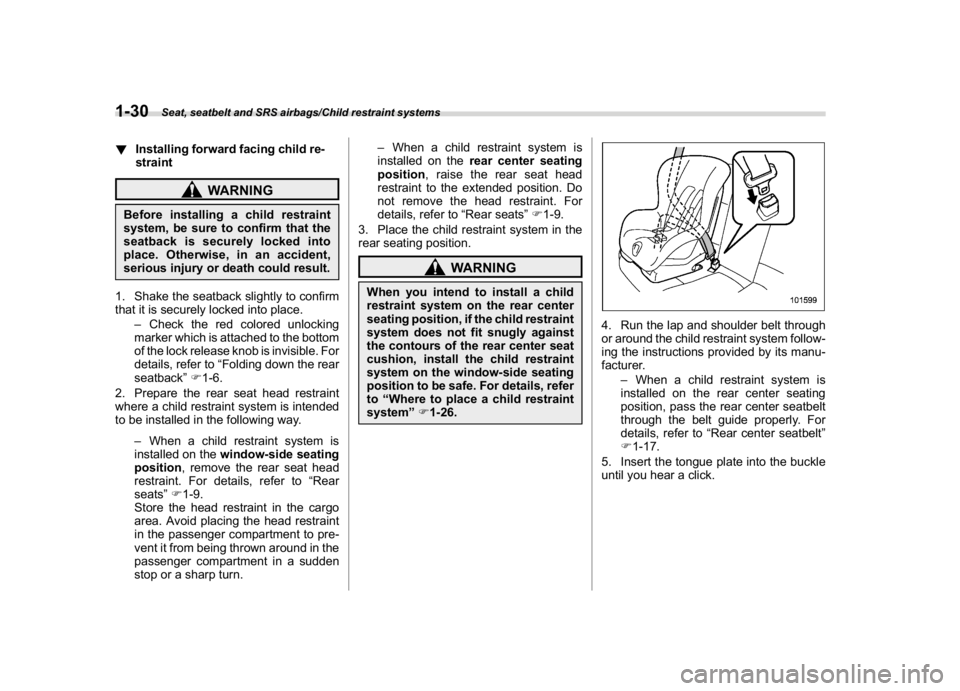
4. Run the lap and shoulder belt through
or around the child restraint system follow-
ing the instructions provided by its manu-
facturer.
–When a child restraint system is
installed on the rear center seating
position, pass the rear center seatbelt
through the belt guide properly. For
details, refer to“Rear center seatbelt”
F1-17.
5. Insert the tongue plate into the buckle
until you hear a click.
Seat, seatbelt and SRS airbags/Child restraint systems
1-30
Page 64 of 474
(65,1)
北米Model "A1320BE-C" EDITED: 2017/ 10/ 10
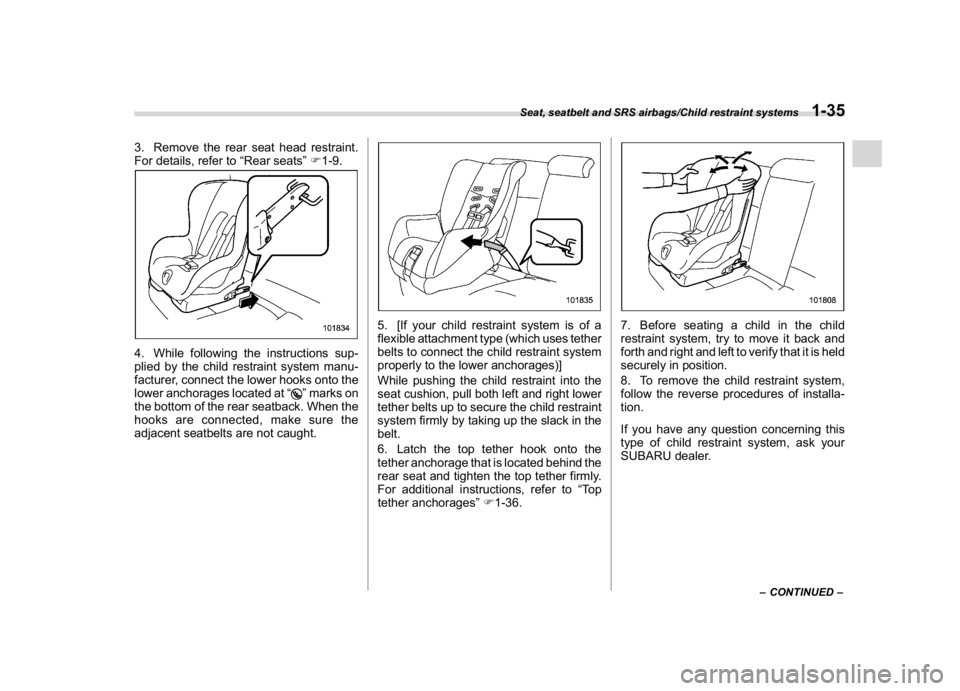
3. Remove the rear seat head restraint.
For details, refer to“Rear seats”F1-9.4. While following the instructions sup-
plied by the child restraint system manu-
facturer, connect the lower hooks onto the
lower anchorages located at“
”marks on
the bottom of the rear seatback. When the
hooks are connected, make sure the
adjacent seatbelts are not caught.
5. [If your child restraint system is of a
flexible attachment type (which uses tether
belts to connect the child restraint system
properly to the lower anchorages)]
While pushing the child restraint into the
seat cushion, pull both left and right lower
tether belts up to secure the child restraint
system firmly by taking up the slack in the
belt.
6. Latch the top tether hook onto the
tether anchorage that is located behind the
rear seat and tighten the top tether firmly.
For additional instructions, refer to“To p
tether anchorages”F1-36.
7. Before seating a child in the child
restraint system, try to move it back and
forth and right and left to verify that it is held
securely in position.
8. To remove the child restraint system,
follow the reverse procedures of installa-
tion.
If you have any question concerning this
type of child restraint system, ask your
SUBARU dealer.
–CONTINUED–
Seat, seatbelt and SRS airbags/Child restraint systems
1-35
1
Page 77 of 474

(78,1)
北米Model "A1320BE-C" EDITED: 2017/ 10/ 10
!Front passenger’s SRS frontal air-
bag
The front passenger’s SRS frontal airbag
uses a dual stage inflator. The inflator
operates in different ways depending on
the severity of impact.1) Occupant detection sensorsThe occupant detection system sensors
are installed between the seat and seat
rails, and monitor the physique and pos-
ture of the front passenger. Using this
information, the occupant detection sys-
tem determines whether the front passen-
ger’s SRS frontal airbag should be de-
ployed or not.
The occupant detection system may not
inflate the front passenger’s SRS frontal
airbag even when the driver’s SRS frontalairbag deploys. This is normal. In this
case, although the front passenger’s SRS
frontal airbag does not operate, the front
passenger’s seatbelt pretensioner oper-
ates with the driver’s seatbelt preten-
sioner. For details about the seatbelt
pretensioner, refer to“Seatbelt preten-
sioners”F1-21.
CAUTION
Observe the following precautions.
Failure to do so may prevent the
SUBARU advanced frontal airbag
system from functioning correctly
or cause the system to fail.
.Do not apply any strong impact to
the front passenger’s seat such
as by kicking.
.Do not let rear passengers rest
their feet between the front seat-
back and seat cushion.
.Do not spill liquid on the front
passenger’s seat. If liquid is
spilled, wipe it off immediately.
.Do not remove or disassemble
the front passenger’s seat.
.Do not install any accessory
(such as an audio amplifier) other
than a genuine SUBARU acces-
sory under the front passenger’sseat.
.Do not place anything (shoes,
umbrella, etc.) under the front
passenger’s seat.
.Do not place any objects (books,
etc.) around the front passen-
ger’s seat.
.Do not use the front passenger’s
seat with the head restraint re-
moved.
.Do not leave any articles on the
front passenger’s seat or the
seatbelt tongue and buckle en-
gaged when you leave your vehi-
cle.
.Do not put sharp object(s) on the
seat or pierce the seat uphols-
tery.
.Do not place a magnet near the
seatbelt buckle and the seatbelt
retractor.
.Do not use front seats with their
forward-backward position and
seatback not being locked into
place securely. If any of them are
not locked securely, adjust them
again. For adjusting procedure,
refer to“Forward and backward
adjustment”F1-5 and“Reclining
the seatback”F1-5.
Seat, seatbelt and SRS airbags/SRS airbag (Supplemental Restraint System airbag)
1-48
Page 80 of 474
(81,1)
北米Model "A1320BE-C" EDITED: 2017/ 10/ 10
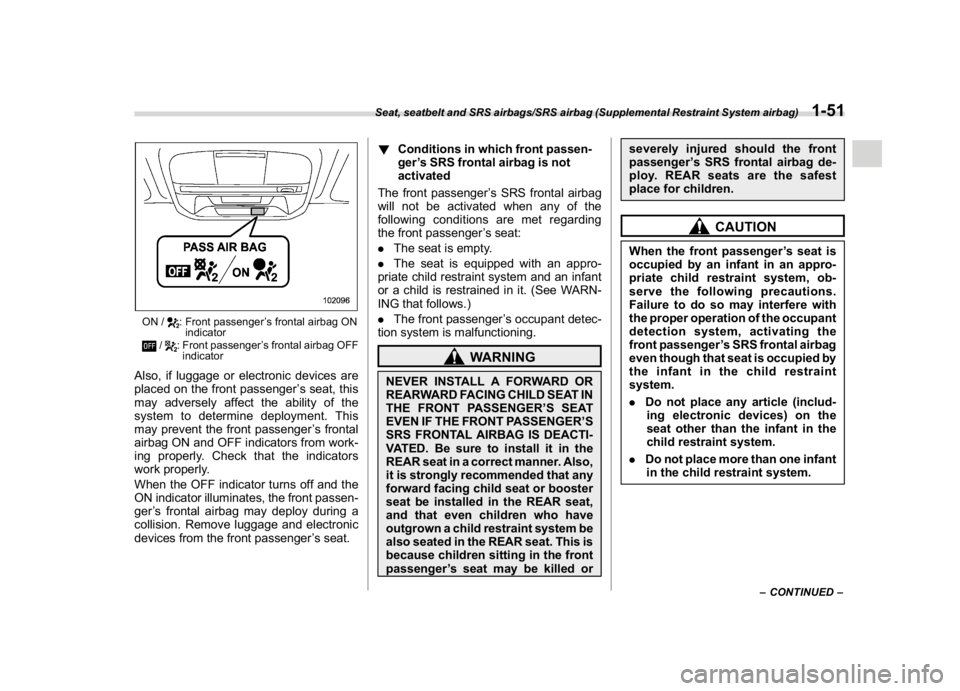
ON /
: Front passenger’s frontal airbag ON
indicator
/
: Front passenger’s frontal airbag OFF
indicator
Also, if luggage or electronic devices are
placed on the front passenger’s seat, this
may adversely affect the ability of the
system to determine deployment. This
may prevent the front passenger’s frontal
airbag ON and OFF indicators from work-
ing properly. Check that the indicators
work properly.
When the OFF indicator turns off and the
ON indicator illuminates, the front passen-
ger’s frontal airbag may deploy during a
collision. Remove luggage and electronic
devices from the front passenger’s seat.!Conditions in which front passen-
ger’s SRS frontal airbag is not
activated
The front passenger’s SRS frontal airbag
will not be activated when any of the
following conditions are met regarding
the front passenger’s seat:
.The seat is empty.
.The seat is equipped with an appro-
priate child restraint system and an infant
or a child is restrained in it. (See WARN-
ING that follows.)
.The front passenger’s occupant detec-
tion system is malfunctioning.
WARNING
NEVER INSTALL A FORWARD OR
REARWARD FACING CHILD SEAT IN
THE FRONT PASSENGER’S SEAT
EVEN IF THE FRONT PASSENGER’S
SRS FRONTAL AIRBAG IS DEACTI-
VATED. Be sure to install it in the
REAR seat in a correct manner. Also,
it is strongly recommended that any
forward facing child seat or booster
seat be installed in the REAR seat,
and that even children who have
outgrown a child restraint system be
also seated in the REAR seat. This is
because children sitting in the front
passenger’s seat may be killed orseverely injured should the front
passenger’s SRS frontal airbag de-
ploy. REAR seats are the safest
place for children.
CAUTION
When the front passenger’s seat is
occupied by an infant in an appro-
priate child restraint system, ob-
serve the following precautions.
Failure to do so may interfere with
the proper operation of the occupant
detection system, activating the
front passenger’s SRS frontal airbag
even though that seat is occupied by
the infant in the child restraint
system.
.Do not place any article (includ-
ing electronic devices) on the
seat other than the infant in the
child restraint system.
.Do not place more than one infant
in the child restraint system.
–CONTINUED–
Seat, seatbelt and SRS airbags/SRS airbag (Supplemental Restraint System airbag)
1-51
1