Page 257 of 416
255
Important: if your vehicle's AdBlue®
tank is completely empty – which is
confirmed by the alert messages and the
impossibility of starting the engine – you
must add at least 4
litres and no more than
10
litres.
F
A
fter emptying the container or bottle, wipe
away any spillage around the tank filler
using a damp cloth.
If any fluid is spilt or splashed, wash
immediately with cold water or wipe with a
damp cloth.
If the fluid has crystallised, clean it off
using a sponge and hot water.
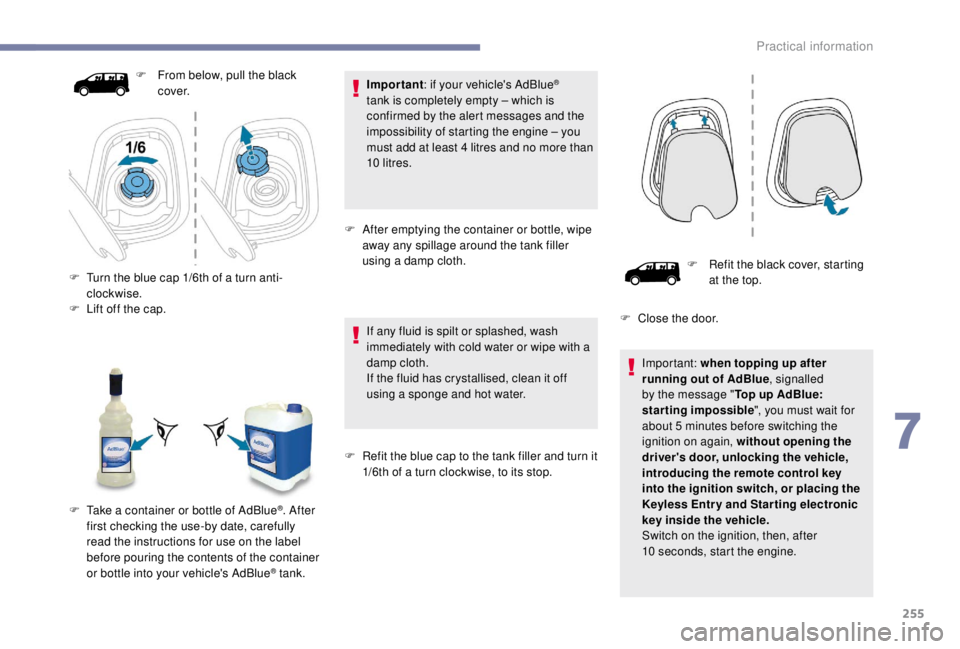
F
R
efit the blue cap to the tank filler and turn it
1/6th of a turn clockwise, to its stop.
F
F
rom below, pull the black
c ove r.
F
T
urn the blue cap 1/6th of a turn anti-
clockwise.
F
L
ift off the cap.
F
T
ake a container or bottle of AdBlue
®. After
first checking the use-by date, carefully
read the instructions for use on the label
before pouring the contents of the container
or bottle into your vehicle's AdBlue
® tank. F
R
efit the black cover, starting
at the top.
F
C
lose the door.
Important: when topping up after
running out of AdBlue , signalled
by the message " Top up AdBlue:
starting impossible ", you must wait for
about 5 minutes before switching the
ignition on again, without opening the
driver's door, unlocking the vehicle,
introducing the remote control key
into the ignition switch, or placing the
K
eyless Entr y and Star ting electronic
key inside the vehicle.
Switch on the ignition, then, after
10
seconds, start the engine.
7
Practical information
Page 258 of 416
256
Advice on care
General recommendations on the care and maintenance of your vehicle are given in the Warranty
and Maintenance Record.Observe the following recommendations to
avoid damaging your vehicle:
-
D
o not clean your headlamps with a dry
or abrasive cloth, nor with detergent or
solvent products. Use a sponge and
soapy water or a pH neutral product.
-
W
hen using a high pressure washer on
stubborn dirt, avoid prolonged use on the
headlamps, the lamps and their edges to
avoid damaging their lacquer finish and
seals.
-
N
ever use an abrasive sponge to clean
persistent dirt, as this may scratch the
paint sur face. Use a soft cloth with soapy
water instead.
-
W
hen washing your vehicle, never clean
the interior with a water jet.
-
W
hen washing your vehicle in an
automatic roller-brush car wash, be sure
to lock your doors and, depending on the
version you have, remove the key and
deactivate the " Hands-Free Tailgate
Access " system. It is always preferable to have paint
repairs carried out by a PEUGEOT dealer
or a qualified workshop.
-
N
ever use high pressure washing to
clean the engine compartment, in order
to avoid damaging the electrical units.
-
L
iquids carried in an open vessel (a cup
or mug) could be spilt, presenting a risk
of damage on contact with the controls
in the dashboard and centre console. Be
careful.
Depending on the version you have, in order
to avoid damaging or unpeeling the stickers
on the bodywork, you are strongly advised
against using high-pressure cleaners to
wash your vehicle. It is recommended that
you wash it using a high-flow water jet and
rinse the vehicle down using demineralised
water.
Only a microfibre cloth is recommended for
wiping your vehicle, it must be clean and
used gently.
Practical information
Page 266 of 416
264
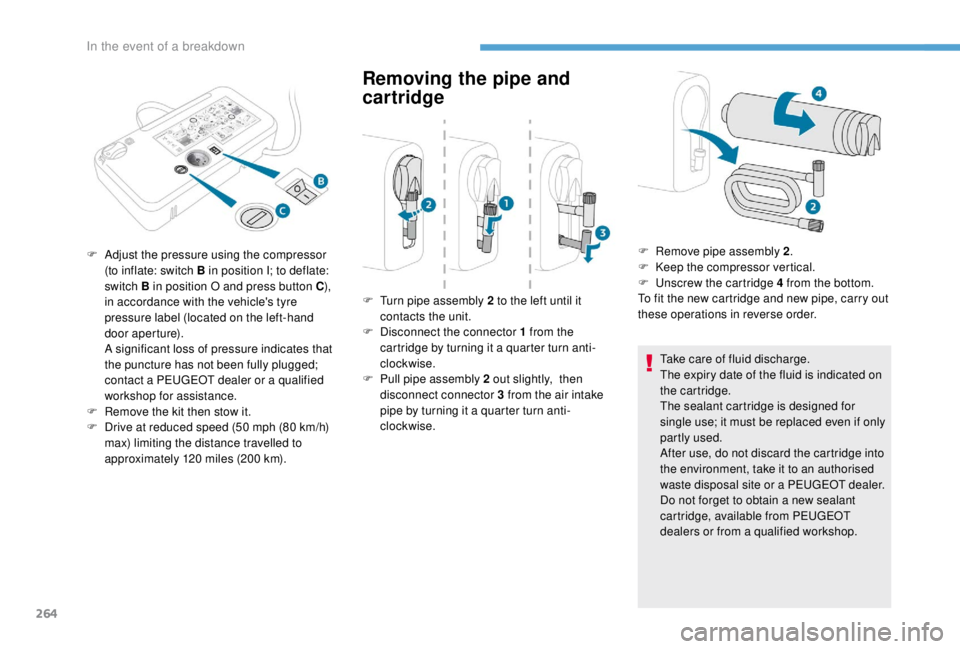
Removing the pipe and
cartridge
Take care of fluid discharge.
The expiry date of the fluid is indicated on
the cartridge.
The sealant cartridge is designed for
single use; it must be replaced even if only
partly used.
After use, do not discard the cartridge into
the environment, take it to an authorised
waste disposal site or a PEUGEOT dealer.
Do not forget to obtain a new sealant
cartridge, available from PEUGEOT
dealers or from a qualified workshop.
F
T
urn pipe assembly 2
to the left until it
contacts the unit.
F
D
isconnect the connector 1
from the
cartridge by turning it a quarter turn anti-
clockwise.
F
P
ull pipe assembly 2 out slightly, then
disconnect connector 3
from the air intake
pipe by turning it a quarter turn anti-
clockwise.
F
A
djust the pressure using the compressor
(to inflate: switch B in position I; to deflate:
switch B in position O and press button C ),
in accordance with the vehicle's tyre
pressure label (located on the left-hand
door aperture). A s
ignificant loss of pressure indicates that
the puncture has not been fully plugged;
contact a PEUGEOT dealer or a qualified
workshop for assistance.
F
R
emove the kit then stow it.
F
D
rive at reduced speed (50
mph (80 km/h)
max) limiting the distance travelled to
approximately 120
miles (200
km). F
R
emove pipe assembly 2
.
F
K
eep the compressor vertical.
F
U
nscrew the cartridge 4 from the bottom.
To fit the new cartridge and new pipe, carry out
these operations in reverse order.
In the event of a breakdown
Page 269 of 416
267
Access to the spare wheel
F Access to the spare wheel is from the rear.
F O pen the side-hinged rear doors or the
tailgate, according to the configuration of
your vehicle.
To avoid any unwanted opening of the
electric side door(s), deactivate the
" Hands-Free Tailgate Access " function
in the vehicle configuration menu.
For more information on the Hands-
free sliding side door , refer to the
corresponding section. F
I
f your vehicle is fitted with a towbar, raise
the rear of the vehicle using the jack (must
be at jacking point B ) to allow sufficient
space to remove the spare wheel.
Removing
F Access the carrier bolt, located on the rear door sill. F
T
urn the bolt anti-clockwise using the
wheelbrace (about 14 turns) until the carrier
is low enough to allow the carrier hook to be
disengaged.
F
R
elease the carrier from the hook, take the
spare wheel and place it next to the wheel
to be changed.
8
In the event of a breakdown
Page 271 of 416
269
Removing a wheel
Parking the vehicle
Park the vehicle where it does not block
traffic: the ground must be level, stable
and non-slippery.
With a manual gearbox, engage first gear
then switch off the ignition to block the
wheels.
With an automatic gearbox, place the gear
selector to position P then switch off the
ignition to block the wheels.
With an electronic gearbox, place the gear
selector to position A then switch off the
ignition to block the wheels.
Apply the parking brake and check that
the warning lamp is on in the instrument
panel.
The passengers must get out of the
vehicle and wait where they are safe.
Never go underneath a vehicle raised
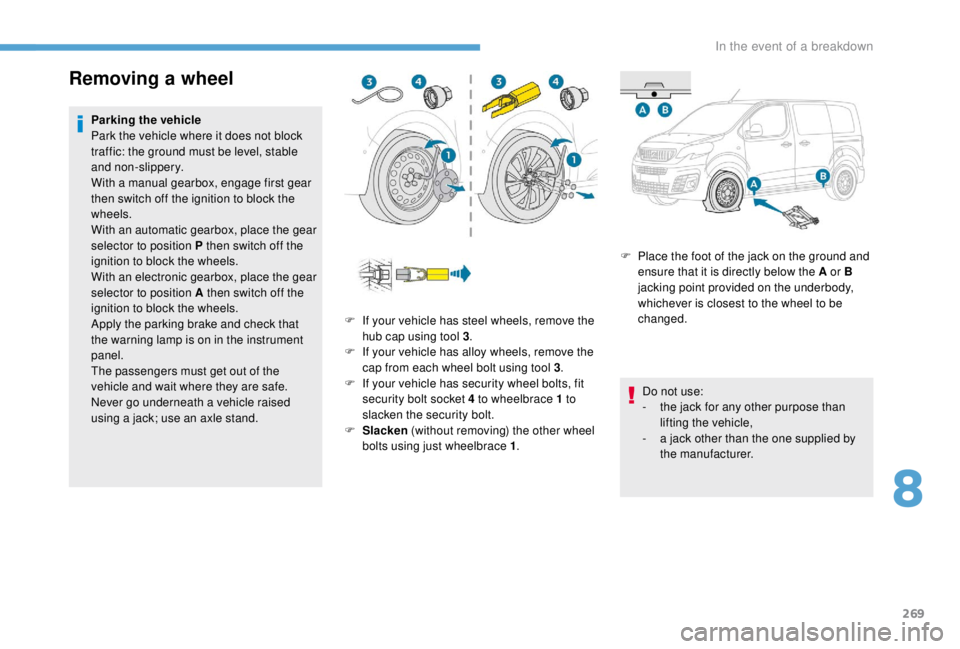
using a jack; use an axle stand.F
P
lace the foot of the jack on the ground and
ensure that it is directly below the A or B
jacking point provided on the underbody,
whichever is closest to the wheel to be
changed.
Do not use:
-
t
he jack for any other purpose than
lifting the vehicle,
-
a j
ack other than the one supplied by
the manufacturer.
F
I
f your vehicle has steel wheels, remove the
hub cap using tool 3 .
F
I
f your vehicle has alloy wheels, remove the
cap from each wheel bolt using tool 3 .
F
I
f your vehicle has security wheel bolts, fit
security bolt socket 4
to wheelbrace 1 to
slacken the security bolt.
F
S
lacken (without removing) the other wheel
bolts using just wheelbrace 1 .
8
In the event of a breakdown
Page 274 of 416
272
Changing a bulb
The headlamps have polycarbonate
lenses with a protective coating:
F
d
o not clean them using a dr y or
abrasive cloth, nor with a detergent
or solvent product,
F
u
se a sponge and soapy water or a pH
neutral product,
F
w
hen using a high pressure washer
on persistent marks, do not keep the
lance directed towards the lamps or
their edges for too long, so as not to
damage their protective coating and
seals.
Changing a bulb should only be done after
the headlamp has been switched off for
several minutes (risk of serious burns).
F
D
o not touch the bulb directly with your
fingers, use a lint-free cloth.
It is essential only to use anti-ultraviolet
(UV) type bulbs, so as not to damage the
headlamp.
Always replace a failed bulb with a new
bulb with the same type and specification. In some weather conditions (e.g. low
temperature or humidity), the presence
of misting on the internal sur face of the
glass of the headlamps and rear lamps is
normal; it disappears after the lamps have
been on for a few minutes.
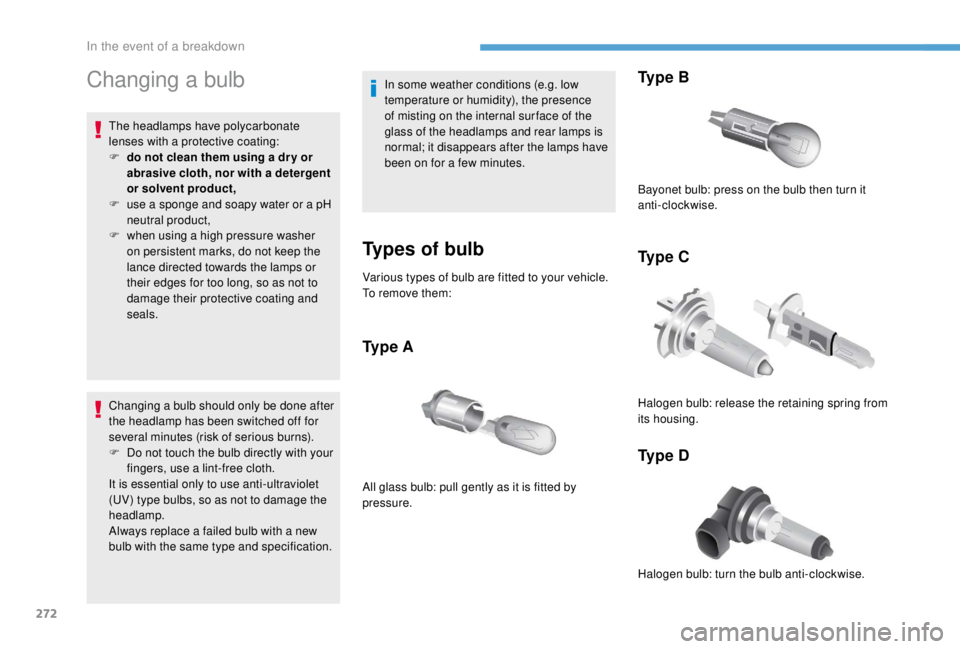
Types of bulb
Various types of bulb are fitted to your vehicle.
To remove them:
Ty p e A
Ty p e B
Ty p e C
Ty p e D
All glass bulb: pull gently as it is fitted by
pressure. Bayonet bulb: press on the bulb then turn it
anti-clockwise.
Halogen bulb: release the retaining spring from
its housing.
Halogen bulb: turn the bulb anti-clockwise.
In the event of a breakdown
Page 278 of 416
276
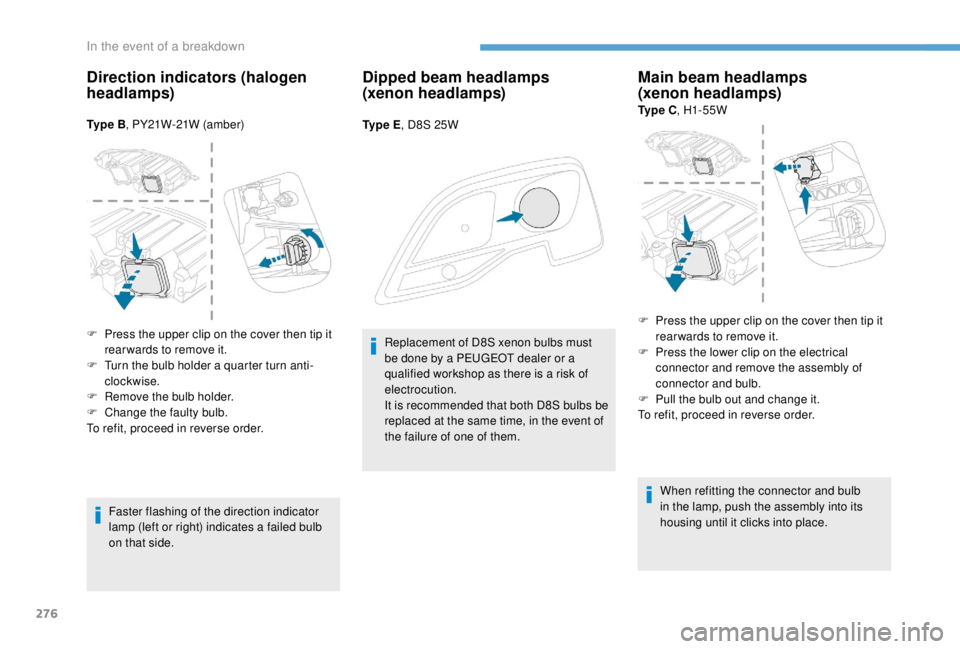
Direction indicators (halogen
headlamps)
Ty p e B, PY21W-21W (amber)
Faster flashing of the direction indicator
lamp (left or right) indicates a failed bulb
on that side.
Dipped beam headlamps
(xenon headlamps)
Ty p e E , D8S 25W
Replacement of D8S xenon bulbs must
be done by a PEUGEOT dealer or a
qualified workshop as there is a risk of
electrocution.
It is recommended that both D8S bulbs be
replaced at the same time, in the event of
the failure of one of them.
Main beam headlamps
(xenon headlamps)
Ty p e C , H1- 55W
When refitting the connector and bulb
in the lamp, push the assembly into its
housing until it clicks into place.
F
P
ress the upper clip on the cover then tip it
rear wards to remove it.
F
T
urn the bulb holder a quarter turn anti-
clockwise.
F
R
emove the bulb holder.
F
C
hange the faulty bulb.
To refit, proceed in reverse order. F
P
ress the upper clip on the cover then tip it
rear wards to remove it.
F
P
ress the lower clip on the electrical
connector and remove the assembly of
connector and bulb.
F
P
ull the bulb out and change it.
To refit, proceed in reverse order.
In the event of a breakdown
Page 279 of 416
277
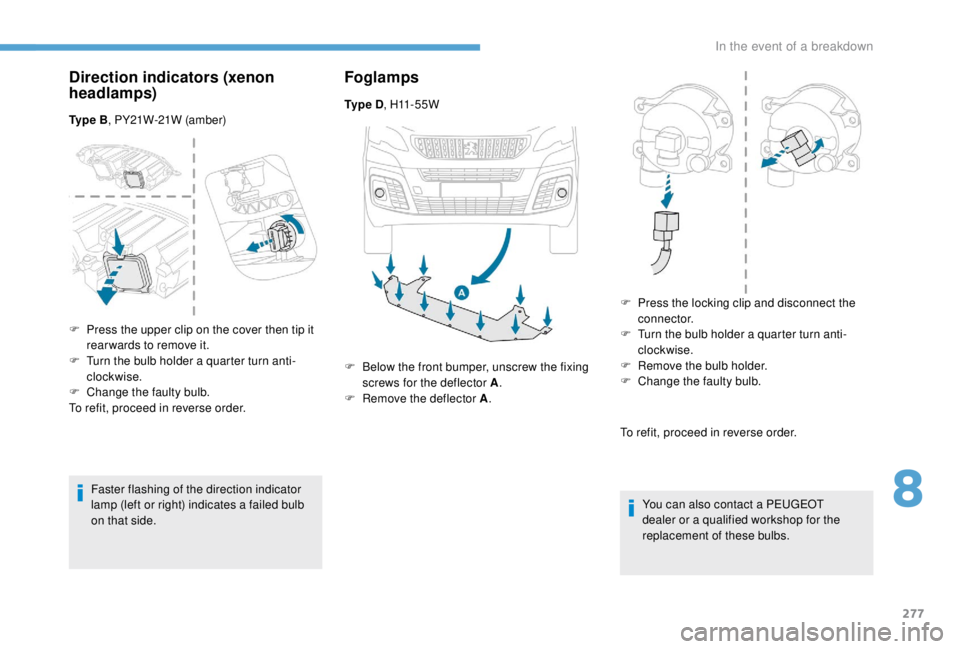
Direction indicators (xenon
headlamps)
Ty p e B, PY21W-21W (amber)
Faster flashing of the direction indicator
lamp (left or right) indicates a failed bulb
on that side.
Foglamps
Ty p e D , H11 - 5 5 W
F
B
elow the front bumper, unscrew the fixing
screws for the deflector A .
F
R
emove the deflector A . F
P
ress the locking clip and disconnect the
connector.
F
T
urn the bulb holder a quarter turn anti-
clockwise.
F
R
emove the bulb holder.
F
C
hange the faulty bulb.
To refit, proceed in reverse order.
You can also contact a PEUGEOT
dealer or a qualified workshop for the
replacement of these bulbs.
F
P
ress the upper clip on the cover then tip it
rear wards to remove it.
F
T
urn the bulb holder a quarter turn anti-
clockwise.
F
C
hange the faulty bulb.
To refit, proceed in reverse order.
8
In the event of a breakdown