2018 PEUGEOT EXPERT wheel
[x] Cancel search: wheelPage 4 of 416

2
.
.
Instrument panel 10
Warning and indicator lamps 1 3
Indicators
2
7
Lighting dimmer
3
4
Trip computer
3
5
Date and time adjustment
3
7
Key
39
Key, remote control
3
9
Keyless Entry and Starting
4
6
Locking/unlocking from inside
6
1
Front doors
6
3
Manual sliding side door(s)
6
4
Electric sliding side door(s)
6
6
Hands-free sliding side door(s)
7
4
Side-hinged rear doors
7
7
Tailgate
80
Alarm
81
Electric windows
8
3Steering wheel adjustment
8
5
Mirrors 85
Front seats
87
A
dditional adjustments
9
1
2-seat front bench seat
9
2
Moduwork
9
4
Fixed one-piece bench seat
9
9
Fixed rear seat and bench seat 1 02
Precautions for the seats and
bench seats 1 05
Fixed crew cab
1
06
Folding crew cab
1
07
Interior fittings
1
08
Loading area fittings
1
12
Seating area fittings
1
13
Heating
115
Manual air conditioning
1
15
Dual-zone automatic air conditioning
1
17
Recirculation of the interior air
1
20
Front demist – defrost
1
20
Door mirrors demist – defrost
1
21
Rear screen demist – defrost
1
22
Rear Heating – Air conditioning
1
24
Programmable Heating/Ventilation
1
25
Courtesy lamp(s)
1
28Lighting control stalk
1
30
Daytime running lamps
1
32
Automatic illumination of headlamps
1
32
Cornering lighting
1
34
Automatic headlamp dipping
1
35
Headlamp beam height
adjustment
137
Wiper control stalk
1
37
General safety recommendations
1
42
Hazard warning lamps
1
43
Emergency or assistance call
1
43
Hor n
14
5
Electronic stability control (ESC)
1
45
Grip control
1
48
Seat belts
1
50
Airbags
154
Child seats
1
57
Deactivating the passenger front airbag
1
59
ISOFIX mountings and child seats
1
66
Manual child lock
1
74
Electric child lock
1
74
Child lock on rear windows
1
75
Over view
Instruments
Access Ease of use and comfort
Safety
Lighting and visibility
Eco-driving
Instruments and controls 4
L abels 7
Eco-driving
8
Contents
Page 5 of 416

3
.
.
Driving recommendations 176
Starting/switching off the engine,
manual key, remote control
1
78
Starting/switching off the engine,
Keyless Entry and Starting
1
81
Anti-theft protection
1
85
Parking brake
1
85
Hill start assist
1
86
5-speed manual gearbox
1
87
6-speed manual gearbox
1
87
Gear shift indicator
1
88
Automatic gearbox
1
89
Electronic gearbox
1
94
Stop & Start
1
98
Head-up display
2
00
Memorising speeds
2
02
Recognition of speed limit signs and
recommendation
202
Spe
ed limiter
20
6
Cruise control
2
09
Adaptive cruise control
2
11
Collision Risk Alert and Active
Safety Brake
2
18
Lane departure warning system
2
22
Fatigue detection system
2
23
Blind spot monitoring system
2
25
Parking sensors
2
27
Reversing camera, interior mirror
2
29
Visiopark 1
2
30
Under-inflation detection
23
4Fuel
237
Diesel misfuel prevention 23 8
Compatibility of fuels
2
40
Snow chains
2
41
Towing a trailer
2
42
Energy economy mode
2
42
Load reduction mode
2
43
Roof bars/Roof rack
2
43
Changing a wiper blade
2
45
Bonnet
246
Engine
247
Checking levels
2
47
Checks
2
50
AdBlue
® (BlueHDi engines) 2 52
Advice on care 2 56
Warning triangle
2
57
Running out of fuel (Diesel)
2
57
Tool box
2
58
Temporary puncture repair kit
2
60
Spare wheel
26
6
Changing a bulb
2
72
Changing a fuse
2
83
12
V battery
2
88
To w i n g
2
9 2Characteristics of the engines and
towed loads
2
94
Dimensions
301
Identification markings
3
05
PEUGEOT Connect Nav
PEUGEOT Connect Radio
Bluetooth audio system
Driving Practical information
In the event of a breakdown Technical data
Alphabetical index
Audio equipment and telematics
.
Contents
Page 7 of 416

5
Steering mounted controls
1.External lighting/direction indicator
control stalk
2. Wiper/screenwash/trip computer control
stalk
3. Audio system adjustment controls
(depending on version).
4. Controls for Speed limiter/Cruise control/
Adaptive cruise control
5. Instrument panel display mode selection
wheel
6. Voice synthesis control (depending on
ve r s i o n).
Volume adjustment (depending on
ve r s i o n).
7. Audio system adjustment controls
(depending on version).
With touch screen
Depending on your vehicle's equipment,
the storage compartments may be open
or closed. This configuration is shown for
illustrative purposes.
1.
Open glove box.
2. 12 V accessory sockets (120 W).
Obser ve the maximum power rating to
avoid damaging your accessory.
3. USB port.
4. Auxiliary socket (JACK).
5. Cup or can holder.
6. Storage compartments.
7. Cooled glove box (if fitted).
Via a ventilation nozzle, if opened, engine
running and air conditioning on.
8. Upper glove box.
9. 230 V accessory socket (150 W, if fitted).
Obser ve the maximum power rating to
avoid damaging your accessory.
10. Horn.
.
Over view
Page 11 of 416
9
Limit the causes of excess
consumption
Spread loads throughout the vehicle; place
the heaviest items in the bottom of the boot,
as close as possible to the rear seats.
Limit the loads carried in the vehicle and
reduce wind resistance (roof bars, roof rack,
bicycle carrier, trailer, etc.). Preferably, use a
roof box.
Remove roof bars and roof racks after use.
At the end of winter, remove snow tyres and
refit your summer tyres.
Observe the recommendations
on maintenance
Check the tyre pressures regularly, when cold,
referring to the label in the door aperture,
driver's side.
Carry out this check in particular:
-
b
efore a long journey,
-
a
t each change of season,
-
a
fter a long period out of use.
Do not forget the spare wheel and the tyres on
any trailer or caravan. Have your vehicle ser viced regularly (engine
oil, oil filter, air filter, cabin filter, etc.) and
obser ve the schedule of operations in the
manufacturer's service schedule.
When filling the tank, do not continue after the
3rd
cut-off of the nozzle to avoid over flow.
At the wheel of your new vehicle, it is only
after the first 1,800
miles (3,000 kilometres)
that you will see the fuel consumption settle
down to a consistent average. With a BlueHDi Diesel engine, if the SCR
system is faulty, your vehicle becomes
polluting. Visit a PEUGEOT dealer or a
qualified workshop as soon as possible to
make your vehicle’s level of nitrogen oxide
emissions compliant to the standard.
.
Eco-driving
Page 20 of 416
18
Warning/indicator lampStateCause Action/Observations
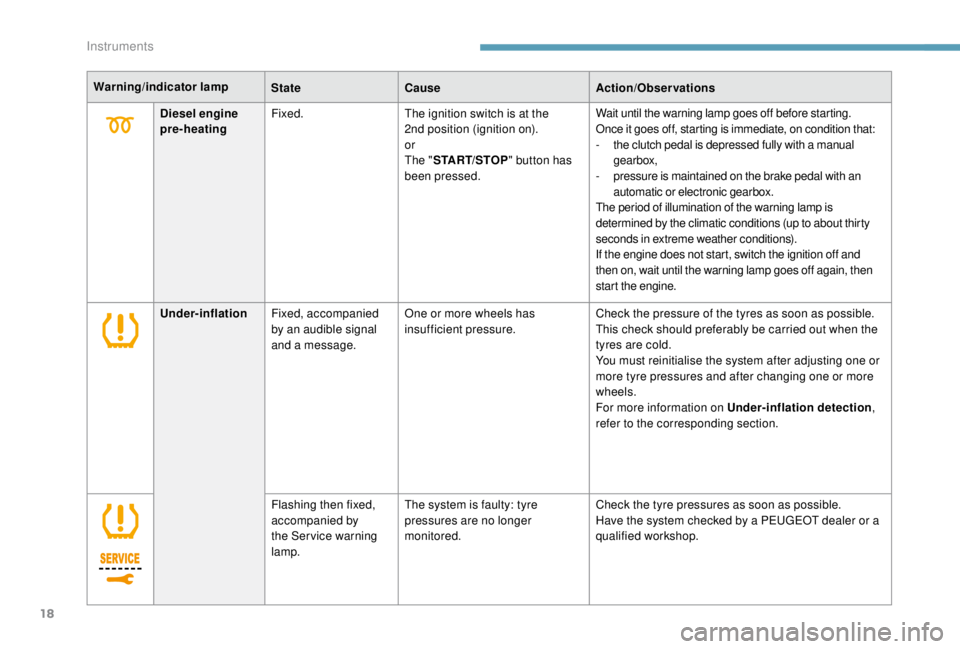
Under-inflation Fixed, accompanied
by an audible signal
and a message. One or more wheels has
insufficient pressure.
Check the pressure of the tyres as soon as possible.
This check should preferably be carried out when the
tyres are cold.
You must reinitialise the system after adjusting one or
more tyre pressures and after changing one or more
wheels.
For more information on Under-inflation detection
,
refer to the corresponding section.
Flashing then fixed,
accompanied by
the Ser vice warning
lamp. The system is faulty: tyre
pressures are no longer
monitored.
Check the tyre pressures as soon as possible.
Have the system checked by a PEUGEOT dealer or a
qualified workshop.
Diesel engine
pre-heating
Fixed.
The ignition switch is at the
2nd position (ignition on).
or
The "START/STOP " button has
been pressed. Wait until the warning lamp goes off before starting.
Once it goes off, starting is immediate, on condition that:
-
t
he clutch pedal is depressed fully with a manual
gearbox,
-
p
ressure is maintained on the brake pedal with an
automatic or electronic gearbox.
The period of illumination of the warning lamp is
determined by the climatic conditions (up to about thirty
seconds in extreme weather conditions).
If the engine does not start, switch the ignition off and
then on, wait until the warning lamp goes off again, then
start the engine.
Instruments
Page 37 of 416

35
On the instrument panel
F Press this button.
With steering-mounted controls
F Press the thumbwheel on the steering wheel .
Trip computer
Data displays
To display the various on-board computer tabs
in succession:
F
P
ress this button, located on the end of the
wiper control stalk .
Information displayed about the current journey
(range, current fuel consumption, average fuel
consumption, etc.).
-
I
nstant information with:
•
range,
•
c
urrent fuel consumption,
•
S
top & Start time counter.
- t he trip 1 tab with:
• a verage speed,
•
a
verage fuel consumption,
•
d
istance travelled, for the first
trip.
Depending on your vehicle's equipment, a 2nd
trip is available. -
t
he trip 2 tab with:
•
a
verage speed,
•
a
verage fuel consumption,
•
d
istance travelled, for the
second trip.
Trips 1
and 2 are independent but their use is
identical.
For example, trip 1
can be used for daily figures
and trip 2
for monthly figures.
1
Instruments
Page 38 of 416
36
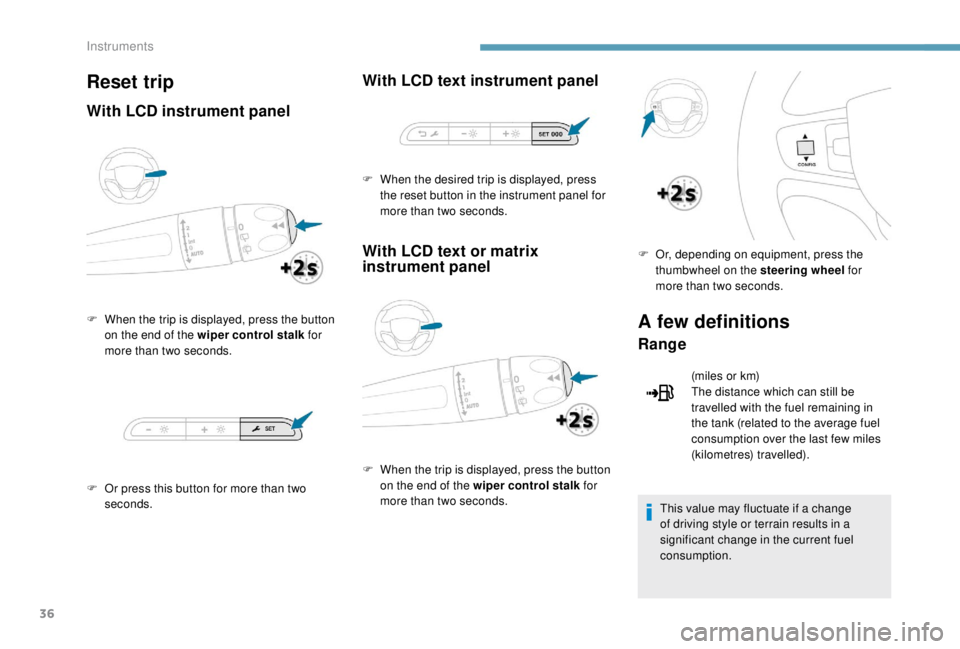
Reset trip
With LCD instrument panel
F When the trip is displayed, press the button on the end of the wiper control stalk for
more than two seconds.
F
O
r press this button for more than two
seconds.
With LCD text instrument panel
With LCD text or matrix
instrument panel
F When the trip is displayed, press the button on the end of the wiper control stalk for
more than two seconds. F
O
r, depending on equipment, press the
thumbwheel on the steering wheel for
more than two seconds.
A few definitions
Range
(miles or km)
The distance which can still be
travelled with the fuel remaining in
the tank (related to the average fuel
consumption over the last few miles
(kilometres) travelled).
This value may fluctuate if a change
of driving style or terrain results in a
significant change in the current fuel
consumption.
F
W
hen the desired trip is displayed, press
the reset button in the instrument panel for
more than two seconds.
Instruments
Page 79 of 416
77
The side door may open or close
erratically if:
-
y
our vehicle is fitted with a towbar,
-
y
ou hitch or unhitch a trailer,
-
y
ou fit or remove a bicycle carrier,
-
y
ou load or unload bicycles on a
bicycle carrier,
-
y
ou place or lift something behind the
vehicle,
-
an
animal approaches the bumper,
-
y
ou are washing your vehicle,
-
a s
er vice is being carried out on your
vehicle,
-
y
ou change a wheel. Ensure that no person or object could
prevent the correct opening or closing of
the doors.
Be aware of children when operating the
doors.
To avoid unwanted operation,
keep the key away from the
detection zone or deactivate
the function in the vehicle
configuration menu.
To avoid unwanted operation,
keep the key away from the
detection zone (also from
the boot’s interior sides) or
deactivate the function in the
vehicle configuration menu.Side-hinged rear doors
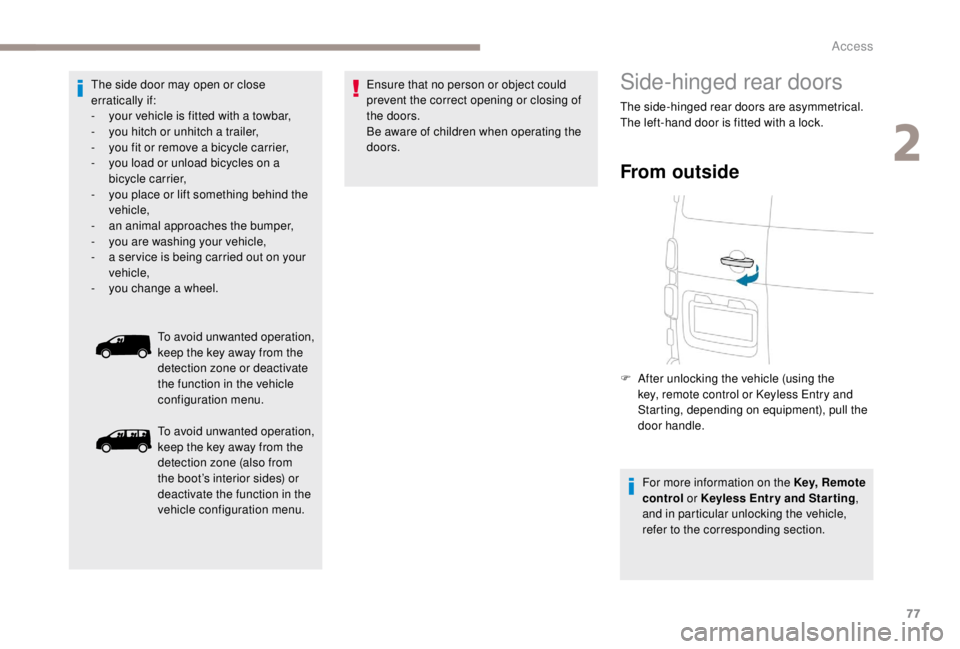
The side-hinged rear doors are asymmetrical.
The left-hand door is fitted with a lock.
From outside
F After unlocking the vehicle (using the key, remote control or Keyless Entry and
Starting, depending on equipment), pull the
door handle.
For more information on the Key, Remote
control or
K
eyless Entr y and Star ting ,
and in particular unlocking the vehicle,
refer to the corresponding section.
2
Access