2018 PEUGEOT EXPERT wheel
[x] Cancel search: wheelPage 147 of 416
145
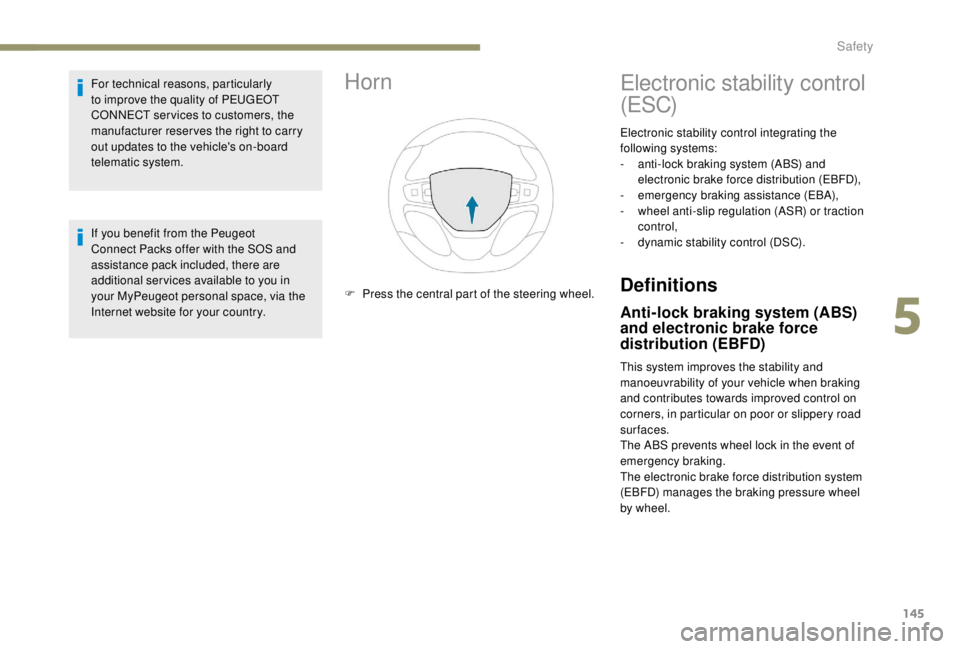
Horn
F Press the central part of the steering wheel.
Electronic stability control
(ESC)
Electronic stability control integrating the
following systems:
-
a
nti-lock braking system (ABS) and
electronic brake force distribution (EBFD),
-
em
ergency braking assistance (EBA),
-
w
heel anti-slip regulation (ASR) or traction
control,
-
d
ynamic stability control (DSC).
For technical reasons, particularly
to improve the quality of PEUGEOT
CONNECT ser vices to customers, the
manufacturer reser ves the right to carry
out updates to the vehicle's on-board
telematic system.
If you benefit from the Peugeot
Connect Packs offer with the SOS and
assistance pack included, there are
additional ser vices available to you in
your MyPeugeot personal space, via the
Internet website for your country.
Definitions
Anti-lock braking system (ABS)
and electronic brake force
distribution (EBFD)
This system improves the stability and
manoeuvrability of your vehicle when braking
and contributes towards improved control on
corners, in particular on poor or slippery road
surfaces.
The ABS prevents wheel lock in the event of
emergency braking.
The electronic brake force distribution system
(EBFD) manages the braking pressure wheel
by wheel.
5
Safety
Page 148 of 416
146
Emergency braking assistance
(EBA)
In an emergency, this system permits the
optimum braking pressure to be reached
more quickly, therefore reducing the stopping
distance.
It is triggered in relation to the speed at which
the brake pedal is pressed. The effect of this is
a reduction in the resistance of the pedal and
an increase in braking efficiency.
Anti-slip regulation (ASR)
The ASR system (also known as Traction
Control) optimises traction in order to limit
wheel slip by acting on the brakes of the driving
wheels and on the engine. It also improves
the directional stability of the vehicle on
acceleration.
Dynamic stability control (DSC)
If there is a difference between the path
followed by the vehicle and that required by
the driver, the DSC monitors each wheel and
automatically acts on the brake of one or more
wheels and on the engine to return the vehicle
to the required path, within the limits of the laws
of physics.
Intelligent traction control
If your vehicle has this system, it features a
system to help driving on snow: intelligent
traction control.
This system detects situations of difficult
sur face grip that could make it difficult to move
off or make progress on deep fresh snow or
compacted snow.
In these situations, the intelligent traction
control limits the amount of wheel spin to
provide the best traction and trajectory control
for your vehicle.
The use of snow tyres is strongly
recommended on sur faces offering low
levels of grip.
Anti-lock braking system
(ABS) and electronic brake
force distribution (EBFD)
The fixed illumination of this warning
lamp indicates that there is a fault
with the ABS.If this warning lamp comes on, in
conjunction with the STOP and
ABS warning lamps, an audible
signal and a message, it means
that the electronic brake force
distribution (EBFD) is defective.
You must stop as soon as it is
safe to do so.
In both cases, have the system
checked by a PEUGEOT dealer
or a qualified workshop as soon
as possible.
When changing wheels (tyres and rims),
ensure that these are approved for your
vehicle.
Normal operation of the ABS may make
itself felt by slight vibrations of the brake
pedal.
Safety
Page 149 of 416
147
If you need to brake in an emergency,
press the brake pedal ver y firmly and
keep the pressure applied.
After an impact, have the system checked
by a PEUGEOT dealer or a qualified
workshop.
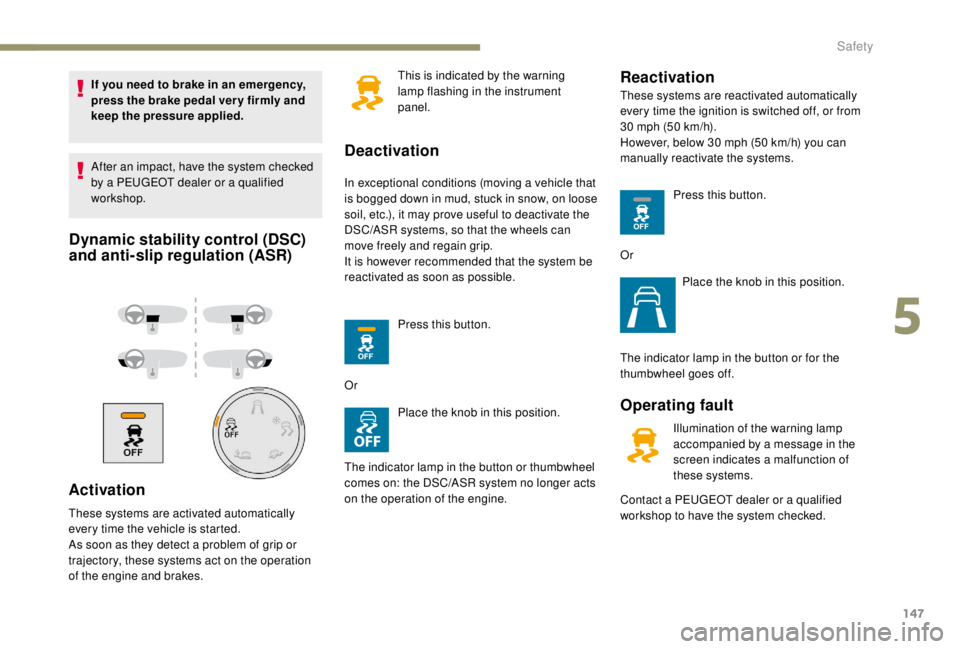
Dynamic stability control (DSC)
and anti-slip regulation (ASR)
Activation
These systems are activated automatically
every time the vehicle is started.
As soon as they detect a problem of grip or
trajectory, these systems act on the operation
of the engine and brakes. This is indicated by the warning
lamp flashing in the instrument
panel.
Deactivation
In exceptional conditions (moving a vehicle that
is bogged down in mud, stuck in snow, on loose
soil, etc.), it may prove useful to deactivate the
DSC/ASR systems, so that the wheels can
move freely and regain grip.
It is however recommended that the system be
reactivated as soon as possible.
Press this button.
Or Place the knob in this position.
The indicator lamp in the button or thumbwheel
comes on: the DSC/ASR system no longer acts
on the operation of the engine.
Reactivation
These systems are reactivated automatically
every time the ignition is switched off, or from
30 mph (50 km/h).
However, below 30
mph (50 km/h) you can
manually reactivate the systems.
Press this button.
Or Place the knob in this position.
The indicator lamp in the button or for the
thumbwheel goes off.
Operating fault
Illumination of the warning lamp
accompanied by a message in the
screen indicates a malfunction of
these systems.
Contact a PEUGEOT dealer or a qualified
workshop to have the system checked.
5
Safety
Page 150 of 416
148
Grip control
Special patented traction control system which
improves traction on snow, mud and sand.
This system, the operation of which has been
optimised for each situation, allows you to
manoeuvre in most conditions of poor grip
(encountered during touring use).
The accelerator pedal should be pressed
sufficiently to allow the system to use the power
of the engine. Operation at high engine speeds
is completely normal.
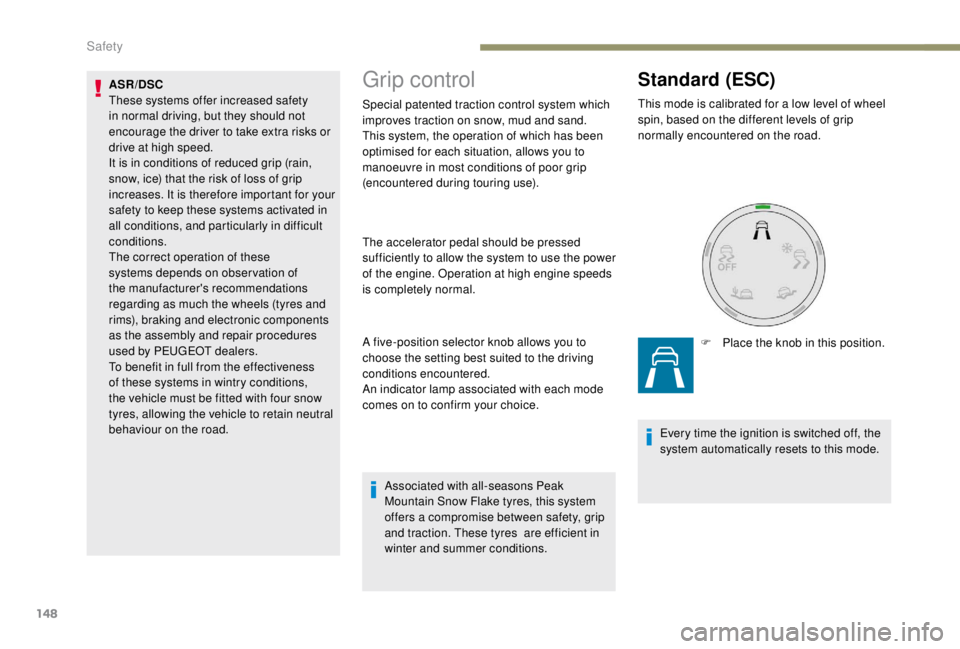
Standard (ESC)
F Place the knob in this position.
ASR/DSC
These systems offer increased safety
in normal driving, but they should not
encourage the driver to take extra risks or
drive at high speed.
It is in conditions of reduced grip (rain,
snow, ice) that the risk of loss of grip
increases. It is therefore important for your
safety to keep these systems activated in
all conditions, and particularly in difficult
conditions.
The correct operation of these
systems depends on obser vation of
the manufacturer's recommendations
regarding as much the wheels (tyres and
rims), braking and electronic components
as the assembly and repair procedures
used by PEUGEOT dealers.
To benefit in full from the effectiveness
of these systems in wintry conditions,
the vehicle must be fitted with four snow
tyres, allowing the vehicle to retain neutral
behaviour on the road.
A five-position selector knob allows you to
choose the setting best suited to the driving
conditions encountered.
An indicator lamp associated with each mode
comes on to confirm your choice.
Associated with all-seasons Peak
Mountain Snow Flake tyres, this system
offers a compromise between safety, grip
and traction. These tyres are efficient in
winter and summer conditions. This mode is calibrated for a low level of wheel
spin, based on the different levels of grip
normally encountered on the road.
Every time the ignition is switched off, the
system automatically resets to this mode.
Safety
Page 151 of 416
149
Snow
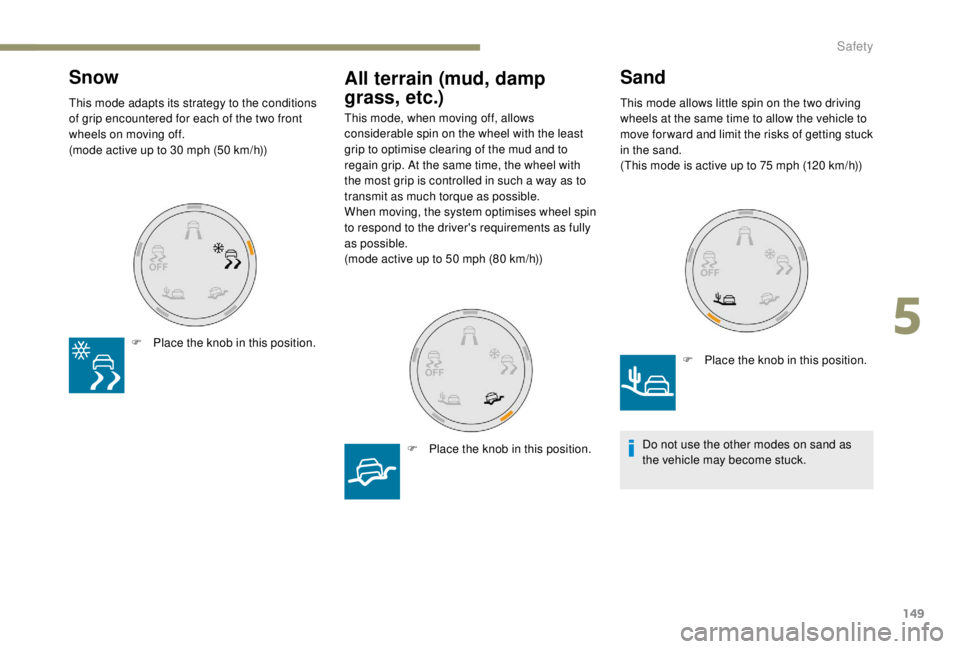
F Place the knob in this position.
All terrain (mud, damp
grass, etc.)
F Place the knob in this position.
This mode adapts its strategy to the conditions
of grip encountered for each of the two front
wheels on moving off.
(mode active up to 30
mph (50
km/h))
This mode, when moving off, allows
considerable spin on the wheel with the least
grip to optimise clearing of the mud and to
regain grip. At the same time, the wheel with
the most grip is controlled in such a way as to
transmit as much torque as possible.
When moving, the system optimises wheel spin
to respond to the driver's requirements as fully
as possible.
(mode active up to 50 mph (80 km/h))
Sand
This mode allows little spin on the two driving
wheels at the same time to allow the vehicle to
move for ward and limit the risks of getting stuck
in the sand.
(This mode is active up to 75
mph (120 km/h))
F
P
lace the knob in this position.
Do not use the other modes on sand as
the vehicle may become stuck.
5
Safety
Page 156 of 416
154
Airbags
The airbags do not operate when the
ignition is switched off.
This equipment will only deploy once. If a
second impact occurs (during the same or
a subsequent accident), the airbag will not
be deployed again.
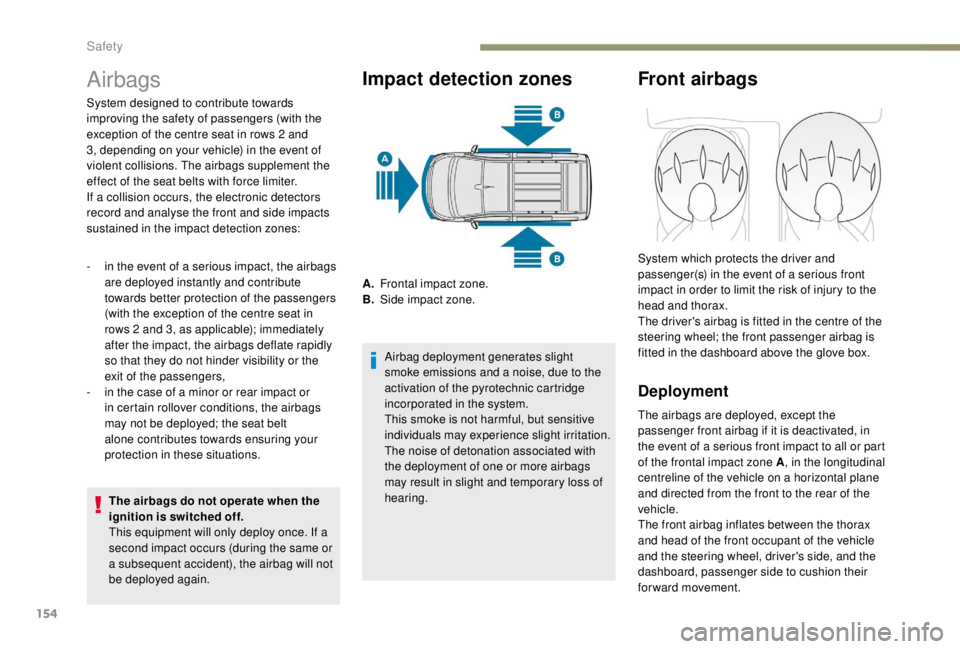
Impact detection zones
Airbag deployment generates slight
smoke emissions and a noise, due to the
activation of the pyrotechnic cartridge
incorporated in the system.
This smoke is not harmful, but sensitive
individuals may experience slight irritation.
The noise of detonation associated with
the deployment of one or more airbags
may result in slight and temporary loss of
hearing.
A.
F
rontal impact zone.
B.
S
ide impact zone.
Front airbags
System which protects the driver and
passenger(s) in the event of a serious front
impact in order to limit the risk of injury to the
head and thorax.
The driver's airbag is fitted in the centre of the
steering wheel; the front passenger airbag is
fitted in the dashboard above the glove box.
Deployment
The airbags are deployed, except the
passenger front airbag if it is deactivated, in
the event of a serious front impact to all or part
of the frontal impact zone A
, in the longitudinal
centreline of the vehicle on a horizontal plane
and directed from the front to the rear of the
vehicle.
The front airbag inflates between the thorax
and head of the front occupant of the vehicle
and the steering wheel, driver's side, and the
dashboard, passenger side to cushion their
for ward movement.
System designed to contribute towards
improving the safety of passengers (with the
exception of the centre seat in rows 2
and
3, depending on your vehicle) in the event of
violent collisions. The airbags supplement the
effect of the seat belts with force limiter.
If a collision occurs, the electronic detectors
record and analyse the front and side impacts
sustained in the impact detection zones:
-
i
n the event of a serious impact, the airbags
are deployed instantly and contribute
towards better protection of the passengers
(with the exception of the centre seat in
rows 2
and 3, as applicable); immediately
after the impact, the airbags deflate rapidly
so that they do not hinder visibility or the
exit of the passengers,
-
i
n the case of a minor or rear impact or
in certain rollover conditions, the airbags
may not be deployed; the seat belt
alone contributes towards ensuring your
protection in these situations.
Safety
Page 158 of 416

156
Advice
For the airbags to be fully effective,
observe the safety recommendations
below.
Adopt a normal and upright sitting position.
Wear a correctly adjusted seat belt.
Do not leave anything between the occupants
and the airbags (a child, pet, object, etc.),
nor fix or attach anything close or in the way
of airbag trajectory; this could cause injuries
during their deployment.
Never modify the original definition of your
vehicle, particularly in the area directly
around the airbags.
After an accident or if the vehicle has been
stolen, have the airbag systems checked.
All work on the airbag system must be carried
out by a PEUGEOT dealer or a qualified
workshop.
Even when following all the precautions
listed, a risk of injuries or slight burns to
the head, the chest or the arms, when an
airbag deploys cannot be excluded. The
bag inflates almost instantly (within a few
milliseconds) then deflates within the same
time discharging the hot gas via openings
provided for this purpose.Front airbags
Do not drive holding the steering wheel by its
spokes or resting your hands on the centre
part of the wheel.
Passengers must not place their feet on the
dashboard.
Do not smoke as deployment of the airbags
can cause burns or the risk of injury from a
cigarette or pipe.
Never remove or pierce the steering wheel or
hit it violently.
Do not fit or attach anything to the steering
wheel or dashboard, this could cause injuries
in case of airbag deployment.
Curtain airbags
Do not attach anything or hang anything to the
roof, as this could cause head injuries when the
curtain airbag is deployed.
If fitted to your vehicle, do not remove the grab
handles installed on the roof, they play a part in
securing the curtain airbags. Side airbags
Use only approved covers on the seats,
compatible with the deployment of the lateral
airbags. For information on the range of seat
covers suitable for your vehicle, you can
contact a PEUGEOT dealer.
Do not attach or hang anything to the seat
backrests (clothes, etc.) as this could cause
injuries to the thorax or arm when the side
airbag is deployed.
Do not sit with the upper part of the body any
nearer to the door than necessary.
The vehicle's front door panels include side
impact sensors.
A damaged door or any unauthorised or
incorrectly executed work (modification or
repair) on the front doors or their interior trim
could compromise the operation of these
sensors – Risk of malfunction of the lateral
airbags!
Such work must only be done by a PEUGEOT
dealer or a qualified workshop.
Safety
Page 178 of 416
176
Driving recommendations
Observe the driving regulations and remain
vigilant whatever the traffic conditions.
Pay close attention to the traffic and keep your
hands on the wheel so that you are ready to
react at any time to any eventuality.
As a safety measure, the driver should only
carry out any operations that require close
attention when the vehicle is stationary.
On a long journey, a break every two hours is
strongly recommended.
In difficult weather, drive smoothly, anticipate
the need to brake and increase the distance
from other vehicles.
Driving on flooded roads
We strongly advise against driving on flooded
roads, as this could cause serious damage
to the engine or gearbox, as well as to the
electrical systems of your vehicle.
Important!
Never drive with the parking brake
applied – Risk of overheating and damage
to the braking system!
As the exhaust system of your vehicle
is very hot, even several minutes after
switching off the engine, never park or run
the engine on inflammable sur faces (dry
grass, fallen leaves, etc.): Risk of fire!
Never leave a vehicle unsuper vised with
the engine running. If you have to leave
your vehicle with the engine running, apply
the parking brake and put the gearbox into
neutral or position N or P, depending on
the type of gearbox.
To assure the durability of your vehicle and
your safety, remember that certain precautions,
described hereafter, should be taken when
driving your vehicle:
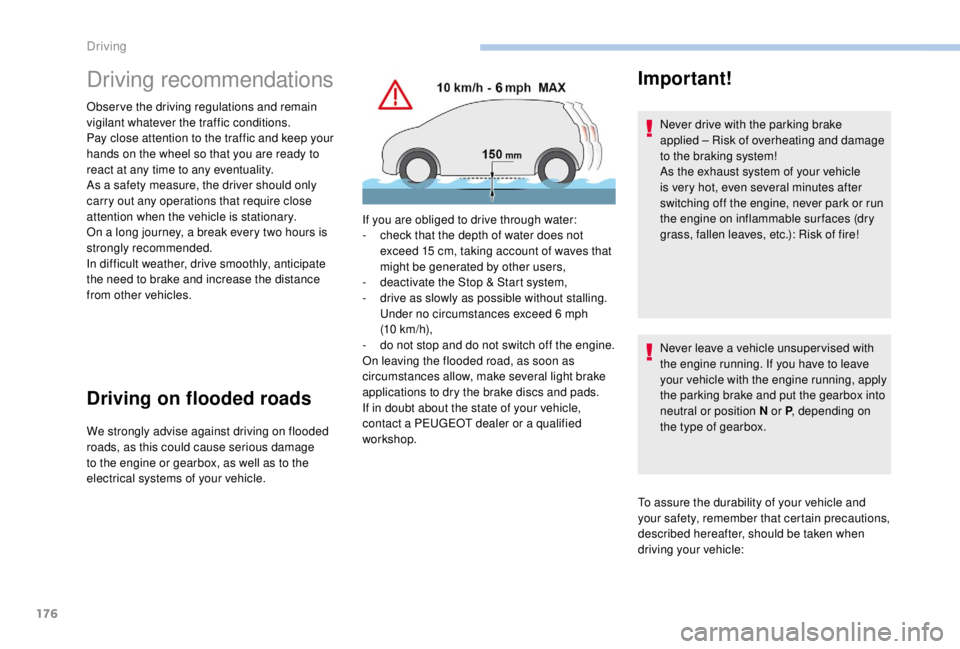
If you are obliged to drive through water:
-
c
heck that the depth of water does not
exceed 15
cm, taking account of waves that
might be generated by other users,
-
d
eactivate the Stop & Start system,
-
d
rive as slowly as possible without stalling.
Under no circumstances exceed 6
mph
(10
km/h),
-
d
o not stop and do not switch off the engine.
On leaving the flooded road, as soon as
circumstances allow, make several light brake
applications to dry the brake discs and pads.
If in doubt about the state of your vehicle,
contact a PEUGEOT dealer or a qualified
workshop.
Driving