2018 Peugeot 308 Folding
[x] Cancel search: FoldingPage 45 of 324

43
If one of the doors or the boot is still open
or if the electronic key for the K eyless
Entry and Starting system has been left
inside the vehicle, the central locking does
not take place.
If the vehicle is unlocked inadvertently and
if no action is taken at the doors or boot,
the vehicle will automatically lock itself
again after about 30
seconds.
If fitted to your vehicle, the alarm is not
reactivated.
The automatic folding and unfolding of
the door mirrors can be deactivated by a
PEUGEOT dealer or a qualified workshop.
As a safety measure (children on board),
never leave the vehicle without taking the
electronic key for the
K
eyless Entry and
Starting system with you, even for a short
period.
Be aware of the risk of theft when the
electronic key for the
K
eyless Entry and
Starting system is in one of the defined
zones with the vehicle unlocked. In order to preser ve the battery in the
electronic key and the vehicle's battery,
the "hands-free" functions are put into
long-term standby after 21 days without
use. To restore these functions, press
one of the remote control buttons or start
the engine with the electronic key in the
reader.
For more information on Star ting -
switching off the engine with "
Keyless
Entr y and Star ting ", refer to the
corresponding section.
Locking/unlocking from
the inside
Automatic central locking
of the doors
The doors can lock automatically while driving
(speed above 6 mph [10 km/h]).
To activate or deactivate this
function, press and hold the button
until a message appears in the
screen. After unlocking, if no door is opened
within 30
seconds, the doors lock again
automatically.
F
P
ress the button.
This locks and unlocks the doors and the boot.
If the vehicle is deadlocked or locked with
the remote control or the door handles,
the button is not operational. In this case,
use the key or remote control to unlock.
When carrying large objects with the boot
open, you can press this button to lock
just the doors.
When locking from inside, the door mirrors
do not fold.
2
Access
Page 57 of 324
55
Steering wheel adjustment
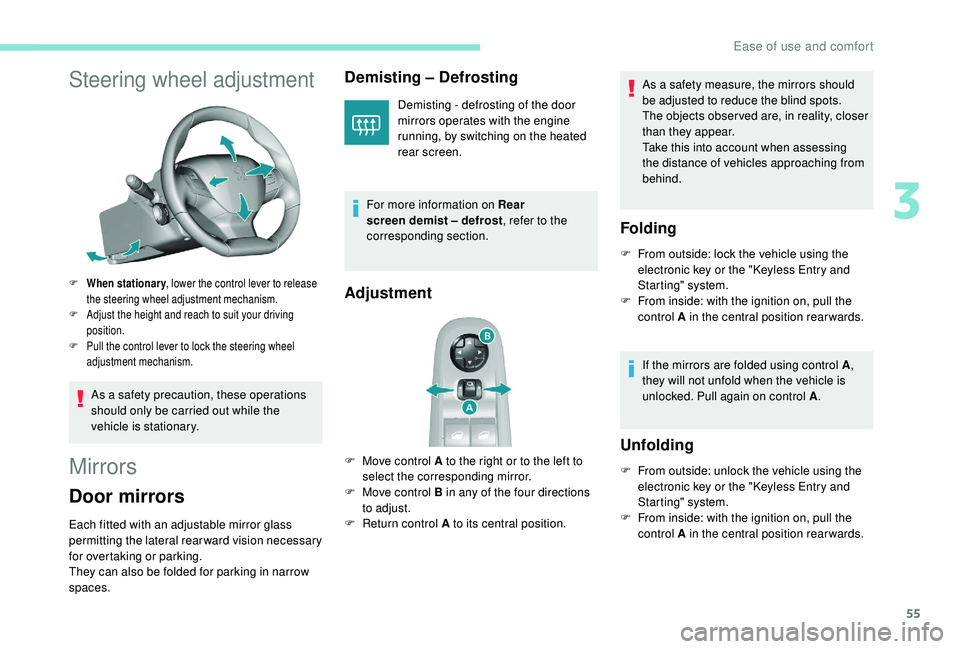
F When stationary, lower the control lever to release
the steering wheel adjustment mechanism.
F
A
djust the height and reach to suit your driving
position.
F
P
ull the control lever to lock the steering wheel
adjustment mechanism.
As a safety precaution, these operations
should only be carried out while the
vehicle is stationary.
Mirrors
Door mirrors
Each fitted with an adjustable mirror glass
permitting the lateral rearward vision necessary
for overtaking or parking.
They can also be folded for parking in narrow
spaces.
Demisting – Defrosting
Demisting - defrosting of the door
mirrors operates with the engine
running, by switching on the heated
rear screen.
For more information on Rear
screen demist – defrost , refer to the
corresponding section.
Adjustment
F Move control A to the right or to the left to select the corresponding mirror.
F
M
ove control B in any of the four directions
to adjust.
F
R
eturn control A to its central position. As a safety measure, the mirrors should
be adjusted to reduce the blind spots.
The objects obser ved are, in reality, closer
than they appear.
Take this into account when assessing
the distance of vehicles approaching from
behind.
Folding
F From outside: lock the vehicle using the
electronic key or the " K eyless Entry and
Starting" system.
F
F
rom inside: with the ignition on, pull the
control A in the central position rearwards.
If the mirrors are folded using control A ,
they will not unfold when the vehicle is
unlocked. Pull again on control A .
Unfolding
F From outside: unlock the vehicle using the
electronic key or the " K eyless Entry and
Starting" system.
F
F
rom inside: with the ignition on, pull the
control A in the central position rearwards.
3
Ease of use and comfort
Page 58 of 324

56
The folding and unfolding of the door
mirrors using the remote control can be
deactivated by a PEUGEOT dealer or a
qualified workshop.
If necessary, the mirrors can be folded
manually.
Rear view mirror
Equipped with an anti-dazzle system, which
darkens the mirror glass and reduces the
nuisance to the driver caused by the sun, the
headlamps of other vehicles, etc.
Manual model
Adjustment
F A djust the mirror so that the mirror is
directed correctly in the "day" position.
Day/night position
Automatic "electrochrome"
model
This system automatically and progressively
changes between day and night use by means
of a sensor measuring the light coming from the
rear of the vehicle.
In order to ensure optimum visibility during
your manoeuvres, the mirror lightens
automatically when reverse gear is
engaged.
Rear seats (hatchback)
Bench seat with fixed one-piece cushion and
folding backrest (1/3 – 2/3), which can be
folded to adapt the loading space in the boot.
Folding the backrest
When folding the seat, the centre seat belt
should not be buckled but laid out flat on
the seat.
The rear seat cushion does not fold:, to
increase the load volume in the boot, only
the backrest folds.
F
P
ull the lever to change to the "night" anti-
dazzle position.
F
P
ush the lever to change to the normal
"day" position. F
M
ove the corresponding front seat for wards
if necessary. F
P
osition the corresponding outer seat belt
against the backrest and buckle it.
F
P
lace the head restraints in the low position.
F
P
ress control 1 to release seat backrest 2
.
F
F
old seat backrest 2 onto cushion 3
.
Ease of use and comfort
Page 59 of 324
57
Repositioning the backrest
When repositioning the seat backrest,
take care not to trap the seat belts.
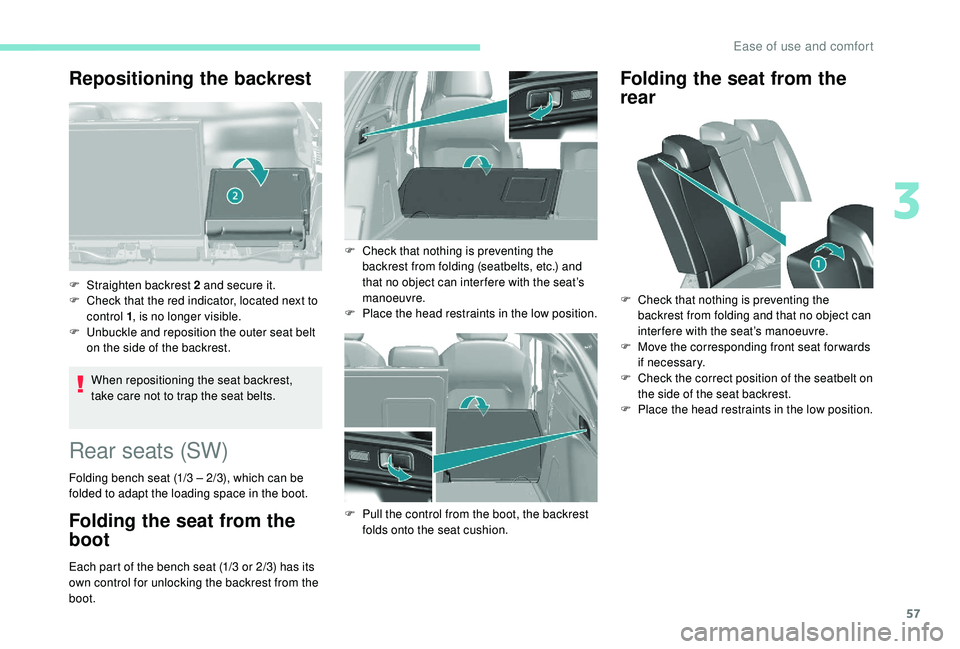
F
S
traighten backrest 2 and secure it.
F
C
heck that the red indicator, located next to
control 1 , is no longer visible.
F
U
nbuckle and reposition the outer seat belt
on the side of the backrest.
Rear seats (SW)
Folding bench seat (1/3 – 2/3), which can be
folded to adapt the loading space in the boot.
Folding the seat from the
boot
Each part of the bench seat (1/3 or 2/3) has its
own control for unlocking the backrest from the
boot.
Folding the seat from the
rear
F Check that nothing is preventing the backrest from folding (seatbelts, etc.) and
that no object can inter fere with the seat’s
manoeuvre.
F
P
lace the head restraints in the low position.
F
P
ull the control from the boot, the backrest
folds onto the seat cushion. F
C
heck that nothing is preventing the
backrest from folding and that no object can
interfere with the seat’s manoeuvre.
F
M
ove the corresponding front seat for wards
if necessary.
F
C
heck the correct position of the seatbelt on
the side of the seat backrest.
F
P
lace the head restraints in the low position.
3
Ease of use and comfort
Page 64 of 324
62
Boot fittings (hatchback)
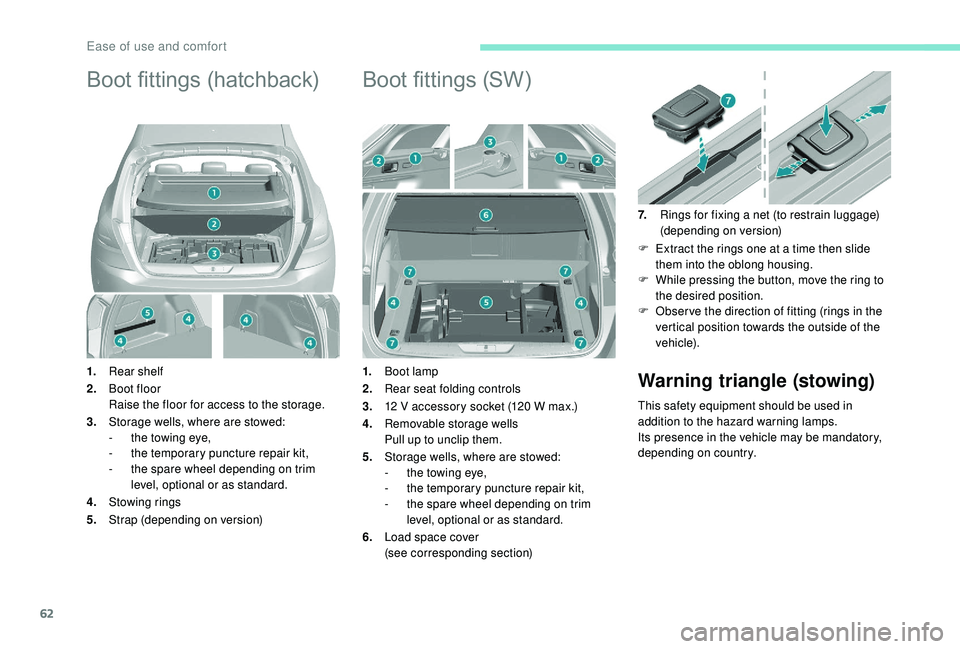
1.Rear shelf
2. Boot floor
Raise the floor for access to the storage.
3. Storage wells, where are stowed:
-
t
he towing eye,
-
t
he temporary puncture repair kit,
-
t
he spare wheel depending on trim
level, optional or as standard.
4. Stowing rings
5. Strap (depending on version)
Boot fittings (SW)
1.Boot lamp
2. Rear seat folding controls
3. 12 V accessory socket (120 W max.)
4. Removable storage wells
Pull up to unclip them.
5. Storage wells, where are stowed:
-
t
he towing eye,
-
t
he temporary puncture repair kit,
-
t
he spare wheel depending on trim
level, optional or as standard.
6. Load space cover
(see corresponding section) 7.
Rings for fixing a net (to restrain luggage)
(depending on version)
F
E
xtract the rings one at a time then slide
them into the oblong housing.
F
W
hile pressing the button, move the ring to
the desired position.
F
O
bser ve the direction of fitting (rings in the
vertical position towards the outside of the
vehicle).Warning triangle (stowing)
This safety equipment should be used in
addition to the hazard warning lamps.
Its presence in the vehicle may be mandatory,
depending on country.
Ease of use and comfort
Page 66 of 324
64
High load (SW)
Luggage retaining net
This allows the use of the entire loading
capacity, up to the roof:
-
b
ehind the front seats (1
st row) when the
rear seats are folded down,
-
b
ehind the rear seats (2
nd row).
1st row 2
nd row
F Remove the covers, on each side, in the
upper section in the roof.
F
P
osition the net's upper hooks in the roof.
F
A
ttach the bottom of the net to the rings
located either side of the boot carpet or on
the boot rails (depending on trim level).
F
P
ull on the straps to stretch the net.
F
F
old down the rear seats.
F
R
emove the covers, on each side, in the
upper section in the roof.
F
P
osition the net's upper hooks in the roof.
F
A
ttach the bottom of the net to the hooks
located at the seat belt mountings.
F
P
ull on the straps to stretch the net.
Once fitted, the net does not prevent folding of
the rear seat backrests.
Heating and Ventilation
Air intake
The air circulating in the passenger
compartment is filtered and originates either
from the outside via the grille located at the
base of the windscreen or from the inside in air
recirculation mode.
Controls
The incoming air follows various routes
depending on the controls selected by the
driver, the front passenger or rear passengers,
depending on the level of equipment.
The temperature control enables you to obtain
the level of comfort required by mixing the air of
the various circuits.
The air distribution control enables you to
select the air vents used in the passenger
compartment by the combined use of the
associated buttons.
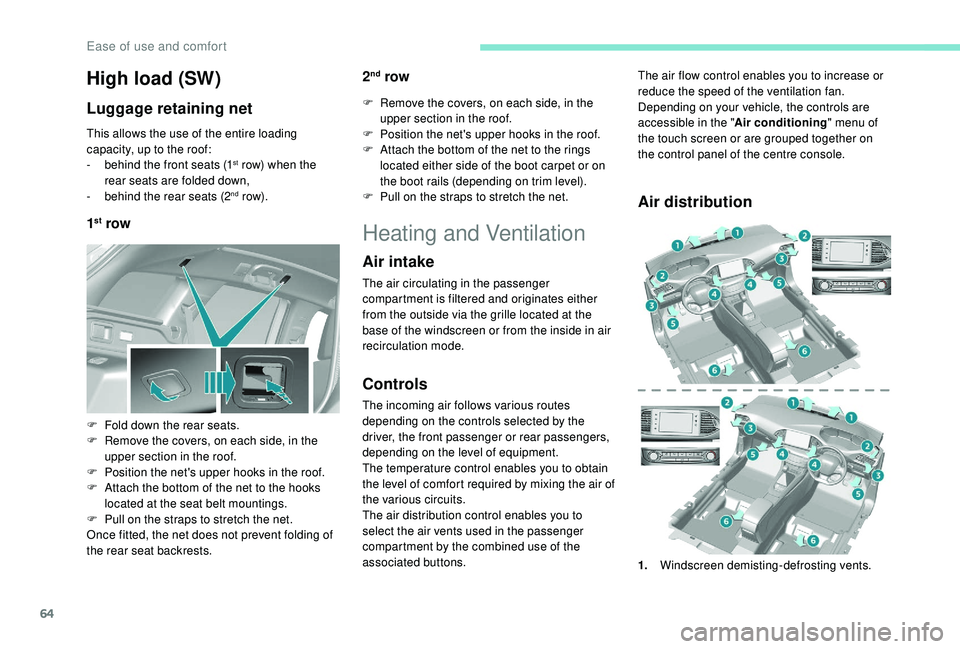
Air distribution
The air flow control enables you to increase or
reduce the speed of the ventilation fan.
Depending on your vehicle, the controls are
accessible in the " Air conditioning" menu of
the touch screen or are grouped together on
the control panel of the centre console.
1. Windscreen demisting-defrosting vents.
Ease of use and comfort
Page 93 of 324
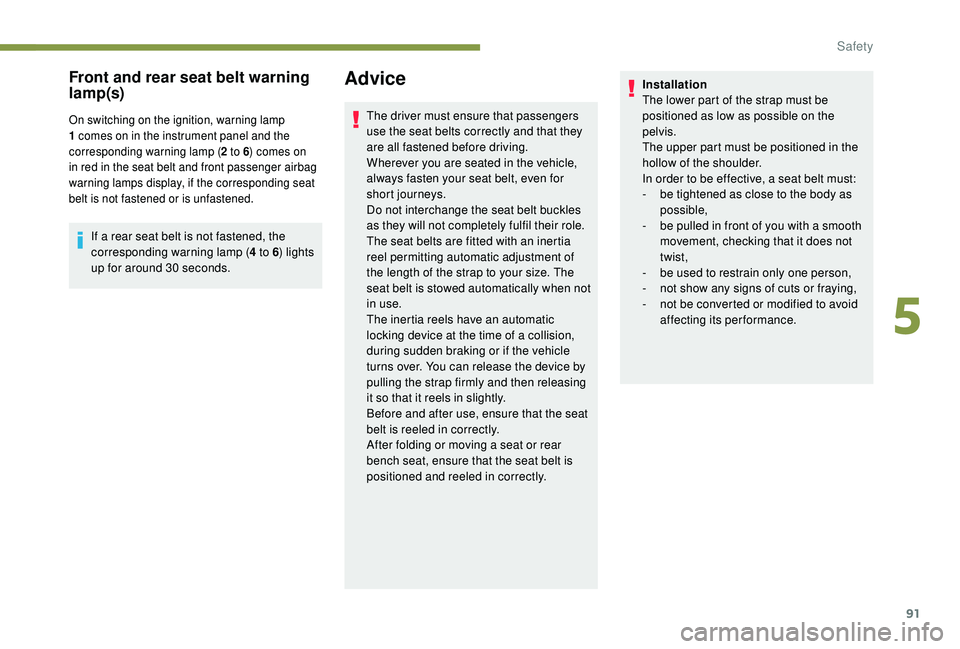
91
Front and rear seat belt warning
lamp(s)
On switching on the ignition, warning lamp
1 comes on in the instrument panel and the
corresponding warning lamp (2 to 6) comes on
in red in the seat belt and front passenger airbag
warning lamps display, if the corresponding seat
belt is not fastened or is unfastened.
If a rear seat belt is not fastened, the
corresponding warning lamp ( 4 to 6) lights
up for around 30
seconds.
Advice
The driver must ensure that passengers
use the seat belts correctly and that they
are all fastened before driving.
Wherever you are seated in the vehicle,
always fasten your seat belt, even for
short journeys.
Do not interchange the seat belt buckles
as they will not completely fulfil their role.
The seat belts are fitted with an inertia
reel permitting automatic adjustment of
the length of the strap to your size. The
seat belt is stowed automatically when not
in use.
The inertia reels have an automatic
locking device at the time of a collision,
during sudden braking or if the vehicle
turns over. You can release the device by
pulling the strap firmly and then releasing
it so that it reels in slightly.
Before and after use, ensure that the seat
belt is reeled in correctly.
After folding or moving a seat or rear
bench seat, ensure that the seat belt is
positioned and reeled in correctly. Installation
The lower part of the strap must be
positioned as low as possible on the
pelvis.
The upper part must be positioned in the
hollow of the shoulder.
In order to be effective, a seat belt must:
-
b
e tightened as close to the body as
possible,
-
b
e pulled in front of you with a smooth
movement, checking that it does not
twist,
-
b
e used to restrain only one person,
-
n
ot show any signs of cuts or fraying,
-
n
ot be converted or modified to avoid
affecting its performance.
5
Safety
Page 314 of 324

236
DDAB (Digital Audio Broadcasting) – Digital radio .............6 -7, 8, 22
Date (setting)
........................... 30 -32, 38, 18, 31
Daytime running lamps
.............74, 76, 206, 208
Deactivating the passenger airbag
...........93, 99
Deactivation of DSC
....................................... 88
Deadlocking
.............................................. 40 - 42
Defrosting
............................................ 6 6 , 70 -71
Demisting
.................................................. 66, 70
Demisting, rear
................................................ 55
Demisting, rear screen
...................................55
Denon (audio system)
..................................... 63
Dimensions
..............................
..............231,232
Dipstick
................
........................24 -25, 18 4,185
Direction indicators
.................79, 206, 208,210
Display screen, instrument panel
.................127
Display screen, multifunction (with audio system)
.................................3
0-32
Distance Alert
.................................. 16, 14 6,147
Doors
............................................................... 46
Driver’s attention warning
.............................149
Driver Sport Pack
................................... 126,127
Driving abroad ................................................. 75
Driving economically ......................................... 6
Driving positions (storing)
...............................53
DSC
................................................................. 87
Dynamic (sport)
...................................... 126,127
Dynamic pack
........................................ 12
6,127
Dynamic stability control (DSC)
..........18, 8 6 - 89
EEarth point, remote ....................................... 18 3
EBA ................................................................. 87
EBFD
................
......................................... 86 - 87
Eco-driving (advice)
.......................................... 6
Economy mode
............................................. 18
1
Electronic brake force distribution (EBFD) ...86 - 87
Electronic stability control (ESC) .................... 86
E lectronic stability control (ESC) ........8
6 - 87, 89
Emergency braking assistance (EBA)
............86
Emergency call
......................................... 85-86
Emergency switching off
...............................113
Emissions control system, SCR
...................188
Energy economy mode
................................. 18
1
Engine, Diesel
..................17, 172, 220, 227,230
Engine, petrol
........................ 1
72, 183, 222,226
Engine compartment
.................................... 18
3
Engines
.................................................. 2 21, 23 0
Environment
................................................ 6, 46
FFatigue detection .......................................... 149
Filling the AdBlue® tank ......................... 19 0,191
Filling the fuel tank ................................. 170,172
Filter, air
................................................. 18 6,187
Filter, Diesel fuel
........................................... 18 4
Filter, oil
................
......................................... 187
Filter, particle
......................................... 18 6,187
Filter, passenger compartment
........65, 18 6,187
Fitting a wheel
............................... 202, 204,205
Fitting roof bars
............................................. 182
Fittings, boot
................................................... 62
Fittings, interior
............................................... 58
F
lap, fuel filler
.......................................... 170,171
Foglamp, rear
............................. 74 -75 , 2 0 9 , 210
Foglamps, front
.................................. 74 -75 , 2 0 7
Foglamps, rear
.......................................... 2
0 , 74
Folding the rear seats
............................... 57- 5 8
Frequency (radio)
....................................... 21-22
Fuel ............................................................ 6 , 172
Fuel consumption
.............................................. 6
Fusebox, engine compartment
..................... 214
Fuses
...................................................... 21
1,214
GGauge, fuel.............................................. 170,171
Gearbox, automatic .............6, 22, 118,129, 187
Gearbox, electronic
.......................................... 6
Gearbox, manual
...............6, 118, 128,130, 187
Gear lever
......................................................... 6
Gear lever, automatic gearbox
......119,123, 125
Gear lever, manual gearbox
.........................11 8
Gear shift indicator ~ Gear efficiency indicator
..................................... 127
Glove box, refrigerated
................................... 58
G
. P. S .
.............................................................. 12
HHazard warning lamps ........................62, 84- 85Hazard warning lamps, automatic operation ...85Headlamp adjustment ...............................79-80
Headlamps, automatic dipping ............21, 76 -78
Headlamps, automatic illumination
....74, 76, 78
Headlamps, dipped beam
................21, 206,207
Headlamps, halogen
.......................79, 205,207
Headlamps, main beam
..................21, 206,208
Headlamp wash
..............................
................81
Head restraints, front
...................................... 51
Head restraints, rear
.................................57- 5 8
Heating
...................................... 6
, 64, 66 - 67, 69
Hill start assist
......................................... 117,11 8
Horn ................................................................. 86
Horn ................................................................. 86
IIdentification, vehicle .................................... 233
Ignition ................ .........................6 9 , 112 ,113 , 2 8
Ignition on ...................................................... 113
Immobiliser, electronic
............................4 4 , 11 0
Indicator, AdBlue
® range ................................. 25
Alphabetical index