2018 MERCEDES-BENZ E-CLASS WAGON ECU
[x] Cancel search: ECUPage 68 of 506
cally opening,this process is stopped. The auto‐
matic obs tacle de tection function is only an aid.
It is not a substitute foryo ur attentiveness when
opening theta ilgate.
Closing the tailgate
&
WARNING Risk of injury from unsecured
items in theve hicle
If objects, luggage or loads are not secured
or not secured suf ficientl y,they could slip,
tip ove r or be throw n around and thereby hit
ve hicle occupants.
There is a risk of injur y,particularly in the
ev ent of sudden braking or a sudden change
in direction.
#Alw aysstow objects in such a wayth at
th ey cannot be thro wn around.
#Before the journe y,secure objects, lug‐
ga ge or loads against slipping or tipping
ove r.
&
WARNING Risk of becoming trapped
duri ng au tomatic closing of theta ilgate
Pa rts of the body could become trapped dur‐
ing automatic closing of theta ilgate. More‐
ove r,people, e.g. children, may be standing
in the closing area or may enter the closing
area during the closing process.
#Make sure that nobody is in the vicinity
of the closing area during the closing
process.
Use one of thefo llowing options tostop the
closing process:
RPress thep button on the SmartK ey.
RPress or pull there mo teoperating switch
on the driver's door.
RPress the closing or locking button on the
ta ilgate.
RPull theta ilgate handle.
Ve hicles with HANDS-FREE ACCESS: It is also
possible tostop the closing process bymoving
yo ur foot in a kicking motion under there ar
bumper. To
close theta ilgate, thefo llowing options are
av ailable:
#Pull theta ilgate down wards slightly. Release
it as soon as it begins toclose.
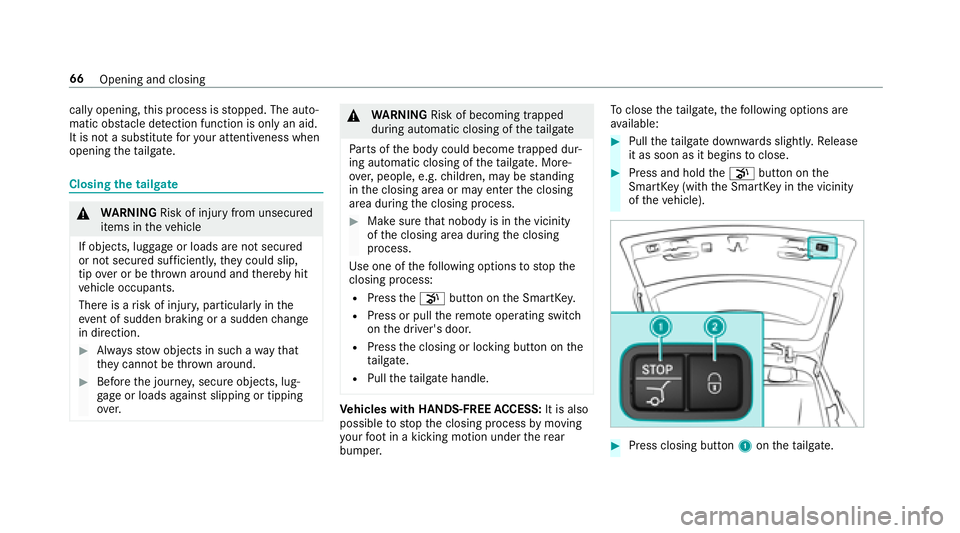
#Press and hold thep button on the
SmartK ey(with the SmartK eyinthe vicinity
of theve hicle).
#Press closing button 1ontheta ilgate.
66
Opening and closing
Page 71 of 506

1Sensor detection range
If se veral consecutive kicking mo vements are
not successful, waitte n seconds.
Sy stem limitations
The sy stem may be impaired or may not function
if:
RThe area around the sensor is dirty, e.g. due
to road salt or snow .
RThe kicking movement is made using a pros‐
th etic leg. The
tailgate can open or close unin tentional lyin
th efo llowing situations:
RIf persons' arms or legs mo veinthe sensor
de tection range, e.g. when polishing theve hi‐
cle, sitting on the edge of the cargo compart‐
ment, or picking up objects.
RIf objects are guided behind or placed behind
th eve hicle, e.g. charging cables, tensioning
st ra ps or luggage.
RWhen working on the trailer coupling, trailers
or rear bicycle rack s.
Deactivate KEYLESS-GO (
→page 57) or do not
car rythe SmartK eyabout your person in such
situations.
Limiting the opening angle of the tailgate
Ac tivating the opening angle limiter
Yo u can limit the opening angle of theta ilgate in
th eto p half of its opening range, toappr ox‐
imately 8 in (20 cm) before the end position.
#St op the opening procedure of theta ilgate at
th e desired position.
#Press and hold the closing button in theta il‐
ga te until you hear a short acoustic signal.
The opening angle limiter is activated. The
ta ilgate then stops in thestored position
when opened.
To open theta ilgate full y,pull the handle on the
outside of theta ilgate again af ter it has stopped
automaticall y.
Deactivating th eopening angle limiter
#Press and hold the closing button on theta il‐
ga te unt iltwo short tones sound.
Un locking the tailgate with the mechanical
ke y
#Foldthere ar seat backrest forw ard.
#Re mo vethe combined cargo co ver and net
(→page 108).
Opening and closing 69
Page 97 of 506
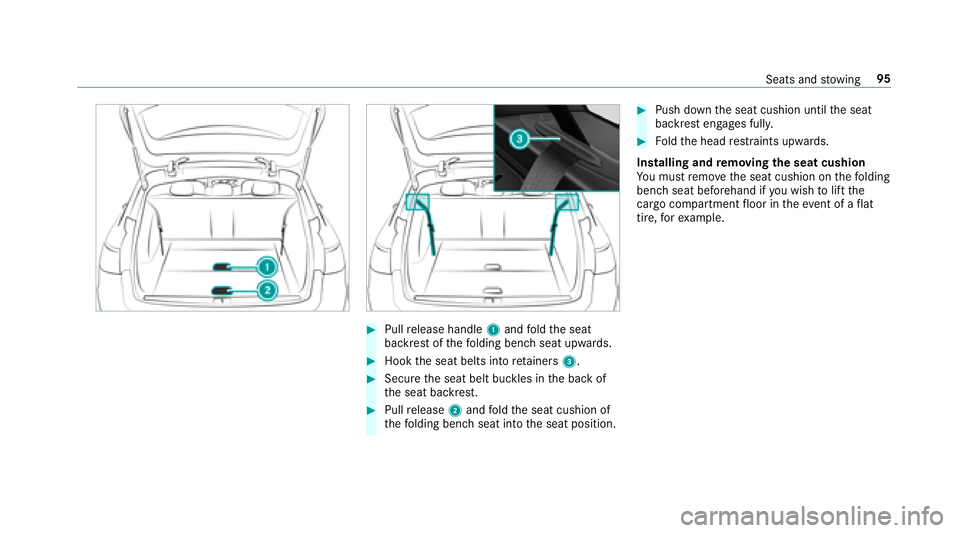
#Pullrelease handle 1and fold the seat
backrest of thefo lding bench seat upwards.
#Hook the seat belts into retainers 3.
#Secure the seat belt buckles in the back of
th e seat backrest.
#Pull release 2and fold the seat cushion of
th efo lding bench seat into the seat position.
#Push down the seat cushion until the seat
backrest engages full y.
#Foldthe head restra ints upwards.
Installing and removing the seat cushion
Yo u must remo vethe seat cushion on thefo lding
bench seat beforehand if youwish tolift the
cargo compart mentfloor in theev ent of a flat
tire, forex ample.
Seats and stowing 95
Page 103 of 506

&WARNING Risk of entrapment if the
memory function is activated bychildren
Children could become trapped if they acti‐
va te the memory function, particularly when
unattended.
#Ne ver lea vechildren unatte nded inthe
ve hicle.
#When leaving theve hicle, alw aysta ke
th eke ywit hyo u and lock theve hicle.
The memory function can be used when the igni‐
tion is switched off.
Seat adjustments for up tothre e people can be
st ored and called up using the memory function.
The following sy stems can be selected:
RSeat, backrest and head restra int
RSt eering wheel
ROutside mir rors
RHead-up Display
#To save :set the seat, thesteering wheel, the
Head-up Display and the outside mir rorto
th e desired position.
#Press the memory button M toge ther with
one of thestorage position buttons 1,2 or 3.
An acou stic signal sounds. The settings are
st ored.
#To call up: press and hold there leva nt pre‐
set position button 1,2 or 3 until the front
seat is in thestored position.
St ow age areas
Note s on loading theve hicle
&
WARNING Risk ofexhaust gas poisoning
Combustion engines emit poisonous exhaust
ga ses such as carbon monoxide. Exhaust
ga ses can enter theve hicle interior if theta il‐
gate is open when the engine is running,
especially if theve hicle is in motion.
#Alw ays switch off the engine before
opening theta ilgate.
#Ne ver drive with theta ilgate open.
&
WARNING Risk of injury from unsecured
items in theve hicle
If objects, luggage or loads are not secured
or not secured suf ficientl y,they could slip,
Seats and stowing 10
1
Page 104 of 506

tipove r or be throw n around and thereby hit
ve hicle occupants.
There is a risk of injur y,particularly in the
ev ent of sudden braking or a sudden change
in direction.
#Alw aysstow objects in such a wayth at
th ey cannot be thro wn around.
#Before the journe y,secure objects, lug‐
ga ge or loads against slipping or tipping
ove r.
&
WARNING Risk of injury duetoobjects
being stowed incor rectly
If objects in theve hicle interior are stowed
incor rectly, they can slide or be throw n
around and hit vehicle occupants. In addi‐
tion, cup holders, open stowage spaces and
mobile phone brac kets cann otalw aysre tain
all objects they contain.
There is arisk of injur y,particularly in the
ev ent of sudden braking or a sudden change
in direction.
#Alw aysstow objects so that they can‐
not be throw n around in such situa‐
tions.
#Alw ays make sure that objects do not
pr otru de from stowage spaces, luggage
nets or stowage nets.
#Close the loc kable stow age spaces
before starting a journe y.
#Stow and secure objects that are heavy,
hard, pointe d, sharp-edged, fragile or
to o lar geinthe cargo compartment.
&
WARNING Risk of burn s fromtailpipes
and tailpipe trim
The tailpipe and tailpipe trim can become
ve ry hot. If you come into contact withth ese
parts of theve hicle, you could burn yourself.
#Alw ays be particular lycareful around
th eta ilpipe and theta ilpipe trim.
#Allow theve hicle parts tocool down
before youto uch them.
The handling characteristics of your vehicle are
dependent on the distribution of the load within
th eve hicle. You should bear thefo llowing in
mind when loading theve hicle:
Rne verex ceed the permissible gross mass or
th e permissible axle loads forth eve hicle
(including occupants). The values are speci‐
fi ed on theve hicle identification plate on the
ve hicle's B-pillar.
Rthe load must not pr otru de abo vethe upper
edge of the seat backrests.
Rwhen transporting objects in the cargo com‐
partment, the combined cargo co ver and net
must alw ays be ins talled (cargo compart‐
ment co ver and saf etynet) .
Ralways place the load behind unoccupied
seats if possible.
Rsecure the load using the tie-down eyes and
distribute the load evenl y.
102
Seats and stowing
Page 108 of 506

Folding there ar seat backrest back
* NO
TEDama getothe seat belt
The seat belt could become trapped and thus
damaged when folding back the seat back‐
re st.
#Make sure that the seat belt is not trap‐
ped when folding back the seat back‐
re st.
If th e seat backrest is not engaged and loc ked,
th is will be shown in the multifunction display in
th e instrument clus ter.
#Mo vethe driver's or front passenger seat for‐
wa rds, if necessar y.
#Fold cor responding seat backrest 1back
until it engages.
Left and right seat backrests: ifth e seat
backrest is not cor rectly engaged, this will be
shown in the multifunction display in the
instrument clus ter.
Center seat backres t:ifth e seat backrest is
not cor rectly engaged, red lock verification
indicator 2will be visible. Lo
cking the center rear seat backrest
Lock the center seat backrest if youwa ntto
secure the cargo compartment from unauthor‐
ized access. The center seat backrest can then
only be folded forw ard toget her with the left seat
backrest.
Bo th seat backrests must be engaged and joined
to ge ther.
10 6
Seats and stowing
Page 109 of 506
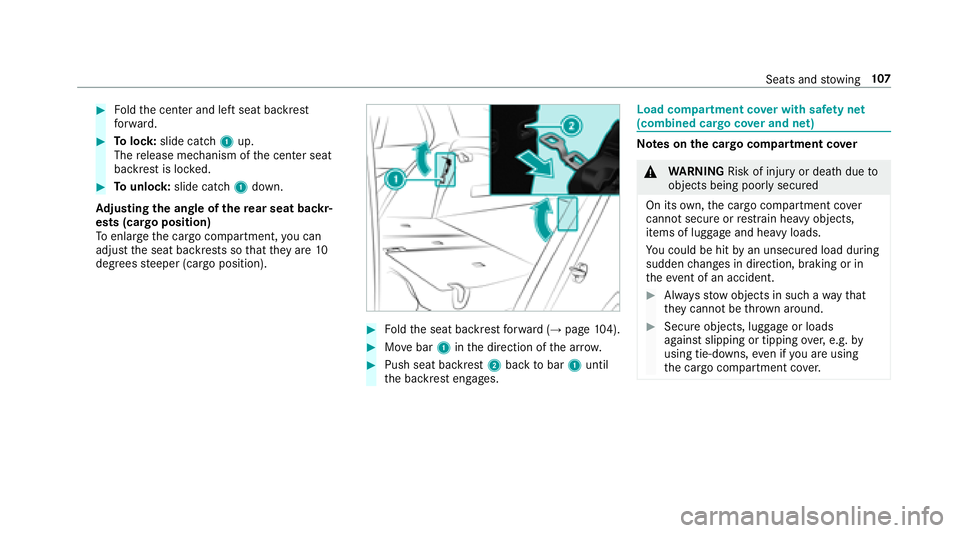
#Foldthe center and left seat backrest
fo rw ard.
#To lock: slide catch 1up.
The release mechanism of the center seat
backrest is loc ked.
#To unlock :slide catch 1down.
Ad justing the angle of the rear seat backr‐
ests (cargo position)
To enlar gethe cargo compartment, you can
adjust the seat backrests so that they are 10
degrees steeper (cargo position).
#Fo ldthe seat backrest forw ard (→page 104).
#Mo vebar 1inthe direction of the ar row.
#Push seat backrest 2back tobar 1until
th e backrest engages.
Load compartment co ver with saf ety net
(combined cargo co ver and net)
Note s onthe cargo compa rtment co ver
&
WARNING Risk of injury or death dueto
objects being poorly secured
On its own,the cargo compartment co ver
cannot secure orrestra in heavy objects,
items of luggage and heavy loads.
Yo u could be hit byan unsecured load during
sudden changes in direction, braking or in
th eev ent of an accident.
#Alw aysstow objects in such a wayth at
th ey cannot be thro wn around.
#Secure objects, luggage or loads
against slipping or tipping over,e.g. by
using tie-do wns,eve n if you are using
th e cargo compartment co ver.
Seats and stowing 10
7
Page 112 of 506
Attachin gth e saf ety net
&
WARNING Risk of injury duetopoorly
secured objects
On its own,the saf etyne tcanno tsecur eor
re stra in heavy objects, items of luggage or
heavy loads.
Yo u could behit byan unsecured load during
sudden changes in direction, braking or in
th eev ent of an accident. There is an
increased risk of injury or even fata l injur y.
#Alwaysstow objects in such a wayth at
th ey cannot be thro wn around.
#Secure objects, luggage or loads
against slipping or tipping over,e.g. by
using lashing mater ial,even if you are
using the saf etynet.
Fo r saf etyre asons, alw ays use a saf etyne twhen
transporting aload.
Damaged saf etynets can no lon ger fulfill their
pr otective functions and must be replaced. Visit
a qu alified specialist workshop.
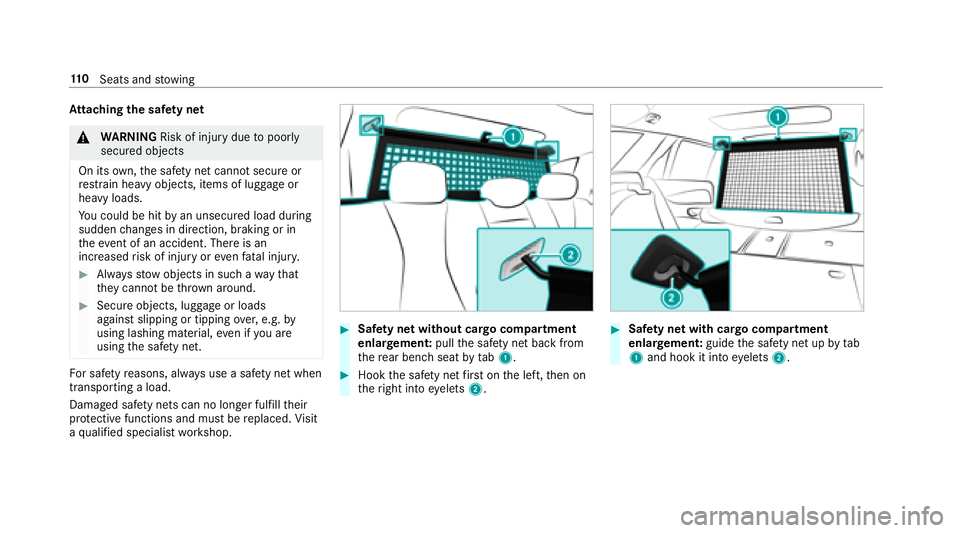
#Saf ety net without cargo compartment
enlar gement: pullthe saf etyne tbac kfrom
th ere ar bench seatbytab1.
#Hook the saf etyne tfirs t on the left, then on
th eright into eyelets 2.
#Safety net with cargo compartment
enlar gement: guidethe saf etyne tup bytab
1 and hook it into eyelets 2.
110
Seats and stowing