2018 MERCEDES-BENZ E-CLASS WAGON ECU
[x] Cancel search: ECUPage 356 of 506
&WARNING Risk of accident due tolimi‐
te d saf ety-re lated functions during the
to wing process
Saf ety-re lated functions are limited or no lon‐
ge rav ailable in thefo llowing situations:
Rth e ignition is switched off.
Rthe brake sy stem or po werst eering sys‐
te m is malfunctioning.
Rth e energy supply or the on-board electri‐
cal sy stem is malfunctioning.
When your vehicle is then towe daw ay, signif‐
icantly more ef fort may be requ ired tosteer
and brake than is no rmally requ ired.
#Use a tow bar.
#Make sure that thesteering wheel can
mo vefreely, before towing theve hicle
aw ay.
* NO
TEDama gedue toexcessive tracti ve
po we r
Ifyo u pull away sharpl y,the tractive po wer
may be too high and theve hicles could be
damaged.
#Pull away slowly and smoo thly.
Loading the vehicle for transport
#Obser vethe no tes on towing away
(→page 352).
#Connect theto w bar totheto wing eyeto
load theve hicle.
#Ve hicles with automatic transmission:
Shift the automatic transmission toposition
i.
% Ve
hicles with automatic transmission:
The au tomatic transmission may be loc ked
in position jintheeve nt of damage tothe
electrical sy stem. Toshift toi, pr ovide the
on-board electrical sy stem with po wer
(
→page 348).
#Load theve hicle onto the transpor ter.
#Ve hicles with automatic transmission:
Shift the automatic transmission toposition
j.
#Use the electric parking brake tosecure the
ve hicle and pr event it from rolling away.
#Only secure theve hicle bythe wheels.
Ve hicles with ADS PLUS (Adaptive Damping
Sy stem PLUS)
&
WARNING Risk of an accident when
transporting vehicles with Adaptive
Damping Sy stem PLUS
The reduced damping forc es on theve hicle
being transpor ted can cause theve hicle/
trailer combination tostart toswing.
As a result, when transporting vehicles with
th eAd aptive Damping Sy stem PLUS, the
ve hicle/trailer combination may start toskid.
Consequentl y,yo u could lose cont rol of your
ve hicle.
#When transporting, ensure that:
354
Breakdown assis tance
Page 357 of 506
RThevehicle has been loaded onto
th e transpor ter cor rectly
RThe vehicle is secured at all four
wheels with suit abletensioning
st ra ps
RThe maximum permissible speed of
35 mph (60 km/h) is not exceeded
when transporting
* NO
TEDama getotheve hicle from secur‐
ing it incor rectly
#Af ter loading, theve hicle must be
secured at all four wheels. Otherwise,
th eve hicle could be damaged.
#A minimum dis tance of 8 in (20 cm) up
and 4 in (10 cm) down must bekept to
th e transport platform.
#Secure theve hicle on all four wheels af ter
loading. 4MATIC
vehicles/ve hicles with automatic
transmission
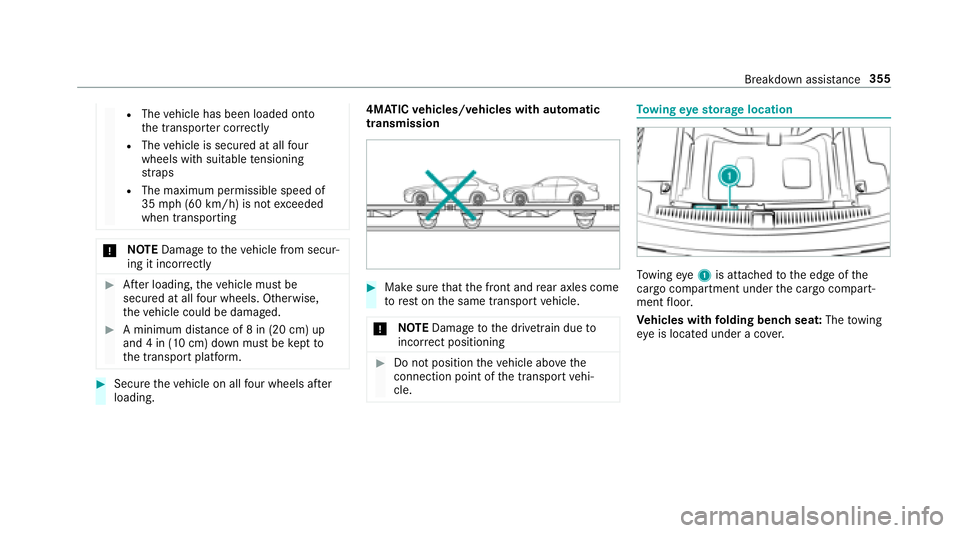
#Make sure that the front and rear axles come
to rest on the same transport vehicle.
* NO
TEDama getothe driv etra in due to
incor rect positioning
#Do not position theve hicle abo vethe
connection point of the transport vehi‐
cle.
To wing eyesto rage location
Towing eye1 is attached tothe edge of the
cargo compart ment underthe cargo compart‐
ment floor.
Ve hicles with folding bench seat: Thetowing
ey e is located under a co ver.
Breakdown assis tance 355
Page 359 of 506

color and fuserating. The fuse ratings are li sted
in the fuse assignment diagram.
Fu se assignment diag ram: onthe fuse box in
th e cargo compartment (
→page 359).
* NO
TEDama geor malfunctions caused
by moisture
Moisture may cause dama getothe electrical
sy stem or cause it tomalfunction.
#When the fuse box is open, make sure
th at no moisture can enter the fuse
box.
#When closing the fuse box, make sure
th at the seal of the lid is positioned cor‐
re ctly on the fuse box.
If a newly inser ted fuse also blo ws, ha vethe
cause traced and rectified at a qualified special‐
ist workshop.
Ensure thefo llowing before replacing a fuse:
RThe vehicle is secured against rolling away.
RAll electrical consumers are switched off.
RThe ignition is switched off. The electrical fuses are located in
various fuse
bo xes:
RFu se box in the engine compartment on the
driver's side (→page 357)
RFu se box on the driver's side of the cockpit
(→page 358)
RFu se box in the front-passen gerfo ot we ll
(→page 358)
RFu se box in the cargo compartment on the
ri ght-hand side of theve hicle, when vie wed
in the direction of tra vel (
→page 359)
Fu se box in the engine compa rtment
Prerequisites
Observ eth e no tes on electrical fuses
(
→page 356).
Ha ve thefo llowing readily available:
RA dry clo th
RA screwdriver Opening
&
WARNING Risk of injury from usingthe
windshield wipers while the engine hood
is open
When the engine hood is open and the wind‐
shield wipers are set in motion, you can be
trapped bythe wiper linkage.
#Alw ays switch off the windshield wipers
and ignition before opening the engine
hood.
Breakdown assis tance 357
Page 366 of 506
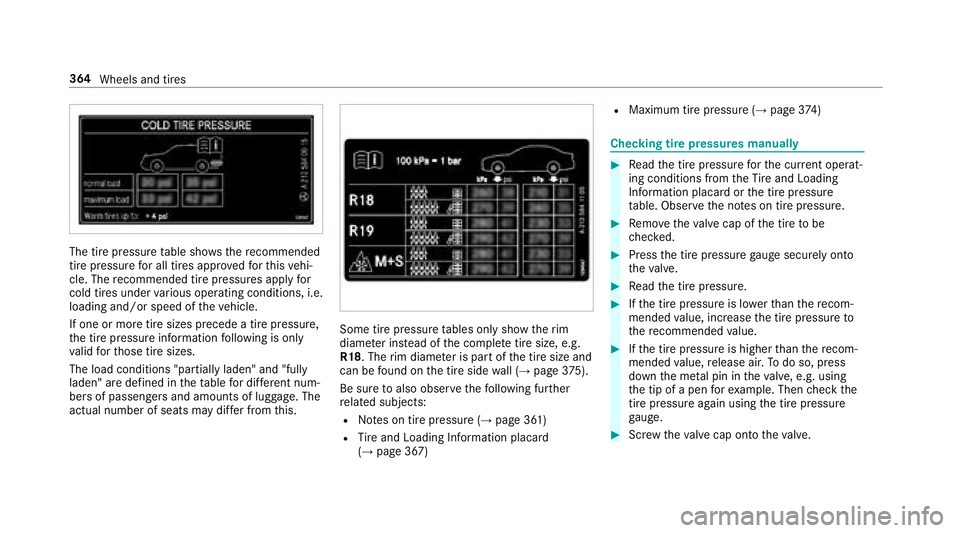
The tire pressuretable sho ws there commended
tire pressure for all tires app rove dfo rth is vehi‐
cle. The recommended tire pressures apply for
cold tires under various operating conditions, i.e.
loading and/or speed of theve hicle.
If one or more tire sizes precede a tire pressure,
th e tire pressure information following is only
va lid forth ose tire sizes.
The load conditions "partially laden" and "fully
laden" are defined in theta ble for dif fere nt num‐
be rs of passengers and amounts of luggage. The
actual number of seats may dif fer from this.
Some tire pressure tables only show therim
diame ter ins tead of the comple tetire size, e.g.
R18 . The rim diame ter is part of the tire size and
can be found on the tire side wall (
→page 375).
Be sure toalso observ eth efo llowing fur ther
re lated subjects:
RNo tes on tire pressure (→page 361)
RTire and Loading Info rmation placard
(→page 367)
RMaximum tire pressure (→page 374)
Che cking tire pressures manually
#Re ad the tire pressure forth e cur rent operat‐
ing conditions from theTire and Loading
Info rmation placard or the tire pressure
ta ble. Obser vethe no tes on tire pressure.
#Re mo vetheva lve cap of the tire tobe
ch ecked.
#Press the tire pressure gauge securely onto
th eva lve.
#Re ad the tire pressure.
#Ifth e tire pressure is lo werth an there com‐
mended value, inc rease the tire pressure to
th ere commended value.
#Ifth e tire pressure is higher than there com‐
mended value, release air. Todo so, press
down the me tal pin in theva lve, e.g. using
th e tip of a pen forex ample. Then check the
tire pressure again usingthe tire pressure
ga uge.
#Sc rew theva lve cap onto theva lve.
364
Wheels and tires
Page 381 of 506
these are ins talled on theve hicle, but does not
include passengers or luggage.
Maximum tire load: the maximum tire load is
th e maximum permissible weight in kilog rams or
lbs for which a tire is appr oved.
Maximum permissible tire pressure: maxi‐
mum permissible tire pressure for one tire.
Maximum load on one tire: maximum load on
one tire. This is calculated bydividing the maxi‐
mum axle load of one axle bytwo.
PSI (pounds per square in ch):standard unit of
measurement for tire pressure .
Aspect ratio: ratio between tire height and tire
width in pe rcent.
Ti re pressure: pressure inside the tire applying
an outward forc eto eve rysquare inch of the tire.
The tire pressure is specified in pounds per
square inch (psi), in kilopascals (kPa) or in bar.
The tire pressure should only be cor rected when
th e tires are cold.
Cold tire pressure: the tires are cold when the
ve hicle has been par kedfo r at least 3 hours without direct sunlight on
the tires or theve hicle
has been driven for less than 1 mile (1.6 km).
Ti re contact sur face: the part of the tire that
comes into con tact wi th thero ad.
Ti re bead: the purpose of the tire bead is to
ensure that the tire sits securely on the wheel
ri m. There are se veral wire cores in the tire bead
to pr
eve ntthe t
ire fromchanging length on the
wheel rim.
Side wall:the part of the tire between the tread
and the tire bead.
We ight of optional equipment: the combined
we ight of the optional equipment weighing more
th an there placed standard parts and more than
5 lbs (2.3 kg).This optional equipment, such as
high-per form ance brakes, le vel control sy stem, a
ro of luggage rack or high-per form ance batte ries,
is not included in the curb weight and thewe ight
of the accessories.
TIN (Tire Identification Number): a unique
identification number which can be used bya
tire manufactu rerto identify tires, forex ample,
in a product recall, and thus identify the pur‐
ch asers. The TIN is made up of the manufactur‐ er's identity code, tire size, tire type code and
th
e manufacturing date.
Load-bearing index: the load-bearing index is a
code that con tains the maximum load-bearing
capacity of a tire.
Tr action: traction is the grip resulting from fric‐
tion between the tires and thero ad sur face.
We ar indicator: narrow bars (tread wear bars)
th at are distributed overth e tire conta ct surface.
If th e tire tread is le vel with the bars, thewe ar
limit of 1/ 16in (1.6 mm) has been reached.
Distribution of vehicle occupants: distribution
of vehicle occupants ov
er design
ated seat posi‐
tions in a vehicle.
Maximum permissible pa yload weight: nomi‐
nal load and luggage load plus 150 lb (68 kg)
multiplied bythe number of seats in theve hicle.
Wheels and tires 37
9
Page 421 of 506

Displaymessages
Possible causes/consequences and MSolutions
)URQW 3DVVHQJHU $LUEDJ
(QDEOHG 6HH 2SHUDWRU
V
0DQXDO *T
he front passenger air bag and knee air bags are enabled while theve hicle is moving:
Reve n when a child, a small adult or an object weighing less than the sy stem weight thre shold is located on the
front passenger seat
Reve n when the front passenger seat is not occupied
The sy stem may de tect objects or forc es that are adding tothewe ight applied tothe seat.
&
WARNING Risk of injury orfata l injury byusing a child restra int sy stem with the front passenger airbag
enabled
If yo u secure a child in a child restra int sy stem on the front passenger seat and the front passenger airbag is
enabled, the front passenger airbag can deploy in theev ent of an accident.
The child could be stru ck bythe airbag.
#Make sure, bo thbefore and during the journe y,that thest atus of the front passenger airbag is cor rect.
#Pull over and stop theve hicle safely as soon as possible, paying attention toroad and traf fic conditions.
#Check thest atus of the automatic front passenger air bag shutoff .
#If necessar y,consult a qualified specialist workshop immediatel y.
Displaymessage s andwarning/indicator lamps 41
9
Page 482 of 506

seeActive Speed Limit Assi st
see Active Steering Assist
see AIR BODY CONTROL
see ATTENTION ASSIST
see Blind Spot Assist
see Cruise contro l
see Driving saf etysy stem
see HOLD function
see Parking Assist PARKTRONI C
see Rear view camera
see Traf fic Sign Assist
Drivin gtips
Drinking and drivin g............................ 146
Gene ral driving tips ............................ .146
No tes on breaking-in a new vehicle ..... 146
Dr ow siness de tection
see ATTENTION ASSIST
DY NA MIC BODY CONT ROL
Suspension .......................................... 187
Dynami chandling cont rol sy stem
see ESP
®(Elect ronic Stability Prog ram)
DY NA MIC SELECT .................................... 150
Confi guring drive program I ................. 151
Displ aying engine data ........................ .151 Displ
aying vehicle data ........................ 151
Drive program display .......................... 151
Drive programs .................................... 150
Fu nction .............................................. 150
Operating (DYNAMIC SELECT switch) .. 151
Selecting the drive prog ram ................. 151
E
E10 ............................................................ 395
Easy entry feature
Operation/no tes ................................... 99
Setting .................................................1 00
Easy exitfeature
Operation/no tes ................................... 99
Setting .................................................1 00
EA SY-PAC K load-secu ring kit .................. .111
No tes ................................................... 111
Te nsioning the luggage holder .............. 112
Te nsioning thete lescopic rod .............. 113
EBD (electronic brake forc e distribu‐
tion)
Function/no tes ................................... 170
ECO display Function .............................................. 150 Re
setting ............................................. 221
ECO start/s top function ......................... 149
Au tomatic engine start ........................ 149
Au tomatic engine stop .........................1 49
Operation ............................................ 149
Switching off/on ................................. 149
Electric pa rking brake .............163, 164, 165
App lying automatically ........................ 163
App lying or releasing manually ............ 164
Emergency braking .............................. 165
R
e leasing automatically ...................... .164
Electrical fuses see Fuses
Electronic Stability Prog ram
see ESP
®(Electronic Stability Prog ram)
Electronics ............................................... 390
Emer gency
Overview of the help functions .............. 16
Saf etyve st .......................................... 340
Eme rgency braking ................................ .165
Emer gency call sy stem
Mercedes-Benz mbrace
®(USA) .......... .295
Emer gency engine start ......................... 356
480
Index
Page 487 of 506

iPhone®
see Apple CarPlay™
J
Jack Storage location ..................................3 83
Jump-start connection ............................ 348
Jump-starting see Ju mp-sta rt connection
K
Ke y
Battery .................................................. 58
Energy consump tion .............................. 57
KEYLESS-GO Locking theve hicle ................................ 61
Problem .................................................6 2
Unlocking setting .................................. .57
Unlocking theve hicle ............................. 61
Kic kdow n................................................ .154
Using ................................................... 154
Knee airbag ................................................ 38
L
Labeling (ti res)
see Tire labeling
Laden ........................................................ .111
Bag hook .............................................. 111
Ro ofrack ............................................. 114
St ow age space unde rneath the cargo
compartment floor ...............................1 14
Ti e-down eyes ...................................... 111
Laden see EA SY-PAC K load-securing kit
Lamp see Interior lighting
Lamp (In stru ment Displ ay)
see Warning/indicator lamps
Lane Keeping Assist
see Active Lane Keeping Assist
Language Notes .................................................. 252
Setting .................................................2 52
LA TC H-type (ISOFIX) child seat
attachment
Installing ................................................ 50 No
tes ..................................................... 49
Le vel control sy stem
see AIR BODY CONTROL
Light switch Overview .............................................1 23
Lighting .................................................... 127
Lighting see Lights
Lights ................................................ 123, 127
Ad aptive Highbeam Assist .................. .126
Ad justing the instrument lighting ......... 218
Au tomatic driving lights ....................... 124
Comb ination switch
............................. 124
Corn
e ri ng light function ....................... 125
Hazard warning lights .......................... 125
High beam ........................................... 124
High-beam flasher .............................. .124
Light switch ......................................... 123
Low beam ............................................ 123
Pa rking lights ...................................... .123
Re ar fog light ....................................... 124
Re sponsibility for lighting sy stems ...... .123
Setting the sur round lighting .............. .127
St anding lights .................................... .123
Index 485