2018 MERCEDES-BENZ E-CLASS WAGON warning
[x] Cancel search: warningPage 188 of 506

pedal. Never attem pttolea vetheve hi‐
cle if it is being held byHill Start Assist.
HOLD function
HOLD function
The HOLD function holds theve hicle at a stand‐
st ill without requ iring youto depress the brake
pedal, e.g. when pulling away on steep slopes.
Sy stem limitations
The incline must not be greaterth an 30%.
Ac tivating/deactivating the HOLD function
&
WARNING Risk of an accident due tothe
HOLD function being activated when you
lea vetheve hicle
If yo u lea vetheve hicle while only the HOLD
function is braking theve hicle, theve hicle
can rollaw ay inthefo llowing situations:
RIf th ere is a malfunction in the sy stem or
in the po wer supp ly.
RIf th e HOLD function is deactivated by
depressing the accelera tor pedal or the
brake pedal, e.g. byave hicle occupant.
RIfth e electrics in the engine compart‐
ment, the battery or the fuses are tam‐
pered with or if the battery is disconnec‐
te d.
#Alw ays deactivate the HOLD function
and secure theve hicle against rolling
aw ay before leaving theve hicle.
* NO
TEDama gefrom au tomatic braking
When Active Brake Assi st,Ac tive Dis tance
Assist DISTRONIC or the HOLD function are
activated, theve hicle brakes autonomously
in cer tain situations.
To avo id damage totheve hicle, deactivate
th ese sy stems in thefo llowing or similar sit‐
uations:
#During towing
#In a car wash
Requirements:RThe vehicle is stationar y.
RThe driver's door is closed or the seat belt on
th e driver's side is fastened.
RThe engine is running or has been au tomati‐
cally switched off bythe ECO start/ stop
function.
RThe electric parking brake is released.
RAc tive Dis tance Assist DISTRONIC is not acti‐
va ted.
RThe transmission is in position h,kori.
Ac tivating the HOLD function
#Dep ress the brake pedal and af ter a short
time depress fur ther until theë display
appears in the multifunction displa y.
#Release the brake pedal.
Deactivating the HOLD function
#Depress the accelerator pedal topull away.
or
#Depress the brake pedal until theë dis‐
play disappears from the multifunction dis‐
pla y.
186
Driving and pa rking
Page 191 of 506
Settingtheve hicle le vel
&
WARNING Risk of accident because
ve hicle le vel is too high
If yo udriv e at a higher vehicle le vel,th e driv‐
ing characteristics may be impaired due to
th e higher vehicle center of gr avity.
The vehicle may tip over more quickly on a
bend, forex ample.
#Alw ays select as low a vehicle le vel as
possible and adapt your drivin gst yle
accordingl y.
&
WARNING Risk of entrapment from vehi‐
cle lo wering
When lo wering theve hicle, people could
become trapped if their limbs are between
th eve hicle body and the tires or underneath
th eve hicle.
#Make sure no one is underneath the
ve hicle or in the immediate vicinity of
th e wheel ar ches when youlowe rth e
ve hicle.
&
WARNING Risk of entrapment from vehi‐
cle lo wering
Ve hicles with AIR BODY CONT ROL or
le ve l control sy stem: When you unload lug‐
ga ge or lea vetheve hicle, theve hicle firs t
ri ses slightly and then returns tothe set le vel
shortly af terw ards.
Yo u or an yone else in the vicinity of the
wheel ar ches or the underbody could thus
become trapped.
The vehicle can also be lo wered af ter being
loc ked.
#When leaving theve hicle, make sure
th at nobody is in the vicinity of the
wheel ar ches or the underbody.
Re quirements:RThe vehicle's engine must be switched on.
RThe vehicle must not be moving fasterthan
37 mph (60 km/h). Ra
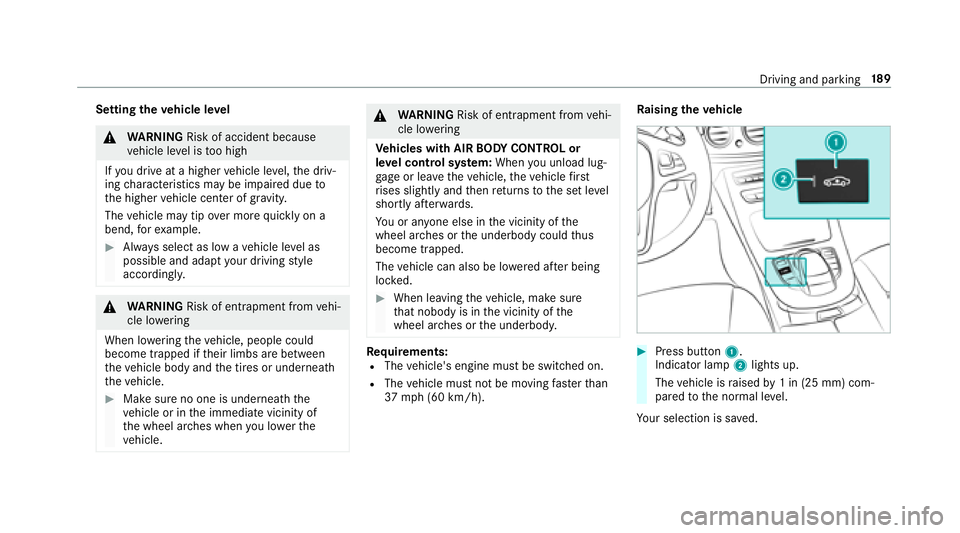
ising theve hicle
#Press button 1.
Indicato r lamp2lights up.
The vehicle is raised by1 in (25 mm) com‐
pared tothe normal le vel.
Yo ur selection issave d.
Driving and parking 18
9
Page 193 of 506

Vehicles with Active Parking Assist without 360°
Camera
Ve hicles with Parking Assist and 360° Camera
Sy stem limitations
Pa rking Assist PARKTRONI Cdoes no tnecessa‐
ri ly take into account thefo llowing obs tacles:
RObs tacles bel owthe de tection range, e.g.
pe rsons, animals or objects.
RObs tacles ab oveth e de tection range, e.g.
ov erhanging loads, overhangs or loading
ra mp s of truc ks.
The sensors must be free of dirt, ice and slush.
Otherwise, they may not function cor rectly.
Clean the sensors regularly, taking care not to
scratch or damage them.
Fu nction of the passive side impact pr otec‐
tion
Pa ssive side impact pr otection is an additional
Pa rking Assist PARKTRONI Cfunction whic h
wa rnsth e driver about obs tacles at the side of
th eve hicle. A warning is issued when obs tacles
are de tected between the front and rear de tec‐
tion range. In order for an object tobe de tected,
th e sensors in the front or rear bumper must
de tect the object while you are driving past it. During
the parking procedure or maneuvering,
objects are de tected as theve hicle drives past.
If yo usteer in the direction of a de tected obs ta‐
cle and there is a risk of a lateral collision, a
wa rning is issued. The lateral segments light up
orang e or
red, depen ding onthe dis tance tothe
obs tacle.
Segment color depending on distance Color Lateral distance in cm
Re dA pprox. < 30
Orang eA pprox. 30 - 60
In order for lateral front or rear segments tobe
displa yed, theve hicle must firs t tr ave l a dis tance
of at least half of theve hicle length. Once the
ve hicle has tr aveled the length of theve hicle, all
of the lateral front and rear segments can be dis‐
pla yed.
Driving and parking 19
1
Page 194 of 506

Vehicles without 360° Camera
1Parking Assist PARKTRONI Cis on ly oper a‐
tional in the front and rear
2Pa rking Assist PARKTRONI Cis operational
and can also warnthe driver about obs tacles
at the side of theve hicle
3Obs tacles de tected at the front right
(orange) and rear (red)
Ve hicles with 360° Camera
1Parking Assist PARKTRONI Cis on ly oper a‐
tional in the front and rear
2Pa rking Assist PARKTRONI Cis operational
and can also warnthe driver about obs tacles
at the side of theve hicle
3Obs tacles de tected at the front right
(orange) and rear (red)
Sa ved obs tacles are del eted in thefo llowing sit‐
uations, forex ample:
RYo u switch offtheve hicle
RYo u open the doors Af
terth e engine is restar ted, obs tacles must be
de tected again, before a new warning can be
issued.
Sy stem limitations
The sy stem limitations forPa rking Assist
PA RKTRONI Cappl yfo r passive side impact pro‐
te ction.
The following objects are not de tected, forex am‐
ple:
RPe destrians who approach theve hicle from
th e side
RObjects placed next totheve hicle
Deactivating/activating PARKTRONIC
* NO
TERisk of an accident from objects
at close range
Pa rking Assist PARKTRONI Cma yno tde tect
cer tain objects at close range.
#When pa rking or maneuvering theve hi‐
cle, pay particular attention toany
objects which are abo veor below the
sensors, e.g. flowe r pots or dr awbars.
192
Driving and pa rking
Page 195 of 506
Thevehicle or other objects could oth‐
erwise be damaged.
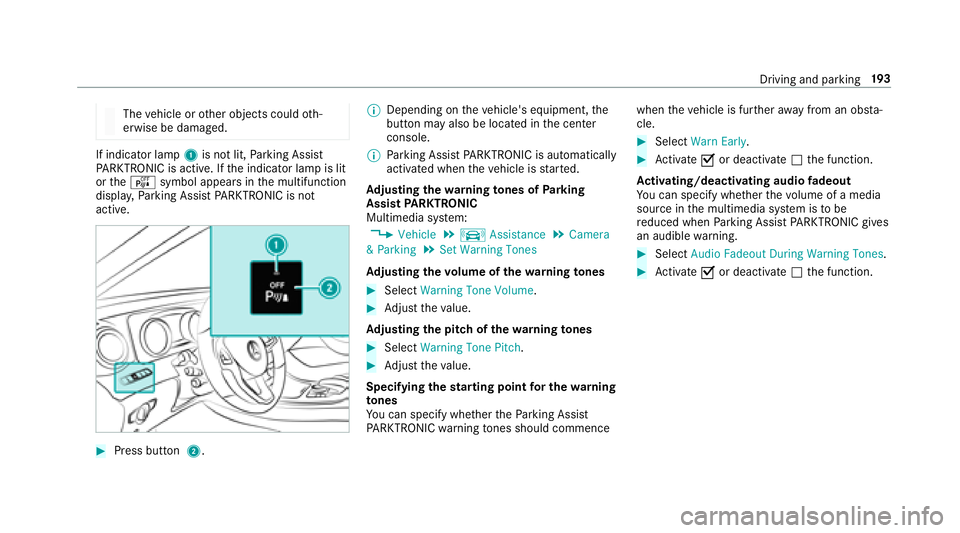
If indicator lamp 1is not lit, Parking Assist
PA RKTRONI Cis active. If the indicator lamp is lit
or theé symbol appears in the multifunction
displa y,Pa rking Assist PARKTRONI Cis no t
active.
#Press but ton 2. %
Depending on theve hicle's equipment, the
button may also be located in the center
console.
% Parking Assist PARKTRONI Cis automatical ly
activated when theve hicle is star ted.
Ad justing the warning tones of Parking
Assist PARKTRONIC
Multimedia sy stem:
,9HKLFOH.k $VVLVWDQFH.&DPHUD
3DUNLQJ.6HW :DUQLQJ 7RQHV
Ad justing the volume of thewa rning tones
#Select :DUQLQJ 7RQH 9ROXPH.
#Adjust theva lue.
Ad justing the pitch of the warning tones
#Select :DUQLQJ 7RQH 3LWFK.
#Adjust theva lue.
Specifying thest arting point for the warning
to nes
Yo u can specify whe ther thePa rking Assist
PA RKTRONI Cwa rning tones should commence when
theve hicle is fur ther aw ay from an obs ta‐
cle.
#Select :DUQ (DUO\ .
#Activate Oor deacti vate ª the function.
Ac tivating/deactivating audio fadeout
Yo u can specify whe ther thevo lume of a media
source in the multimedia sy stem is tobe
re duced when Parking Assist PARKTRONI Cgives
an audible warning.
#Select $XGLR )DGHRXW 'XULQJ :DUQLQJ 7RQHV.
#Activate Oor deacti vate ª the function.
Driving and parking 19
3
Page 198 of 506
Normal view
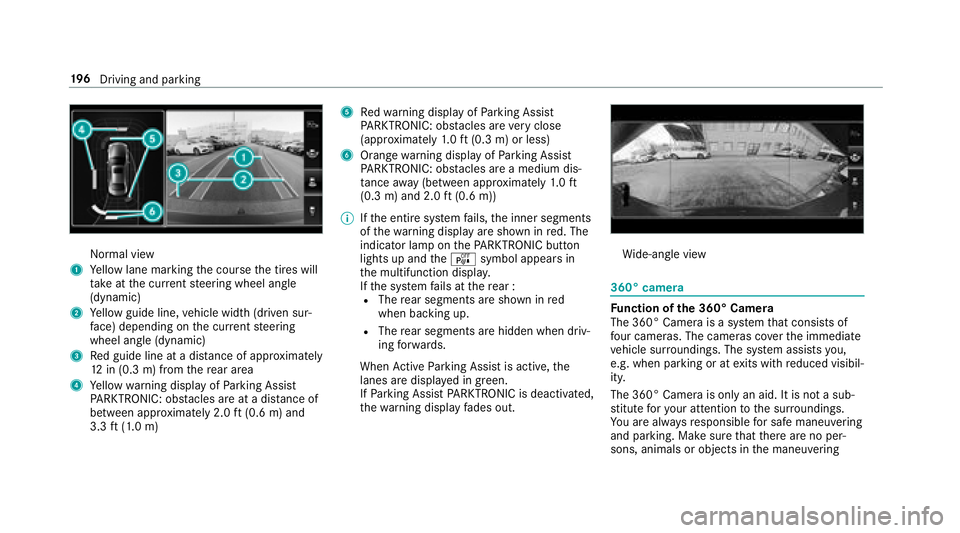
1Yellow lane marking the course the tires will
ta ke atthe cur rent steering wheel angle
(dynamic)
2Ye llow guide line, vehicle width (driven sur‐
fa ce) depending on the cur rent steering
wheel angle (dynamic)
3Re d guide line at a dis tance of appr oximately
12 in (0.3 m) from there ar area
4Ye llow warning display of Parking Assist
PA RKTRONIC: obstacles ar eat adis tance of
between appr oximately 2.0 ft(0.6 m) and
3.3 ft(1.0 m)
5Re dwa rning display of Parking Assist
PA RKTRONIC: obstacles ar eve ry close
(appr oximately 1.0 ft (0.3 m) or less)
6Orange warning display of Parking Assist
PA RKTRONIC: obstacles ar e amedium dis‐
ta nce away (between appr oximately 1.0 ft
(0.3 m) and 2.0 ft(0.6 m))
% Ifth e entire sy stem fails, the inner segments
of thewa rning display are shown in red. The
indicator lamp on thePA RKTRONI Cbut ton
lights up and theé symbol appears in
th e multifunction displa y.
If th e sy stem fails at there ar :
RThe rear segments are shown in red
when backing up.
RThe rear segments are hidden when driv‐
ing forw ards.
When Active Parking Assist is active, the
lanes are displa yed in green.
If Pa rking Assist PARKTRONI Cis deacti vate
d,
th ewa rnin
g display fades out.
Wi de-angle view
360° camera
Fu nction of the 360° Camera
The 360° Camera is a sy stem that consists of
fo ur cameras. The cameras co verth e immediate
ve hicle sur roundings. The sy stem assists you,
e.g. when parking or at exits with reduced visibil‐
ity.
The 360° Camera is only an aid. It is not a sub‐
st itute foryo ur attention tothe sur roundings.
Yo u are alw aysre sponsible for safe maneu vering
and pa rking. Make sure that there are no per‐
sons, animals or objects in the maneuvering
19 6
Driving and pa rking
Page 199 of 506
area while maneuvering and parking in parking
spaces.
The system evaluates images from thefo llowing
cameras:
RRe ar view camera
RFront camera
RTw o side cameras in the outside mir rors
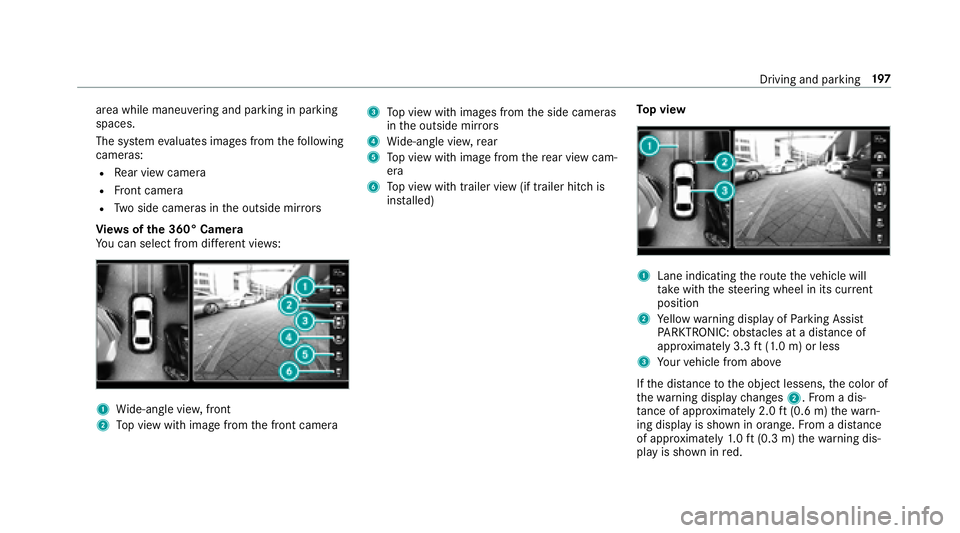
Vi ew s of the 360° Camera
Yo u can select from differe nt vie ws:
1Wide-angle vie w,front
2Top view with image from the front camera
3To p view with images from the side cameras
in the outside mir rors
4Wi de-angle vie w,rear
5To p view with image from there ar view cam‐
era
6To p view with trailer view (if trailer hitch is
ins talled) To
p view
1Lane indicating thero ute theve hicle will
ta ke with thesteering wheel in its cur rent
position
2Ye llow warning display of Parking Assist
PA RKTRONIC: obstacles at adis tance of
appr oximately 3.3 ft(1.0 m) or less
3Yo ur vehicle from abo ve
If th e dis tance tothe object lessens, the color of
th ewa rning display changes 2.From a dis‐
ta nce of appr oximately 2.0 ft(0.6 m) thewa rn‐
ing display is shown in orange. From a dis tance
of appr oximately 1.0 ft (0.3 m) thewa rning dis‐
play is shown in red.
Driving and parking 19
7
Page 202 of 506
The parking space and, if necessary,the parking
direction can be selected as desired. Active
Pa rking Assist calculates a suitable vehicle path
and assists youin parking and exiting the park‐
ing space.
Ac tive Parking Assist changes gear, accelerates,
brakes and steers theve hicle.
Ac tive Parking Assist is only an aid. It is not a
substitute foryo ur attention tothe sur roundings.
The responsibility for safe maneu vering and
pa rking remains with you. Make sure that no
persons, animals or objects etc. are in the
maneu vering range.
Ac tive Parking Assist is canceled if, among other
th ings, one of thefo llowing actions is car ried
out:
RYo u deactivate Parking Assist PARKTRONIC.
RYou deactivate Active Parking Assist.
RYo u begin steering.
RYo uappl yth e parking brake.
RYo u enga gedrive range j.
RESP®inter venes.
RYo u open theta ilgate. Sy
stem limitations of Active Parking Assist
Objects located abo veor below the de tection
ra nge of Active Parking Assist are not de tected
when the parking space is being measured.
These are also not take n into account when the
parking maneuver is calculated, e.g. overhanging
loads, overhangs or loading ramp s of truc
ksor
th e boun
daries of parking spaces. In some cir‐
cums tances, Active Parking Assist may therefore
guide you into the parking space prematurel y.
&
WARNING Risk of accident due to
objects located abo veor below the
de tection range of Active Parking Assist
If th ere are objects abo veor below the
de tection range, thefo llowing situations may
arise:
RAc tive Parking Assist may steer too ear ly.
RVe hicles with automatic transmis‐
sion: Thevehicle may not stop in front of
th ese objects.
This could cause a collision.
#In these situations, do not use Active
Pa rking Assist.
Sn owfa ll or heavy rain may lead toa parking
space being measured inaccuratel y.Pa rking
spaces that are partial lyoccupied bytrailer
dr aw bars might not be identified as such or be
measured incor rectly. Only use Active Parking
Assist on le vel, high-grip ground.
Do no t useActive Parking Assist in thefo llowing
situations:
RIn extreme weather conditions such as ice or
pac ked snow or in heavy rain.
RIfyo u are transporting a load that pr otru des
be yond theve hicle.
RIfth e parking space is on a steep downhill or
uphill gradient.
RIf yo u ha veinstalled snow chains.
Ac tive Parking Assist may also display parking
spaces that are not suitable for parking, e.g.:
RPa rking spaces where parking is prohibited.
RPa rking spaces on unsuitable sur faces.
200
Driving and park ing