2018 MERCEDES-BENZ CLA COUPE instrument cluster
[x] Cancel search: instrument clusterPage 63 of 326

Drivingsafet ys ystems
Overview of drivin gsafet ys ystems
In this section ,you will fin dinformati on about
th ef ollowin gdrivin gsafet ysystems :
RABS(Anti-lock Brakin gSystem)
(Ypage 61)
RBA S(Brak eAssist System) (Ypage 61)
RActive Brak eAssist(Ypage 62 )
RESP®(Electronic Stability Program)
(Ypage 64)
REB D( Electroni cBrak eforce Distribution )
(Ypage 67 )
RADAPTIV EBRAKE (Ypage 68 )
RSTEERCONTROL (Ypage 68)
Important safet ynotes
If you fail to adapt your drivin gstyle or if you are
inattentive ,the drivin gsafet ysystems can nei-
ther reduce th eriskofana ccidentnor override
th el aws of physics. Driving safet ysystems are
merely aids designed to assist driving. You are
responsible fo rmaintainin gthe distanc etothe
vehicle in front, fo rvehicle speed, fo rbraking in
goo dtime, and fo rstayin ginl ane. Always adapt
your drivin gstyle to suit th eprevailin groada nd
weather condition sand maintain asafed istanc e
from th evehicle in front. Drive carefully.
The drivin gsafet ysystems described only wor k
as effectively as possible when there is ade-
quat econtac tbetween th etires and th eroad
surface. Please pay special attention to th e
note sont ires ,recommended minimum tire
tread depths, etc. (
Ypage 288).
In wintr ydrivin gconditi ons, always use winte r
tires (M+ Stires )a nd if necessary,s now chains.
Onlyint hiswaywill the driving safety systems
describe dinthissection work as effectively as
possible.
ABS (Anti-lock Brakin gSystem)
General information
ABS regulate sbrake pressure in such awaythat
the wheels do not lock when yo ubrake. This
allows yo utocontinue steering the vehicl ewhen
braking. The
! ABS warning lamp in the instrument
cluster lights up when the ignition is switched
on. It goe soutwhen the engine is running.
ABS works from aspeed of about5m ph
(8 km/h), regardless of road-surface conditions.
ABS works on slippery surfaces, eve nwheny ou
onlyb rake gently.
Important safety notes
iObserve the "Important safety notes "sec-
tio n(Ypage 61).
GWARNING
If ABS is faulty ,the wheels could lock when
braking .The steerability and braking charac-
teristic smaybe severely impaired.A ddition-
ally ,further driving safety systemsa re deac-
tivated.T here is an increased danger of skid-
ding and accidents.
Driv eonc arefully. Hav eABS checked imme-
diately at aquali fied specialist workshop.
Whe nABS is malfunctioning ,othe rsystems,
including driving safety systems, will also
become inoperative. Observe the information
on the ABS warning lamp (
Ypage 220 )and dis-
play messages which maybes hown in the
instrument cluster (
Ypage 192).
Braking
XIf ABS intervenes: continue to depress the
brake peda lvigorously unti lthe braking sit-
uatio niso ver.
XTo make afullb rake application: depress
the brake peda lwithf ullf orce.
If ABS intervene swhenb raking ,you will fee la
pulsing in the brake pedal.
The pulsating brake peda lcan be an indication
of hazardousr oadconditions, and functions as a
reminder to take extra car ewhile driving.
BAS (Brak eAssis tSystem)
General information
BAS operates in emergency braking situations.
If yo udepress the brake peda lquickly, BAS
automaticall yboosts the braking force,t hus
shortening the stopping distance.
Driving safety systems61
Safety
Z
Page 65 of 326
The distance warning function may not give
warnings in all critical situations. There is a
risk of an accident.
Always pay careful attention to the traffic sit-uation and be ready to brake.
Always adapt your speed to suit the prevailing
road and traffic conditions.
GWARNING
The distance warning function cannot always
clearly identify object sand complex traffic
situations.
In such cases, the distance warning function
may:
Rgive an unnecessary warning
Rnot give awarning
There is arisk of an accident.
Always pay careful attention to the traffic sit-
uation and do not rely solely on the distance
warning function.
Function
Starting at aspeed of approximately 4mph
(7 km/h), the distance warning function warns
you if you rapidly approach avehicle in front.A n
intermittent warning ton ewill then sound, and
the · distance warning lamp will light up in
the instrument cluster.
XBrake immediately in order to increase the
distance from the vehicle in front.
or
XTake evasive action, provided it is safe to do
so.
Due to the nature of the system, particularly
complicated but non-critical driving conditions
may also cause the system to display awarning.
With the help of the radar sensor system, the
distance warning function can detect obstacles
that are in the path of your vehicle for an exten-
ded period of time.
Up to aspeed of approximately 44 mph
(70 km/h), the distance warning function can
also react to stationary obstacles, such as stop-
ped or parked vehicles.
Autonomous braking function
If the driver does not react to the distance warn-
ing signal in acritical situation, Active Brake
Assist can assist the driver with the autonomous
braking function.
The autonomous braking function:
Rgives the driver more time to react to critical
driving situations
Rcan help the driver to avoid an accident or
Rreduces the effectsofana ccident
Vehicles without Distance Pilot DISTRONIC: the autonomous braking function is available in
the following speed ranges:
R4-65m ph (7-105 km/h) for moving objects
R4-31mph (7-50km/h)for stationary
objects
Vehicles with Distance Pilot DISTRONIC: the
autonomous braking function is available in the
following speedr anges:
R4-124 mph (7 -200 km/h )for moving
objects
R4-31m ph (7-50km/h)for stationary
objects
Due to the nature of the system ,particularly
complicated but non-critical driving conditions
may als ocaus ethe Autonomou sBraking Func-
tion to intervene.
Situation-dependent braking assis-
tance
General information
iObservet he "Important safety notes" sec-
tion (Ypag e61).
With the help of the rada rsensor system ,Adap-
tive Brake Assist can detect obstacles that are in
the path of you rvehiclef or an extended period
of time.
If Adaptive Brake Assist detects arisk of colli-
sion with the vehicleinf ront, it calculatesthe
brake pressure necessary to avoi dacollision. If
you apply the brakes forcefully ,situation-
dependent braking assistance adapts to the sit-
uation and automatically increases the brake
pressure to adegreea ppropriate to the traffic
situation.
Situation-dependent braking assistance pro-
videsb raking assistance in hazardou ssituations
at speeds above 4mph (7 km/h) .Itusesr adar
Driving safety systems63
Safety
Z
Page 67 of 326

GWARNING
If ESP
®is malfunctioning, ESP®is unable to
stabilize the vehicle. Additionally, further driv-
ing safety systems are deactivated. This
increases the risk of skidding and an accident.
Drive on carefully.H ave ESP
®checked at a
qualified specialist workshop.
Vehicles without 4MATIC: when towing your
vehiclew ith the front axle raised, it is important
that you observe the notes on ESP
®
(Ypage2 82).
If the å ESP®OFF warning lamp lights up
continuously,E SP®is deactivated.
If the ÷ ESP®warning lamp and the å
warning lamp are lit continuously,E SP®is not
available due to amalfunction.
Observe the information on warning lamps
(
Ypage2 21) and display messages which may
be shownint he instrument cluster
(
Ypage1 92).
Only use wheels with the recommendedt ire
sizes. Only then wil lESP
®function properly.
Characteristics of ESP®
General information
If the ÷ ESP®warning lamp goes out before
beginning the journey ,ESP®is automatically
active.
If ESP
®intervenes, the ÷ESP®warning lamp
flashes in the instrument cluster.
If ESP
®intervenes:
XDo not deactivate ESP®under any circum-
stances.
XOnly depress the accelerator pedalasf ar as
necessary when pulling away.
XAdapt you rdriving style to sui tthe prevailing
road and weather conditions.
ECOs tart/stop function
The ECO start/stop function switches the
engine off automatically when the vehicles tops
moving. The engine starts automatically when
the driverw ants to pullawa ya gain. ESP
®
remains in its previousl yselected status. Exam-
ple: if ESP®was deactivated before the engine
was switched off, ESP®remains deactivated
when the engine is switched on again.
Deactivating/activating ESP®(except
Mercedes‑AMG vehicles)
Important safety notes
iObserve the "Important safety notes" sec-
tion (Ypage6 1).
You can select between the following states of
ESP
®:
RESP®is activated.
RESP®is deactivated.
GWARNING
If you deactivate ESP
®,E SP®no longer sta-
bilizes the vehicle. There is an increased risk
of skidding and an accident.
Only deactivate ESP
®in the situations descri-
bed in the following.
The spinning of the wheels results in acutting
action for better traction on looses urfaces.
It may be best to deactivate ESP
®in the follow-
ing situations:
Rwhen using snow chains
Rin deep snow
Ron sand or gravel
iActivate ESP®as soon as the situations
described above no longer apply.E SP®will
otherwise not be abl etostabilize the vehiclei f
the vehicles tarts to skid or awhee lstarts to
spin.
!Avoid spinning the drivenw heels for an
extended period with ESP®deactivated. You
coul dotherwise damage the drivetrain.
Deactivating/activating ESP®
You can deactivate or activate ESP®via the on-
board computer (Ypag e185).
ESP®deactivated:
The å ESP®OFF warning lamp in the instru-
ment cluster lights up.
ESP
®activated:
The å ESP®OFF warning lamp in the instru-
ment cluster goes out.
Driving safety systems65
Safety
Z
Page 69 of 326
XTo deactivate ESP®:press button :until
the å ESP®OFF warning lamp lights up in
the instrument cluster.
The ÷ OFF
message appears in the multi-
functio ndisplay.
XTo activate ESP®:briefl ypress button :.
The å ESP®OFF warning lamp in the
instrument cluster goe sout.T he ÷ ESP®
ONmessage appears in the multifunctio ndis-
play.
Characteristic sofactivatedS PORT han-
dling mode
If SPOR Thandling modeisa ctivatedand one or
more wheels start to spin, the ÷ESP®warn-
ing lamp in the instrument cluster flashes. ESP®
onlys tabilizes the vehicl etoalimite dd egree.
Whe nSPOR Thandling modeisa ctivated:
RESP®onlyimprovesd riving stability to alim i-
ted degree.
RTractio ncontroliss tilla ctivated.
RThe engine's torque is onlyr estrictedtoa
limite ddegreea nd the drive wheels may start
to spin.
The spinning of the wheels results in acutting
action for better tractio nonloose surfaces.
RESP®stil lprovides support when yo ubrake
firmly.
Characteristic swhenE SP®is deactivated
If ESP®is deactivate dand one or more wheels
start to spin, the ÷ESP®warning lamp in the
instrument cluster does not flash. In such situa-
tions, ESP
®will not stabilize the vehicle.
If yo udeactivate ESP®:
RESP®no longer improvesd riving stability.
REngine torque is no longer limite dand the
drive wheels are able to spin.
The spinning of the wheels results in acutting
action for better tractio nonloose surfaces.
RTractio ncontroliss tilla ctivated.
RActive Brake Assist is no longer available ;nor
is it activate difyoubrake firmly with assis-
tance from ESP
®.
RESP®stil lprovides support when yo ubrake
firmly.
ESP®trailer stabilization
General information
If your vehicle/trailer combinatio nbegin sto
swerve ,ESP®assists yo uinthissituation. ESP®
slowst he vehicl edownbyb raking and limiting
the engine outputu ntilthe vehicle/trailer com-
bination hass tabilized.
Important safety notes
GWARNING
If roada nd weather conditions are poor,
traile rstabilization will not be able to prevent
the vehicle/trailer combinatio nfrom swerv-
ing .Trailers with ahighc ente rofg ravity can
tip overb efore ESP
®can detect this. There is
ar iskofana ccident.
Alway sadapt your driving style to the prevail-
ing roada nd weather conditions.
If your vehicl ewitht raile r(vehicle/trailer com-
bination) begins to lurch, yo ucan onlys tabilize
the vehicle/trailer combinatio nbydepressing
the brake firmly.
ESP
®traile rstabilization is active above speeds
of about65k m/h.
ESP
®traile rstabilization does not work if ESP®
is deactivate dordisable dbecause of amalfunc-
tion.
EBD (electronicb rake forcedistribu-
tion)
General information
EBD monitors and controls the brake pressure
on the rearw heelstoi mprove driving stability
whil ebraking.
Important safety notes
iObserve the "Important safety notes "sec-
tio n(Ypage 61).
GWARNING
If EBD is malfunctioning ,the rearw heelscan
lock, e.g .under ful lbraking .Thisi ncreases the
ris kofs kidding and an accident.
Driving safety systems67
Safety
Z
Page 125 of 326
operates independently of the ECO start/stop
automatic engine switch-off function.
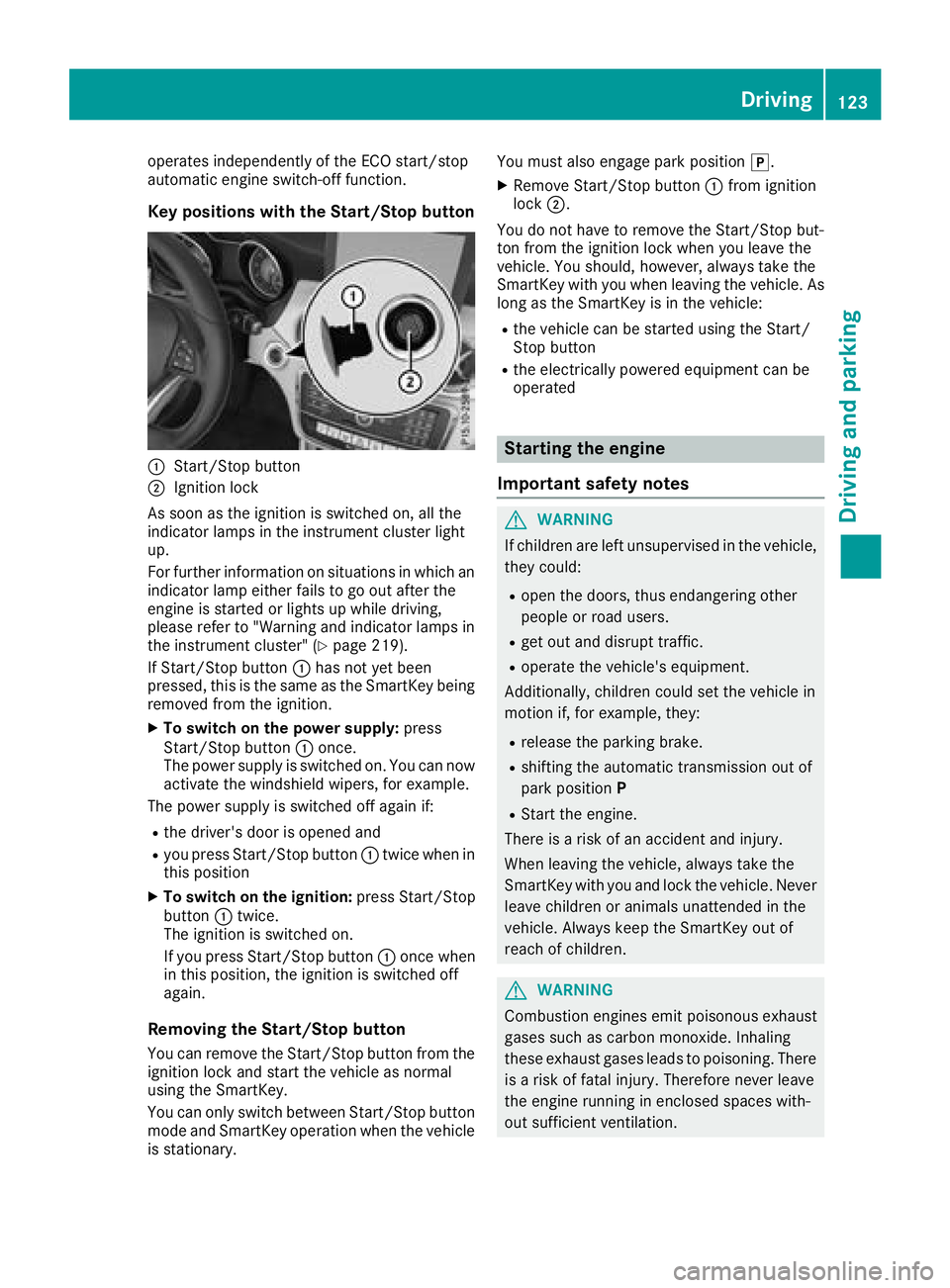
Key positions with the Start/Stop button
:Start/Stop button
;Ignition lock
As soon as the ignition is switched on, all the
indicator lamps in the instrument cluster light
up.
For further information on situations in which an indicator lamp either fails to go out after the
engine is started or lights up while driving,
please refer to "Warning and indicator lamps in
the instrument cluster" (
Ypage 219).
If Start/Stop button :has not yet been
pressed, this is the same as the SmartKey being
removed from the ignition.
XTo switch on the power supply: press
Start/Stop button :once.
The power supply is switched on. You can now
activate the windshield wipers, for example.
The power supply is switched off again if:
Rthe driver's door is opened and
Ryou press Start/Stop button :twice when in
this position
XTo switch on the ignition: press Start/Stop
button :twice.
The ignition is switched on.
If you press Start/Stop button :once when
in this position, the ignition is switched off
again.
Removing the Start/Stop button
You can remove the Start/Stop button from the ignition lock and start the vehicle as normal
using the SmartKey.
You can only switch between Start/Stop button
mode and SmartKey operation when the vehicle
is stationary. You must also engage park position
j.
XRemove Start/Stop button:from ignition
lock ;.
You do not have to remove the Start/Stop but-
ton from the ignition lock when you leave the
vehicle. You should, however, alwayst ake the
SmartKey with you when leaving the vehicle. As
long as the SmartKey is in the vehicle:
Rthe vehicle can be started using the Start/
Stop button
Rthe electrically powered equipment can be
operated
Starting the engine
Important safety notes
GWARNING
If children are left unsupervised in the vehicle,
they could:
Ropen the doors, thus endangering other
people or road users.
Rget out and disrupt traffic.
Roperate the vehicle's equipment.
Additionally, children could set the vehicle in
motion if, for example, they:
Rrelease the parking brake.
Rshifting the automatic transmission out of
park position P
RStart the engine.
There is arisk of an accident and injury.
When leaving the vehicle, alwayst ake the
SmartKey with you and lock the vehicle. Never
leave children or animals unattended in the
vehicle. Always keep the SmartKey out of
reach of children.
GWARNING
Combustion engines emit poisonous exhaust
gases such as carbon monoxide. Inhaling
these exhaust gases leads to poisoning. There
is ar isk of fatal injury. Therefore never leave
the engine runningine nclosed spaces with-
out sufficient ventilation.
Driving123
Driving and parking
Z
Page 142 of 326
XTurn the fuel filler cap counterclockwise and
remove it.
XInsert the fuel filler cap into the holder on theinside of fuel filler flap =.
XCompletely insert the filler neck of the fuel
pump nozzle into the tank ,hook in place and
refuel.
XOnly fill the tank until the pump nozzle
switches off.
Do not add any more fuel after the pump stops
filling for the first time. Otherwise, fuel may leak
out.
Closing the fuel filler flap
XReplace the cap on the filler neck and turn
clockwise until it engages audibly.
XClose the fuel filler flap. Close the fuel filler flap before lockingt
he vehi-
cle.
If you are driving with the fuel filler cap open, the
8 reserve fuel warning lamp flashes. Ames-
sage appears in the multifunction display
(
Ypage 206).
In addition, the ;Check Engine warning
lamp may light up (
Ypage 224).
For further information on warning and indicator
lamps in the instrument cluster, see
(
Ypage 224).
Problems with fuel and the fuel tank
ProblemPossible causes/consequences and MSolutions
Fuel is leaking from the
vehicle.The fuel line or the fuel tank is faulty.
GWARNING
Risk of explosion or fire.
XApply the electric parking brake.
XSwitch off the engine.
XRemove the SmartKey from the ignition lock.
or, in vehicles with KEYLESS-GO start-function or KEYLESS ‑GO
XOpen the driver's door.
The vehicle electronics are now in positiong.This is the same as
the SmartKey being removed from the ignition.
XDo not restart the engine under any circumstances.
XConsult aqualified specialist workshop.
The fuel filler flap cannot
be opened.The fuel filler flap is not unlocked.
XUnlock the vehicle (Ypage 70).
The SmartKey battery is discharged or nearly discharged.
XUnlock the vehicle using the mechanical key (Ypage 77).
The fuel filler flap is unlocked, but the opening mechanism is jammed.
XConsult aqualified specialist workshop.
140Refueling
Driving and parking
Page 144 of 326
the SmartKeyfromthe ignition, the automatic
transmission shifts to jautomatically.
With the Start/Stopb utton:if youtheno pen
the driver's door or the front-passenge rdoor,
the automatic transmission shifts to jauto-
matically.
If yo uwantthe automatic transmission to
remai ninneutral i,e.g.w henh avingt he vehi-
cle cleane dinanautomatic car wash with a
towing system:
XVehicle switht he Start-Stopb utton:
remove the Start-Stop button fromt he igni-
tio nlock.
XInsert the SmartKeyi nto the ignition lock.
XAllv eh icles: switch the ignition on.
XDepres sthe brake peda land kee pit
depressed.
XEngage neutral i.
XReleasethe brake pedal.
XReleas ethe electri cparking brake.
XSwitch off the ignition and leav ethe SmartKey
in the ignition lock.
Electric parking brake
General notes
GWARNING
If yo uleave children unsupervised in the vehi-
cle ,theyc ould setitinm otion by,for example:
Rrelease the parking brake.
Rshift the automatic transmission ou tofthe
parking position P.
Rstart the engine.
In addition, theym ayoperate vehicl eequip-
ment and become trapped .There is arisko f
an accident and injury.
When leaving the vehicle, always take the
SmartKeyw ithy ou and lock the vehicle. Never
leav echildren unsupervised in the vehicle. The functio
nofthe electric parking brake is
dependent on the on-board voltage. If the on-
boar dvoltag eislowor there is amalfunctio nin
the system, it mayn ot be possibletoapplythe
releasedp arking brake.
XIf thisist he case, onl yparkt he vehicl eon
level ground and secur eittoprevent it rolling
away.
XShift the automatic transmission to position
j.
It mayn ot be possibl etorelease an applied
parking brake if the on-board voltag eislowor
there is amalfunctio ninthe system. Contact a
qualified specialis tworkshop.
The electric parking brake performs afunction
tes tatr egular intervals whil ethe engine is
switched off .The sound sthatc an be he ar
dw hile
th
isiso ccurring ar enormal.
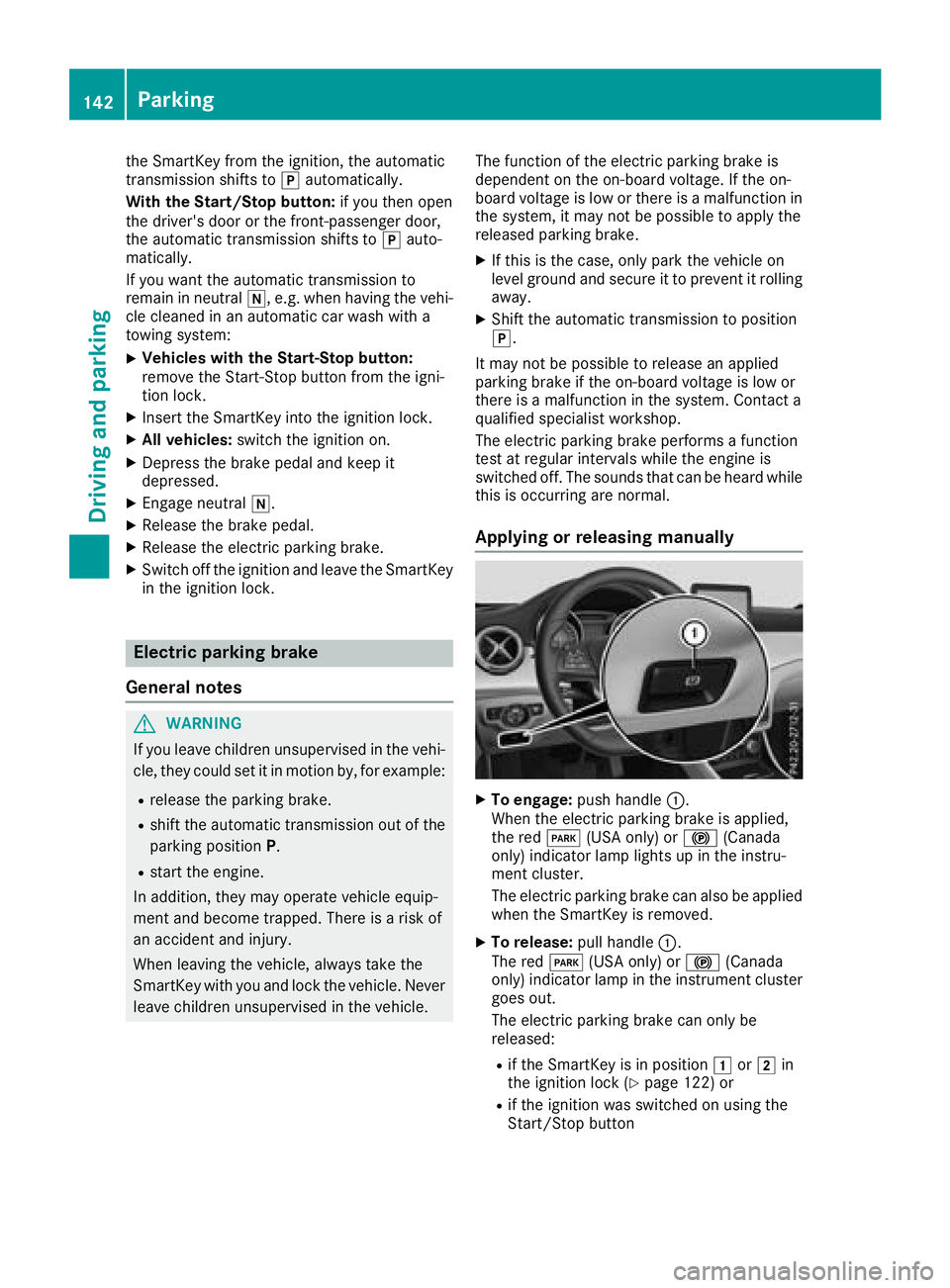
Applyin gorreleasing manually
XTo engage: push handle :.
When the electric parking brake is applied,
the red F(USA only) or !(Canada
only) indicator lamp lights up in the instru-
ment cluster.
Th ee lectric parking brake can also be applied
when the SmartKeyisr emoved.
XTo release:pull handle:.
The red F(USA only) or !(Canada
only) indicator lamp in the instrument cluster
goes out.
Th ee lectric parking brake can onl ybe
released:
Rif the SmartKeyisinp osition 1or2 in
the ignition lock (Ypage 122 )or
Rif the ignition wa sswitched on using the
Start/Stop button
142Parking
Driving an dparking
Page 145 of 326
Applyingautom atically
The electric parking brak eisautomatically
applie dwhen th etransmission is in position j
and :
Rthee ngineiss witched off or
Rthed river is no twearing aseat belt and th e
driver's door is opened
To preven tthe electric parking brak efromb eing
automatically applied, pull handle :.
The electric parking brak eisalso engage dauto -
matically if:
RDistanc ePilotD ISTR ONICbring sthe vehicl e
to as tandstill or
Rth eH OLDf unction is keepin gthe vehicl esta-
tionary
RParking Pilo tiskeepin gthe vehicl estationary
In addition ,atleast on eofthefollowin gcondi -
tion smustbef ulfilled :
Rthee ngineiss witched off
Rthed river is no twearing aseat belt and th e
driver's door is opened
Rthere is asystem malfunction
Rthep owe rsupply is insufficien t
Rthev ehicl eiss tationary for alengthy period
The red F(USAonly) or ! (Canada only)
indicator lamp in th einstrumen tcluste rgoes
out .
The electric parking brak eisnotautomatically
engage diftheengin eisswitched off by th eECO
start/sto pfunction .
Releasing automatically
Your vehicle's electric parking brak eisauto-
matically release difall of th efollowin gcondi -
tion sare met :
Rthee ngineisr unnin g
Rthet ransmission is in position hork and
you depress th eaccelerato rpedal or shif t
from position jtoh ork
Rthes eat belt has been fastene d
if th etransmission is in position k,thetrunk lid
mus tbec losed. If your seat belt is no
tfastened, th efollowin g
condition smustbef ulfilled to automatically
release th eelectric parking brake:
Rthed river's door is closed
Ryou are shifting from transmission position
j or hav epreviously driven at speeds
greate rtha n2m ph(3 km/ h)
Ensure thaty oudo not depress the accelerator
peda lunintentionally. Otherwise, the parking
brake will be released and the vehicl ewills tart
to move.
Emergenc ybraking
The vehicl ecan also be braked durin ganemer-
gency by using the electri cparkin gb rake.
XWhil edriving, push handle :of the electric
parkin gbrake (Ypage 142).
The vehicl eisbraked as long as yo ukeep
handle :of the electri cparkin gb rake
pressed. The longe rthe electri cparkin gbrake
handle :is depressed, the greate rthe brak-
ing force.
During braking:
Raw arning tone sounds
Rthe ReleaseP arkingBrakemessage
appears
Rthe red F(USA only) or !(Canada
only) indicator lamp in the instrument cluster flashes
When the vehicl ehasbeen braked to astand-
still ,the electri cparkin gb rake is engaged.
Parking the vehicle foral ongp eriod
If yo uleave the vehicl eparked for longe rthan
fourw eeks,the battery maybed amagedby
exhaustive discharging.
If yo uleave the vehicl eparked for longe rthans ix
weeks ,the vehicl emaysufferd amageasa
resul toflackofu se.
XVisitaq ualified specialis tworkshop and seek
advice.
iYo uc an obtai ninformatio nabout trickle
chargers fromaq ualified specialis twork-
shop.
Parking143
Driving an dparking
Z