2018 MERCEDES-BENZ CLA COUPE belt
[x] Cancel search: beltPage 43 of 326

Restraint system warninglamp
The functions of the restraint system are
checke dafterthe ignition is switched on and at
regular interval swhile the engine is running.
Therefore, malfunctions can be detected in
goodt ime.
The 6 restraint system warning lamp on the
instrument cluster lights up when the ignition is
switched on. It goeso utno later than afew sec-
onds afte rthe vehicl eisstarted. The compo-
nents of the restraint system are in operational
readiness.
Am alfunction haso ccurred if the6restraint
system warning lamp:
Rdoe snot light up afte rthe ignition is switched
on
Rdoe snot go outa fteraf ew seconds with the
engine running
Rlights up agai nwhile the engine is running
GWARNING
If the restraint system is malfunctioning,
restraint system components may be trig-
gered unintentionally or may not deplo yas
intended during an accident. Thisc an affect
for exampl ethe Emergency Tensioning
Device or the ai rbag.Thisp oses an increased
ris kofi njury or evenf atalinjury.
Have the restraint system checke dand
repaired in aquali fied specialist workshopa s
soona spossible.
PASSENGER AI RBAG indicator lamp
PASSENGER AIR BAG ON indicator lamp :and
PASSENGER AIR BAG OFF indicator lamp ;are
part of the Occupant Classification System
(OCS). The indicator lamps display the statu
softhe
front-passenger front ai rbag.
RPASSENGER AIR BAG ON lights up for 60 sec-
onds ,sub sequently both indicator lamps are
off (PASSENGER AIR BAG ON and OFF):t he
front-passenger front ai rbag is able to deploy
in the event of an accident.
RPASSENGER AIR BAG OFF lights up :the front-
passenger front ai rbag is deactivated. It will
then not be deploye dinthe event of an acci-
dent.
If the PASSENGER AIR BAG ON indicator lamp is
off, only the PASSENGER AIR BAG OFF indicator lamp shows the statu softhe front-passenger
front ai rbag.T he PASSENGER AIR BAG OFF
indicator lamp may be li tcontinuously or be off.
Depending on the person in the front-passenger
seat, the front-passenger front ai rbag must
either be deactivated or enabled; see the fol-
lowing points. Yo umustm ake sure of this both
before and during ajourney.
RChildreninac hild restraintsystem:
whethert he front-passenger front ai rbag is
enabled or deactivated depends on the instal- le dc hild restraint system, and the ag eand
size of the child .Therefore, be sure to observe
the notes on the "Occupant Classification
System (OCS)" (
Ypage 47 )and on "Chil-
dre nint he vehicle" (Ypage 54). There you
will also find instructions on rearward and
forward-facing child restraint systems on the
front-passenger seat.
RAl lo the rpersons: depending on the classi-
fication of the person in the front-passenger
seat, the front-passenger front ai rbag is ena-
bled or deactivated (
Ypage 47). Be sure to
observe the notes on "Seat
belts“ (
Ypage 41 )and "Ai rbags"
(Ypage 45). There yo ucan also find infor-
mation on the correct seatp osition.
Seat belts
Introduction
Seatb elts are the most effective means of
restricting the movement of vehicl eoccupants
in the event of an accident or the vehicl erolling
over. Thisr educesthe ris kofvehicleoccupants
coming into contact with parts of the vehicle
interio rorbeing ejecte dfrom the vehicle. Fur-
thermore,t he seatbelth elps to keep the vehicle
Occupan tsafety41
Safety
Z
Page 44 of 326
occupant in the best position in relation to the
air bag.
The seat belt system comprises:
RSeat belts
REmergency TensioningDevices for the front
seat belts and the outer seat belts in the rear
RSeat belt force limiters for the front seat belts
and the outer seat belts in the rear
If the seat belt is pulled out of the belt outlet
quickly or with ajerk ym ovement,t he belt
retractor locks. The belt strap cannot be extrac-
ted any further.
The Emergency TensioningD evice tightensthe
seat belt in an accident,p ulling the belt close
against the body. However it does not pull the
vehicle occupant back in the direction of the
backrest.
The Emergency TensioningD evice does not cor-
rect an incorrect seat position or the routing of
an incorrectly fastened seat belt.
When triggered, aseat belt force limiter helps to
reduce the force exerted by the seat belt on the
vehicle occupant.
The seat belt force limiters for the front seats are
synchronized with the front air bags, which
absorb part of the deceleration force. This can
reduce the force exerted on the vehicle occu-
pants during an accident.
!If the front-passenger seat is not occupied,
do not engage the seat belt tongue in the
buckle on the front-passenger seat. Other-
wise, the Emergency TensioningD evice and
side impact air bag could be triggered in the
event of an accident and would need to be
replaced.
Important safety notes
The use of seat belts and child restraint systems
is required by law in:
Rall 50 states
Rthe U.S. territories
Rthe District of Columbia
Rall Canadian provinces
Even where this is not required by law, all vehicle
occupantss hould correctly fasten their seat
belts before starting the journey.
GWARNING
If the seat belt is not worn correctly, it cannot
perform its intended protective function. An
incorrectly fastened seat belt can also cause
injuries, for example, in the event of an acci-
dent or when braking or changing direction
abruptly. This poses an increased risk of injury or even fatal injury.
Always ensure that all vehicle occupantsh ave
their seat belts fastened correctly and are sit-
ting properly.
The components of the restraint system work in
conjunction with each other. They can only
deploy their protective function if, at all times, all vehicle occupants:
Rhave fastened their seat belts correctly
(Ypage 43)
Rhave the seat and head restraint adjusted
properly (Ypage 90)
GWARNING
The seat belt does not offer the intended level of protection if you have not moved the back-
rest to an almost vertical position. When brak-
ing or in the event of an accident,y ou could
slide underneath the seat belt and sustain
abdomen or neck injuries, for example. This
poses an increased risk of injury or even fatal injury.
Adjust the seat properly before beginning
your journey. Always ensure that the backrest
is in an almost vertical position and that the
shoulder section of your seat belt is routed
across the center of your shoulder.
GWARNING
Persons less than 5ft(1.50 m) tall cannot
wear the seat belt correctly without an addi-
tional and suitable restraint system. If the
seat belt is not worn correctly, it cannot per-
form its intended protective function. An
incorrectly fastened seat belt can also cause
injuries, for example, in the event of an acci-
dent or when braking or changing direction
abruptly. This poses an increased risk of injury or even fatal injury.
For this reason, alwayss ecure persons under
5ft( 1.50 m) tall in suitable additional restraint
systems.
42Occupant safety
Safety
Page 45 of 326
Ifac hild younger than twelve years old and
under 5ft(1.50m)inh eight is travelingint he
vehicle:
Ralways secur ethe child in achild restraint
system suitable for this Mercedes-Ben zvehi-
cle. The child restraint system must be appro-
priatetot he age, weight and size of the child
Ralways observe the instructions and safety
notes on "Children in the vehicle"
(
Ypage 54) in addition to the child restraint
system manufacturer'si nstallation and oper-
atin ginstructions
Ralways observe the instructions and safety
notes on the "Occupant classification system
(OCS)" (
Ypage 47)
GWARNING
The seat belts may not perform their intended protective function if:
Rthe yare damaged, modified, extremely
dirty, bleache dordyed
Rthe seat belt buckle is damaged or
extremely dirty
Rthe Emergency Tensionin gDevices, belt
anchoragesori nertia reels have been modi-
fied.
Seat belts may be damaged in an accident,
althoug hthe damage may not be visible, e.g.
due to splinters of glass. Modifiedord amaged
seat belts may tear or fail, e.g. in an accident.
ModifiedE mergency Tensionin gDevices
could accidentally trigger or fail to deploy
when necessary. This poses an increased risk
of injury or even fatal injury.
Never modifyt he seat belts,Eme rgency Ten-
sioning Devices, belt anchoragesa nd inertia
reels. Make sure that the seat belts are
undamaged, not worn out and clean .Follow-
ing an accident ,have the seat belts checked
immediately at aqualified specialist work-
shop.
Only use seat belts that have been approved for
your vehicle by Mercedes-Benz.
Sports seat or AMG Performance seat: this
seat is designed for the standard three-point
seat belt. If you install another multi-point seat
belt, e.g. sport or racin gseat belts ,the restraint system cannot provide the best level of protec-
tion.
GWARNING
If you feed seat belts through the opening in
the seat backrest,t he seat backrest may be
damaged or may even break in the eventofa n
accident .This poses an increased risk of
injury or even fatal injury.
Only use the standard three-point seat belt.
Never modifyt he seat belt system.
Proper use of th eseat belts
Observe the safetyn otes on the seat belt
(Ypage 42).
All vehicle occupant smust be wearingt he seat
belt correctly beforeb eginningthe journey. Also
make sure that all vehicle occupant sare always
wearing the seat belt correctly while the vehicle
is in motion.
When fastenin gthe seat belt, always make sure
that:
Rthe seat belt buckle tongue is inserted only
int ot he belt buckle belonging to that seat
Rthe seat belt is pulled tigh tacross your body
Avoid wearing bulky clothing ,e.g. aw inter
coat.
Rthe seat belt is not twisted
Only the ncan the forces which occur be dis-
tributed over the area of the belt.
Rthe shoulder section of the belt is routed
across the center of your shoulder
The shoulder section of the seat belt should
not touc hyour nec korber outed under your
arm or behindy our back.Where possible,
adjust the seat belt to the appropriate height.
Rthe lap belt is taut and passes across your lap as low down as possible
The lap belt must always be routed across
your hip joints and not across your abdomen.
This applies particularly to pregnant women.
If necessary, push the lap belt down to your
hip join tand pull it tigh tusing the shoulder
section of the belt.
Rthe seat belt is not routed across sharp, poin-
ted or fragile objects
If you have such item slocated on or in your
clothing ,e.g. pens ,keys or eyeglasses,s tore
these in asuitable place.
Ronly one personisu singaseat belt
Occupant safety43
Safety
Z
Page 46 of 326
Infants and childrenmust never travel sitting
on the lap of avehicle occupant. In the event
of an accident, they could be crushed
between the vehicle occupant and seat belt.
Robjects are never secured with aseat belt if
the seat belt is also being used by one of the
vehicle's occupants
Also ensure that there are never objects
between aperson and the seat, e.g. cushions.
Seat belts are only intended to secure and
restrain vehicle occupants. Alway sobserve the
"Loading guidelines" for securing objects, lug-
gage or loads(
Ypage 237).
Fastening and adjusting the seat belts
Observe the safety notes on the seat belt
(Ypage 42) and the notes on correct use of seat
belts (Ypage 43).
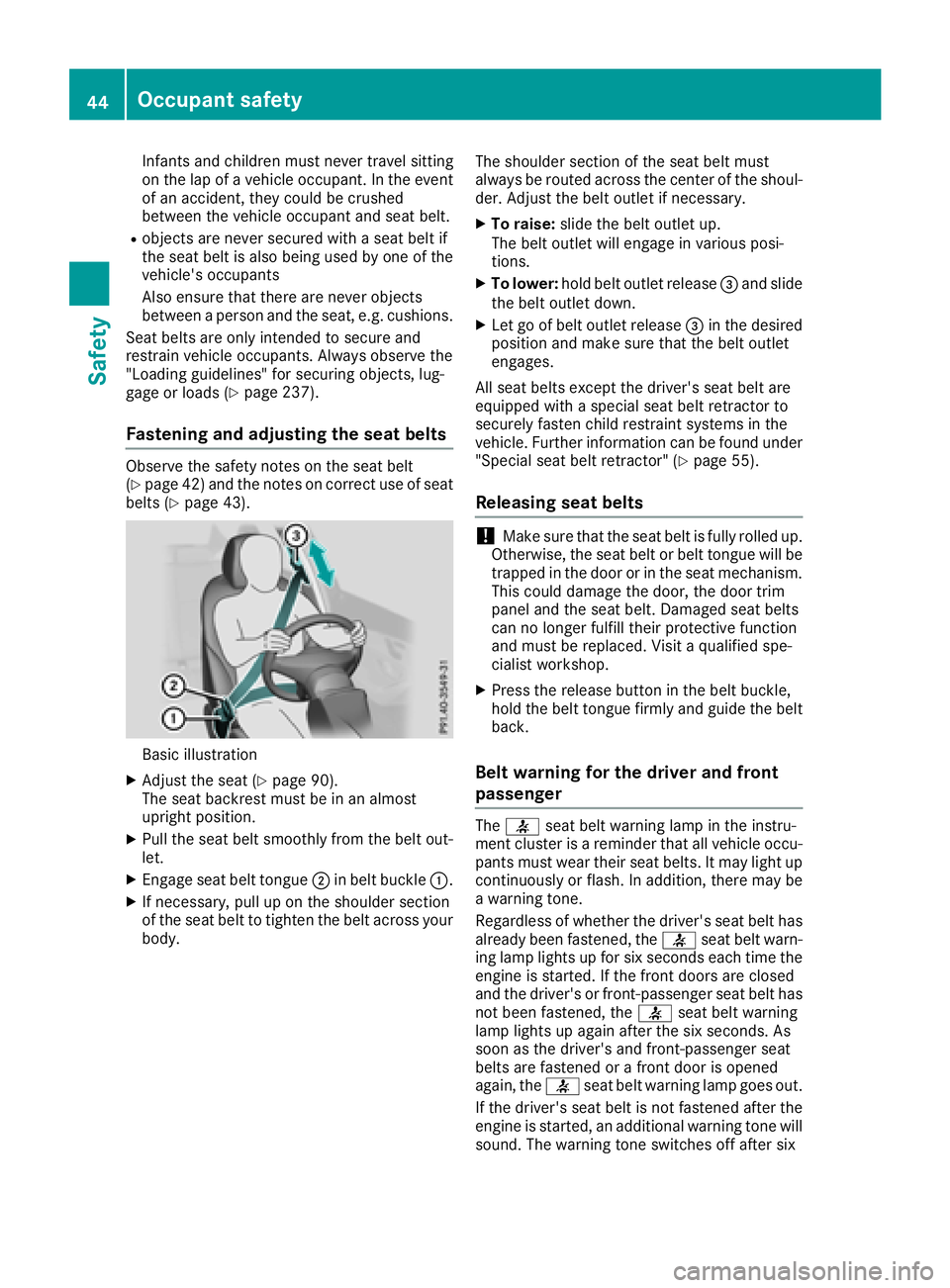
Basic illustration
XAdjust the seat (Ypage 90).
The seat backrest must be in an almost
upright position.
XPul lthe seat belt smoothly from the belt out-
let.
XEngage seat belt tongue ;in belt buckle :.
XIf necessary,pullupont he shoulder section
of the seat belt to tighten the belt across your
body. The shoulder section of the seat belt must
always be routed across the center of the shoul-
der. Adjust the belt outlet if necessary.
XTo raise:
slidethe belt outlet up.
The belt outlet wille ngage in variousposi-
tions.
XTo lower: hold belt outlet release =and slide
the belt outlet down.
XLet go of belt outlet release =in the desired
positiona nd make sure that the belt outlet
engages.
All seat belts except the driver's seat belt are
equipped with aspecials eat belt retractor to
securelyf asten child restraint systems in the
vehicle.F urther information can be found under
"Specials eat belt retractor" (
Ypage 55).
Releasing seat belts
!Make sure that the seat belt is fullyr olledup.
Otherwise,t he seat belt or belt tongue willb e
trapped in the door or in the seat mechanism.
This could damage the door, the door trim
panel and the seat belt. Damaged seat belts
can no longer fulfill their protective function
and must be replaced. Visit aqualifieds pe-
cialist workshop.
XPress the release button in the belt buckle,
hold the belt tongue firmly and guide the belt
back.
Belt warning for the driver and front
passenger
The 7 seat belt warning lamp in the instru-
ment cluster is areminder that all vehicle occu-
pants must weart heir seat belts. It may light up
continuously or flash. In addition, there may be
aw arning tone.
Regardless of whether the driver's seat belt has
already been fastened, the 7seat belt warn-
ing lamp lights up for six seconds each time the engine is started. If the front doors are closed
and the driver's or front-passenger seat belt has
not been fastened, the 7seat belt warning
lamp lights up again after the six seconds. As
soon as the driver's and front-passenger seat
belts are fastened or afront door is opened
again, the 7seat belt warning lamp goes out.
If the driver's seat belt is not fastened after the
engine is started, an additional warning tone will sound. The warning tone switches off after six
44Occupant safety
Safety
Page 47 of 326
seconds or once the driver's seat belt is fas-
tened.
If the vehicle's speed exceeds 15 mph
(25 km/h) once and the driver's and front-
passenger seat belts are not fastened,awarning
tone sounds. Awarning tone also sounds with
increasing intensityf or 60 seconds or until the
driver or front passenger have fastened their
seat belts.
If the driver or front passenger unfasten their
seat belts during the journey, the seat belt warn-
ing is activated again.
Air bags
Introduction
The installation point of an air bag can be rec-
ognized by the AIRBAG marking.
An air bag complements the correctly fastened
seat belt. It is no substitute for the seat belt. The
air bag provides additional protection in appli-
cable accident situations.
Not all air bags are deployed in an accident. The
different air bag systems function independ-
ently from one another (
Ypage 52).
However, no system available today can com-
pletely eliminate injuries and fatalities.
It is also not possible to rule out arisk of injury
caused by an air bag due to the high speed at
which the air bag must be deployed.
Important safety notes
GWARNING
If you do not sit in the correct seat position,
the air bag cannot protect as intended and
could even cause additional injury when
deployed. This poses an increased risk of
injury or even fatal injury.
To avoid hazardous situations, always make
sure that all of the vehicle's occupants:
Rhave fastened their seat belts correctly,
including pregnant women
Rare sitting correctly and maintain the great-
est possible distance to the air bags
Rfollow the following instructions
Always make sure that there are no objects
between the air bag and the vehicle's occu-
pants.
RAdjust the seats properly before beginning
your journey. Always make sure that the seat
is in an almost upright position. The center of
the head restraint must support the head at
about eye level.
RMove the driver's and front-passenger seats
as far back as possible.T he driver's seat posi-
tion must allow the vehicle to be driven safely.
ROnly hold the steering wheel on the outside.
This allowst he air bag to be fully deployed.
RAlways lean against the backrest while driv-
ing. Do not lean forward or lean against the
door or side window. You may otherwise be in
the deployment area of the air bags.
RAlways keep your feet in the footwell in front
of the seat. Do not put your feet on the dash-
board, for example. Your feet may otherwise
be in the deployment area of the air bag.
RFor this reason, always secure persons less
than5ft(1.50 m) tall in suitable restraint sys-
tems. Up to this height, the seat belt cannot
be worn correctly.
If ac hild is traveling in your vehicle,a lso
observe the following notes:
RAlways secure children under twelve years of age and less than 5ft(1.50 m)tallins uitable
child restraint systems.
RChil drestraint systems shoul dbeinstalle don
the rea rseats.
ROnlys ecureac hild in arearward-facing child
restraint systemont he front-passengerseat
when the front-passengerf ront airbag is
deactivated .Ifthe PASSENGER AIR BAG OFF
indicator lamp is permanentl ylit,t he front-
passengerf ront airbag is deactivated
(
Ypage 41).
RAlway sobser ve the instructions and safety
notesont he "Occupant Classification System
(OCS) "(Ypage 47) and on "Children in the
vehicle" (Ypage 54 )ina ddit iontot he child
restraint systemm anufacturer's installation
and operating instructions.
Occupant safety45
Safety
Z
Page 49 of 326
The driver's and front-passenger knee bags
offer additional thigh, knee and lower leg pro-
tection for the occupantsinthe front seats.
Side impact air bags
GWARNING
Unsuitable seat covers can obstruct or pre-
vent deployment of the air bags integrated
into the seats. Consequently, the air bags
cannot protec tvehicle occupantsast hey are
designed to do. In addition, the operation of
the occupant classification system (OCS)
could be adversely affected. This poses an
increased risk of injury or even fatal injury.
You should only use seat covers that have
been approved for the respective seat by
Mercedes-Benz.
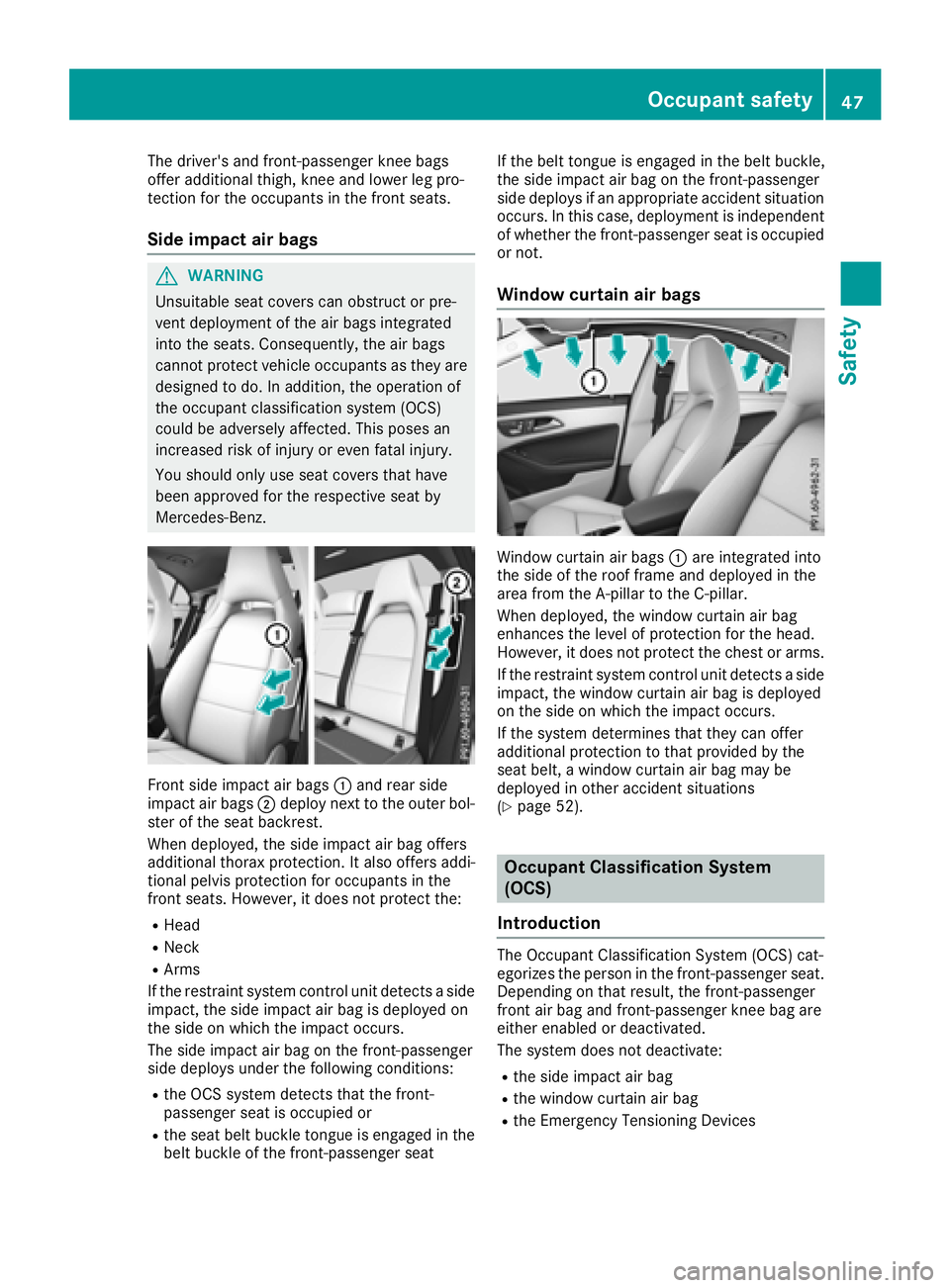
Fronts ide impact air bags :and rear side
impact air bags ;deploy next to the outer bol-
ster of the seat backrest.
When deployed, the side impact air bag offers
additional thorax protection. It also offers addi-
tional pelvis protection for occupantsint he
front seats. However, it does not protec tthe:
RHead
RNeck
RArms
If the restraint system control unit detect saside
impact, the side impact air bag is deployed on
the side on which the impact occurs.
The side impact air bag on the front-passenger
side deploys under the following conditions:
Rthe OCS system detect sthat the front-
passenger seat is occupied or
Rthe seat belt buckle tongue is engaged in the belt buckle of the front-passenger seat If the belt tongue is engaged in the belt buckle,
the side impact air bag on the front-passenger
side deploys if an appropriate accident situation
occurs. In this case, deployment is independent
of whether the front-passenger seat is occupied
or not.
Window curtain air bags
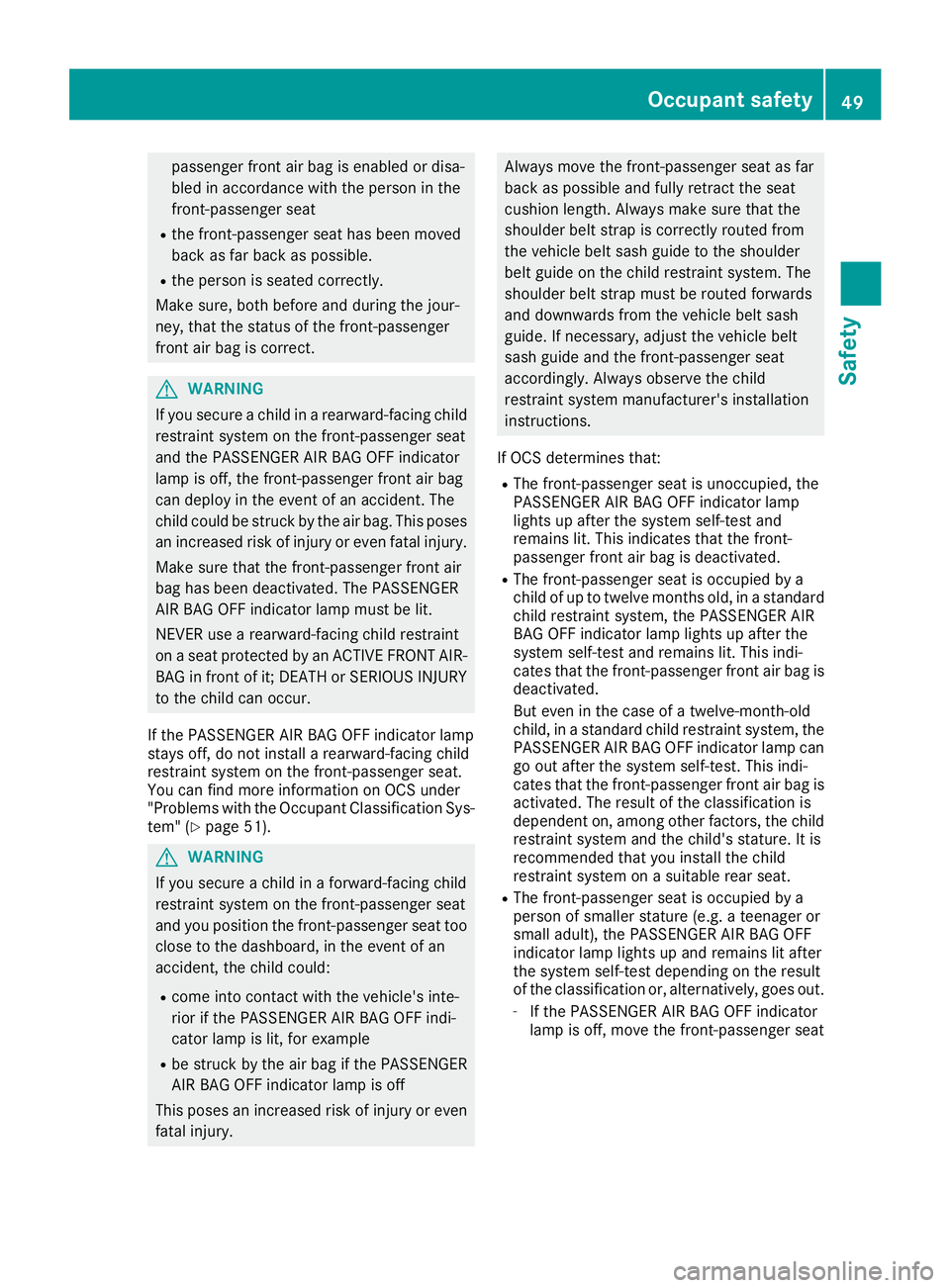
Window curtain air bags
:are integrated into
the side of the roof frame and deployed in the
area from the A-pillar to the C-pillar.
When deployed, the window curtain air bag
enhances the level of protection for the head.
However, it does not protec tthe chest or arms.
If the restraint system control unit detect saside
impact, the window curtain air bag is deployed
on the side on which the impact occurs.
If the system determines that they can offer
additional protection to that provided by the
seat belt, awindow curtain air bag may be
deployed in other accident situations
(
Ypage 52).
Occupant Classification System
(OCS)
Introduction
The Occupant Classification System (OCS) cat-
egorizes the person in the front-passenger seat.
Dependin gonthat result, the front-passenger
front air bag and front-passenger knee bag are
either enabled or deactivated.
The system does not deactivate:
Rthe side impact air bag
Rthe window curtain air bag
Rthe Emergency TensioningD evices
Occupant safety47
Safety
Z
Page 51 of 326
passenger frontair bag is enabled or disa-
bled in accordance with the person in the
front-passenger seat
Rthe front-passenger seat has been moved
back as far back as possible.
Rthe person is seated correctly.
Make sure, both before and during the jour-
ney, that the status of the front-passenger
fronta ir bag is correct.
GWARNING
If you secure achild in arearward-facing child
restraint system on the front-passenger seat
and the PASSENGER AIR BAGO FF indicator
lamp is off, the front-passenger fronta ir bag
can deploy in the event of an accident. The
child could be struck by the air bag. This poses an increased risk of injury or even fatal injury.
Make sure that the front-passenger fronta ir
bag has been deactivated. The PASSENGER
AIR BAGO FF indicator lamp must be lit.
NEVER use arearward-facing child restraint
on aseat protected by an ACTIVE FRONT AIR-
BAGinf rontofit; DEATH or SERIOUS INJURY
to the child can occur.
If the PASSENGER AIR BAGO FF indicator lamp
stays off, do not install arearward-facing child
restraint system on the front-passenger seat.
You can find more information on OCS under
"Problems with the Occupant Classification Sys-
tem" (
Ypage 51).
GWARNING
If you secure achild in aforward-facingc hild
restraint system on the front-passenger seat
and you position the front-passenger seat too close to the dashboard, in the event of an
accident, the child could:
Rcome int ocontact with the vehicle's inte-
rior if the PASSENGER AIR BAGO FF indi-
cator lamp is lit, for example
Rbe struck by the air bag if the PASSENGER
AIR BAGO FF indicator lamp is off
This poses an increased risk of injury or even fatal injury.
Always move the front-passenger seat as far
back as possible and fully retract the seat
cushion length. Always make sure that the
shoulder belt strap is correctly routed from
the vehicle belt sash guide to the shoulder
belt guide on the child restraint system. The
shoulder belt strap must be routed forwards
and downwards from the vehicle belt sash
guide. If necessary, adjust the vehicle belt
sash guide and the front-passenger seat
accordingly. Always observe the child
restraint system manufacturer's installation
instructions.
If OCS determines that:
RThe front-passenger seat is unoccupied, the
PASSENGER AIR BAGO FF indicator lamp
lights up after the system self-test and
remains lit. This indicates that the front-
passenger fronta ir bag is deactivated.
RThe front-passenger seat is occupied by a
child of up to twelve months old, in astandard
child restraint system, the PASSENGER AIR
BAGO FF indicator lamp lights up after the
system self-test and remains lit. This indi-
cates that the front-passenger fronta ir bag is
deactivated.
But even in the case of atwelve-month-old
child, in astandard child restraint system, the
PASSENGER AIR BAGO FF indicator lamp can
go out after the system self-test. This indi-
cates that the front-passenger fronta ir bag is
activated. The result of the classification is
dependen ton, among other factors, the child
restraint system and the child's stature. It is
recommended that you install the child
restraint system on asuitable rear seat.
RThe front-passenger seat is occupied by a
person of smaller stature (e.g. ateenager or
small adult), the PASSENGER AIR BAGO FF
indicator lamp lights up and remains lit after
the system self-test dependin gonthe result
of the classification or, alternatively, goes out.
-If the PASSENGER AIR BAGO FF indicator
lamp is off, move the front-passenger seat
Occupant safety49
Safety
Z
Page 52 of 326
as far back as possible. Alternatively,aper-
son of smaller statur ecan sit on arear seat.
-If th ePASSENG ER AIRBAG OFFi ndicator
lamp is lit,ap erson of smaller stature
shouldn otuse th efront-pa ssenger seat.
RThe front-passenger seat is occupied by an
adult or aperson of adult stature, the
PASSENGER AI RBAG OFFi ndicator lamp
goes out after th esystem self-test.T his indi-
cates that th efront-pa ssenger fronta ir bag is
activated.
If childrena re travelinginthevehicle ,besure to
observ ethe note son" Children in th evehicle"
(
Ypage 54).
When th eOccupan tClassification System
(OCS)ism alfunctioning, th ered 6 restraint
system warning lamp on th einstrumentc luster
and th ePASSENG ER AIRBAG OFFi ndicator
lamp light up simultaneously. The front-
passenger fronta ir bag is deactivate dinthis
cas eand does no tdeployd uringana ccident.
Hav ethe Occupan tClassification System (OCS)
checked and repaired immediately at aqualified
specialist workshop.M ercedes-Benzrecom-
mends that you use an authorized Mercedes-
Ben zCenter for this purpose.
If th efront-pa ssenger seat,t heseat cover or the
seat cushion are damaged, have th enecessary
repai rwork carried out at aqualified specialist
workshop.M ercedes-Benzrecommend sthat
you use an authorized Mercedes-Ben zC
en
ter
for this purpose.
For safety reasons, Mercedes-Ben zrecom-
mends that you only use seat accessories that
have been approved by Mercedes-Benz.
If th edriver'sa ir bag deploys, this does not
mean that th efront-pa ssenger fronta ir bag will
also deploy. The Occupan tClassification Sys-
te m( OCS)c ategorize sthe occupant on the
front-passenger seat.D ependingont hatresult,
th ef ront-pa ssenger fronta ir bag is either ena-
bled or deactivated.
System self-test
GDANGER
If botht hePASSENGER AI RBAG OFFa nd
PASSENGER AI RBAG ON indicator lamps do
no tlight up durin gthe system self-test,t he
system is malfunctioning. The front-
passenger fronta ir bag mightbetriggered
unintentionally or mightn otbe triggered at all
in th eeven tofana ccidentw ith high deceler-
ation. This posesani ncreased risk of injury or
even fatal injury.
In this cas ethe front-passenger seat may not
be used. Do no tinstall achild restraint system
on th efront-pa ssenger seat.H avet he Occu-
pant Classification System (OCS)c hecked
and repaired immediately at aqualified spe-
cialis tworkshop.
GWARNING
If th ePASSENG ER AIRBAG OFFi ndicator
lamp remains lit after th esystem self-test,t he
front-passenger fronta ir bag is disabled. It will
no tbed eployed in th eeven tofana ccident. In
this case, th efront-pa ssenger fronta ir bag
canno tperform its intended protective func-
tion, e.g .when aperson is seated in th efront -
passenger seat.
That person could, for example, com einto
contac twith th evehicle's interior, especially
if th eperson is sittin gtoo close to th edash-
board .This posesani ncreased risk of injury or
even fatal injury.
When th efront-pa ssenger seat is occupied,
always ensure that:
Rth ec lassification of th eperson in th efront -
passenger seat is correc tand th efront -
passenger fronta ir bag is enabled or disa-
bled in accordance with th eperson in the
front-passenger seat
Rth ep erson is seated properly with acor-
rectly fastene dseatbelt
Rthef ront-pa ssenger seat has been moved
as far back as possible
If th ePASSENG ER AIRBAG OFFi ndicator
lamp remains lit when it shouldn ot,the front-
passenger seat may no tbeused. Do not
install achild restraint system on th efront -
passenger seat.H avet he Occupan tClassifi-
cation System (OCS)c hecked and repaired
immediately at aqualified specialist work-
shop.
50Occupant safety
Safety