2018 LEXUS LS500 park
[x] Cancel search: parkPage 173 of 514

1734-2. Driving procedures
LS500_OM_OM50F54U_(U) 4
Driving
Press the brake hold switch to turn the
system on The brake hold standby indicator (green)
comes on. While the system is holding
the brakes, the brake hold operated indica-
tor (yellow) comes on.
■
Brake hold system operating conditions
The brake hold system cannot be turned on
in the following conditions:
●
The driver’s door is not closed.
●
The driver is not wearing the seat belt.
If any of the conditions above are detected
when the brake hold system is enabled, the
system will turn off and the brake hold
standby indicator light will go off. In addi-
tion, if any of the conditions are detected
while the system is holding the brake, a
warning buzzer will sound and a message will be shown on the multi-information dis-
play. The parking brake will then be set
automatically. ■
Brake hold function ●
If the brake pedal is left released for a
period of about 3 mi nutes after the sys-
tem has started holding the brake, the
parking brake will be set automatically. In
this case, a warning buzzer sounds and a
message is shown on the multi-informa-
tion display. ●
To turn the system off while the system is
holding the brake, firmly depress the
brake pedal and press the button again. ●
The brake hold function may not hold the
vehicle when the vehicle is on a steep
incline. In this situation, it may be neces-
sary for the driver to apply the brakes. A
warning buzzer will sound and the
multi-information display will inform the
driver of this situat ion. If a warning mes-
sage is shown on the multi-information
display, read the message and follow the
instructions. ■
When the parking brake is set automati-
cally while the system is holding the
brakes
Perform any of the following operations to
release the parking brake. ●
Depress the accelerator pedal. (The
parking brake will not be released auto-
matically if the seat belt is not fastened.) ●
Operate the parking brake switch with
the brake pedal depressed.
Make sure that the pa rking brake indicator
light goes off. ( → P.170)
■
When an inspection at your Lexus
dealer is necessary
When the brake hold standby indicator
(green) does not illuminate even when the
brake hold switch is pressed with the brake
hold system operating conditions met, the
system may be malfun ctioning. Have the
vehicle inspected at your Lexus dealer.Brake Hold The brake hold system keeps the
brake applied when the shift posi-
tion is in D, M or N with the system
on and the brake pedal has been
depressed to stop the vehicle. The
system releases the brake when the
accelerator pedal is depressed with
the shift position in D or M to allow
smooth start off.
Enabling the system A
B
Page 174 of 514
174 4-2. Driving procedures
LS500_OM_OM50F54U_(U) ■
If “Brake Hold Fault Depress Brake to
Deactivate Visit Your Dealer” or “Brake
Hold Malfunction Visit Your Dealer” is
displayed on the multiinformation dis-
play
The system may be ma lfunctioning. Have
the vehicle inspected by your Lexus dealer. ■
Warning messages and buzzers
Warning messages and buzzers are used to
indicate a system malfunction or to inform
the driver of the need for caution. If a warn-
ing message is shown on the multi-informa-
tion display, read the message and follow
the instructions. ■
If the brake hold operated indicator
flashes
→ P.425
WARNING■
When the vehicle is on a steep incline
When using the brake hold system on a
steep incline exercise caution. The brake
hold function may not hold the vehicle in
such a situation. ■
When stopped on a slippery road
The system cannot stop the vehicle when
the gripping ability of the tires has been
exceeded. Do not use the system when
stopped on a slippery road.
NOTICE
■
When parking the vehicle
The brake hold system is not designed
for use when parking the vehicle for a
long period of time. Turning the engine
switch off while the system is holding the
brake may release the brake, which
would cause the vehicle to move. When
operating the engine switch, depress the
brake pedal, shift the shift position to P
and set the parking brake.
Page 175 of 514

1754-3. Operating the lights and wipers
LS500_OM_OM50F54U_(U) 4
Driving 4-3.Operating the lights and wipers
Turning the end of the lever turns on
the lights as follows:
U.S.A.
Canada
1 The side marker, parking, tail,
license plate, instrument panel
lights, and daytime running lights
( → P.175) turn on.
2 The headlights and all lights
listed above (except daytime run-
ning lights) turn on.
3 The headlights, daytime run-
ning lights ( → P.175) and all the lights listed above turn on and off
automatically.
4 (U.S.A.) Off
(Canada) The daytime run-
ning lights turn on. ( → P.175)■
AUTO mode can be used when
The engine switch is in IGNITION ON
mode. ■
Daytime running light system ●
The daytime running lights illuminate
using the same lights as the parking lights
and illuminate brighter than the parking
lights. ●
To make your vehicle more visible to
other drivers during daytime driving, the
daytime running lights turn on automati-
cally when all of the following conditions
are met. (The daytime running lights are
not designed for use at night.)
• The engine is running
• The parking brake is released
• The headlight switch is in the (Can-
ada only), or *
position*
: When the surroundings are bright
The daytime running lights remain on after
they illuminate, even if the parking brake is
set again. ●
For the U.S.A.: Daytime running lights
can be turned off by operating the switch. ●
Compared to turning on the headlights,
the daytime running light system offers
greater durability and consumes less
electricity, so it can help improve fuel
economy.
■
Headlight control sensorHeadlight switch The headlights can be operated
manually or automatically.
Operating instructions
A
B
Page 177 of 514

1774-3. Operating the lights and wipers
LS500_OM_OM50F54U_(U) 4
Driving lever away from you to turn on the
high beams.Pull the lever toward you to the center
position to turn the high beams off.
2 Pull the lever toward you and
release it to flash the high beams
once.You can flash the high beams with the
headlights on or off.
AFS (Adaptive Front-lighting System)
secures excellent visibility at intersec-
tions and on curves by automatically
adjusting the direction of the light axis
of the headlights according to vehicle
speed and the degree of the tire’s angle
as controlled by steering input. AFS operates at speed s of approximately
6 mph (10 km/h) or higher.
■
Customization
Some functions can be customized.
( → P.468)
When the steering wheel or turn
signal lever is operated while the
headlights are on (low beam), a cor-
nering light will turn on and light up
the direction of movement of the
vehicle. The cornering lights are
designed to ensure excellent visibil-
ity when making a turn at an inter-
section. However, when vehicle speed is approxi-
mately 22 mph (35 km/h) or higher, the
cornering lights will not turn on. When the shift position is in R while
the headlights are on (low beam),
both cornering lights will turn on.
This is designed to enhance visibility
when parking. ■
Cornering lights
When the cornering lights are on for more
than 30 minutes, they will turn off automati-
cally.
AFS (Adaptive Front-lighting
System) (if equipped)
Cornering lights
Page 183 of 514
1834-3. Operating the lights and wipers
LS500_OM_OM50F54U_(U) 4
Driving When the windshield wipers are not
being used, they retract to below the
hood. To enable the windshield wipers
to be lifted when parking in cold condi-
tions or when replacing a windshield
wiper insert, change the rest position of
the windshield wipers to the service
position using the wiper lever. ■
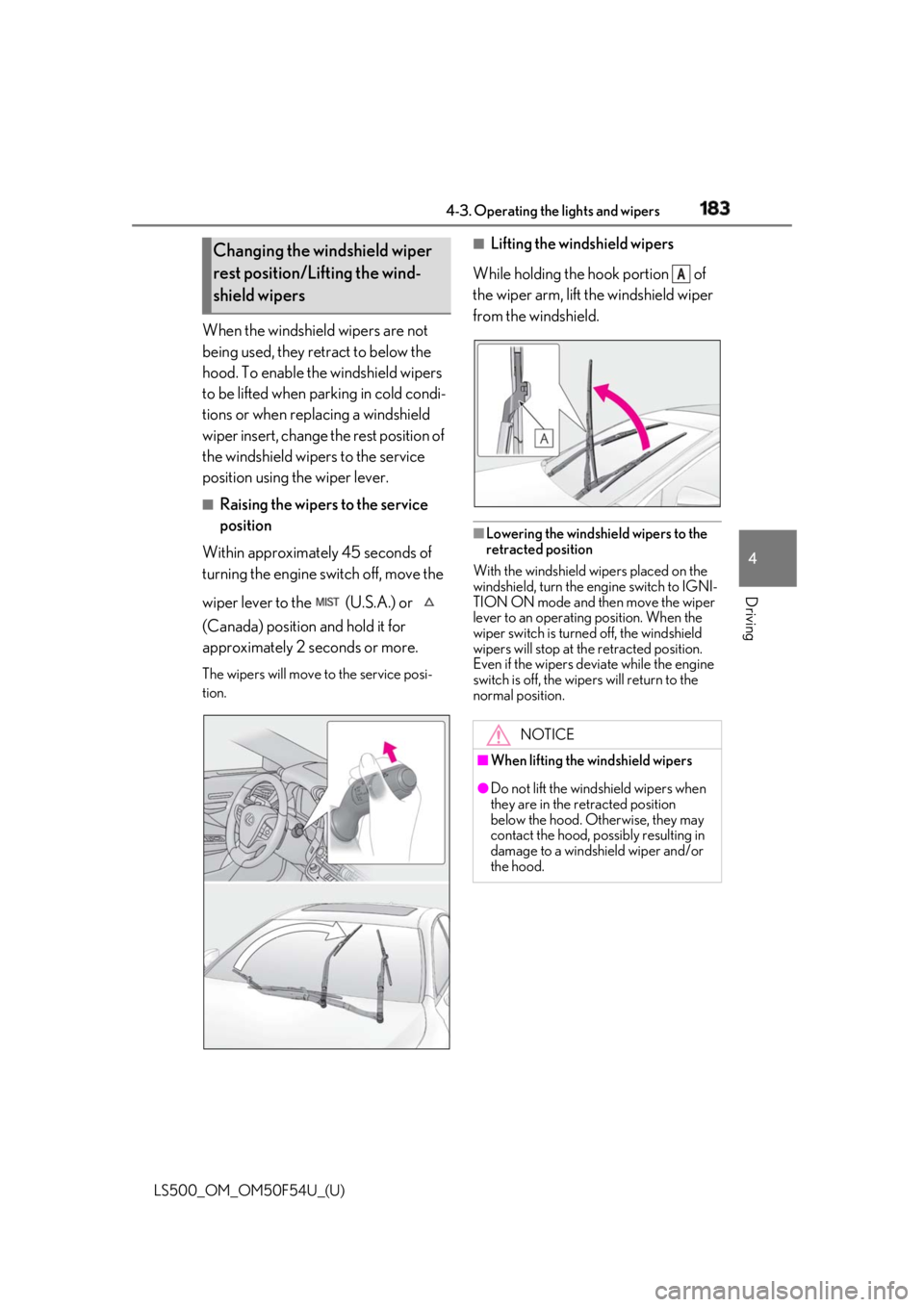
Raising the wipers to the service
position
Within approximately 45 seconds of
turning the engine switch off, move the
wiper lever to the (U.S.A.) or
(Canada) position and hold it for
approximately 2 se conds or more.The wipers will move to the service posi-
tion. ■
Lifting the windshield wipers
While holding the hook portion of
the wiper arm, lift the windshield wiper
from the windshield.
■
Lowering the windshield wipers to the
retracted position
With the windshield wipers placed on the
windshield, turn the en gine switch to IGNI-
TION ON mode and then move the wiper
lever to an operating position. When the
wiper switch is turned off, the windshield
wipers will stop at the retracted position.
Even if the wipers deviate while the engine
switch is off, the wipers will return to the
normal position.Changing the windshield wiper
rest position/Lifting the wind-
shield wipers
NOTICE■
When lifting the windshield wipers
●
Do not lift the wind shield wipers when
they are in the retracted position
below the hood. Otherwise, they may
contact the hood, possibly resulting in
damage to a windshield wiper and/or
the hood. A
Page 185 of 514
1854-4. Refueling
LS500_OM_OM50F54U_(U) 4
Driving 4-4.Refueling
Close all the doors and windows,
and turn the engine switch off.
Confirm the type of fuel. ■
Fuel types
→ P.457■
Fuel tank opening for unleaded gasoline
To help prevent incorrect fueling, your vehi-
cle has a fuel tank opening that only accom-
modates the special nozzle on unleaded
fuel pumps.Opening the fuel tank cap Perform the following steps to open
the fuel tank cap:
Before refueling the vehicle
WARNING■
When refueling the vehicle
Observe the following precautions while
refueling the vehicle. Failure to do so may
result in death or serious injury.
●
After exiting the ve hicle and before
opening the fuel door, touch an
unpainted metal surface to discharge
any static electricity. It is important to
discharge static electricity before refu-
eling because sparks resulting from
static electricity can cause fuel vapors
to ignite while refueling.
●
Always hold the grips on the fuel tank
cap and turn it slowly to remove it.
A whooshing sound may be heard
when the fuel tank cap is loosened.
Wait until the sound cannot be heard
before fully removing the cap. In hot
weather, pressurized fuel may spray
out the filler neck and cause injury. ●
Do not allow anyone that has not dis-
charged static electricity from their
body to come close to an open fuel
tank. ●
Do not inhale vaporized fuel.
Fuel contains substances that are
harmful if inhaled. ●
Do not smoke while refueling the vehi-
cle.
Doing so may cause the fuel to ignite
and cause a fire. ●
Do not return to the vehicle or touch
any person or object that is statically
charged.
This may cause static electricity to
build up, resulting in a possible ignition
hazard. ■
When refueling
Observe the following precautions to
prevent fuel overflowing from the fuel
tank: ●
Securely insert the fuel nozzle into the
fuel filler neck. ●
Stop filling the tank after the fuel noz-
zle automatically clicks off. ●
Do not top off the fuel tank.
NOTICE
■
Refueling
Do not spill fuel during refueling.
Doing so may damage the vehicle, such
as causing the emission control system to
operate abnormally or damaging fuel
system components or the vehicle’s
painted surface.
Page 187 of 514

1874-5. Using the driving support systems
LS500_OM_OM50F54U_(U) 4
Driving 4-5.Using the driving support systems
*
:If equipped
■
PCS (Pre-Collision System) (vehi-
cles with Lexus Safety System+A)
→ P.200 ■
FCTA (Front Cross Traffic Alert)
→ P.218 ■
LTA (Lane Tracing Assist)
→ P.221 ■
AHB (Automatic High Beam)
→ P.178 ■
RSA (Road Sign Assist)
→ P.238 ■
Dynamic radar cruise control with
full-speed range
→ P.241 The pre-collision system is equipped
with a sophisticated computer that will
record certain data, such as:
• Accelerator status
•Brake status
• Vehicle speed
• Operation status of the pre-collision
system functions
• Information (such as the distance
and relative speed between your
vehicle and the vehicle ahead or
other objects)
• Images from the camera sensor
(available only in situations when
sudden inputs occur while driving
[sudden acceleration, etc.], the
pre-collision braking function or the
pre-collision brake assist function
was operating, the Parking Support
Brake function [static objects] was
operating, or your vehicle was
involved in a collision)
The pre-collision system does not Lexus Safety System+A *
The Lexus Safety System+A con-
sists of the following drive assist sys-
tems and contributes to a safe and
comfortable driving experience:
Drive assist systems of Lexus
Safety System+A WARNING■
Lexus Safety System+A
The Lexus Safety System+A is designed
to operate under the assumption that the
driver will drive safely , and is designed to
help reduce the impact to the occupants
and the vehicle in the case of a collision
or assist the driver in normal driving con-
ditions.
As there is a limit to the degree of recog-
nition accuracy and control performance
that this system can provide, do not
overly rely on this system. The driver is
always responsible for paying attention
to the vehicle’s surroundings and driving
safely.
Vehicle data recording
Page 206 of 514
206 4-5. Using the driving support systems
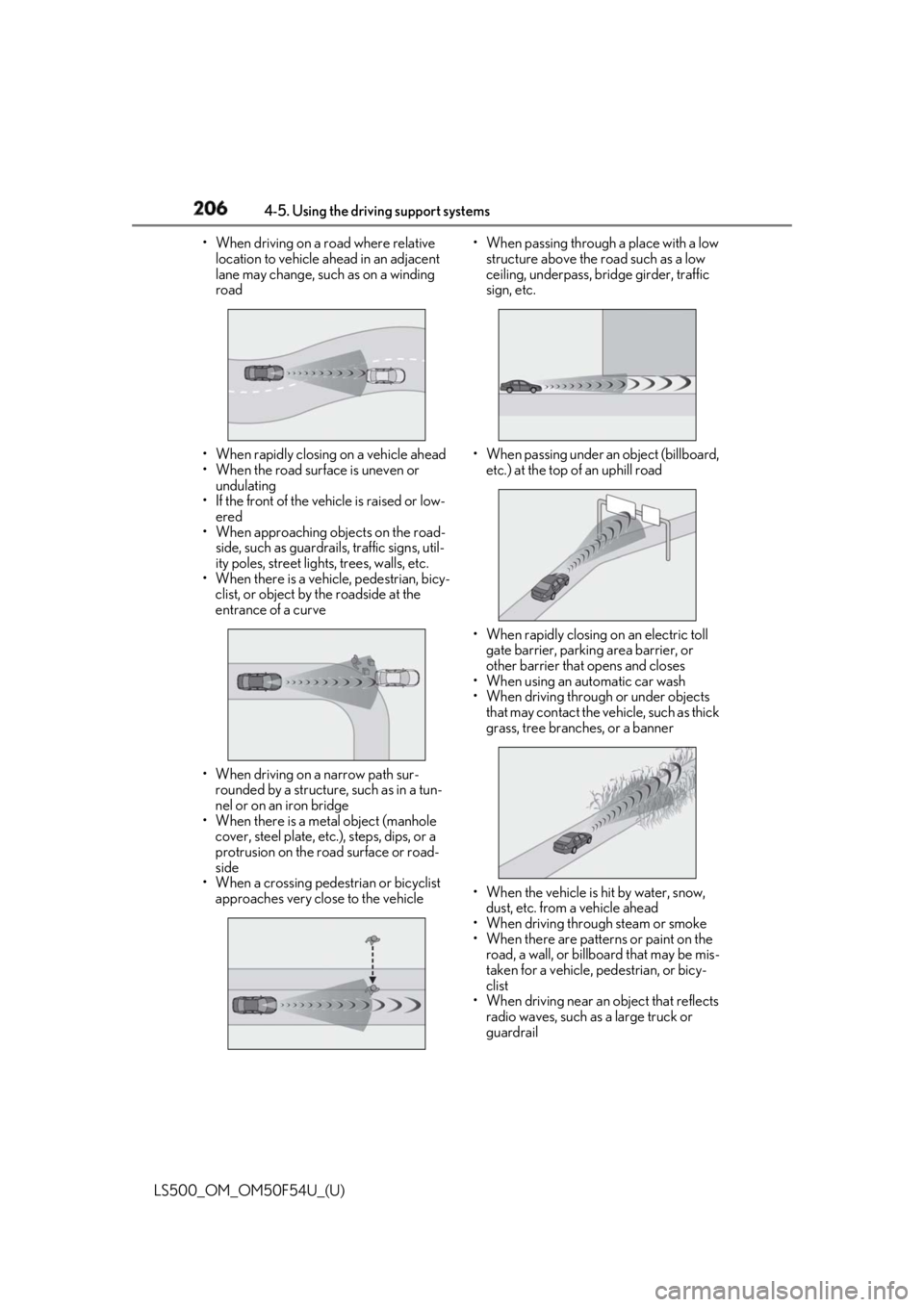
LS500_OM_OM50F54U_(U) • When driving on a road where relative
location to vehicle ahead in an adjacent
lane may change, such as on a winding
road
• When rapidly closing on a vehicle ahead
• When the road surface is uneven or
undulating
• If the front of the vehicle is raised or low-
ered
• When approaching ob jects on the road-
side, such as guardrails, traffic signs, util-
ity poles, street light s, trees, walls, etc.
• When there is a vehicle, pedestrian, bicy-
clist, or object by the roadside at the
entrance of a curve
• When driving on a narrow path sur-
rounded by a structure, such as in a tun-
nel or on an iron bridge
• When there is a metal object (manhole
cover, steel plate, etc.), steps, dips, or a
protrusion on the ro ad surface or road-
side
• When a crossing pedestrian or bicyclist
approaches very close to the vehicle • When passing through a place with a low
structure above the road such as a low
ceiling, underpass, bridge girder, traffic
sign, etc.
• When passing under an object (billboard,
etc.) at the top of an uphill road
• When rapidly closing on an electric toll
gate barrier, parking area barrier, or
other barrier that opens and closes
• When using an automatic car wash
• When driving through or under objects
that may contact the vehicle, such as thick
grass, tree branches, or a banner
• When the vehicle is hit by water, snow,
dust, etc. from a vehicle ahead
• When driving through steam or smoke
• When there are patterns or paint on the
road, a wall, or billboard that may be mis-
taken for a vehicle, pedestrian, or bicy-
clist
• When driving near an object that reflects
radio waves, such as a large truck or
guardrail