2018 KIA STONIC Start
[x] Cancel search: StartPage 311 of 523

Making turns
When you’re turning with a trailer,
make wider turns than normal. Do this so your trailer won’t strike soft should‐
ers, curbs, road signs, trees, or other
objects. Avoid jerky or sudden maneu‐ vers. Signal well in advance.
Turn signals when towing a trailer
When you tow a trailer, your vehicle
has to have a different turn signal flasher and extra wiring. The green ar‐
rows on your instrument panel will
flash whenever you signal a turn or lane change. Properly connected, the
trailer lights will also flash to alert oth‐
er drivers you’re about to turn, change lanes, or stop.
When towing a trailer, the green ar‐
rows on your instrument panel will
flash for turns even if the bulbs on the trailer are burned out. Thus, you may
think drivers behind you are seeing
your signals when, in fact, they are not. It’s important to check occasionally to
be sure the trailer bulbs are still work‐
ing. You must also check the lights ev‐ ery time you disconnect and then re‐
connect the wires.
Do not connect a trailer lighting system
directly to your vehicle’s lighting sys‐ tem. Use only an approved trailer wir‐
ing harness. Have yourself assisted by a professio‐
nal workshop in installing the wiring harness.
Kia recommends to visit an authorized
Kia dealer/service partner.
WARNING
Failure to use an approved trailerwiring harness could result in dam‐age to the vehicle electrical systemand/or personal injury.
Driving on grades
Reduce the speed and shift to a lower
gear before you start down a long or steep downgrade. If you don’t shift
down, you might have to use your
brakes so much that they would get hot and no longer operate efficiently.
On a long uphill grade, shift down and
reduce your speed to around 70 km/h
(45 mph) to reduce the possibility of engine and transaxle overheating.
If your trailer weighs more than the
maximum trailer weight without trailer
brakes and you have an automatic transaxle, you should drive in D (Drive)
when towing a trailer. Operating your vehicle in D (Drive)
when towing a trailer will minimize heat build up and extend the life of
your transaxle.
CAUTION
•When towing a trailer on steepgrades (in excess of 6%) pay closeattention to the engine coolanttemperature gauge to ensure theengine does not overheat. If theneedle of the coolant temperaturegauge moves across the dial to‐wards L
Page 312 of 523

Parking on hills
Generally, if you have a trailer attached
to your vehicle, you should not park your vehicle on a hill. People can be se‐
riously or fatally injured, and both your
vehicle and the trailer can be damaged if unexpectedly roll down hill.
WARNING
nParking on a hill
Parking your vehicle on a hill with atrailer attached could cause seriousinjury or death, should the trailerbreak loose.
However, if you ever have to park your
trailer on a hill, here's how to do it: 1. Pull the vehicle into the parking space. Turn the steering wheel in
the direction of the curb (right if
headed down hill, left if headed up
hill).
2. If the vehicle has a manual trans‐ axle, place the car in neutral. If the
vehicle has an automatic transaxle,
place the car in P (Park).
3. Set the parking brake and shut off the vehicle. 4. Place chocks under the trailer
wheels on the down hill side of the
wheels.
5. Start the vehicle, hold the brakes, shift to neutral, release the parking
brake and slowly release the brakes
until the trailer chocks absorb the
load.
6. Reapply the brakes, reapply the parking brake and shift the vehicleto R (Reverse) for manual transaxle
or P (Park) for automatic transaxle.
7. Shut off the vehicle and release the vehicle brakes but leave the parking
brake set.WARNING
nParking brake
It can be dangerous to get out ofyour vehicle if the parking brake isnot firmly set.If you have left the engine running,the vehicle can move suddenly. Youor others could be seriously or fatal‐ly injured.
When you are ready to leave after
parking on a hill
1. With the manual transaxle in Neu‐ tral or automatic transaxle in P
(Park), apply your brakes and hold
the brake pedal down while you: • Start your engine;
• Shift into gear; and
• Release the parking brake.
2. Slowly remove your foot from the brake pedal.
3. Drive slowly until the trailer is clear of the chocks.
4. Stop and have someone pick up and store the chocks.
Driving your vehicle
6-90
Page 313 of 523

Maintenance when trailer
towing
Your vehicle will need service more of‐
ten when you regularly pull a trailer.
Important items to pay particular at‐ tention to include engine oil, automatic
transaxle fluid, axle lubricant and cool‐
ing system fluid. Brake condition is an‐ other important item to frequently
check. Each item is covered in this man‐
ual, and the Index will help you find them quickly. If you’re trailering, it’s a
good idea to review these sections be‐
fore you start your trip.
Don’t forget to also maintain your trail‐ er and hitch. Follow the maintenance
schedule that accompanied your trailer
and check it periodically. Preferably, conduct the check at the start of each
day’s driving. Most importantly, all
hitch nuts and bolts should be tight.
CAUTION
•Due to higher load during trailerusage, overheating might occur inhot days or during uphill driving. Ifthe coolant gauge indicates over‐heating, switch off the A/C andstop the vehicle in a safe area tocool down the engine.
•When towing, check the transaxlefluid more frequently.
•If your vehicle is not equipped withan air conditioner, you should in‐stall a condenser fan to improveengine performance when towinga trailer.
If you do decide to pull a trailer
Here are some important points if you
decide to pull a trailer:
• Consider using a sway control. You can ask a hitch dealer about swaycontrol. • Do not do any towing with your car
during its first 2,000 km (1,200 miles)
in order to allow the engine to prop‐
erly break in. Failure to heed this cau‐
tion may result in serious engine or transaxle damage.
• When towing a trailer, Kia recom‐ mends that you consult an author‐
ized Kia dealer/service partner on ad‐
ditional requirements such as a tow‐
ing kit, etc.
• Always drive your vehicle at a moder‐ ate speed (less than 100 km/h
(60 mph)).
• On a long uphill grade, do not exceed 70 km/h (45 mph) or the posted tow‐
ing speed limit, whichever is lower.
• The chart contains important consid‐ erations that have to do with weight:
For Europe
Item1.0L T-GDI1.2L MPI1.4L MPI1.6L Diesel
6M/T5M/T6M/T6M/T
Maximum trailerweight Without brake System 450 (992) 450 (992) 450 (992) 450 (992)
6-91
6
Driving your vehicle
Page 317 of 523

Road warning............................................................................. 7-02Hazard warning flasher........................................................7-02
In case of an emergency while driving.................................. 7-03 If the engine stalls at a crossroad or crossing................. 7-03
If you have a flat tire while driving.................................... 7-03
If the engine stalls while driving......................................... 7-03
If the engine will not start....................................................... 7-04 If the engine doesn't turn over or turns over slowly...... 7-04
If the engine turns over normally but does not start.... 7-04
Emergency starting.................................................................. 7-05 Jump starting.........................................................................7-05
Push-starting........................................................................ 7-06
If the engine overheats............................................................ 7-07
Tire pressure monitoring system (TPMS) ........................... 7-08 System Overview.................................................................. 7-08
TPMS Setting......................................................................... 7-08
Indication of Low Tire Pressure.......................................... 7-09
Tire Pressure Monitoring System malfunction................7-10
Reference : Indicator Light Status..................................... 7-11
If You Have A Flat Tire (With Spare Tire).............................. 7-12 Jack and tools........................................................................ 7-12
Removing and storing the spare tire................................. 7-12
Changing tires........................................................................ 7-13
Jack label.................................................................................7-18
EC Declaration of Conformity for Jack.............................. 7-19
If you have a flat tire (with tire mobility kit)........................7-20 Introduction............................................................................7-21
Components of the Tire Mobility Kit (TMK)......................7-22
Using the Tire Mobility Kit................................................... 7-23
Distributing the sealant....................................................... 7-24 Checking the tire inflation pressure...................................7-24
Notes on the safe use of the Tire Mobility Kit................ 7-25
Technical data........................................................................ 7-25
Towing......................................................................................... 7-26 Towing service....................................................................... 7-26
Removable towing hook ..................................................... 7-27
Emergency towing................................................................ 7-27
Emergency commodity ........................................................... 7-30 Fire extinguisher................................................................... 7-30
First aid kit............................................................................. 7-30
Triangle reflector.................................................................. 7-30
Tire pressure gauge .............................................................7-30
What to do in an emergency
7
Page 319 of 523

IN CASE OF AN EMERGENCY WHILE DRIVING
If the engine stalls at a
crossroad or crossing
• If the engine stalls at a crossroad orcrossing, set the shift lever in the N
(Neutral) position and then push the vehicle to a safe place.
• If your vehicle has a manual transaxle not equipped with a ignition lock
switch, the vehicle can move forward
by shifting to the 2 (second) or 3
(third) gear and then turning the starter without depressing the clutch
pedal.
If you have a flat tire while
driving
If a tire goes flat while you are driving: 1. Take your foot off the accelerator pedal and let the vehicle slow down
while driving straight ahead. Do not
apply the brakes immediately or
attempt to pull off the road as this
may cause a loss of control. When
the vehicle has slowed down to
such a speed that it is safe to do so, brake carefully and pull off the
road. Drive off the road as far as
possible and park on a firm level
ground. If you are on a divided
highway, do not park in the median
area between the two traffic lanes. 2. When the vehicle is stopped, turn
on your emergency hazard flash‐
ers, set the parking brake and put
the transaxle in P (automatic
transaxle) or reverse (manual transaxle).
3. Have all passengers get out of the vehicle. Be sure they all get out on
the side of the vehicle that is away
from traffic.
4. When changing a flat tire, follow the instruction provided L
Page 320 of 523

IF THE ENGINE WILL NOT START
If the engine doesn't turn over
or turns over slowly
1. If your vehicle has an automatictransaxle, be sure the shift lever is
in N (Neutral) or P (Park) and the
emergency brake is set.
2. Check the battery connections to be sure they are clean and tight.
3. Turn on the interior light. If the light dims or goes out when you
operate the starter, the battery is
discharged.
4. Check the starter connections to be sure they are securely tightened.
5. Do not push or pull the vehicle to start it. See instructions for L
Page 321 of 523
EMERGENCY STARTING
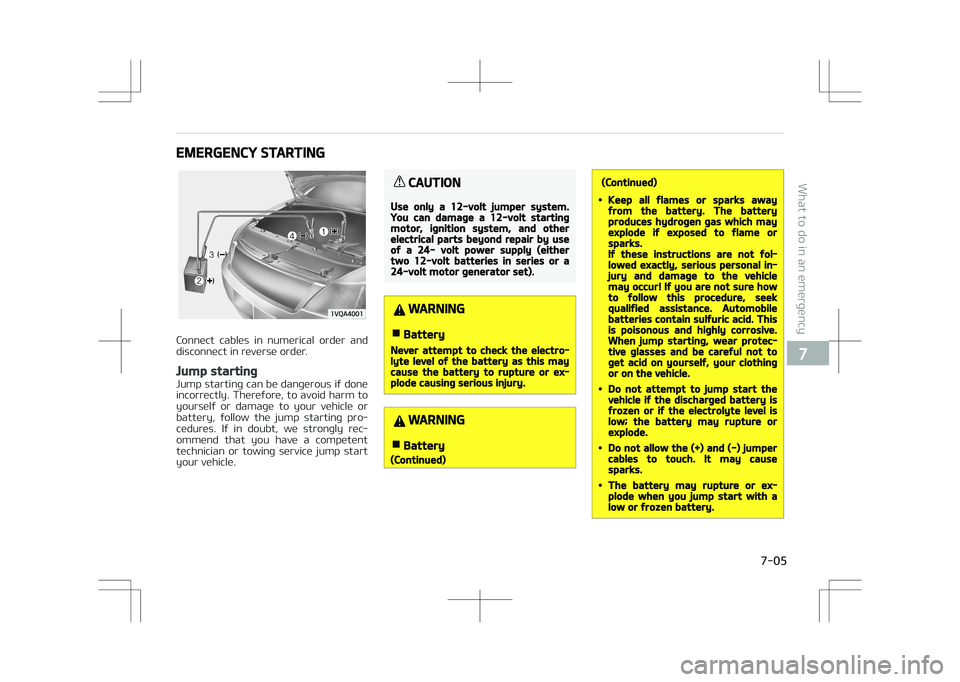
Connect cables in numerical order and
disconnect in reverse order.
Jump starting
Jump starting can be dangerous if done
incorrectly. Therefore, to avoid harm to yourself or damage to your vehicle or
battery, follow the jump starting pro‐
cedures. If in doubt, we strongly rec‐ ommend that you have a competent
technician or towing service jump start
your vehicle.
CAUTION
Use only a 12-volt jumper system.You can damage a 12-volt startingmotor, ignition system, and otherelectrical parts beyond repair by useof a 24- volt power supply (eithertwo 12-volt batteries in series or a24-volt motor generator set).
WARNING
nBattery
Never attempt to check the electro‐lyte level of the battery as this maycause the battery to rupture or ex‐plode causing serious injury.
WARNING
nBattery
(Continued)
(Continued)
•Keep all flames or sparks awayfrom the battery. The batteryproduces hydrogen gas which mayexplode if exposed to flame orsparks.If these instructions are not fol‐lowed exactly, serious personal in‐jury and damage to the vehiclemay occur! If you are not sure howto follow this procedure, seekqualified assistance. Automobilebatteries contain sulfuric acid. Thisis poisonous and highly corrosive.When jump starting, wear protec‐tive glasses and be careful not toget acid on yourself, your clothingor on the vehicle.
•Do not attempt to jump start thevehicle if the discharged battery isfrozen or if the electrolyte level islow; the battery may rupture orexplode.
•Do not allow the (+) and (-) jumpercables to touch. It may causesparks.
•The battery may rupture or ex‐plode when you jump start with alow or frozen battery.
7-05
7
What to do in an emergency
Page 322 of 523
Jump starting procedure
1. Make sure the booster battery is12-volt and that its negative termi‐ nal is grounded.
2. If the booster battery is in another vehicle, do not allow the vehicles to
come in contact.
3. Turn off all unnecessary electrical loads.
4. Connect the jumper cables in the exact sequence shown in the illus‐
tration. First connect one end of a
jumper cable to the positive termi‐
nal of the discharged battery (1),
then connect the other end to the
positive terminal on the booster
battery (2).
Proceed to connect one end of the other jumper cable to the negative
terminal of the booster battery (3),
then the other end to a solid, sta‐
tionary, metallic point (for example,
the engine lifting bracket) away
from the battery (4). Do not con‐
nect it to or near any part that
moves when the engine is cranked.
Do not allow the jumper cables to
contact anything except the correct
battery terminals or the correct
ground. Do not lean over the bat‐ tery when making connections.CAUTION
nBattery cables
Do not connect the jumper cablefrom the negative terminal of thebooster battery to the negative ter‐minal of the discharged battery. Thiscan cause the discharged battery tooverheat and crack, releasing bat‐tery acid.Make sure to connect one end of thejumper cable to the negative termi‐nal of the booster battery, and theother end to a metallic point, faraway from the battery.
5. Start the engine of the vehicle with the booster battery and let it run
at 2,000 rpm, then start the engine
of the vehicle with the discharged
battery.
If the cause of your battery discharging
is not apparent, have the systemchecked by a professional workshop.Kia recommends to visit an authorized Kia dealer/service partner.
Push-starting
Your manual transaxle-equipped vehi‐
cle should not be push-started because it might damage the emission control
system.
Vehicles equipped with automatic
transaxle cannot be push-started.
Follow the directions in this section for L