2018 KIA STONIC trailer
[x] Cancel search: trailerPage 311 of 523

Making turns
When you’re turning with a trailer,
make wider turns than normal. Do this so your trailer won’t strike soft should‐
ers, curbs, road signs, trees, or other
objects. Avoid jerky or sudden maneu‐ vers. Signal well in advance.
Turn signals when towing a trailer
When you tow a trailer, your vehicle
has to have a different turn signal flasher and extra wiring. The green ar‐
rows on your instrument panel will
flash whenever you signal a turn or lane change. Properly connected, the
trailer lights will also flash to alert oth‐
er drivers you’re about to turn, change lanes, or stop.
When towing a trailer, the green ar‐
rows on your instrument panel will
flash for turns even if the bulbs on the trailer are burned out. Thus, you may
think drivers behind you are seeing
your signals when, in fact, they are not. It’s important to check occasionally to
be sure the trailer bulbs are still work‐
ing. You must also check the lights ev‐ ery time you disconnect and then re‐
connect the wires.
Do not connect a trailer lighting system
directly to your vehicle’s lighting sys‐ tem. Use only an approved trailer wir‐
ing harness. Have yourself assisted by a professio‐
nal workshop in installing the wiring harness.
Kia recommends to visit an authorized
Kia dealer/service partner.
WARNING
Failure to use an approved trailerwiring harness could result in dam‐age to the vehicle electrical systemand/or personal injury.
Driving on grades
Reduce the speed and shift to a lower
gear before you start down a long or steep downgrade. If you don’t shift
down, you might have to use your
brakes so much that they would get hot and no longer operate efficiently.
On a long uphill grade, shift down and
reduce your speed to around 70 km/h
(45 mph) to reduce the possibility of engine and transaxle overheating.
If your trailer weighs more than the
maximum trailer weight without trailer
brakes and you have an automatic transaxle, you should drive in D (Drive)
when towing a trailer. Operating your vehicle in D (Drive)
when towing a trailer will minimize heat build up and extend the life of
your transaxle.
CAUTION
•When towing a trailer on steepgrades (in excess of 6%) pay closeattention to the engine coolanttemperature gauge to ensure theengine does not overheat. If theneedle of the coolant temperaturegauge moves across the dial to‐wards L
Page 312 of 523

Parking on hills
Generally, if you have a trailer attached
to your vehicle, you should not park your vehicle on a hill. People can be se‐
riously or fatally injured, and both your
vehicle and the trailer can be damaged if unexpectedly roll down hill.
WARNING
nParking on a hill
Parking your vehicle on a hill with atrailer attached could cause seriousinjury or death, should the trailerbreak loose.
However, if you ever have to park your
trailer on a hill, here's how to do it: 1. Pull the vehicle into the parking space. Turn the steering wheel in
the direction of the curb (right if
headed down hill, left if headed up
hill).
2. If the vehicle has a manual trans‐ axle, place the car in neutral. If the
vehicle has an automatic transaxle,
place the car in P (Park).
3. Set the parking brake and shut off the vehicle. 4. Place chocks under the trailer
wheels on the down hill side of the
wheels.
5. Start the vehicle, hold the brakes, shift to neutral, release the parking
brake and slowly release the brakes
until the trailer chocks absorb the
load.
6. Reapply the brakes, reapply the parking brake and shift the vehicleto R (Reverse) for manual transaxle
or P (Park) for automatic transaxle.
7. Shut off the vehicle and release the vehicle brakes but leave the parking
brake set.WARNING
nParking brake
It can be dangerous to get out ofyour vehicle if the parking brake isnot firmly set.If you have left the engine running,the vehicle can move suddenly. Youor others could be seriously or fatal‐ly injured.
When you are ready to leave after
parking on a hill
1. With the manual transaxle in Neu‐ tral or automatic transaxle in P
(Park), apply your brakes and hold
the brake pedal down while you: • Start your engine;
• Shift into gear; and
• Release the parking brake.
2. Slowly remove your foot from the brake pedal.
3. Drive slowly until the trailer is clear of the chocks.
4. Stop and have someone pick up and store the chocks.
Driving your vehicle
6-90
Page 313 of 523

Maintenance when trailer
towing
Your vehicle will need service more of‐
ten when you regularly pull a trailer.
Important items to pay particular at‐ tention to include engine oil, automatic
transaxle fluid, axle lubricant and cool‐
ing system fluid. Brake condition is an‐ other important item to frequently
check. Each item is covered in this man‐
ual, and the Index will help you find them quickly. If you’re trailering, it’s a
good idea to review these sections be‐
fore you start your trip.
Don’t forget to also maintain your trail‐ er and hitch. Follow the maintenance
schedule that accompanied your trailer
and check it periodically. Preferably, conduct the check at the start of each
day’s driving. Most importantly, all
hitch nuts and bolts should be tight.
CAUTION
•Due to higher load during trailerusage, overheating might occur inhot days or during uphill driving. Ifthe coolant gauge indicates over‐heating, switch off the A/C andstop the vehicle in a safe area tocool down the engine.
•When towing, check the transaxlefluid more frequently.
•If your vehicle is not equipped withan air conditioner, you should in‐stall a condenser fan to improveengine performance when towinga trailer.
If you do decide to pull a trailer
Here are some important points if you
decide to pull a trailer:
• Consider using a sway control. You can ask a hitch dealer about swaycontrol. • Do not do any towing with your car
during its first 2,000 km (1,200 miles)
in order to allow the engine to prop‐
erly break in. Failure to heed this cau‐
tion may result in serious engine or transaxle damage.
• When towing a trailer, Kia recom‐ mends that you consult an author‐
ized Kia dealer/service partner on ad‐
ditional requirements such as a tow‐
ing kit, etc.
• Always drive your vehicle at a moder‐ ate speed (less than 100 km/h
(60 mph)).
• On a long uphill grade, do not exceed 70 km/h (45 mph) or the posted tow‐
ing speed limit, whichever is lower.
• The chart contains important consid‐ erations that have to do with weight:
For Europe
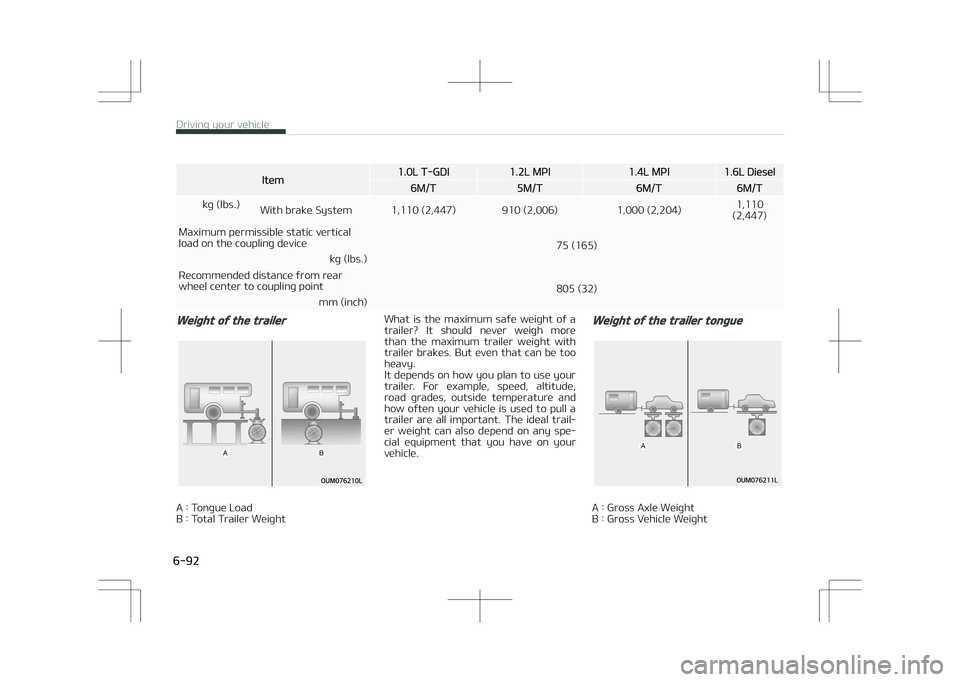
Item1.0L T-GDI1.2L MPI1.4L MPI1.6L Diesel
6M/T5M/T6M/T6M/T
Maximum trailerweight Without brake System 450 (992) 450 (992) 450 (992) 450 (992)
6-91
6
Driving your vehicle
Page 314 of 523
Item1.0L T-GDI1.2L MPI1.4L MPI1.6L Diesel
6M/T5M/T6M/T6M/T
kg (Ibs.) With brake System 1,110 (2,447) 910 (2,006) 1,000 (2,204) 1,110
(2,447)
Maximum permissible static vertical
load on the coupling device 75 (165)
kg (Ibs.)
Recommended distance from rear
wheel center to coupling point 805 (32)
mm (inch)
Weight of the trailer
A : Tongue Load
B : Total Trailer Weight What is the maximum safe weight of a
trailer? It should never weigh more than the maximum trailer weight with
trailer brakes. But even that can be too
heavy.
It depends on how you plan to use your trailer. For example, speed, altitude,
road grades, outside temperature and
how often your vehicle is used to pull a trailer are all important. The ideal trail‐
er weight can also depend on any spe‐
cial equipment that you have on your vehicle.
Weight of the trailer tongue
A : Gross Axle Weight
B : Gross Vehicle Weight
Driving your vehicle
6-92
Page 315 of 523
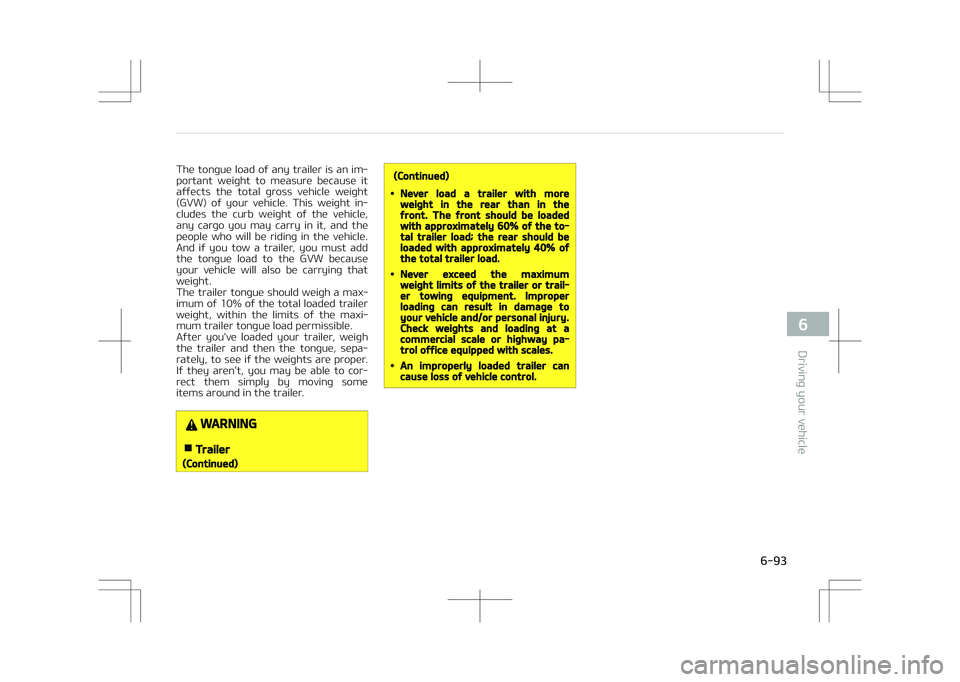
The tongue load of any trailer is an im‐
portant weight to measure because it affects the total gross vehicle weight
(GVW) of your vehicle. This weight in‐
cludes the curb weight of the vehicle, any cargo you may carry in it, and the
people who will be riding in the vehicle.
And if you tow a trailer, you must add the tongue load to the GVW because
your vehicle will also be carrying that
weight.
The trailer tongue should weigh a max‐ imum of 10% of the total loaded trailer
weight, within the limits of the maxi‐
mum trailer tongue load permissible.
After you've loaded your trailer, weigh the trailer and then the tongue, sepa‐
rately, to see if the weights are proper.
If they aren’t, you may be able to cor‐ rect them simply by moving some
items around in the trailer.
WARNING
nTrailer
(Continued)
(Continued)
•Never load a trailer with moreweight in the rear than in thefront. The front should be loadedwith approximately 60% of the to‐tal trailer load; the rear should beloaded with approximately 40% ofthe total trailer load.
•Never exceed the maximumweight limits of the trailer or trail‐er towing equipment. Improperloading can result in damage toyour vehicle and/or personal injury.Check weights and loading at acommercial scale or highway pa‐trol office equipped with scales.
•An improperly loaded trailer cancause loss of vehicle control.
6-93
6
Driving your vehicle
Page 333 of 523

(Continued)
•The operation of this vehicle is notrecommended with more than onecompact spare tire in use at thesame time.
WARNING
The compact spare tire is for emer‐gency use only. Do not operate yourvehicle on this compact spare at thespeed over 80 km/h (50 mph). Theoriginal tire should be repaired or re‐placed as soon as possible to avoidfailure of the spare possibly leadingto personal injury or death.
The compact spare should be inflated
to 420 kPa (60 psi).
NOTICE
Check the inflation pressure after in‐
stalling the spare tire. Adjust it to
the specified pressure, as necessary.
When using a compact spare tire, ob‐
serve the following precautions: • Under no circumstances should you
exceed 80 km/h (50 mph); a higherspeed could damage the tire.
• Ensure that you drive slowly enough to avoid all hazards. Any road hazard,
such as a pothole or debris, could se‐
riously damage the compact spare.
• Any continuous road use of this tire could result in tire failure, loss of ve‐
hicle control, and possible personal in‐ jury.
• Do not exceed the vehicle’s maximum load rating or the load-carrying ca‐
pacity shown on the sidewall of the
compact spare tire.
• Avoid driving over obstacles. The compact spare tire diameter is small‐
er than the diameter of a convention‐
al tire and reduces the ground clear‐
ance approximately 2.5 cm (1 inch),
which could result in damage to the
vehicle.
• Do not take the vehicle through an automatic car wash while the com‐
pact spare tire is installed.
• Do not use tire chains on the tempo‐ rary compact tire. Because of the
smaller size, a tire chain will not fit properly. This could damage the vehi‐
cle and result in loss of the chain. • Temporary compact tire should not
be installed on the front axle if the
vehicle must be driven in snow or on
ice.
• Do not use the temporary compact tire on any other vehicle because this
tire has been designed especially for
your vehicle.
• The temporary compact tire tread life is shorter than a regular tire. In‐
spect your temporary compact tire regularly and replace worn compact
spare tires with the same size and
design, mounted on the same wheel.
• The temporary compact tire should not be used on any other wheels, norshould standard tires, snow tires,
wheel covers or trim rings be used
with the temporary compact spare
wheel. If such use is attempted, dam‐
age to these items or other car com‐ ponents may occur.
• Do not use more than one temporary compact tire at a time.
• Do not tow a trailer while the tempo‐ rary compact tire is installed.
7-17
7
What to do in an emergency
Page 337 of 523
Introduction
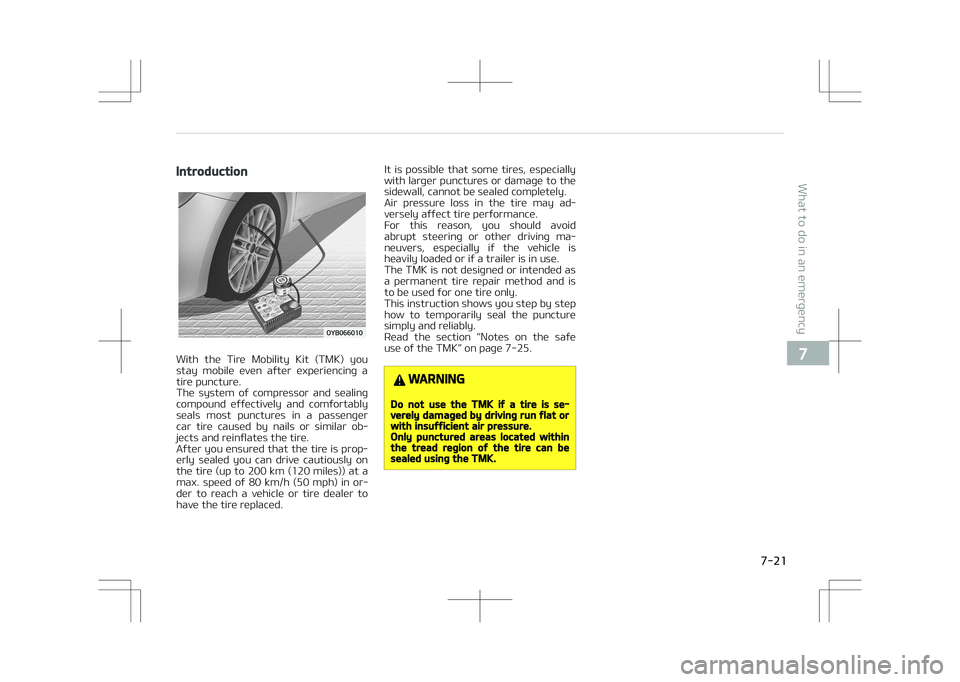
With the Tire Mobility Kit (TMK) you
stay mobile even after experiencing a tire puncture.
The system of compressor and sealing
compound effectively and comfortably
seals most punctures in a passenger car tire caused by nails or similar ob‐
jects and reinflates the tire.
After you ensured that the tire is prop‐
erly sealed you can drive cautiously on the tire (up to 200 km (120 miles)) at a
max. speed of 80 km/h (50 mph) in or‐
der to reach a vehicle or tire dealer to have the tire replaced. It is possible that some tires, especially
with larger punctures or damage to the
sidewall, cannot be sealed completely.
Air pressure loss in the tire may ad‐ versely affect tire performance.
For this reason, you should avoid
abrupt steering or other driving ma‐
neuvers, especially if the vehicle is heavily loaded or if a trailer is in use.
The TMK is not designed or intended as
a permanent tire repair method and is
to be used for one tire only.This instruction shows you step by step
how to temporarily seal the puncture simply and reliably.
Read the section L
Page 357 of 523

SCHEDULED MAINTENANCE SERVICE
Scheduled maintenance service
precaution
Follow the Normal Maintenance Sched‐
ule if the vehicle is usually operated
where none of the following conditions apply. If any of the following conditions
apply, follow the Maintenance Under
Severe Usage Conditions. • Repeated driving short distance of less than 8 km (5 miles) in normaltemperature or less than 16 km
(10 miles) in freezing temperature
• Extensive engine idling or low speed driving for long distances
• Driving on rough, dusty, muddy, un‐ paved, graveled or salt-spread roads
• Driving in areas using salt or other corrosive materials or in very cold
weather
• Driving in heavy dust condition
• Driving in heavy traffic area
• Driving on uphill, downhill, or moun‐ tain road repeatedly
• Towing a trailer or using a camper, or roof rack
• Driving as a patrol car, taxi, other commercial use of vehicle towing
• Driving over 170 km/h (106 mile/h) • Frequently driving in stop-and-go
condition
If your vehicle is operated under the
above conditions, you should inspect,
replace or refill more frequently than the following Normal Maintenance
Schedule. After the periods or distance
shown in the chart, continue to follow the prescribed maintenance intervals.
8-11
8
Maintenance