2018 AUDI A8 steering wheel
[x] Cancel search: steering wheelPage 132 of 356

Intellig ent T echn olo gy
- New brake pads do not achieve their full
braking effect during the first 250 mi
(400 km). They must be "broken in" first.
However, you can compensate for the
sl ightly reduced brak ing force by pressing
firmly on the brake pedal. Avoid heavy brak
i ng dur ing t he break- in per iod.
- Certa in weather and operat ing cond it ions
such as dr iv ing through water, driving in
heavy ra in or driving after washing your ve
hicle can impair the effectiveness of the
brakes . In the winter, ice may build up on
the brake pads, rotors and drums . Check
these components by braking carefu lly. Ap
plying the brakes carefully severa l times
dr ies the brakes and removes ice bu ild-up.
- The effic iency of the brakes can also be im
paired by driving for long stretches on roads
covered w ith salt w ithout using the brakes.
You can remove salt deposits from the brake rotors and pads by carefully applying
the b rakes severa l t imes .
- If the front spo iler is damaged or you install
another spoiler, make sure the front wheel
bra kes are vent ilated properly. Otherwise,
the brake system could ove rheat, w hich re
duces the ir effectiveness.
- Failure of a b rake circuit impa irs b raking
perfo rmance, which inc reases brak ing dis
tance . Avoid driving the vehicle and have it
towed it to the nearest authorized Audi
dealer or authorized Audi Service Facility .
- If the brake booster is not working, you will
have to press m uch harder on the brake
peda l to compensate for the lack of the
booster.
@ Note
- Never let the brakes " rub" by pressing the
pedal light ly when braking is not actually
necessary. This causes the brakes to over
heat and increases braking distance and
causes wear.
- Before driving downhill a long distance on a
steep hill, decrease your speed and select a l ower gear. This makes use of the engine
braking effect and relieves the brakes. If
130
you need to brake add itiona lly, brake in in
terva ls and not continuous ly .
(D Tips
- If the bra ke boos ter is not wor king, you
must press the brake peda l with much more
force than normal.
- If you retrof it your vehicle with a front spoi l
er, wheel covers or simi lar items, make sure
that the air flow to the front wheels is not interrupted. Otherwise the brake system
can become too hot.
Electromechanical
steering, dynamic
steering
The electromechonicol steering supports the
driver's steering movements.
Power steering adapts electronically based on
the vehicle speed .
Indicator lights and messages
• Do not drive vehi cle: S tee rin g defect ive
If this indicator light turns on and stays on and
th is message appears, the power steering may
have failed .
Stop the vehicle in a safe location as soon as pos
s ible. Do
not conti nue driving. See an authorized
Audi dealer or authorized Audi Service Fac il ity for
ass istance.
l;rfl St ee ring: System faul t You ca n cont inue
dr ivi ng
If the indicator light turns on and the message
appears, the steering wheel may be more diffi
cu lt to move or more sensitive than usual. The
steering wheel may also be at an angle when driv ing stra ight .
Drive slowly to an authorized Audi dea ler or au
thori zed Audi Serv ice Facility to have the mal
funct io n corrected.
'-r-ij Dynamic stee ring: Init ializing
If the indicato r light is blinking and this message
appears, dynamic steering* is being initialized.
IJ>-
Page 133 of 356

u. co .... N
" N .... 0 0 :c '
starting the engine. Re-initialization might be
necessary if the steering whee l was moved hard
to the left and right while the vehicle was not
moving . The display turns off if the initia liz ation
was successful.
(D Tips
- If the . or l;:r-ij indicator light only stays on
for a short time, you may continue driving.
-The dynamic steering stability systems
<=>page 127 are not available in the event of
a system malfunction.
-For additional informat ion on dynamic
steering, see
<=> page 111.
ALL wheel drive (quattro)
In all wheel drive, all four wheels are powered .
General information
In all wheel drive, the driving power is divided be
tween a ll four wheels . This happens automatical
ly depending on your driving behavior as well as
the current road conditions. Also see
<=> page 12 7, E lectronic Stabilization Control
(ESC) .
With the sport differential*, power distri
bution to the rear wheels is variable and can be
adjusted using the drive select
<=>page 111.
The all wheel drive concept is designed for high
engine power . Your vehicle is exceptionally pow
erful and has excellent driving characterist ics
both under normal driving conditions and on
snow and ice. Always read and follo w safety pre
cautions<=>.&. .
Winter tires
By using all wheel drive, your vehicle has good
forward mot ion with standard tires in winter con
ditions. However, in winter we recommend using
winter or all season tires on all four wheels, be
cause this will improve the braking effect.
Snow chains
If there are snow cha in laws, snow chains must
a lso be used on vehicles with all wheel drive
<=> page 298, Snow chains .
Intelligent Technology
Replacing tires
For vehicles with all wheel drive, only wheels with
the same rolling circumference should be used.
Avoid using tires with different tread depths
<=> page 2 90, New tires or wheels.
Offroad vehicle?
Your Audi is not an offroad vehicle -there is not
enough ground clearance. For this reason, avoid
difficu lt terrain .
A WARNING ~ -
-Also, in vehicles with all whee l drive, adapt
your driving style to the current road and
traffic cond itions. Do not let the increased
safety prov ided tempt you into taking r isks,
because this increases the risk of an acci
dent.
- The braking ability of your vehicle is limited
to the traction of the wheels. In this way, it
is not different from a two wheel drive vehi
cle. Do not be tempted to accelerate to a
high speed when the road is slipp ery, be
cause this incr eases the risk of an accident.
- Note that on wet streets, the front wheels
can "hydrop lane" if dr iv in g at speeds that
are too high . Unlike front wheel drive
vehicles, the engine does not rev higher sud
den ly when the vehicle begins hydroplaning.
For this reason, adapt your speed to the
road conditions to reduce the risk of an acci
dent.
Energy management
The starting ability is optimized
The energy management system manages the
electrical energy distribution and optimizes the
availability of electrical energy for starting the
engine.
When a vehicle with a conventiona l energy sys
tem is not driven for a long t ime, the vehicle bat
te ry is drained by equipment (for example, the
immobilizer). In certain circumstances, there
cou ld may not be enough energy to start the en-
gine.
.,.
131
Page 137 of 356

lL t:0 ....
"" ......
"" .... 0 0 :c '
Traffic safety information
Audi recommend s performing certain Infotain
ment system fun ctions, such as entering a desti
nation, only when the vehicle is stationary . Al
ways be prepared to stop operating the Infotain
ment system in the interest of your safety and
the safety of other road users.
_& WARNING
Only use the Infotainment system when traf
fic conditions permit and always in a way that
allows you to maintain complete control over
your vehicle.
Introduction
T he Multi Media Interface , or MMI for short ,
combines various systems for communication,
naviga tion and entertainmen t in your Audi. You
can operate the MMI using the MMI control pan
el, the multifunction steering wheel or the voice
recognition system* .
Fig. 153 MMI control pa nel wi th MMI touc h control pad
MMI control panel overview
(D MMI touch control pad . . . . . . . . . 137
@ Buttons for open ing menus
directly . . . . . . . . . . . . . . . . . . . . . . 136
® On/Off knob . . . . . . . . . . . . . . . . . 135
@ Arrow buttons . . . . . . . . . . . . . . . . 137
® Control buttons . . . . . . . . . . . . . . . 136
@ Control knob . . . . . . . . . . . . . . . . . 136
0 IBACKlbutton . . . . . . . . . . . . . . . . 136
Multi Media Inte rface
Switching the MMI on
and off
The MMI switches on and off automatically with
the ignition. It can also be switched on or off
manually .
-Switching on manually: press the On/Off knob
® briefly c::;, page 135, fig. 153 . Or: press the
IM ENU I button or one of the buttons to directly
open the
menus @,:::;, page 136, fig . 154 .
When the system is switched on, the last menu
that was selected is displayed and the last audio
source that was selected begins playing .
-Switching off manually: press and hold the
On/Off
knob ® c::;, page 135, fig. 153 until the
MMI switches off.
If the MMI has been switch
ed off manually, it does
not switch on again au
tomatically the next time the ignition is switch
ed on.
The MMI can still be operated for approximately
ten minutes after switching the ignition
off. If
you do not press any buttons or the control knob
on the MMI control panel with in this time, the
MM I switches
off automatically.
a) Tips
-The MMI switches off automatically if the
engine is not running and the veh icle bat
tery is low.
-There may be delays when extending or re
tracting the display.
Adjusting the volume
The volume of an audio source or a system mes
sage (for example, from the voice recognition
system) con be adjusted directly while the sound
is playing using the On/Off knob.
-Increasing or decreasing the volume: turn the
On/Off
knob ® c::;, page 135, fig. 153 to the
right or left.
- Muting or pausing : press the On/Off knob@
,:::;,page 135, fig. 153 briefly . Or: turn the On/
Off knob to the left . ..,.
135
Page 211 of 356

lL t:0 ....
"' ......
"' .... 0 0 :c '
weather conditions.
~ Take frequent breaks on long trips. Do not drive
for more than two hours at a stretch.
~ Do NOT drive when you are tired, under pres
s ure or when you are stressed .
A WARNING
Impaired driv ing safety increases the risk of
ser ious personal inj ury and death whenever a
vehicle is being used .
Correct passenger
seating positions
Proper seating position for the driver
The proper driver sea ting po sit ion is impor tan t
for safe, relaxed driving .
Fig. 217 Correc t seat ing posit ion
F or your own s afety and to reduce the risk of in
jury in the event of an accident, we recommend
that you adjust the driver 's seat to the following
position :
~ Adjust the dr iver's seat so tha t you can easily
push the pedals all the way to the f loor wh ile
keeping your knee(s) s light ly bent
c:!;> _& .
~ Adjust the ang le of the seatback so that it is in
an upright position so that your back comes in
full contact w ith it when you drive.
~ Adjust the steering wheel so that there is a dis
tance of at least 10 inches (25 cm) between the
stee ring wheel and you r breast bone
<:!;> fig . 217 .
If no t possib le, see you r autho riz ed Aud i dea l
ersh ip about adaptive equipment .
Driving safety
~ Adjust the steering wheel so that the steering
wheel and airbag
cover points at your chest and
not at yo ur face.
~ Grasp the top of the steering wheel with you r
elbow(s) slightly bent.
~ Adjust the head restraint so the upper edge is
as
even as possible w ith the top of your head . If
that is not possible, t ry to adjust the head re
s traint so that it is as close to this posit ion as
possible .
~ Fasten and wear safety belts correctly
c:!;> page 2 2 2.
~ Always keep both feet in the footwell so that
you are in contro l of the ve hicle at a ll times .
F or detailed information on how to adj ust the
driver's seat,
see r:!;> page 54 .
A WARNING
-
Drivers who are unbelted, out of position or
too close to the airbag can be se riously in
jured by an airbag as it unfolds. To help re duce the risk of serious personal injury:
- Always ad just the driver's seat and the
steer ing whee l so that there are at least
10 inc hes (25 cm) between you r breastbone
and the steer ing wheel.
- Always ad just the d river's seat and the
steer ing wheel so that there are at least
4 inches (10 cm) between the knees and the
lowe r part of the instrument panel.
- Always hold the steering w heel on the out
side of the steering wheel r im with yo ur
hands at the 9 o'clock and 3 o'clock posi
tions to help reduce the risk of personal in
jury if the driver's airbag inflates.
- N ever hold the stee ring wheel at the
12 o' clock position o r wi th yo ur hands at
other posi tions i nside the steer ing whee l
rim or on the steering wheel hub . Holding
the steering wheel the wrong way can cause
serio us injuries to the hands, arms and head
if the dr iver's airbag inf lates .
- Pointing the steering wheel toward your
face decreases the abi lity of the supplemen
tal driver's airbag to protect you in a coll i-
sion .
..,
209
Page 222 of 356

Safe ty belts
-Failure to pay attention to the warning light
that come on, could lead to personal injury.
Why use safety belts?
Frontal collisions and the law of physics
Frontal crashes create very strong forces for peo
ple riding in vehicles.
F ig. 220 Unbe lted occupants in a vehicle heading for a wall
Fig . 221 The veh icle crashes into the wall
The physical principles are simple . Both the vehi
cle and the passengers possess energy which var
ies with vehicle speed and body weight. Engi
neers call this energy "kinet ic energy."
The higher the speed of the vehicle and the greater the vehicle 's we ight, the more energy
that has to be "absorbed" in the crash.
Vehicle speed is the most significant fac tor. If
the speed doubles from 15 to 30 mph (25 to SO
km/h), the energy increases 4 times!
Because the passengers of th is veh icle are not us
ing safety
belts<=> fig. 220, they will keep mov ing
at the same speed the ve hicle was moving just
before the crash, u nti l something stops them -
here, the wall<=>
fig. 221.
220
The same principles apply to people s itting in a
vehicle that is involved in a fronta l collision. Even
at city speeds of 20 to 30 mph (30 to 50 km/h),
the forces acting on the body can reach one ton
(2,000 lbs, or 1,000 kg) or more. At greater
speeds, these forces are even higher.
People who do not use safety belts are a lso not
attached to their vehicle. In a frontal coll is ion
they will also keep mov ing forward at the speed
their vehicle was travelling just befo re the crash.
Of course, the laws of physics don't just apply to
frontal collisions, they determine what happens
i n a ll kinds of accide nts and co lli sions.
What happens to occupants not wearing
safety belts?
In crashes unbelted occupants cannot stop
themselves from flying forward and being in
jured or killed. Always wear your safety belts!
Fig. 222 A driver not wearing a safety belt is violently
thrown forward
F ig. 223 A rear passenger not wearing a safety belt will fly
forwa rd a nd strike the driver
Unbelted occ upants are not ab le to res ist the tre
mendous forces of impact by holding tight or
braci ng themselves . Without the benefit of safe
ty restraint systems, the unrestra ined occupant
will slam violently into the steering wheel,
liJJ,,
Page 230 of 356

Airbag syste m
also not inflate in side or rear co llisions, or in
ro ll- overs.
Alwa ys rem ember : Airbags will deploy only once,
and on ly in ce rtain k inds of coll is ions. Yo ur safety
be lts are always there to offer protection in those
situations in which airbags are not supposed to
deploy, or when they have already deployed; for
examp le, when your vehicle str ikes or is struck by
another vehicle after the first collision.
This is just one of the reasons why an airbag is a
supplementary restraint and is not a substitute
for a safety belt. The a irbag system works most
effect ively when used with the safety belts.
Therefore, always properly wear your safety belts
r;:;, page 219 .
A WARNING
Sitting too close to the steering wheel o r in
st rument panel will decrease the effective
ness of the airbags and will inc rease the risk
of personal injury in a co llision.
- Never sit closer than 1 0 inches ( 25 cm) to
the steering wheel or instrument panel.
- If you cannot sit mo re than 10 inches
( 2 5 cm) from the steering wheel, invest i
gate whether adap tive equipment may be
available to help yo u reach the pedals and
increase your seating distance from the
steering wheel.
- If you are unrestrained, leaning forward, sit
ting sideways or out of position in any way,
your risk of in jury is much h igher.
- Yo u will also receive serious injuries and
could even be killed if you are up aga inst the
airbag or too close to it when it inflates
-
even with an Advanced Airbag.
- To reduce the risk of injury when an airbag inflates, a lways wear safety belts properly
c> page 222, Safety belts .
- Always make certain that chi ldren age 12 or
younger always ride in the rear seat. If chil dren are not properly restra ined, they may
be severe ly injured or k illed when an airbag
inflates.
- Never let children ride unrestrained or im prope rly restrained in the vehicle . Adjust the
front seats properly.
228
-
- Never ride with the back rest recl ined .
-Always sit as far as possible from the steer -
ing wheel or the instrument panel
c>page209.
- Always sit upright with your back against
the backrest of your seat.
- Never p lace your feet on the instrument
panel or on the seat. Always keep both feet
on the floor in front of the seat to help pre
vent serious injur ies to the legs and hips if
the airbag inflates.
- Never recl ine the front passenger's seat to
transport objects. Items can also move into
the area of the s ide a irbag or the front air
bag during brak ing or in a sudden maneu
ver. Objects nea r the airbags can become
pro jecti les and cause injury when an airbag
inflates.
A WARNING
A irbags tha t have deployed in a cr ash m ust be
replaced.
- Use on ly orig inal equipment airbags ap
proved by Audi and insta lled by
a trained
technician who has the necessary tools and
diagnostic equipment to prope rly replace
any airbag in yo ur vehicle and assure system
effectiveness in a crash.
- Never permit salvaged or recycled airbags to
be installed in your vehicle .
Child restraints on the front seat - some
important things to know
"' Be sure to read the important informat ion and
heed the WARNINGS fo r important deta ils
about ch ild ren and Advanced A irbags
r;:;, page 249 .
Even thoug h your veh icle is equ ipped w it h an Ad
vanced Airbag Sys tem, make certa in that a ll chil
dre n, espec ia lly those 12 yea rs and younger, al
ways ride i n the b ack seat prope rly res train ed fo r
t h eir age and size. The ai rbag on the passenger
s ide makes t he front seat a potentia lly dange rous
place for a child to ride . The front seat is not the
safest p lace for a c hild in a forward-fac ing c hild
.,.
Page 233 of 356
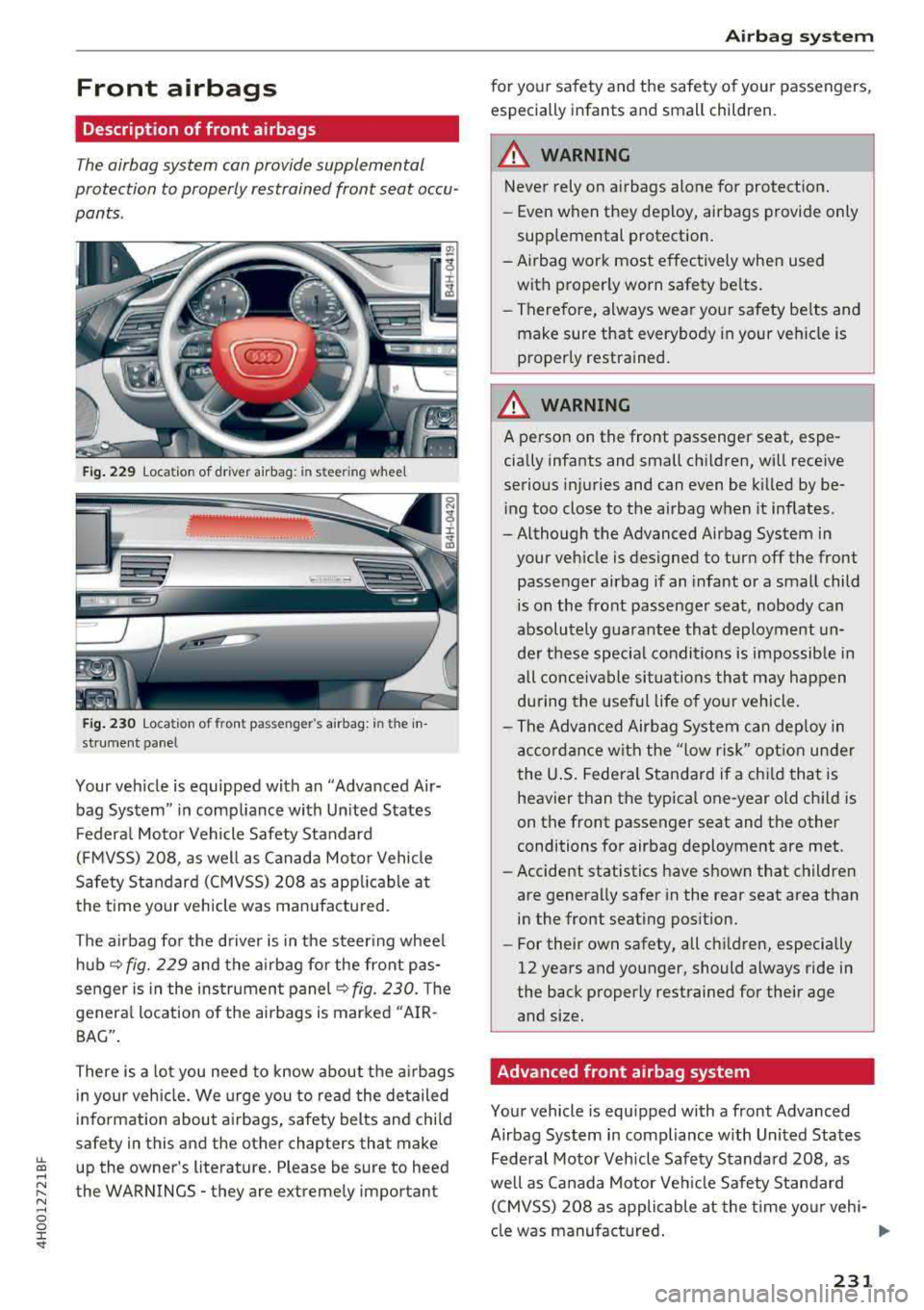
Front airbags
Description of front airbags
The airbag system can provide supplemental
protection to properly restrained front seat occu
pants .
Fig. 229 Location of driver airbag: in steering wheel
Fig. 230 Location of front passenger's airbag : in the in
strument panel
Your vehicle is equipped with an "Advanced Air
bag System" in compliance with United States
Federal Motor Vehicle Safety Standard
(FMVSS) 208, as well as Canada Motor Vehicle
Safety Standard (CMVSS) 208 as applicable at
the time your vehicle was manufactured .
The airbag for the driver is in the steer ing wheel
hub ~ fig. 229 and the airbag for the front pas
senger is in the instrument panel
~ fig. 230. The
general location of the airbags is marked
"AIR
BAG" .
There is a lot you need to know about the airbags
in your vehicle. We urge you to read the detailed
information about airbags, safety belts and child
safety in this and the other chapters that make
lL ~ up the owner's literature. Please be sure to heed
~ the WARNINGS -they are extreme ly important N ...... 0 0 :c '
for your safety and the safety of your passengers,
especially infants and small children.
A WARNING
-
Never rely on airbags alone for protection.
- Even when they deploy, airbags provide only
supplemental protection.
-Airbag work most effectively when used with properly worn safety belts.
- Therefore, always wear your safety belts and
make sure that everybody in your vehicle is
properly restrained.
_&. WARNING
A person on the front passenger seat, espe
cially infants and small children, will receive
serious injuries and can even be killed by be ing too close to the airbag when it inflates.
- Although the Advanced Airbag System in
your vehicle is designed to turn off the front
passenger airbag if an infant or a small child
is on the front passenger seat, nobody can
absolutely guarantee that deployment un
der these specia l conditions is impossib le in
all conceivable situations that may happen
during the useful life of your vehicle.
- The Advanced Airbag System can dep loy in
accordance with the "low risk" opt ion under
the U.S. Federal Standard if a child that is
heavier than the typical one-year old child is
on the front passenger seat and the other
conditions for airbag deployment are met.
- Accident statistics have shown that children
are generally safer in the rear seat area than
in the front seating position.
- For their own safety, all children, especially
12 years and younger, should always ride in
the back properly restrained for their age
and size.
Advanced front airbag system
Your vehicle is equipped with a front Advanced
Airbag System in compliance with United States Federal Motor Vehicle Safety Standard 208, as
well as Canada Motor Vehicle Safety Standard (CMVSS) 208 as applicable at the time your vehi-
cle was manufactured .
IJJ,,
231
Page 234 of 356

Airbag syste m
The front Advanced Airbag System supp lements
the safety belts to provide additional protection
for the dr iver's and front passenger's heads and
upper bodies in frontal crashes. The airbags in
flate only in frontal impacts when the veh icle de
celerat ion is high enough.
The front Advanced Airbag System for the front
seat occupants is not a substitute for your safety belts. Rather, it is part of the overall occupant re
stra int system in your vehicle. Always remember
that the a irbag system can only help to protect
you, if you are sitt ing upr ight, wear ing your safe
ty belt and wear ing it prope rly. This is why you
and your passengers must always be prope rly re
stra ined, not just because the law req uires yo u to
be .
The Advanced Airbag System i n your veh icle has
been ce rt ified to meet the " low r isk" requ ire
men ts for 3 and 6 yea r-old children on the pas
senger side and very sma ll adults on the driver
side . The low risk dep loyment criteria are intend
ed to he lp reduce the risk of injury through inter
action with the front airbag that can occur, for
examp le, by being too close to the steering wheel
and instrument panel when the airbag inflates .
In addition, the system has been certified to
comp ly w ith the "suppression" requirements of
the Safety Standard, to turn
off the front a irbag
for infants 12 months old and younger who are
restrained on the front passenger seat in c hild re
stra ints that are listed in the Standa rd
¢ page 251, Child restraints and Advanced Air
bags.
"Suppress ion" requ ires t he front a irbag on the
passenger side to be turned
off if:
- a chi ld up to about one year of age is restra ined
on the front passenger seat in one of the rear
facing o r fo rward-fac ing infant restra ints listed
i n Federal Motor Vehicle Safety Standard
208
with wh ic h the Advanced Airbag System in your
vehicle was ce rt ified. For a l isting of the c hild
restra ints that were used to certify your veh i
cle's compliance with the US Safety Standard
¢ page 251,
232
-weight less than a threshold leve l stored in t he
control unit is detected on the front passenger
seat.
When a person is detected on the fron t passen
ger seat, weig hing more than the total weight of
a chi ld that is about 1 year old restrained in one
of the rea r-facing or forward-fac ing infant re
straints (listed in Federal Motor Vehicle Safety
Standard
208 with w hich the Advanced Airbag
System in your vehicle was certified), the front
a irbag on the passenger s ide may or may not de
ploy.
The
PASSENGER AIR BA G OFF light comes on
whe n the electronic control unit detects a tota l
weight on t he front passenger seat that requ ires
t h e front a irbag to be tur ned
off . If t he PASSEN
GER AIR BAG OFF
light does not come on, the
front a irbag on the passenge r side has no t been
tu rne d
off by t he control unit and can dep loy if
the control unit senses an impact t hat meets the
conditions stored in its memory.
If the total weig ht on the front passe nger sea t is
more than that of a typ ica l 1 year-o ld, but less
than the weight of a small adult, the front airbag
on the passenger side may dep loy (the
PASSEN
GER AIR BAG O FF
light does not come on).
For example , the airbag ma y deplo y if:
- a small ch ild that is heav ier than a typ ica l 1
year-old child is on the front passenger seat (regard less of whethe r the child is in one of t he
child seats listed
¢ page 251),
-a child who has outgrown c hild res traints is on
the front passenge r seat.
If the front passenger a irbag is tu rned
off, the
PA SSENGER AIR BAG OFF light in the center of
t h e i nstr ument pane l w ill come on and s tay on.
The front airbag on the passenger side may
not
deploy (the PASSENGER AIR BAG OFF light does
not ill uminate and stay lit) if:
- a small adult or teenager is on the front pas
senger seat
- a passenger who is not s itting upright with
their back against a no n-reclined backrest with
their feet on the veh icle floor in front of the
seat is on the front passenger seat .