Page 552 of 672
5528-2. Steps to take in an emergency
SIENNA_OM_OM08007U_(U)
WARNING
■Maintenance of the tires
Each tire, including the spare (if provided), should be checked monthly
when cold and inflated to the inflation pressure recommended by the
vehicle manufacturer on the vehicle placard or tire inflation pressure
label (tire and load information label). (If your vehicle has tires of a dif-
ferent size than the size indicated on the vehicle placard or tire inflation
pressure label [tire and load information label], you should determine
the proper tire inflation pressure for those tires.)
As an added safety feature, your vehicle has been equipped with a tire
pressure monitoring system (TPMS-ti re pressure warning system) that
illuminates a low tire pre ssure telltale (tire pressure warning light) when
one or more of your tires is significantly under-inflated. Accordingly,
when the low tire pressure telltale (tire pressure warning light) illumi-
nates, you should stop and check your tires as soon as possible, and
inflate them to the proper pressure. Driving on a significantly under-
inflated tire causes the tire to overheat and can lead to tire failure.
Under-inflation also reduces fuel effi ciency and tire tread life, and may
affect the vehicle’s hand ling and stopping ability.
Please note that the TPMS (tire pres sure warning system) is not a sub-
stitute for proper ti re maintenance, and it is the driver’s responsibility to
maintain correct tire pressure, even if under-inflation has not reached
the level to trigger illumina tion of the TPMS low tire pressure telltale (tire
pressure warning light).
Your vehicle has also been equipped with a TPMS (tire pressure warn-
ing system) malfunction indicator to indicate when the system is not
operating properly. The TPMS (tire pressure warning system) malfunc-
tion indicator is combined with the lo w tire pressure telltale (tire pressure
warning light). When the system dete cts a malfunction, the telltale will
flash for approximately one minute and then remain continuously illumi-
nated. This sequence will continue up on subsequent vehicle start-ups
as long as the malfunction exists. When the malfunction indicator is illu-
minated, the system may not be able to detect or signal low tire pres-
sure as intended.
TPMS (tire pressure warning system) malfunctions may occur for a vari-
ety of reasons, including the installati on of replacement or alternate tires
or wheels on the vehicle that prevent the TPMS (tire pressure warning
system) from functioning properly. Always check the TPMS (tire pres-
sure warning system) malfunction te lltale after replacing one or more
tires or wheels on your vehicle to ensure that the replacement or alter-
nate tires and wheels allow the TPMS (tire pressure warning system) to
continue to function properly.
Page 569 of 672
5698-2. Steps to take in an emergency
SIENNA_OM_OM08007U_(U)
8
When trouble arises
■Messages displays
The message illustrations used are intended as examples, and may differ
from the image that is actually displayed on the multi-information display.
■ Warning buzzer
P. 550
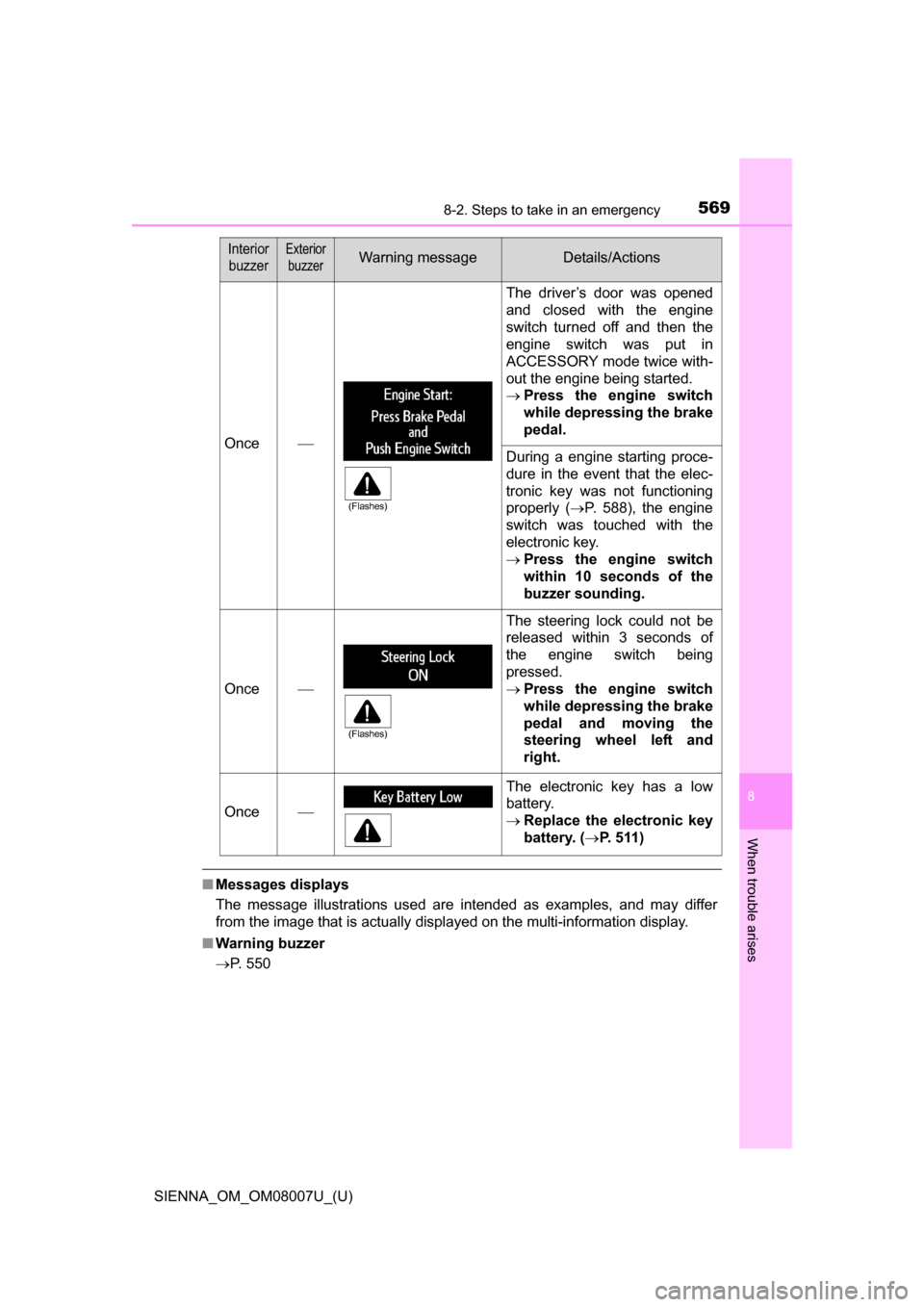
Once
The driver’s door was opened
and closed with the engine
switch turned off and then the
engine switch was put in
ACCESSORY mode twice with-
out the engine being started.
Press the engine switch
while depressing the brake
pedal.
During a engine starting proce-
dure in the event that the elec-
tronic key was not functioning
properly ( P. 588), the engine
switch was touched with the
electronic key.
Press the engine switch
within 10 seconds of the
buzzer sounding.
Once
The steering lock could not be
released within 3 seconds of
the engine switch being
pressed.
Press the engine switch
while depressing the brake
pedal and moving the
steering wheel left and
right.
Once
The electronic key has a low
battery.
Replace the electronic key
battery. ( P. 511)
Interior
buzzerExterior buzzerWarning messageDetails/Actions
(Flashes)
(Flashes)
Page 571 of 672
5718-2. Steps to take in an emergency
SIENNA_OM_OM08007U_(U)
8
When trouble arises
NOTICE
■When replacing the tires
When removing or fitting the wheels, tires or the tire pressure warning
valve and transmitter, contact your Toyota dealer as the tire pressure
warning valve and transmitter may be damaged if not handled correctly.
■When driving over bumps
If a vehicle has a flat tire, the vehicle height will be lower than usual.
Ensure that nothing strikes the bottom of the vehicle.
■To avoid damaging the tire pressure warning valves and transmit-
ters
When a tire is repaired with liquid sealants, the tire pressure warning
valve and transmitter may not operate properly. If a liquid sealant is
used, contact your Toyota dealer or other qualified service shop as soon
as possible. Make sure to replace the tire pressure warning valve and
transmitter when replacing the tire. ( P. 497)
Page 572 of 672
572
SIENNA_OM_OM08007U_(U)
8-2. Steps to take in an emergency
If you have a flat tire (vehicles with a
compact spare tire)
●Stop the vehicle in a safe place on a hard, flat surface.
● Set the parking brake.
● Shift the shift lever to P.
● Stop the engine.
● Turn on the emergency flashers. ( P. 536)
Your vehicle is equipped with a spare tire. The flat tire can be
replaced with the spare tire.
For details about tires: P. 4 9 6
WARNING
■If you have a flat tire
Do not continue driving with a flat tire.
Driving even a short distance with a fl at tire can damage the tire and the
wheel beyond repair, which could result in an accident.
Before jacking up the vehicle
Page 573 of 672
5738-2. Steps to take in an emergency
SIENNA_OM_OM08007U_(U)
8
When trouble arises
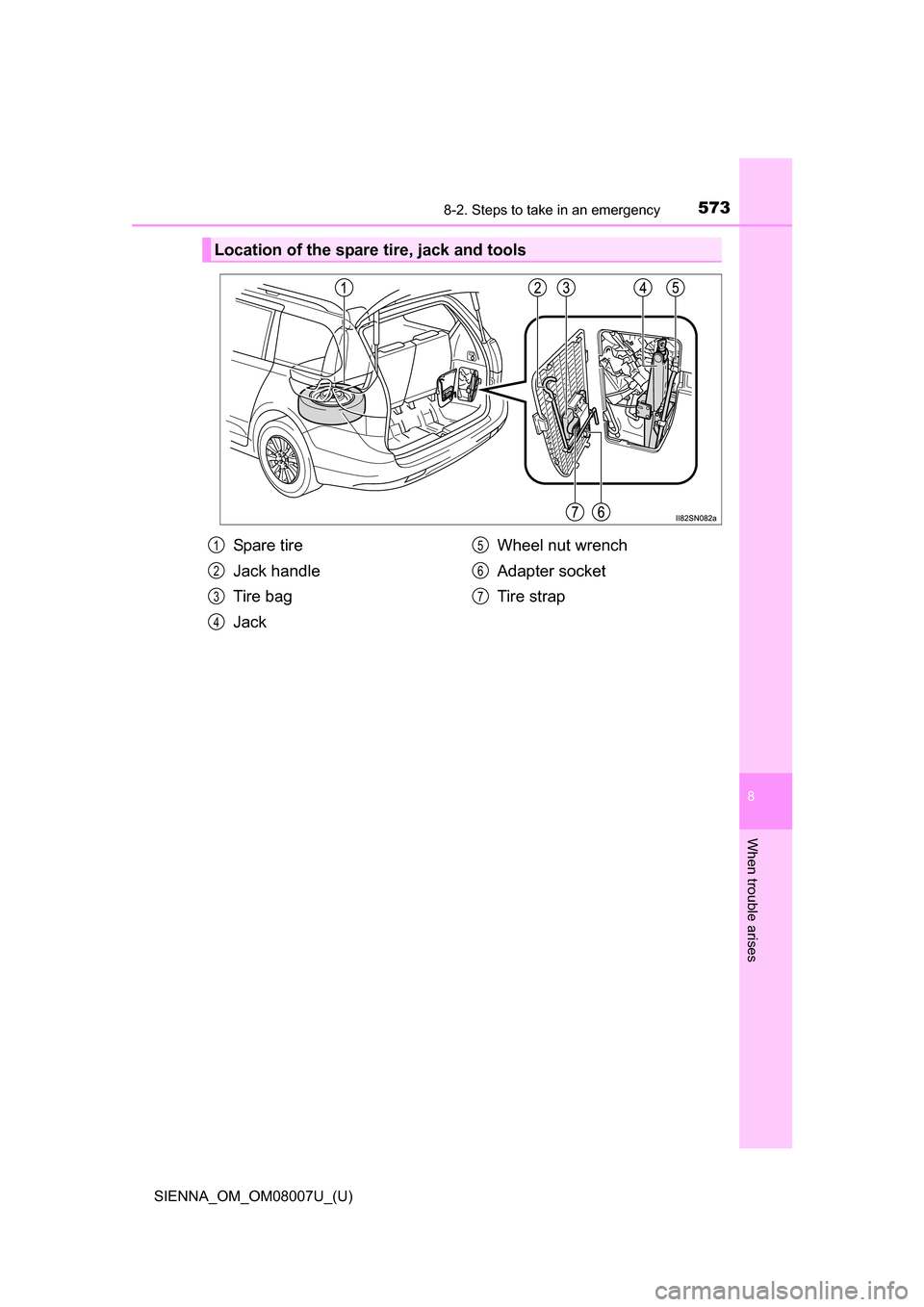
Location of the spare tire, jack and tools
Spa re ti r e
Jack handle
Tire bag
JackWheel nut wrench
Adapter socket
Tire strap1
2
3
4
5
6
7
Page 575 of 672
5758-2. Steps to take in an emergency
SIENNA_OM_OM08007U_(U)
8
When trouble arises
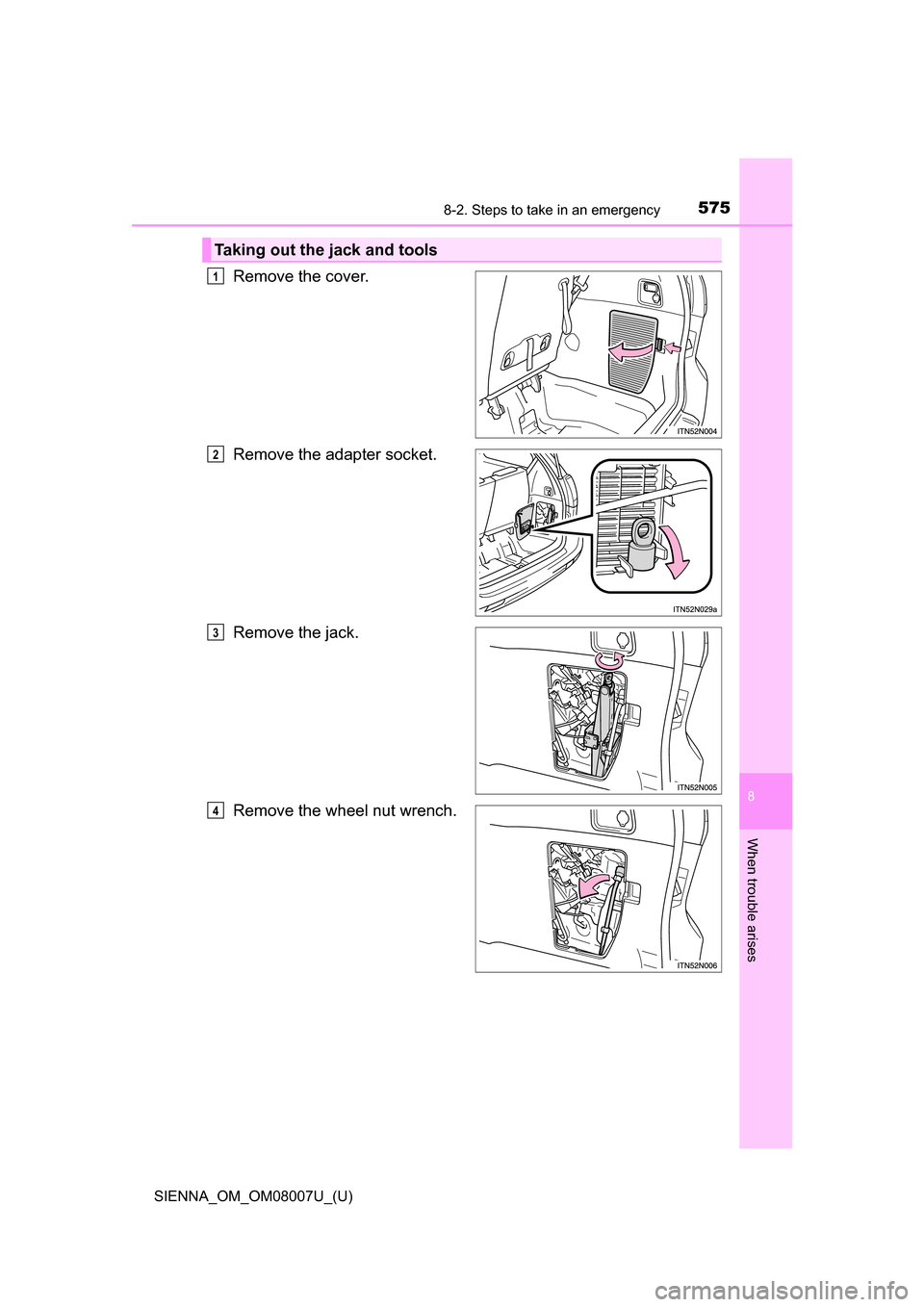
Remove the cover.
Remove the adapter socket.
Remove the jack.
Remove the wheel nut wrench.
Taking out the jack and tools
1
2
3
4
Page 577 of 672
5778-2. Steps to take in an emergency
SIENNA_OM_OM08007U_(U)
8
When trouble arises
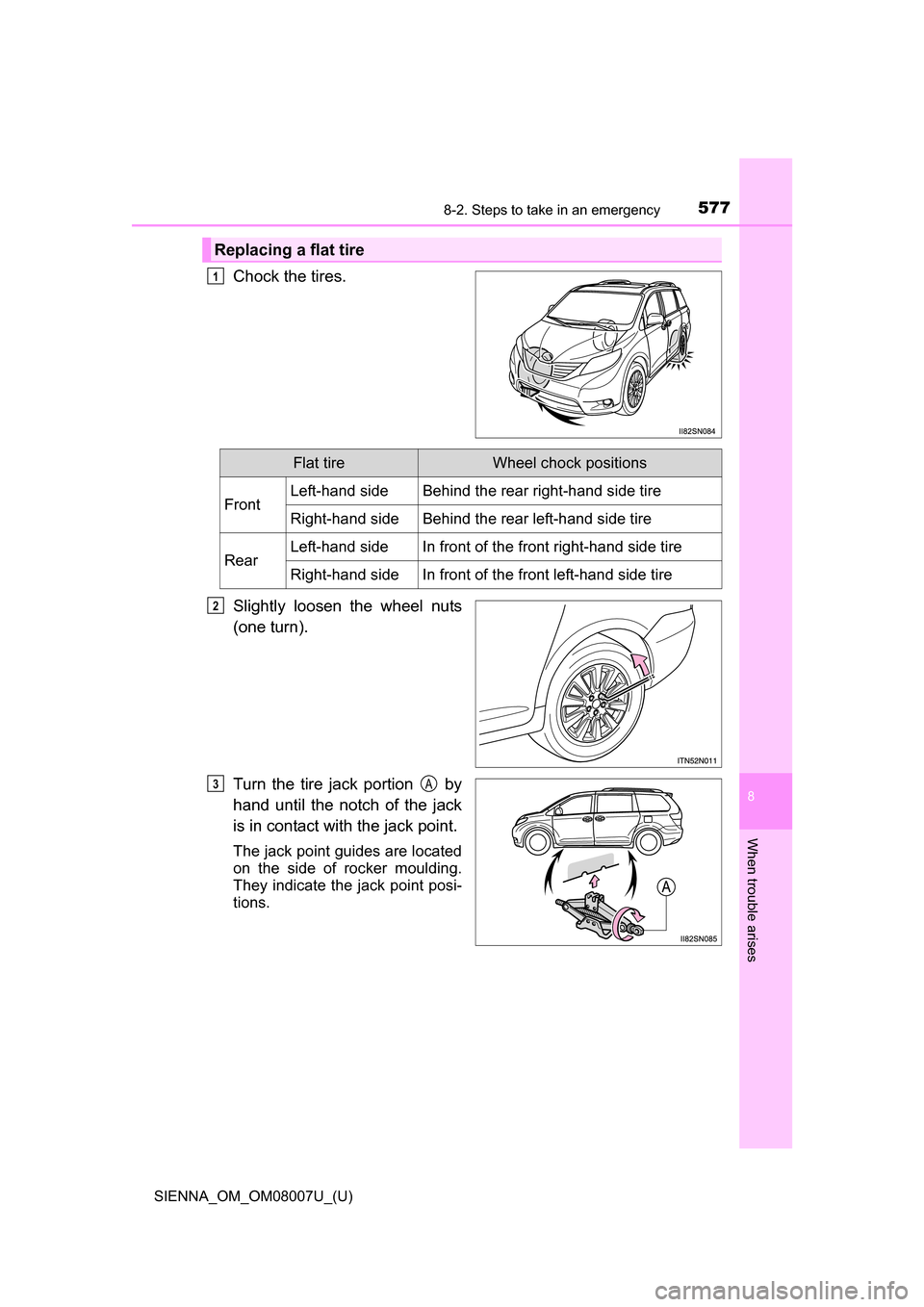
Chock the tires.
Slightly loosen the wheel nuts
(one turn).
Turn the tire jack portion by
hand until the notch of the jack
is in contact with the jack point.
The jack point guides are located
on the side of rocker moulding.
They indicate the jack point posi-
tions.
Replacing a flat tire
1
Flat tireWheel chock positions
FrontLeft-hand sideBehind the rear right-hand side tire
Right-hand sideBehind the rear left-hand side tire
RearLeft-hand sideIn front of the front right-hand side tire
Right-hand sideIn front of the front left-hand side tire
2
3A
Page 578 of 672
5788-2. Steps to take in an emergency
SIENNA_OM_OM08007U_(U)
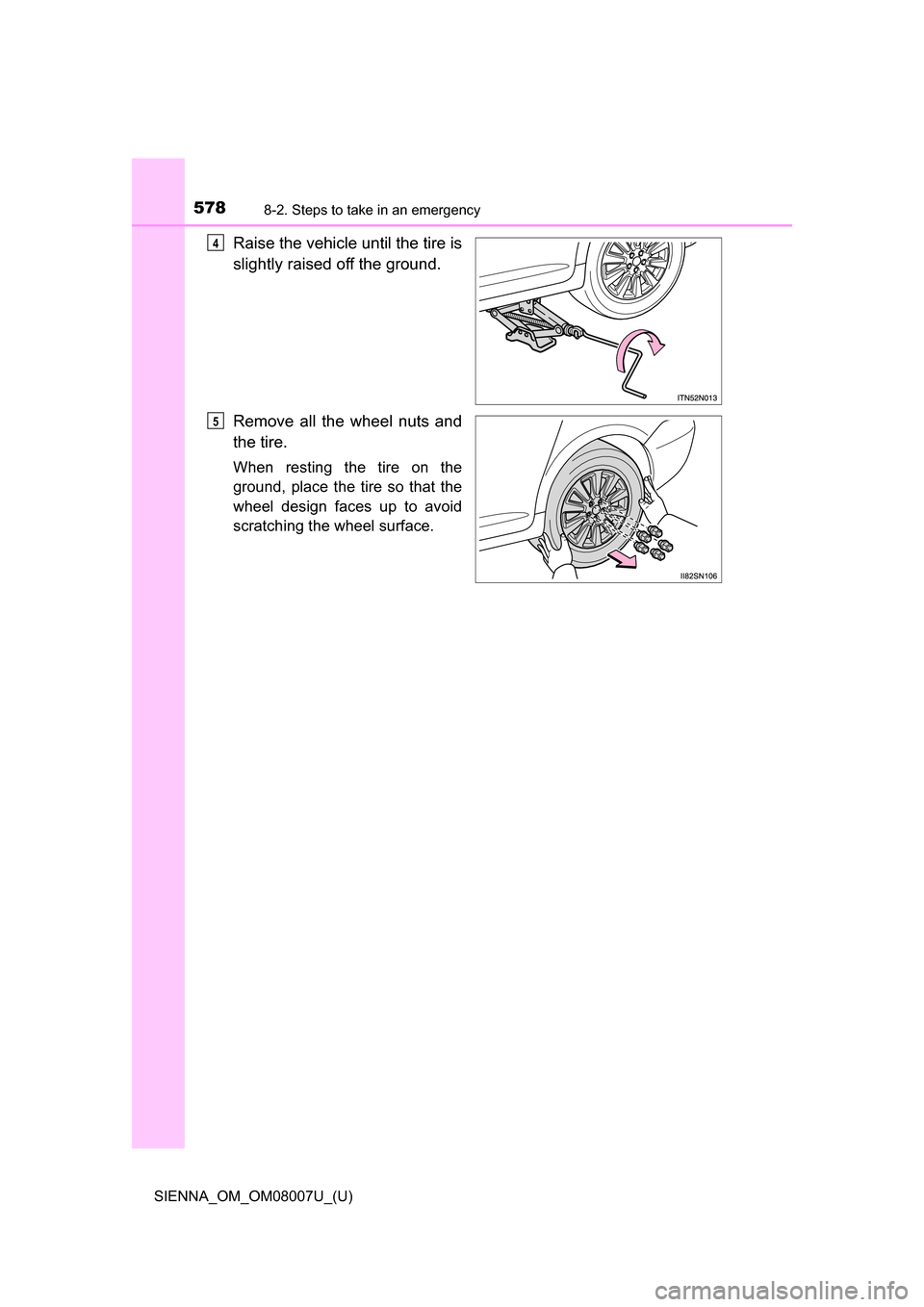
Raise the vehicle until the tire is
slightly raised off the ground.
Remove all the wheel nuts and
the tire.
When resting the tire on the
ground, place the tire so that the
wheel design faces up to avoid
scratching the wheel surface.
4
5