2017 TOYOTA SIENNA wheel
[x] Cancel search: wheelPage 615 of 672
SIENNA_OM_OM08007U_(U)
6159-1. Specifications
9
Vehicle specifications
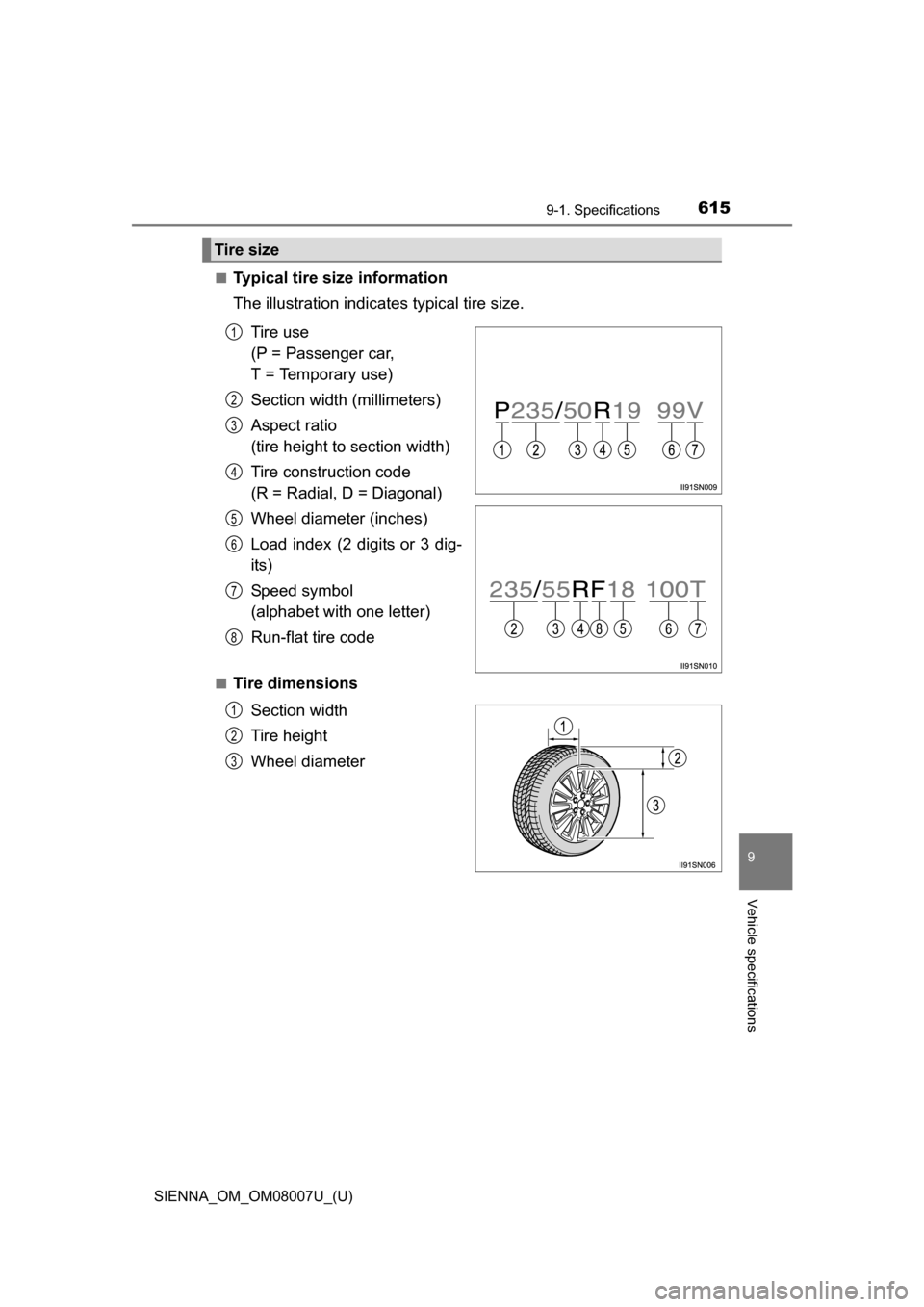
■Typical tire size information
The illustration indicates typical tire size.
■Tire dimensionsSection width
Tire height
Wheel diameter
Tire size
Tire use
(P = Passenger car,
T = Temporary use)
Section width (millimeters)
Aspect ratio
(tire height to section width)
Tire construction code
(R = Radial, D = Diagonal)
Wheel diameter (inches)
Load index (2 digits or 3 dig-
its)
Speed symbol
(alphabet with one letter)
Run-flat tire code1
2
3
4
5
6
7
8
1
2
3
Page 617 of 672
SIENNA_OM_OM08007U_(U)
6179-1. Specifications
9
Vehicle specifications
■Treadwear
The treadwear grade is a comparative rating based on the wear
rate of the tire when tested under controlled conditions on a speci-
fied government test course.
For example, a tire graded 150 would wear one and a half (1-1/2)
times as well on the government course as a tire graded 100.
The relative performance of tire s depends upon the actual condi-
tions of their use. Performance may differ significantly from the norm
due to variations in driving habits , service practices and differences
in road characteristics and climate.
■Traction AA, A, B, C
The traction grades, from highest to lowest, are AA, A, B and C,
and they represent the tire’s ability to stop on wet pavement as
measured under controlled conditio ns on specified government test
surfaces of asphalt and concrete.
A tire marked C may have poor traction performance.
Warning: The traction grade assigned to this tire is based on braking
(straight ahead) traction tests and does not include cornering (turn-
ing) traction.
■Temperature A, B, C
The temperature grades are A (the hi ghest), B, and C, representing
the tire’s resistance to the generation of heat and its ability to dissi-
pate heat when tested under cont rolled conditions on a specified
indoor laboratory test wheel.
Sustained high temperature can cause the material of the tire to
degenerate and reduce tire life, and excessive temperature can lead
to sudden tire failure.
Grade C corresponds to a level of performance which all passenger
car tires must meet under the Federal Motor Vehicle Safety
Standard No. 109.
Grades B and A represent higher le vels of performance on the labo-
ratory test wheel than the minimum required by law.
Warning: The temperature grades of a tire assume that it is properly
inflated and not overloaded.
Excessive speed, underinflation, or excessive loading, either sepa-
rately or in combination, can cause heat buildup and possible tire
failure.
Page 619 of 672
SIENNA_OM_OM08007U_(U)
6199-1. Specifications
9
Vehicle specifications
RimA metal support for a tire or a tire and tube
assembly upon which the tire beads are
seated
Rim diameter
(Wheel diameter) Nominal diameter of the bead seat
Rim size designation Rim diameter and width
Rim type designation The industry manufacturer’s designation for a
rim by style or code
Rim width Nominal distance between rim flanges
Vehicle capacity
weight (Total load
capacity) The rated cargo and luggage load plus 150 lb.
(68 kg) times the vehicle’s designated seating
capacity
Vehicle maximum load
on the tire The load on an individual tire that is deter-
mined by distributing to each axle its share of
the maximum loaded vehicle weight, and
dividing by two
Vehicle normal load
on the tire The load on an individual tire that is deter-
mined by distributing to each axle its share of
curb weight, accessory weight, and normal
occupant weight (distributed in accordance
with Table 1
* below), and dividing by two
Weather side The surface area of the rim not covered by the
inflated tire
Bead The part of the tire that is made of steel wires,
wrapped or reinforced by ply cords and that is
shaped to fit the rim
Bead separation A breakdown of the bond between compo-
nents in the bead
Bias ply tire A pneumatic tire in which the ply cords that
extend to the beads are laid at alternate
angles substantially less than 90 degrees to
the centerline of the tread
Carcass The tire structure, except tread and sidewall
rubber which, when inflated, bears the load
Chunking The breaking away of pieces of the tread or
sidewall
Cord The strands forming the plies in the tire
Tire related termMeaning
Page 621 of 672
SIENNA_OM_OM08007U_(U)
6219-1. Specifications
9
Vehicle specifications
Open spliceAny parting at any junction of tread, sidewall,
or innerliner that extends to cord material
Outer diameter The overall diameter of an inflated new tire
Overall width The linear distance between the exteriors of
the sidewalls of an inflated tire, including ele-
vations due to labeling, decorations, or protec-
tive bands or ribs
Passenger car tire A tire intended for use on passenger cars,
multipurpose passenger vehicles, and trucks,
that have a gross vehicle weight rating
(GVWR) of 10,000 lb. or less
Ply A layer of rubber-coated parallel cords
Ply separation A parting of rubber compound between adja-
cent plies
Pneumatic tire A mechanical device made of rubber, chemi-
cals, fabric and steel or other materials, that,
when mounted on an automotive wheel, pro-
vides the traction and contains the gas or fluid
that sustains the load
Radial ply tire A pneumatic tire in which the ply cords that
extend to the beads are laid at substantially 90
degrees to the centerline of the tread
Reinforced tire A tire designed to operate at higher loads and
at higher inflation pressures than the corre-
sponding standard tire
Section width The linear distance between the exteriors of
the sidewalls of an inflated tire, excluding ele-
vations due to labeling, decoration, or protec-
tive bands
Sidewall That portion of a tire between the tread and
bead
Sidewall separation The parting of the rubber compound from the
cord material in the sidewall
Tire related termMeaning
Page 622 of 672
622
SIENNA_OM_OM08007U_(U)
9-1. Specifications
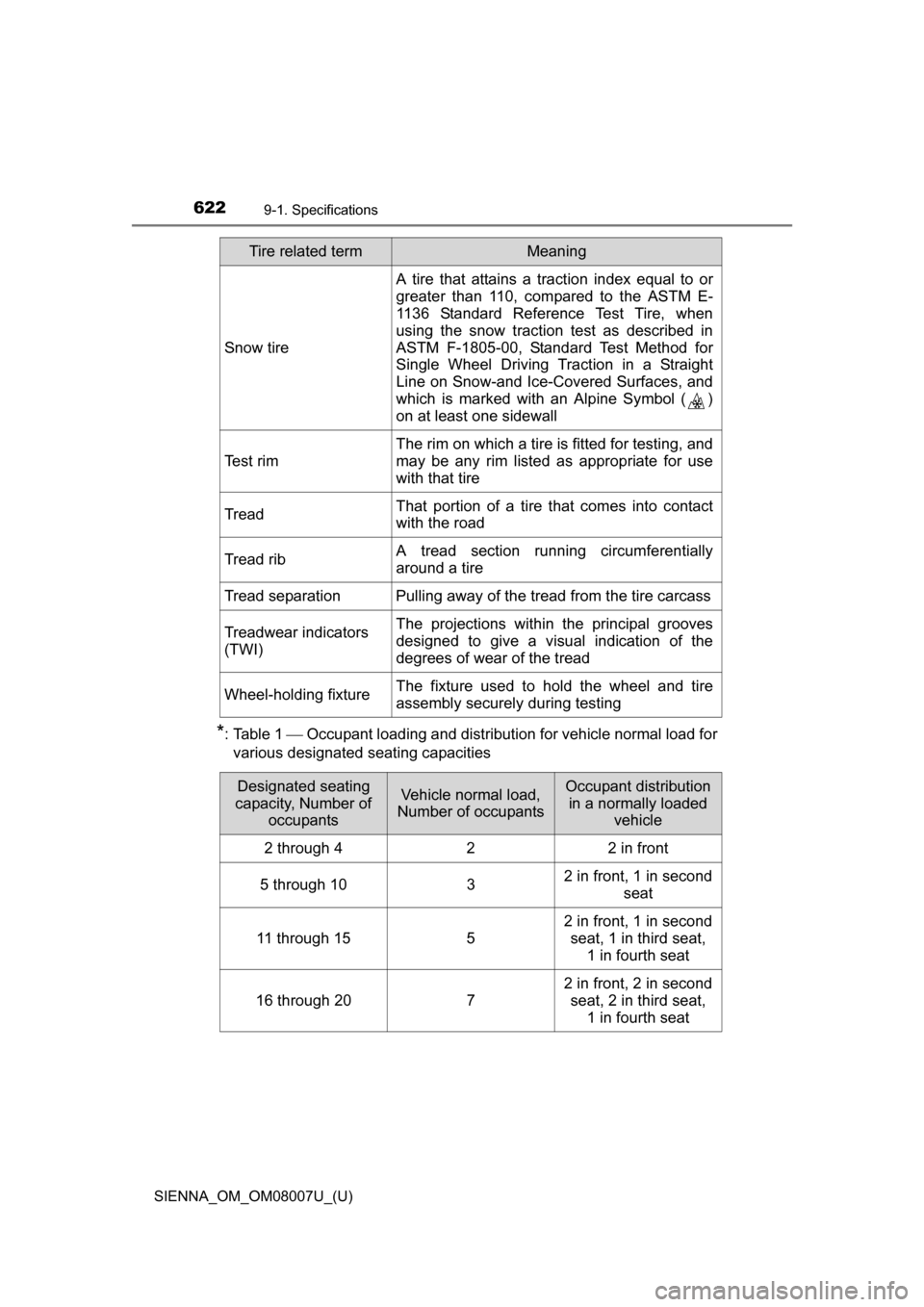
*: Table 1 Occupant loading and distribution for vehicle normal load for
various designated seating capacities
Snow tire
A tire that attains a traction index equal to or
greater than 110, compared to the ASTM E-
1136 Standard Reference Test Tire, when
using the snow traction test as described in
ASTM F-1805-00, Standard Test Method for
Single Wheel Driving Traction in a Straight
Line on Snow-and Ice-Covered Surfaces, and
which is marked with an Alpine Symbol ( )
on at least one sidewall
Test rim The rim on which a tire is fitted for testing, and
may be any rim listed as appropriate for use
with that tire
Tread That portion of a tire that comes into contact
with the road
Tread rib A tread section running circumferentially
around a tire
Tread separation Pulling away of th e tread from the tire carcass
Treadwear indicators
(TWI) The projections within the principal grooves
designed to give a visual indication of the
degrees of wear of the tread
Wheel-holding fixture The fixture used to hold the wheel and tire
assembly securely
during testing
Tire related termMeaning
Designated seating
capacity, Number of occupantsVehicle normal load,
Number of occupantsOccupant distribution
in a normally loaded vehicle
2 through 4 2 2 in front
5 through 10 32 in front, 1 in second
seat
11 through 15 52 in front, 1 in second
seat, 1 in third seat, 1 in fourth seat
16 through 20 72 in front, 2 in second
seat, 2 in third seat, 1 in fourth seat
Page 651 of 672
651What to do if... (Troubleshooting)
SIENNA_OM_OM08007U_(U)
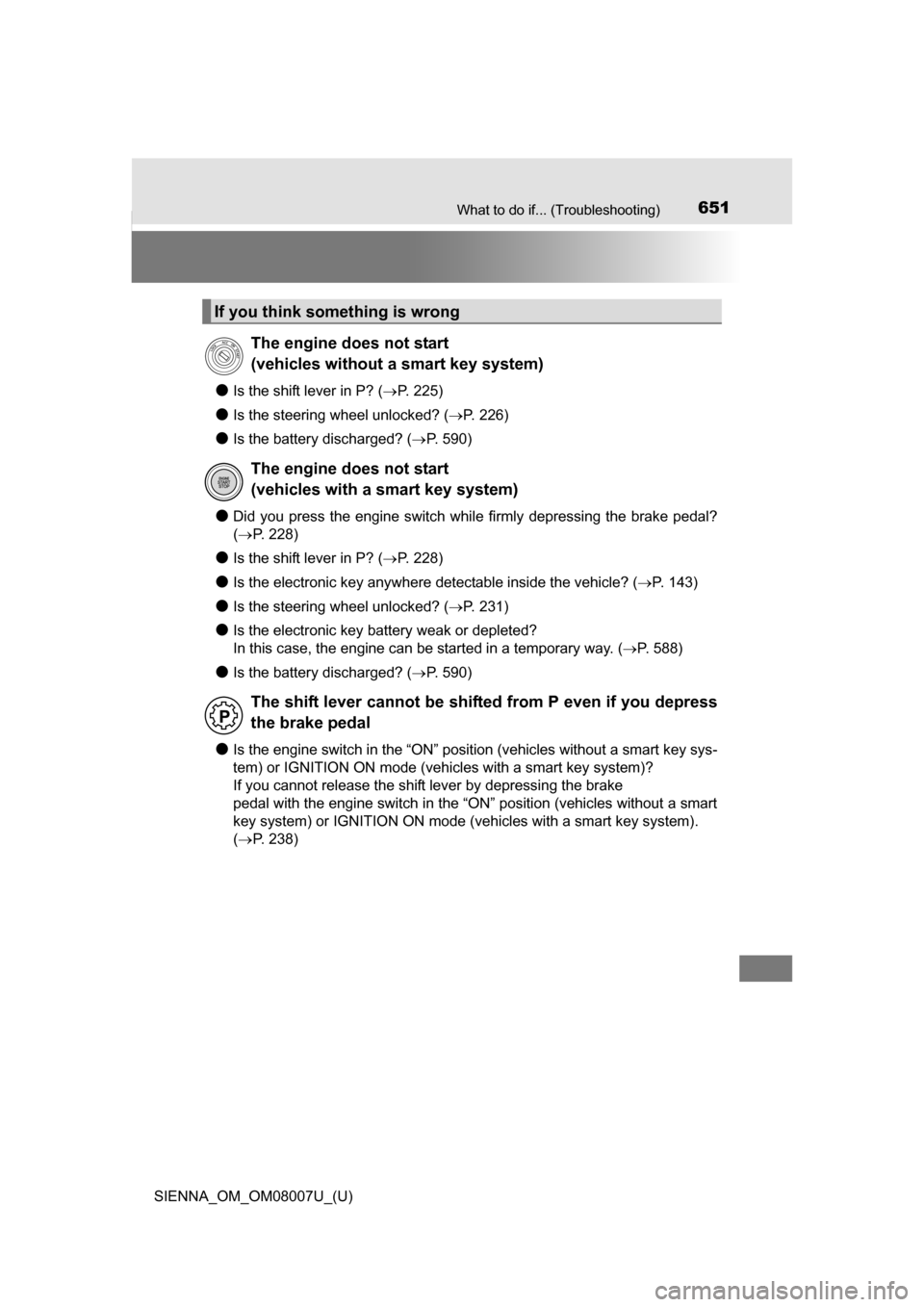
●Is the shift lever in P? (P. 225)
●Is the steering wheel unlocked? ( P. 226)
●Is the battery discharged? (P. 590)
●Did you press the engine switch while firmly depressing the brake pedal?
( P. 228)
●Is the shift lever in P? ( P. 228)
●Is the electronic key anywhere detectable inside the vehicle? ( P. 143)
●Is the steering wheel unlocked? (P. 231)
●Is the electronic key battery weak or depleted?
In this case, the engine can be started in a temporary way. ( P. 588)
●Is the battery discharged? (P. 590)
●Is the engine switch in the “ON” position (vehicles without a smart key sys-
tem) or IGNITION ON mode (vehicles with a smart key system)?
If you cannot release the shift lever by depressing the brake
pedal with the engine switch in the “ON” position (vehicles without a smart
key system) or IGNITION ON mode (vehicles with a smart key system).
( P. 238)
If you think something is wrong
The engine does not start
(vehicles without a smart key system)
The engine does not start
(vehicles with a smart key system)
The shift lever cannot be shifted from P even if you depress
the brake pedal
Page 652 of 672
652What to do if... (Troubleshooting)
SIENNA_OM_OM08007U_(U)
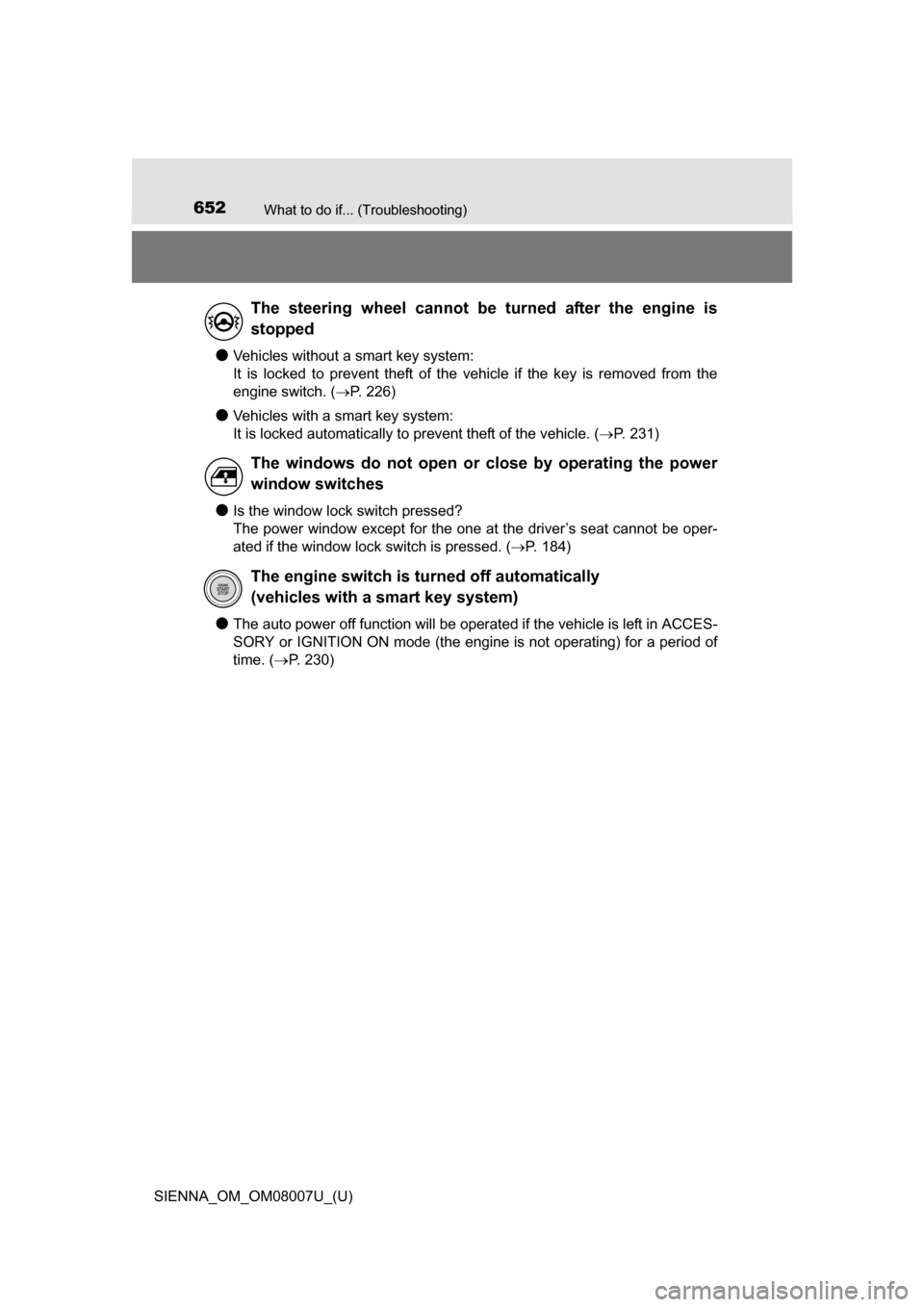
●Vehicles without a smart key system:
It is locked to prevent theft of the vehicle if the key is removed from the
engine switch. (P. 226)
●Vehicles with a smart key system:
It is locked automatically to prevent theft of the vehicle. ( P. 231)
●Is the window lock switch pressed?
The power window except for the one at the driver’s seat cannot be oper-
ated if the window lock switch is pressed. (P. 184)
●The auto power off function will be operated if the vehicle is left in ACCES-
SORY or IGNITION ON mode (the engine is not operating) for a period of
time. ( P. 230)
The steering wheel cannot be turned after the engine is
stopped
The windows do not open or close by operating the power
window switches
The engine switch is tu rned off automatically
(vehicles with a smart key system)
Page 656 of 672
656Alphabetical index
SIENNA_OM_OM08007U_(U)
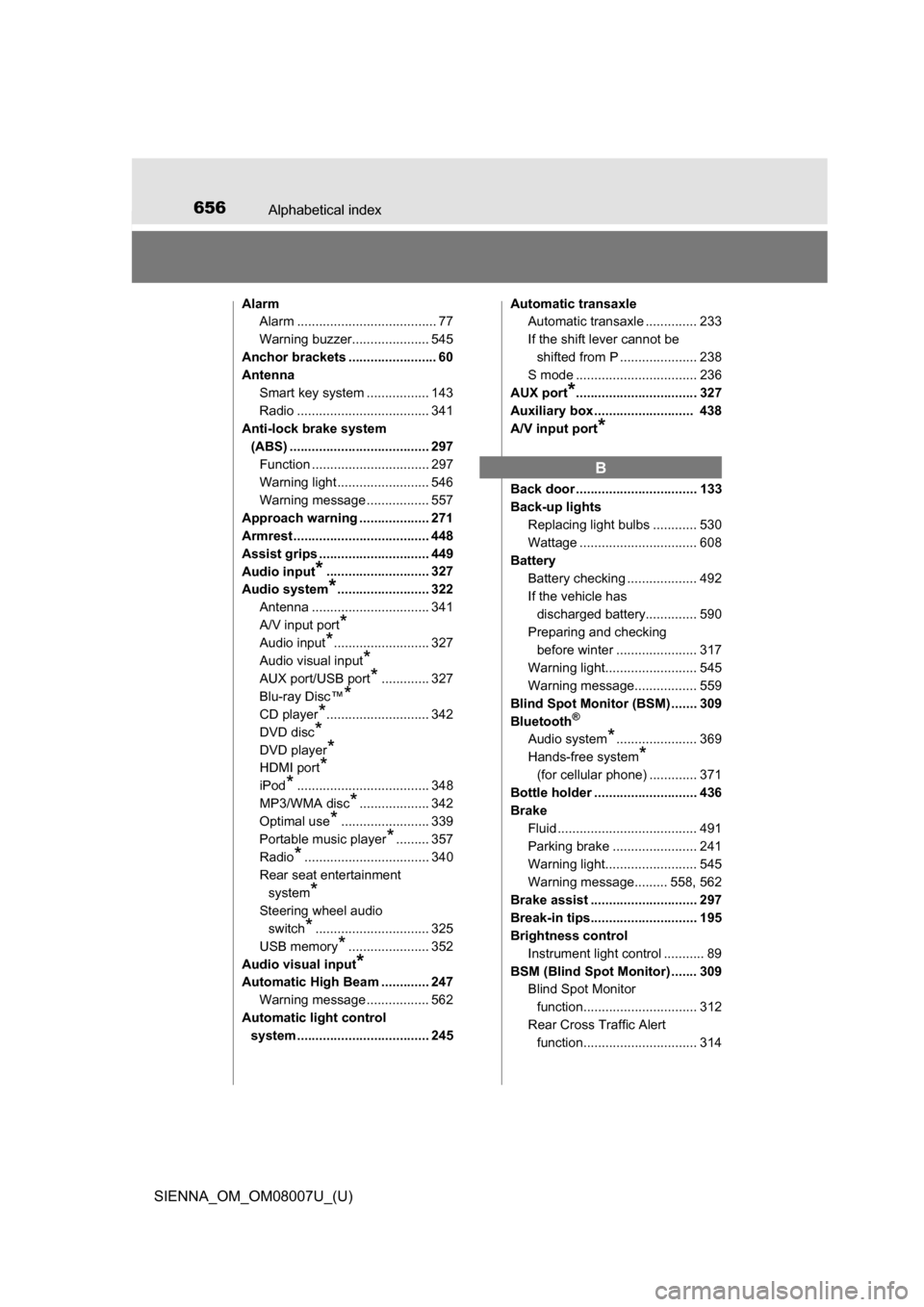
AlarmAlarm ...................................... 77
Warning buzzer..................... 545
Anchor brackets ........................ 60
Antenna Smart key system ................. 143
Radio .................................... 341
Anti-lock brake system
(ABS) ...................................... 297Function ................................ 297
Warning light ......................... 546
Warning message ................. 557
Approach warning ................... 271
Armrest ..................................... 448
Assist grips .............................. 449
Audio input
*............................ 327
Audio system
*......................... 322
Antenna ................................ 341
A/V input port
*
Audio input*.......................... 327
Audio visual input
*
AUX port/USB port*............. 327
Blu-ray Disc™
*
CD player*............................ 342
DVD disc
*
DVD player*
HDMI port*
iPod*.................................... 348
MP3/WMA disc
*................... 342
Optimal use
*........................ 339
Portable music player
*......... 357
Radio
*.................................. 340
Rear seat entertainment
system
*
Steering wheel audio switch
*............................... 325
USB memory
*...................... 352
Audio visual input
*
Automatic High Beam ............. 247 Warning message ................. 562
Automatic light control system .................................... 245 Automatic transaxle
Automatic transaxle .............. 233
If the shift lever cannot be
shifted from P ..................... 238
S mode ................................. 236
AUX port
*................................. 327
Auxiliary box ........................... 438
A/V input port
*
Back door ................................. 133
Back-up lights Replacing light bulbs ............ 530
Wattage ................................ 608
Battery Battery checking ................... 492
If the vehicle has discharged battery.............. 590
Preparing and checking before winter ...................... 317
Warning light......................... 545
Warning message................. 559
Blind Spot Monitor (BSM) ....... 309
Bluetooth
®
Audio system*...................... 369
Hands-free system
*
(for cellular phone) ............. 371
Bottle holder ............................ 436
Brake Fluid ...................................... 491
Parking brake ....................... 241
Warning light......................... 545
Warning message......... 558, 562
Brake assist ............................. 297
Break-in tips............................. 195
Brightness control Instrument light control ........... 89
BSM (Blind Spot Monitor) ....... 309 Blind Spot Monitor
function............................... 312
Rear Cross Traffic Alert function............................... 314
B