2017 RENAULT ALASKAN belt
[x] Cancel search: beltPage 225 of 340

The Stop/Start System is designed to prevent un-
necessary fuel consumption, exhaust emissions,
and noise during ajourney:
• When you stop the vehicle with the shift lever in
N(
Neutral) and clutch pedal released, the en-
gine is turned off automatically.
• When you push the clutch pedal, the engine is
automatically turned on.
CAUTION
At the end of the journey the engine must be
stopped and ignition turned off. Lock the vehicle
as normal. Turning the ignition switch OFF will
shut down all electrical systems. Failure to do
this may result in aflat battery.
NOTE
For model with Stop/Start System, use the spe-
cial battery that is enhanced in regard to the
charge-discharge capacity and life performance.
Avoid using anon-special battery for the Stop/
Start System, as this may cause early deteriora-
tion of the battery or amalfunction of the Stop/
Start System. For the battery, it is recommended
to use Genuine RENAULT parts. For more infor-
mation, contact an approved dealer or qualified
workshop.
NOTE
The Stop/Start System will not activate under
the following conditions:
• When the engine is kept idling without any
driving after the engine is turned on. •
When the engine coolant temperature is low.
• When the battery capacity is low.
• When the battery temperature is low.
• When the vehicle is moved.
• When the vacuum in the brake servo
decreases.
• When the engine bonnet is opened with the
engine running.
• When the engine is turned on with the engine
bonnet open.
• When the driver’s seat belt is not fastened.
• When the driver’s door is open.
• When the Stop/Start System indicator blinks
at
alow speed.
• When the fan speed control is in any position
other than OFF (0) while the air flow control is
in the front defogger position.
• When the front defogger switch is on.
• When the temperature inside the vehicle is
too high or low. (When the Auto air condition-
ing system is off, the Stop/Start System will
operate.)
• When the fan speed of the air conditioner is
set to the maximum speed.
• When the Stop/Start OFF switch is turned on.
• When the power consumption is large. •
When the vehicle is travelling at altitudes
higher than 2000
m(6562 ft) (MT model).
• For Manual Transmission (MT) models
• When the shift lever is in any position except
the
N(Neutral) position.
• When the clutch pedal is depressed.
• When the Remote Control Key is not in the
vehicle.
• When the steering wheel is turning or turned
more than 45 degrees.
NOTE
The engine will not restart even if the clutch pedal
is pressed while the Stop/Start System is acti-
vated under the following condition:
• When the engine bonnet is opened.
• When the driver seat belt is unfastened and
the driver’s door is opened.
• When the shift lever is not in the
N(Neutral)
position.
NOTE
It may take some time until the Stop/Start Sys-
tem activates under the following conditions:
• When the battery is discharged.
• When the outside temperature is low or high.
• When the battery is replaced or the battery
terminal is disconnected for extended peri-
ods and then reconnected.
STOP/START SYSTEM
(where fitted)
Starting and driving5-23
Page 226 of 340

NOTE
When the Stop/Start System indicator illumi-
nates, the engine starts running automatically
under at least one of the following conditions:
• The battery voltage becomes low (due to elec-
trical load from other vehicle systems like
headlights, heaters, etc., or auxiliary devices
connected to the 12 volt socket inside the
vehicle).
• The vehicle speed is above about
2km/h (1
MPH).
• The front defogger is operated.
• When the temperature inside the vehicle is
too high or low. (When the air conditioner is
off, the Stop/Start System will operate.)
• When the front defogger is turned on. (The
engine may not start depending on the out-
side temperature.)
• When the battery capacity is low.
• When the power consumption is high.
• When the clutch pedal is depressed.
CAUTION
Only engage gear when the clutch pedal is fully
depressed. NOTE
The following conditions will prevent the Stop/
Start System from automatically restarting the
engine. Starting the engine with the ignition
switch operation is then necessary:
• The driver’s seat belt is unfastened, and driv-
er’s door is open.
• The bonnet is open.
Use this system while waiting at stoplight, etc. When
the vehicle is stopped for long periods of time, turn
off the engine.
When the engine is stopped by the Stop/Start Sys-
tem, heating, cooling and dehumidifying functions
will be deactivated. To avoid the air conditioning
functions from being deactivated, turn off the Idling
Stop mode by pressing the Stop/Start OFF switch.
STOP/START SYSTEM DISPLAY
Engine stop When the engine is stopped the information is dis-
played for
afew seconds.
Stop/Start System ON or OFF
If the Stop/Start System is activated or deactivated
using the Stop/Start System OFF switch, the mes-
sage is shown.
CO2 or fuel saved and engine stop time JVS0341XZ JVS0638XZ
JVS0430XZ
5-24 Starting and driving
Page 234 of 340

TYRE RECOMMENDATION FOR 4WD
CAUTION
• Always use tyres of the same size, brand, con-
struction (bias, bias-belted or radial), and
tread pattern on all four wheels. Failure to do
so may result in acircumference difference
between tyres on the front and rear axles,
which will cause excessive tyre wear and may damage the transmission, transfer case and
differential gears.
• ONLY use spare tyres specified for the Four-
Wheel Drive (4WD) models.
If excessive tyre wear is found, it is recommended
that all four tyres be replaced with tyres of the same
size, brand, construction and tread pattern. The tyre
pressure and wheel alignment should also be
checked and corrected as necessary. Contact an
approved dealer or qualified workshop.
Snow tyres
If you install snow tyres, they must also be of the
same size, brand, construction and tread pattern on
all four wheels.
Tyre inflation pressure
Periodically check the pressures of all tyres, includ-
ing the spare, with agauge while at aservice sta-
tion. If necessary, adjust to the specified pressure.
Tyre pressures are shown on the tyre placard af-
fixed to the driver’s side centre pillar or rear access
door. Tyre rotation
RENAULT recommends that tyres should be rotated
every 5,000 km (3,000 miles).
Snow chains
Snow chains must be installed only on the rear
wheels and not on the front wheels.
Do not drive with snow chains on paved roads that are clear of snow. Driving with chains in such condi-
tions can cause damage to the various mechanisms of the vehicle due to overstress. When driving on
clear paved roads, be sure to change to Two-Wheel
Drive (2WD) mode. The rear differential lock is designed to transmit en-
gine power to the left and right rear wheels equally.
If your vehicle is stuck in sand, snow, mud, etc. or
one wheel is off the ground and the differential lock
is not on, engine power is transmitted to the wheel
with least resistance causing it to spin, leaving insuf-
ficient traction on the other wheel. The rear differen-
tial lock allows the left and right wheels to rotate as
au
nit, enabling your vehicle to free itself.
To lock the rear differential gear:
1) Stop the vehicle completely.
2) Turn the 4WD mode switch to the 4LO position. For operation of the 4WD mode switch, see
“Four-Wheel Drive (4WD) (where fitted)” earlier
in this section.
3) Push the differential lock mode switch to the ON position.
The differential lock indicator light will blink
in the meter and then remains on while the differ-
ential gear is completely locked. JVS0533XZ
REAR DIFFERENTIAL LOCKING
SYSTEM (where fitted)
5-32 Starting and driving
Page 251 of 340

When leaving your vehicle unoccupied:
• Always take the key with you
-even when leav-
ing the vehicle in your own garage.
• Close all windows completely and lock all doors.
• Always park your vehicle where it can be seen.
Park in
awell lit area during the night.
• If the security system is equipped, use it
-even
for ashort period.
• Never leave children or pets in the vehicle unat-
tended.
• Never leave valuables inside the vehicle. Always
take valuables with you.
• Never leave the vehicle documents in the ve-
hicle.
• Never leave articles on
aroof rail. Remove them
from the rack and keep and lock them inside the
vehicle.
• Never leave the spare key in the vehicle. WARNING
If the engine is not running or is turned off while
driving, the power assist for the steering will not
work. The steering will be much harder to oper-
ate.
The power assisted steering is designed to use a
hydraulic pump driven by the engine, to assist steer-
ing.
If the engine stops or the drive belt breaks, you will
still have control of the vehicle. However, greater
steering effort is needed, especially in sharp turns
and at low speeds. The brake system has two separate hydraulic cir-
cuits. If one circuit malfunctions, you will still have
braking ability at two wheels.
BRAKE PRECAUTIONS
Vacuum assisted brakes
The brake booster aids braking by using engine
vacuum. If the engine stops, you can stop the ve-
hicle by depressing the footbrake pedal. However,
greater foot pressure on the footbrake pedal will be
required to stop the vehicle. The stopping distance
will be longer.
If the engine is not running or is turned off while driv-
ing, the power assisted brakes will not function.
Braking will be harder. WARNING
Do not coast with the engine stopped.
Using brakes
Avoid resting your foot on the footbrake pedal while
driving. This will overheat the brakes, wear out the
brake linings/pads faster, and increase fuel con-
sumption.
To help reduce brake wear and to prevent the brakes
from overheating, reduce speed and downshift to a
lower gear before going down aslope or long grade.
Overheated brakes may reduce braking perfor-
mance and could result in loss of vehicle control.
VEHICLE SECURITY
POWER STEERING SYSTEM BRAKE SYSTEM
Starting and driving5-49
Page 253 of 340

When the ABS senses that one or more wheels are
close to locking up, the actuator rapidly applies and
releases hydraulic pressure. This action is similar to
pumping the brakes very quickly. You may feel a
pulsation in the brake pedal and hear anoise from
under the bonnet or feel avibration from the actua-
tor when it is operating. This is normal and indicates
that the ABS is operating properly. However, the
pulsation may indicate that road conditions are haz-
ardous and extra care is required while driving.
When the differential lock (where fitted) is engaged,
the ABS warning light illuminates. This indicates that
the anti-lock function is not fully operating. (See
“Rear differential locking system (where fitted)” ear-
lier in this section for the rear differential lock func-
tion.) WARNING
• Whatever the condition, drive with caution.
Accelerate and decelerate with great care. If
accelerating or decelerating too fast, the drive
wheels will lose even more traction.
• Allow more stopping distance in cold weather
driving. Braking should be started sooner than
on dry pavement.
• Keep at
agreater distance from the vehicle in
front of you on slippery roads.
• Wet ice (0°C, 32°F and freezing rain), very cold
snow and ice can be slick and very difficult to
drive on. The vehicle will have
alot less trac-
tion or grip under these conditions. Try to
avoid driving on wet ice until the road is salted
or sanded.
• Watch for slippery spots (glaring ice). These
may appear on an otherwise clear road in
shaded areas. If
apatch of ice is seen ahead,
brake before reaching it. Try not to brake while
actually on the ice, and avoid any sudden
steering manoeuvres.
• Do not use cruise control on slippery roads.
• Snow can trap dangerous exhaust gas under
your vehicle. Keep snow clear of the exhaust
pipe and from around your vehicle. BATTERY
If the battery is not fully charged during extremely
cold weather conditions, the battery fluid may freeze
and damage the battery. To maintain maximum effi-
ciency, the battery should be checked regularly. For
details, see “Battery” in the “8. Maintenance and
do-it-yourself” section of this manual.
ENGINE COOLANT
If the vehicle is to be left outside without anti-freeze,
drain the cooling system, including the engine block.
Refill before operating the vehicle. For details, see
“Engine cooling system” in the “8. Maintenance and
do-it-yourself” section of this manual.
TYRE EQUIPMENT
1. If you have snow tyres installed on the front/rear
wheels of your vehicle, they should be of the
same size, loading range, construction and type
(bias, bias-belted or radial) as the rear/front tyres.
2. If the vehicle is to be operated in severe winter conditions, snow tyres should be installed on all
four wheels.
3. For additional traction on icy roads, studded tyres may be used. However, some countries, prov-
inces and states prohibit their use. Check local,
state and provincial laws before installing stud-
ded tyres.
Skid and traction capabilities of studded snow
tyres, on wet or dry surfaces, may be poorer
than that of non-studded snow tyres.
COLD WEATHER DRIVING
Starting and driving5-51
Page 266 of 340

11. Start the engine of the jumped vehicle
jBi nthe
normal manner.
CAUTION
Never keep the starter motor engaged for
more than 10 seconds. If the engine does not
start right away, place the ignition switch in
the “LOCK” position and wait at least 10 sec-
onds before trying again.
12. After the engine is started, carefully disconnect the jumper cables in the opposite sequence
from that illustrated ( ➃,
➂ ,
➁ ,
➀ ).
13. Remove and dispose of the cloth properly as it may be contaminated with corrosive acid.
14. Replace the vent caps, if removed. Do not attempt to start the engine by pushing the
vehicle.
CAUTION
• Automatic Transmission (AT) model cannot
be started by pushing. Attempting to do so
may cause damage to the transmission.
• Three-way catalyst equipped model should
not be started by pushing. Attempting to do
so may cause damage to the three-way cata-
lyst.
• Diesel Oxidation Catalyst equipped model
should not be started by pushing. Attempting
to do so may cause damage to the catalyst.
• Never try to start the engine by towing. When
the engine starts, the forward surge could
cause the vehicle to collide with the towing
vehicle. WARNING
• Never continue driving if your vehicle over-
heats. Doing so could cause engine damage
and/or avehicle fire.
• Never open the bonnet if steam is coming
out.
• Never remove the radiator or coolant reser-
voir cap while the engine is hot. If the radiator
or coolant reservoir cap is removed when the
engine is hot, pressurised hot water will spurt
out and possibly cause burning, scalding or
serious injury.
• If steam or coolant is coming from the engine,
stand clear of the vehicle to prevent getting
scalded.
• The engine cooling fan can start at any time
when the coolant temperature exceeds pre-
set degrees.
• Be careful not to allow your hands, hair, jewel-
lery or clothing to come into contact with, or
to get caught in the cooling fan or drive belts.
If your vehicle is overheating, or if you feel alack of
engine power, detect unusual noise, etc., take the
following steps:
1. Safely move the vehicle off the road away from traffic.
2. Turn on the hazard indicator flashers.
3. Apply the parking brake.
PUSH STARTING
IF YOUR VEHICLE OVERHEATS
6-12 In case of emergency
Page 271 of 340
7
Appearance and care
Appearance and care
Cleaning exterior...................................................... 7-2 Washing ............................................................. 7-2
Removing spots .................................................. 7-2
Waxing ............................................................... 7-2
Glass ................................................................. 7-3
Underbody ......................................................... 7-3
Wheels ............................................................... 7-3
Aluminium alloy wheels ....................................... 7-3
Chrome parts ..................................................... 7-3
Cleaning interior ...................................................... 7-3 Air fresheners ..................................................... 7-4
Floor mats .......................................................... 7-4
Glass ................................................................. 7-4
Seat belts ........................................................... 7-4
Corrosion protection ................................................ 7-5
Most common factors contributing to vehicle
corrosion ............................................................ 7-5
Environmental factors influence the rate of
corrosion ............................................................ 7-5
To protect your vehicle from corrosion ................ 7-5
Page 274 of 340
AIR FRESHENERS
Most air fresheners use asolvent that could affect
the vehicle interior. If you use an air freshener, take
the following precautions:
• Hanging-type air fresheners can cause perma-
nent discoloration when they contact vehicle in-
terior surfaces. Place the air freshener in
aloca-
tion that allows it to hang free and not contact an
interior surface.
• Liquid-type air fresheners typically clip on the
vents. These products can cause immediate
damage and discoloration when spilled on inte-
rior surfaces.
Carefully read and follow the manufacturer’s instruc-
tions before using air fresheners.
FLOOR MATS
The use of floor mats (where fitted) can extend the
life of your vehicle carpet and make it easier to clean
the interior. Regardless of what mats are used, be
sure they are fitted for your vehicle and are properly
positioned in the foot well to prevent interference
with pedal operation. Mats should be maintained
with regular cleaning and replaced if they become
excessively worn. Floor mat positioning aid
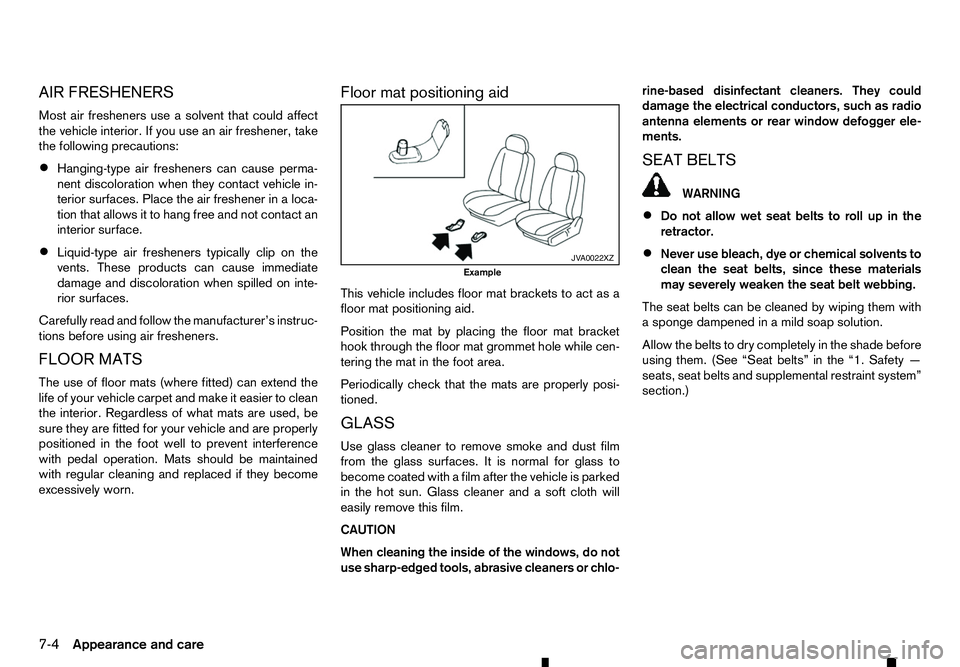
This vehicle includes floor mat brackets to act as a
floor mat positioning aid.
Position the mat by placing the floor mat bracket
hook through the floor mat grommet hole while cen-
tering the mat in the foot area.
Periodically check that the mats are properly posi-
tioned.
GLASS
Use glass cleaner to remove smoke and dust film
from the glass surfaces. It is normal for glass to
become coated with afilm after the vehicle is parked
in the hot sun. Glass cleaner and asoft cloth will
easily remove this film.
CAUTION
When cleaning the inside of the windows, do not
use sharp-edged tools, abrasive cleaners or chlo- rine-based disinfectant cleaners. They could
damage the electrical conductors, such as radio
antenna elements or rear window defogger ele-
ments.
SEAT BELTS WARNING
• Do not allow wet seat belts to roll up in the
retractor.
• Never use bleach, dye or chemical solvents to
clean the seat belts, since these materials
may severely weaken the seat belt webbing.
The seat belts can be cleaned by wiping them with
as ponge dampened in amild soap solution.
Allow the belts to dry completely in the shade before
using them. (See “Seat belts” in the “1. Safety —
seats, seat belts and supplemental restraint system”
section.) JV A0022XZ
Example
7-4 Appearance and care