2017 NISSAN JUKE odometer
[x] Cancel search: odometerPage 90 of 416
FUEL GAUGE
The gauge*1indicates theapproximate fuel
level in the tank.
The gauge may move slightly during braking,
turning, acceleration, or going up or down hills.
Refill the fuel tank before the gauge
registers 0 (empty) .
The low fuel warning light
illuminates when
the amount of fuel in the tank is getting low.
Refuel as soon as it is convenient, preferably
before the gauge reaches 0. There will be a
small reserve of fuel in the tank when the fuel
gauge reaches 0.
The
indicates that the fuel-filler door is
located on the front passenger’s side of the
vehicle.
CAUTION
. If the vehicle runs out of fuel, themalfunction indicator light (MIL)
may come on. Refuel as soon as
possible. After a few driving trips,
the
light should turn off. If the
light remains on after a few driving
trips, have the vehicle inspected. It
is recommended you visit a NISSAN
dealer for this service. .
For additional information, see
“Malfunction Indicator Light (MIL)”
(P.2-22) .
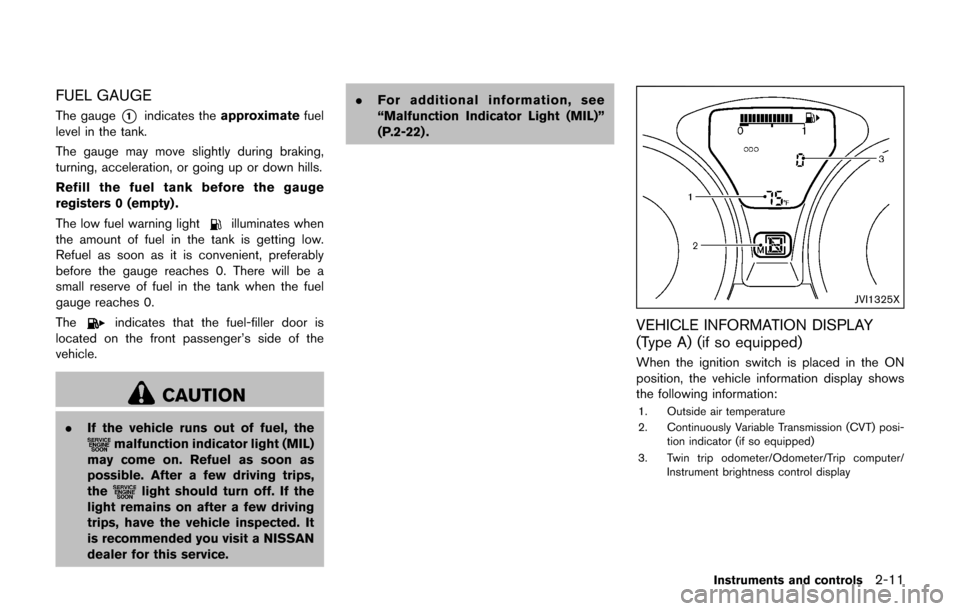
JVI1325X
VEHICLE INFORMATION DISPLAY
(Type A) (if so equipped)
When the ignition switch is placed in the ON
position, the vehicle information display shows
the following information:
1. Outside air temperature
2. Continuously Variable Transmission (CVT) posi-
tion indicator (if so equipped)
3. Twin trip odometer/Odometer/Trip computer/ Instrument brightness control display
Instruments and controls2-11
Page 91 of 416

2-12Instruments and controls
SIC4531
VEHICLE INFORMATION DISPLAY
(Type B) (if so equipped)
When the ignition switch is placed in the ON
position, the vehicle information display shows
the following information:
1. Outside air temperature
2. Continuously Variable Transmission (CVT) posi-tion indicator (if so equipped)
3. Odometer/Instrument brightness control display
4. Twin trip odometer/Trip computer
OUTSIDE AIR TEMPERATURE
The outside air temperature is displayed in 8For
8C.
When the outside air temperature becomes
378F(3 8C) or lower, the outside air temperature
display blinks to give a warning. The display will
stop blinking after 1 minute or when the outside
air temperature becomes 398F(4 8C) or above.
The display may differ from the actual outside
temperature displayed on various signs or bill-
boards.
CONTINUOUSLY VARIABLE TRANS-
MISSION (CVT) POSITION INDICATOR
(if so equipped)
The Continuously Variable Transmission (CVT)
position indicator indicates the shift lever posi-
tion when the ignition switch is in the ON
position.
JVI1326X
Type A (if so equipped)
SIC4532Type B (if so equipped)
Page 93 of 416

2-14Instruments and controls
JVI1327X
Type A (if so equipped)
SIC4600Type B (if so equipped)
Torque vectoring AWD (AWD model)
The Torque vectoring mode shows the current
amount of torque distributed to each wheel.
Each torque indicator is displayed as a bar
graph
*1divided into 3 segments. The upper
indicator displays the current amount of torque
distribution (left and right) for the front wheels.
The lower indicator displays the current amount
of torque distribution (left and right) for the rear
wheels. The number of segments shows the
amount of torque currently distributed to each
wheel.
Resetting displays
For Type A (if so equipped):
When the average fuel consumption or TRIP B
is displayed, push the trip computer mode
switch
*Afor longer than 3 seconds. The
average fuel consumption and trip odometer
(TRIP B only) displays will be reset at the same
time.
For Type B (if so equipped):
When the average fuel consumption, elapsed
time or TRIP B is displayed, push the trip
computer mode switch
*Afor longer than 3
seconds. The average fuel consumption,
elapsed time and trip odometer (TRIP B only)
displays will be reset at the same time.
Page 101 of 416

2-22Instruments and controls
Exterior light indicator
This indicator illuminates when the headlight
switch is turned to the AUTO (if so equipped) ,
orposition and the front parking lights,
instrument panel lights, rear combination lights,
license plate lights or headlights are on. The
indicator turns off when these lights are turned
off.
Front fog light indicator light (if so
equipped)
The front fog light indicator light illuminates
when the front fog lights are on. (See “Fog light
switch” (P.2-44) .)
Front passenger air bag status light
The front passenger air bag status light (located
on the center of the instrument panel) will be lit
and the passenger front air bag will be OFF
depending on how the front passenger seat is
being used.
For front passenger air bag status light opera-
tion, see “NISSAN Advanced Air Bag System
(front seats)” (P.1-44) of this manual.
High beam indicator light
This light illuminates when the headlight high
beam is on and goes out when the low beam is
selected.
Malfunction Indicator Light (MIL)
If the malfunction indicator light comes on
steady or blinks while the engine is running, it
may indicate a potential emission control and/or
Continuously Variable Transmission (CVT) mal-
function.
The malfunction indicator light may also illumi-
nate steady if the fuel-filler cap is loose or
missing, or if the vehicle runs out of fuel. Check
to make sure the fuel-filler cap is installed and
closed tightly, and that the vehicle has at least 3
US gallons (11.4 liters) of fuel in the fuel tank.
After a few driving trips, the
light should
turn off if no other potential emission control
system malfunction exists.
If this indicator light remains on for 20 seconds
and then blinks for 10 seconds when the engine
is not running, it indicates that the vehicle is not
ready for an emission control system inspection/
maintenance test. (See “Readiness for Inspec-
tion/Maintenance (I/M) test” (P.10-21) .) Operation:
The malfunction indicator light will come on in
one of two ways:
.
Malfunction indicator light illuminated steady
— An emission control system and/or CVT
malfunction has been detected. Check the
fuel-filler cap if the LOOSE FUEL CAP
warning message is displayed on the twin
trip odometer. If the fuel-filler cap is loose or
missing, tighten or install the cap and
continue to drive the vehicle. The
light
should turn off after a few driving trips. If the
light does not turn off after a few driving
trips, have the vehicle inspected. It is
recommended you visit a NISSAN dealer
for this service. You do not need to have
your vehicle towed to the dealer.
. Malfunction indicator light blinking — An
engine misfire has been detected which may
damage the emission control system.
To reduce or avoid emission control system
damage:
1) Do not drive at speeds above 45 MPH
(72 km/h) .
2) Avoid hard acceleration or deceleration.
3) Avoid steep uphill grades.
4) If possible, reduce the amount of cargo being hauled or towed.
The malfunction indicator light may stop
Page 374 of 416

To help ensure smooth, safe and economical
driving, NISSAN provides two maintenance
schedules that may be used, depending upon
the conditions in which you usually drive. These
schedules contain both distance and time
intervals, up to 120,000 miles (192,000 km)/
144 months. For most people, the odometer
reading will indicate when service is needed.
However, if you drive very little, your vehicle
should be serviced at the regular time intervals
shown in the schedule.
After 120,000 miles (192,000 km)/144
months, continue maintenance at the
same mileage/time intervals.
ADDITIONAL MAINTENANCE ITEMS
FOR SEVERE OPERATING CONDI-
TIONS
Additional maintenance items for severe
operating conditions;should be performed
on vehicles that are driven under especially
demanding conditions. Additional maintenance
items should be performed if you primarily
operate your vehicle under the following condi-
tions:
. Repeated short trips of less than 5 miles (8
km) .
. Repeated short trips of less than 10 miles
(16 km) with outside temperatures remain-
ing below freezing. .
Operating in hot weather in stop-and-go
“rush hour” traffic.
. Extensive idling and/or low speed driving for
long distances, such as police, taxi or door-
to-door delivery use.
. Driving in dusty conditions.
. Driving on rough, muddy or salt spread
roads.
. Using a car-top carrier.
NOTE:
For vehicles operated in Canada, both
standard and severe maintenance items
should be performed at every interval. The following tables show the standard main-
tenance schedule. Depending upon weather
and atmospheric conditions, varying road sur-
faces, individual driving habits and vehicle
usage, additional or more frequent maintenance
may be required.
After 120,000 miles (192,000 km)/144
months, continue maintenance at the
same mileage/time intervals.
Maintenance and schedules9-7
MAINTENANCE SCHEDULES
STANDARD MAINTENANCE
Page 410 of 416

Odometer ................................................................. 2-7
Speedometer ........................................................... 2-7
Tachometer ............................................................... 2-9
Trip computer ....................................................... 2-13
General maintenance .................................................. 9-2
Giving voice commands ........................................... 4-97
Glove box ..................................................................... 2-48
H
Hazard warning flasher switch .................................. 6-2
Head restraints/headrests .......................................... 1-5
Headlights Bulb replacement ................................................ 8-23
Headlight switch .................................................. 2-40
Xenon headlights ................................................. 2-39
Heated seats ............................................................... 2-45
Heater Engine block heater ............................................ 5-40
Heater and air conditioner operation ............. 4-28
Help voice commands ........................................... 4-100
High temperature warning light .............................. 2-18
Hood release ............................................................... 3-15
Horn ............................................................................... 2-44
How to say numbers ................................................. 4-98
How to use brightness control button .................... 4-8
How to use the APPS·i button ................................. 4-5
How to use the back button ..................................... 4-5
How to use the CAMERA button ............................ 4-8
How to use the ON·OFF button/Volume
control knob ................................................................... 4-8
I
Ignition switch ............................................................... 5-9
Immobilizer system ..................................................... 2-34
In-cabin microfilter ...................................................... 4-35 Indicator lights ............................................................. 2-21
Inside mirror ................................................................. 3-21
Inspection/maintenance (I/M) test ....................... 10-21
Instrument brightness control .................................. 2-43
Instrument panel ........................................................... 2-4
Integrated control system ............................. 2-24, 5-21
Intelligent Key system .................................................. 3-6
Intelligent Key system warning light ............... 2-18
Key operating range .............................................. 3-8
Key operation ........................................................... 3-9
P position selecting warning light ................... 2-20
Remote keyless operation ................................. 3-12
Interior light replacement .......................................... 8-26
Interior lights ................................................................ 2-54
iPod
Šplayer operation .............................................. 4-68
ISOFIX child restraint ................................................ 1-20
J
Jump starting ................................................................. 6-9
K
Keyless entry With Intelligent Key system (See Intelligent
Key system) .......................................................... 3-12
Keys ................................................................................. 3-2 For Intelligent Key system .................................... 3-6
L
LabelsAir bag warning labels ....................................... 1-54
Air conditioner specification label ................. 10-13
Emission control information label ................ 10-12
Engine serial number ........................................ 10-11
F.M.V.S.S./C.M.V.S.S. certification label ...... 10-12 Tire and Loading information label .... 8-30, 10-12
Vehicle identification number (VIN) .............. 10-11
LATCH system ............................................................ 1-20
License plate, Installing front license plate ....... 10-13
Liftgate .......................................................................... 3-16
Light Air bag warning light .......................................... 1-54
Bulb replacement ................................................ 8-23
Fog light switch ................................................... 2-44
Headlight switch .................................................. 2-40
Headlights bulb replacement ........................... 8-23
Indicator lights ...................................................... 2-21
Interior lights ......................................................... 2-54
Map lights .............................................................. 2-54
Replacement ......................................................... 8-23
Warning/indicator lights and
audible reminders ................................................ 2-16
Xenon headlights ................................................. 2-39
Lights, Exterior and interior light replacement .... 8-26
Loading information (See vehicle
loading information) ................................................ 10-15
Lock Automatic door locks ............................................ 3-5
Door locks ................................................................ 3-4
Liftgate lock .......................................................... 3-16
Power door lock ..................................................... 3-4
Loose fuel cap warning ................................... 2-8, 3-19
Low fuel warning light ............................................... 2-18
Low tire pressure warning light .............................. 2-18
Low tire pressure warning system (See tire
pressure monitoring system (TPMS)) ..................... 5-3M
Maintenance Battery .................................................................... 8-10
General maintenance ............................................ 9-2
11-3
Page 411 of 416

11-4
Inside the vehicle .................................................... 9-3
Maintenance log .................................................. 9-15
Maintenance precautions ..................................... 8-2
Maintenance requirements ................................... 9-2
Maintenance schedules ........................................ 9-7
Maintenance under severe
driving conditions ................................................ 9-14
Outside the vehicle ................................................ 9-2
Seat belt maintenance ....................................... 1-15
Standard maintenance .......................................... 9-7
Maintenance schedules .............................................. 9-7
Making a call ................................................................ 4-92
Malfunction indicator light (MIL) ............................. 2-22
Manual air conditioner ............................................... 4-29
Manual front seat adjustment .................................... 1-3
Map lights ..................................................................... 2-54
Mechanical key (Intelligent Key system) ................. 3-3
Meter Trip computer ....................................................... 2-13
Meters and gauges ...................................................... 2-5 Instrument brightness control ........................... 2-43
Mirror Inside mirror .......................................................... 3-21
Outside mirrors .................................................... 3-22
Vanity mirror .......................................................... 3-23
Monitor, RearView Monitor ........................................ 4-8
Moonroof ...................................................................... 2-52
Moving Object Detection (MOD) ........................... 4-24
N
Navigation system voice commands ..................... 4-99
New vehicle break-in ................................................. 5-27
NISSAN Vehicle Immobilizer System .................... 2-34
NISSAN Voice Recognition System ...................... 4-96
NissanConnect App smartphone integration ...... 4-75
O
Odometer ....................................................................... 2-7
Off-road recovery ......................................................... 5-6
Oil Capacities and
recommended fluids/lubricants ........................ 10-2
Changing engine oil and filter ............................. 8-6
Checking engine oil level ..................................... 8-5
Engine oil .................................................................. 8-5
Engine oil viscosity .............................................. 10-8
One Shot Call ............................................................. 4-91
Outside air temperature display.............................. 2-12
Outside mirrors ........................................................... 3-22
Overheat, If your vehicle overheats ....................... 6-11
Owner’s Manual/Service Manual
order information ...................................................... 10-22
P
Panic alarm .................................................................. 3-13
Parking Brake break-in ...................................................... 5-35
Parking brake operation ..................................... 5-25
Parking on hills ..................................................... 5-33
Phone Car phone or CB radio ...................................... 4-80
Phone settings ............................................................ 4-96
Power Electric power steering ...................................... 5-34
Moonroof ............................................................... 2-52
Power door lock ..................................................... 3-4
Power outlet .......................................................... 2-46
Power windows .................................................... 2-50
Precautions Audio operation .................................................... 4-35
Braking precautions ............................................ 5-35 Child restraints ..................................................... 1-19
Cruise control ....................................................... 5-26
Driving safety ........................................................... 5-7
Maintenance ............................................................. 8-2
Seat belt usage .................................................... 1-10
Supplemental restraint system ......................... 1-38
When starting and driving .................................... 5-2
Push starting ................................................................ 6-11
Push-button ignition switch ............................ 5-9, 5-10
R
Radio ............................................................................. 4-35 Car phone or CB radio ...................................... 4-80
Steering wheel audio controls ......................... 4-73
Rapid air pressure loss ............................................... 5-6
Readiness for inspection/maintenance
(I/M) test .................................................................... 10-21
Rear door lock, Child safety rear door lock .......... 3-6
Rear seats ...................................................................... 1-4
Rear window and outside mirror
defroster switch .......................................................... 2-38
Rear window wiper and washer switch ............... 2-37
RearView Monitor ......................................................... 4-8
Recorders, Event data ............................................ 10-22
Registering in another country ............................. 10-10
Registering with NissanConnect App ................... 4-75
Remote keyless entry function, For Intelligent
Key system ................................................................... 3-12
Reporting safety defects ....................................... 10-20
Roadside assistance program ................................... 6-2
Rollover ........................................................................... 5-6
Roof, Moonroof ........................................................... 2-53