2017 MERCEDES-BENZ G-Class ignition
[x] Cancel search: ignitionPage 105 of 286
Notesonb reaking-in anew vehicle
Important safety notes
Thes ensors ystemofs omedriving and driving
safety systems adjusts automaticall ywhile a
certai ndistance is being driven after the vehicle
ha sb eend elivere dorafter repairs. Full system
effectiveness is not reachedu ntilthe end of this
teach-inp rocedure.
New and replaced brake pads and discs only
reach their optimum braking effect after several hundred kilometers of driving. Compensate for
thi sb yapplyin ggreate rforce to the brake pedal.
The first 1000 miles (150 0km)
Them orey ou look after the engine when it is
new ,the mor esatisfied yo uwillbew ithi ts per-
formance in the future.
RYo us houl dtherefore drive at varying vehicle
and engine speeds for the first 1,000 miles
(1,500 km).
RAvoi dheavy loads, e.g .driving at full throttle,
during thi speriod.
RWhen shifting gear smanually, shift up in good
time, befor ethe tachomete rneedl ereaches
Ô of the wa ytothe red area of the tachom-
ete rdisplay .
RDo not manuall yshift to alower gear to brake
the vehicle.
RTry to avoi ddepressing the accelerator pedal
beyond the pressure point (kickdown).
Additiona lbreaking-i nnote sfor Mercedes-AMG
vehicles:
RDo not drive fastert han85m ph (140km/h)
for the first 1,000 mile s(1,50 0km).
ROnlyb rieflyallow the engine to reach amax-
imum engine spee dof4,500 rpm.
RAvoiddriving off-roa dbefor et he first differ-
ential oi lchange at 2,000 mile s(3,000 km).
RIdeally ,for the first 1,000 mile s(1,50 0km),
drive in program C.
After 1,000 mile s(1,500 km), you can increase
the engine speedg radually and bring the vehicle
to ful lspeed.
You should also observe these notes on break-
i
ng in if the engine or parts of the drive train on
you rvehicle have beenr eplaced.
Always observe the maximu mpermissible
speed.
Axl edifferential transmission
(Mercedes-AMG vehicles)
Change the oil after abreaking-in period of
2,000 miles( 3,000 km) to improve protectiono f
the axle differential transmission.
This oil change prolongs the service life of the
axle differential transmission. Have the oil
change carrie dout at aqualified specialist work-
shop.
Driving
Important safety notes
GWARNING
Objects in the driver's footwell may restrict
the clearance around the pedal sorblock a
depressedp edal.This jeopardizes the oper-
ating and road safety of the vehicle. There is a risk of an accident.
Stow al lobjects securely in the vehicle so that
they do not get into the driver's footwell.
When using floormats or carpets, make sure
that they are properly secured so that they do not sliporo bstruct the pedals. Do not place
severalf loormats or carpets on top of one
another.
GWARNING
Unsuitabl efootwear can hinde rcorrect usage
of the pedals, e.g.:
Rshoesw ith thick soles
Rshoeswith high heels
Rslippers
There is arisk of an accident.
Wears uitablefootwear to ensure correct
usage of the pedals.
GWARNING
If you switch off the ignition while driving,
safety-relevant functions are only available
with limitations, or not at all. This coul daffect,
for example, the power steering and the brake
boosting effect. You wil lrequire considerably
more effort to steer and brake .There is arisk
of an accident.
Driving103
Driving and parking
Z
Page 106 of 286

Do not switch off the ignition whiledriving.
GWARNING
If the parkin gbrake hasn ot been fully
released when driving, the parkin gbrake can:
Roverheat and cause afire
Rlose its hol dfunction.
There is ariskoff irea nd an accident. Release
the parkin gbrake full ybefor ed rivin goff.
!Warm up the engine quickly. Do not us ethe
engine's full performance unti lithasreached
operating temperature.
Onlys hift the automatic transmission to the
desired drive positio nwhent he vehicl eissta-
tionary.
Where possible, avoi dspinning the drive
wheels when pulling away on slippery roads.
Yo uc ould otherwis edamag ethe drive train.
!Avoi dhighe ngine speeds when the engine
is cold. The engine's servic elifec ould other-
wise be significantl yshortened. Do not use
the engine's full performance unti lithas
reachedo perating temperature.
!Mercedes-AMG vehicles: at lowengine oil
temperatures belo w68‡ (+20† ),the max-
imu me ngine spee disrestricted in order to
protect the engine .Toprotect the engine and
maintain smooth engine operation, avoi ddriv-
ing at full throttle when the engine is cold.
SmartKey positions
gTo remove the SmartKey
1Powe rsuppl yfor som econsumers ,suc ha s
the windshiel dwiper s
2Ignitio n(powe rsuppl yfor al lconsumers)
and drive position
3To start the engine
As soo nasthe ignition is switched on, al lthe
indicator lamps in the instrument cluster light
up .Ifani ndicator lamp does not go ou tafter
startin gthe engine or lights up whil edriving, see
(
Ypage 189).
If the SmartKeyisinp osition gin the ignition
lock for alon gerp eriod, it can no longe rbe
turned in the ignition lock. The steerin gisthen
locked .Tounlock, remove the SmartKeya nd
reinsert it into the ignition lock.
The steerin gislocked when yo uremove the
SmartKeyf romthe ignition lock.
XRemov ethe SmartKeyw hent he engine is
switched off.
The starter battery could otherwis ebedis-
charged.
If yo ucanno tturnt he SmartKeyint he ignition
lock, the starter battery mayn ot be charged
sufficiently.
XCheck the starter battery and charge it if nec-
essar y(Ypage 243).
or
XJump-star tthe vehicl e(Ypage 243).
Yo uc an onl yremove the SmartKeyi f:
Rthe SmartKeyisinpositiongin the ignition
lock
Rthe automatic transmission selecto rlev er is
in j
Starting the engine
Important safety notes
GWARNING
If children ar eleftu nsupervised in the vehicle,
theyc ould:
Ropen the doors ,thuse ndangering other
people or roa dusers.
Rgeto utand disrupt traffic.
Roperate the vehicle's equipment.
104Driving
Driving an dparking
Page 110 of 286
Problems with the engine
ProblemPossible causes/consequences andMSolutions
The engine does not
start. The starter motor
can be heard.RThere isamalfunction in the engine electronics.
RThere is amalfunction in the fuel supply.
XTurn the SmartKey back to position gin the ignition lock before
attempting to start the engine again.
XTry to start the engine again (Ypage 105). Avoid excessively long
and frequent attemptstos tart the engine (Ypage 104) as these will
drain the battery.
If the engine does not start after several attempts:
XConsult aqualified specialist workshop.
The engine does not
start. The starter motor
can be heard. The yellow
reserve fuel warning
lamp is lit and the needle
of the fuel gage display
shows 0.The fuel tank is empty.
XRefuel the vehicle.
The engine does not
start. You cannot hear
the starter motor.The on-board voltage is too low because the battery is too weak or
discharged.
XJump-start the vehicle (Ypage 243).
If the engine does not start despite attempt stojump-start it:
XConsult aqualified specialist workshop.
The starter motor was exposed to athermal load that was too high.
XAllow the starter motor to cool down for approximately two minutes.
XTry to start the engine again.
If the engine still does not start:
XConsult aqualified specialist workshop.
The engine is not running
smoothly and is misfir-
ing.There is amalfunction in the engine electronics or in amechanical
componentoft he engine management system.
XOnly depress the accelerator pedal slightly.
Otherwise, non-combusted fuel may get into the catalytic converter
and damage it.
XHave the cause rectified immediately at aqualified specialist work-
shop.
108Driving
Driving and parking
Page 112 of 286

For this reason, shift the automatic transmis-
sio ntoP whe nthe engine is switched off and
the vehicle is at astandstill. Appl ythe parking
brake to prevent the vehicle from rolling
away.
Selector lever
Overviewoft ransmissionp ositions
!If the engine speed is too hig horifthe vehi-
cle is rolling, do not shift the transmission
directly from Dto R,f rom Rto Dor directly to
P.
Do not opent he driver's doorw hile the vehi-
cle is in motion. At low speeds in transmission
position Dor R,p arkp osition Pis otherwise
engaged automatically.
The transmission could be damaged.
:P button: park positio nwithp arking lock
kReverse gear
iNeutral
hDrive
Wheny ouselect atransmission position, the
selector lever subsequently returns to its origi-
nal position.
The current transmission position P,R, Nor D
appears in the transmission positio ndispla yin
the multifunction display.
Transmissionp ositionand drive pro-
gram display
!If the transmission positio ndispla yint he
multifunction displa yisnot working, you
should pull away carefully to check whether
the desire dtransmission positio nisengaged.
Select transmission position D.Don ot
restrict the shift range.
Current transmission position :and current
drive program ;appea rinthe multifunction
display.
The current positio nofthe selector lever is
shownb ythe indicators next to the selector
lever.
The indicators light up whe nthe SmartKe yis
inserted into the ignition lock. The indicators go
outw hent he SmartKe yisremoved from the
ignition lock.
Whent he selector lever is in position D,y ou can
influence the gearshifts mad ebythe automatic
transmission by:
Rrestricting the shift range
Rchanging geary ourself
Engaging park positionP
XMake sur ethat the vehicle is stationary.
XDepress the brake pedal and keep it
depressed.
XPresst hePbutton in the center console.
If yo udepress the brake pedal and push the
selector lever forward sorbacktot he firs tpoint
of resistance ,parkp osition Pis disengaged.T he
transmission shifts to neutral N.
Engaging reverse gear R
!Only move the automatic transmission to
k whe nthe vehicle is stationary.
XMake sur ethat the vehicle is stationary.
XDepress the brake pedal and keep it
depressed.
XPush the selector lever forward spastthe first
point of resistance.
Transmissio nposition Ris engaged.
If yo uengage reverse geara nd the ECO start/
stop function is activated, the engine starts
automaticall y(
Ypage 106).
110Automatic transmission
Drivingand parking
Page 113 of 286
Shifting to neutralN
GWARNING
If children are left unsupervised in the vehicle,
they could:
Ropen the doors, thus endangering other
people or road users.
Rget out and disrupt traffic.
Roperate the vehicle's equipment.
Additionally, children could set the vehicle in
motion if, for example, they:
Rrelease the parking brake.
Rshifting the automatic transmission out of
park position P
RStart the engine.
There is arisk of an accident and injury.
When leaving the vehicle, always take the
SmartKey with you and lock the vehicle. Never
leave children or animals unattended in the
vehicle. Always keep the SmartKey out of
reach of children.
XMake sure that the vehicle is stationary.
XDepress the brake pedal and keep it
depressed.
XDepending on the current transmission posi-
tion, press the selector lever forwards or
backwards to the first point of resistance.
The automatic transmission shifts into N.
If the engine has been switched off, the auto-
matic transmission automatically shifts to N.
If the vehicle is braked to astandstill in neutral
N,t he ECO start/stop function switches off the
engine automatically (
Ypage 106).
Remaining in neutra lN
GWARNING
If children are left unsupervised in the vehicle,
they could:
Ropen the doors, thus endangering other
people or road users.
Rget out and disrupt traffic.
Roperate the vehicle's equipment.
Additionally, children could set the vehicle in
motion if, for example, they:
Rrelease the parking brake.
Rshifting the automatic transmission out of
park position P
RStart the engine.
There is arisk of an accident and injury.
When leaving the vehicle, always take the
SmartKey with you and lock the vehicle. Never
leave children or animals unattended in the
vehicle. Always keep the SmartKey out of
reach of children.
XMake sure that the vehicle is stationary.
XMake sure that the ignition is switched on.
XDepress the brake pedal and keep it
depressed.
XShift to neutral N.
XRelease the brake pedal.
XMake sure that the parking brake is released.
XSwitch off the ignition and leave the SmartKey
in the ignition lock.
Engaging drive position D
XMake sure that the vehicle is stationary.
XDepress the brake pedal and keep it
depressed.
XPush the selector lever back past the first
point of resistance.
The automatic transmission shifts into D.
If the vehicle is braked to astandstill in trans-
mission position D,the ECO start/stop function
switches off the engine automatically
(
Ypage 106).
Automatic transmission111
Driving and parking
Z
Page 114 of 286
Transmission positions
BPark position
Thisprevents the vehicl efromr olling
away when stopped.
Onlys hift the transmission into posi-
tion Pwhen the vehicl eisstationary
(
Ypage 110). The parkin gloc k
shoul dnot be used as abrake when
parking. Alway sapply the parking
brake in additio ntothe parkin gloc k
in order to secur ethe vehicle.
The SmartKeyc an onlyberemove dif
the transmission is in position P.
When there is no SmartKeyint he
ignition lock, the selecto rlev er is
locked in position P.
CRevers egear
Onlys hift the transmission into posi-
tion Rwhen the vehicl eisstationary.
A!Coasting in neutral imay
cause damage to the drive train.
Neutral
Do not shift the transmission to N
whil edriving. Otherwise, the auto-
matic transmission could be dam-
aged.
No powe ristransmitted fromt he
engine to the drive wheels.
Releasing the brakes will allo wyouto
mov ethe vehicl efreely, e.g .topush
it or tow it.
If ESP
®is deactivated or faulty and
the vehicl eisindangerofs kidding
e.g .oni cy roads :shift the transmis-
sion to position N.
If yo uengag ethe transferc ase, shift
briefl yinto N(
Ypage 146).
7Drive
The automatic transmission changes
gear automatically. All forward gears
ar ea vailable.
Changin ggear
The automatic transmission shifts to the indi-
vidua lgears automaticall ywhenitisint rans-
mission position D.T hisa utomatic gear shifting
behavio risdetermine dby:
Rashift range restriction, if selected
Rthe positio nofthe transferc ase( HIGH
RANGE orLO WR ANGE )
Rthe positio nofthe accelerator pedal
Rthe roa dspeed
Driving tips
Accelerator peda lposition
Your style of drivin ginfluences how the auto-
matic transmission shifts gear:
Rlittle throttle :early upshifts
Rmor ethrottle :lat eu pshifts
Kickdown
Use kickdow nfor maximum acceleration.
XDepres sthe accelerator peda lbeyond the
pressure point.
The automatic transmission shifts to alower
gear depending on the engine speed.
XEas eoff the accelerator peda lonce the
desired spee disreached.
The automatic transmission shifts back up.
Kickdown is not availabl einthe permanent man-
ua ld rive programonM ercedes-AMG vehicles.
Rockin gthe vehicle free
Rocking freebys hifting back and forth between
transmission positions Dand Rcan help to free
the vehicl eifitgetss tuck. The vehicle's engine
management system limits the spee dtoamax-
imu mof5m ph (9 km/h )whens hifting back and
forth.
Shifting back and forth between transmission
positions Dand R:
XMovethe selecto rlev er forwards or back-
wards past the point of resistance.
112Automati ctransmission
Driving an dparking
Page 119 of 286
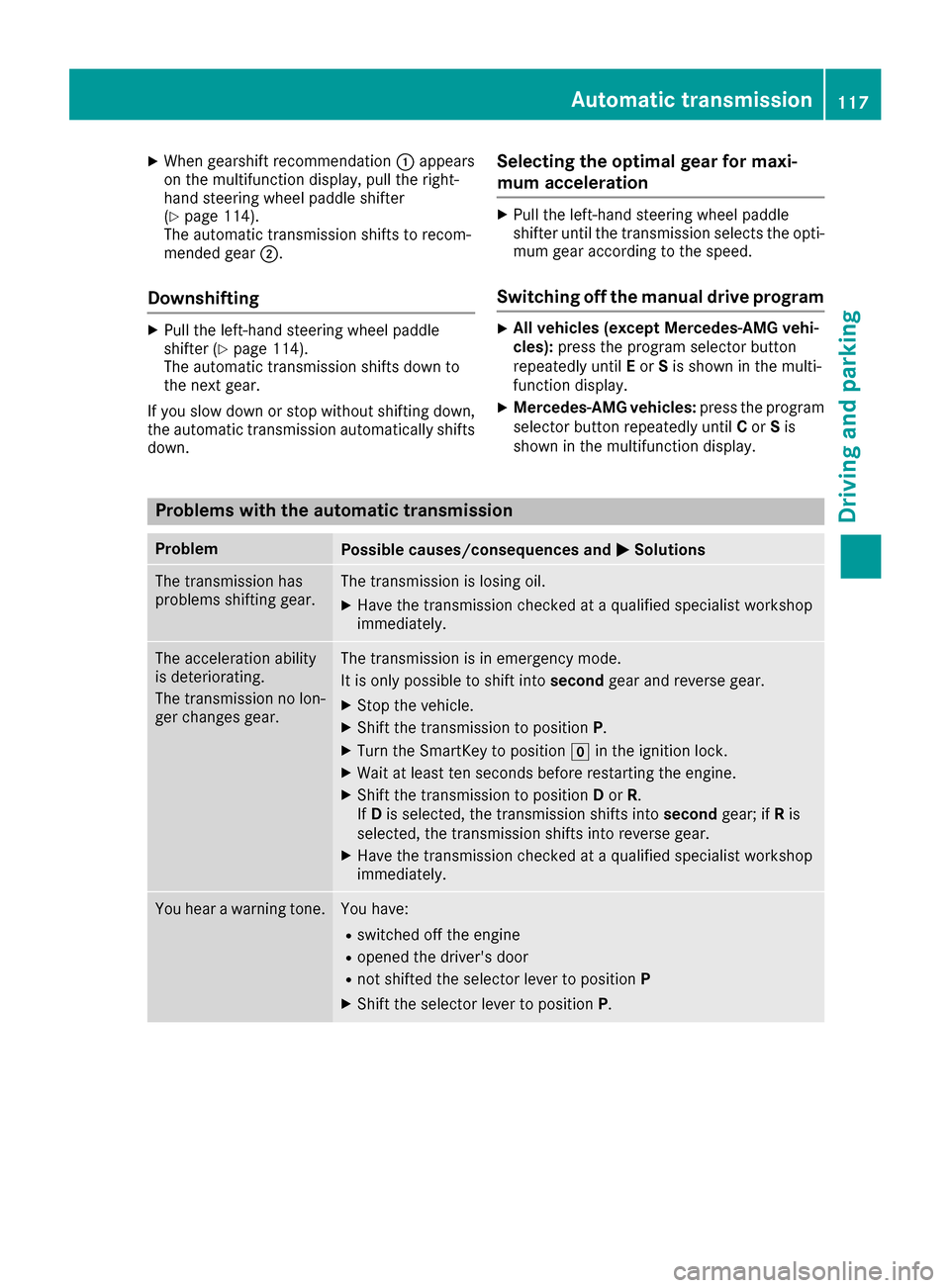
XWhen gearshift recommendation:appears
on the multifunction display, pull the right-
hand steerin gwheel paddle shifter
(
Ypage 114).
The automatic transmission shifts to recom-
mended gear ;.
Downshifting
XPull the left-hand steerin gwheel paddle
shifter (Ypage 114).
The automatic transmission shifts down to
the next gear.
If you slow down or stop without shiftin gdown,
the automatic transmission automatically shifts
down.
Selecting the optimal gear for maxi-
mum acceleration
XPull the left-hand steerin gwheel paddle
shifter until the transmission selects the opti-
mum gear accordingtot he speed.
Switching off the manual drive program
XAll vehicles (except Mercedes ‑AMG vehi-
cles): press the program selector button
repeatedly until Eor Sis shown in the multi-
function display.
XMercedes‑AMG vehicles: press the program
selector button repeatedly until Cor Sis
shown in the multifunction display.
Problems with the automatic transmission
ProblemPossible causes/consequences and MSolutions
The transmission has
problems shiftinggear.The transmission is losing oil.
XHave the transmission checked at aqualified specialist workshop
immediately.
The acceleration ability
is deteriorating.
The transmission no lon-
ger changes gear.The transmission is in emergency mode.
It is only possible to shift into secondgear and reverse gear.
XStop the vehicle.
XShift the transmission to position P.
XTurn the SmartKey to positiongin the ignition lock.
XWait at least ten seconds before restarting the engine.
XShift the transmission to position Dor R.
If D is selected, the transmission shifts into secondgear; ifRis
selected, the transmission shifts into reverse gear.
XHave the transmission checked at aqualified specialist workshop
immediately.
You hear awarning tone.You have:
Rswitched off the engine
Ropened the driver's door
Rnot shifted the selector lever to position P
XShift the selector lever to positionP.
Automatic transmission117
Driving and parking
Z
Page 120 of 286
Refueling
Important safety notes
GWARNING
Fue lish ighly flammable. If yo uhandlef uel
incorrectly, there is ariskoff ire and explo-
sion.
Yo um usta void fire ,ope nf lames ,creating
sparks and smoking. Switch off the engine
and ,ifa pplicable, the auxiliary heating before
refueling.
GWARNING
Fue lisp oisonous and hazardoustoh ealth.
There is ariskofi njury.
Yo um ustm ake sure that fue ldoe sn ot come
into contact with your skin, eyes or clothing
and that it is not swallowed. Do not inhale fuel
vapors. Keepf uelawa yfrom children.
If yo uoro thers come into contact with fuel,
observe the following:
RWash away fue lfrom skin immediately
using soapa nd water.
RIf fuelcomesi nto contact with your eyes,
immediately rins ethem thoroughly with
clean water. Seek medica lassistance with-
outd elay.
RIf fuelisswallowed, seekm edicalassis-
tance withoutd elay.Don ot induce vomit-
ing.
RImmediately change outofc lothing which
hasc ome into contact with fuel.
GWARNING
Electrostatic buildu pcan create sparks and
ignite fue lvapors. There is ariskoff ire and
explosion.
Alway stouch the vehicl ebodyb efore opening
the fue lfille rflaport ouching the fue lpum p
nozzle .Any existing electrostati cbuildup is
thereby discharged.
Do not get into the vehicl eagain during the refu-
eling process .otherwise electrostati ccharge
could buil dupagain.
!Do not us ediese ltor efuel vehicles with a
gasoline engine. Do not switch on the ignition
if yo uaccidentall yrefuel with the wrong fuel.
Otherwise, the fue lwille nter the fue lsys tem.
Even small amounts of the wrong fue lcould
resul tind amagetot he fue lsystem and the
engine. Notify aquali fied specialist workshop
and have the fue ltank and fue llin es drained
completely.
!Overfilling the fue ltank could damag ethe
fue lsystem.
!Take care not to spill any fue lonpainted
surfaces. Yo ucould otherwise damag ethe
paintwork.
!Use afilter when adding fue lfrom afue lcan.
The fue llin es and/or the fue linjection system
could otherwise be blocked by particles from
the fue lcan.
If yo uoverfil lthe fue ltank, fue lcould spray out
when the fue lpum pnozzle is removed.
If yo uoverfil lthe fue ltank, pressure may build
up in the fue ltank. Thisc ould ca
use fue
ltospray
outw hent he fue lpum pnozzle is removed.
There is ariskofi njury. The fue ltank is ful lwhen
the fue lpum pnozzle firs tswitches off. End the
refueling process.
For further information on fue land fue lquali ty
(
Ypage 276).
Refueling
General information
Paya ttention to the important safety notes
(Ypage 118).
If yo uunlock/lock the vehicl efrom the outside,
the fue lfille rflapa lsou nlocks/locks.
The position of the fue lfille rcap is displayed in
the instrument cluster 8.The arrow next to
the filling pump indicates the sid eofthe vehicle.
118Refueling
Driving and parking