2017 MERCEDES-BENZ G-Class fuel cap
[x] Cancel search: fuel capPage 12 of 286
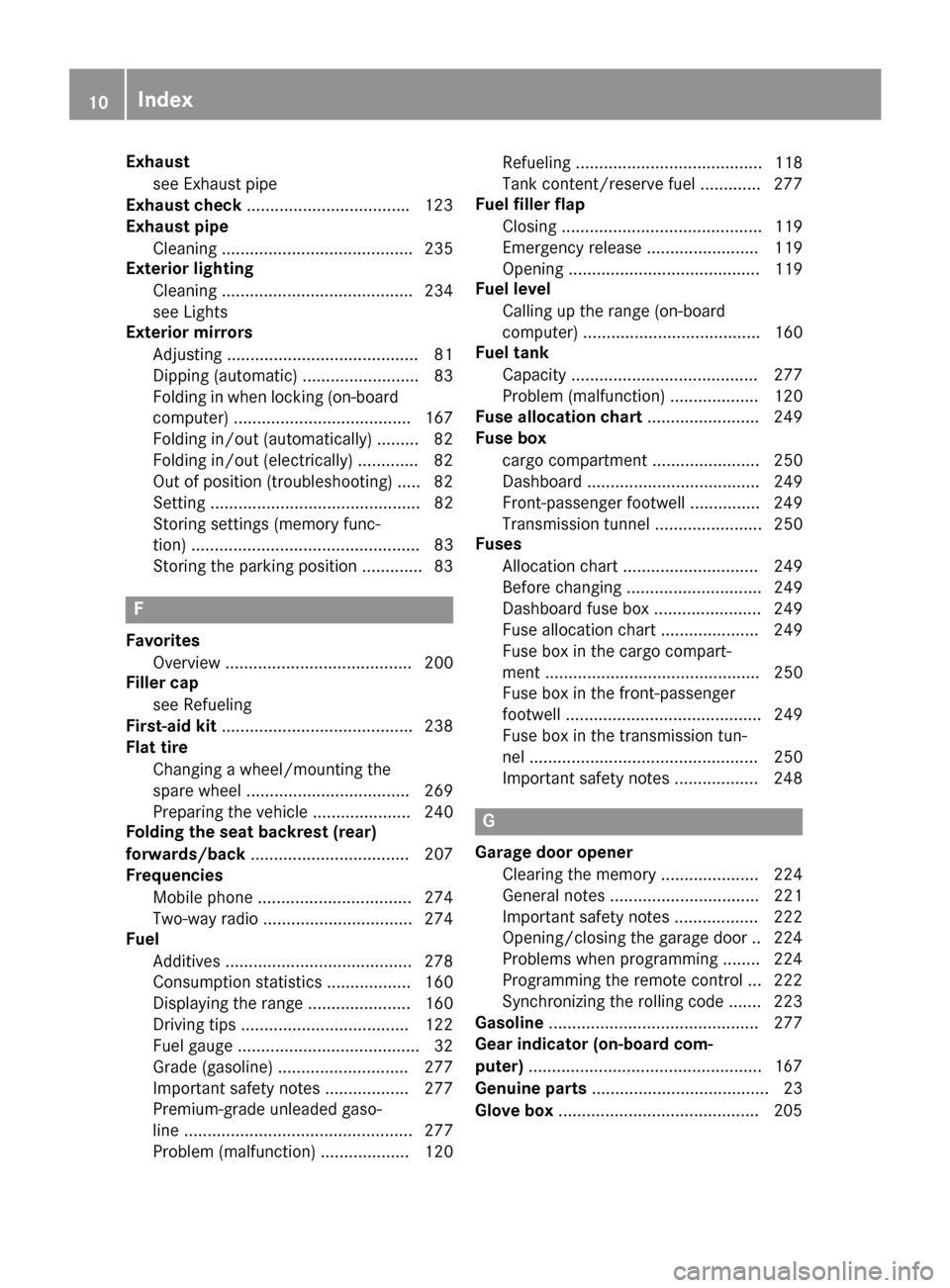
Exhaustsee Exhaust pipe
Exhaust check .................................. .123
Exhaus tpipe
Cleaning ......................................... 235
Exterior lighting
Cleaning ......................................... 234
see Lights
Exterior mirrors
Adjusting ......................................... 81
Dipping (automatic) ......................... 83
Folding in whe nlocking (on-board
computer) ...................................... 167
Folding in/out( automatically). ........ 82
Folding in/out (electrically) ............. 82
Outofp osition (troubleshooting )..... 82
Setting ............................................. 82
Storing settings (memory func-
tion) ................................................. 83
Storing the parking position ............. 83
F
Favorites
Overview ........................................ 200
Filler cap
see Refueling
First-aidk it......................................... 238
Flat tire
Changing awheel /mounting the
spare wheel. .................................. 269
Preparing the vehicl e..................... 240
Folding the seat backres t(rear)
forwards/back .................................. 207
Frequencies
Mobil ephone ................................. 274
Two-way radio ................................ 274
Fuel
Additives ........................................ 278
Consumption statistics .................. 160
Displaying the rang e...................... 160
Driving tip s.................................... 122
Fue lgauge ....................................... 32
Grade (gasoline )............................ 277
Important safety notes .................. 277
Premium-grade unleade dgaso-
line ................................................. 277
Problem (malfunction) ................... 120 Refueling ........................................ 118
Tank content/reserve fue
l............. 277
Fue lfille rflap
Closing ........................................... 119
Emergency release ........................ 119
Opening ......................................... 119
Fue llevel
Calling up the rang e(on-board
computer) ...................................... 160
Fue ltank
Capacity ........................................ 277
Problem (malfunction) ................... 120
Fus eallocatio nchart ........................ 249
Fus ebox
cargo compartment ....................... 250
Dashboard ..................................... 249
Front-passenger footwell ............... 249
Transmission tunne l....................... 250
Fuses
Allocation chart ............................. 249
Before changing ............................. 249
Dashboard fus ebox ....................... 249
Fus ealloc ation chart ..................... 249
Fus ebox in the carg ocompart-
ment .............................................. 250
Fus ebox in the front-passenger
footwell .......................................... 249
Fus ebox in the transmission tun-
nel ................................................. 250
Important safety notes .................. 248
G
Garaged ooro pener
Clearing the memory ..................... 224
Generaln otes ................................ 221
Important safety notes .................. 222
Opening/closing the garag edoor..2 24
Problems whe nprogramming ........2 24
Programming the remote control ... 222
Synchronizing the rolling code ....... 223
Gasoline ............................................. 277
Gear indicator (on-board com-
puter) ..................................................1 67
Genuine parts ...................................... 23
Glove box ...........................................2 05
10Index
Page 19 of 286

Convenience opening feature .......... 70
Display message ............................ 187
Door central locking/unlocking ...... .63
Important safety notes .................... 63
Loss .................................................6 6
Mechanical key ................................ 64
Overview .......................................... 63
Positions (ignition lock) ................. 104
Problem (malfunction) ..................... 66
Starting the engine ........................ 105
SMS
see also Digital Operator's Man-
ual .................................................. 198
Snow chains ...................................... 253
Socket (12 V)
Cargo compartment. ...................... 213
Front-passenger footwell ............... 212
General notes ................................ 212
Rear compartment. ........................213
Sound
Switching on/off ........................... 199
Spare fuses ........................................ 249
Spare wheel
Spare wheel bracket at the rear .... 239
Stainless-steel spare hub cap ........2 39
Special seat beltr etractor.................. 50
Specialist workshop ............................ 27
Speedometer
Digita l............................................ 160
In the Instrument cluster ................. 32
Segments ...................................... 157
Selecting the displayu nit ...............165
Standingl amps
Display message ............................ 176
Switching on/off .............................. 86
Starting the engine
Important safety notes .................. 104
Steering (display message) .............. 187
Steering wheel
Adjusting (electrically). .................... 80
Buttons (on-board computer) ......... 158
Cleaning ..................... .................... 236
Important sa
fety notes .................... 79
Paddle shifters ............................... 114
Steering wheel heating .................... 80
Storing settings (memory func-
tion) ................................................. 83 Steering wheel heating
Indicator lamp (malfunction) ............ 80
Steering wheel paddle shifters ........114
Stopwatch (RACETIMER) ................... 168
Stowage areas ................................... 205
Stowage compartment
Door stowage compartment .......... 206
Stowage compartments
Armrest (under) .............................2 06
Cu ph olders ................................... 210
Glove box ....................................... 205
Important safety information ......... 205
Stowag enet ................................... 206
Stowag epockets ........................... 206
Stowage net ....................................... 206
Summer opening
see Convenience opening feature
Summer tires
In winter ........................................ 253
Sun visor ............................................ 210
Surround lighting (on-board com-
puter) ..................................................1 65
SUV
(Sport Utility Vehicle) ....................... 26
Switchin gair-recirculation mode
on/off ................................................. 101
Switchin gonmedia mode
Via the device lis t.......................... 203
T
Tachometer ........................................ 157
Tail lamp
Replacing bulb s............................... 91
Tail lamps
Displa ymessage ............................ 176
Tank content
Fuelgauge ....................................... 32
Technical data
Capacities ...................................... 276
Drawba rloa d( maximum) ............... 284
Information .................................... 274
Trailer load s................................... 284
Vehicl edata. .................................. 281
Telephone
Accepting acall. ............................ 163
Authorizing amobilephone (con-
necting) ......................................... 202
Index17
Page 120 of 286
Refueling
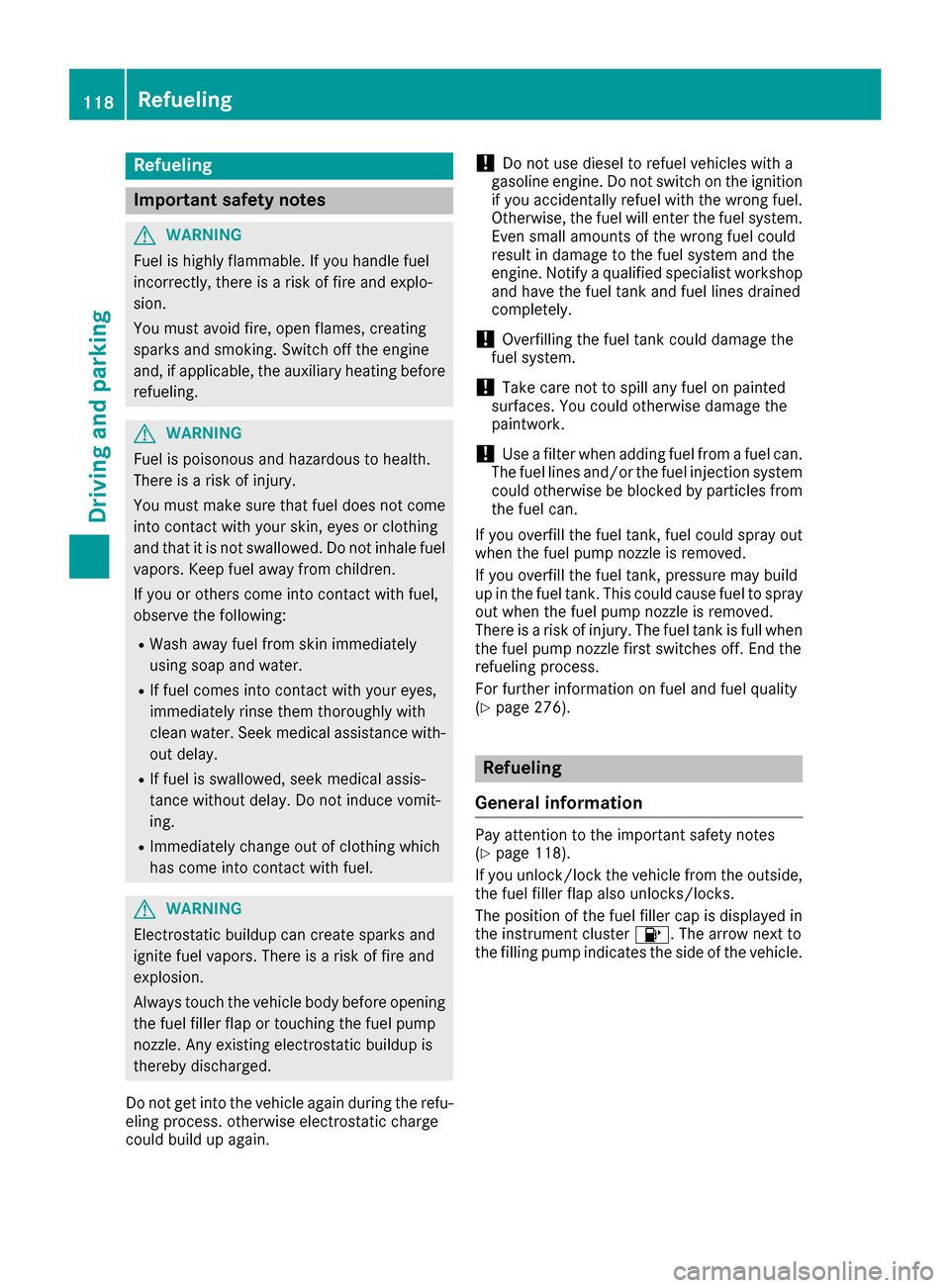
Important safety notes
GWARNING
Fue lish ighly flammable. If yo uhandlef uel
incorrectly, there is ariskoff ire and explo-
sion.
Yo um usta void fire ,ope nf lames ,creating
sparks and smoking. Switch off the engine
and ,ifa pplicable, the auxiliary heating before
refueling.
GWARNING
Fue lisp oisonous and hazardoustoh ealth.
There is ariskofi njury.
Yo um ustm ake sure that fue ldoe sn ot come
into contact with your skin, eyes or clothing
and that it is not swallowed. Do not inhale fuel
vapors. Keepf uelawa yfrom children.
If yo uoro thers come into contact with fuel,
observe the following:
RWash away fue lfrom skin immediately
using soapa nd water.
RIf fuelcomesi nto contact with your eyes,
immediately rins ethem thoroughly with
clean water. Seek medica lassistance with-
outd elay.
RIf fuelisswallowed, seekm edicalassis-
tance withoutd elay.Don ot induce vomit-
ing.
RImmediately change outofc lothing which
hasc ome into contact with fuel.
GWARNING
Electrostatic buildu pcan create sparks and
ignite fue lvapors. There is ariskoff ire and
explosion.
Alway stouch the vehicl ebodyb efore opening
the fue lfille rflaport ouching the fue lpum p
nozzle .Any existing electrostati cbuildup is
thereby discharged.
Do not get into the vehicl eagain during the refu-
eling process .otherwise electrostati ccharge
could buil dupagain.
!Do not us ediese ltor efuel vehicles with a
gasoline engine. Do not switch on the ignition
if yo uaccidentall yrefuel with the wrong fuel.
Otherwise, the fue lwille nter the fue lsys tem.
Even small amounts of the wrong fue lcould
resul tind amagetot he fue lsystem and the
engine. Notify aquali fied specialist workshop
and have the fue ltank and fue llin es drained
completely.
!Overfilling the fue ltank could damag ethe
fue lsystem.
!Take care not to spill any fue lonpainted
surfaces. Yo ucould otherwise damag ethe
paintwork.
!Use afilter when adding fue lfrom afue lcan.
The fue llin es and/or the fue linjection system
could otherwise be blocked by particles from
the fue lcan.
If yo uoverfil lthe fue ltank, fue lcould spray out
when the fue lpum pnozzle is removed.
If yo uoverfil lthe fue ltank, pressure may build
up in the fue ltank. Thisc ould ca
use fue
ltospray
outw hent he fue lpum pnozzle is removed.
There is ariskofi njury. The fue ltank is ful lwhen
the fue lpum pnozzle firs tswitches off. End the
refueling process.
For further information on fue land fue lquali ty
(
Ypage 276).
Refueling
General information
Paya ttention to the important safety notes
(Ypage 118).
If yo uunlock/lock the vehicl efrom the outside,
the fue lfille rflapa lsou nlocks/locks.
The position of the fue lfille rcap is displayed in
the instrument cluster 8.The arrow next to
the filling pump indicates the sid eofthe vehicle.
118Refueling
Driving and parking
Page 121 of 286

Opening the fuel filler flap
:To open the fuel filler flap
;Tire pressure table
=Instruction label for fuel type to be refueled
?To insert the fuel filler cap
XSwitchthe engine off.
iWhen the engine is running and the fuel filler
flap is open, the yellow reserve fuel warning
lamp and the =(USA only) or ;(Can-
ada only) Check Engine warning lamp may
light up.
Further information about warning and indi-
cator lamps in the instrument cluster can be
found in the Digital Operator's Manual.
XRemove the SmartKey from the ignition lock.
XTurn the fuel filler cap counterclockwise and
remove it.
XInser tthe fuel filler cap into the holder
bracket on the inside of filler flap ?.
XCompletely insert the filler neck of the fuel
pump nozzle into the tank and refuel.
XOnly fill the tank until the pump nozzle
switches off.
Do not add any more fuel after the pump stops
filling for the first time. Otherwise, fuel may leak
out.
Closing the fuel filler flap
XReplace the cap on the filler neck and turn
clockwise until it engages audibly.
XClose the fuel filler flap.
Close the fuel filler flap before lockin gthe vehi-
cle. If you are driving with the fuel filler cap open, the
8
reservef uel warning lamp flashes. Ames-
sage appears in the multifunction display
(
Ypage 179).
Fuel filler flap emergency release
The emergency release is located in the cargo
compartment ,onthe right-hand side when
viewed in the direction of travel, behind the rear
panel trim.
The vehicle walls in the area around the emer-
genc yrelease have sharp edges. There is arisk
of injury. Avoid contact with the edges on the
inside of the vehicle body.
XOpen the rear door.
XPull off edge protection ;.
XRemove rear wall trim:.
XPull emergency release =in the direction of
the arrow.
The fuel filler flap is unlocked.
XOpen the fuel filler flap (Ypage 119).
Refueling119
Driving and parking
Z
Page 153 of 286

When towingatrailer, your vehicle's handling
characteristic swill be differentinc omparison
with when driving without atrailer.
The vehicle/trailer combination:
Ris heavier
Ris restricted in its acceleration and gradient-
climbing capability
Rhas an increased braking distance
Ris affected more by stron gcrosswinds
Rdemands more sensitive steering
Rhas alarger turning radius
This could impair the handling characteristics.
Adapt your driving style accordingly. Maintain a
safe distance. Drive carefully.
When towing atrailer, alwaysa djust your speed
to the currentr oad and weather conditions. Do
not exceed the maximum permissible speed for
your vehicle/trailer combination.
Notes on towing atrailer
General notes
RDo not exceed the maximum permissible
speed for vehicle/trailer combinations in the
relevant country.
This lowers the risk of an accident.
ROnly install an approved trailer coupling on
your vehicle.
Further information on availability and on
installation is available from any authorized
Mercedes-Benz Center.
RThe bumpers of your vehicle are not suitable
for installing detachable trailer couplings.
RDo not install hired trailer couplings or other
detachable trailer couplings on the bumpers
of your vehicle.
RIf you do not need the ball coupling, remove
the ball coupling from the ball coupling
recess. This will reduce the risk of damage to
the ball coupling.
When towing atrailer, set the tire pressure on
the rear axle of the towing vehicle for the max-
imum load. Further information on the tire pres-
sure table in the fuel filler flap (
Ypage 119).
Please not ethat when towing atrailer,
PARKTRONIC (
Ypage 140) and Blind Spot
Assist (Ypage 137) availability is limited or not
available at all. The height of the ball coupling changes with the
load of the vehicle. If necessary, use
atrailer
with aheight-adjustable drawbar.
You will find permissible trailer loads under
"Technical data" (
Ypage 284).
Driving tips
XObserve the notes on ESP®trailer stabiliza-
tion (Ypage 60).
XOn long and steep downhill gradients ,select
shift range 1,2or 3(Ypage 114) in good time.
This also applies if you have activated cruise
control or the speed limiter.
XIf necessary, shift the transfer case to LOW
RANGE (Ypage 146).
This will use the braking effect of the engine, so that less braking will be required to main-
tain the speed. This relieves the load on the
brake system and preventst he brakes from
overheatin gand wearing too quickly. If you
need additional braking, depress the brake
pedal repeatedly rather than continuously.
The maximum permissible speed for vehicle/
trailer combinations depends on the type of
trailer. Beforeb eginningthe journey, check the
trailer's document stosee what the maximum
permitted speed is. Observe the maximum per-
missible speed in the relevant country.
For certain Mercedes-Benz vehicles, the maxi-
mum permissible rear axle load is increased
when towing atrailer. See the "Technical data"
section to find out whether this applies to your
vehicle (
Ypage 284). In the event of increased
rear axle load, the car/trailer combination may
not exceed amaximum speed of 60 mph
(100 km/ h)for reasons concerning the operat-
ing permit. This als oapplie sinc ountries in
which the maximu mpermissible speedf or car/
trailer combinations is greater than 60 mph
(100 km/h).
When towing atrailer, you rvehicle's handling
characteristics wil lbedifferent in comparison to
when driving without atrailer and it wil lcon-
sume more fuel.
Towing atrailer151
Driving and parking
Z
Page 181 of 286
Display messagesPossible causes/consequences andMSolutions
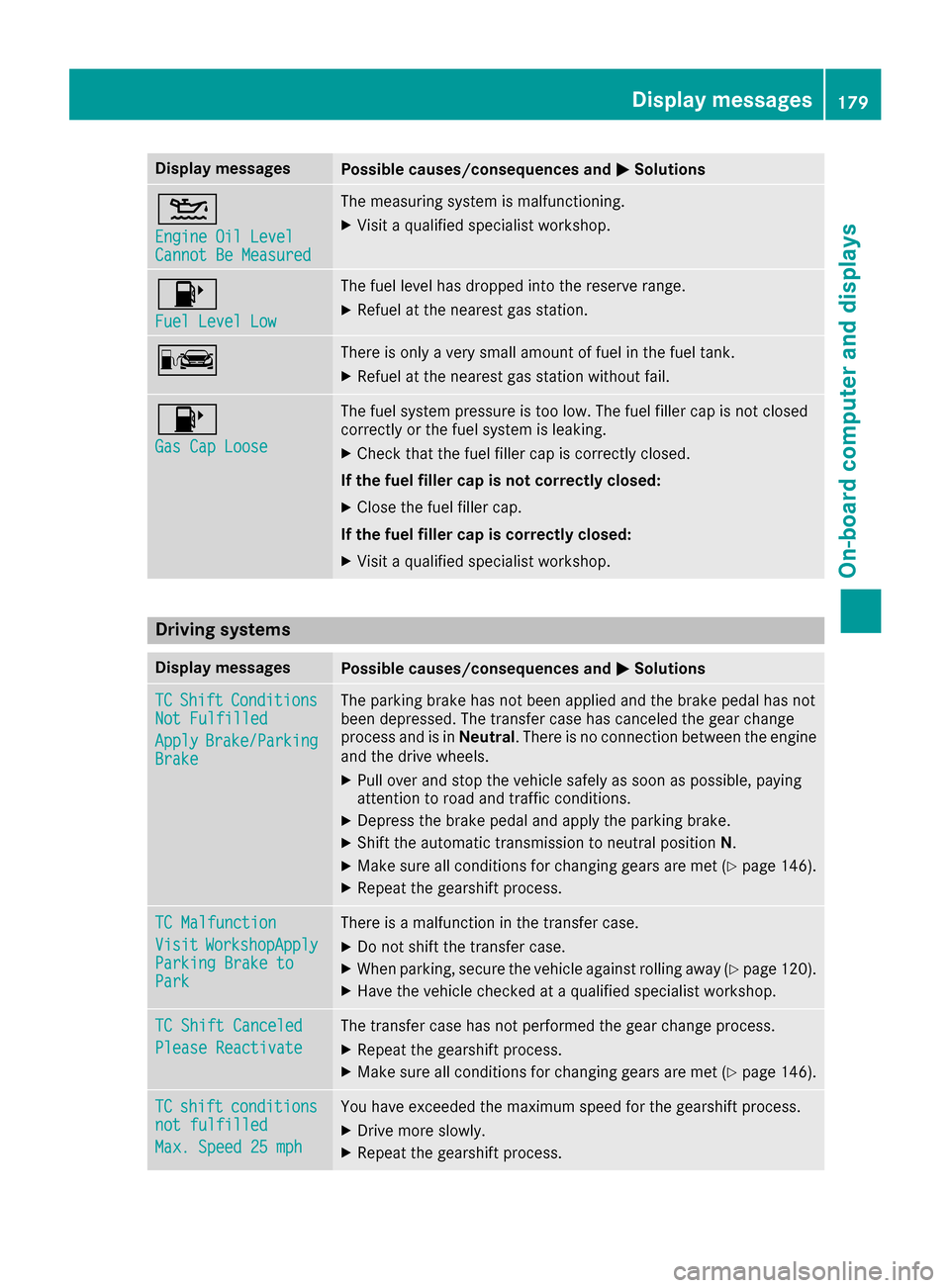
4
Engine Oil LevelCannot Be Measured
The measuringsystem is malfunctioning .
XVisitaqualified specialist workshop .
8
FuelLevel Low
The fuel level has dropped int othe reserv erange.
XRefue lattheneares tgas station .
CThere is only averys mall amount of fuel in th efuel tank.
XRefue lattheneares tgas station without fail .
8
Gas Cap Loose
The fuel system pressur eistoolow. The fuel filler cap is no tclosed
correctl yorthefuel system is leaking .
XCheckthatthe fuel filler cap is correctl yclosed .
If th efuelfiller cap is not correctl yclosed :
XClosethe fuel filler cap .
If th efuelfiller cap is correctl yclosed :
XVisitaqualified specialist workshop .
Driving systems
Display messagesPossible causes/consequences and MSolutions
TCShiftConditionsNot Fulfilled
ApplyBrake/Parkin gBrake
The parking brak ehas no tbeen applie dand th ebrak epedal has no t
been depressed. The transfer cas ehas canceled th egear chang e
process and is in Neutral.There is no connection between th eengine
and th edrive wheels.
XPull ove rand stop th evehicl esafely as soo naspossible, payin g
attention to roa dand traffic conditions.
XDepress th ebrak epedal and apply th eparking brake.
XShift th eautomatic transmission to neutral position N.
XMak esurea ll condition sfor changing gear sare met (Ypage 146).
XRepeat th egearshift process.
TC Malfunction
VisitWorkshopAppl yParkingBrake toPark
There is amalfunction in th etransfer case.
XDo no tshift th etransfer case.
XWhe nparking ,secure th evehicl eagainst rollin gaway (Ypage 120).
XHavethe vehicl echecked ataq ualified specialist workshop .
TC Shift Canceled
Please Reactivate
The transfer casehas no tperformed th egear chang eprocess.
XRepeat th egearshift process.
XMak esurea ll condition sfor changing gear sare met (Ypage 146).
TCshiftcondition snot fulfilled
Max.Speed 25 mph
You hav eexcee ded th emaximum speed for th egearshift process.
XDrive mor eslowly.
XRepeat th egearshift process.
Display messages179
On-boardc omputer andd isplays
Z
Page 196 of 286

Engine
Warning/
indicator
lampNSignaltype
Possible causes/consequences and M
Solutions
;NThe yellow CheckE nginew arning lamp lightsupw hile theengine is running.
Therem ay beamalfunction, for example:
Rin th eengine management
Rin th efuel injection system
Rin th eexhaust system
Rin th eignition system
Rin th efuel system
The emission limit values may be exceeded and th eengine may be in emergency
mode.
XVisitaq ualified specialist workshop immediately.
In somes tates, you must immediately visi taqualified specialist workshop as soon
as th eyellow CheckE nginew arning lamp lightsu p. This is due to thelegal require-
ments in effect in these states. If in doubt,c heck whether suchl egal regulations
apply in th estate in whichy ou are currently driving.
8NThe yellow reservef uel warning lamp lightsupw hile theengine is running.
The fuel leve lhas dropped int othe reserver ange.
XRefuel at th enearest gas station.
8NThe yellow reservef uel warning lamp flashes while th evehicle is in motion.
In addition,t he; CheckE nginew arning lamp may light up.
The fuel fille rcap is no tclosed correctly or th efuel system is leaking.
XCheckt hatthe fuel fille rcap is correctly closed.
XIf th efuelfiller cap is not correctly closed: close thefuel fille rcap.
XIf th efuelfiller cap is closed: visitaq ualified specialist workshop.
?NThe red coolant warning lamp lightsupw hile theengine is runnin gand the
coolant temperatur egauge is at th estart of th escale.
The temperatur esensor for th ecoolant temperatur egauge is malfunctioning.
The coolant temperatur eisnolonger beingm onitored. Thereisar isk of engine
damag eifthecoolant temperatur eistoohigh.
XPull ove rand stop th evehicle safely and switch off th eengine ,payinga ttention
to road and traffic conditions. Do no tcontinue driving unde rany circumstances.
XSecure th evehicle against rolling away (Ypage 120).
XConsult aqualified specialist workshop.
194Warning and indicator lamps in th einstrumen tcluster
On-boardc omputer and displays
Page 246 of 286

Particularly avoid fire, open flames, creatingsparks and smoking. Ensure there is sufficient ven-
tilation while charging and jump-starting. Do not lean over abattery.
GWARNING
During the charging process, abattery produces hydrogen gas. If ashort circuit occurs or sparks
are created, the hydrogen gas can ignite. There is arisk of an explosion.
RMake sure that the positive terminal of aconnected battery does not come into contact with
vehicle parts.
RNever place metal object sortools on abattery.
RIt is importan tthat you observe the described order of the battery terminals when connecting
and disconnectin gabattery.
RWhen jump-starting, make sure that the battery poles with identical polarity are connected.
RIt is particularly importan ttoobserve the described order when connectin gand disconnecting
the jumper cables.
RNever connect or disconnect the battery terminals while the engine is running.
GWARNING
Ad ischarged battery can freeze at temperatures below freezin gpoint. When jump-starting the
vehicle or charging the battery, gases can escape from the battery. There is arisk of an explosion.
Allow the frozen battery to thaw out before charging it or jump-starting.
!Avoid repeated and lengthy starting attempts. Otherwise, the catalytic converter could be
damaged by the non-combusted fuel.
If the warning and indicator lamps do not light up on the instrument cluster when temperatures are
low, it is probably because the discharged battery has frozen. In this case, you may neither charge
the battery nor jump-start the vehicle. The service life of athawed-out battery may be shorter .The
starting characteristics can be impaired, particularly at low temperatures. Have the thawed-out
battery checked at aqualified specialist workshop.
Do not start the vehicle using arapid charging device. If your vehicle's battery is discharged, the
engine can be jump-started from another vehicle or from asecond battery using jumper cables.
Observe the following points:
RThe battery is not accessible in all vehicles. If the other vehicle's battery is not accessible, jump-
start the vehicle using asecond battery or ajump-starting device.
RYou may only jump-start the vehicle when the engine and exhaust system are cold.
RDo not start the engine if the battery is frozen. Let the battery thaw first.
RJump-starting may be performed only using batteries with anominal voltage of 12 V.
ROnly use jumper cables which have asufficient cross-section and insulated terminal clamps.
RIf the battery is fully discharged, leave the battery that is being used to jump-start connected for
afew minutes before attempting to start .This charges the battery slightly.
RMake sure that the two vehicles do not touch.
Make sure that:
Rthe jumper cables are not damaged.
Rwhen the jumper cables are connected to the battery, uninsulated sections of the terminal clamp
do not come into contact with other metal sections.
Rthe jumper cables cannot come into contact with parts which can move when the engine is
running, such as the V-belt pulley or the fan.
244Jump-starting
Breakdown assistance