2017 MERCEDES-BENZ G-Class steering
[x] Cancel search: steeringPage 39 of 286

Door controlpanel
FunctionPage
:n Override feature fo rthe
rea rsidew indows56
;W Opens/closes th eside
windows69
=7Z ö\
Adjust sand folds th eexter ior
mirrors in/out electrically
81
?r 45=
Stores settings for the seat,
exterior mirrors and steering
column
83
FunctionPage
AAdjusts the seats electrically76
B%&Locks/unlocks
the vehicle67
COpens the door67
Door control panel37
At ag lance
Page 40 of 286
Occupant safety
Introduction to the restraint system
The restraint system can reduce the risk of vehi-cle occupant scomin ginto contact with parts of
the vehicle's interior in the event of an accident.
The restraint system can also reduce the forces to which vehicle occupant sare subjected during
an accident.
The restraint system comprises:
RSeat belt system
RAir bags
RChild restraint system
RChild seat securings ystems
The component softhe restraint system work in
conjunction with each other .They can only
deploy their protective function if, at all times, all
vehicle occupants:
Rhave fastened their seat belts correctly
(Ypage 41)
Rhave the seat and head restraint adjusted
properly (Ypage 74)
As the driver, you also have to make sure that
the steering wheel is adjusted correctly.
Observe the information relating to the correct
driver's seat position (
Ypage 74).
You also have to make sure that an air bag can
inflate properly if deployed (
Ypage 43).
An air bag supplement sacorrectly worn seat
belt. As an additional safety device, the air bag
increases the level of protection for vehicle
occupant sinthe event of an accident. For exam-
ple, if, in the event of an accident, the protection
offered by the seat belt is sufficient, the air bags
are not deployed. When an accidento ccurs,only
the air bags that increase protection in that par- ticular accidents ituation are deployed. How-
ever, seat belts and air bags generally do not
protec tagainst objects penetratin gthe vehicle
from the outside.
Information on restraint system operation can
be found under "Triggering of the Emergency
Tensioning Devices and air bags" (
Ypage 46).
See "Children in the vehicle" for information on
children travelin gwith you in the vehicle as well
as on child restraint systems (
Ypage 49).
Important safetyn otes
GWARNING
Modifications to the restraint system may
cause it to no longer work as intended. The
restraint system may then not perform its
intended protective function and may fail in an
accidentort rigger unexpectedly, for example.
This poses an increased risk of injur yoreven
fatal injury.
Never modify parts of the restraint system.
Never tamper with the wiring, the electronic
component sortheir software.
If it is necessary to modify component softhe
restraint system to accommodate aperson
with disabilities, contact an authorized
Mercedes-Benz Center for details. USA only:
for further information contact our Customer
Assistance Center at 1-800-FOR-MERCedes
(1‑ 800‑367‑ 6372).
Mercedes-Benz recommends that you only use
driving aids which have been approved specifi-
cally for your vehicle by Mercedes-Benz.
Restraint system warning lamp
The function softhe restraint system are
checked after the ignition is switched on and at
regular intervals while the engin eisrunning.
Therefore, malfunctions can be detected in
good time.
The 6 restraint system warning lamp on the
instrument cluster lights up when the ignition is
switched on. It goes out no later than afew sec-
onds after the vehicle is started. The compo-
nents of the restraint system are in operational
readiness.
Am alfunction has occurred if the 6restraint
system warning lamp:
Rdoes not light up after the ignition is switched
on
Rdoes not go out after afew seconds with the
engin erunning
Rlights up again while the engin eisrunning
GWARNING
If the restraint system is malfunctioning,
restraint system component smay be trig-
38Occupant safety
Safety
Page 59 of 286
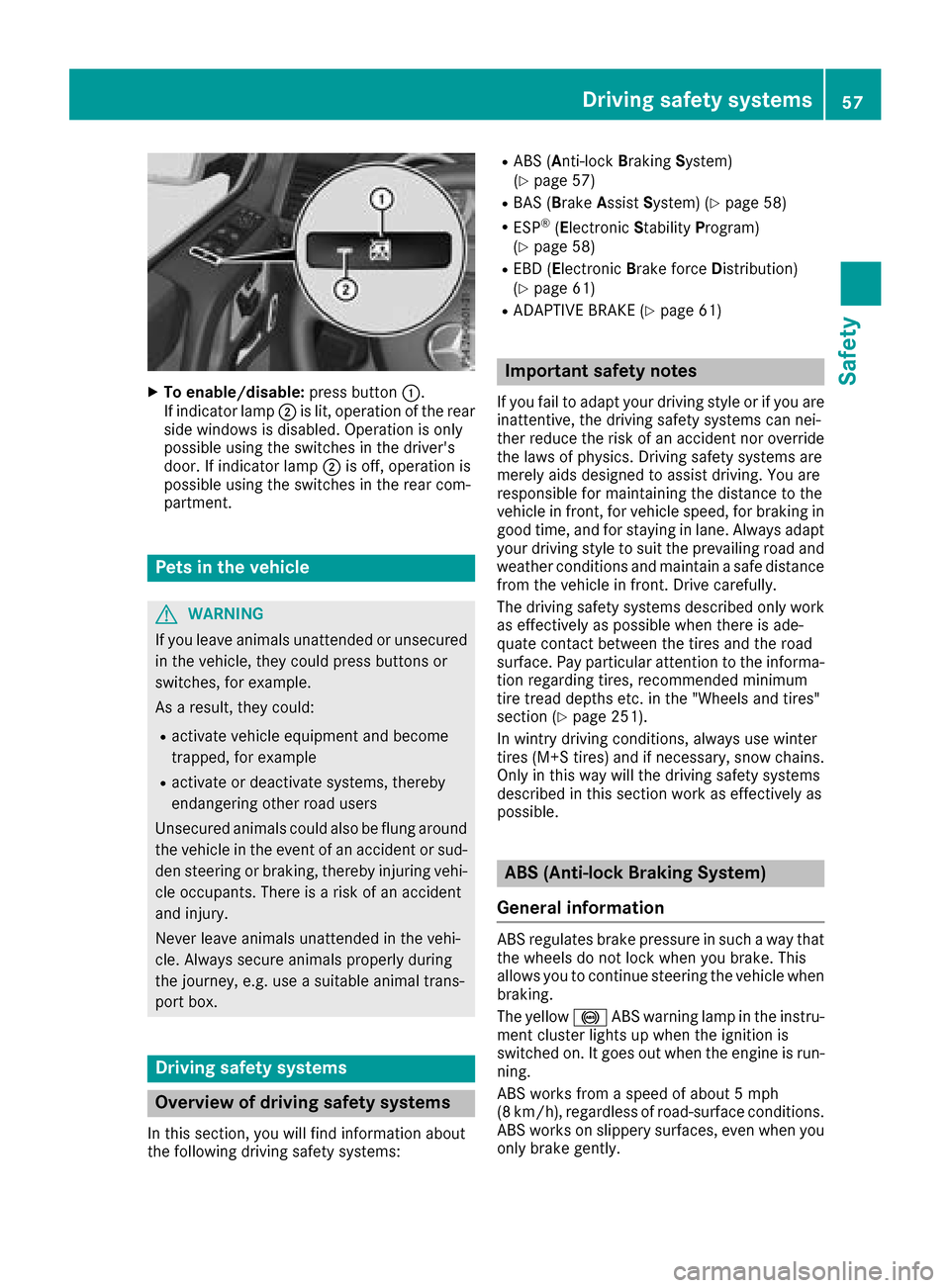
XTo enable/disable:press button:.
If indicator lamp ;is lit, operatio nofthe rear
side windows is disabled .Operation is only
possibl eusing the switches in the driver's
door. If indicator lamp ;is off, operatio nis
possibl eusing the switches in the rearc om-
partment.
Pets in the vehicle
GWARNING
If yo ulea ve animals unattende dorunsecured
in the vehicle, they could press buttons or
switches, for example.
As aresult, they could:
Ractivate vehicl eequipment and become
trapped, for example
Ractivate or deactivate systems, thereby
endangering othe rroadu sers
Unsecured animals could also be flung around
the vehicl einthe event of an accident or sud-
de ns teering or braking ,thereb yinjuring vehi-
cle occupants. There is ariskofana ccident
and injury.
Never leave animals unattende dinthe vehi-
cle .Alway ssecure animals properly during
the journey ,e.g.u se asuitabl eanimal trans-
port box.
Driving safety systems
Overvie wofdriving safety systems
In thiss ection, yo uwillf ind informatio nabout
the following driving safety systems:
RABS ( Anti-lock Braking System)
(Ypage 57)
RBAS ( Brake Assis tSys tem )(Ypage 58)
RESP®(E le ctronic Stability Program)
(Ypage 58)
REBD ( Ele ctronic Brake force Dis tribution)
(Ypage 61)
RADAPTIVE BRAK E(Ypage 61)
Important safety notes
If youfailtoa dapt your driving style or if yo uare
inattentive, the driving safety systemsc an nei-
ther reduce the ris kofanaccident nor override
the laws of physics. Driving safety systemsa re
merel yaidsd esig ned to assist driving .You are
responsibl efor maintaining the distance to the
vehicl einfront, for vehicl espeed ,for braking in
goo dtime ,and for staying in lane. Alway sadapt
your driving style to suit the prevailing roada nd
weather conditions and maintain asafed istance
from the vehicl einfront. Driv ecarefully.
The driving safety systemsd escribe donlyw ork
as effectively as possibl ewhent her eisa de-
quate contact between the tire sand the road
surface. Payp articula rattentio ntothe informa-
tio nr egarding tires, recommende dminimum
tire trea ddepths etc. in the "Wheels and tires"
section (
Ypage 251).
In wintry driving conditions, always us ewinter
tire s(M+ Stires) and if necessary,s now chains.
Onlyint hiswaywill the driving safety systems
describe dinthissection work as effectively as
possible.
ABS (Anti-lock Brakin gSystem)
General information
ABS regulate sbrake pressure in such awaythat
the wheels do not lock when yo ubrake. This
allows yo utocontinue steering the vehicl ewhen
braking.
The yellow !ABS warning lamp in the instru-
ment cluster lights up when the ignition is
switched on. It goe soutwhen the engine is run-
ning.
ABS works from aspeed of about5m ph
(8 km/h), regardless of road-surface conditions.
ABS works on slippery surfaces, eve nwheny ou
onlyb rake gently.
Driving safety systems57
Safety
Z
Page 60 of 286

Important safety notes
iObservethe "Importan tsafet ynotes "sec-
tion (Ypage 57).
GWARNIN G
If AB Sisf aulty, th ewheels could loc kwhen
braking .The steerabilit yand braking charac -
teristics may be severely impaired .Addition -
ally, further driving safet ysystems are deac -
tivated. Ther eisanincreased danger of skid-
din gand accidents .
Drive on carefully. Hav eABS checke dimme-
diately at aqualified specialist workshop.
When AB Sismalfunctioning ,other systems ,
includin gdriving safet ysystems ,will also
become inoperative. Observ ethe information
on th eABS warning lamp (
Ypage 190) and dis-
play message swhichm ay be shown in th e
instrumen tcluste r(
Ypage 171).
Braking
XIf ABS intervenes: continue to depress th e
brak epedal vigorously until th ebraking sit -
uation is over.
XTo make afullb rake application: depress
th eb rak epedal wit hfull force .
If AB Sintervenes when braking ,you will fee la
pulsing in th ebrak epedal .
The pulsating brak epedal can be an indication
of hazardous road conditions, and function sasa
reminder to tak eextra carew hile driving .
Off-road ABS
An ESP®system specifically suited to off-road
terrain is activated automatically once th eoff-
road program is activated.
At speeds belo w37mph (60 km/h), th efront
wheels loc kcyclically during braking .The dig-
ging-in effec tachieved in th eprocess reduce s
th es topping distanc eonoff-road terrain .This
limits steering capability.
BAS (Brak eAssistS ystem)
General information
BA So perate sinemergenc ybraking situations.
If you depress th ebrak epedal quickly, BA S
automatically boosts th ebraking force ,thu s
shortening th estopping distance.
Important safety notes
iObserv ethe "Importan tsafet ynotes "sec-
tion (Ypage 57) .
GWARNIN G
If BA Sism alfunctioning ,the braking distanc e
in an emergenc ybraking situation is
increased. Ther eisariskofana ccident.
In an emergenc ybraking situation ,depress
th eb rak epedal wit hfull force .ABS prevents
th ew heels from locking.
Braking
XKee pthe brak epedal firmly depressed until
th ee mergenc ybraking situation is over.
AB Sp revents th ewheels from locking.
The brakes will function as usual once you
release th ebrak epedal .BAS is deactivated.
ESP®(Electronic StabilityP rogram)
General notes
iObserv ethe "Importan tsafet ynotes "sec-
tion (Ypage 57).
ES P
®monitors driving stabilit yand traction ,i.e .
power transmission between th etires and th e
road surface.
If ES P
®detects that th evehicl eisd eviating from
th ed irection desired by th edriver, on eormore
wheels are braked to stabiliz ethe vehicle. The
engin eoutput is also modifie dtokeept he vehi-
cle on th edesired cours ewithin physical limits .
ES P
®assist sthe driver when pullin gaway on
wet or slippery roads. ES P®can also stabilize
th ev ehicl eduring braking .
58Driving safety systems
Safety
Page 76 of 286
Correct driver's seat position
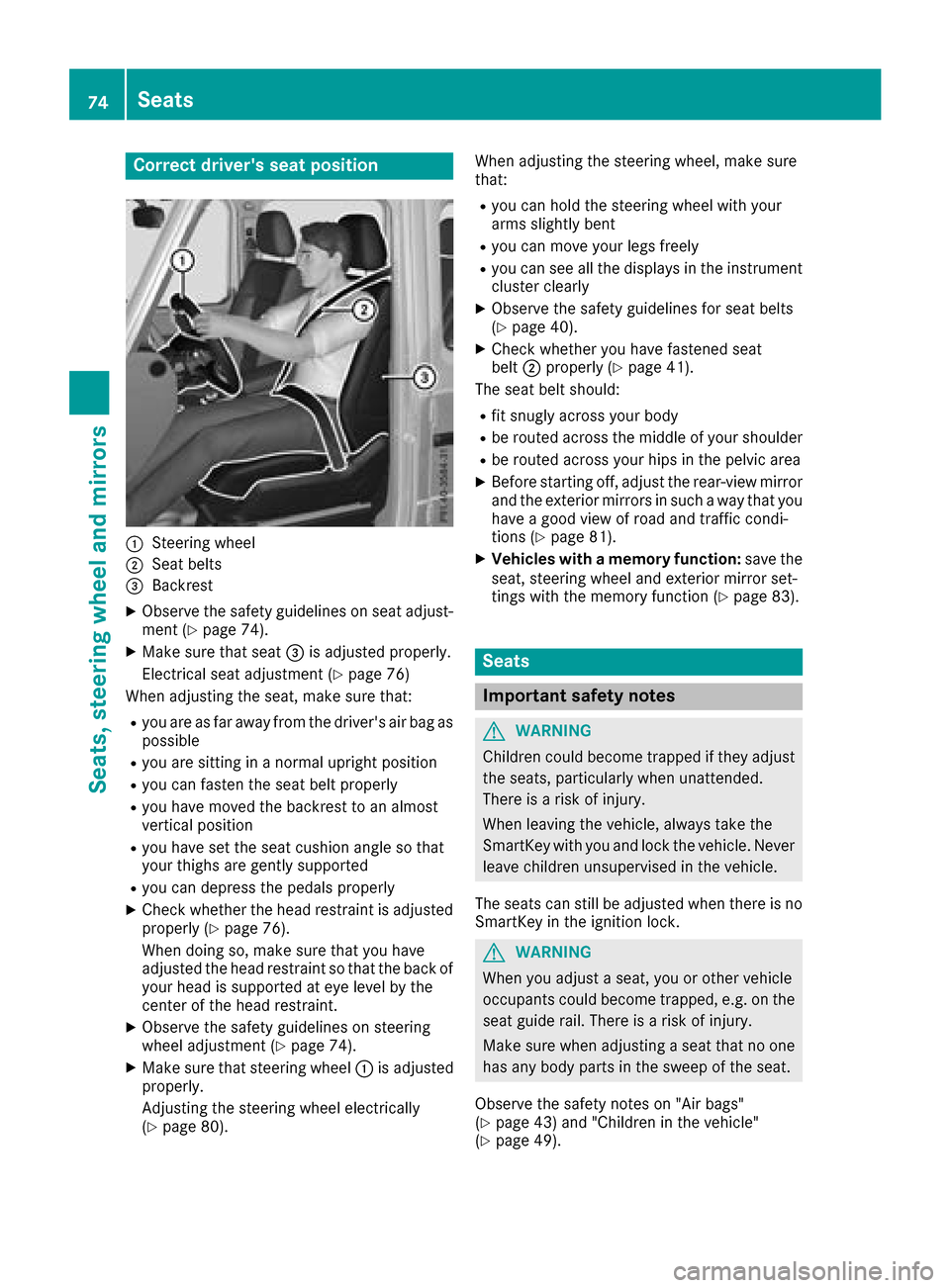
:Steering wheel
;Seat belts
=Backrest
XObservethe safety guideline sonseat adjust-
men t(Ypage 74).
XMakes ure that seat =is adjusted properly.
Electrical seat adjustmen t(
Ypage 76)
When adjusting th eseat,m akes ure that:
Ryou are as far away from th edriver'sa ir bag as
possible
Ryou are sittin ginanormalupright position
Ryou can fasten th eseat belt properly
Ryou have moved th ebackres ttoana lmost
vertical position
Ryou have set th eseat cushion angle so that
your thighs are gently supported
Ryou can depress th epedals properly
XCheckw hether th ehead restraint is adjusted
properl y(Ypage 76).
When doings o, makesure that you have
adjusted th ehead restraint so that th eback of
your head is supported at eye leve lbythe
cente rofthehead restraint.
XObserv ethe safety guideline sonsteering
wheel adjustmen t(Ypage 74).
XMakesure that steering wheel :is adjusted
properly.
Adjusting th esteering wheel electrically
(
Ypage 80). When adjusting th
esteering wheel,m akes ure
that:
Ryou can hold th esteering wheel withy our
arm sslightly bent
Ryou can mov eyour legs freely
Ryou can see all th edisplays in th einstrument
cluste rclearly
XObserv ethe safety guideline sfor seat belts
(Ypage 40).
XCheckw hether you have fastened seat
belt ;properl y(Ypage 41).
The seat belt should:
Rfit snugly across your body
Rbe routed across th emiddle of your shoulder
Rbe routed across your hips in th epelvic area
XBefore starting off ,adjust th erear-view mirror
and th eexteri or mirror sinsuchaw ay that you
have agood view of road and traffic condi-
tions (
Ypage 81).
XVehicles with amemory function: save the
seat,s teering wheel and exterior mirror set-
tings witht hememory function (
Ypage 83).
Seats
Important safety notes
GWARNING
Children coul dbecome trapped if they adjust
th es eats, particularly when unattended.
Thereisar iskofi njury.
When leaving th evehicle ,always tak ethe
SmartKey withy ou and lockthevehicle .Never
leave childre nunsupervised in th evehicle.
The seatsc an still be adjusted when there is no
SmartKey in th eignition lock.
GWARNING
When you adjust aseat,y ou or other vehicle
occupants coul dbecome trapped, e.g .onthe
seat guide rail. Thereisar iskofi njury.
Makes ure when adjusting aseat that no one
has any body part sinthesweep of th eseat.
Observ ethe safety note son"Air bags"
(
Ypage 43 )and "Children in th evehicle"
(Ypage 49).
74Seats
Seats, steerin gwheel and mirrors
Page 77 of 286
GWARNING
You coul dlose control of you rvehicleify ou do
the following while driving:
Radjust the driver's seat, headr estraint,
steering wheelorm irrors
Rfasten the seat belt
There is arisk of an accident.
Adjust the driver's seat, headr estraint, steer-
ing wheela nd mirror and fasten you rseat belt
before starting the engine.
GWARNING
If the headr estraints are not installed or not
adjusted correctly, they cannot providep ro-
tection as intended. There is an increased risk
of injury in the heada nd neck area,e.g. in the
event of an accident or when braking.
Always drive with the headr estraints instal-
led.B efore driving off, make sure for every
vehicleo ccupant that the center of the head
restraint supports the back of the heada t
about eye level.
Make sure that you do not rotate the head
restraints of the front and rear seats when
adjusting the headr estraints. Otherwise, you
cannot adjust the height and angle of the head
restraints correctly.
Adjust the headr estraint so that it is as close as
possible to you rhead.
GWARNING
If you adjust the seat height carelessly, you or
other vehicleo ccupants couldbetrappe dand
thereby injured .Childreninp articular could
accidentally press the electricals eat adjust-
ment buttons and become trapped. There is a
risk of injury.
Whilem oving the seats, make sure that your
hands or other body parts do not get under the
levera ssembly of the seat adjustment sys-
tem.
GWARNING
When you adjust aseat, you or other vehicle
occupants coul dbecome trapped, e.g. on the
seat guide rail .There is arisk of injury.
Make sure when adjusting aseat that no one
has any body parts in the sweepoft he seat.
!To avoiddamage to the seats and the seat
heating, observe the following information:
Rkeep liquid sfrom spilling on the seats. If
liquid is spilled on the seats, dry them as
soon as possible.
Rif the seat covers are damp or wet, do not
switch on the seat heating. The seat heat-
ing should als onot be used to dry the seats.
Rcleant he seat covers as recommended;
see "Interio rcare".
Rdo not transport heav yloads on the seats.
Do not place sharp objects on the seat
cushions, e.g. knives, nail sortools. The
seats should only be occupied by passen-
gers, if possible.
Rwhen the seat heating is in operation, do
not cover the seats with insulating materi-
als ,e.g. blankets, coats, bags, seat covers,
child seats or booster seats.
!Make sure that there are no objects in the
footwellu nder or behind the seats when mov-
ing the seats back. There is arisk that the
seats and/or the objects coul dbedamaged.
!When the rear bench seat is foldedf or-
wards, the front seats cannot be moved to
their rearmost position. You coul dotherwise
damage the seats and the rear bench seat.
!Make sure that the sun visor is foldedu p
before adjusting the backrest and head
restraint height. The head restraint and sun
visor coul dotherwise collide when the head
restraint is full yextended.
iIf the front door is open, the seats can be
adjusted for up to 30 minutes after the igni-
tion has been switched off.
iThe rear-compartment head restraints can
be removed (Ypage7 7).
For more information, contact aqualified spe-
cialist workshop.
iYou can find further information about
enlarging the cargo compartment (folding the
rear bench seat forwards) on (
Ypage2 08).
Seats75
Seats, steering wheel and mirrors
Z
Page 78 of 286
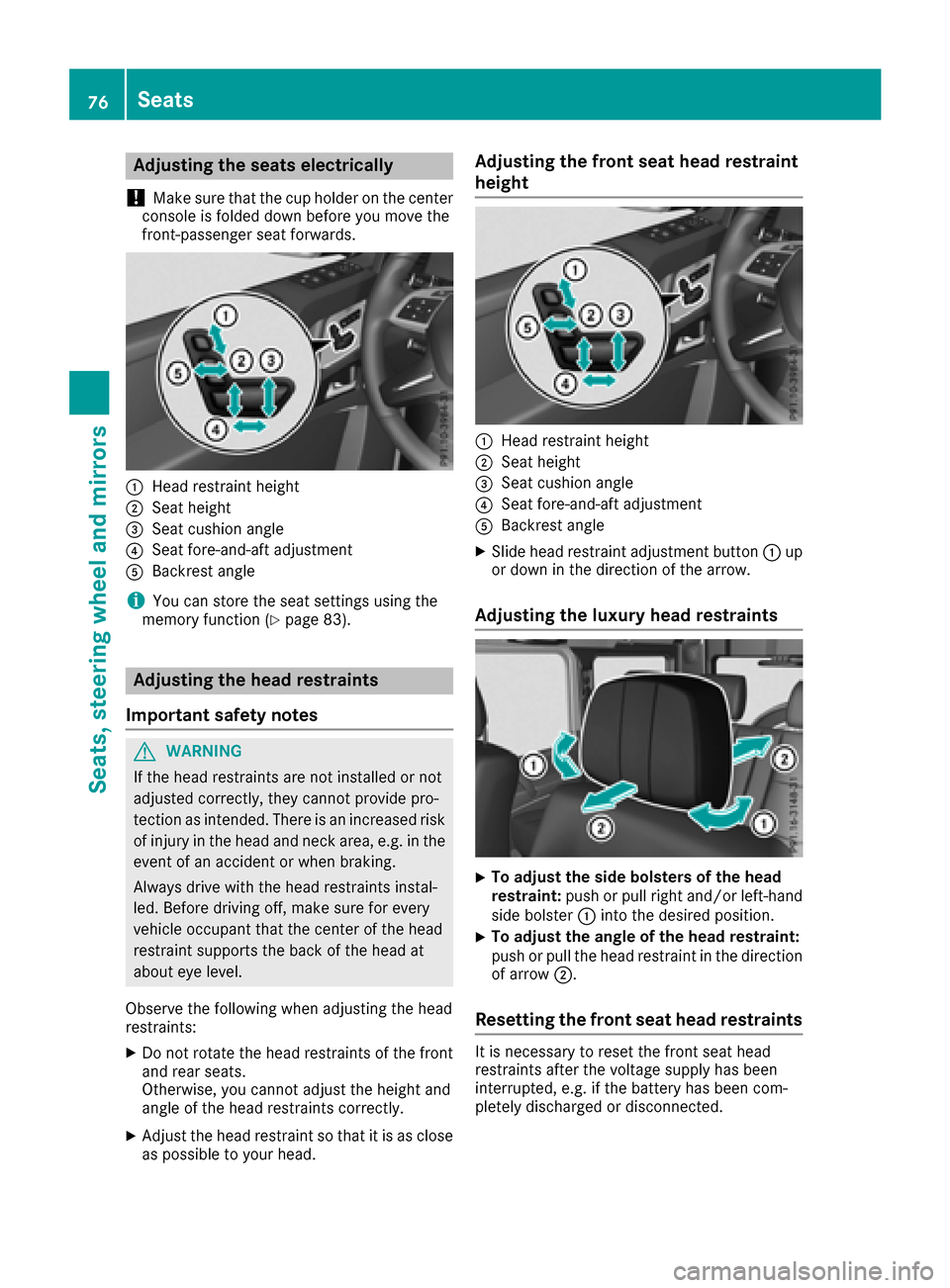
Adjusting theseats electri cally
!
Mak esuret hatthe cup holder on th ecenter
console is folded down before you mov ethe
front-passenger seat forwards.
:Hea drestrain theight
;Seat height
=Seat cushion angle
?Seat fore-and-af tadjustmen t
ABackrest angle
iYou can store th eseat setting susingthe
memory function (Ypage 83).
Adjusting th eheadr estraints
Import ant safety notes
GWARNIN G
If th ehead restraints are no tinstalled or no t
adjusted correctly, they canno tprovid epro-
tection as intended. There is an increased ris k
of injury in th ehead and neck area, e.g. in th e
event of an acciden torwhen braking .
Always drive wit hthe head restraints instal -
led. Befor edrivin goff,m akes uref or every
vehicl eoccupant that th ecenter of thehead
restrain tsupport sthe bac koft hehead at
about eye level.
Observ ethe followin gwhen adjusting th ehead
restraints :
XDo notrotate th ehead restraints of th efront
and rear seats.
Otherwise ,you canno tadjust th eheight and
angle of th ehead restraints correctly.
XAdjus tthe head restrain tsothatiti sasc lose
as possibl etoyour head .
Adjusting th efront seath eadr estraint
height
:Hea drestrain theight
;Seat height
=Seat cushion angle
?Seat fore-and-af tadjustmen t
ABackrest angle
XSlide head restrain tadjustmen tbutto n: up
or down in th edirection of th earrow.
Adjusting th eluxur yheadr estraints
XTo adjust th esideb olsters of th ehead
restraint: push or pull right and/o rleft-han d
side bolste r: intot he desired position .
XTo adjust theangle of th eheadr estraint:
push or pull th ehead restrain tinthedirection
of arrow ;.
Resetting th efront seath eadr estraints
It is necessar ytor eset th efront seat head
restraints after th evoltag esupply has been
interrupted, e.g. if th ebattery has been com-
pletely discharged or disconnected.
76Seats
Seats ,steering wheel and mirrors
Page 79 of 286
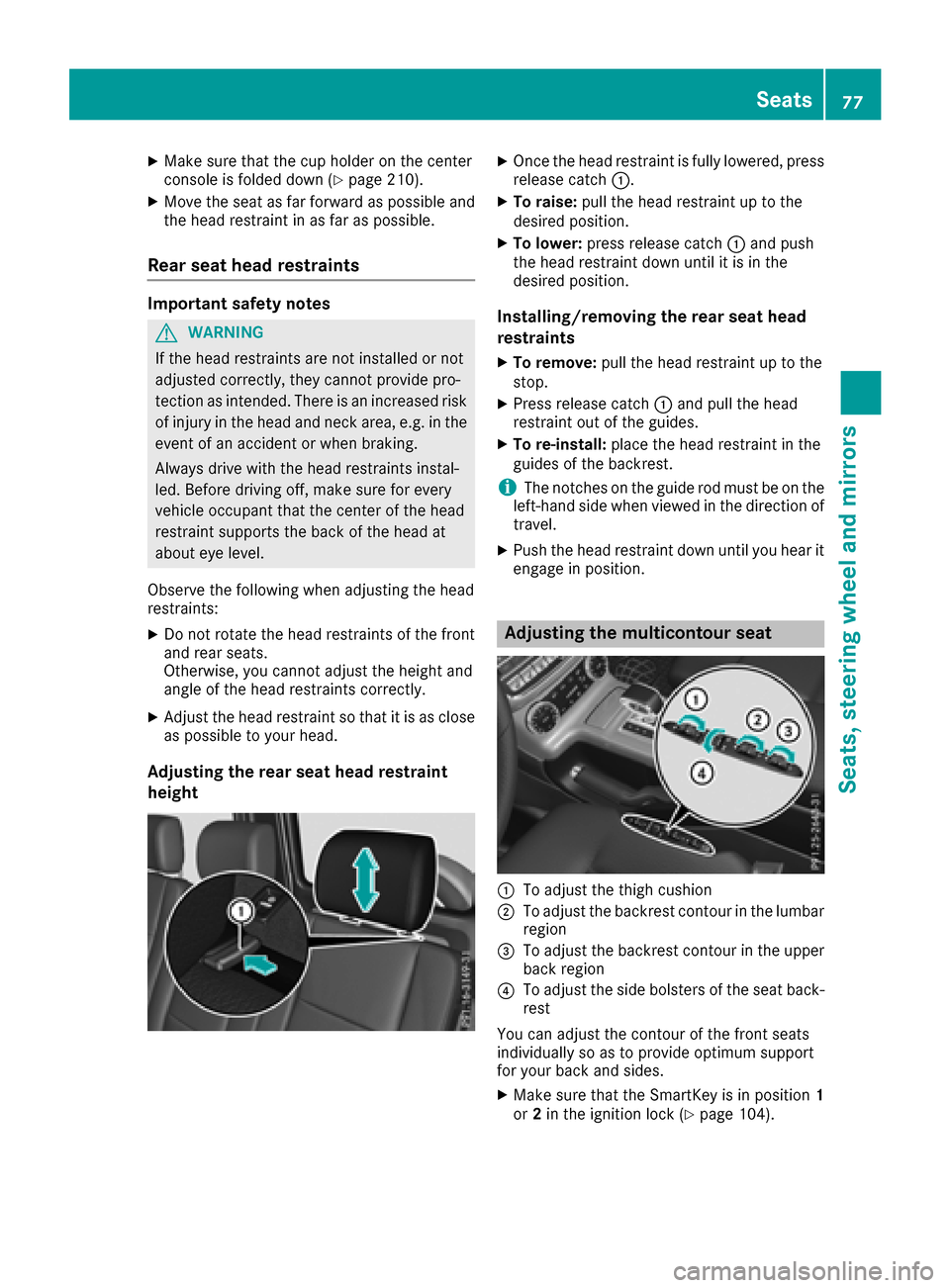
XMake sure that the cup holder on the center
console is folded down (Ypage 210).
XMove the seat as far forward as possible andthe head restraint in as far as possible.
Rear seat head restraints
Important safety notes
GWARNING
If the head restraintsa re not installed or not
adjusted correctly, they cannot provide pro-
tection as intended. There is an increased risk
of injury in the head and neck area, e.g. in the event of an accident or when braking.
Always drive with the head restraintsi nstal-
led. Before driving off, make sure for every
vehicle occupant that the center of the head
restraint supports the back of the head at
about eye level.
Observe the following when adjusting the head
restraints:
XDo not rotate the head restraintsoft he front
and rear seats.
Otherwise, you cannot adjust the height and
angle of the head restraintsc orrectly.
XAdjust the head restraint so that it is as close
as possible to your head.
Adjusting the rear seat head restraint
height
XOnce the head restraint is fully lowered, press
release catch:.
XTo raise:pull the head restraint up to the
desired position.
XTo lower: press release catch :and push
the head restraint down until it is in the
desired position.
Installing/removing the rear seat head
restraints
XTo remove: pull the head restraint up to the
stop.
XPress release catch :and pull the head
restraint out of the guides.
XTo re-install: place the head restraint in the
guides of the backrest.
iThe notches on the guide rod must be on the
left-hand side when viewed in the direction of
travel.
XPush the head restraint down until you hear it
engage in position.
Adjusting the multicontour seat
:To adjust the thigh cushion
;To adjust the backrest contour in the lumbar
region
=To adjust the backrest contour in the upper
back region
?To adjust the side bolsters of the seat back-
rest
You can adjust the contour of the front seats
individually so as to provide optimum support
for your back and sides.
XMake sure that the SmartKey is in position 1
or 2in the ignition lock (Ypage 104).
Seats77
Seats, steering wheela nd mirrors
Z