2017 AUDI TT ROADSTER weight
[x] Cancel search: weightPage 252 of 314
Wheel s
(c) Vehicle capaci ty weight, and
(d) Production options we ig ht
Maximum (permissible)
inflation pressure
means the maximum cold infla
tion pressure to which a tire may be inflated . Also called "max i
mum i nflation pressure ."
Normal occupant weight
means 150 lbs (68 kg) times the
number of occupants seated in
the vehicle up to the to tal seat ing
capacity of your vehicle .
Occupant distribution
means distribution of occupants
in a vehicle.
Outer diameter
means the overall diameter of an
inflated new tire.
Overall width
means the linear distance be
tween the exteriors of the side
walls of an inflated tire, inc luding
e levations due to label ing, deco
rations, or protective bands or
ribs .
Ply
means a layer of rubber-coated
parallel cords .
250
Production options weight
means the combined weight of
those installed regular product ion
options weighing over 5 lbs (2.3 kg) in excess of those standard
items which they replace, not pre
viously considered in curb weight or accessory weight, including
heavy duty brakes , ride levelers,
roof rack, heavy duty ba ttery, a nd
special trim.
Radial ply tire
means a pneumatic tire in which
the ply cords that extend to the
beads are la id at substantially 90
deg rees to the centerline o f the
tread.
Recommended inflation
pressure
see ¢ page 249 , Cold tire infla
tion pressure.
Reinforced tire
means a tire designed to operate
at higher loads and at higher in
flation pressures than the corre
sponding standard tire . Rein
forced tires may be identified as "XL", "xl", "EXTRA LOAD", or "RF"
on the s idewall. ...
Page 254 of 314
Wheels
comparisons among tires. The
UTQG is not a safety rating and not a guarantee that a tire will
last for a prescribed number of
miles (kilometers) or perform in a
certain way. It simply gives tire
buyers additional information to
combine with other considera
tions, such as price, brand loyalty
and dealer recommendations. Un
der UTQG, tires are graded by the
tire manufacturers in three areas:
treadwear, traction, and tempera
ture resistance. The UTQG i nfor
mation on the tires, molded into
the sidewalls .
U.S. DOT Tire Identification
Number (TIN)
This is the tire's "serial number".
It begins with the letters "DOT"
and indicates that the tire meets
all federal standards. The nex t
two numbers or letters indicate
the plant where it was manufac
tured, and the last four numbers represent the week and year of
manufacture. For example,
DOT ... 2216 ...
means that the tire was produced
in the 22nd wee k of 2016. The
other numbers are marketing co
des that may or may not be used
252
by the t ire manufacturer . This in
formation is used to contact con
sumers if a tire defect requ ires a
recall.
Vehicle capacity weight
means the rated cargo and lug
gage load pl us 150 lbs (68 kg)
times the veh icle's designated
seating capacity.
Vehicle maximum load on the
tire
means that load on an individual
tire that is determined by distrib
uting to each axle its sha re of the
maximum loaded vehic le we ight
and dividing
by two.
Vehicle normal load on the tire
means that load on an individual
tire that is determined by d istrib
ut ing to each axle its share of the
curb weight, accessory weight,
and normal occupan t weight (dis
tr ibuted in accordance with
¢ ta
ble on page 258) and d ividing by
two.
~
Page 260 of 314
Wheels
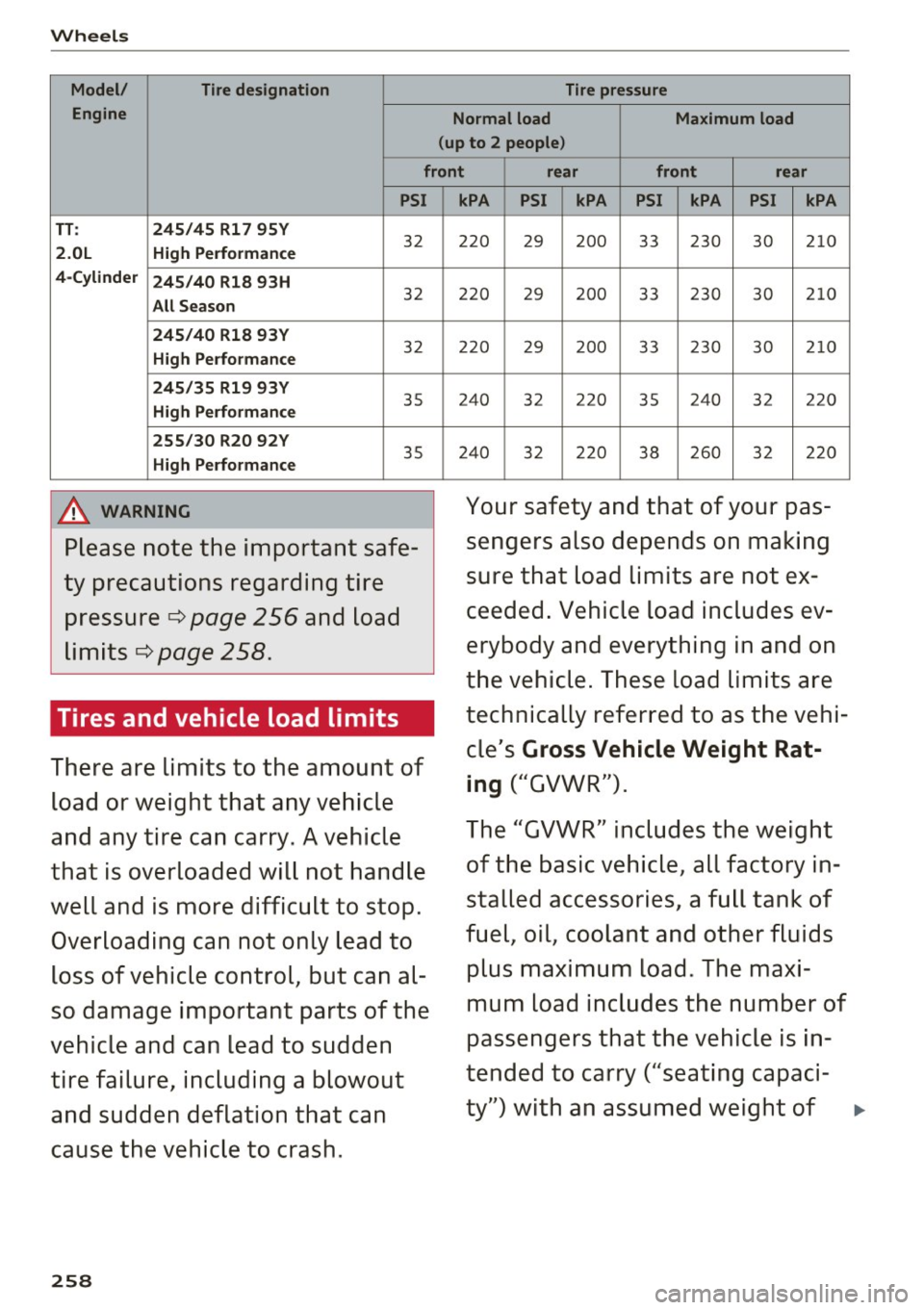
Model/ Tire designation Tire pressure
Engine Normal load Maximum load
(up to 2 people)
front rear front rear
PSI
TT : 245/45 R17 95Y
2.0L High Performance
32
4-Cylinder 245/40 R18 93H
All Season
32
245/40 R18 93Y
High Performance 32
245/35 R19 93Y
High Performance
35
255/30 R20 92Y
High Performance
35
A WARNING
Please note the important safe
ty precautions regarding tire pressure ¢
page 256 and load
limits¢
page 258.
Tires and vehicle load limits
There are limits to the amount of
load or weight that any vehicle
and any tire can carry. A vehicle
that is overloaded will not handle
well and is more difficult to stop .
Overloading can not only lead to
loss of vehicle control, but can al
so damage important parts of the
vehicle and can lead to sudden
tire failure, including a blowout and sudden deflation that can
cause the vehicle to crash.
258
kPA PSI kPA
PSI kPA PSI kPA
220 29 200 33 230 30 210
220 29 200 33 230 30 210
220 29 200 33 230 30 210
240 32 220 35 240
32 220
240 32 220 38 260 32 220
Your safety and that of your pas
sengers also depends on making
sure that load limits are not ex
ceeded. Vehicle load includes ev
erybody and everything in and on
the vehicle. These load limits are
technically referred to as the vehi
cle's
Gross Vehicle Weight Rat
ing
("GVWR").
The "GVWR" includes the weight
of the basic vehicle, all factory in
stalled accessories, a full tank of
fuel, oil, coolant and other fluids plus maximum load. The maxi
mum load includes the number of
passengers that the vehicle is in
tended to carry ("seating capaci-
ty") with an assumed weight of ..,
Page 261 of 314
a, a, ... N
" N ... 0
" V, a:,
150 lbs (68 kg) for each passen
ger at a designated seating posi
tion and the total weight of any
luggage in the vehicle .
The
Gross Axle Weight Rating
("GAWR") is the maximum load
that can be applied at each of the
vehicle's two axles.
The fact that there is an upper
limit to your vehicle's Gross Vehi
cle Weight Rating means that the
total weight of whatever is being
carried in the vehicle is limited.
The more passengers in the vehi
cle or passengers who are heavier
than the standard weights as
sumed mean that less weight can
be carried as luggage.
The Gross Vehicle Weight Rating
and the Gross Axle Weight Rating
are listed on the safety compli
ance sticker label located on the
driver's side 8-pillar
¢ page 256,
fig. 190.
&_ WARNING
Overloading a vehicle can cause
loss of vehicle control, a crash
or other accident, serious per
sonal injury, and even death.
-Carry ing more weight than
your vehicle was designed to
carry will prevent the vehicle
Wheels
from handling properly and
increase the risk of the loss of
vehicle control.
-The brakes on a vehicle that
has been overloaded may not
be able to stop the vehicle
within a safe distance.
-Tires on a vehicle that has
been overloaded can fail sud
denly, including a blowout and
sudden deflation, causing loss
of control and a crash.
-Always make sure that the to tal load being transported
does not make the vehicle
heavier than the vehicle's
Gross Vehicle Weight Rating.
Determining correct load
limit
Use the example below to calcu
late the total weight of the pas
sengers and luggage or other
things that you plan to transport
so that you can make sure that
your vehicle will not be overload ed.
Steps for Determining Correct Load Limit
1 . Locate the statement "THE
COMBINED WEIGHT OF OCCU-
PANTS AND CARGO SHOULD .,.
259
Page 262 of 314
Wheels
NEVER EXCEED XXX KG OR XXX
LBS"on your vehicle's placard
(tire inflation pressure label)
¢ page 256, fig. 190.
2. Determine the combined
weight of the driver and pas
sengers that will be riding in
your vehicle.
3. Subtract the combined weight
of the driver and passengers
from
"XXX" kilograms or "XXX"
pounds shown on the sticker
¢ page 256, fig. 190.
4. The resulting figure equals the
available amount of cargo and
luggage load capacity. For ex
ample, if the "XXX" amount
equals 1400 lbs and there will
be five 150 lbs passengers in
your vehicle, the amount of available cargo and luggage
load capacity is 650 lbs
(1400-750 (5
X 150) = 650 lbs)
5. Determine the combined weight of luggage and cargo
being loaded on the vehicle.
That weight may not safely ex ceed the available cargo and luggage load capacity calculat
ed in Step 4.
6. If your vehicle will be towing a
trailer, load from your trailer
will be transferred to your ve-
260
hicle. Consult this manual to
determine how this reduces
the available cargo and lug
gage load capacity of your vehi
cle.
~check the tire sidewall
(¢ page 246, fig. 188) to deter
mine the designated load rating
for a specific tire.
· Wheel bolts and rims
Wheel bolts
Wheel bolts must be clean and loosen/tighten
easily.
Rims
Rims with a bolted rim ring* or with bolted wheel
covers* consist of multiple pieces. These compo
nents were bolted together using special bolts
and a special procedure. You must not repair or
disassemble them
¢ &..
_8. WARNING
-Wheel bolts that are tightened or repaired in
correctly can become loose and result in loss
of vehicle control, which increases the risk of
an accident. For the correct tightening specifi
cation, see
¢ page 2 78, Finishing.
- Always keep the wheel bolts and the threads in the wheel hub clean and free of
grease .
- Only use wheel bolts that fit the rim.
- Always have damaged rims repaired by an
authorized Audi dealer or authorized Audi
Service Facility . Never repair or disassemble
rims yourself, because this increases the risk
of an accident .
Winter tires
Winter tires significantly improve the vehicle's
handling when driving in winter conditions . Be-
cause of their construction (width, compound, ..,.
Page 290 of 314
Emergency situations
Raising the vehicle
Lifting with workshop hoist and with floor
jack
Th e vehicle may only b e lift ed at the lifting
poin ts illust rated.
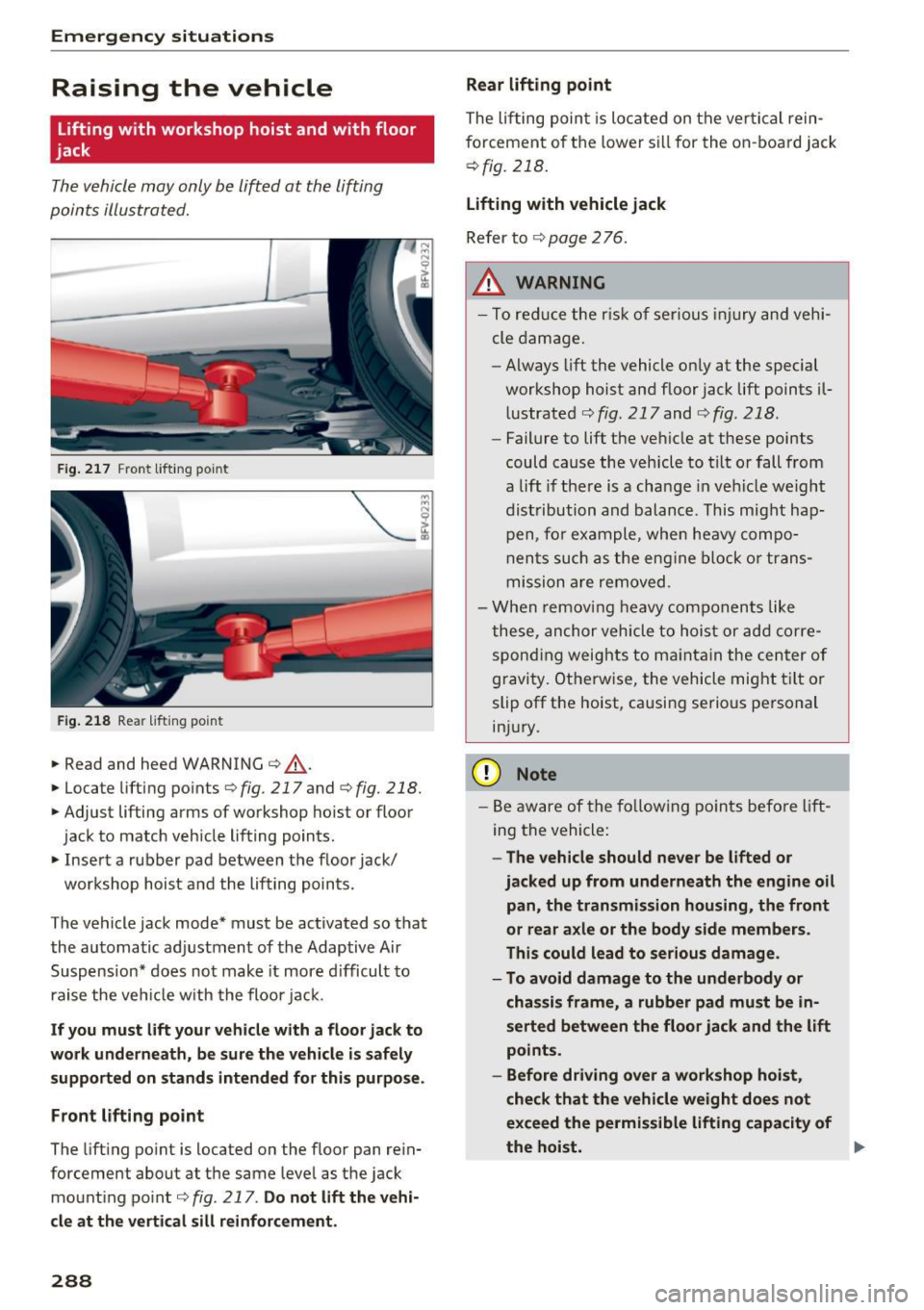
F ig .. 217 F ro nt lift ing po int
F ig. 218 Rea r lifti ng po int
.,. Read and heed WARNING ¢ A-
.,. Locate lifti ng po ints ¢ fig. 217 and ¢ fig. 218 .
.,. Adjust lifting arms of wo rkshop hoist or floor
jack to match veh icle lifting points.
.,. In se rt a rubb er pad between t he floor jack/
wor kshop hoist a nd the lif ting poin ts .
The vehicle jack mode * must be activated so that
the au tomatic ad justment of the Adaptive Air
Suspens ion * d oes no t mak e it more difficult to
raise the ve hicl e with the floo r jack.
If you must lift your vehicle with a floor jack to
work underneath, be sure the vehicle is safely
supported on stands intended for this purpose .
F ront lifting point
The lift ing po int is located on the floor pan re in
forcement about at the same leve l as the jack
mo unt ing point ¢
fig. 217 . Do not lift the vehi
cle at the vertical sill reinforcement.
288
Rear lifting point
The li fting poin t is lo cated on the ve rtic al rein
f orcement o f th e lower s ill for the on -boar d ja ck
¢fig. 218 .
Lifting with vehicle jack
Refer to ¢ page 2 76.
Ln., WARNING
- To reduc e the r isk of s erious in ju ry and vehi
cle dam age.
- Always lift the vehicle on ly at the special
wor ksh op hoist an d flo or jack lift points il
l ustrated
¢ fig. 217 and ¢fig . 218.
- Failur e to lift t he ve hicle at these points
could cause th e veh icle to tilt o r fall from
a lift if t he re is a cha nge in vehi cle w eight
dist ribution and balanc e. This mi ght hap
p en, fo r exa mple , whe n he avy co mpo
n en ts s uch as the e ngine blo ck or t ra n s
mis sion a re removed .
- Wh en r em ov ing heavy com ponen ts like
t hese, an ch or veh icle t o hoi st or add corre
s p ond ing weights t o maintain the ce n ter of
gravi ty. Oth e rw ise, the vehicle mig ht til t o r
slip off t he hoist, causi ng serious pe rsona l
in jur y .
(D Note
- B e aw are of the fo llow ing poin ts bef ore lif t
ing the vehicle:
- The vehicle should never be lifted or
jacked up from underneath the engine oil
pan, the transmission housing, the front
or rear axle or the body side members .
This could lead to serious damage .
- To avoid damage to the underbody or
chassis frame, a rubber pad must be in
serted between the floor jack and the lift
points .
- Before driving over a workshop hoist ,
check that the vehicle weight does not
exceed the permissible lifting capacity of
the hoist. ..,.
Page 292 of 314

Technical data
Technical data
Vehicle specifications
Fig. 219 Windshiel d (fro nt left s ide): V IN
XXXXX XX -X -XXX X XX X xx
®--+ f AHRZC . - ll)[jj f -Nil . Vlll[l£ • OOIT • NO. XX XXXXXX XX X XX XX XXX X
1YP /rtl'! XXX XXX
xx xxxxxxx
xx xx xx
XXX KW XXX
OC. OOll / lll AMS . lllO! xxxx XXX XXX ®-t Ml) TORKB./ CETll kS.
©+ IACl( flR./ INNENAIJSS t
XXXX I XXXX XXX I XX PAI NT NO. / WlllllOfl
II. -AUSST . / OPTIO NS
E 0 A 7D 5 4U B 6XM 5SG 5RW
2 EH JO Z l lB lA S lBA
3 FC 5M U 7X1
F0A 9G3 0G7 0 YH 0JF
TL 6 3 KA 8EH UlA X 9B OZ 7
lXW 8 0 3 908 8Z4 020
7T6 C V7
7K0 4
X3 2 K2
3 L4 4 KC 3 Y0 413 5 02
1 SA 7GB 0 1A 4GO
XX X XX X X X X xxxx
F ig . 220 Vehicle id entifica tion labe l
Vehicle Identification Number (VIN) in the
Infotainment system
0
0
0:, 0 ' J: .. a:,
~ Select in the Infotainment system: the I MENU I
button > left control button > Service & checks
> Vehicle information .
Vehicle Identification Number (VIN)
The VIN can be found in the Infotainment sys
tem, on the vehicle data label and under the
windshield on the driver's side*
¢ fig. 219.
290
Vehicle identification label
The vehicle identification label¢
fig. 220 is locat
ed in the luggage compartment under the cargo
floor cover.
The information of the vehicle identification label
can also be found in your Warranty
& Mainte
nance booklet.
The st icker contains the follow ing vehicle data:
(D Vehicle Identifica tion Number (VIN)
@ Vehicle type, eng ine output, transmission
® Engine and transmission cod es
@ Paint and interior codes
® Optional equipment numbers
Safety compliance sticker
The safety compliance sticker is your assurance
that your new veh icle complies with all applicable
Federal Motor Vehicle Safety Standards which
were in effect at the time the vehicle was manu
factured. You can find this sticker on the door
jamb on the driver's side. It shows the month and
year of production and the vehicle identification
number of your vehicle (perforation) as well as
the Gross Vehicle Weight Rating (GVWR) and the Gro ss Axle We ight Rating (GAWR).
High voltage warning label
The high voltage warn ing label is located in the
engine compartment next to the engine hood re
lease. The spark ignition system complies w ith
the Canadian standard IC ES-002.
Weights
Gross Vehicle Weight Rating
The Gross Vehicle Weight Rating (GVWR), and
the Gross Axle Weight Rat ing (GAWR) for front
and rear are li sted on a sticker on the door jamb
on the driver 's side.
The Gross Vehicle Weight Rating includes the
weight of the basic vehicle plus full fuel tank, oil
and coolant, plus maximum load, which includes
passenger weigh t (150 lbs/68 kg per designated
seat ing position) and luggage weight
c::> ,&.. ..,.
Page 293 of 314

co
co
.... N
" N .... 0
" "' c:o
Gross Axle Weight Rating
The G ross Axle We igh t Rating is the max imum
l oad that can be applied at each axle of the vehi
cle ~.& .
Vehicle capacity weight
The vehicle capac ity we ight (max. load) is listed
on the drive r's side 8-p illar.
_& WARNING
- T he ac tual Gross Ax le Weight Ra ting a t the
front and rear axles sho uld not exceed the
permissible weights, and their combination
must not exceed the Gross Ve hicle We ight
Rating.
Dimensions
The dimens io ns can vary depending on the mod
e l, equipment and measur ing methods used in
e a ch ma rket.
Leng th
Width
Width across the m irrors
He ight at cu rb we ight
When driving on poor roads, by cu rbs and on
steep ramps, make s ure that low-hang ing com
ponents such as the spo iler and exhaust system
Capacities
F uel t ank
Windsh ield and headlight washer system*
Techn ical data
- Exceeding permissible weight ratings can
res ult in vehicle damage, accidents and per
sonal injury.
(D Note
- The vehi cle capacity weig ht figures apply
when the load is d istributed evenly in the
vehicle (passengers and luggage) . When
transport ing a heavy load in the luggage
compartment, carry the load as near to the
rear axle as possib le so that the veh icle's
hand ling is not impaired .
- Do not exceed the maximum perm iss ible
ax le loads or the maximum g ross ve hicle
we igh t. Always remember that the veh icle's
han dling will be affe cted by the extra load.
Th erefore, adjust your spee d accordingly.
- Always observe local regulations.
TT
in (mm) 164. 7 (4,18 4)
i n (mm)
72.1 (1,832)
i n (mm) 77 .4 (1,966)
i n (mm) 53.3 (1,353)
do not come i nto contact with these or they cou ld
be damaged. This applies especially when the ve
hicle is fully loaded.
ga l (l) approx. 1 4.5 (5 5)
ga l
(l) approx . 2 .4 (9 .0)
291