2017 AUDI TT ROADSTER weight
[x] Cancel search: weightPage 222 of 314
Child safety
Advanced front airbag system and children
Your vehicle is equipped with a front "Advanced
Airbag System" in compliance with United States Federal Motor Vehicle Safety Standard (FMVSS)
208 as applicable at the time your vehicle was
manufactured.
The Advanced Airbag system in your vehicle has
been certified to meet the "low-risk" require
ments for 3- and 6-year old children on the pas
senger side and small adults on the driver side.
The low risk deployment criteria are intended to
reduce the risk of injury through interaction with
the airbag that can occur, for example, by being
too close to the steering wheel and instrument panel when the airbag inflates. In addition, the
system has been certified to comply with the
"suppression" requirements of the Safety Stand
ard, to turn off the front airbag for infants up to
12 months who are restrained on the front pas
senger seat in child restraints that are listed in
the Standard .
Even though your vehicle is equipped with an Ad
vanced Airbag system, a child should always ride
in the seat properly restrained for its age and
size . The airbag on the passenger side makes the
front seat a potentially dangerous place for a
child to ride. The front seat is not the safest place
for a child in a forward-facing child safety seat. It
can be a very dangerous place for an infant or a larger child in a rearward-facing seat .
The vehicle's Advanced Airbag System has a ca pacitive passenger detection system in the front
passenger seat cushion that can detect the pres
ence of a baby or a child in a child restraint sys
tem on this seat.
The capacitive passenger detection system regis
ters the changes that result in an electrical field
when a ch ild, a child restraint, and a baby blanket
are on the front passenger seat. The change in
the measured capacitance due to the presence of
a child, a child restraint, and a baby blanket on
the front passenger seat is related to the child
restraint system resting on the seat. The meas
ured capacitance of a child restraint system var ies depending on the type of system and specific
make and model.
220
The electrical capacitance of the various types, makes, and models of child restraints specified
by the U.5 .National Highway Traffic Safety Ad
ministration (NHTSA) in the relevant safety
standard are stored in the Advanced Airbag Sys
tem control unit together with the capacitances
typical of infants and a 1-year old child . When a
child restraint is used on the front passenger
seat with a typical 1 year-old infant, the Ad
vanced Airbag System compares the capacitance
measured by the capacitive passenger detection
system with the data stored in the electronic con
trol unit.
Child restraints and Advanced front airbag
system
Regardless of the child restraint that you use,
make sure that it has been certified to meet Unit
ed States Federal Motor Vehicle Safety Standards
and has been certified by its manufacturer for
use with an airbag. If in exceptional circumstan
ces you must use it on the front passenger seat,
carefully read all of the information on child safe
ty and Advanced Airbags and heed all of the ap
plicable WARNINGS. Make certain that the child
and child restraint are correctly recognized by the
capacitive passenger detection system in the
front passenger seat, that the front passenger
airbag is turned off, and that the airbag status is
always correctly signaled by the
PASSENGER AIR
BAG OFF~;
light.
Many types and models of child restraints have
been available over the years, new models are in
troduced regularly incorporating new and im
proved designs and older models are taken out of
production. Child restraints are not standardized.
Child restraints of the same type typically have
different weights and sizes and different "foot
prints", the size and shape of the bottom of the
child restraint that sits on the seat, when they
are installed on a vehicle seat. These differences
make it virtually impossible to certify compliance
with the requirements for advanced airbags with each and every child restraint that has ever been
sold in the past or will be sold over the course of
the useful life of your vehicle. ..,.
Page 224 of 314
Child safety
"'Push the child safety seat down with your full
weight to get the safety belt really tight so that
the seat cannot move forward and sideways
more than 1 in (2.5 cm).
Always remember: Even though your vehicle is
equipped with an Advanced Airbag system, a
child should always ride in the seat properly re
strained for its age and si ze.
A WARNING
Not using a child safety seat, using the wrong
child safety seat or improperly installing a
child restraint increases the risk of serious
personal injury and death.
-All vehicle occupants and especially children
must be restrained properly whenever riding
in a vehicle. An unrestrained or improperly
restrained child could be injured by striking
the interior or by being ejected from the ve
hicle during a sudden maneuver or impact.
An unrestrained or improperly restrained
child is also at greater risk of injury or death
through contact with an inflating airbag.
- Commercially available child safety seats
are required to comply with U .S. Federal
Motor Vehicle Safety Standard (FMVSS) 213
(in Canada CMVSS 213).
- When buying a child restraint, select one
that fits your child and the vehicle.
- Only use child restraint systems that fully
contact the flat portion of the seat cush
ion. The child restraint must not tip or
lean to either side. Audi does not recom
mend using child safety seats that rest on
legs or tube-like frames. They do not pro
vide adequate contact with the seat.
- Always heed all legal requirements per
taining to the installation and use of child
safety seats and carefully follow the in
structions provided by the manufacturer
of the seat you are using .
- Never let more than one child occupy a child
safety seat .
- Never let babies or older children ride in a
vehicle while sitting on the lap of another
passenger .
222
-Holding a child in your arms is never a sub
stitute for a child restraint system.
- The strongest person could not hold the
child with the forces that exist in an acci
dent. The child will strike the interior of
the vehicle and can also be struck by the passenger.
- The child and the passenger can also in
jure each other in an accident.
- Never install rear-facing child safety seats
or infant carriers on the front passenger
seat . A child will be seriously injured and
can be killed when the passenger airbag in
flates -even with an Advanced Airbag Sys
tem.
- The inflating airbag will hit the child safety
seat or infant carrier with great force and
will smash the child safety seat and child
against the backrest, center armrest, door
or roof.
- If exceptional circumstances require the use
of a forward-facing child restraint on the
front passenger's seat, the child's safety
and well-being require that the following
special precautions be taken:
- Make sure the forward-facing seat has
been designed and certified by its manu
facturer for use on a front seat with a pas
senger front and side airbag.
- Always carefully follow the manufacturer's
instructions provided with the child safety
seat or carrier.
- Always move the front passenger seat into
the rearmost position of the passenger
seat's fore and aft adjustment range, and
as far away from the airbag as possible be
fore installing the child restraint.
- Always make sure that nothing prevents
the front passenger's seat from being
moved to the rearmost position in its fore
and aft adjustment range.
- Always make sure that the backrest is in
the upright position.
- Never place or use any electrical device
(such as a laptop, CD player, electronic
games device, power inverter or seat heat-
er for child seats) on the front passenger ..,.
Page 225 of 314
CD
CD
.... N
" N .... 0
" V, co
seat if the device is connected to the 12-
volt socket or the cigarette lighter socket.
- If a seat heater has been retrofitted or
otherwise added to the front passenger
seat, never install any child restraint sys
tem on th is seat.
- Make sure that there are no wet objects
(such as a wet towel) and no water
or oth
er liqu ids on the front passenger seat
cushion.
- Never place objects on the seat (such as a
laptop, CD player, electronic games de
vice, power inverter or seat heater for
child seats). These may influence the elec
tr ica l capacitance measured by the capaci
tive passenge r detection system and can
also fly around in an accident and cause
serio us personal i njury.
- Always buckle the child safe ty seat firmly in
place even if a child is not sitting in it. A
loose child safety seat can fly around during
a sudden stop or in a collision .
-Always read and heed all WARNINGS when"
ever using a child restrained in a veh icle is
being used¢
page 189, Safety belts,
¢page 196, Airbag system
and
¢ page 218, Child safety.
A WARNING
To reduce the risk of serious in jury, make sure
that the PASSENGER AIR BAG OFF~; light
comes on and stays on wheneve r a child re
st raint is ins talled on the front passenger seat
and the ignition is sw itched on.
- Never ins tall a reward facing ch ild safety
seat on the front passenger seat if the PAS
SENGER AIR BAG OFF~; ligh t does not
t u rn on and stay on.
- Have the airbag system inspected by your
authori zed Aud i deale r im mediately.
Ch ild sa fety
Child seats
Infant seats
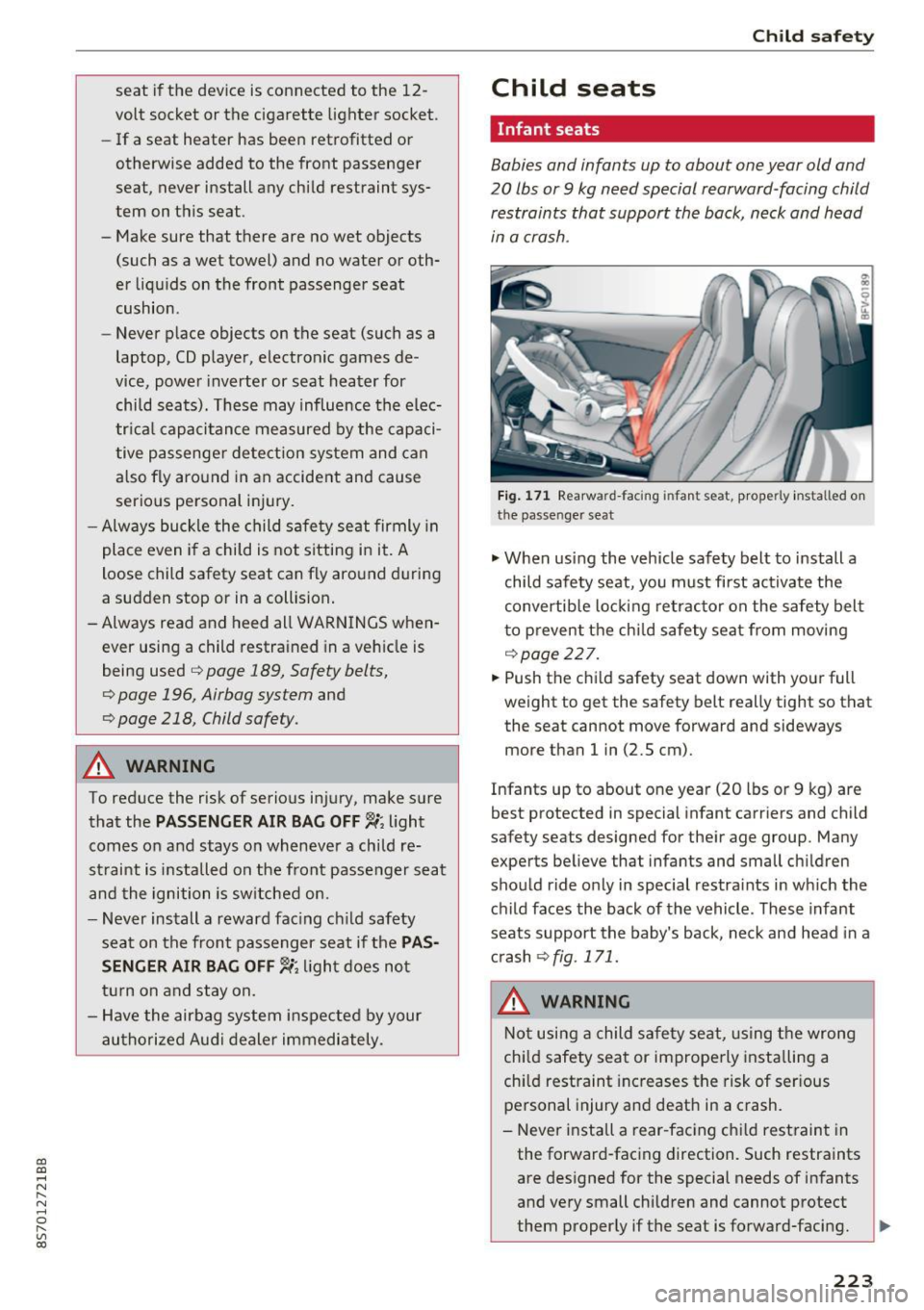
Babies and infants up to about one year old and
20 lbs or
9 kg need special rearward-facing child
restraints that support the back, neck and head
in a crash .
Fig . 17 1 Rearwa rd-facing infant seat, prope rly installed on
the passenger seat
.,. When us ing the vehicle safety belt to install a
child safety seat, yo u must first activate the
convertib le lo ckin g re tractor on the safety belt
to p revent the ch ild safety seat from moving
¢ page 227.
.,. Push the ch ild safety seat down with your full
weight to get the safety belt really tight so that
the seat cannot move forward and sideways
more than 1 in (2.5 cm).
Infants up to about one year (20 lbs or 9 kg) are
best protected in special infant carriers and child
safety seats designed for their age group. Many
experts be lieve that infants and small ch ildren
should ride only in special restraints in wh ich the
child faces the back of the vehicle . These infant
seats support the baby's back, neck and head in a
cr ash
¢fig. 171.
A WARNING
Not using a child sa fe ty seat, using t he wrong
chi ld safety seat or imprope rly inst alling a
chi ld restraint increases the risk of ser ious
personal injury and death in a crash.
- Never install a rear -fac ing ch ild rest raint in
the forward-facing direction. Such restraints
are des igned for the special needs of infants
and very small children and cannot protect
them proper ly if the seat is forward-facing.
223
Page 226 of 314
Child safety
-Never install a rearward facing child safety
seat on the front passenger seat unless the
PASSE NGER AIR BAG OFF,;; light comes
on and stays on. If the
PA SSEN GE R AIR
BAG OFF ,;;
light does not come on and stay
on the inf lating airbag w ill hit the child safe
ty seat or infant ca rr ier with great force and
will smash the chi ld safety seat and chi ld
against the backrest, center armrest, door
or roof. Have the airbag system inspected
immediately by your Audi dealer.
- Never place or use any electrical device
(such as a laptop, CD player, electronic
games device, power inverter or seat heater
for child seats) on the front passenger seat
if the device is connected to the 12-volt
socket or the cigarette lighter socket.
- If a seat heater has been retrof itted or oth
erwise added to the front passenger seat,
never install any ch ild restraint system on
this seat .
- Make sure that there are no wet objects
(such as a wet towel) and no water or other
liquids on the front passenger seat cushion.
- Never place objects on the seat (such as a
laptop, CD player, electronic games dev ice,
power inverter or seat heater for child
seats). T hese may influence the e lectr ica l
capacitance measured by the capaci tive pas
senger detection system and can also fly
around in an accident and ca use serious per
sonal injury.
- Always read and heed all WARN INGS when
ever using a child restrained in a vehicle is
being used
Q page 189, Safety belts,
¢ page 196, Airbag system
and
¢ page 218, Important information.
224
Convertible child safety seats
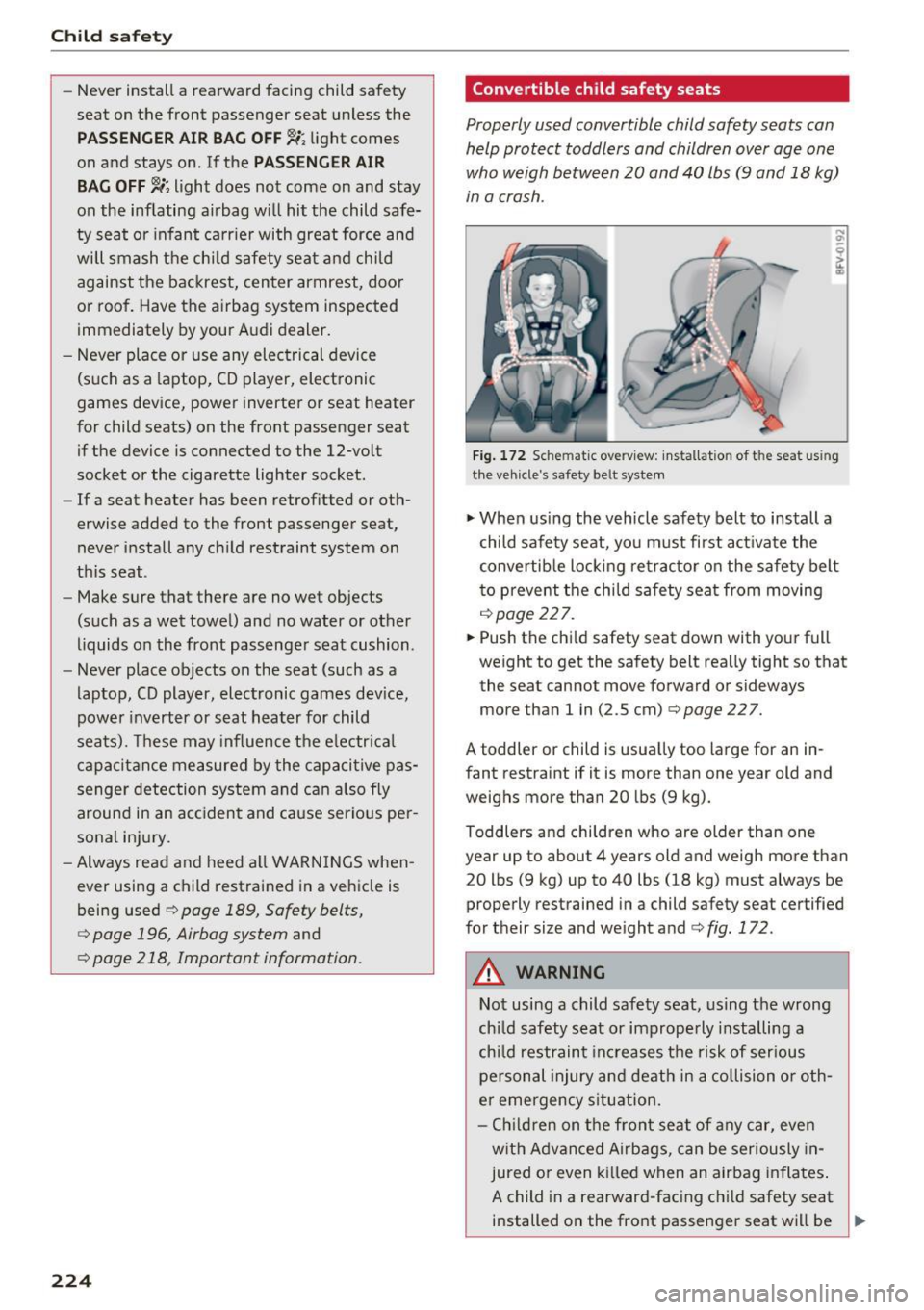
Properly used convertible child safety seats con
help protect toddlers and children over age one who weigh between 20 and 40 lbs (9 and 18 kg)
in a crash .
.... a,
Fig. 1 72 Sche matic overv iew : installat ion of t he seat using
the vehicle's safety belt system
""When using the vehicle safety belt to install a
child safety seat, yo u must first act ivate the
convertib le locking retractor on the safety belt
t o prevent the chi ld safety seat from moving
¢ page 227.
"" Push the chi ld safety seat down with your full
weight to get the safety belt really tight so that
the seat cannot move forward or sideways
more than 1 in (2.S cm)¢
page 227.
A toddler or child is usua lly too large for an in
fant restraint if it is more than one year old and
weighs more than 20 lbs (9 kg).
Toddlers and children who are older than one
year up to about 4 years old and weigh more than 20 lbs (9 kg) up to 40 lbs (18 kg) must always be
properly restrained in a child safety seat certified
for their size and we ight and ¢
fig. 172 .
A WARNING
Not using a child safety seat, using the wrong
chi ld safety seat or imprope rly installing a
chi ld restrain t inc reases the risk of ser ious
personal injury an d death in a co llision or oth
e r emergency s ituation.
- Ch ild ren on t he front seat of a ny car, eve n
w it h Advanced Airbags, can be seriously in
jured or even kill ed when an airbag inflates .
A child in a rearward-facing ch ild safety seat
installed on the front passenger seat will be .,.
Page 228 of 314
Child safety
The vehicle's safety belts alone will not fit most
childr en until they are at least 4
ft 9 in (57 in/
1.45 m) tall and weigh about 80 lbs (36 kg) .
Booster seats raise these children up so that the
safety belt will pass properly over the s tronger
parts of their bodies and the safety belt can help
protect them in a crash .
"' Do not use the convertible locking retractor
when using the vehicle's safety belt to restrain
a child on a booster seat .
"'The shoulder belt must lie as close to the cen
ter of the child's collar bone as possible and must lie flat and snug on the upper body.
It
must never lie across the throat or neck. The
lap belt must lie across the pelvis and never
across the stomach or abdomen. Make sure the
belt lies flat and snug . Pull on the belt to tight
en if necessary .
Children up to at least 8 years old (over 40 lbs or
18 kg) are best protected in child safety seats de
signed for their age and weight. Experts say that
the skeletal structure, particularly the pelvis, of
these children is not fully developed, and they
must not use the vehicle safety belts without a
suitable child restraint.
It is usually best to put these children in appro
priate booster seats. Be sure the booster seat
meets all applicable safety standards.
Booster seats raise the seating position of the
child and reposition both the lap and shoulder
parts of the safety belt so that they pass across
the child's body in the right places . The routing of
the belt over the child's body is very important
for the child's protection, whether or not a boos
ter seat is used.
Never use the lap belt portion of the vehicle 's
safety belt alone to restrain any child, regardless
of how big the child is. Always remember that
children do not have the pronounced pelvic struc
ture required for the proper function of lap belt
port ion of the vehicle's three point lap and
shoulder belts . The child's safety absolutely re
quires that a lap belt portion of the safety belt be
fastened snugly and as low as possible around the pelvis. Never let the lap belt portion of the
226
safety belt pass over the child's stomach or abdo
men.
In a crash, airbags must inflate w ithin a blink of
an eye and with considerable force. In order to do
its job, the airbag needs room to inflate so that it
will be there to protect the occupant as the occu
pant moves forward into the airbag.
A vehicle occupant who is out of pos it ion and too
close to the airbag gets in the way of an inflating
airbag. When an occupant is too close, he or she
will be struck vio lently and w ill receive serious or
possibly even fatal injury.
In order for the airbag to offer protection, it is
important that all vehicle occupants , especially
any ch ildren, who must be in the front seat be
cause of exceptional circumstances, be properly
restrained and as far away from the airbag as
possible. By keeping room between the child 's
body and the front of the passenger compart
ment, the airbag can inflate completely and pro
vide supplemental protection in certa in frontal
collisions.
,&. WARNING
Not using a booster seat, using the booster
seat improperly, incorrect ly installing a boos
ter seat or using the vehicle safety belt im
proper ly increases the risk of serious personal
injury and death in a collision or other emer
gency situation. To help reduce the risk of se
rious personal injury and/or death:
- The shoulder belt must lie as close to the
center of the child's collar bone as possible
and must lie flat and snug on the upper
body . It must never lie across the throat or
neck . T he lap belt must lie across the pelvis
and never across the stomach or abdomen.
Ma ke sure that the be lt lies flat and snug.
Pull on the belt to tighten if necessary.
- Failure to properly route safety belts over a
child's body will cause severe injuries in an
accident or other emergency situation
<=> page 189.
- The rear side of the chi ld safety seat should
be positioned as close as possible to the
backrest on the veh icle seat.
-
Page 231 of 314
co
co
.... N
" N .... 0
" "' c:o
~ Route it around or through the child restraint
belt path
¢ .&_.
~ Push the child safety seat down with your full
weight to get the safety be lt really tight.
~ I nsert the belt tongue into the buckle for that
seating position .
~ Guide the safety belt back into the retractor un
t il the belt lies flat and snug on t he chi ld safety
seat.
~ You should hear a "clicking" no ise as the belt
winds back into the inertia reel. Test the con
vertib le locking retractor by pu lling on the belt .
You should no longer be able to pu ll the belt
out of the retractor. The convertible locking re
tractor is now activated .
~ Make sure that the red release button is facing
away from the child restraint so that it can be
unbuckled qu ickly.
~ Pullon the belt to make sure the safety belt is
properly tig ht and fastened so that the seat
cannot move forward and s ideways more than
1 in (2 .5 cm) .
A WARNING
Using the wrong child restraint or an improp
erly installed child restraint can cause serious
personal injury or death in a crash.
- Always make sure that the safety belt re-
tractor is locked when install ing a child
safety seat. An unlocked safety belt retrac
tor cannot hold the child safety seat in place
dur ing normal driving or in a crash .
- Always buckle the child safety seat firmly in
place even if a child is not sitting in it . A
loose child safety seat can fly around during
a sudden stop or in a crash.
-Always make sure the seat backrest to which the ch ild restraint is installed is in an up
right position. Othe rw ise, the seatback with
the ch ild safety seat attached to it could fly
forward in the event of an accident o r other
emergency sit uation .
- Always read and heed all WARN INGS when
ever using a child res trained in a veh icle is
being used
¢ page 218. Spec ia l precautions
apply when installing a child safety seat on
the front passenger seat ¢
page 19 7, Child
Child safety
restraints on the front seat -some impor
tant things to know.
Deactivating the convertible locking
retractor
The convertible locking retractor for child re
straints will be deactivated automatically when
the belt is wound all the way back into the re
tractor .
~ Press the red button on the safety belt buckle.
The belt tongue will pop out of the buckle.
~ Guide the safety belt all the way back into its
stowed posit ion.
Always let the safety belt retract completely into its stowed posit ion. The safety belt can now be
u sed as an ord inary safety belt without the con
vertible locking retractor for c hild restraints .
If the convertible locking retractor should be ac
t ivated inadvertently, the safety belt must be un
fastened and guided complete ly back into its
stowed pos ition to deactivate th is feature. If the
conve rtible locking retractor is not deactivated,
the safety be lt will g radually become t igh ter and
u ncomfortab le to wear.
A WARNING ,...___ -
Improperly installed child safety seats in
crease the risk of serious personal injury and
death in a co llision.
- Never unfasten the safety belt to deactivate
the convertible locking retractor for child re
stra ints wh ile the vehicle is moving. You
would not be restrained and could be seri
ously injured in an accident .
- Always read and heed all WARNINGS when
ever us ing a child restrained in a vehicle is
be ing used
¢ page 218. Special precautions
apply when instal ling a child safety seat on
the front passenge r seat¢
page 197, Child
restraints on the front seat -some impor
tant things to know.
229
Page 250 of 314

Wheels
able to provide you with more in
formation.
® Mud and snow capability
"M/S" or "M+S" indicates the tire
has properties making it suitable
to drive in mud or snow.
& indi
cates a w inter t ire.
@ Compos ition of the tire cord
and materials
The number of plies indicates the
number of rubberized fabric lay
ers in the tire . In general: the
more layers, the more weight a
tire can carry. Tire manufacturers must also specify the materia ls
used in the tire. These include
steel, nylon, polyester and other
materials .
@ Maximum permitted load
This number indicates the maxi
mum load in k ilograms and
pounds that the tire can carry.
@ Uniform tire quality grade
standards for treadwear,
traction and temperature
resistance
Tread wear, t raction and temper
ature ranges ¢
page 262.
248
@ Running direction
~ Maximum permitted
inflation pressure
This number indicates the maxi
mum pressure to wh ich a t ire can
be inflated unde r normal operat
ing condit ions .
Glossary of tire and loading
terminology
Accessory weight
means the combined weight (in
excess of those standard items
which may be replaced) of auto
matic transmission , power steer
ing , power brakes , power win
dows, power seats , radio, and
heater, to the extent that these
items a re available as fac tory-in
stalled equipment (whet her in
stalled or no t).
Aspect ratio
means the rat io of the height to
the width of the tire in pe rcent.
Numbers of 55 or lower indicate a
low sidewall fo r imp roved steer
ing response and better overa ll
handling on dry pavement .
Bead
means the part of the tire that is
made of steel wires, wrapped or ...
Page 251 of 314
a, a, .... N
" N .... 0
" V, a:,
reinforced by ply cords and that is
shaped to fit the rim.
Bead separation
means a breakdown of the bond
between components in the bead.
Cord
means the strands forming the
plies in the tire.
Cold tire inflation pressure
means the tire pressure recom
mended by the vehicle man ufac
turer for a tire of a designated
size that has not been driven for
more than a couple of miles (kilo
meters) at low speeds in the
three ho ur period before the tire
pressure is measured or adjusted.
Curb weight
means the weight of a motor ve
hic le with standard equipment in
c lud ing the maximum capac ity of
fuel, oil, and coolant, a ir condi
tioning and add itional weigh t of
optional equ ipment .
Extra load ti re
means a tire designed to operate
at higher loads and at h igher in
flation pressures than the corre
sponding standard tire . Extra load
tires may be ident ified as "XL",
Wheels
"xl" "EXTRA LOAD" or "RF" on , ,
the sidewall.
Gross Axle Weight Rating
("GAWR")
means the load-carrying capacity
of a single axle system, measured
at the tire-ground in terfaces.
Gross Vehicle Weight Rating
( " GVWR ")
means the maxim um total loaded
weight of the vehic le.
Groove
means the space between two ad
jacent tread ribs .
Load rating (code)
means the maxim um load that a
tire is rated to carry for a g iven in
flation pressu re. You may not find
this informat ion on all tires be
ca use it is no t requ ired by law.
Maximum load rating
means the load rating for a tire at
the maximum permissible infla
tion pressure for that tire .
Maximum loaded vehicle
weight
means the sum of:
(a) Curb weight
(b) Accessory we ight
2 4 9
...