2017 AUDI TT ROADSTER seats
[x] Cancel search: seatsPage 199 of 314
co
co
.... N
" N .... 0
" "' c:o
impact, vehicle speed, etc. The front airbags will
also not inflate in side or rear collisions, or in roll-overs.
A lwa ys remember : Airbags will deploy only once,
and only in certain kinds of collisions . Your safety
be lts are always there to offer protection in those
situations in which airbags are not supposed to
deploy, or when they have already deployed; for
example, when your vehicle str ikes or is struck by
another vehicle after the first collis ion.
This is just one of the reasons why an airbag is a
supp lementary restraint and is not a substitute
for a safety belt. The airbag system works most
effect ively when used with the safety belts .
Therefore, always properly wear your safety belts
¢ page 189.
.8, WARNING
Sitting too close to the steer ing whee l o r i n
strument panel will decrease the effect ive
ness of the airbags and will increase the risk
of persona l injury in a co llision.
- Never sit closer than 1 0 in (25 cm) to the
steering wheel or instrument pane l.
-If you cannot si t mo re than 10 in (25 cm)
from the steer ing whee l, inves tigate wheth
er adaptive equipment may be avai lab le to
held yo u reach the pedals and increase your
seating distance from the steering wheel.
- If you are unrestrained, leaning forward, s it
ting s ideways or out of position in any way,
your risk of in jury is much h igher.
- Yo u will also receive serious injur ies and
cou ld even be killed if you are up against the
airbag or too close to it when it inf lates -
even with an Advanced Airbag.
- To reduce the risk of in jury when an airbag
inflates, a lways wear safety belts p roperly
¢ page 192, Safety belts .
- If children are not properly restrained, they
may be severely injured or killed when an
airbag inflates.
- Never let children ride unrestrained or im
properly restrained in the veh icle. Adjust the
front seats proper ly .
-
Airb ag sys tem
-Always sit as fa r as possible from the steer
ing wheel or the instrument panel
¢page 182.
-Always sit upright w ith your back against
the backrest of your seat.
- Never p lace your feet on the instrument
panel or on the seat. Always keep both feet
on the floor in front of the seat to help pre
vent ser ious injuries to the legs and hips if
the airbag inflates.
.8, WARNING
A irbags that have deployed in a crash must be
r eplaced.
- Use o nly orig inal equipment ai rbags ap
proved by A udi and installed by a trained
technician who has the necessary tools and
d iagnostic equipment to prope rly replace
any airbag in yo ur vehicle and ass ure system
effe ct iveness in a crash .
- Never permit salvaged or recycled airbags to
be installed in you r vehicle.
Child restra ints on the front seat -some
important things to know
.. Be sure to read the important informat ion and
head the WARNINGS for important details
about ch ildren and Advanced A irbags
¢page 218.
The airbag on the passenger side makes the front
seat a potent ially dangerous place for a child to
ride. The front seat is not the safest place for a
c h ild in a forward-fac ing c hild safety seat. It can
be a ve ry dange rous p lace for an infant or a ch ild
i n a rearward-fac ing seat.
The Advanced A irbag System in your vehicle has
been certified to com ply wit h the Requ irements
of United States Fede ral Motor Ve hicle Safety
Standa rd 208 as applicable at t he t ime you r vehi
cl e was manufac tured.
The Standard requires the front airbag on the passenger side to be turned off ("supp ressed") if
a ch ild up to abou t one yea r of age rest rained i n
one of the rear-fac ing o r forward-f acing infant re-
straints lis ted in Fede ral Motor Vehicle Sa fe ty ..,.
197
Page 200 of 314
Airbag system
Standard 208 with which the Advanced Airbag
System in your vehicle was cert ified has been in
stalled on the front passenger seat. For a listing
of the child restraints that were used to certify
compliance with the US Safety Standard
¢page 220.
The PASSENGER AIR BAG OFF~; light in the
headliner tells you when the front Advanced Air
bag on the passenger side has been turned off by
the electronic control unit.
Each t ime you turn on the ignition, the
PASSEN·
GER AIR BAG OFF,-;; ON ~
light will come on
for a few seconds and:
- PASSENGER AIR BAG OFF~; will come on if
the front passenger seat is not occupied,
- PASSENGER AIR BAG OFF ~; will come on if
the e lectrical capacitance measured by the ca
pacitive passenger detection system for the
front passenger seat equals the combined ca pacitance of an infant up to about one year of
age and one of the rearward-facing or forward
facing child restraints listed in Federal Motor
Vehicle Safety Standard 208 with which the Ad
vanced Airbag System in your vehicle was certi
fied. For a listing of the child restraints that
were used to certify your vehicle's compliance
with the U.S. Safety Standard¢
page 220.
-PASSENGER AIR BAG OFF ~; will come on if
there is a small child or chi ld restraint on the
front passenger seat,
- PASSENGER AIR BAG ON @will go off if the
front passenger seat is occupied by an adult as
registered by the capacitive passenger detec
tion system ¢
page 20 7, Monitoring the Ad
vanced Airbag System.
The PASSENGER AIR BAG OFF~; light comes on
when electrical capacitance registered on the
front passenger seat is equa l to or less than the
comb ined capacitance of a typ ica l 1 year-old in
fant and one of the rearward-fac ing or forward
facing ch ild restraints listed in Federal Motor Ve
h icle Safety Standard 208 with wh ich the Ad
vanced Ai rbag System in your vehicle was cert i
fied.
If the total electrical capac itance registered on
the front passenger seat is more than that of a
198
typical 1 year -old chi ld but less than the weight
of a sma ll adult, the front airbag on the passen
ger side can deploy (the
PASSENGER AIR BAG
OFF ~;
light does not come on).
If the
PASSENGER AIR BAG OFF~; light does
not come on, the front airbag on the passenger
s ide has not been turned off by the e lectron ic
contro l unit and can deploy if the control unit
senses an impact that meets the conditions stor
ed in its memory .
For example, the airbag may deploy if :
-a small child that is heav ier than a typical 1
year -old child is on the front passenger seat
(regard less of whether the child is in one of the
child safety seats listed¢
page 220), or
- a child who has outgrown child restraints is on
the front passenger seat.
If the front passenger airbag is turned off, the
PASSENGER AIR BAG OFF,-;; light comes on in
the headliner and stays on .
If the front passenger airbag deploys, the Feder
al Standard requ ires the airbag to meet the " low
risk" deployment criteria to reduce the risk of in
jur y through interaction with the airbag. "Low
risk" deployment occurs in those crashes that
take place at lower decelerations as defined in
the electronic control unit¢
page 208, PASSEN
GER AIR BAG OFF~; ON~ light.
Always remember, a child seat or infant carrier
installed on the front seat may be struck and
knocked out of posit ion by the rapidly inflating
passenger's airbag in a frontal collision. The a ir
bag could greatly reduce the effectiveness of the
ch ild restraint and even ser iously injure the child
during inflation.
.&, WARNING
-
A child in a rearward-facing child seat instal
l ed on the front passenger seat will be seri
ously injured and can be killed if the front air
bag inflates - even with an Advanced Airbag
System.
- The inflating airbag will hit the ch ild seat or
infant carrier with great force and will .,.
Page 201 of 314
co
co
.... N
" N .... 0
" "' c:o
smash the child seat and child against the
backrest, center armrest, door or roof.
- Forward-facing child seats installed on the
front passenger's seat may interfere with
the deployment of the airbag and cause se
rious personal injury to the child.
A WARNING
If, in exceptional circumstances, you must in
stall a forward-facing child restraint on the
front passenger's seat:
- Always make sure the forward-facing seat
has been designed and certified by its man
ufacturer for use on a front seat with a pas
senger front and side airbag.
- Never put the forward-facing child restraint
up against or very near the instrument pan
el.
- Always move the front passenger seat to
the highest position in the up and down ad
justment range and move it back to the
rearmost position in the seat's fore and aft
adjustment range, as far away from the air
bag as possible, before installing the for·
ward-facing child restraint.
- Always make sure that the safety belt upper
anchorage is behind the child restraint and
not next to or in front of the child restraint
so that the safety belt will be properly posi
tioned.
- Make sure that the
PASSENGER AIR BAG
OFF~;
light comes on and stays on all the
time whenever the ignition is switched on.
A WARNING
To reduce the risk of serious injury, make sure
that the
PASSENGER AIR BAG OFF~; light
will be displayed whenever a child restraint is
installed on the front passenger seat and the
ignition is switched on.
- If the PASSENGER AIR BAG OFF~; light
does not stay on, perform the checks descri
bed
Q page 20 7, Monitoring the Advanced
Airbag System.
- Have the airbag system inspected by your
Audi dealer immediately.
Airbag system
-Always carefully follow instructions from
child restraint manufacturers when instal
ling child restraints.
A WARNING
If, in exceptional circumstances, you must in
stall a forward or rearward-facing child re
straint on the front passenger's seat:
- Improper installation of child restraints can
reduce their effectiveness or even prevent
them from providing any protection.
- An improperly installed child restraint can
interfere with the airbag as it deploys and
seriously injure or even kill the child -even
with an Advanced Airbag System.
- Always carefully follow the manufacturer's
instructions provided with the child seat or
earner.
-Always make sure that there is nothing on
the front passenger seat that will cause the
capacitive passenger detection system in
the seat to signal to the Airbag System that
the seat is occupied by a person when it is
not, or to signal that it is occupied by some ·
one who is heavier than the person actually
sitting on the seat. The presence of addi
tional objects could cause the passenger
front airbag to be turned on when it should
be off, or could cause the airbag to work in a
way that is different from the way it would have worked without the object on the seat.
199
Page 202 of 314
Airbag system
Front airbags
Description of front airbags
The airbag system can provide supplemental
protection to properly restrained front seat occu
pants.
Fig. 163 Location of dr iver airbag: in steering whee l
Fig. 164 Location of front passenger's airbag: in the in
strument panel
Your vehicle is equipped with an "Advanced Air
bag System" in compliance with Un ited States
Federal Motor Vehicle Safety Standard
(FMVSS)
208, as well as Canada Motor Vehicle
Safety Standard (CMVSS)
208 as applicable at
the time your vehicle was manufactured. The
safety belts for the front seats have "pretension
ers" that help to take slack out of the belt sys
tem. The pretensioners are also activated by the
electronic control unit for the airbag system.
The front safety be lts also have load limiters to
help reduce the forces applied to the body in a
crash.
The airbag for the driver is in the steering wheel
hub<=>
fig . 163 and the airbag for the front pas
senger is in the instrument panel
<=>fig. 164. The
general location of the airbags is marked "AIR
BAG".
200
There is a lot you need to know about the airbags
in your vehicle . We urge you to read the detai led
i nformation about airbags, safety belts and ch ild
safety in this and the other chapters that make
up the owner's literature. Please be sure to heed
the WARNINGS -they are extremely important
for your safety and the safety of your passengers,
especially infants and small children .
.&_ WARNING -
Never rely on airbags alone for protection.
- Even when they deploy, airbags provide only
supp lemental protection.
- Airbag work most effectively when used
with properly worn safety belts .
- Therefore, always wear your safety belts and make sure that everybody in your vehicle is
properly restrained.
- Always hold the steering wheel w ith both
hands on the outside of the steering wheel
rim at the 9:00 o'clock and 3:00 o'clock po
sitions to help reduce the risk of personal in
jury if the driver's airbag inflates.
- Never hold the steering wheel at the
12
o'clock position or with your hands any
where inside the steering wheel or on the
steering whee l hub. Holding the steering
wheel the wrong way increases the risk of
severe injury to the arms, hands, and head if
the driver airbag deploys.
.&_ WARNING
Objects between you and the airbag will in
crease the r isk of injury in a crash by interfer
ing with the way the airbag unfolds and/or by
being pushed into you as the airbag inflates.
- Always make sure nothing is in the front air-
bag deployment zone that could be struck
by the airbag when it inflates.
- Objects in the zo ne of a deploying airbag
can become projectiles when the airbag de
ploys and cause serious personal injury.
- Never hold things in your hands or on your
lap when the vehicle is in use.
- Never place accessories or other objects (such as cup holders, telephone brackets,
note pads, navigation systems, or things
-
Page 206 of 314

Airbag syste m
-Repairs to the front passenger seat must be
performed by qua lified and properly trained
workshop personnel.
- Never remove the front passenger or driver
seat from the vehicle.
- Never remove the upholstery from the front
passenger seat.
- Never disassemble or remove parts from the
seat or disconnect wires from it.
- Never carry sharp objects in your pockets or
put them on the seat . The capacitive pas
senger detection mat in the front passenger
seat will not function properly if it is punc
tured.
- Never carry things on your lap or carry ob
jects on the front passenger seat. Such ob
jects can influence the capac itance regis
tered by the capac itive passenger detection
system, so that incorrect information is pro
vided to the airbag control unit.
- Never store items under the front passenger
seat. Parts of the Advanced Airbag System
under the passenger sea t could be dam
aged, preven ting them and the airbag sys
tem from working properly.
- Never place seat covers o r rep lacemen t up
holstery that have not been spec ifically ap
proved by Audi on the front seats.
- Seat covers can prevent the Advanced Air
bag System from recogn izing child re
straints or occupants on the front passenge r
seat and prevent the side airbag in the seat
backrest from dep loying proper ly.
- If a seat heater has been retrofitted or oth
erwise added to the front passenger seat,
never install any ch ild restraint system on
this seat.
- Never use cush ions, pillows, blankets, or
similar items on the front passenger seat.
The add itiona l layers prevent the capacitive
passenge r detection system from accurate ly
measuring the capac itance of the ch ild safe
ty seat and/or the pe rson on the seat and
t hu s keep the Advanced Airbag System from
wor king p roperly.
- Never place o r use any electrical device
(s uch as a laptop, CD player, elec tronic
games dev ice, power inverte r or seat he ater
204
for child seats) on the front passenger seat
if the device is connected to the 12-volt
socket or the cigarette lighter socket. Such
dev ices can influence the capac itance regis
tered by the capacitive passenger detection
system, so that incorrect informat ion is pro
vided to the airbag cont ro l unit.
- If you must use a child restra int on the front
passenger seat and the child restra int man
ufacturer's instructions requ ire t he use of a
towel, foam c ushion or someth ing else to
proper ly posit ion the child restra int, make
certa in that the
PASSENGER AIR BAG OFF
,; ; light comes on and stays on whenever
the child restraint is insta lled on the front
passenger seat.
- If the
PASSENGER AIR BAG OFF,;, light
does not come on and stay on, have the air bag system inspected by your Audi dealer.
A WARNING
If the front passenger seat gets wet, dry it immediately .
- If liq uid soaks into the front passenger seat,
this can keep the airbag system from work
ing proper ly and may, for instance, deacti
vate the passenger frontal airbag. If this
happens, the
PASSENGER AIR BAG OFF,;,
light will come on and stay on together w ith
t he airbag indica to r li gh t
min the instru
ment cluster.
'
- I f liq uid is pooled on the seat, but has not
soaked in, th is may also keep the airbag sys
tem from working p roperly and cause the
passenger fronta l airbag to be enabled
(turned on), even though there is a properly
installed child restraint system on the seat.
Wet towels or other wet things on the seat
cushion can have the same effect. If the
front passenger frontal airbag is turned o n,
the
PASSENGER AIR B AG OFF ,;, light light
w ill go out.
How the Advanced Airbag System
components work together
The front Advanced Airbag System and the side
airbags supp lement the protection offered by the .,,.
Page 207 of 314
CD
CD
.... N
" N ...... 0 r--. V, co
front three-point safety belts with pretensioners
and load limiters to help reduce the risk of in jury
in a wide range of accident and crash situations .
Be sure to read the important information about
safety and heed the WARNINGS in this chapter.
Dep loyment of the Advanced Airbag System and
the act ivat ion of the safety belt pretensioners de
pend on the deceleration measured by the crash
sensors and registered by the electronic control
un it . Crash severity depends on speed and decel
eration as wel l as the mass and stiffness of the
vehicle or object invo lved in the c rash .
On the passenger side, regardless of safety belt
use, the front passenger frontal airbag w ill be
turned off if the electrical capac itance measured
by the capacit ive passenger detection system on
the fro nt passenger seat is less than the amount
p rogr ammed in the elect ronic control uni t. The
front passenger fronta l airbag will also be turned
off if the capacitance measured by the system for
the front passenger seat equals that of an infant
of about one year of age in one of the child seats
that was used to certify the Advanced Airbag Sys
tem under Federal Motor Veh icle Safety Standard
208. The
PA SSENGER AIR BAG OFF,;; light
comes on and stays on to tell you when the front
Advanced Airbag System on the passenger side has been turned off
Q page 208.
& WARNING
T o red uce the risk of i njury when an a irbag in
flates, a lways wear safety belts proper ly .
- If you are unrestrained, lean ing fo rw ar d, s it
t ing s idew ays or o ut o f pos ition in any way,
your risk of i nju ry is much higher.
- Yo u w ill also re ceive se rious injur ies and
cou ld even be killed if you are up aga inst the
airbag or too close to it when it inf lates -
even with an Advanced Airbag
~page 196.
Airb ag sys tem
More important things to know about front
airbags
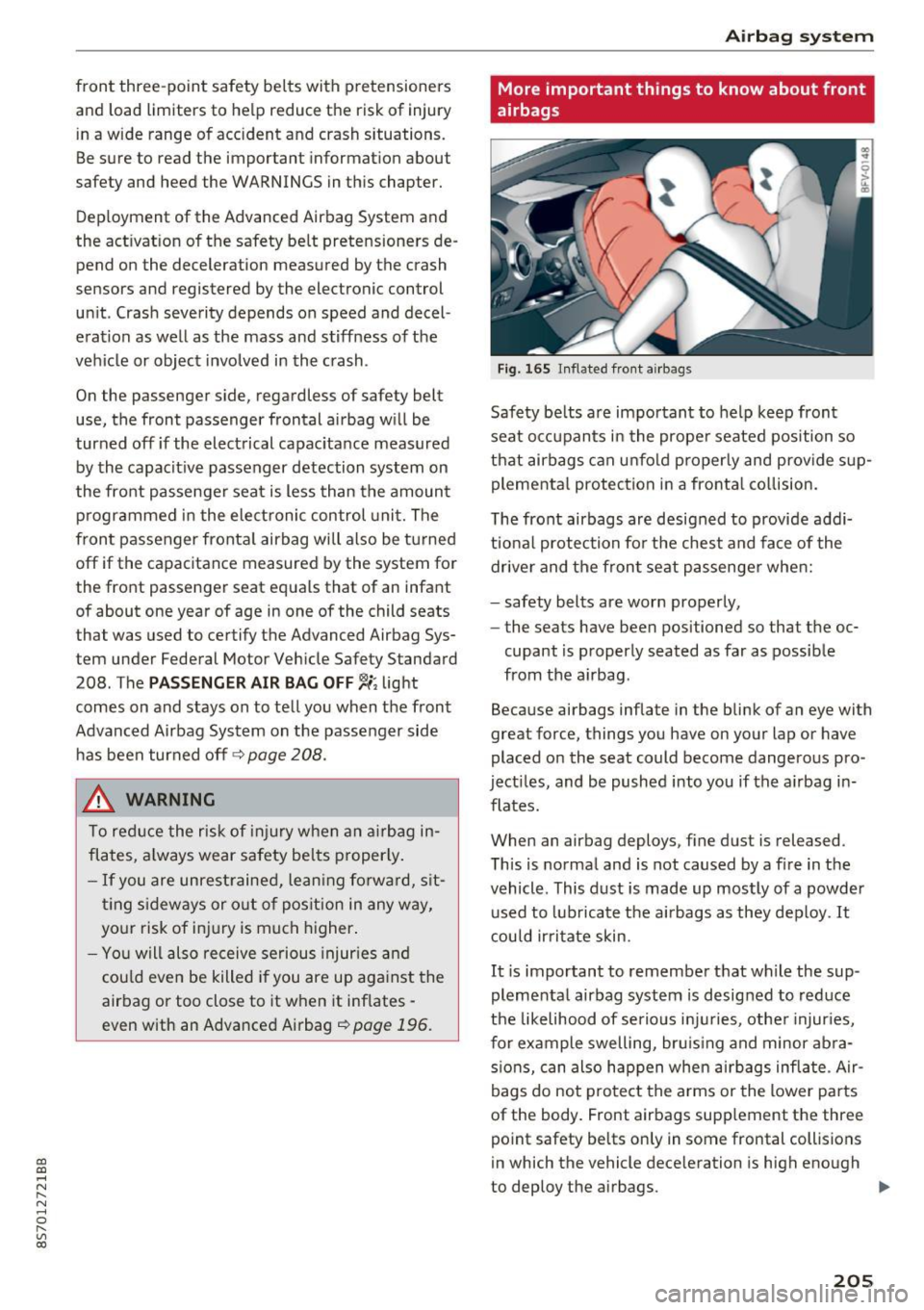
Fig. 165 I nflated fro nt ai rbags
Safety be lts are impo rtan t to he lp keep front
seat oc cupants in the proper seated position so
that airbags can unfo ld properly and prov ide s up
pleme nta l protection i n a fronta l co llision .
The front airbags are designed to provide addi
t iona l protec tion fo r the chest and face of the
driver and the fron t seat passenger whe n:
- safety belts are worn properly,
- the seats have been positioned so that t he oc-
cupant is properly seated as far as possible
from the a irbag .
Because airbags inflate in the blink of an eye with
great force, things you have on your lap or have
placed on the seat could become dangerous pro
ject iles, and be pushed into you if the a irbag i n
flates.
When an airbag deploys, fine dust is released.
This is norma l and is not caused by a fire in the
vehicle . This dust is made up mostly of a powder
used to lub rica te t he a irbags as they deploy.
It
cou ld irritate skin.
It is important to remembe r that wh ile the sup
pleme nta l airbag system is designed to reduce
the likelihood of serio us inj uries, othe r injuries,
for example swelling, bru is ing and minor abra
s ions, can also happen when a irbags inflate . Air
bags do not prote ct the arms or the lower p arts
of the body. Front airbags supp lement the three
point safety belts on ly in some frontal collisions
in which the vehicle dece leration is high enough
to deploy the airbags.
II>
205
Page 211 of 314

co
co
.... N
" N .... 0
" "' c:o
met, be sure to check the light regularly to make
certain that the
P A SSENGER AIR BAG OFF '-1;
light stays on continuously whenever the ignition
is on. If the
PAS SENGER AIR BAG OFF '-1; light
does not appear on and does not stay on all the
time, stop as soon as it is safe to do so and
- reactivate the system by turning the ign ition
off for more than 4 seconds and then turning it
on again;
- remove and reinstall the child restraint. Make sure that the child restraint is properly installed and that the safety belt for the front pas
senger seat has been correctly routed through
the child restraint as descr ibed in the child re
straint manufacturer's i nstructions;
- make sure that the convertible locki ng retrac
tor on the safety be lt for the front passenger
seat has bee n activated and that the safety belt
has been pulled tight.
- make sure that no electrical device (such as a
laptop, CD player, electronic games device,
power inverter or seat hea ter for child seats) is
placed or used on the front passenger seat if
the device is connected to the 12•volt socket or
the cigarette lighter socket;
- make sure that no seat heater has been retro
fitted or otherwise added to the front passen
ger seat;
- make sure that nothing can interfere with the
safety belt buckles and that they are not ob
structed;
- make sure that there are no wet objects (such
as a wet towel) and no water or other liquids on
the front passenger seat cush ion.
If the PASSENGER AIR BAG OFF~; light st ill
doe s not come on ...
If the PAS SENGER AIR BA G OFF '-1; light sti ll
does not come on and does not stay on continu
ously (when the ignition is sw itched on),
- take the child restraint off t he front passenger
seat and have the airbag system inspected by
your Audi dealer immed iate ly.
Th e PASSENGER AIR BAG OFF~; light
should NOT come on ...
The PA SSENGER AIR BAG OFF ~ ; light should
NOT come on when the ign ition is on and an
Airb ag sys tem
adult is sitting in a proper seating pos ition on the
front passenger seat. If the
PASSENGER AIR
BAG OFF~;
light comes on and stays on whi le
driv ing, under these c ircumstances, make sure
that:
- the adult on the front passenger seat is proper
ly seated on the center of the seat cushion w ith
his or her back up against the backrest and the backrest is not reclined,
- the adult is not taking we ight off the seat by
holding on to the passenger assist handle
above the front passenger door or support ing
their weight on the armrest,
- the safety belt is being properly worn and that
there is not a lot of slack in the safety belt web
b ing ,
- there are no aftermarket seat covers or cush
ions or other things (such as blankets) on the
front passenger seat that might cause the ca pacitive passenge r detection system to miscal
culate e lectr ica l capaci ta nce.
' Important safety instructions on
monitoring the Advanced Airbag System
A WARNING
--- If the stat us of the Advanced Airbag System
has changed while the vehicle is moving, the
PASSENGER AIR BAG OFF '-1; ON @ light
blin ks for about 5 seconds to cat ch the driv
er 's attent ion . If this happens, a lways stop
as soon as it is sa fe to do so and check the
steps described above .
- If the
PASSENGER AIR BAG OFF~; light
does not go off when an adult who is not
very small is sitting on the front passenger
seat after tak ing the steps described above,
have the airbag system inspected by your
author ized Audi dealer before t ransporting
anyone on the front passenger seat .
A WARNING ....._
An airbag system that is not functioning prop
e rly cannot prov ide supplemental protect io n
i n a fronta l crash.
- If the ai rbag ind icator light
<=:> page 14
comes when the veh icle is being used, have
209
Page 212 of 314
Airbag syste m
the system inspected immediately by your
authorized Audi dealer. It is possible that
the airbag will inflate when it is not sup
posed to, or will not inflate when it should.
A WARNING
If the front airbag inflates, a child without a
child restra int, or in a rearward-facing child
safety seat, or in a forward-facing child re
straint that has not been properly installed
w ill be seriously injured and can be killed.
- If you must install a rearward-fac ing child
seat on the front passenger seat because of
exceptional c ircumstances and the
PA SSEN
G ER AIR BAG OFF,;;
light does not appear
and stay on, have the airbag system inspect
ed by your Audi dealer.
- If, in exceptional circumstances, you must
install a forward-facing chi ld restraint on
the front passenger seat, always move the
seat into its rearmost pos ition in the seat's
fore and aft adjustment range, as far away
from the airbag as possible. The backrest
must be adjusted to an upright posit ion.
Make s ure that the PASSENGER AI R BAG
OFF ,;;
light comes on and stays on a ll the
t ime whenever the ignition is switched on.
A WARNING
If the PAS SENGER AIR BAG OFF~; light does
not go out when an adult is s itting on the
front passenger seat afte r taking the steps
described above, have the airbag system in
spected by your Audi dealer before transport
ing anyone on the front passenger seat.
(D Tips
If the capacitive passenger detection system
determines that the front passenger seat is
empty, the frontal airbag on the passenger
side w ill be turned off, and the
PA SSENGER
AIR BA G OFF ~;
light will stay on.
Repair, care and disposal of the airbags
Parts of the a irbag system are installed at many
d ifferent places on your Aud i. Instal ling, remov-
210
ing, servicing or repairing a part in an area of the
vehicle can damage a part of an airbag system
and prevent that system from work ing properly
i n a coll is ion.
There are some important things you have to know to make sure that the effectiveness of the
system will not be impaired and that discarded
components do not cause injury or pollute the
environment.
A WARNING
Improper care, servicing and repair proce
dures can increase the risk of personal injury
and death by preventing an airbag from de
p loying when needed or deploy ing an a irbag
unexpectedly:
-
- Never cover, obstruct, or change the steer
ing wheel ho rn pad or airbag cover or the in
strumen t panel or modify them in any way.
- Never attach any objects such as cup ho lde rs
or telephone mountings to the surfaces cov
ering the a irbag un its.
- For cleaning the horn pad or instr ument
panel, use only a soft, dry doth or one mois
tened w ith plain water. Solvents or cleaners
could damage the airbag cover or change
the st iffness or strength of the material so
that the airbag cannot deploy and protect proper ly.
- Never repair, ad just, or change any parts of
the airbag system.
- All work on the steering wheel, inst rument
panel, front seats or e lectr ica l system (in
cluding the installation of audio equ ipment,
cellular te lephones and CB radios, etc.)
m ust be perfo rmed by a qualified techn ician
who has the training and spec ial equipment
necessary.
- For any work on the airbag system, we
strong ly recommend tha t you see you r au
thori zed A udi dealer or qualified wo rkshop.
- Never modify the front bumper or pa rts of
the vehicle body.
- Always make sure that the side a irbag can
inflate w ithout interfe rence: