2017 AUDI TT ROADSTER ABS
[x] Cancel search: ABSPage 165 of 314
co
co
.... N
" N .... 0
" "' c:o
connector from the Apple device with the re
lease tabs pressed in@
¢page 162, fig. 142.
The media are started and operated through the
mobile device or the MMI, depending on the de
vice being used
q page 164.
Connecting two mobile devices: if two mobile
devices (for example iPod and smartphone) are
connected at the same time, then both devices
can be used as playback sources.
You can connect mobile devices using the analog
AUX port.
-Connecting a mobile device to the AUX input:
connect the cable®¢ fig. 143 to the AUX in
put @ on the Audi music interface and then to
the mobile device © (such as an MP3 player or
smartphone) .
-Disconnecting a mobile device from the AUX
input:
remove the cable®¢ fig. 143 from the
Audi music interface.
-Operation: select and confirm the External au
dio player
source @¢ page 164, fig. 144 . The
media are started and operated through the
mobile device@~
fig. 143.
.8, WARNING
Driving requires your complete and undivided
attention. As the driver, you have complete
responsibility for safety in traffic. Never oper
ate mobile devices while driving, because this
increases the risk of an accident.
@ Note
- Remove the connector from the Audi music
interface carefully so it is not damaged.
- Use a USB extension cable to connect devi
ces that have an integrated USB connector
(such as a USB stick) to prevent damage to
your USB device and the Audi music inter
face.
- Extremely high or low temperatures that
can occur inside vehicles can damage mobile
devices and/or impair their performance.
Never leave mobile devices in the vehicle in
extremely high or low temperatures .
Media
{!) Tips
-Do not use an additional adapter or USB ex
tension cable to connect mobile devices to
the Audi music interface that already have a
cable or that must be connected with a USB
adapter( ¢
page 162). They may impair the
functionality .
- You can purchase the AUX connector cable
from an authorized Audi dealer or at spe
cialty stores .
- Functionality is not guaranteed for mobile
devices that do not conform to the USB 2.0
standard.
- USB hubs are not supported .
- Some versions of the iPod such as the iPod
shuffle cannot be connected to the USB
adapter for devices with Apple Dock connec
tor . Connect these devices using a AUX con
nector cable.
- Video playback through the Audi music in
terface is only supported if the connected
device is recognized as a USB storage device
(for example a USB stick). Apple devices and
MTP devices (such as smartphones) are not
recognized as USB storage devices .
- iPod/iPhone malfunctions also affect the
operation of the MMI. Reset your iPod/
iPhone if this happens.
- For important information on operating
your iPod/iPhone, refer to the user guide for
the device. Audi recommends updating the
iPod/iPhone software to the latest version.
- For more information about the Audi music
interface and supported devices, check the
Audi database for mobile devices at
www.audiusa.com/bluetooth or contact an
authorized Audi dealer or authorized Audi
Service Facility.
163
Page 188 of 314
Safe driving
_& WARNING
Heavy loads will influence the way your vehi
cle handles. To help reduce the risk of a loss
of control leading to serious personal injury:
- Always keep in mind when transporting
heavy objects, that a change in the center of
gravity can also cause changes in vehicle
handling:
- Always distribute the load as evenly as
possible .
- Place heavy objects as far forward in the luggage compartment as possible.
- Never exceed the Gross Axle Weight Rating
or the Gross Vehicle Weight Rating specified
on the safety compliance sticker on the left
door jamb. Exceeding permissible weight
standards can cause the vehicle to slide and hand le differently .
- Please observe information on safe driving
c';> page 181.
_& WARNING
To help prevent poisonous exhaust gas from
being drawn into the vehicle, always keep the
rear lid closed while driving.
- Never transport objects larger than those
fitting completely into the luggage area be cause the rear lid cannot be fully closed .
- If you absolutely must drive with the rear lid open, observe the following notes to reduce
the risk of poisoning:
- Close all windows,
- Close the convertible top,
- Open all air outlets in the instrument pan-
el,
- Switch off the air recirculation,
- Set the fresh air fan to the highest speed .
_& WARNING
'
-
Always make sure that the doors, all win
dows, the convertible top and the rear lid are
securely closed and locked to reduce the risk
of injury when the vehicle is not being used.
- After closing the rear lid, always make sure
that it is properly closed and locked.
186 -
Never leave your vehicle unattended espe
cially with the rear lid left open. A child
could crawl into the vehicle through the lug
gage compartment and close the rear lid be
coming trapped and unable to get out . Be
ing trapped in a vehicle can lead to serious
personal injury.
- Never let children play in or around the vehi
cle.
- Never let passengers ride in the luggage compartment . Vehicle occupants must al
ways be properly restrained in one of the ve hicle 's seating positions.
{1) Tips
- Air circulation helps to reduce window fog
ging . Stale air escapes to the outside
through vents in the trim panel, on the left
side of the luggage compartment. Be sure
to keep these slots free and open.
- The tire pressure must correspond to the
load. The tire pressure is shown on the tire
pressure label. The tire pressure label is lo
cated on the driver's side B-pillar. The tire
pressure label lists the recommended cold
tire inflation pressures for the vehicle at its
maximum capacity weight and the tires that
were on your vehicle at the time it was man ufactured. For recommended tire pressures
for normal load conditions, please see chap
ter
c';> page 257.
Tie -downs
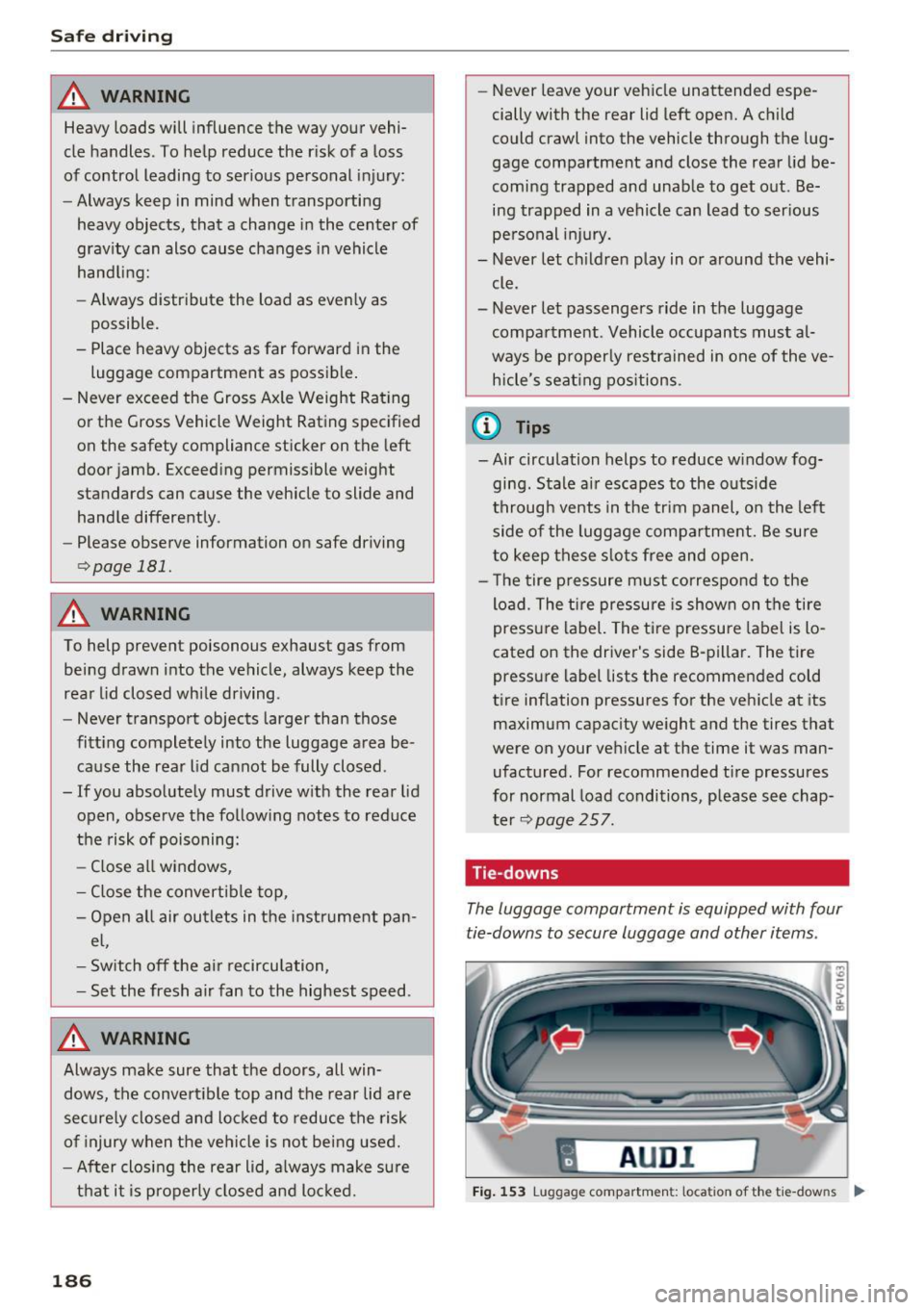
The luggage compartment is equipped with four
tie-downs to secure luggage and other items .
fl AUD I I
Fig. 153 Lug gage compar tmen t: loca ti on of th e tie-dow ns ....
Page 192 of 314
Safety belts
Why safety belts?
Frontal collisions and the law of physics
Frontal crashes create very strong forces for peo
ple riding in vehicles .
Fig. 155 Unbelted occupants in a veh icle headi ng fo r a wall
Fig. 156 The vehicle c rashes into the wall
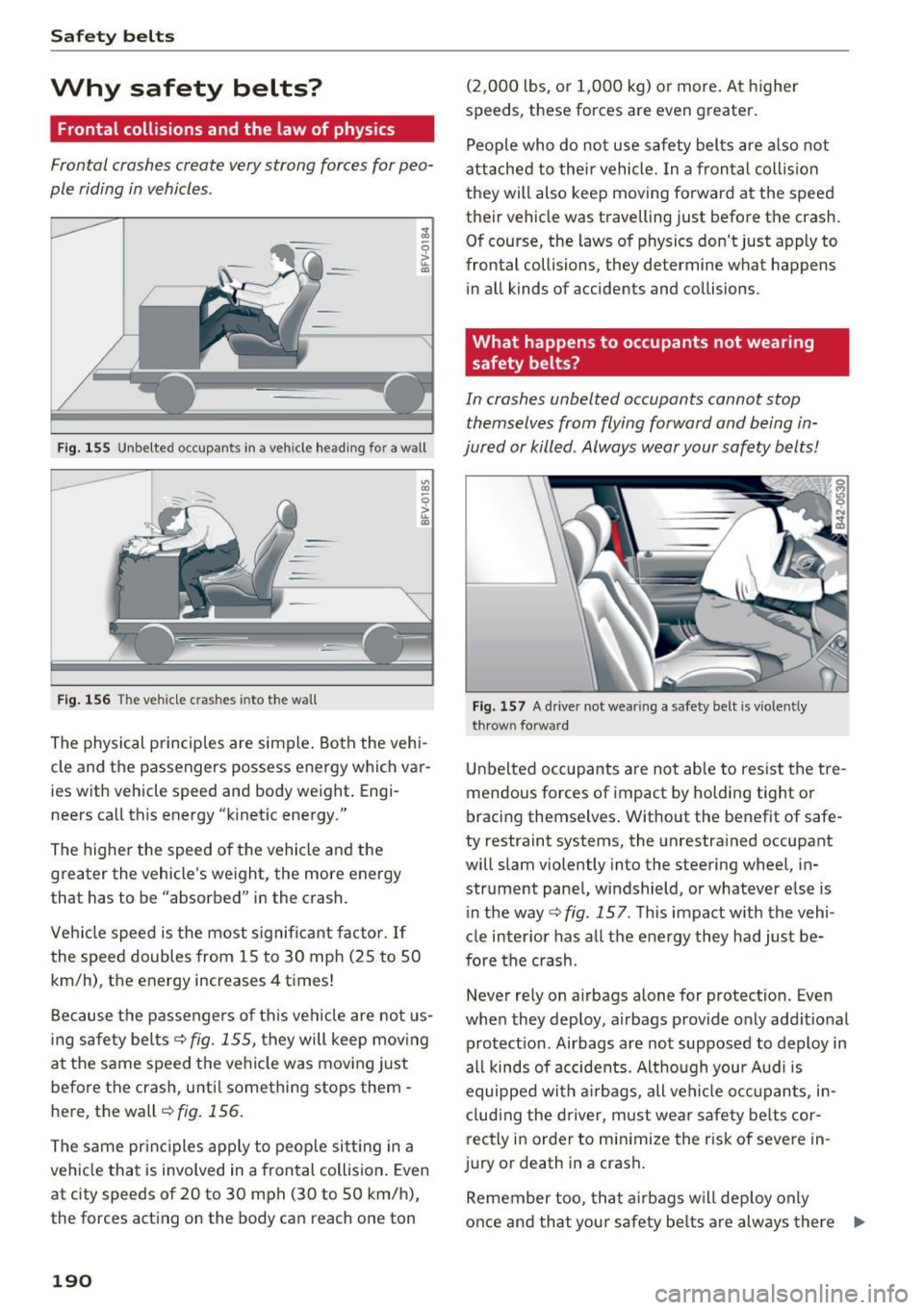
The physical principles are simple. Both the vehi
cle and the passengers possess energy which var
ies w ith vehicle speed and body weight . Engi
neers call this energy "k inetic energy."
The higher the speed of the vehicle and the
greater the vehicle's weight, the more energy
that has to be "absorbed" in the crash.
Vehicle speed is the most significant factor .
If
the speed doubles from 15 to 30 mph (25 to 50
km/h), the energy increases 4 times!
Because the passengers of this vehicle are not us
ing safety belts
c::> fig. 155, they will keep moving
at the same speed the vehicle was moving just
before the crash, unti l something stops them -
here, the wall
c::> fig . 156.
The same principles apply to people sitting in a
vehicle that is involved in a frontal collision . Even
at c ity speeds of 20 to 30 mph (30 to 50 km/h),
the forces acting on the body can reach one ton
190
(2,000 lbs, or 1,000 kg) or more . At higher
speeds, these forces are even greater.
People who do not use safety belts are also not
attached to their vehicle. In a frontal collision
they will also keep moving forward at the speed
their vehicle was travelling just before the crash.
Of course, the laws of physics don't just apply to
frontal collisions, they determine what happens
in all kinds of accidents and collisions .
What happens to occupants not wearing
safety belts?
In crashes unbelted occupants cannot stop
themselves from flying forward and being in
jured or killed . Always wear your safety belts!
Fig. 157 A drive r not wea ring a safety belt is vio len tly
t hrow n forward
Unbelted occupants are not ab le to resist the tre
mendous forces of impact by holding tight o r
bracing themselves . Without the benefit of safe
ty restraint systems, the unrestrained occupant
will slam violently into the steering wheel, in
strument panel, windshield, or whatever else is i n the way
c::> fig . 157 . This impact w ith the vehi
cle inter ior has all the energy they had just be
fore the crash.
Never rely on a irbags alone for protection. Even
when they deploy, a irbags provide only addit ional
protection. Airbags are not supposed to deploy in
all kinds of accidents. Although your Audi is
equipped with airbags, all vehicle occupants, in
cluding the driver, must wear safe ty belts cor
rectly in order to minimize the risk of severe in
ju ry or death in a crash.
Remember too, that airbags will deploy only
once and that your safety be lts are always there .,...
Page 193 of 314
CD
CD
.... N
" N ...... 0 r--. V, co
to offer protection in those accidents in which
airbags are not supposed to deploy or when they have a lready deployed. Unbelted occupants can
also be thrown out of the vehicle where even more severe or fatal injuries can occur.
Safety belts protect
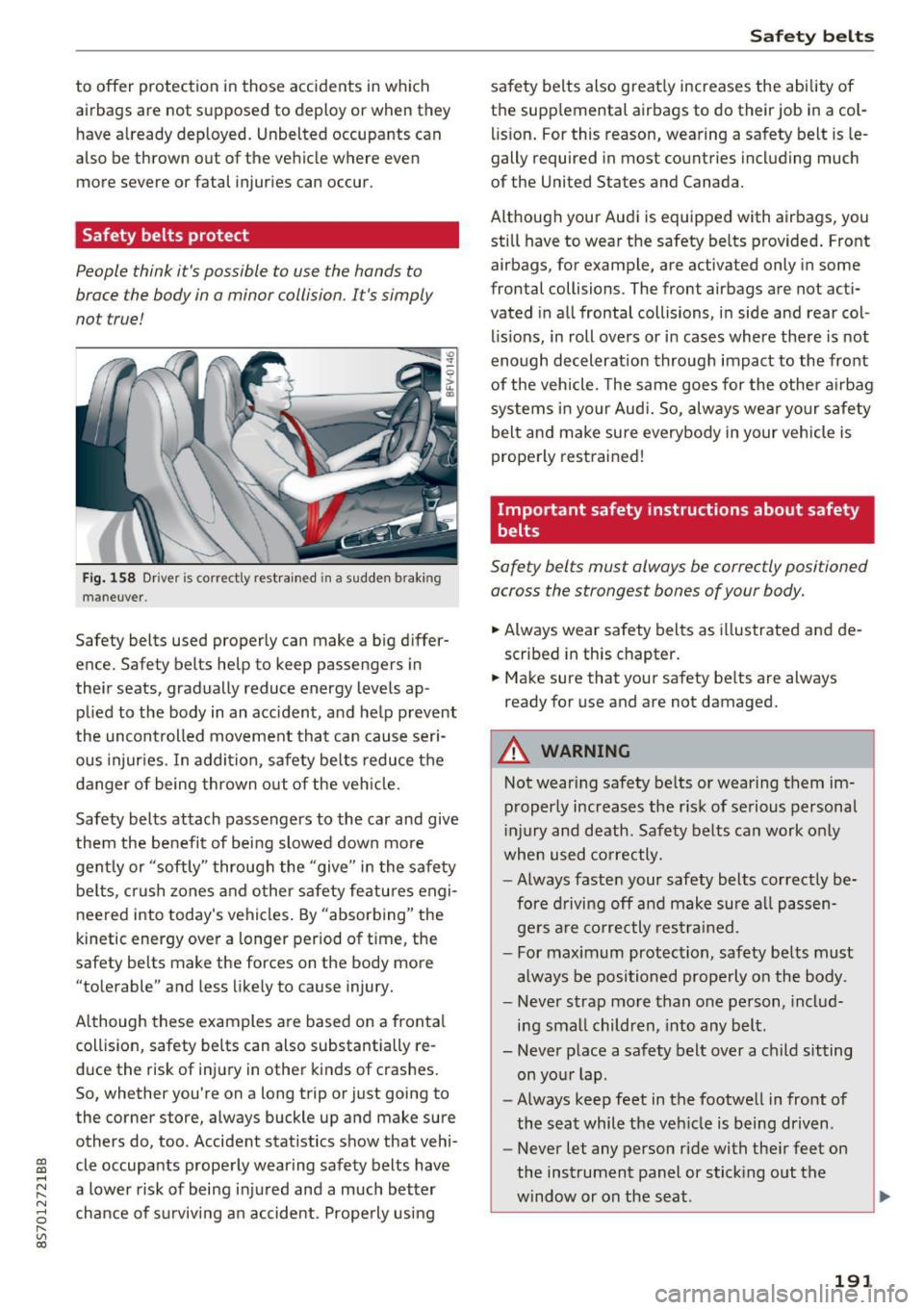
People think it's possible to use the hands to
brace the body in a minor collision. It's simply
not true!
Fi g. 158 Driver is correctly restra ined in a sudde n braking
maneuver .
Safety belts used properly can make a big differ
ence. Safety belts help to keep passengers in
their seats, gradually reduce energy levels ap plied to the body in an acc ident, and help prevent
the uncon trolled movement tha t can cause seri
ous injur ies. In addi tion, safety belts reduce the
danger of being thrown out of the veh icle.
Safety belts attach passengers to the car and give
them the be nefi t of bei ng slowed down more
gent ly or "softly" through the "give" in the safe ty
be lts, crush zones and other safety features engi
neered into today's vehicles . By "absorbing" the
kinetic energy over a longer period of time, the
safety belts make the forces on the body more
"to lerable" and less likely to cause injury.
Although these examples are based on a fronta l
coll is ion, safety belts can also substantially re
duce the risk of inj ury in other k inds of crashes.
So, whether you're on a long trip or just going to
the corner store, always buckle up and make sure
others do, too . Accident stat istics show that vehi
cle occupants prope rly wearing safety belts have
a lower risk of being in ju red and a much better
chance of s urviv ing a n accide nt. Prope rly using
Safet y bel ts
safety belts also great ly increases the ability of
the supp lemental airbags to do their job in a col
lis ion . For this reason, wearing a sa fety be lt is le
gally required in most countries including much
of the United States and Canada.
Although your Audi is equipped with airbags, you still have to wear the safety be lts p rovided . Front
airbags, for example, are activated only in some
frontal collisions. The front airbags are not acti
vated in a ll frontal collisions, i n side and rear col
lis ions, in roll overs or i n cases where there is not
enough decelerat ion through impact to the front
of the vehicle. The same goes for the othe r air bag
systems in your Aud i. So, always wear yo ur safe ty
belt and make sure everybody in your vehicle is
prope rly restrained!
Important safety instructions about safety
belts
Safety belts must always be correctly positioned
across the strongest bones of your body.
.. Always wear safety belts as i llustrated and de
scribed in this chapter .
.. Make sure that your safety be lts a re always
ready for use and are not damaged.
A WARNING
Not wear ing safety be lts o r wearing t hem im
p roperly increases the r is k of serious personal
i njury and death. Safety belts can work only
when used correctly.
- Always faste n your safety belts correctly be
fore d riving off and make sure a ll passen
ge rs a re co rrectly res trained.
- For maximum protection, safety belts must
a lways be positioned properly o n the body.
- Never strap more than one person, includ
i n g sma ll children, into any belt.
- Never p lace a safety belt over a child sitting
on yo ur lap.
- Always keep feet in the footwe ll in front of
the seat while the veh icle is being driven.
- Never let any person ride with the ir feet on
the instrument panel or stick ing o ut the
w indow or on the seat.
191
Page 203 of 314
co
co
.... N
" N .... 0
" "' c:o
that are large, heavy, or bulky) on the doors;
never attach then to the doors or the wind
shield; never place them over or near or at
tach them to the area marked ,.AIRBAG" on
the steering wheel, instrument panel or the
seat backrests; never place them between
these areas and you or any other person in
the vehicle.
- Never attach objects to the windshield
above the passenger front airbag, such as
accessory GPS navigation units or music
players. Such objects could cause serious in
jury in a collision, especially when the air bags inflate.
&_ WARNING
A person on the front passenger seat, especially infants and small children, will receive
serious injuries and can even be killed by be
ing too close to the airbag when it inflates.
- Although the Advanced Airbag System in
your vehicle is designed to turn off the front
passenger airbag if an infant or a small child
is on the front passenger seat, nobody can
absolutely guarantee that deployment un
der these special conditions is impossible in
all conceivable situations that may happen
during the useful life of your vehicle.
- The Advanced Airbag System can deploy in
accordance with the "low risk" option under
the U.S. Federal Standard if a child that is
heavier than the typical one-year old child is
on the front passenger seat and the other
conditions for airbag deployment are met.
- For its own safety, a child should always ride
properly restrained for its age and si ze.
Advanced front airbag system
Your vehicle is equipped with a front Advanced
Airbag System in compliance with United States
Federal Motor Vehicle Safety Standard (FMVSS)
208, as well as Canada Motor Vehicle Safety
Standard (CMVSS) 208 as applicable at the time
your vehicle was manufactured.
T he front Advanced Airbag System supplements
the safety belts to provide additional protection
Airbag system
for the driver's and front passenger's heads and
upper bodies in frontal crashes. The airbags in
flate only in frontal impacts when the vehicle de
celeration is high enough.
The front Advanced Airbag System for the front
seat occupants is not a substitute for your safety
belts. Rather, it is part of the overall occupant re
straint system in your vehicle . Always remember
that the airbag system can only help to protect
you, if you are sitting upright, wearing your safe
ty belt and wearing it properly. This is why you
and your passengers must always be properly re
strained, not just because the law requires you to
be.
The Advanced Airbag System in your vehicle has
been certified to meet the "low risk" require
ments for 3 and 6 year-old children on the pas
senger side and very small adults on the driver
side. The low risk deployment criteria are intend
ed to help reduce the risk of injury through inter
action with the front airbag that can occur, for
example, by being too close to the steering wheel
and instrument panel when the airbag inflates.
In addition, the system has been certified to
comply with the "suppression" requirements of
the Safety Standard, to turn off the front airbag
for infants 12 months old and younger who are res trained on the front passenger seat in child re
straints that are listed in the Standard
¢ page 220, Child restraints and Advanced front
airbag system.
"Suppression" requires the front airbag on the
passenger side to be turned off if:
- a child up to about one year of age is restrained
on the front passenger seat in one of the rear
facing or forward-facing infant restraints listed in Federal Motor Vehicle Safety Standard 208
with which the Advanced Airbag System in your
vehicle was certified . For a listing of the child
restraints that were used to certify your vehi
cle's compliance with the US Safety Standard
¢page 220,
-When a person is detected on the front passen
ger seat that has an electrical capacitance that
is more than the total electrical capacitance of
a child that is about 1 year old restrained in one .,.
201
Page 204 of 314
Airbag syste m
of the rear -facing or forward-facing infant re
straints (listed in Federal Motor Vehicle Safety
Standard 208 with wh ich the Advanced Airbag
System in your vehicle was certified), the front a irbag on the passenger side may or may not
deploy .
The
P A SSENGER AIR BAG OFF ~ ; light comes on
when the e lectron ic control un it detects a total
electrical capacitance on the front passenger seat
that requires the front airbag to be turned off. If
the
PASSEN GER AIR BA G OFF ~; light does not
come on, the front airbag on the passenger side has not been turned off by the control u nit and
can dep loy if t he con trol unit senses an impact
that meets the conditions stored in its memory.
If the tota l electrical capac itance registered on
the front passenger seat is more than that of a
typical 1 year-old, but less than the weigh t of a
small adu lt, the front airbag on the passenger
side may deploy (the
PASSENGER AIR BAG OFF
~ ; light does not come on) .
For example, the airbag may deploy if :
- a small child that is heavier than a typical 1
year-old ch ild is on the front passe nger seat
( r ega rdless of whether the child is in one of the
c hi ld se ats l isted
q page 220),
- a chi ld who has outg rown child restraints is on
t h e front passenger seat.
If the front passenger airbag is turned off, the
PASSENGER A IR BA G OFF ~; light in the head
line r will come on and stay on .
If the front passenger airbag deploys, the Feder
al Standard requires the airbag to meet the "low
risk " deployment criteria to help reduce the risk
of injury through inte raction with the airbag.
" Low risk" deployment occu rs in those c rashes
t hat take place at lower dece le rations as defined
in the electronic control unit
q page 207.
Alway s rememb er: Please be su re to read the im
portant information in the sections that follow
and be sure to heed all of t he WARNINGS.
A WARNING
To red uce the risk of inj ury when an airbag in
flates, a lways wear safety belts properly .
202
-If you are un restrained, leaning forward, sit
ting sideways or out of position in any way,
your risk of injury is much higher.
- You will a lso receive ser ious injuries and
could even be killed if you are up against the
airbag or too close to it when it inflates -
even with an Advanced Airbag
¢ page 196 .
A WARNING
A child in a rearward -facing child seat instal
led on the front passenger seat will be seri
ously injured and can be killed if the front air
bag inflates -even with an Advanced Airbag
Sys tem.
- Although the Advanced Airbag System in
your veh icle is designed to turn off the front
airbag when a rearwar d-fac ing ch ild re
straint has been installed on the front pas
senger seat, nobody can absolutely guaran
tee that dep loyment is impossib le in all con
ceivab le situat ions that may happen du ring
the useful life of your vehicle.
- The inflating airbag will h it the ch ild seat or
infant carrier with great force and will
smash the child seat and child against the
backrest, center armrest, doo r, or roof .
- If you must install a rearward facing child
safety seat on the front passenger seat be
cause of excep tional circumstances and the
PASSENGER AIR BAG OFF~; light does not
come on and stay on have the a irbag system
inspected by your Audi dealer.
A WARNING
I f, in ex ceptional ci rcums tances, you must in
stall a forward-facing child restraint on the
front passenger's seat:
- Always make sure the forward-facing sea t
has been des igned and certified by its man
ufacturer for use on a front seat with a pas
senger front and side airbag.
- Never put the forward -facing child restraint
up against or very nea r the instrument pan
el.
- Always move the front passenger seat to
the highest position in the up and down ad
justment range and move it back to the
Page 213 of 314
co
co
.... N
" N .... 0
" "' c:o
-Never install seat covers or replacement
upholstery over the front seatbacks that
have not been specifically approved by
Audi.
- Never use additional seat cushions that
cover the areas where the side airbags in
flate.
- Damage to the original seat covers or to
the seam in the area of the side airbag module must always be repaired immedi
ately by an authorized Audi dealer.
- The airbag system can deploy only once. Af
ter an airbag has been deployed, it must be
replaced with new replacement parts de
signed and approved especially for your
Audi model version. Replacement of com plete airbag systems or airbag components
must be performed by qualified workshops
only. Make sure that any airbag service ac
tion is entered in your Audi Warranty
&
Maintenance booklet under AIRBAG RE
PLACEMENT RECORD.
- For safety reasons in severe accidents, the
alternator and starter are separated from
the vehicle battery with a pyrotechnic circuit interrupter.
- Work on the pyrotechnic circuit interrupt
er must only be performed by a qualified
technicians who have the experience, in
formation and special tools necessary to
perform the work safely.
- If the vehicle or the circuit interrupter is
scrapped, all applicable safety precautions must be followed.
@ For the sake of the environment
Undeployed airbag modules and pretension
ers might be classified as Perchlorate Materi
al -special handling may apply, see
www.dtsc.ca.gov/hazardouswaste/perchlo
rate. When the vehicle or parts of the re
straint system including airbag modules and
safety belts with pretensioners are scrapped,
all applicable laws and regulations must be
observed. Your authorized Audi dealer is fa
miliar with these requirements and we recom
mend that you have your dealer perform this
service for you.
Airbag system
Other things that can affect Advanced
Airbag performance
Changing the vehicle's suspension system can
change the way that the Advanced Airbag System
performs in a crash. For example, using tire-rim
combinations not approved by Audi, lowering the
vehicle, changing the stiffness of the suspension, including the springs, suspension struts, shock
absorbers etc . can change the forces that are
measured by the airbag sensors and sent to the
electronic control unit. Some suspension changes
can, for example, increase the force levels meas
ured by the sensors and make the airbag system
deploy in crashes in which it would not deploy if
the changes had not been made. Other kinds of
changes may reduce the force levels measured by
the sensors and prevent the airbag from deploy ing when it should.
A WARNING
-Changing the vehicle's suspension including use of unapproved tire-rim combinations can
change Advanced Airbag performance and in
crease the risk of serious personal injury in a
crash.
- Never install suspension components that
do not have the same performance charac
teristics as the components originally instal
led on your vehicle.
- Never use tire-rim combinations that have
not been approved by Audi.
211
Page 228 of 314
Child safety
The vehicle's safety belts alone will not fit most
childr en until they are at least 4
ft 9 in (57 in/
1.45 m) tall and weigh about 80 lbs (36 kg) .
Booster seats raise these children up so that the
safety belt will pass properly over the s tronger
parts of their bodies and the safety belt can help
protect them in a crash .
"' Do not use the convertible locking retractor
when using the vehicle's safety belt to restrain
a child on a booster seat .
"'The shoulder belt must lie as close to the cen
ter of the child's collar bone as possible and must lie flat and snug on the upper body.
It
must never lie across the throat or neck. The
lap belt must lie across the pelvis and never
across the stomach or abdomen. Make sure the
belt lies flat and snug . Pull on the belt to tight
en if necessary .
Children up to at least 8 years old (over 40 lbs or
18 kg) are best protected in child safety seats de
signed for their age and weight. Experts say that
the skeletal structure, particularly the pelvis, of
these children is not fully developed, and they
must not use the vehicle safety belts without a
suitable child restraint.
It is usually best to put these children in appro
priate booster seats. Be sure the booster seat
meets all applicable safety standards.
Booster seats raise the seating position of the
child and reposition both the lap and shoulder
parts of the safety belt so that they pass across
the child's body in the right places . The routing of
the belt over the child's body is very important
for the child's protection, whether or not a boos
ter seat is used.
Never use the lap belt portion of the vehicle 's
safety belt alone to restrain any child, regardless
of how big the child is. Always remember that
children do not have the pronounced pelvic struc
ture required for the proper function of lap belt
port ion of the vehicle's three point lap and
shoulder belts . The child's safety absolutely re
quires that a lap belt portion of the safety belt be
fastened snugly and as low as possible around the pelvis. Never let the lap belt portion of the
226
safety belt pass over the child's stomach or abdo
men.
In a crash, airbags must inflate w ithin a blink of
an eye and with considerable force. In order to do
its job, the airbag needs room to inflate so that it
will be there to protect the occupant as the occu
pant moves forward into the airbag.
A vehicle occupant who is out of pos it ion and too
close to the airbag gets in the way of an inflating
airbag. When an occupant is too close, he or she
will be struck vio lently and w ill receive serious or
possibly even fatal injury.
In order for the airbag to offer protection, it is
important that all vehicle occupants , especially
any ch ildren, who must be in the front seat be
cause of exceptional circumstances, be properly
restrained and as far away from the airbag as
possible. By keeping room between the child 's
body and the front of the passenger compart
ment, the airbag can inflate completely and pro
vide supplemental protection in certa in frontal
collisions.
,&. WARNING
Not using a booster seat, using the booster
seat improperly, incorrect ly installing a boos
ter seat or using the vehicle safety belt im
proper ly increases the risk of serious personal
injury and death in a collision or other emer
gency situation. To help reduce the risk of se
rious personal injury and/or death:
- The shoulder belt must lie as close to the
center of the child's collar bone as possible
and must lie flat and snug on the upper
body . It must never lie across the throat or
neck . T he lap belt must lie across the pelvis
and never across the stomach or abdomen.
Ma ke sure that the be lt lies flat and snug.
Pull on the belt to tighten if necessary.
- Failure to properly route safety belts over a
child's body will cause severe injuries in an
accident or other emergency situation
<=> page 189.
- The rear side of the chi ld safety seat should
be positioned as close as possible to the
backrest on the veh icle seat.
-