2017 AUDI Q5 ECU
[x] Cancel search: ECUPage 186 of 296
Child safety
-Never attach two child restraint systems to
one tether strap or tether anchorage.
- Never attach a tether strap to a tie-down
hook in the luggage compartment.
- Never use chil d restraint tether anchorages
to secure safety belts or other kinds of occu
pant restraints.
- Never secure or attach any luggage or other
items to the LATCH lower anchorages or to
the tether anchors.
- If a tether or other strap is used to attach a
child restraint to the front passenger seat,
make sure that it is not so tight, that it
causes the we ight-sens ing mat to measure
more weight than is actually on the seat.
- The heav ier we ight registered can make the
Advanced Airbag System work as though an
adul t were on the seat and deploy the Ad
vanced Airbag when it must be suppressed ca using se rious or even fatal inju ry to the
child.
- If you must install a rearward fac ing ch ild
safety seat on the front passenger seat be
ca use of exceptiona l circumsta nces and the
PAS SENGER AIR BAG OFF light does not
come on and stay on, immediate ly install
the rear-fac ing chi ld safety seat in a rear
seat ing pos ition and have the airbag system
inspected by your Audi dealer.
Installing the upper tether strap on the
anchorage
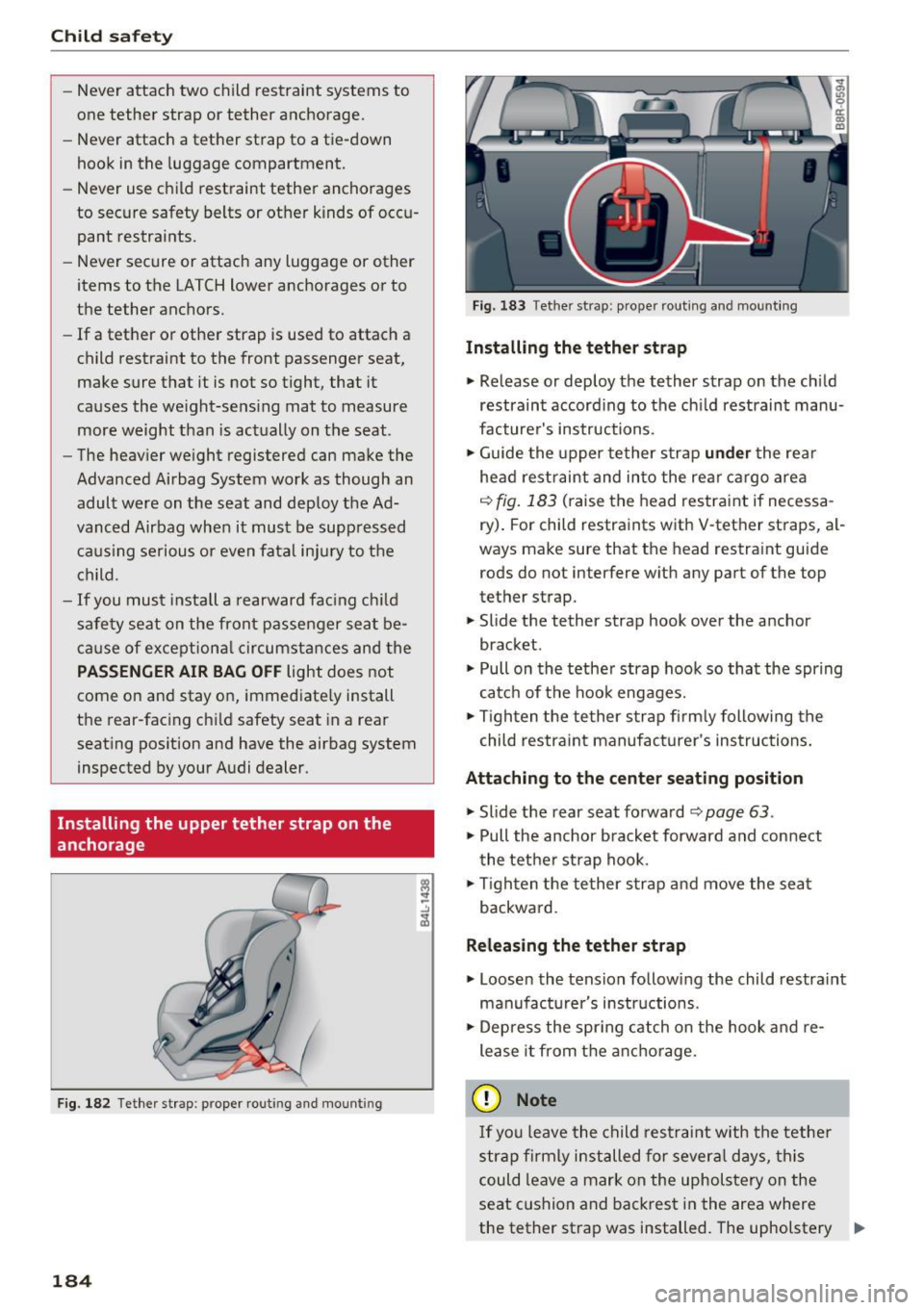
F ig. 18 2 Tether strap : proper routing and mount ing
184
Fig. 1 83 Tether strap: proper routing and mount ing
Installing the tether st rap
~ Release or deploy the tether strap on the ch ild
restraint accord ing to the ch ild restraint manu
facture r's instructions.
~ Guide the upper tether s trap under the rea r
head rest raint and in to the rear cargo area
~ fig. 183 (raise the head restraint if necessa
ry). For child restraints with V -tet her straps, al
ways make sure that the head restra int guide
rods do not interfere with any pa rt of the top
tether strap.
~ Slide the tether strap hook over the anchor
bracket .
~ Pull on the tether strap hook so that the spring
ca tch of the hook engages.
~ Tighten the tether stra p firm ly following the
child restra int manufacturer's instruc tions .
Attaching to the cente r seating position
~ Slide the rear seat forward ~ page 63 .
~ Pull the anchor bracket forward and con nect
the tethe r strap hook.
~ Tigh ten the te ther strap a nd move the seat
backward.
Releasing the tether strap
~ Loosen the tension following the child restra int
manufac turer's instr uctions .
~ Depress the spr ing catch on the hook and re
lease it from t he a nch o rage.
(D Note
If yo u leave the child restraint w ith the tethe r
strap firmly installed for severa l d ays, this
could leave a mark on the upholstery on the
seat cushion and backrest in the area where
the tether strap was installed. The upholstery
IJ>
Page 200 of 296

Offroad dri ving
Offroad driving
Driving under difficult
conditions and off-road
General information
The operation of the Electronic Stabilization Con
trol (ESC) is expanded for operation away from
paved roads. In situations where slip or a differ
ential locking function is required, the offroad mode can be activated
<=> page 186. Your Audi al
so has permanent all-wheel drive in addition .
However, your Audi is not a pure offroad vehicle.
It was not built for driving under extreme condi
tions, e.g. for trips that are in the nature of an
expedition .
Drive only on roads and offroad sections which
match the design of your vehicle and your abili
ties as a driver. Never take risks!
Befo re driving offroad
-Check the eng ine oil level, tire pressure, coo l
ant level, and the fluid leve l in the windshield
washer reservoir.
- Stow luggage items and other objects in the
lu ggage compartment, and secure them
against sliding around.
After driving offroad
-After trips offroad, remove any twigs and other
foreign objects from the grill, the underbody
and the wheels. Pay specia l attention to foreign
objects (stones) which have become lodged in
the tire tread.
- Clean the body and the vehicle underside, and
inspect the vehicle for possible damage.
- Clean dirty windows, headlamp lenses, rear
lights, and license plates.
- Perform a brake check (particularly after travel
ling through water) .
A WARNING
- Drive especially attentive ly and plan ahead
in difficult road conditions and when off
road. Excessive speed or incorrect maneu
vers can cause in juries and damage to the
vehicle.
198
- Always adapt your speed and driving style to
road, offroad, traffic, and weather condi
tions. Drive especially slowly offroad when
your view is restricted.
- Please be aware that in offroad mode, par
ticularly on a smooth and slippery road, the
wheels may have an increased tendency to
spin and the vehicle may break away - dan
ger of skidding!
- Stability is limited in the offroad mode.
® For the sake of the environment
Avoid damage to the environment and re
spect nature.
(D Tips
Only drive where it is permitted and stay on
marked roads and paths.
Explanation of some technical terms
The following data refer to ideal conditions. De pending on vehicle load and ground conditions
and the env ironment, the numbers may vary. It is
the driver's responsibility to decide whether ave
hicle can overcome a specific s ituation
<=> .&. .
Gradient angle
The number of meters in alt itude gained over a
distance of 109.4 yards or 100 meters (grade)
are given as a percentage or degrees . Informa
tion about the gradient the vehicle can cl imb un
der its own power (depends in part on the road
surface and eng ine power). Maximum permitted
grade: 31
°
Ground clearance
The distance between the road surface and the lowest point of the vehicle underbody. Ground
clearance 7.9 in (200 mm)
.&, WARNING
Exceeding the stated maximum figures can
result in severe injuries or vehicle damage.
- All the information was gathered on level,
firm and non-slippery road surfaces, and un-
-
der dry weather conditions. ..,
Page 202 of 296

Trailer towing
Trailer towing
Driving with a trailer
General information
Your Audi was designed primarily for passenger
transportation.
If you plan to tow a trailer, please remember that
the additional load will affect durability, economy and performance.
Trailer towing not on ly places more stress on the
ve hicle, it also ca lls for more concentration from
the dr iver.
F or this reason, always follow the operating and
driving instructions provided and use common
sense.
Technical requirements
Trailer hitch
Use a weight-carrying hitch conforming to the
gross tra iler weight. The hitch must be suitab le
for your veh icle and tra iler and must be mounted
securely on the vehicle's chassis at a technically
sound
locat ion . Use on ly a trailer hitch with a re
movable ba ll mount . Always che ck with the t rail
er hitch man ufac tur er to make s ure t hat you are
using the co rrect hi tc h.
Do not use a bumper hitch.
The hitch must be installed in such a way that it
does not interfere with the impact -absorbing
bumper system. No mod ificat ions should be
made to the vehicle exhaust and b rake systems .
Fr om t ime to t ime, che ck that all hitch mo unti ng
bol ts rem ain securely f aste ned.
W hen you are not tow ing a tra iler, remove the
tra ile r hitc h ba ll mount . This prevents the hit ch
from caus ing damage s hou ld your veh icle be
s truck from be hind ¢
,&..
Trailer brakes
If you r trailer is equipped with a brak ing system,
check to be su re that it conforms to all regula
tions .
200
The t rai ler hydraulic bra ke system must not be
directly connected to the vehicle's hydraulic
bra ke system ¢&. .
Safety chains
Always use s afety chains be tween you r vehi cle
and t he tra ile r.
Trailer lights
Traile r lights must meet all regula tions . B e s ure
to check w ith your author ized Audi dealer for cor
r ec t wir ing, swi tches, an d relays.
Mirrors
If you are unable to see t he traffic behind you us
i ng t he regular outs ide mirrors, then yo u
must in
stall ex tended mirro rs . It is impo rtant that you
al ways have clear vision to the rear.
.&_ WARNING
- If a tra ile r has e lectr ical brake s ple ase no te
t h at these b ra kes are not activated by the
factory -fit ted contro l unit -risk of accident!
- After removing the traile r h itch, d o no t
s t o re it in your vehicle. In case of sud den
braking, the hitch co uld fly forwar d and in
jure you or yo ur passenge rs.
- Never install a "we igh t distribu tin g" or
"loa d eq ualizing" trailer hitch on your veh i
cle . The vehicle was not designed fo r these
kinds o f trailer hitches. The hitch attach
ment can fail, ca us ing the tra ile r to tear
loose from the vehicle .
- The Gross Vehicle Weight Rating for your
veh icle, found on the safety compliance la
be l on the driver's s ide B-pillar, must never
be exceeded under any circ umstances . Ex
ceed ing the Gross Vehicle We ight Rat ing of
your veh icle is likely to damage yo ur vehicle,
a nd such d amage will no t be covered by
your Limi ted New Vehicle W arra nty . Exceed
ing the Gross Ve hicl e We ight Rating will al
so change the pe rformance and han dling
characte ristics o f yo ur vehicle, which could
cause a crash result ing in se rious injury or
death.
Page 203 of 296
CD
CD
.... N ,-... N ..... 0 0 C<'. 00
Operating instructions
6" r-2
~·~
1/2"
1·1/2"
ill
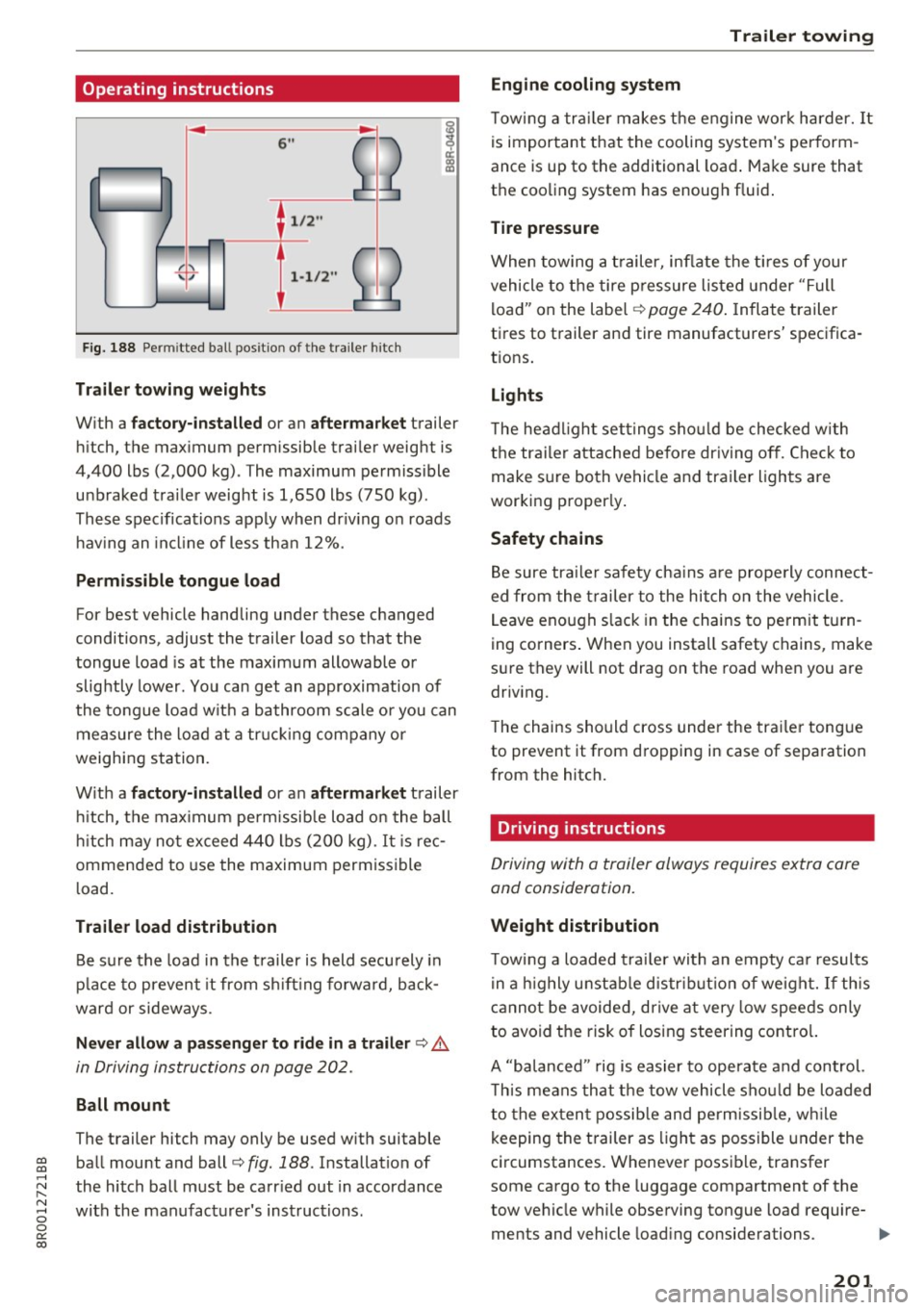
Fig. 188 Permi tted ba ll pos it io n of the trailer h itch
Trailer towing weights
With a
factory-installed or an aftermarket trailer
hitch, the maximum permissible trailer weight is
4,400 lbs (2,000 kg) . The maximum permissible
unbraked trailer weight is 1,650 lbs (750 kg).
These specifications apply when driving on roads having an incline of less than 12%.
Permissible tongue load
For best vehicle handling under these changed
conditions, adjust the trailer load so that the
tongue load is at the maximum allowable or
slightly lower. You can get an approximation of
the tongue load with a bathroom scale or you can
measure the load at a trucking company or
weighing station.
With a
factory-installed or an aftermarket trailer
hitch, the maximum permissible load on the ball
hitch may not exceed 440 lbs (200 kg) .
It is rec
ommended to use the maximum permissible
load.
Trailer load distribution Be sure the load in the trailer is held securely in
place to prevent it from shifting forward, back
ward or sideways.
Never allow a passenger to ride in a trailer ¢.&.
in Driving instructions on page 202.
Ball mount
The trailer hitch may only be used with suitable ball mount and ball¢
fig. 188 . Installation of
the hitch ball must be carried out in accordance
with the manufacturer's instructions .
Trailer towing
Engine cooling system
Towing a trailer makes the engine work harder. It
is important that the cooling system's perform
ance is up to the additional load. Make sure that
the cooling system has enough fluid.
Tire pressure
When towing a trailer, inflate the tires of your
vehicle to the tire pressure listed under "Full
load" on the label¢
page 240. Inflate trailer
tires to trailer and tire manufacturers' specifica
tions.
Lights
The headlight settings should be checked with
the trailer attached before driving off. Check to
make sure both vehicle and trailer lights are
working properly.
Safety chains
Be sure trailer safety chains are properly connect
ed from the trailer to the hitch on the vehicle .
Leave enough slack in the chains to permit turn
ing corners. When you install safety chains, make
sure they will not drag on the road when you are
driving.
The chains should cross under the trailer tongue
to prevent it from dropping in case of separation
from the hitch.
· Driving instructions
Driving with a trailer always requires extra care
and consideration.
Weight distribution
Towing a loaded trailer with an empty car results
in a highly unstable distribution of weight. If this
cannot be avoided, drive at very low speeds only
to avoid the risk of losing steering control.
A "balanced " rig is easier to operate and control.
This means that the tow vehicle should be loaded
to the extent possible and permissible, while
keeping the trailer as light as possible under the
circumstances. Whenever possible, transfer
some cargo to the luggage compartment of the
tow vehicle while observing tongue load require-
ments and vehicle loading considerations. .,.
201
Page 218 of 296

Fuel and Refueling
-A permitted refill bott le contains approxi
mately 0 .5 gallons (1.9 liters) of Ad Blue.
Refilling Ad Blue with a canister
A ppl ies to: ve hicles w ith select ive ca talyt ic reduction
®
+®
F ig. 193 Canister wit h attac hab le hose
N
~ 0 :::, a:, m
.., Remove the cover from the refill canister~ A
in Filling AdBlue on page 215, c>(D in Filling
AdBlue on page 215 .
... Secure the end of the hose (Don the opening in
the canister @ by turning the hose to the right.
... Remove the cap @from the other end of the
hose @.
"' Pos ition the end of the hose@ on the f iller
neck in the vehicle and turn the hose to the
right to tighten it.
.., Lift the canister up and then tip it. Continue
holding the can ister in a tipped position unti l it
is empty or until no mo re fluid flows into the
tank .
... Remove the canister and close the fi ller tube
c> page 216 , Completing AdBlue refill .
(D Note
Only use refill canisters that are approved for
your vehicle. Using other systems can cause
Ad Blue to leak.
@ Tips
- An authorized Audi dealer or authorized
Audi repair facility can tell you which refill
can isters are approved for your vehicle.
- A permitted refill canister contains approxi
mately 1.3 gallons (5 liters) of Ad B lue.
216
· Completing AdBlue refill
App lies to : vehicles with selective cata lyt ic re du ction
Closing the filler neck
... Turn the cap on the filler neck to the right w ith
the wheel w rench until the cap clicks into place .
This tightens the cap to the specification ~
A
in Filling AdBlue on page 215, c>(D in Filling
AdBlue on page 215 .
... Then press on the left side of the tank door un-
til it latches.
After filling
The vehicle must be driven so that the system
recognizes that the Ad Blue was refilled. This can
take several minutes .
.., If there was no AdB lue left in the tank and a
range of
O mi (0 km ) was shown in the display,
sw itch the ignition on for about 30 seconds be
fore starting the engine .
(D Tips
Ad Blue can freeze at very low temperatures.
If this happens, the system will not detect
that the Ad B lue was refilled and it will contin
ue to inform you of the low Ad Blue level. The
message turns off as soon as the tank thaws
out again.
Page 219 of 296

Checking and Filling Hood
Releasing the engine hood
The engine hood is released from inside the vehi
cle .
Fig. 194 Drive r's side footwell: e ng ine hood re lease lever
"' Wi th the driver's door open, pu ll th e leve r un
der the instrument panel in the direction of the
arrow ¢fig.194 .
The hood pops up s light ly unde r spri ng p ressure.
Opening the engine hood
Fi g. 19 5 Release lever under t he eng ine hood
Before opening the engine hood, make sure tha t
the w indshield wipe rs are fla t against the w ind
shie ld. Otherwise, they could d amage t he paint
on the hood .
"' Pull up on the release under the hood
~fig . 195. Th is releases the cat ch.
"' Open the hood all the way¢&,, .
a,
~ ,&. WARNING
r--
~ Hot engine coo lant can burn you. 0 0
0:
co
Checking and Filling
- To reduce the r isk of being burned, never
open the hood if you see or hear steam or
coo lant escaping from the engine compart
ment. Wa it until no steam or coolant can be
seen or hea rd before carefully ope ning t he
hood.
Closing the engine hood
"' Pull the hood down until the press ure from the
s truts is red uced.
"' Le t the hood
drop down and latch in p lace. Do
not try to push it shut ;
it may fail to engage
¢ &,, .
A WARNING
- -
A hood that is not completely latched co uld
f ly up and block your view while dr iv ing.
- When you close the engine hood, c heck it to
make sure the safety catch has prope rly en
gaged . The hood should be flush with the
sur rounding vehicle body parts .
- If you notice while driv ing that the hood is
not secured prope rly , stop at once and close
it .
Working in the engine compartment
Be especially careful whenever you work in the
engine compartment.
Whenever you must pe rfo rm any work in the
eng ine compa rtment , for e xample check ing and
fill ing diffe rent fluids, the re is a ris k of injury,
burns and acciden ts. To pre vent personal injur y
always ob serve the fo llowing WARNINGS . The
eng ine compartment of any vehicle is a hazard
ou s area
~ .&, .
A WARNING
To he lp avoid injury, befo re yo u check any
t h ing u nder the hood:
- Tur n off the engine.
- Remove the ig nitio n key .
- Apply the parking brake.
-
- Move selector lever of automatic t ransm is-
sion to P (Park).
217
Page 225 of 296

CD
CD
.... N ,-... N ..... 0 0 C<'. 00
Cooling system
Coolant
The engine cooling system is filled with a mixture
of purified water and coolant additive at the fac
tory. This coo lant must not be not changed.
The coolant level is monitored through the. in
dicator light
¢page 26. However , we do recom
mend occasionally check ing the coo lant level
manually.
If you must add coolant, use a mixture of water
and coolant addit ive. Mixing the coolant additive
with distilled water is recommended.
Coolant additive
The coolant additive is made of anti-freez ing and
corros ion protection agents. Only use the follow
ing coolant addit ives . These additives may be
mixed with each other.
Coolant additive Specification
G13
TL 774 J
G12++ TL 774 G
The amount of coo lant add itive that needs to be
mixed with water depends on the climate where
the vehicle will be operated.
If the coolant addi
tive percentage is too low, the coolant can freeze
and damage the engine.
Coolant Freeze protec-
additive tion
Warm min. 40% m in. -13 °F
regions max. 45% (-25 °C)
Cold min. 50% max
. -40 °F
regions max. 55% (-40 °C)
(D Note
-Before the start of winter, have your author
ized Audi dealer or authorized Audi Service
Facility check if the coolant additive in your
vehicle matches the percentage appropriate
for the climate . Th is is especially important
when driving in colder climates.
- If the appropriate coolant additive is not
available in an emergency, do not add any
other additive . You could damage the en-
Checking and Filling
gine. If this happens, only use water and re
store the correct mixture ratio with the
specified coolant add it ive as soon as possi
ble.
- Only refill with new coolant .
- Radiator sealant must not be mixed with
the coolant.
Adding coolant
Fig. 198 Engine compartment: coolant expansio n ta nk
cover
Checking the engine coolant level
.,. Park your vehicle on a level surface.
.,. Switch the ignit ion off.
-N
-N
"" CD co
.,. Read the coolant level on the coolant expansion
tank
¢ page 219, fig . 196. The coolant level
must be between the MIN and MAX mark ings
when the engine in cold. When the engine is
warm it can be slightly above the MAX marking.
Adding coolant
Requirement: there must be a residual amount of
coolant in the expansion tank
¢(D .
.,. Let the engine cool down.
.,. Place a cloth over the coolant expansion tank
cap and unscrew the cap counterclockw ise
¢ _& .
.,. Add coo lant mixed in the correct rat io
¢ page 223 up to the MAX marking .
.,. Make sure that the fluid level remains stable.
Add more coolant if necessary .
.,. Close the cap securely.
Coolant loss usually indicates there is a lea k. Im
mediately drive your vehicle to an authorized
Audi dealer or authorized Audi Service Facility
and have the cooling system inspected.
If the
223
Page 252 of 296

Emerg ency assis ta nce
Emergency assistance
Vehicle jack, vehicle tool kit and collapsible spare
tire
Onboard tool kit and vehicle jack
The vehicle tools and vehicle jock* ore stored in
the luggage comportment under the floor cover.
Fig. 207 Luggage compartment: on board tool kit and vehi
cle jack
The vehicle jack* is stored under the onboard tool
kit ¢ fig. 207.
Hybr id d rive*: the storage location of the on
board tool kit varies
r:!) page 107.
The onboard tool k it includes:
- Hook for removing wheel covers*
- Plastic hook to remove wheel bolt covers*
- Alignment pin for changing wheels
- Wheel bolt wrench
- Folding chocks
- Screwdriver with revers ible blade
- Socket (removable Torx socket)*
- 10 x 13 open ended wrench (for disconnecting
the battery cables)
- Towing eye
A WARNING
Improper use of the vehicle jack* can cause
ser ious personal injuries.
- Never use the jack* supplied with your Aud i
on another vehicle, particularly on a heavier
one. The jack* is only su itable for use on the
vehicle it came w ith.
250
- Using a bumper jack to raise the vehicle will
damage the bumper system. The jack may
slip, caus ing injury.
- Never support your vehicle on cinder blocks,
bricks or other objects. These may not be
able to support the load and could cause in
jury when they fail.
- Never start or run the engine while the vehi
cle is supported by the jack* .
- If you must work under the vehicle, always
use safety stands specifically designed for
this purpose.
- Never use the hexagonal socket in the han
dle of the screwdr iver to loosen or tighten
the wheel bolts .
- Always make sure the inflatab le spare tire*
and even a flat tire are secured in place and
not loose, otherwise they could fly forward,
causing personal inj ury to passenge rs in the
vehi cle in an a cc ident or sudden maneuve r.
@ Tips
The vehicle jack in your vehicle is mainte
nance-free.
Folding chocks
The folding chocks ore port of the on board tool
kit .
---
Fig . 208 Open ing fo lding chocks
To use the chocks, you fi rst have to raise the sup
port plate
¢ fig. 208 (D and then insert the lock
ing plate with the two "tabs" into the elongated
holes in the base plate
@ c> &.. .,,_