Page 1862 of 3641
FRONT COIL SPRING AND STRUTFSU-17
< UNIT DISASSEMBLY AND ASSEMBLY >
C
DF
G H
I
J
K L
M A
B
FSU
N
O P
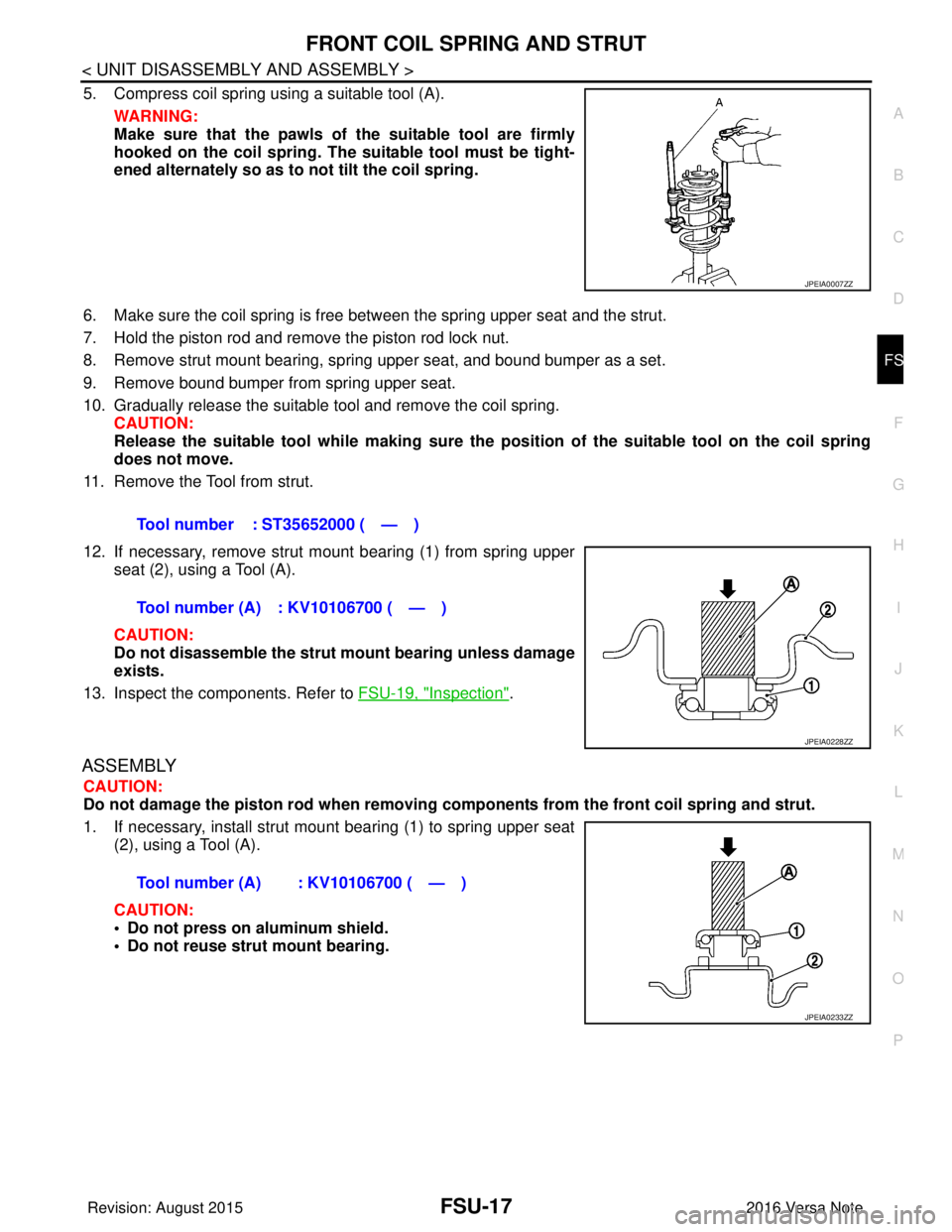
5. Compress coil spring using a suitable tool (A). WARNING:
Make sure that the pawls of the suitable tool are firmly
hooked on the coil spring. The suitable tool must be tight-
ened alternately so as to not tilt the coil spring.
6. Make sure the coil spring is free between the spring upper seat and the strut.
7. Hold the piston rod and remove the piston rod lock nut.
8. Remove strut mount bearing, spri ng upper seat, and bound bumper as a set.
9. Remove bound bumper from spring upper seat.
10. Gradually release the suitable tool and remove the coil spring. CAUTION:
Release the suitable tool while making sure the pos ition of the suitable tool on the coil spring
does not move.
11. Remove the Tool from strut.
12. If necessary, remove strut mount bearing (1) from spring upper seat (2), using a Tool (A).
CAUTION:
Do not disassemble the strut mount bearing unless damage
exists.
13. Inspect the components. Refer to FSU-19, "
Inspection".
ASSEMBLY
CAUTION:
Do not damage the piston rod when removing components from th e front coil spring and strut.
1. If necessary, install strut mount bearing (1) to spring upper seat (2), using a Tool (A).
CAUTION:
• Do not press on aluminum shield.
• Do not reuse strut mount bearing.
JPEIA0007ZZ
Tool number : ST35652000 ( — )
Tool number (A) : KV10106700 ( — )
JPEIA0228ZZ
Tool number (A) : KV10106700 ( — )
JPEIA0233ZZ
Revision: August 2015 2016 Versa Note
cardiagn.com
Page 1863 of 3641
FSU-18
< UNIT DISASSEMBLY AND ASSEMBLY >
FRONT COIL SPRING AND STRUT
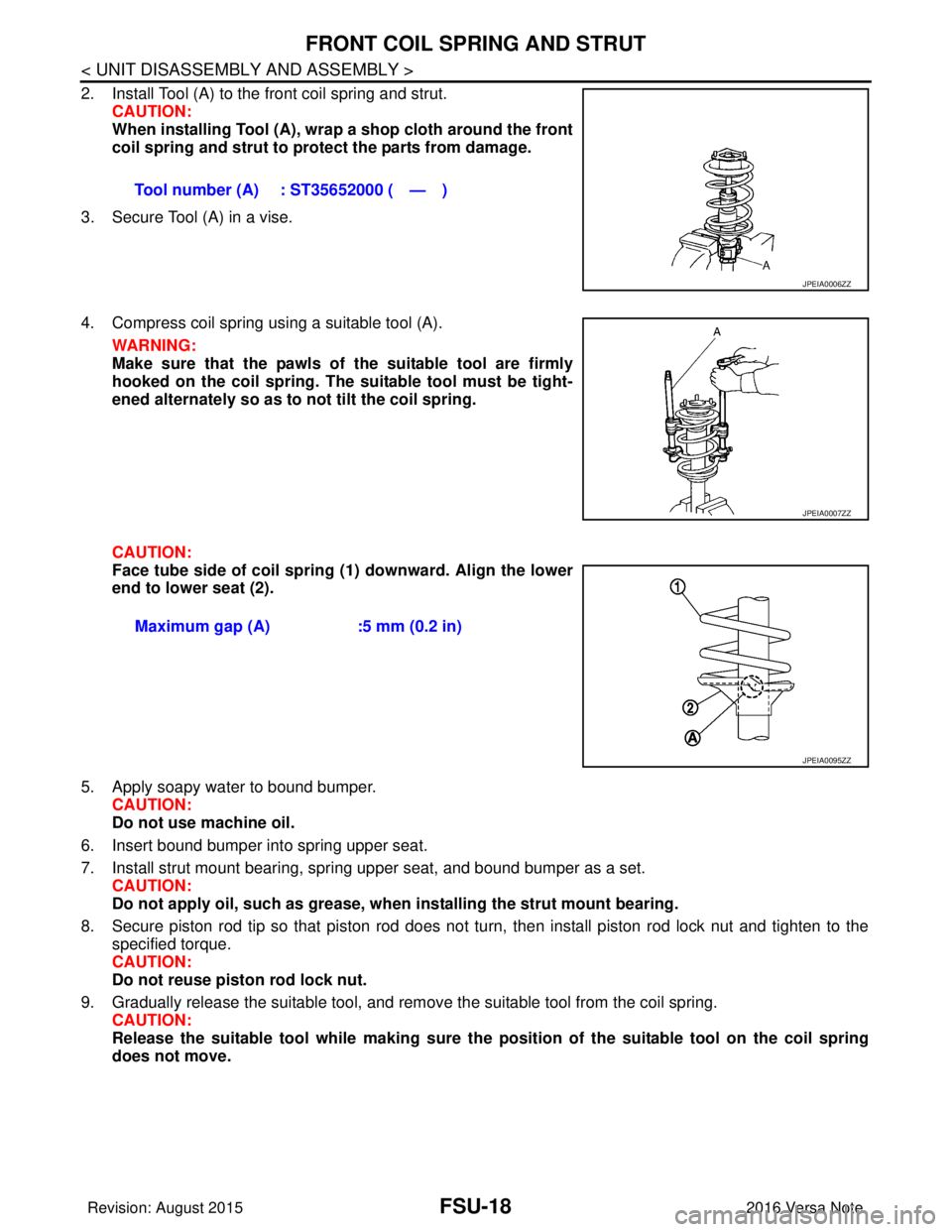
2. Install Tool (A) to the front coil spring and strut.CAUTION:
When installing Tool (A), wrap a shop cloth around the front
coil spring and strut to protect the parts from damage.
3. Secure Tool (A) in a vise.
4. Compress coil spring using a suitable tool (A). WARNING:
Make sure that the pawls of the suitable tool are firmly
hooked on the coil spring. The suitable tool must be tight-
ened alternately so as to not tilt the coil spring.
CAUTION:
Face tube side of coil spring (1) downward. Align the lower
end to lower seat (2).
5. Apply soapy water to bound bumper. CAUTION:
Do not use machine oil.
6. Insert bound bumper into spring upper seat.
7. Install strut mount bearing, spring upper seat, and bound bumper as a set. CAUTION:
Do not apply oil, such as grease, when installing the strut mount bearing.
8. Secure piston rod tip so that piston rod does not turn, then install piston rod lock nut and tighten to the specified torque.
CAUTION:
Do not reuse piston rod lock nut.
9. Gradually release the suitable tool, and remove the suitable tool from the coil spring. CAUTION:
Release the suitable tool while making sure the po sition of the suitable tool on the coil spring
does not move. Tool number (A) : ST35652000 ( — )
JPEIA0006ZZ
JPEIA0007ZZ
Maximum gap (A)
:5 mm (0.2 in)
JPEIA0095ZZ
Revision: August 2015 2016 Versa Note
cardiagn.com
Page 1870 of 3641
FL-4
< PREPARATION >
PREPARATION
PREPARATION
PREPARATION
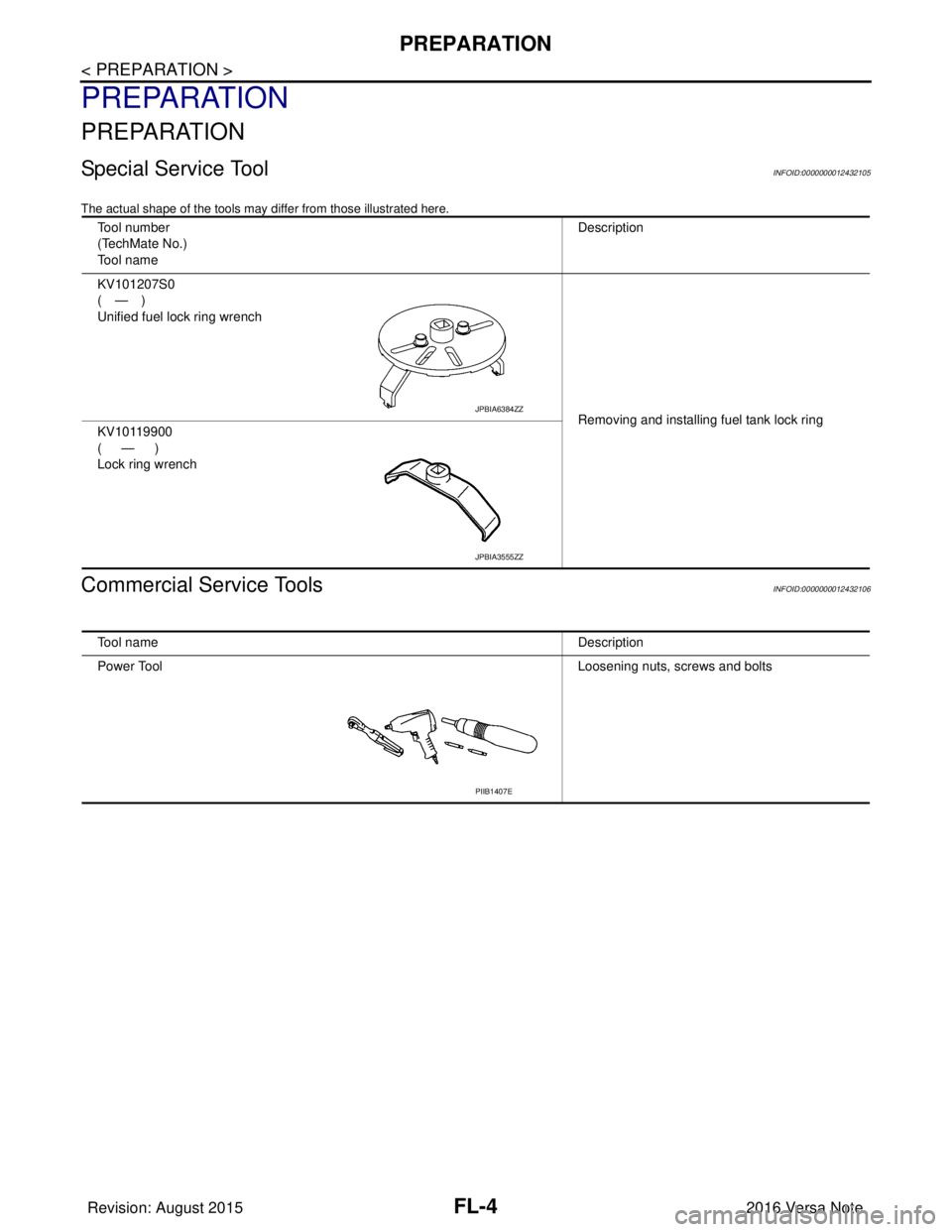
Special Service ToolINFOID:0000000012432105
The actual shape of the tools may differ from those illustrated here.
Commercial Service ToolsINFOID:0000000012432106
Tool number
(TechMate No.)
Tool nameDescription
KV101207S0
(—)
Unified fuel lock ring wrench
Removing and installing fuel tank lock ring
KV10119900
(—)
Lock ring wrench
JPBIA6384ZZ
JPBIA3555ZZ
Tool name Description
Power Tool Loosening nuts, screws and bolts
PIIB1407E
Revision: August 2015 2016 Versa Note
cardiagn.com
Page 1872 of 3641
FL-6
< REMOVAL AND INSTALLATION >
FUEL LEVEL SENSOR UNIT, FUEL FILTER AND FUEL PUMP ASSEMBLY
REMOVAL AND INSTALLATION
FUEL LEVEL SENSOR UNIT, FUEL FILTER AND FUEL PUMP ASSEMBLY
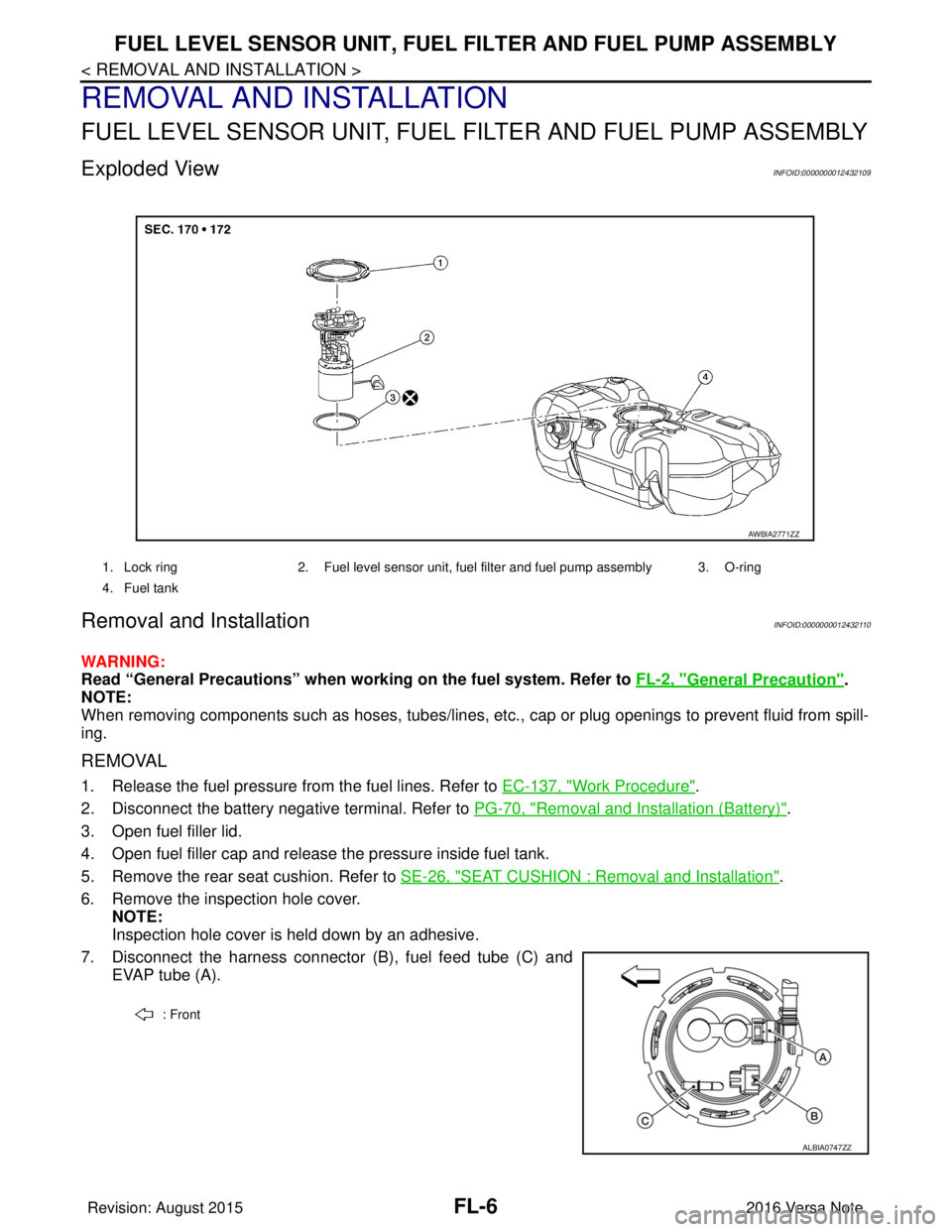
Exploded ViewINFOID:0000000012432109
Removal and InstallationINFOID:0000000012432110
WARNING:
Read “General Precautions” when wo rking on the fuel system. Refer to FL-2, "
General Precaution".
NOTE:
When removing components such as hoses, tubes/lines, etc. , cap or plug openings to prevent fluid from spill-
ing.
REMOVAL
1. Release the fuel pressure from the fuel lines. Refer to EC-137, "Work Procedure".
2. Disconnect the battery negative terminal. Refer to PG-70, "
Removal and Installation (Battery)".
3. Open fuel filler lid.
4. Open fuel filler cap and release the pressure inside fuel tank.
5. Remove the rear seat cushion. Refer to SE-26, "
SEAT CUSHION : Removal and Installation".
6. Remove the inspection hole cover. NOTE:
Inspection hole cover is held down by an adhesive.
7. Disconnect the harness connector (B), fuel feed tube (C) and EVAP tube (A).
1. Lock ring 2. Fuel level sensor unit, fuel filter and fuel pump assembly 3. O-ring
4. Fuel tank
AWBIA2771ZZ
: Front
ALBIA0747ZZ
Revision: August 2015 2016 Versa Note
cardiagn.com
Page 1874 of 3641
FL -8
< REMOVAL AND INSTALLATION >
FUEL LEVEL SENSOR UNIT, FUEL FILTER AND FUEL PUMP ASSEMBLY
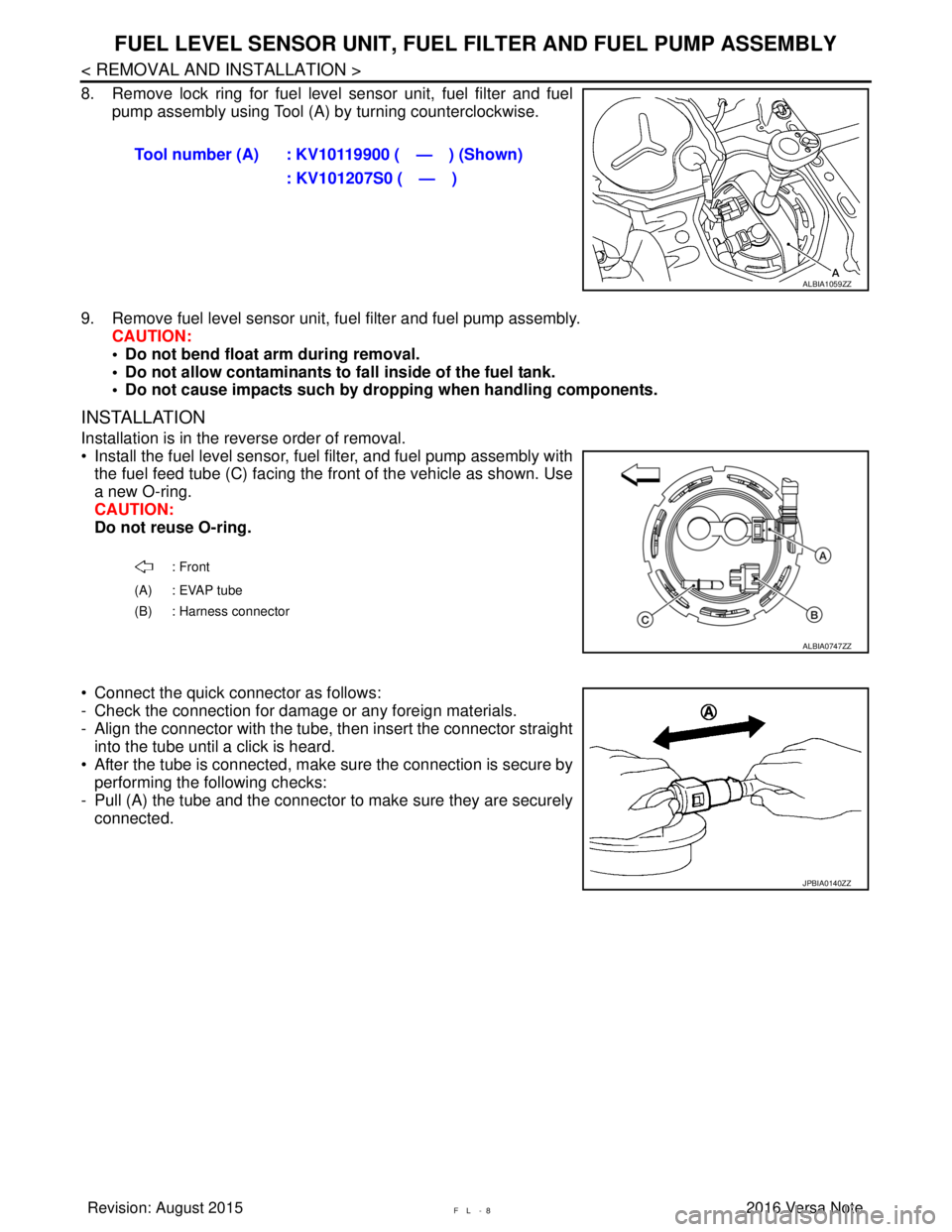
8. Remove lock ring for fuel level sensor unit, fuel filter and fuel
pump assembly using Tool (A) by turning counterclockwise.
9. Remove fuel level sensor unit, fuel filter and fuel pump assembly. CAUTION:
• Do not bend float arm during removal.
• Do not allow contaminants to fa ll inside of the fuel tank.
• Do not cause impacts such by dro pping when handling components.
INSTALLATION
Installation is in the reverse order of removal.
• Install the fuel level sensor, fuel filter, and fuel pump assembly with
the fuel feed tube (C) facing the front of the vehicle as shown. Use
a new O-ring.
CAUTION:
Do not reuse O-ring.
• Connect the quick connector as follows:
- Check the connection for damage or any foreign materials.
- Align the connector with the tube, then insert the connector straight into the tube until a click is heard.
• After the tube is connected, make sure the connection is secure by performing the following checks:
- Pull (A) the tube and the connector to make sure they are securely
connected. Tool number (A) : KV10119900 ( — ) (Shown)
: KV101207S0 ( — )
ALBIA1059ZZ
: Front
(A) : EVAP tube
(B) : Harness connector
ALBIA0747ZZ
JPBIA0140ZZ
Revision: August 2015 2016 Versa Note
cardiagn.com
Page 1881 of 3641
EVAP CANISTERFL-15
< REMOVAL AND INSTALLATION >
C
DE
F
G H
I
J
K L
M A
FL
NP
O
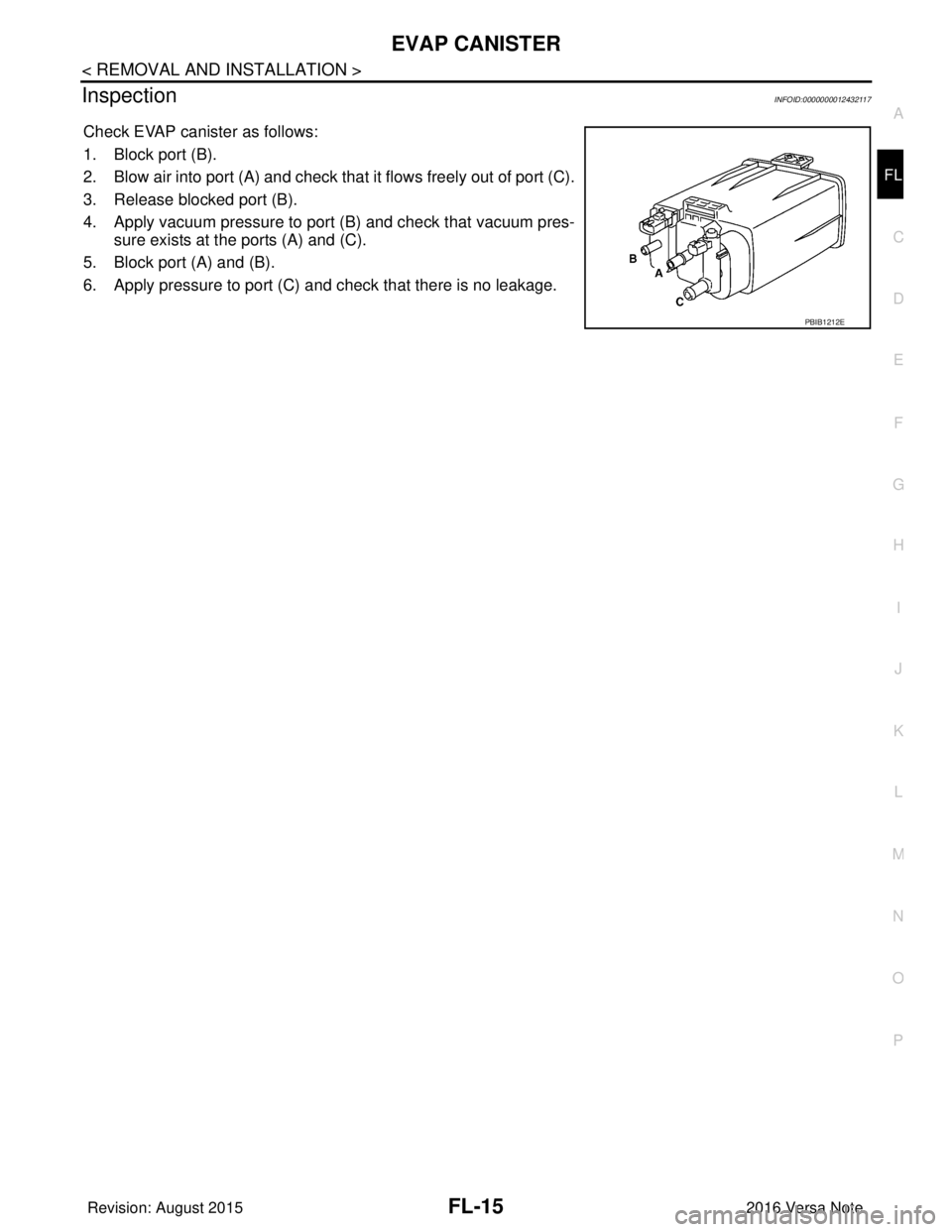
InspectionINFOID:0000000012432117
Check EVAP canister as follows:
1. Block port (B).
2. Blow air into port (A) and check that it flows freely out of port (C).
3. Release blocked port (B).
4. Apply vacuum pressure to port
(B) and check that vacuum pres-
sure exists at the ports (A) and (C).
5. Block port (A) and (B).
6. Apply pressure to port (C) and check that there is no leakage.
PBIB1212E
Revision: August 2015 2016 Versa Note
cardiagn.com
Page 1884 of 3641
FL-18
< REMOVAL AND INSTALLATION >
EVAP CANISTER VENT CONTROL VALVE
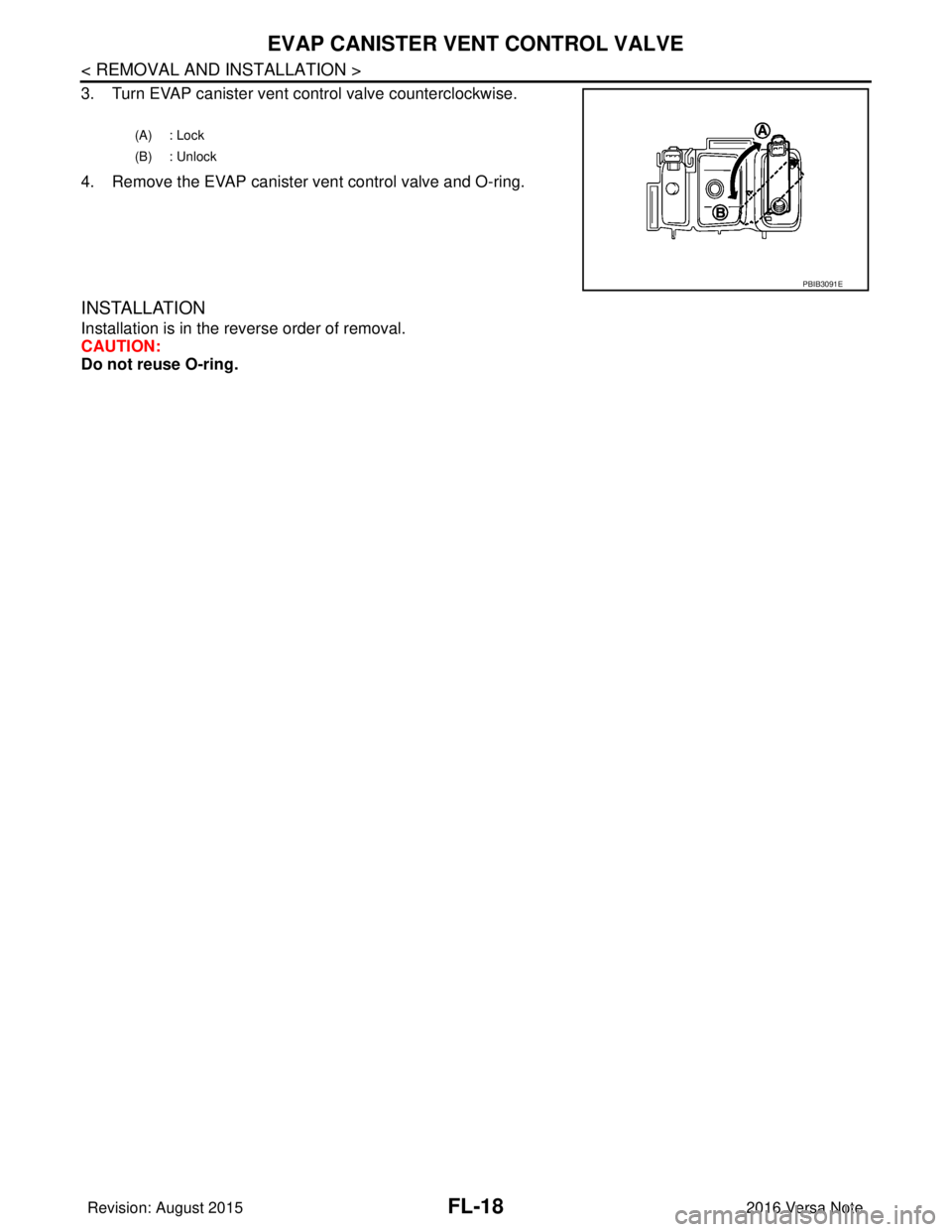
3. Turn EVAP canister vent control valve counterclockwise.
4. Remove the EVAP canister vent control valve and O-ring.
INSTALLATION
Installation is in the reverse order of removal.
CAUTION:
Do not reuse O-ring.
(A) : Lock
(B) : Unlock
PBIB3091E
Revision: August 20152016 Versa Note
cardiagn.com
Page 1891 of 3641
HOW TO USE THIS MANUALGI-3
< HOW TO USE THIS MANUAL >
C
DE
F
G H
I
J
K L
M B
GI
N
O PHOW TO USE THIS MANUAL
HOW TO USE THIS MANUAL
DescriptionINFOID:0000000012433142
This volume explains “Removal, Disassembly, Inst allation, Inspection and Adjustment” and “Trouble Diag-
noses”.
Te r m sINFOID:0000000012433143
• The captions WARNING and CAUTION warn you of steps that must be followed to prevent personal injury
and/or damage to some part of the vehicle.
WARNING indicates the possibility of personal injury if instructions are not followed.
CAUTION indicates the possibility of component damage if instructions are not followed.
BOLD TYPED STATEMENTS except WARNING and CAUTION give you helpful information.
Standard value: Tolerance at inspection and adjustment.
Limit value: The maximum or minimum limit val ue that should not be exceeded at inspection and adjust-
ment.
UnitsINFOID:0000000012433144
• The UNITS given in this manual are primarily expressed as the SI UNIT (International System of Unit), and
alternatively expressed in the metric system and in the yard/pound system.
Also with regard to tightening torque of bolts and nuts, there are descriptions both about range and about the
standard tightening torque.
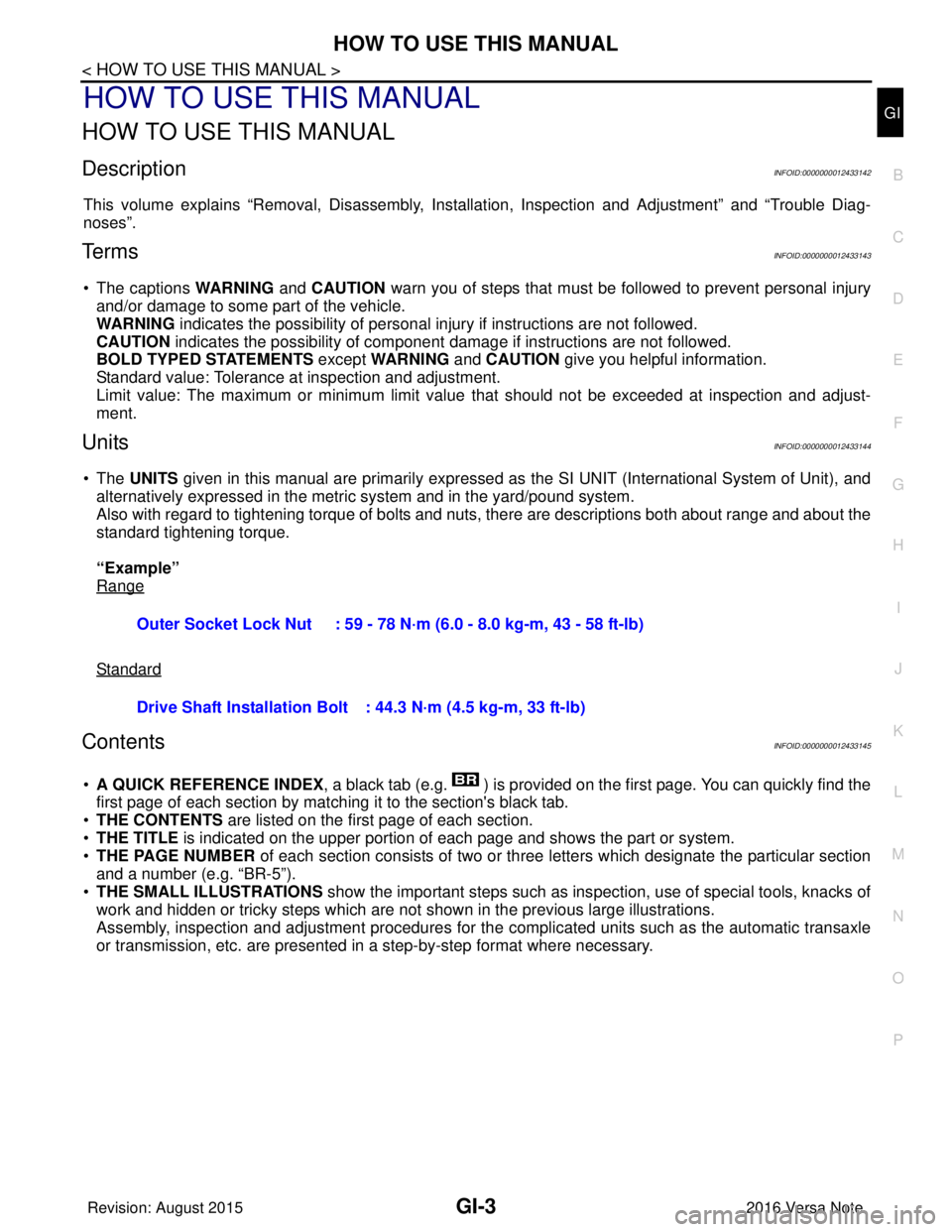
“Example”
Range
Standard
ContentsINFOID:0000000012433145
• A QUICK REFERENCE INDEX , a black tab (e.g. ) is provided on the first page. You can quickly find the
first page of each section by matching it to the section's black tab.
• THE CONTENTS are listed on the first page of each section.
• THE TITLE is indicated on the upper portion of each page and shows the part or system.
• THE PAGE NUMBER of each section consists of two or three letters which designate the particular section
and a number (e.g. “BR-5”).
• THE SMALL ILLUSTRATIONS show the important steps such as ins pection, use of special tools, knacks of
work and hidden or tricky steps which are not shown in the previous large illustrations.
Assembly, inspection and adjustment procedures for the complicated units such as the automatic transaxle
or transmission, etc. are presented in a step-by-step format where necessary. Outer Socket Lock Nut : 59 - 78 N·m (6.0 - 8.0 kg-m, 43 - 58 ft-lb)
Drive Shaft Installation Bolt : 44.3 N·m (4.5 kg-m, 33 ft-lb)
Revision: August 2015
2016 Versa Note
cardiagn.com