Page 169 of 587
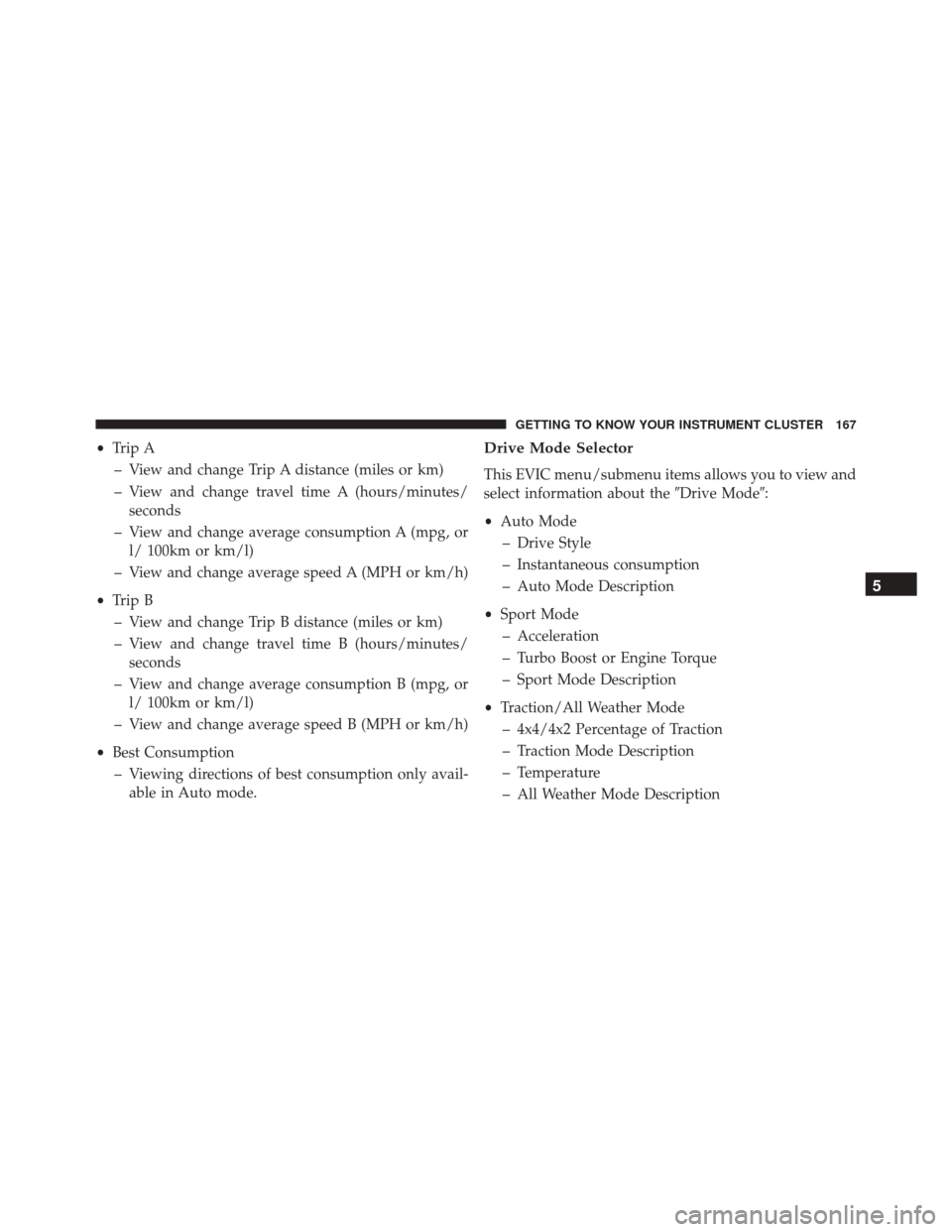
•Trip A
– View and change Trip A distance (miles or km)
– View and change travel time A (hours/minutes/ seconds
– View and change average consumption A (mpg, or l/ 100km or km/l)
– View and change average speed A (MPH or km/h)
• Trip B
– View and change Trip B distance (miles or km)
– View and change travel time B (hours/minutes/ seconds
– View and change average consumption B (mpg, or l/ 100km or km/l)
– View and change average speed B (MPH or km/h)
• Best Consumption
– Viewing directions of best consumption only avail- able in Auto mode.Drive Mode Selector
This EVIC menu/submenu items allows you to view and
select information about the �Drive Mode�:
• Auto Mode
– Drive Style
– Instantaneous consumption
– Auto Mode Description
• Sport Mode
– Acceleration
– Turbo Boost or Engine Torque
– Sport Mode Description
• Traction/All Weather Mode
– 4x4/4x2 Percentage of Traction
– Traction Mode Description
– Temperature
– All Weather Mode Description
5
GETTING TO KNOW YOUR INSTRUMENT CLUSTER 167
Page 271 of 587
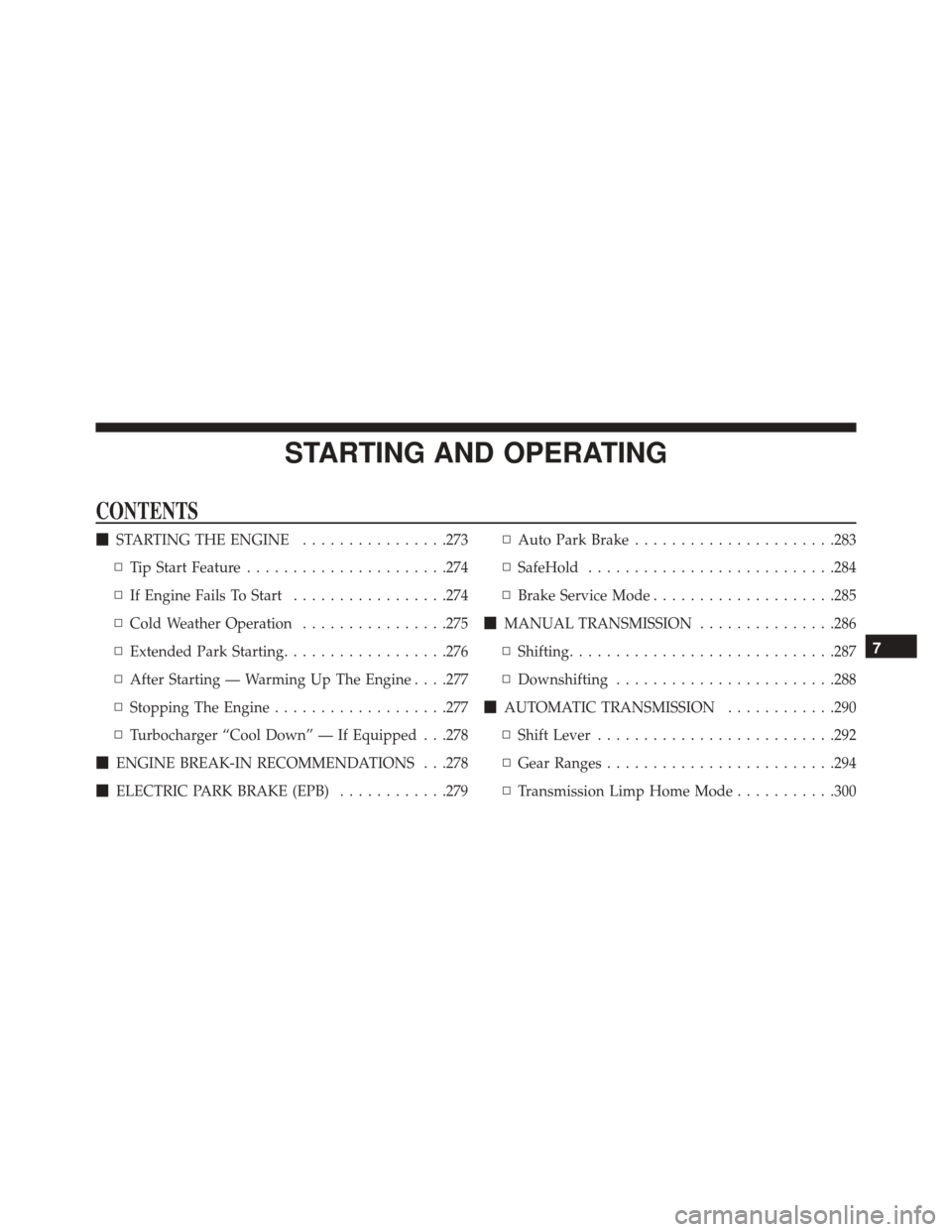
STARTING AND OPERATING
CONTENTS
�STARTING THE ENGINE ................273
▫ Tip Start Feature ..................... .274
▫ If Engine Fails To Start .................274
▫ Cold Weather Operation ................275
▫ Extended Park Starting ..................276
▫ After Starting — Warming Up The Engine . . . .277
▫ Stopping The Engine ...................277
▫ Turbocharger “Cool Down” — If Equipped . . .278
� ENGINE BREAK-IN RECOMMENDATIONS . . .278
� ELECTRIC PARK BRAKE (EPB) ............279▫
Auto Park Brake ..................... .283
▫ SafeHold .......................... .284
▫ Brake Service Mode ....................285
� MANUAL TRANSMISSION ...............286
▫ Shifting ............................ .287
▫ Downshifting ....................... .288
� AUTOMATIC TRANSMISSION ............290
▫ Shift Lever ......................... .292
▫ Gear Ranges ........................ .294
▫ Transmission Limp Home Mode ...........300
7
Page 273 of 587

�LANESENSE — IF EQUIPPED .............321
▫ LaneSense Operation ...................321
▫ Turning LaneSense ON Or OFF ............322
▫ LaneSense Warning Message ..............323
▫ Changing LaneSense Status ..............327
� PARKVIEW REAR BACK UP CAMERA — IF
EQUIPPED .......................... .327
� TIRE PRESSURE MONITORING SYSTEM
(TPMS) ............................. .330
▫ Base System ........................ .333
▫ General Information ....................335
� FUEL REQUIREMENTS ..................335
▫ 1.4L Turbo Engine .....................335
▫ 2.4L Engine ......................... .336▫
Reformulated Gasoline .................336
▫ Gasoline/Oxygenate Blends ..............337
▫ E-85 Usage In Non-Flex Fuel Vehicles .......337
▫ MMT In Gasoline .....................338
▫ Materials Added To Fuel ................338
▫ Fuel System Cautions ...................339
▫ Carbon Monoxide Warnings .............340
� ADDING FUEL ....................... .340
� VEHICLE LOADING ....................344
▫ Certification Label ....................344
� DRIVING ON SLIPPERY SURFACES .........346
▫ Acceleration ........................ .346
▫ Traction ........................... .347
7
STARTING AND OPERATING 271
Page 278 of 587

Turbo engine below -20°F (-29°C) and for the 2.4L engine
below -29°F (-34°C) and is recommended for the 2.4L
engine below -20°F (-29°C).
To prevent possible engine damage while starting at low
temperatures, this vehicle will inhibit engine cranking
when the ambient temperature is less than -34°F (-35°C)
and the oil temperature sensor reading indicates an
engine block heater has not been used. The message
“plug in engine heater” will be displayed in the instru-
ment cluster when the ambient temperature is below -4°F
(-20°C) at the time the engine is shut off as a reminder to
avoid possible crank delays at the next cold start.
Extended Park Starting
NOTE:Extended Park condition occurs when the vehicle
has not been started or driven for at least 35 days.
1. Install a battery charger or jumper cables to the battery to ensure a full battery charge during the crank cycle. 2. Cycle the ignition in the START position and release it
when the engine starts.
3. If the engine fails to start within ten seconds, cycle the ignition to the STOP (OFF/LOCK) position, wait five
seconds to allow the starter to cool, then repeat the
Extended Park Starting procedure.
4. If the engine fails to start after eight attempts, allow the starter to cool for at least 10 minutes, then repeat
the procedure.
CAUTION!
To prevent damage to the starter, do not crank con-
tinuously for more than 10 seconds at a time. Wait 10
to 15 seconds before trying again.
276 STARTING AND OPERATING
Page 280 of 587
When the ignition is in the STOP/OFF position, the
window switches remains active for three minutes.
Opening a front door will cancel this function.
After severe driving, idle the engine to allow the tem-
perature inside the engine compartment to cool before
shutting off the engine.
Turbocharger “Cool Down” — If Equipped
This vehicle is equipped with an after-run pump to cool
the turbocharger after the engine is shut off. Depending
on the type of driving and the amount of cargo, the pump
will run for up to 10 minutes after the engine has been
shut off to circulate coolant through the turbocharger.
Although the pump is rubber-mounted for quiet opera-
tion, it is normal to hear it running during this time.
ENGINE BREAK-IN RECOMMENDATIONS
A long break-in period is not required for the engine and
drivetrain (transmission and axle) in your vehicle.Drive moderately during the first 300 miles (500 km).
After the initial 60 miles (100 km), speeds up to 50 or
55 mph (80 or 90 km/h) are desirable.
While cruising, brief full-throttle acceleration within the
limits of local traffic laws contributes to a good break-in.
Wide-open throttle acceleration in low gear can be detri-
mental and should be avoided.
The engine oil installed in the engine at the factory is a
high-quality energy conserving type lubricant. Oil
changes should be consistent with anticipated climate
conditions under which vehicle operations will occur. For
the recommended viscosity and quality grades, refer to
“Maintenance Procedures” in “Maintaining And Caring
For Your Vehicle.”
278 STARTING AND OPERATING
Page 337 of 587
•This occurs for each subsequent ignition key cycle, a
chime will sound and the Tire Pressure Monitoring
Telltale Light will flash on and off for 75 seconds and
then remain on solid.
• Once you repair or replace the original road tire and
reinstall it on the vehicle in place of the compact spare
tire, the TPMS will update automatically and the Tire
Pressure Monitoring Telltale Light will turn OFF, as
long as no tire pressure is below the low-pressure
warning limit in any of the four active road tires. The
vehicle may need to be driven for up to 20 minutes
above 15 mph (24 km/h) in order for the TPMS to
receive this information.
General Information
This device complies with Part 15 of the FCC rules and
RSS-210 of Industry Canada. Operation is subject to the
following two conditions:
(1) This device may not cause harmful interference. (2) This device must accept any interference received,
including interference that may cause undesired opera-
tion.
NOTE:
Changes or modifications not expressly approved
by the party responsible for compliance could void the
user ’s authority to operate the equipment.
FUEL REQUIREMENTS
1.4L Turbo Engine
This engine is designed to meet all emis-
sion regulations and provide satisfactory
fuel economy and performance when us-
ing high-quality unleaded �regular�gaso-
line having an octane rating of 87 using the
(R+M)/2 method. For optimum performance and fuel
economy the use of 91 octane or higher is recommended.7
STARTING AND OPERATING 335
Page 431 of 587
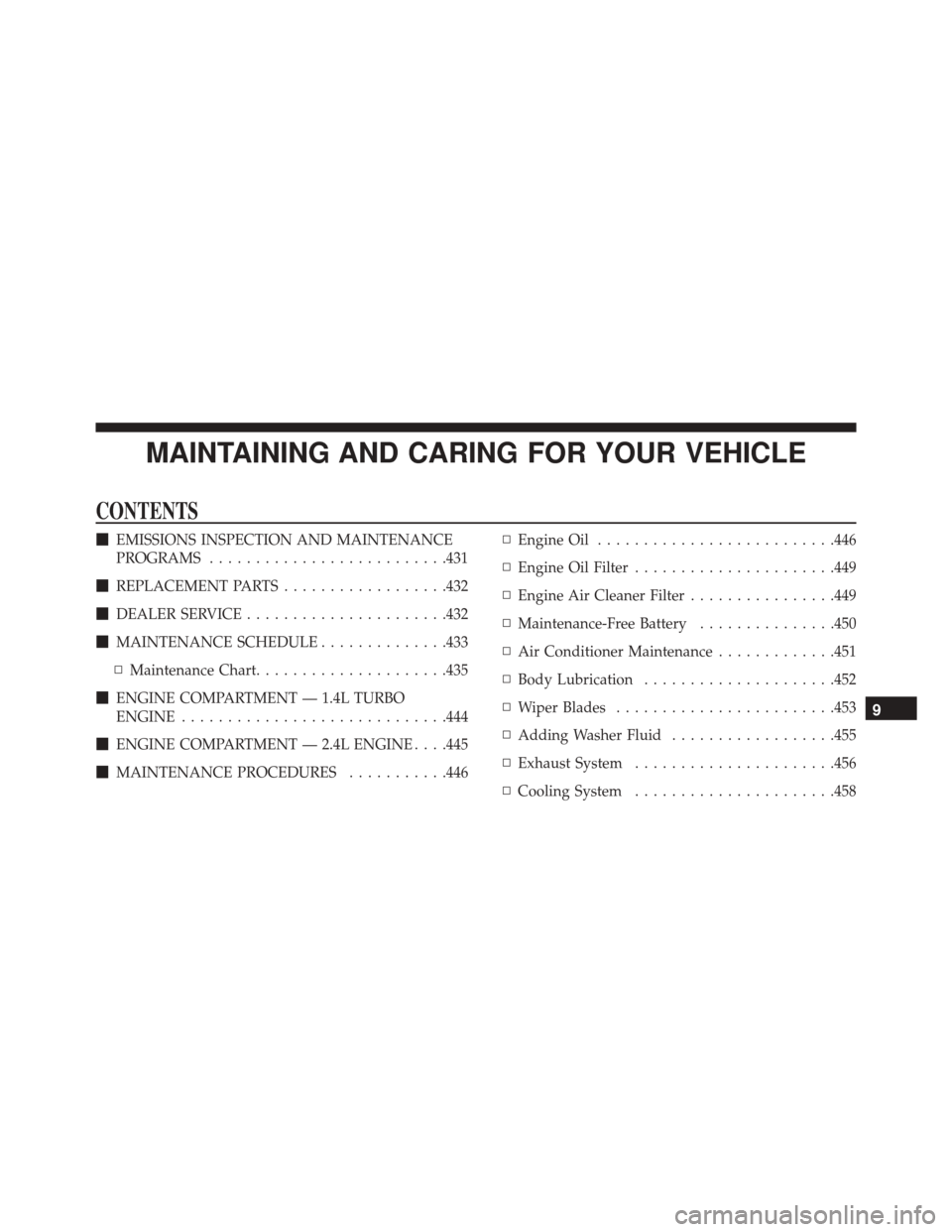
MAINTAINING AND CARING FOR YOUR VEHICLE
CONTENTS
�EMISSIONS INSPECTION AND MAINTENANCE
PROGRAMS ......................... .431
� REPLACEMENT PARTS ..................432
� DEALER SERVICE ..................... .432
� MAINTENANCE SCHEDULE ..............433
▫ Maintenance Chart .....................435
� ENGINE COMPARTMENT — 1.4L TURBO
ENGINE ............................ .444
� ENGINE COMPARTMENT — 2.4L ENGINE . . . .445
� MAINTENANCE PROCEDURES ...........446▫
Engine Oil ......................... .446
▫ Engine Oil Filter ..................... .449
▫ Engine Air Cleaner Filter ................449
▫ Maintenance-Free Battery ...............450
▫ Air Conditioner Maintenance .............451
▫ Body Lubrication .....................452
▫ Wiper Blades ....................... .453
▫ Adding Washer Fluid ..................455
▫ Exhaust System ..................... .456
▫ Cooling System ..................... .458
9
Page 442 of 587
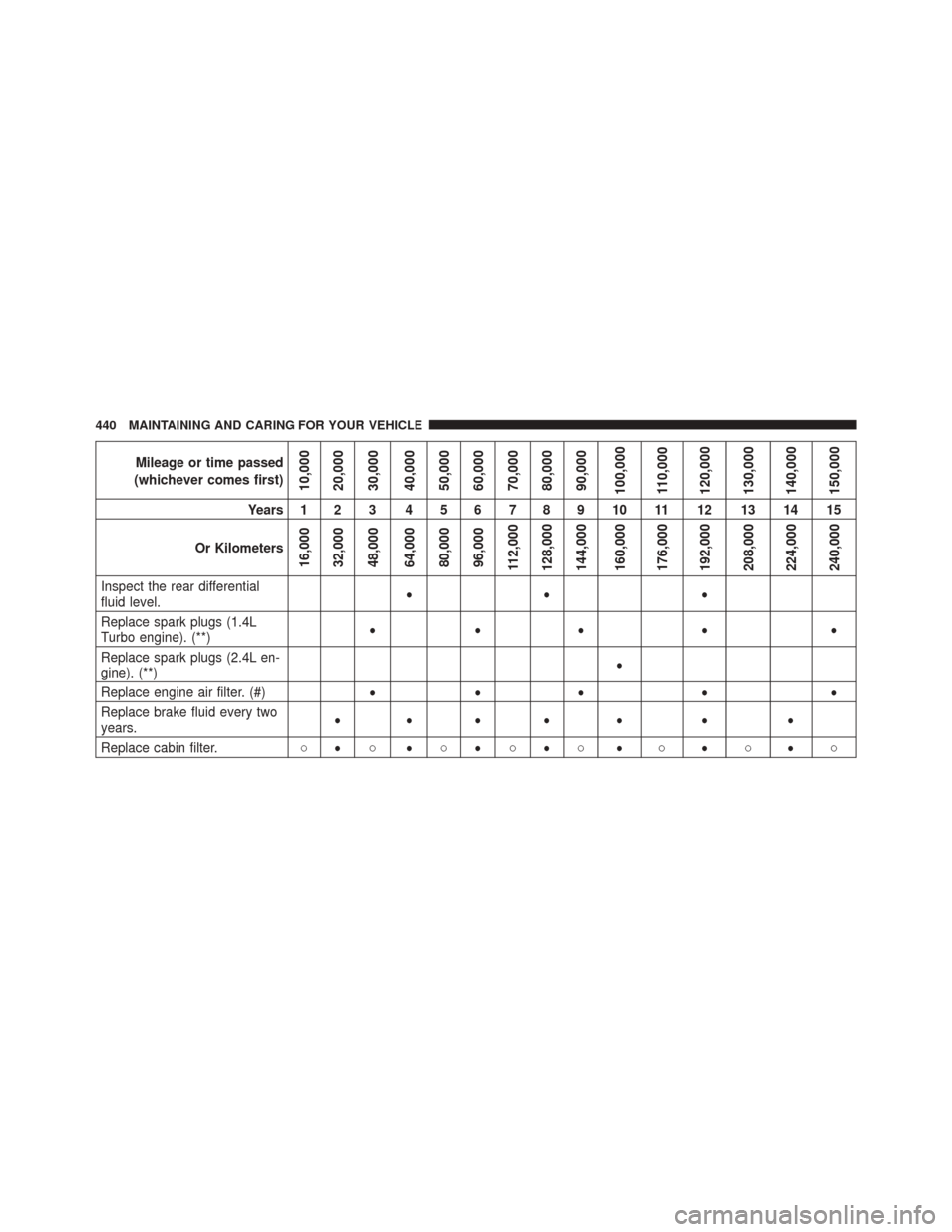
Mileage or time passed
(whichever comes first)
10,000
20,000
30,000
40,000
50,000
60,000
70,000
80,000
90,000
100,000
110,000
120,000
130,000
140,000
150,000
Years 1 2 3 4 5 6 7 8 9 10 11 12 13 14 15
Or Kilometers
16,000
32,000
48,000
64,000
80,000
96,000
112,000
128,000
144,000
160,000
176,000
192,000
208,000
224,000
240,000
Inspect the rear differential
fluid level. •• •
Replace spark plugs (1.4L
Turbo engine). (**) ••• • •
Replace spark plugs (2.4L en-
gine). (**) •
Replace engine air filter. (#) ••• • •
Replace brake fluid every two
years. •••• • • •
Replace cabin filter. ○• ○ •○• ○•○ • ○• ○•○
440 MAINTAINING AND CARING FOR YOUR VEHICLE