Page 186 of 587
LaneSense System•What Does It Mean
Electronic Vehicle Information Center
(EVIC) — If Equipped
The light comes on in the following ways:
Light illuminated (white): indicates that the system is
active and both of the lane markings have been
detected (the lines of the aisle are gray in color).
Light on as flashing light (amber): indicates that the
vehicle is going to cross over the lane marking.
Light illuminated (green): indicates that both lane
markings have been detected, and the system is
“armed.” The system will provide a torque warning
in the steering wheel if an unintentional lane depar-
ture occurs. Park/Headlight ON Indicator
•What Does It Mean
The light comes on by activating the park-
ing lights or headlights.
This feature allows you to maintain the
lights for a period of 30, 60, or 90 seconds
after placing the ignition in the STOP posi-
tion.
In some conditions, such as the poor quality of the
fuel, the light may come on only after starting the
engine.
Automatic High Beam Lights •What Does It Mean
The indicator light comes on by activating
the automatic high beam headlights.
Green
Warning Light
Green
Warning Light
184 GETTING TO KNOW YOUR INSTRUMENT CLUSTER
Page 190 of 587

Electronic Throttle Control (ETC)•What Does It Mean
The light will illuminate when the ignition
is first placed in the MAR/RUN or AVV/
START position and remain on briefly as a
bulb check. If the light does not come on during
starting, have the system checked by an authorized
dealer.
If a problem is detected, the light will come on while
the engine is running. Bring the vehicle to a complete
stop and place it into PARK. Cycle the ignition to the
STOP/OFF position; the light should turn off.
If the light remains lit with the engine running, your
vehicle will usually be drivable. However, see an
authorized dealer for service as soon as possible.
If the light is flashing when the engine is running,
immediate service is required. You may experience reduced performance, an elevated/rough idle or en-
gine stall, and your vehicle may require towing.
Automatic Transmission Failure •What Does It Mean
This light will illuminate when the system
detects a failure of the automatic transmis-
sion.
• What To Do
Contact an authorized dealer as soon as possible.
Oil Temperature Warning Light •What Does It Mean
This light indicates engine oil temperature
is high.
188 GETTING TO KNOW YOUR INSTRUMENT CLUSTER
Page 194 of 587
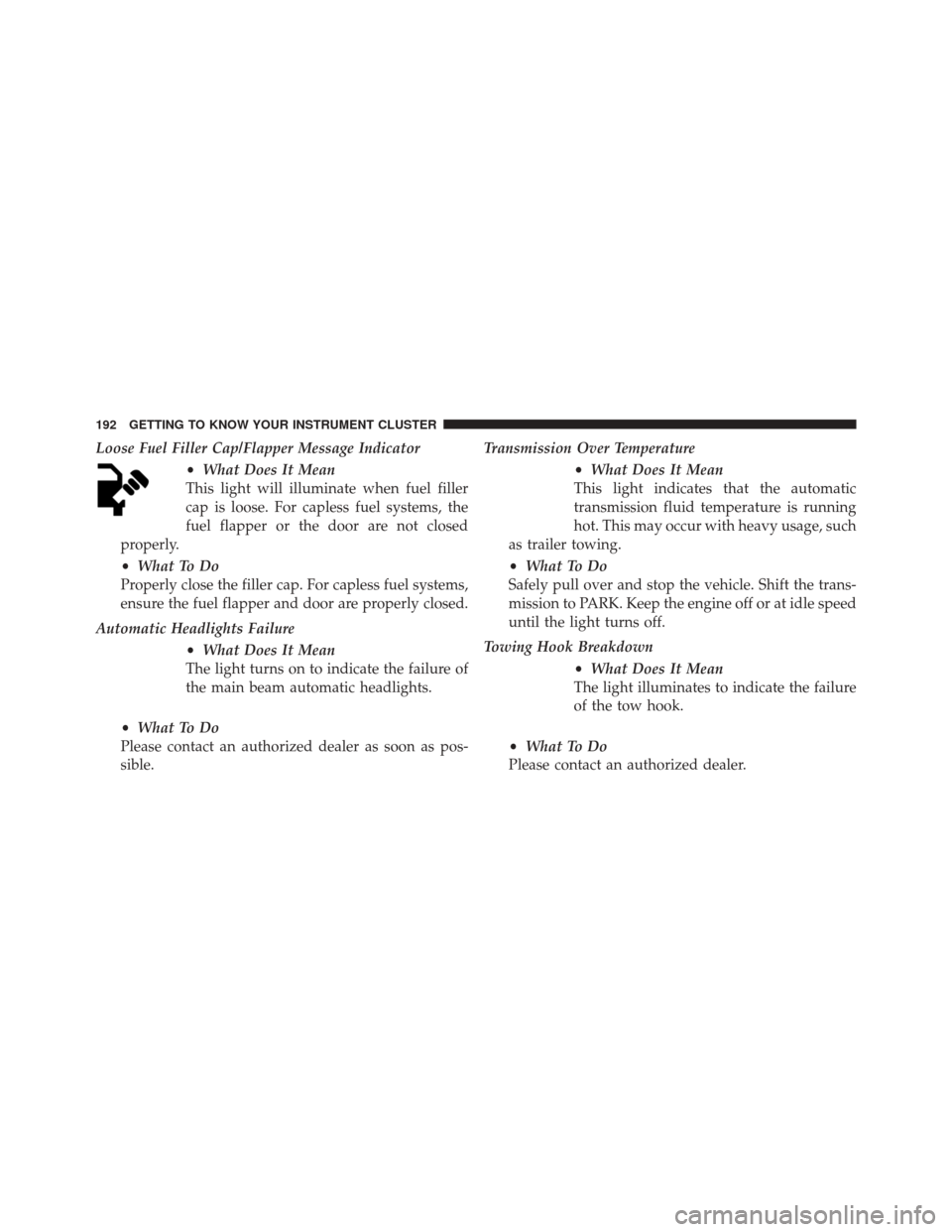
Loose Fuel Filler Cap/Flapper Message Indicator•What Does It Mean
This light will illuminate when fuel filler
cap is loose. For capless fuel systems, the
fuel flapper or the door are not closed
properly.
• What To Do
Properly close the filler cap. For capless fuel systems,
ensure the fuel flapper and door are properly closed.
Automatic Headlights Failure •What Does It Mean
The light turns on to indicate the failure of
the main beam automatic headlights.
• What To Do
Please contact an authorized dealer as soon as pos-
sible. Transmission Over Temperature
•What Does It Mean
This light indicates that the automatic
transmission fluid temperature is running
hot. This may occur with heavy usage, such
as trailer towing.
• What To Do
Safely pull over and stop the vehicle. Shift the trans-
mission to PARK. Keep the engine off or at idle speed
until the light turns off.
Towing Hook Breakdown •What Does It Mean
The light illuminates to indicate the failure
of the tow hook.
• What To Do
Please contact an authorized dealer.
192 GETTING TO KNOW YOUR INSTRUMENT CLUSTER
Page 200 of 587
ELECTRONIC BRAKE CONTROL SYSTEM
Your vehicle is equipped with an advanced Electronic
Brake Control system (EBC). This system includes Elec-
tronic Brake Force Distribution (EBD), Anti-Lock Brake
System (ABS), Brake Assist System (BAS), Hill Start
Assist (HSA), Traction Control System (TCS), Electronic
Stability Control (ESC), Dynamic Steering Torque (DST)
and Electronic Roll Mitigation (ERM). These systems
work together to enhance both vehicle stability and
control in various driving conditions.
Electronic Brake Force Distribution (EBD)
This function manages the distribution of the braking
torque between the front and rear axles by limiting
braking pressure to the rear axle. This is done to prevent
overslip of the rear wheels to avoid vehicle instability,
and to prevent the rear axle from entering ABS before the
front axle.
Brake System Warning Light
The red “Brake System Warning Light” will turn on when
the ignition switch is turned to the ON position and may
stay on for as long as four seconds.
If the “Brake System Warning Light” remains on or
comes on while driving, it indicates that the brake system
is not functioning properly and that immediate service is
required. If the “Brake System Warning Light” does not
come on when the ignition switch is turned to the ON
position, have the light repaired as soon as possible.
Anti-Lock Brake System (ABS)
The Anti-Lock Brake System (ABS) provides increased
vehicle stability and brake performance under most
braking conditions. The system automatically prevents
wheel lock, and enhances vehicle control during braking.
The ABS performs a self-check cycle to ensure that the
ABS is working properly each time the vehicle is started
198 SAFETY
Page 217 of 587
4. Position the lap belt so that it is snug and lies lowacross your hips, below your abdomen. To remove
slack in the lap belt portion, pull up on the shoulder
belt. To loosen the lap belt if it is too tight, tilt the latch
plate and pull on the lap belt. A snug seat belt reduces
the risk of sliding under the seat belt in a collision. 5. Position the shoulder belt across the shoulder and
chest with minimal, if any slack so that it is comfort-
able and not resting on your neck. The retractor will
withdraw any slack in the shoulder belt.
6. To release the belt, push the red button on the buckle. The seat belt will automatically retract to its stowed
Positioning The Lap BeltReleasing The Seat Belt
6
SAFETY 215
Page 221 of 587
7. Position the lap belt so that it is snug and lies lowacross your hips, below your abdomen. To remove
slack in the lap belt portion, pull up on the shoulder
belt. To loosen the lap belt if it is too tight, pull on the
lap belt. A snug seat belt reduces the risk of sliding
under the seat belt in a collision. 8. Position the shoulder belt on your chest so that it is
comfortable and not resting on your neck. The retrac-
tor will withdraw any slack in the seat belt.
9. To release the seat belt, push the red button on the buckle.
10. To disengage the mini-latch plate from the mini- buckle for storage, insert the regular latch plate into
the center red slot on the mini-buckle. The seat belt
will automatically retract to its stowed position. If
necessary, slide the latch plate down the webbing to
allow the seat belt to retract fully. Insert the mini-
latch plate and regular latch plate into its stowed
position.
Inserting Latch Plate Into Buckle
6
SAFETY 219
Page 223 of 587
Position the lap belt snug and low below the abdomen
and across the strong bones of the hips. Place the
shoulder belt across the chest and away from the neck.
Never place the shoulder belt behind the back or under
the arm.
Seat Belt Pretensioner
The front seat belt system is equipped with pretensioning
devices that are designed to remove slack from the seat
belt in the event of a collision. These devices may
improve the performance of the seat belt by removing
slack from the seat belt early in a collision. Pretensioners
work for all size occupants, including those in child
restraints.
NOTE:These devices are not a substitute for proper seat
belt placement by the occupant. The seat belt still must be
worn snugly and positioned properly. The pretensioners are triggered by the Occupant Re-
straint Controller (ORC). Like the air bags, the preten-
sioners are single use items. A deployed pretensioner or
a deployed air bag must be replaced immediately.
Energy Management Feature
This vehicle has a seat belt system with an Energy
Management feature in the front seating positions that
may help further reduce the risk of injury in the event of
a collision. This seat belt system has a retractor assembly
that is designed to release webbing in a controlled
manner.
Switchable Automatic Locking Retractor (ALR) —
If Equipped
The seat belts in the passenger seating positions are
equipped with a Switchable Automatic Locking Retractor
(ALR) which is used to secure a child restraint system.
For additional information, refer to “Installing Child
Restraints Using The Vehicle Seat Belt” under the “Child
6
SAFETY 221
Page 224 of 587
Restraints” section of this manual. The table below
defines the type of feature for each seating position.If the passenger seating position is equipped with an
ALR and is being used for normal usage, only pull the
seat belt webbing out far enough to comfortably wrap
around the occupant’s mid-section so as to not activate
the ALR. If the ALR is activated, you will hear a clicking
sound as the seat belt retracts. Allow the webbing to
retract completely in this case and then carefully pull out
only the amount of webbing necessary to comfortably
wrap around the occupant’s mid-section. Slide the latch
plate into the buckle until you hear a
�click.�
In Automatic Locking Mode, the shoulder belt is auto-
matically pre-locked. The seat belt will still retract to
remove any slack in the shoulder belt. Use the Automatic
Locking Mode anytime a child restraint is installed in a
seating position that has a seat belt with this feature.
Children 12 years old and under should always be
properly restrained in a vehicle with a rear seat.
• ALR = Switchable Automatic Locking Retractor
222 SAFETY