2016 AUDI A3 CABRIOLET fuel
[x] Cancel search: fuelPage 30 of 272
<( co ..... N
" N ..... 0 r--. > 00
.. If you press a button longer (convenience open
ing*), the LED blinks several times .
.. If the LED does not blink, the remote control
key battery is dead. The message
Ill Please
change key battery
may also appear in the in
strument cluster display . Replace the battery .
Replacing the remote control key battery
.. Pry the cover @off of the key (Dusing a coin
¢fig . 15 .
.,. Insert the new battery with the "+" facing up .
.. Press the cover back onto the key until it clicks
into place .
We recommend having the battery replaced by
an authorized Audi dealer or authorized Audi
Service Facility .
@ For the sake of the environment
Dead batteries must be disposed of using
methods that will not harm the env ironment.
Do not dispose of them in household trash .
@ Tips
The replacement battery must meet the same
specifications as the orig inal battery.
Remote control key synchronization
The remote control key must be synchronized if
the vehicle does not lock and unlock with the re
mote control.
.. Press the remote control key button~-
1> Insert the key in the driver's door lock within 30
seconds .
.,. Press the~ button or~ button .
Open ing and closing
Unlocking/locking by remote control
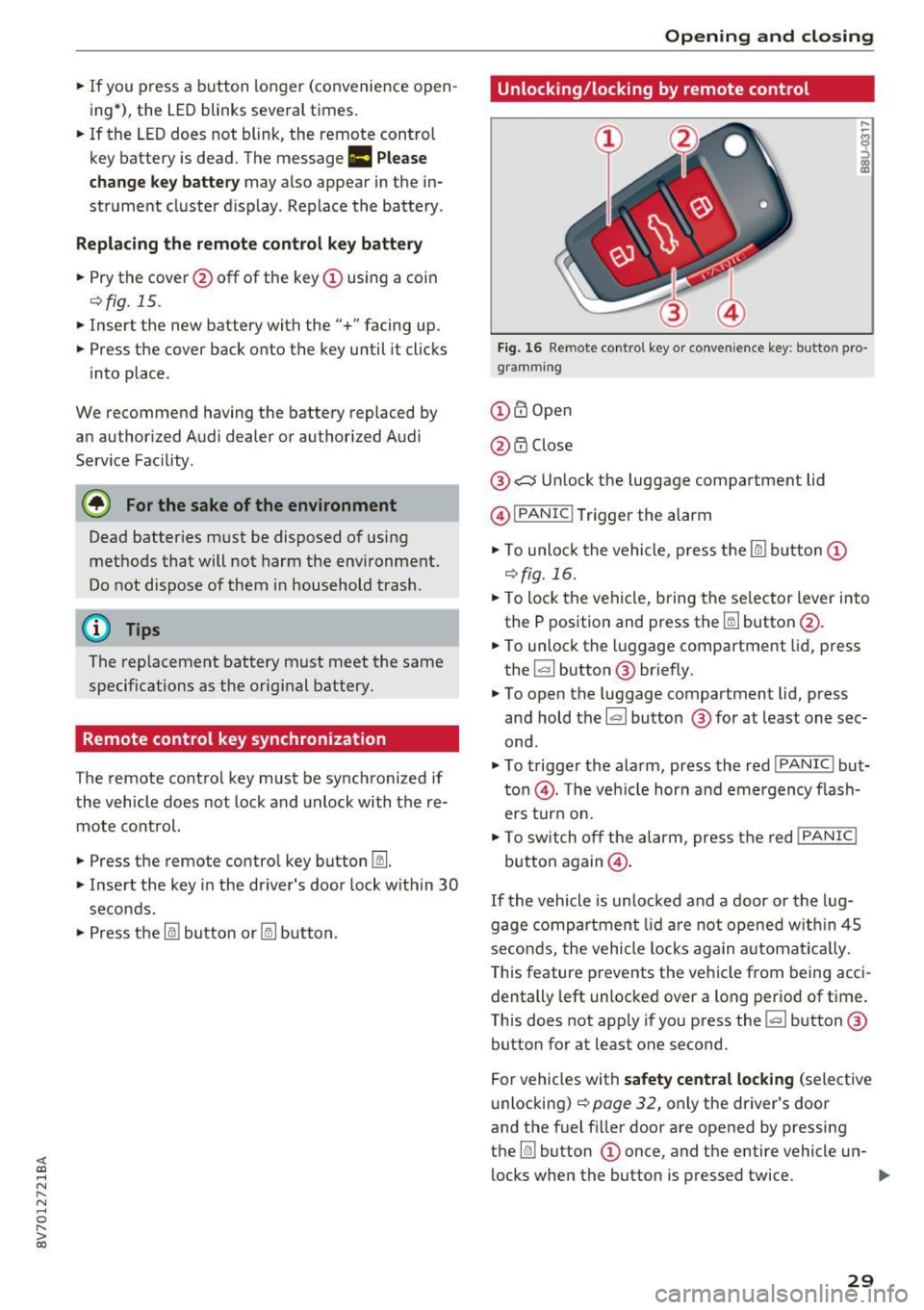
Fig. 16 Remote control key or conve nien ce key : button pro
gramm ing
(D m Open
@ i'.D Close
® .:::::$Unlock the luggage compartment lid
@ I
PANIC ! Trigger the alarm
... To unloc k the vehicle , press the~ but ton (D
c::>fig.16 .
.. To lock the vehicle, bring the selector lever into
the P position and press the~ button @.
.. To unlock the luggage compartment lid, press
the ~ button ® briefly.
.,. To open the luggage compartment lid, press
and hold the~ but ton ® for at least one sec
ond .
... To trigger the alarm, press the red I
PANIC ! but
ton @. T he veh icle horn and emergency flash
ers turn on.
.. To switch off the alarm, press the red
!PANIC I
button again@.
If the vehicle is unlocked and a door or the lug
gage compartment lid are not opened w ithin 45
seconds, the vehicle locks again automat ically.
This feature prevents the vehicle from being acci
dentally left unlocked over a long period of time.
This does not apply if you press the~ button ®
button for at least one second.
For vehicles with
safety central locking (selective
unlocking)
c::> page 32, only the driver's door
and the fuel f iller door are opened by pressing
the ~ button (D once, and the entire vehicle un-
locks when the button is pressed twice .
Ill>
29
Page 33 of 272

Opening and closing
@ Tips
-The vehicle cannot be started if an unau
thorized key is used. It may not be possible
to start the vehicle under certain circum
stances, for example if there is another ra
d io module like the key from another vehi-
cle or a transponder on the same keychain .
- For an explanation on conformity with the
FCC regulations in the United States and the
Industry Canada regulations, refer to
r::;> page 256.
Safety central locking
App lies to: ve hicles w ith safety central lo ck in g
Safety central locking provides the possibility, to
only unlock the driver's door and the fuel filler
door. The rest of the vehicle rema ins locked .
Unlocking the driver's door and the fuel filler
door
.,. Press the remote control key or conven ience
key
[ru button once or turn the key once in the
opening direction .
Unlocking all doors, the luggage
compartment lid and the fuel filler door
.,. Press the remote control key or convenience
key
[ru button twice within five seconds or turn
the key
twice within five seconds in the opening
direction .
When unlocking just the driver's door, the anti
theft alarm system* is also immediately deacti
vated.
I n vehicles with an MMI, you can direct ly adjust
the safety central locking
r::;> page 31.
32
Emergency unlocking/locking the doors
Fig. 19 D river's doo r: door lock
Fig. 20 Front passenger's door: emergency release
M
s 0 :> a> II)
If the central locking fails, you must unlock/lock
the doors separately.
Unlocking/locking the driver 's door
.,. To unlock the driver's door, turn the key to the
open position
@ c:;> fig. 19.
.,. To lock the driver's door, put the selector lever
in the P position and turn the key
once to the
closing position ®
c:;> ,&.
The sett ings in the MMI specify if the entire vehi
cle or one of the doors is unlocked when unlock
ing the vehicle
c;, page 31.
Locking the front passenger's door
The emergency lock is located on the edge of the
front passenger's door . It is only v isible when the
door is open .
.,. Remove the cap from the opening
c;, fig. 20 .
.,. Insert the key bit into the slit on the inside and
turn the key a ll the way to the right.
Once the door has been closed, it can no longer
be opened from the outs ide. The door can be un
l ocked and opened from the inside by pulling the
door handle once.
Page 62 of 272

<( co .... N ,.__
N .... 0 ,.__
> co
Warm and cold Climate control system
Description
The climate control system* cools and removes
humidity from the air in the vehicle interior. It is
the most effect ive when the windows and power
top are closed. If there is a build-up of heat in
side the vehicle, ventilation can help to speed up
the cooling process. Because of this, the windows
can be opened from outside.
¢ page 34, Conven
ience opening/closing
Pollutant filter
The pollutant filter removes pollutants such as
dust and pollen from the air.
Key recognition
Different climate control system* settings are
stored and assigned to the remote control key
that is be ing used .
A WARNING
Poor visibility can lead to accidents.
- For safer driving, keep all windows free of
ice, snow and fog.
- Become familiar as quickly as possible with
the correct use and function of the climate
control system, especially with the defrost
ing and defogging function.
- When the temperature is below freezing,
only use the windshield washer system after
the windshield has been warmed by the cli
mate control system. The washer fluid could
Warm and cold
freeze on the windshield and impair visibili
ty.
@ Note
- If you suspect that the climate contro l sys
tem is damaged, switch the system off to
prevent further damage and have it checked
by an authorized Audi dealer or authorized
Audi Service Facility.
- Repairs to the Audi climate control system
require special technical knowledge and
special tools. See an authorized Audi dealer
or authorized Audi Service Fac ility.
@) For the sake of the environment
Reducing the amount of fuel used also re
duces the amount of pollutants that enter the
air.
(D Tips
- To prevent interference with the heating
and cooling output and to prevent the win
dows from fogging over, the air intake in
front of the windshield must be free of ice, snow or leaves.
- Condensation from the cooling system* can dr ip and form a pudd le of water under the
vehicle. This is normal and does not mean
there is a leak.
- The energy management system may switch
the seat heating* or rear window defroster
off temporarily . These systems are available
again as soon as the energy supply has been
restored.
- The flows through the vents under the rear
window. Make sure the openings are not
covered when placing clothing on the lug
gage compartment cover.
61
Page 66 of 272

<( co .... N ,.__
N .... 0 ,.__
> co
Driving
General information
The first 1,000 miles (1,500 km) and afterwards
The new engine needs to be run-in during the
first 1,000 miles (1,500 km) .
For the first 600 miles (1,000 kilom eter s):
.,. Do not use full throttle.
.,. Do not drive at engine speeds that are more
than 2/3 of the max imum permitted RPM .
.,. Avo id high engine speeds .
From 600 to 1,000 mile s (1 ,000 to
1 ,500 kilomete rs ):
.,. Speeds can gradually be increased to the maxi
mum perm issible road or engine speed .
During and aft er bre ak-in pe riod
.,. Do not rev the engine up to high speeds when it
is cold. This applies whether the transmission is
in
N (Neutral) or in gear .
After th e br eak-in p eriod
.,. Do not exceed maximum engine speed under
any circumstances .
.,. Upshift into the next higher gear
before reach
ing the red area at the end of the tachometer
scale
opage 10.
During the first few hours of driving, the engine's
internal friction is higher than later when all the
mov ing parts have been broken in. How well this
break-in process is done depends to a considera
b le extent on the way the veh icle is driven during
the first 1,000 miles (1,500 kilometers).
CD Note
Extremely high eng ine speeds are automati
cally reduced. However, these rpm lim its are
programmed for an engine well run-in, not a
new engine.
@) For the sake of the environment
Do not dr ive with unnecessarily high eng ine
speeds - upshifting early saves fuel, reduces
noise and protects the environment.
D riv ing
Driving through water on roads
Note the following to avo id vehicle damage when
driv ing th rough water, for examp le on flooded
roads:
- The water must not be any higher than the bot
tom of the vehicle body .
- Do not dr ive faster than walk ing speed .
.&, WARNING ..__
After driv ing through water or mud, the brak
i ng effect can be reduced d ue to moistu re on
the brake d iscs and bra ke pads. A few careful
brake applications should dry off the brakes.
CD Note
Vehicle components such as the engine,
transmission, suspension o r electrical system
can be severely damaged by d riving throug h
water.
(D Tips
- Determine the depth before dr iving through
water.
- Do not stop the vehicle, d rive in reverse or
switch t he engine off when d riving through
water .
- Keep in mind that oncom ing vehicles may
create waves that raise the water level and
ma ke it too deep for yo ur vehicle to drive
through safe ly.
- Avoid dr iv ing th rough salt wate r (cor rosion) .
Economical and environ
mentally-friendly driving
General
Your personal style of driving will determine the
economy of your vehicle, as well as exhaust and
noise levels.
Fuel economy, env ironmental impact, and wear
on your engine, brakes and t ires largely depend
on three factors:
- your personal driving style
- operat ing cond itions
- technical limitations
65
Page 67 of 272

Driving
If you anticipate what you need to do next and
drive economically, you can easily cut your fuel
consumption by 10-15 percent. This section will
give you some tips on how you can help the envi ronment and your pocketbook.
(D Tips
The consumption estimates as published by ENVIRONMENTAL PROTECTION AGENCY
(EPA) and Transport Canada may not corre
spond to your actual consumption on the
road, which will vary depending upon vehicle
load and speed, road and weather conditions,
trip length, etc.
Drive smoothly and keep a lookout ahead
Vehicles use the most fuel when they are acceler
ating.
.. Avoid unnecessary accelerating and braking .
Vehicles use the most fuel when they are acceler
ating. If you anticipate what is going to happen next, you will need to brake less and, thus, accel
erate less. Let the vehicle coast whenever possi
ble -for example when you see that the next traf
fic light is red.
Avoid full throttle
Driving at moderate speeds saves fuel and im
proves your mileage.
.. Try and keep well below your car's maximum
speed .
Accelerating gently reduces fuel consumption,
engine wear, and does not disturb the environ ment.
Fuel consumption, exhaust emissions and engine
noise increase disproportionately at high speeds.
If you drive at approximately three quarters of
top speed, fuel consumption will be reduced by
one half . Never drive faster than the posted
speed limit and weather conditions permit.
66
· Reducing unnecessary idling
Even when your car is just idling it burns up fuel .
.. Shut the engine off when you are not driving
the vehicle .
.,. Do not warm up the vehicle by letting the en-
gine run at idle .
It is efficient to switch off the engine when stop
ped at railroad crossings and long red lights.
Turning the engine off for just 30 -40 seconds
saves more fuel than is burned by starting the
engine again .
It takes a long time for the engine to warm up
fully when it is running at idle . However, wear
and noxious emissions are especially high when
the engine is warming up . So you should drive
away as soon as you start the engine and avoid running at high rpms while the engine is still
warming up .
@ Note
Do not leave engine idling unattended after
starting. If warning lights should come on to
indicate improper operation, they would go
unheeded. Extended idling also produces
heat, which could result in overheating or
other damage to the vehicle or other proper
ty.
Regular maintenance
A badly tuned engine unnecessarily wastes a lot
of fuel.
.. Have your vehicle serviced at regular intervals.
By having your vehicle regularly serviced by an
Audi dealer helps to ensure that it runs properly
and economically. The condition of your vehicle
not only affects its safety and ability to hold its
value, it also affects
fuel consumption.
Check your oil each time you fill your tank.
The amount of oil used is related to engine load
and speed.
It is normal for the oil consumption of a new en
gine to reach its lowest value after a certain mile -
age has been driven . ..,.
Page 68 of 272

<( co ..... N
" N ..... 0
" > 00
You must drive your vehicle about 3,000 miles
(5 ,000 kilomet ers) before you can prop erly as
sess oil consumption .
This also applies to fuel consumption and engine output.
(D Note
- Have your vehicle maintained properly and
in accordance with the service recommenda
tions in your Warranty
& Maintenance book
let. Lack of proper maintenance as well as
improper use of the vehicle will impair the
function of the emission control system and
could lead to damage .
- Do not alter or remove any component of
the Emission Control System unless ap proved by the manufacturer.
- Do not alter or remove any device, such as
heat shields, switches, ignition wires,
valves, which are designed to protect your
vehicle's Emission Control System and other i mportant vehicle components.
Fewer short trips
Fuel consumption will always be relatively high
on short trips.
• Try to avoid driving short dist ances with a cold
engine .
T he eng ine and catalytic converter have to reach
their optimal
operating temperature to reduce
fuel consump tion and noxious emissions effec
tively .
Just after starting, a cold engine in a mid-si ze car
only achieves a fuel economy of 6-8 mi/gal (30-40 l/100 km) . After about a half a mile , fuel
economy climbs to 12 mpg (20 l/100 km) . After
about
2.5 miles (4 km), the engine is at its prop
er operating temperature and fuel economy has reached a normal level. So you can see that you
should avoid sho rt trips whenever possible.
The
outside temperature is also critical in this re
gard . Your car consumes more fuel in the winter
than in the summer .
Driving
Steering
Adjusting the steering wheel position
The steering wheel position is fully adjustable up
and down and forward and back.
Fig. 74 St ee ring co lumn: steering col umn adjus tmen t leve r
• Tilt the lever¢ fig. 74 downward ¢&_ .
• Bring the steering wheel into the desired posi
tion.
• Push the lever against the steering column un
til it latches.
A WARNING
-
Incorrect use of the steering wheel adjust ment and an incorrect seating position can
cause serious injuries .
- Only adjust the steering column when the
vehicle is stationary so that you do not lose control of the vehicle.
-
- Adjust the driver's seat or steer ing wheel so
that there is at least 10 inches (25 cm) dis
tance between your chest and the steering
wheel
r:!> page 125, fig. 120. If you do not
maintain this distance, the airbag system
will not be able to provide its full protection
r:!> page 125, fig. 120.
-If your physical characteristics prevent you
from sitting at least 10 inches (25 cm) or
more away from the steering wheel, see if
your authorized Audi dealer or authorized
Audi Service Facility can provide adapters
that will help.
- If your face is level with the steering wheel,
the airbag does not provide as much protec
tion during a collision . Always make sure
that the steering wheel is level with your
chest.
~
67
Page 77 of 272
Automatic transmissio n
Automatic transmission
S tronic
Introduction
A pp lies to: ve hicles w ith au tomat ic tra nsmi ssio ns
Your veh icle is equipped with an electronically
controlled DSG t ransm iss ion called S t ronic. Two
independent cl utches transfer the power be
tween the engine and t ransmission . It allows the
vehicle to accelerate without a noticeab le inter
ruption in traction.
The transm ission upshifts o r downshifts auto
mat ica lly. The driving sty le continuously influen
ces the selection of the driving program.
When a
mod erat e dri ving styl e is used, the
transmission se lects the most eco nomical d riving
mode . The t ransmission upshifts at a lower RPM
and downshifts at a higher RPM to improve fuel
efficiency.
The transm ission switches to a spo rty mode afte r
a kick-down or when the driver uses a
s port y
dri ving style
characterized by quick accelerator
pedal movements, heavy acce leration, frequent
changes in speed and traveling at the maximum
speed.
I f desired, the driver can also select the gears
manually (tiptronic mode) ¢ page 81, Shifting
manually (tiptronic mode).
Selector lever positions
A ppl ies to: ve hicles w ith a uto mat ic t ra n smi ssio ns
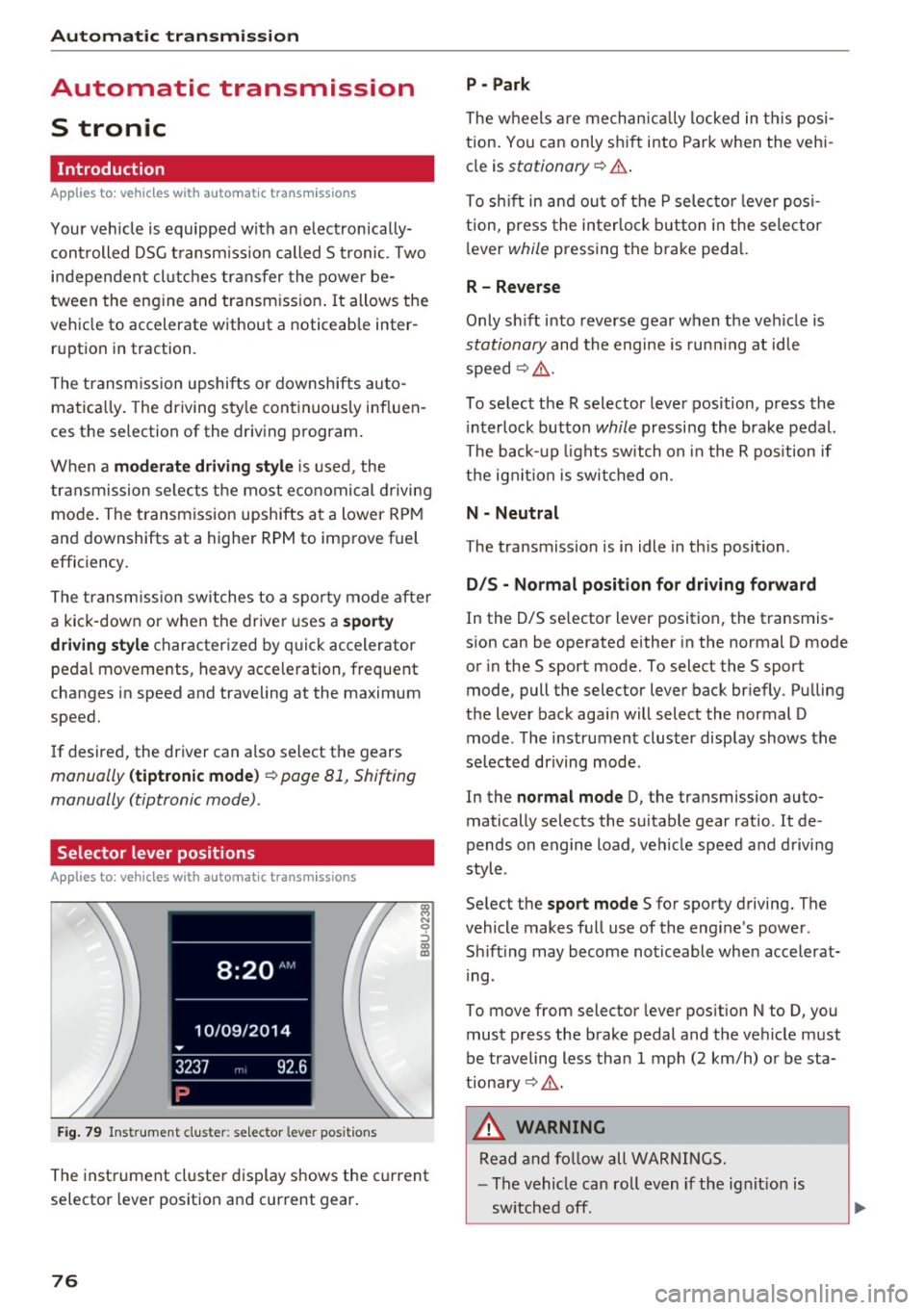
F ig. 79 Instrument cluster: selec tor lever posit ions
The instrument cluste r display shows the current
selector lever position and current gear .
76
P - Park
The w heels a re mechan ically locked in t his posi
tion . Yo u can only sh ift into Park when the vehi
cle is
stationary ¢.&. .
To sh ift in and ou t of the P selecto r leve r posi
tion, press the interlock button in the selector
l ever
while pressing the brake peda l.
R- Reverse
Only shift into reverse gear when the veh icle is
stationary and the engine is run ning at id le
speed¢ ,&..
To select the R selector lever position, press the i nterlock button
while pressing the brake pedal.
The back- up lights switch on i n the R pos ition if
the ign it io n is switched on.
N - Neutral
The transmission is in idle in th is position.
D /S - No rmal po sition fo r dri ving fo rw ard
In the D/S se lector lever position, the transmis
sion can be operated either in the normal D mode
or in the S sport mode. To select the S sport
mode, pull the selector lever back br iefly. Pulling
the lever back aga in will select the normal D
mode . The instrument cluster display shows the
selected driving mode.
In the
normal m ode D, the transmission auto
matically selects the suitable gear ratio . It de
pends on engine load, veh icle speed and driving
style .
Se lect the
sport mo de S for sporty driving. The
vehicle makes full use of the engine's power .
Sh ift ing may become noticeable when accelerat
i ng .
To move from selector lever pos ition N to D, you
must press the brake pedal and the veh icle must
be traveling less than 1 mph (2 km/h) or be sta
tionary ¢,&. .
&, WARNING
Read and fo llow all WARNINGS.
- The vehicle can roll even if the ig nit ion is
sw itched off.
Page 184 of 272

Check ing and F illing
Checking and Filling
Gasoline fuel
Gasoline grade
A pp lies to: ve hicles w ith gaso li ne engines
The correct gasoline grade is stated on the inside
of the fuel filler door .
The vehicle is equipped with a catalytic converter
and must only be driven w ith
unlead ed ga soli ne.
Aud i recommends using TOP TIER Detergent Gas
oline. Additional information on TOP TIER Deter
gent Gasoline can be found on the official web
site (www .toptiergas.com) .
The individua l gasoline grades are differentiated
by
oct ane rating s. This value is given with (R +M)/
2 equating to AK I or in RON.
The fo llowing headings match the corresponding
sticker in the fuel fi ller door .
UNLEADED FUEL ONLY MIN. (R+M) /2 87
R egula r/ MIN. RON
91 Regular
Use regu lar gasoline with minim um 87 AKI/
9 1 RON ~@ .
The max imum engine power is only reached if
p rem ium gasol ine 91 AKI/ 95 RON is used.
UNLEADED FUEL ONLY PREMIUM MIN . (R
+M )/2
91 / SUPER MIN. RON 95
Using premium gasoline with m inim um 91 AKI/
95 RON is recommended.
If premium gasoline is not available, you can also
use regula r gasoline 87 AKI/ 91 RON . However
this does reduce the engine powe r slight ly.
CD Note
- Fil li ng the tank just one time with leaded
fuel or other meta llic additives will cause
permanent deteriorat ion to the cata lyt ic
conve rter func tion.
- When gasoline with an octane rati ng that is
too low is used , h igh speeds o r heavy engine
l oad can lead to engi ne dam age.
184
(D Tips
The vehicle can be fi lled with fue l that has a
h igher octane rating than what is requi red by
the eng ine.
Blended gasoline
App lies to : vehicles wit h gasol ine engi ne
U se of g asoline cont aining alcohol or MTBE
(m ethyl tertiary butyl ether )
You may use unleaded gasoline blended with al
cohol o r M TBE (commonly referred to as oxygen
ates) if the blended m ixt ure meets the fo llow ing
c rit eria:
Blend of ga soline methanol (wood alcohol or
methyl alcohol)
- Anti-knock index must be 87 AKI or h igher.
- Blend must contain no more than 3% metha-
nol.
- Blend must contain more than 2% co-solvents.
Blend of ga soline and ethanol (grain alcoh ol or
ethyl alcohol)
- Anti-knoc k index must be 87 A KI or h igher.
- Blend must not conta in more than 15% etha-
nol.
Blend of gasoline and MTBE
- Anti -knock index must be 87 AKI or higher.
- Blend mus t contain no t more than 15% MTBE .
Seasonall y adjusted ga soline
Many gasoline grades are blended to perform es
pecially well for winter or summer dr iv ing . Du r
i ng seasonal change-over, we suggest that you
fill up at busy gas stat ions where the seaso nal
adjustment is mo re l ikely to be made in t ime .
CD Note
-Methanol fuels which do not meet these re
quirements may cause corrosion and dam
age to plasti c and rubber components in the
fue l system.
- Do not use fue ls that fa il to meet the speci
fied cr iteria in th is chapter.
...